Sea trials demonstrate maximum speed exceeding 53 knots under operational load.
Each of the three ships is powered by four 16-cylinder mtu Series 2000 engines.
35-meter ships are designed as “Surface Effect Ships” (SES)
This is the introductory paragraph.
The Singapore shipbuilder Strategic Marine has commissioned three new offshore supply vessels that, with a maximum speed of over 53 knots, are the fastest of their kind in the world. Each vessel is powered by four 16-cylinder mtu Series 2000M72 engines from Rolls-Royce. The vessels will be used by a national oil company in Africa for passenger transfer to offshore platforms. To enable fast and safe transfer, the 35-meter-long vessels were designed as so-called “Surface Effect Ships”.
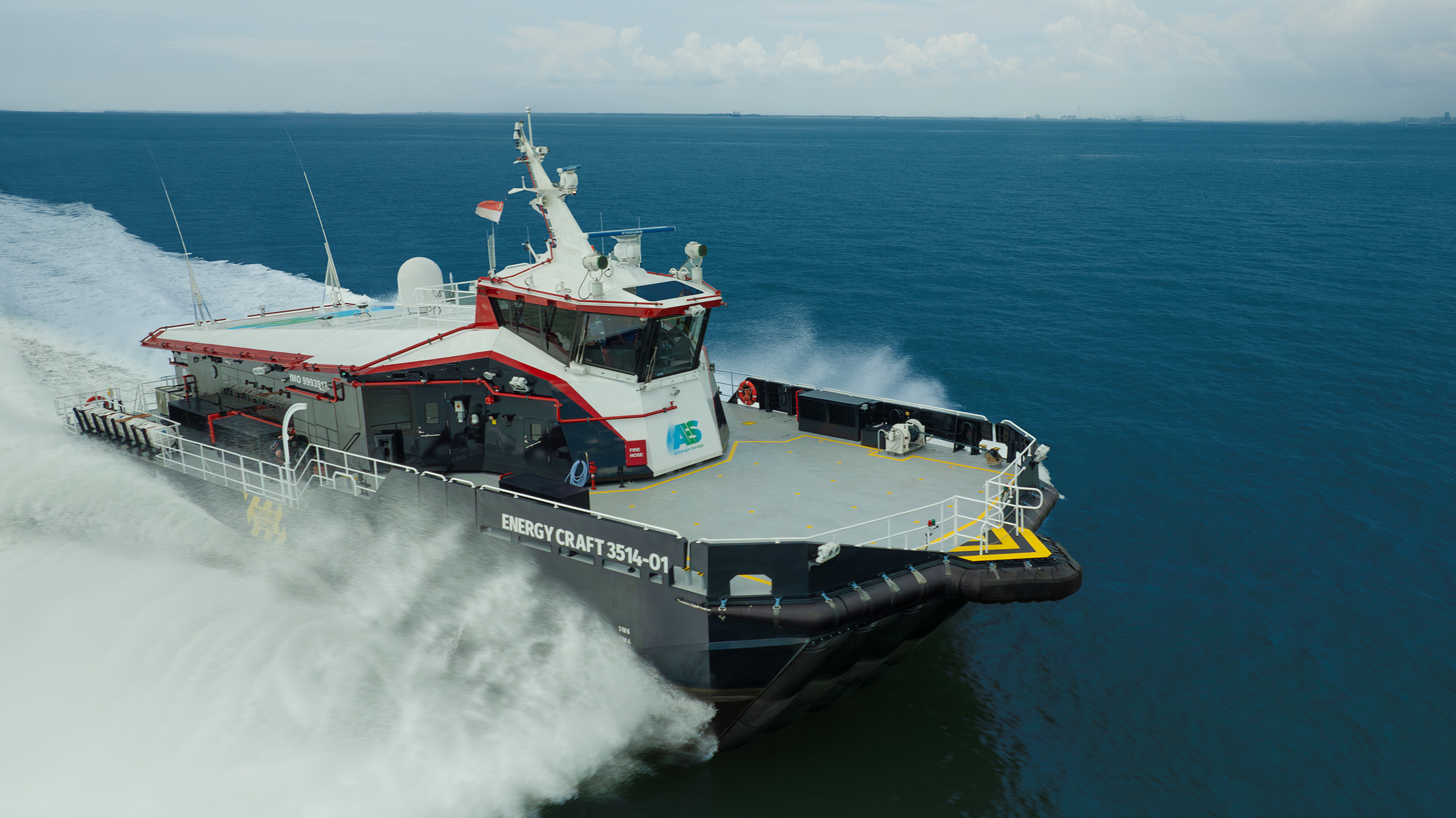
This Rolls-Royce image shows one of the Crew Transfer Vessels at 50 knots.
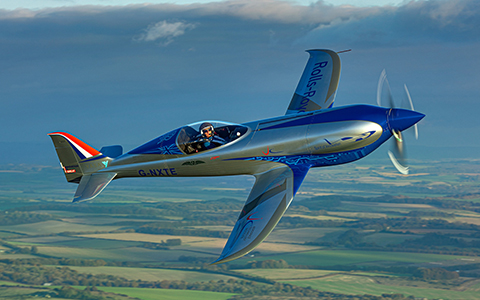
On a slightly different tack, this Rolls-Royce image shows The Spirit of Innovation.
Rolls-Royce described it in this press release which is entitled ‘Spirit of Innovation’ Stakes Claim To Be The World’s Fastest All-Electric Vehicle, using these words.
During its record-breaking runs, the aircraft clocked up a maximum speed of 623 km/h (387.4 mph) which we believe makes the ‘Spirit of Innovation’ the world’s fastest all-electric vehicle.
I’ve probably been over 1,300 mph in Concorde.
So are the three offshore supply vessels, the fastest of their kind in the world?
This video shows one of the Crew Transfer Vessels doing, what they are intended to do.
Rolls-Royce seem to be borrowing a philosophy from their past, where they showed in the Schneider Trophy, just what their engines could do.
These two paragraphs describe the design of the Crew Transfer Vessels.
To enable fast and safe passenger transfer to offshore platforms, the 35-meter-long vessels have been designed as so-called “Surface Effect Ships” (SES). SES uses air-cushion technology within a catamaran hull form. This design was used for the first time in the offshore oil and gas industry.
The boats have an optimized power-to-weight ratio and use powerful fans to generate an air cushion between the hulls that minimizes hull drag and resistance. Combined with the mtu propulsion package (each delivering 5,760 kW of power), the vessels can travel at much higher speeds than conventional monohulls and catamarans, with consumption remaining at the same per hour of operations. The high speed of well over 50 knots (more than 90 km/h) ensures shorter transit times, while the low hull resistance saves fuel and reduces emissions.
I believe, that the Rolls-Royce mtu diesel engines used in these vessels can also be fueled by hydrogen, so is that the next development?
Could we be seeing hydrogen-powered fast ferries on short sea routes around the world?
The revival of supersonic passenger travel, thought to be long dead with the demise of Concorde nearly two decades ago, could be about to take wing as American Airlines has put in an order for 60 aircraft capable of flying at 1.7 times the speed of sound.
Some may feel that the future of supersonic aviation is about as rosy, as an empty glass of tap water.
But!
A flight across the Atlantic in three-and-a-half hours, as is promised by the Boom Overture, is below the four-hour travel limit, where average people start to get anxious about being banged up!
Not for nothing do UK train companies want to get London and Edinburgh services below, the magic four-hour time.
Technology will get better to reduce the noise and carbon emissions of all aircraft and not just supersonic ones!
I don’t put it outside the genius of engineers to by 2050, be able to create a supersonic, almost noise-free aircraft.
These are comparisons of the Boom Overture to Concorde.
Engines – Three as opposed to four.
Length – Similar
Wingspan – 71 % of Concorde
Passengers – 75 % of Concorde
It’s almost as if the Boom Overture is a three-quarter scale model of Concorde.
The Wing/Airframe
When I left Liverpool University in 1968, I wasn’t totally sure, what I wanted to do. So I visited a lot of engineering and aerospace companies including both BAC and Hawker Siddeley. Including my own University, I must have visited about four or five large wind tunnels in that period and every one had a Concorde-like model for the wind tunnel.
Every company had their own ideas on what a supersonic wing, should look like.
And surprise-surprise they were all very similar!
Take the advertising off Formula One cars and paint them all silver and very few could tell them apart.
Aerodynamics defines the shape so strongly, they all look the same.
It’s the same with supersonic aircraft and I’m not surprised that wing planform of the Boom Overture appears to be similar to Concorde, but narrower.
Perhaps the more dart-like shape significantly reduces the drag? It should be noted that drag is proportional to cross-sectional area.
In Concorde’s Wikipedia entry there is a section called Development, which explains how the Royal Aircraft Establishment developed the slender delta wing planform, used by Concorde and now likely to be used by Boom.
Although, it would be different inside the wing, as Concorde was mainly made from metal and the Overture is a composite aircraft.
Perhaps composite construction helps with creating the perfect aerodynamic shape. I don’t have any experience of composites, but they surely mean more aerodynamic shapes and they are regularly used for airframes.
I suspect that Concorde was a nightmare to build, but that the challenge helped develop a large number of machining and fabrication techniques.
The Fuselage
As I said earlier, the length of the plane is similar to Concorde, but the wingspan is 29 % smaller and the number of passengers is around 25 % less.
But if you look at the picture of the aircraft in the Times article, where it is emerging from the hangar, it’s almost as if the fuselage has a square cross section than Concorde.
I wonder about this square cross section. I remember an interview on the radio with Barnes Wallis, where he talked about his latest idea for a fast supersonic aircraft capable of flying between the UK and Australia.
This paragraph is from Barnes Wallis’s Wikipedia entry.
In the late 1950s, Wallis gave a lecture entitled “The strength of England” at Eton College, and continued to deliver versions of the talk into the early 1970s, presenting technology and automation as a way to restore Britain’s dominance. He advocated nuclear-powered cargo submarines as a means of making Britain immune to future embargoes, and to make it a global trading power. He complained of the loss of aircraft design to the US, and suggested that Britain could dominate air travel by developing a small supersonic airliner capable of short take-off and landing.
It sounds to me that he would have been a Brexiteer.
Could this supersonic airliner, be what I heard him talking about?
I distinctly remember that he was advocating a fuselage with a square cross section for supersonic flight.
It would have given more space inside for passengers.
Concorde was a bit pokey with small windows!
The picture in The Times of the interior of the Boom Overture is certainly spacious.
Have Boom, been looking through Barnes Wallis’s ideas?
One quote I heard Barnes Wallis say, in an interview with Chris Brasher was this.
There is no greater thrill in life, than proving something is impossible and then showing how it can be done.
Boom may not have been able to develop a small supersonic airliner capable of short take-off and landing, but it does sound, they’ve developed a smaller supersonic airliner capable of shorter take-off and landing.
The Engines
In the Boom Overture’s Wikipedia entry there is a section called Engines, where this is the last sentence.
In July 2020, the company announced that it had entered into an agreement with Rolls-Royce to collaborate on engine development.
As Rolls-Royce built the engines for Concorde, they probably have some experience locked away.
The engines were fitted with afterburners, as the extra thrust was needed for take-off.
According to Wikipedia the engines had a high thermal efficiency in supersonic cruise.
According to Wikipedia, there was an engine without afterburning for a longer range Concorde under development.
Over the years, there have been various proposals for supersonic aircraft, in military, commercial and business fields, so I suspect Rolls-Royce have done significant work in powering supersonic flight.
But then other engine companies would have gone down similar routes!
Rolls-Royce though probably have all the data on the engine ideas for Concorde that failed.
I wouldn’t be surprised, if one of the major aero-engine companies has a solution to the powerplant for the Boom Overture, based on the chase for supersonic speeds forty and fifty years ago.
But Rolls-Royce because of the Concorde experience could be closer to a successful development.
So I think signing with Rolls-Royce could be a very sensible move.
The Afterburners
The Wikipedia entry for the Boom Overture says this about afterburners.
Boom wants to use moderate bypass turbofans without afterburners, unlike Concorde’s Rolls-Royce/Snecma Olympus.
Could that be one piece of complication, that improvements in technology has eliminated?
The Engine Intakes
The Wikipedia entry for the Olympus 593 engines has a section called Intakes.
They were thought to be clever in the 1960s, but they just look complicated to me, with all my extra experience.
The intakes seem to have used very comprehensive digital control systems, but these days controls like these will be even more comprehensive and a lot more sophisticated, as computing has moved on.
I very much feel that if the Boom Overture needed sophisticated variable-geometry engine intakes like Concorde, we have the knowledge to create them and the computer expertise to make them act as needed.
The Exhaust Nozzle
The Wikipedia entry for the Olympus 593 engines has a section called Exhaust Nozzle.
These too are complicated and a lot of what I said for the intakes, would apply to the nozzles.
The Fuel
The Wikipedia entry for the Boom Overture says
The aircraft is intended to run on Sustainable Aviation Fuel.
It is likely, that Sustainable Aviation Fuel will be used for commercial aviation until there is a significant move to hydrogen.
In the UK, a company called Altalto is building a large plant to make the fuel at Immingham from household and industrial waste.
One idea being pursued by some companies is to create the fuel from used disposable nappies.
Wikipedia indicates that the fuel could cut CO2 emissions by between 20-98%.
Altalto is backed by British Airways and Velocys, who are a spin-out from Oxford University.
There is certainly a lot of money and technology being thrown behind Sustainable Aviation Fuel to make it a net-zero alternative for the powering of aircraft.
The Noise
This Youtube video shows Concorde’s last take-off from New York.
It was certainly a noisy aircraft.
Concorde’s engines had afterburners.
It also needed a long take-off run, so it made more noise on the ground.
It used to take off with a high angle of attack with the nose high.
All of these factors would have increased real and perceived noise levels.
I feel that if the Boom Overture is going to have significantly lower noise levels than Concorde, then its design will need to be radically different.
The lack of afterburners will make some difference.
It carries only about 75 % of the passengers of Concorde.
It is roughly, the same length as Concorde, but the wingspan is nearly thirty percent smaller.
What this blog will eventually be about I do not know.
But it will be about how I’m coping with the loss of my wife and son to cancer in recent years and how I manage with being a coeliac and recovering from a stroke. It will be about travel, sport, engineering, food, art, computers, large projects and London, that are some of the passions that fill my life.
And hopefully, it will get rid of the lonely times, from which I still suffer.
 The Anonymous Widower