Barratt To Pay For Fire Safety Cladding Upgrade On Croydon Block
The title of this post is the same of that on this article on ITV.com.
This is the first couple of paragrphs.
Developers of a high-rise block that failed fire safety tests will pay for safety measures estimated to run into the millions of pounds, including replacing its Grenfell-style cladding, the Government has said.
Barratt Developments has said it will pay for backdated and future fire safety costs to make the Citiscape housing complex in Croydon, south London, safe, the Ministry of Housing, Communities and Local Government said.
The ITV article has a video report.
I feel that they are in a difficult place, as their architects probably thought the cladding was safe to use. So I don’t think there has been too much malfeasance on the part of Barratt.
But to hold up their hand and say we’ll fix it, probably means everyone will be a winner.
- Barratt get to fix the block for the cost of two or three of their more expensive houses.
- If Barratt get an agreement on the deal, they should avoid complex and expensive legal wrangles.
- Replacing the cladding now, will probably be a lot easier on a new building, that was probably built to a high standard in the last couple of years.
- The Government should be pleased as there appears that the hand of Sajid Javid has applied some pressure.
- Croydon Council should be pleased, as it is unlikely many owners will need to be moved to emeergency accommodation.
- Hopefully, the owners will be pleased, as it appears they should get the value of their properties back.
The ITV article quotes a Barratt’s spokesman as saying.
Following the recent ruling that the costs for necessary recladding at Citiscape will fall on the individual apartment owners, many of whom were originally Barratt customers when it was built in 2002, we have decided that we will pay for the work. “Citiscape was built in line with all building regulations in place at the time of construction. While we don’t own the building or have any liability for the cladding, we are committed to putting our customers first. “The important thing now is ensuring that owners and residents have peace of mind.
I suppose Barratt could be accused of spinning a good line, but it is all good publicity for the houses they are building.
Whether other developers, who used the same cladding, as that involved in the tragedy of Grenfell, will follow Barratt’s example is another manner!
Another Ambitious Tunnel
This article on Global Rail News is entitled Study Finds C$1.7bn Undersea Rail Tunnel The Most Attractive Option For Labrador-Newfoundland Link.
The article cites innovations in tunnel technology is one of the reasons, that this tunnel is now possible at an affordable cost.
The study also proposed that the single rail tunnel, uses this operational method.
Travelling at up to 100km/h, the train would take 20 minutes to cross the strait. It would operate 12 hours a day, seven days a week, carrying a maximum of around 130 vehicles.
They indicate because of low traffic levels, this would handle traffic for over forty years.
Tunnel builders will increasingly get more ambitious and we’ll see more plans for tunnels in the future.
A Walk Across Birmingham City Centre
I took this walk across Birmingham City Centre to look at the works on the Midland Metro Extension to Egbaston.
These are some of the pictures I took.
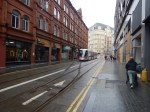


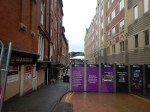
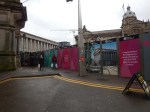





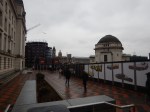

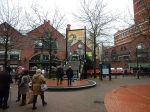

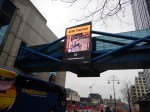
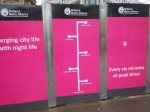
There’s certainly a lot of work going on.
It will be interesting to see how the trams get from New Street station to Victoria Square. It could be power up one hill and gravity down another.
The tram extension is to be finished in 2019.
Will We See More Slab Track On UK Railways?
I ask this question, as I’ve just read this article on Rail Engineer, which is entitled Slab Track Austria: Now A Serious Contender?
Slab track or ballastless track has a Wikipedia entry.
This is said under Characteristics.
In ballastless tracks, the rails are rigidly fastened to a special type of concrete ties/sleepers that are themselves set in concrete. Ballastless tracks therefore offer a high consistency in track geometry, the adjusting of which is not possible after the concreting of the superstructure. Therefore, ballastless tracks must be concreted within a tolerance of 0.5 millimetres. The elasticity of the ballast in the traditional railway superstructure is replaced by flexibility between either the rails and the concrete ties/sleepers or the ties/sleepers and the concrete or asphalt slab as well inherent elasticity within the conglomerate of the tie/sleeper, whereas the concrete or asphalt slab is usually inelastic.
Applications in the UK recently include.
- Tunnels on Merseyrail, Crossrail and other routes.
- Gospel Oak to Barking Line.
- Borders Railway.
- Edinburgh to Glasgow Line at Glasgow Queen Street station and the Winchburgh Tunnel.
This picture shows some of the slab track on the Gospel Oak to Barking Line.

I suspect, that slab track was used here mainly because of limited clearance. But low maintenance and long life, must have improved the financial case.
Returning to the Rail Engineer article, it would appear that the engineers behind the slab track, have rethought a lot of the process of building a railway.
Slab Track Austria, which used to be called PORR-STA, seems to offer the following.
- Factory-build or one-site fabrication.
- Ease of installation.
- Accurate alignment
- Switches and crossing can be fabricated.
- Transition solutions to ballasted track.
- Low noise and vibration.
- Ease of maintenance
- Sixty year life.
Slab Track Austria would also appear to have worked extensively with Austrian Railways, to get everything as right as possible.
It just shows how much improvement can be squeezed out of some traditional industrial and construction processes.
HS2
TheSlab Track Austria track has also been used extensively on the new Berlin to Munich high speed line, that I wrote about in From Berlin To Munich In Four Hours By Train. This is said about the use of the track on that line, in the Rail Engineer article.
PORR was contracted to design and build three major sections of the railway route. Its patented slab track, STA, was installed over a total length of 320km, in tunnels, on bridges and in open sections. Operations started successfully in December 2015 on the VDE 8.2 section, from Erfurt to Leipzig and Halle. Since December 2017, the sections VDE 8.1.2, from Coburg to Illmenau, and VDE 8.1.3, from Bad Staffelstein to Coburg, have been in operation. Trains have been running on the STA slab track layout at speeds of 300km/h. Prior to commissioning, this slab track was tested at 330 km/h.
So it would appear to be suitable for the 400 kph, that is quoted for HS2, with perhaps a bit of tweaking.
The article also says this about using the track on HS2.
Cost analysis research suggests that the savings made from the reduced maintenance required for STA track will equate to a payback of within 15 to 20 years when compared to ballasted track systems. The opportunity for significant savings, as well as increased network availability due to the reduced maintenance requirement, has to mean that this system is a serious contender for any new railway route, one of which, of course, is HS2.
A dedicated factory producing the slabs would surely increase quality.
But whatever happens, with its numerous, bridges, tunnels and viaducts, I suspect that HS2 will be built using slab track.
In the last quote, a payback time of fifteen to twenty years is suggested, if the track is used on a new railway.
So where else could slab track be used to advantage?
East-West Rail Link
I feel that the East West Rail Link, could be a possibility.
Consider.
- It will not be initially electrified.
- It is through terrain that is not very challenging
- It is fairly close to HS2 and a possible slab track factory.
Building the line with slab track, could help make the East West Rail Link a low-energy and low-noise line for battery or hydrogen trains.
West Anglia Main Line Four-Tracking
Adding two extra tracks to the West Anglia Main Line between Coppermill Junction, which is just South of Tottenham Hale station, and Broxbourne station will be a difficult project.
The line is hemmed in on both sides by housing and slab track might give advantages.
- Ease to squeeze the tracks in the limited space available.
- Reduced noise.
- Speedier construction.
If Crossrail 2 is built, this four-tracking will have to be done.
Calder Valley Line
The Calder Valley Line should be updated to create a quality roue across the Pennines from Preston to Leeds.
Parts of the line would be challenging to improve to say the least, with lots of heritage features around the track.
Using slab track in places, has has been done on the Gospel Oak to Barking Line, might help with the following.
- The construction works needed.
- Increasing line speed.
- Lowering noise.
- Reduced maintenance.
The Wikipedia entry for the Calder Valley Line has a section called Holme Tunnel Engineering Work. This is said.
Holme Tunnel, which lies between Hebden Bridge and Burnley Manchester Road, was closed for 20 weeks from November 2013 until March 2014. This was to allow for major engineering work to fix the distorted shape of the tunnel, caused by movement of the ground through which it passes. The project was budgeted to cost £16.3million. During the works, buses replaced train services. Trains can now pass through at 45 mph.
I don’t think slab track was used in the work in this tunnel, but do we need 45 mph speed limits on Trans Pennine routes? After reading this article on Rail Engineer, it would appear that 75 mph will be possible in the future.
But this project does show some of the major problems on Trans Pennine routes!
It will be interesting to see what happens on this line.
Other Trans Pennine Routes
The other two Trans Pennine routes, the Huddersfield Line and the Hope Valley Line both have similar characteristics.
- Twisting routes.
- Several tunnels.
- Lots of bridges.
They are also busy with passenger and freight traffic.
When the plans for the updating of these lines is published, I suspect that slab track will feature, especially in some of the tunnels.
Across Chat Moss
George Stephenson had difficulty building the Liverpool to Manchester Railway across Chat Moss in 1829. Wikipedia says this about his solution.
Chat Moss threatened the completion of the Liverpool and Manchester Railway, until George Stephenson, with advice from East Anglian marshland specialist Robert Stannard, succeeded in constructing a railway line through it in 1829; his solution was to “float” the line on a bed of bound heather and branches topped with tar and covered with rubble stone. The M62 motorway, completed in 1976, also crosses the bog, to the north of Irlam.
I have talked to drivers, who drive Class 319 trains along the now-electrified line across Chat Moss. They told me, that the soft suspension gives an interesting ride.
Under Timings And Line Speeds in the Wikipedia entry for the Liverpool-Manchester Lines, this is said.
The fastest recorded run was from Manchester Exchange to Liverpool Lime St in 30 minutes 46 seconds by a 1936 built Jubilee 5707 with 7 coaches. An 1882-built compound steam locomotive was timed on the same route in 38 minutes 18 seconds. Until 1968 trains from Liverpool to Manchester by all 3 routes were scheduled to take 40 minutes and often took less. The southern route via Warrington is now restricted to 85 mph and the northern route via Earlestown to 90 mph, with 75 mph over Chat Moss.
It would appear that something needs to be done to get timings between Liverpool and Manchester, back to those of the 1930s.
Would slab track across Chat Moss be part of the solution?
Tunnels
Various tunnel upgrades have shown how using slab track in tunnels is a very helpful technique.
Many tunnels will need to be updated to increase clearance for freight trains and overhead wires and also to solve structural problems caused by anno domini.
I believe we’ll see a lot more slab track in tunnels on the UK rail network.
Noise Reduction
The Rail Engineer article, says this about Slab Track Austria’s slab track.
The elastomeric layer also helps to reduce vibration and structure-borne noise, thus offering protection to supporting structures and reducing the noise created by passing trains – an important feature in built-up areas and tunnels.
So will we see increasing use of slab track in areas, where noise asnd vibration is a problem?
Other Lines
I see the Gospel Oak to Barking Line, as an example use of slab track that will be very much copied.
Slab track has been used successfully in sections, where clearance is limited and noise is a problem.
The use of slab track, might have meant that several bridges didn’t need to be rebuilt.
How many places in the UK have similar needs.
Conclusion
The rethinking of how we build railways by Slab Track Austria, will benefit our rail network and all those who use it.
We’ll be seeing a lot more slab track!
Hackney Wick Station And The Florida International University Pedestrian Bridge Collapse
The title of this post might seem a bit unusual, as the two locations are in different continents and thousands of miles apart.
But there is a connection, in that the new Hackney Wick station and the Florida International University bridge, were built using the same construction method called accelerated bridge construction.
There are some major differences.
- At Hackney Wick a short, fat subway was built alongside the railway and moved in using self-propelled modular transporters. In Florida a long thin span was installed , in a similar way.
- The Hackney Wick station subway, probably weighs a lot more than the pedestrian footbridge.
- The Hackney Wick subway and the platforms and track on top, was fully reinstated before trains could cross, whereas the Florida span was part of a cable-stay bridge, which hadn’t been completed.
- The Hackney Wick subway will be carrying trains of several hundred tons, whereas the Florida bridge will be carrying people.
It looks to me, that there has been some inaccurate calculations, which led to the collapse of the Florida International University bridge.
Victorian Tunnelling Uncovered At Bank Station
I took these pictures on the Southbound platform of the Northern Line at Bank station.


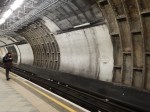

They show the old Victorian lining to the tunnel.
This visualisation, shows what the new Bank station will look like.
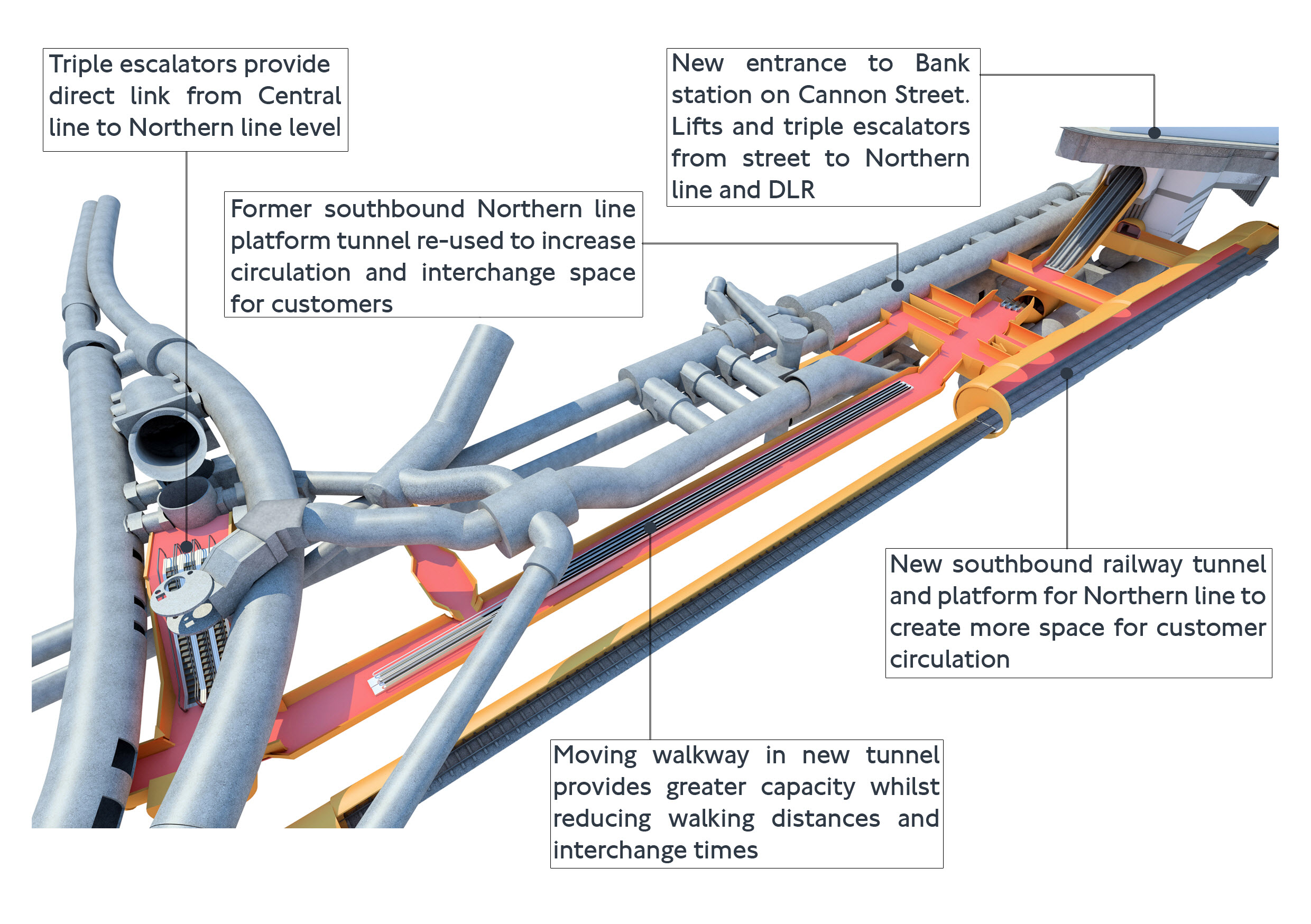
Note.
- The current two Northern Line tunnels are furthest away in the visualisation, with the Northbound one on the outside.
- The lines are aligned left sides together, which is opposite to normal British practice.
- The stairs that lead down from the passageways in the middle, where the tunnel size changes to accommodate the current platforms.
The plan looks to be as follows.
- A new Southbound tunnel will be dug to by-pass the current station. This tunnel is shown in the foreground.
- The current Southbound tunnel will be closed to trains.
- Southbound trains will be diverted to the new tunnel and possibly pass through Bank station without stopping for some time.
- The former Northern tunnel will be used to increase space for the Northbound platform.
Could the fitting out of all the tunnels in the middle be done last, with trains passing through on the outside?
A similar procedure was used at Angel, which explains the extra wide Southbound platform.
Will Some Of The New Buildings For Heathrow Be Built In Scotland?
It’s all explained in this article on the Offsite Hub website, which is entitled Heathrow To Offer Offsite Hubs To Other Mega Projects.
This is the first two paragrahs.
Airport says schemes such as HS2 and Hinkley could make use of planned offsite manufacturing hubs
Heathrow Airport has said it hopes its idea for a series of offsite manufacturing hubs to help with its £16bn expansion plans will be used by other major projects, including the new nuclear power station at Hinkley and the HS2 railway.
Sounds a good idea to me.
A few other points.
- Offsite accounts for 10% of the construction industry.
- Heathrow are aiming for between 25% and 40%.
- It will reduce the peak on-site workforce at Heathrow.
- Offsite was safer, cleaner and less weather dependent.
- Four hubs are plans, with one definitely in Scxotland.
A few months ago I talked to one of the managers building Custom House station, which was largely built offsite in Sheffield.
He told me, that the quality was so much better, than if it had been built traditionally.
The quality certainly wasn’t traditional pre-fab either.
Could this be part of the solution to our housing crisis?
Should This Be Done On More Building Projects?
Buckingham Group are building the new West Hampstead station on the North London Line.
This picture was taken of the architect’s layout drawing of the new station, that was fixed to the hoardings.
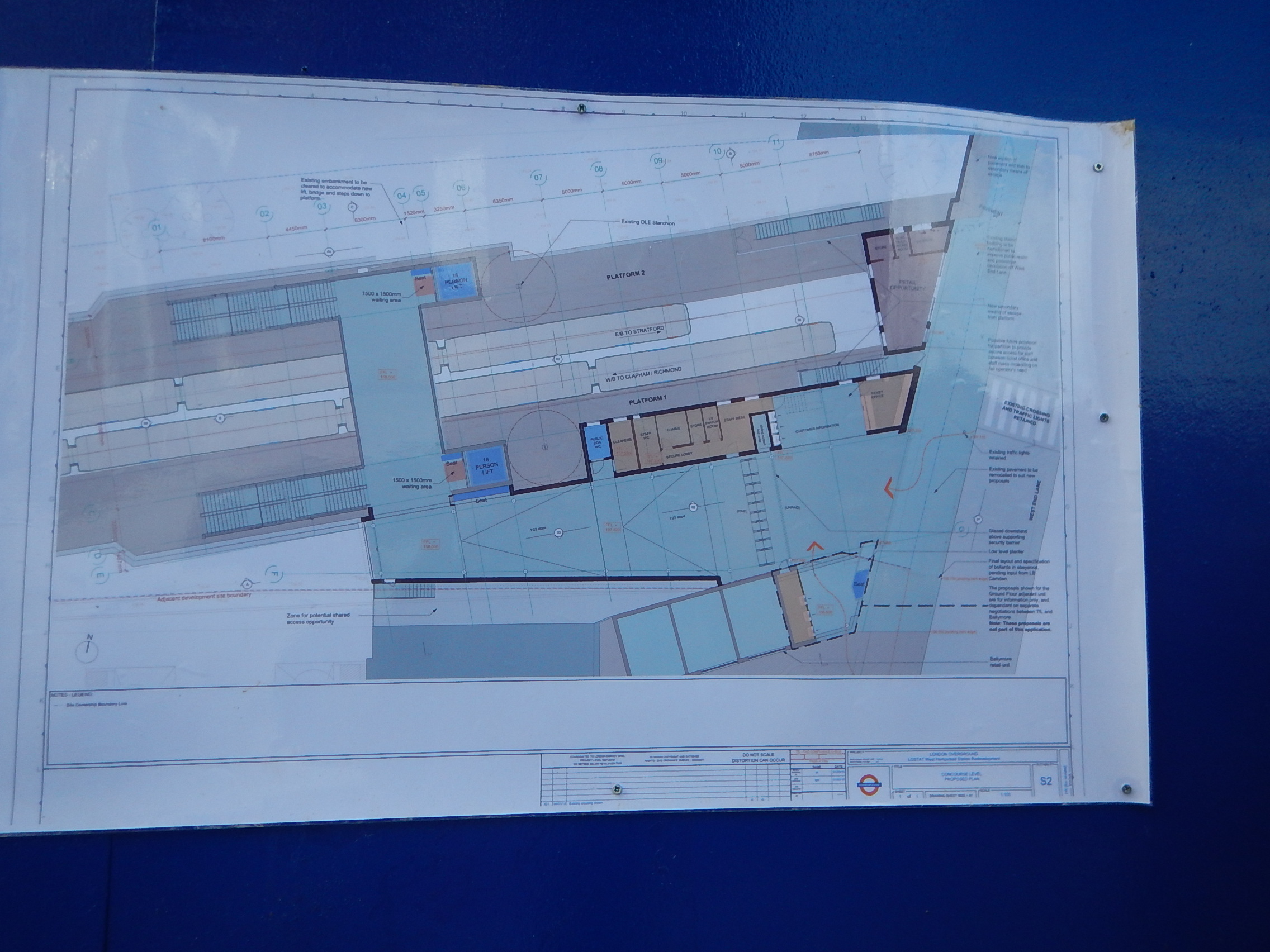
I wasn’t the only person giving it a good study.
I think it is a good way to inform the public.
How To Build Railway Stations
With all the troubles caused by the failure of Carillion, it is good to report on a company, that is providing new and improved railway infrastructuresubstantially on time and on budget.
This article on Rail Engineer is entitled VolkerFitzpatrick: Upgrading Stations.
This is the first two paragraphs.
With Network Rail’s comprehensive Railway Upgrade Plan well underway and the modernisation of Britain’s railways firmly in the spotlight, there is a growing need and expectation for first-class stations and infrastructure to accommodate growing numbers of passengers nationwide.
One business with a huge role in the modernisation programme has developed a reputation as an exceptional multi-disciplinary contractor, with extensive capabilities in civil engineering, building and rail, meeting the demands of a wide range of clients across multiple disciplines. It is this consolidated approach that has helped VolkerFitzpatrick deliver several high-profile UK railway station schemes in the last 10 years.
The article then goes on to describe how the company tackled the following stations.
- Cambridge North – Described in Cambridge Gets Its Own Mini-Crossrail
- Gatwick Airport – New platform and expansion, that opened in 2014
- Hackney Wick – Complete station rebuild for 2018 – The major work is described in A Tough Way To Spend Easter.
- Imperial Wharf – New station in 2007
- Lea Bridge – Described in The People Of London Welcome Lea Bridge Station
It then goes on to detail the company’s omvolvement in the Lea Valley Improvement Program, which will deliver new stations at Tottenham Hale, Northumberland Park and Meridian Water.
Read the Rail |Engineer article, as it gives a good insight into design and construction.
How To 3D-Print Using Concrete!
All the 3D-printing I’ve seen has involved plastic, but Crossrail’s builders are using the technique to create complex shapes in concrete.
It’s all explained in this post on IanVisits, which is entitled How Crossrail Is Using 3D-Printing To Build Its Stations.
They don’t actually 3D-print the concrete, but a wax mould, that is then used to cast the actual piece required.
According to the post, the FreeFAB process has been used to create 1,400 unique moulds, which have then been used to create 36,000 different shaped concrete panels.
Ian’s post is a fascinating read and the mind boggles as to what will eventually produced using this technique.
 The Anonymous Widower