Central London and Gatwick Airport For Free On A Freedom Pass
I have always found it odd, that I can get to Heathrow Airport for free on my Freedom Pass, but for Gatwick Airport, I must buy a ticket.
Not that I’m bothered about the price of the ticket, but for some it might mean that they can’t get to their preferred holiday destination, as planes only fly from Heathrow.
The different treatment of the two airports must also annoy some airport and airline owners and bosses.
But recently, a free route for London’s Freedom Pass holders has opened.
This article on Inside Croydon is entitled Metrobus Rolls Out Zero-Emission Hydrogen Fleet Into Sutton.
These are the first two paragraphs.
Metrobus has been rolling out a fleet of hydrogen-powered buses, and last week its first double deckers, operating the 420 route from Sutton town centre to Gatwick Airport and Crawley, were brought into service.
Metrobus is planning on having more than 40 hydrogen-powered buses, in a partnership with West Sussex, Surrey and Kent county councils and Gatwick, in a £24million investment by the partners including a £10 million grant from the Department for Transport.
Note.
- The range of a Wrightbus Hydroliner is 280 miles on a full tank of hydrogen.
- It looks like as Crawley to Sutton station is a 42.2 miles round trip, so that means six round trips are possible on a tank of hydrogen.
- The Hydroliners may have the speed to use the M23 between Sutton and Crawley.
According to the article, refueling would be at Crawley.
A Zero-Carbon Extension To The Freedom Pass Zone
The free route for Freedom Pass holders to Gatwick Airport will be.
- Southern or Thameslink Train to Sutton.
- 420 bus to Gatwick Airport.
The article says this about the routes that are being planned.
The 420 route runs from Sutton town centre, through Belmont and Banstead, to Tadworth and then on to Reigate and Redhill, serving East Surrey Hospital before going on to the airport and Crawley. Metrobus is planning to use other hydrogen-powered buses on routes that will serve Caterham, Dorking, Tunbridge Wells, Haywards Heath and Brighton.
It appears that the hydrogen buses will add a large zero-carbon area to the Freedom Pass zone.
The only new infrastructure, would be the refueling equipment at Crawley.
I can also see the buses becoming an unusual tourist attraction for the area.
An Extension To An Electric Railway Or Tramway
They may also set a precedent for how a transport network can be extended in a zero-carbon manner from a tram or rail terminal served by an electric railway or tramway.
Battery electric buses could be used, but their range means that on anything but the shortest routes, they would constantly need recharging.
Okehampton Interchange Station
The first paragraph of the Wikipedia entry for Okehampton Interchange station describes it like this.
Okehampton Interchange (formerly known as Okehampton Parkway) is a proposed railway station in Okehampton on the Dartmoor Line. The station would be part of the Devon Metro and has been described as a priority station. The station is to be sited off Exeter Road, by the Business Park and close to the junction with the A30, in the Stockley Hamlet area of Okehampton. It would also serve 900 new homes to be built nearby.
But I believe that Okehampton Interchange station also has another purpose.
If the sea should destroy the coastal railway, as it did a few years ago, then passengers for the South-West could be ferried to and from Okehampton Interchange station by high-speed hydrogen-powered coaches along the A30, to catch trains to Exeter and London.
So, I would build a hydrogen filling station at Okehampton Interchange station, so that if the sea destroys the coastal railway again, the alternative is ready.
Normally, the hydrogen filling station would refuel local hydrogen buses, trucks, cars and other vehicles and those passing on the A30 to and from Cornwall.
Okehampton Interchange station would be the ultimate extension to an electric railway. Even if the Dartmoor Railway was worked by electro-diesel trains.
My Second Ride In A Wrightbus Single-Decker Hydrogen Bus
Or it might have been the third or fourth, but it was the first outside of London in a single-decker Wrightbus hydrogen bus. The earlier rides were in the RV1 route, which I wrote about in London’s Hydrogen Buses.
I took these pictures.
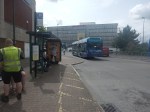















Note.
The trip was in Crawley and Go-Ahead are building a network of hydrogen buses to link the town and Gatwick Airport.
- It was a high quality bus.
- It was busy.
- It was the first bus, I’d seen in the UK, with a detailed route.
Someone had been thinking about how to design a bus route.
Go-Ahead Group Signs Contract For Its First Hydrogen Fuel Cell Buses
The title of this post, is the same as that of this article on Intelligent Transport.
This is the first paragraph.
Brighton & Hove and Metrobus have ordered 20 hydrogen fuel cell vehicles, which are set to be delivered in June 2022, signalling the Go-Ahead Group’s first order of hydrogen powered buses.
The vehicles are single-decker GB Kite Hydroliner FCEV buses.
These buses can be configured to carry up to ninety passengers and they have a range of up to 640 miles.
The article says these buses are for Faraway-branded express buses, so the long range will enable buses to be garaged centrally and refuelled once a day.
It looks like this could be the first of several orders from Go-Ahead for hydrogen buses.
 The Anonymous Widower