Should A Mega-Station Be Created At Kings Cross-St. Pancras-Euston?
The three important stations of Kings Cross, St. Pancras and Euston sit like three isolated islands on Euston Road.
Kings Cross Station
Kings Cross station was extended and refurbished in 2012 and is the most modern of the three, with a well-designed square in front of the station.
Kings Cross serves as a terminus for East Coast Main Line and some Cambridge services.
Underground
Kings Cross has connections to the following Underground lines at Kings Cross St. Pancras tube station.
- Circle, Hammersmith and City and Metropolitan.
- Northern
- Piccadilly
- Victoria
On the whole, the connections to the Underground are generally good, but crowded.
Buses
If you want to go East connectivity is good, but when taking a bus to the West or South, finding the stop can be difficult.
Taxis
The taxi rank at Kings Cross generally works well, as it was reconfigured when the station was updated.
Summing Up Kings Cross Station
Kings Cross has a lot of space both inside and outside and using the station can be an easy process compared to many.
St. Pancras Station
St. Pancras station was rebuilt and extended for Eurostar and Southeastern Highspeed services in 2007.
I always describe St, Pancras as a Fur-Coat-And-No-Knickers station.
It may look spectacular, but it wasn’t designed for passengers or staff, due to the dreadful connectivity between the various services at the station.
- Continental
- Midland Main Line
- Southeastern Highspeed
- Thameslink
With all these services set to expand, I have a feeling that St. Pancras faces a capacity problem.
Underground
To further complicate matters, it’s a often a long walk to the Underground line you need, as these were designed to serve Kings Cross.
- Circle, Hammersmith and City and Metropolitan.
- Northern
- Piccadilly
- Victoria
There is a ticket hall at the front of the station, but it’s often very crowded with large numbers of Eurostar passengers queuing for tickets.
Buses
It’s a walk to Kings Cross in most cases unless you can find a way across the busy Euston Road.
Taxis
I always walk to Kings Cross, as like most passenger facilities at St. Pnncras, the taxi rank wasn’t well-designed.
Summing Up St. Pancras
St. Pancras doesn’t have the space inside or outside that Kings Cross has and often feels cramped with every seat taken.
With the increase in all services expected in the next few years, passengers should think hard about how they can avoid the station,
Euston Station
Euston station is going to be rebuilt in the next few years for HS2.
Currently, it serves as a terminus for West Coast Main Line and a few suburban services.
Underground
The Underground at Euston is a mess with Euston tube station handling the following lines.
- Both branches of the Northern
- Victoria
Round the corner is the cramped Euston Square station which handles the Circle, Hammersmith and City and Metropolitan Lines.
Neither station is fully step-free and the Underground connection will need expansion for HS2.
Buses
Euston has a good bus station if you’re going East, but going West means crossing the busy Euston Road.
Taxis
Euston has an underground taxi rank, that seems to work well.
Summing Up Euston Station
Space is at a premium in Euston station and the Underground connections need urgent improvement.
Crossrail 2
Crossrail 2 is being put forward as the project that will sort out the problems of the three stations on the Euston Road.
A mega station is to be built called Euston St. Pancras, which will serve all three stations.
But Euston and St. Pancras need extra capacity in connecting services now, not in the early 2030s!
Existing Lines
This map from carto.metro.free.fr shows the current Underground Lines at the three stations.

Can these lines be improved to help solve the capacity problems?
Victoria Line
If you want an example of the quality of the engineers working on the London Underground, you only have to look at the Victoria Line.
Fifty years old next year, the line was built on the cheap, but with superb automatic systems and some clever station layouts and now every year, more trains seem to be squeezed down its pair of tunnels. Currently, the frequency of trains is thirty-six trains per hour (tph) along its whole length.
As the Victoria Line calls at all three stations, any improvements to Dear Old Vicky, like step-free access at Euston, will help.
Northern Line
The Northern Line has three major projects underway.
- The extension to Battersea
- The upgrading of Camden Town station.
- The upgrading of Bank station
When these are complete around 2024, it will be possible to split the line into two separate lines each handling 36 tph.
But more trains will be needed.
Piccadilly Line
The major upgrade for the Piccadilly Line will be new trains, which should arrive from 2022, which will bring a double-digit increase in capacity.
It should also be noted that the frequency in the core is only twenty-one tph, so upwards of thorty tph must be an objectve.
Unlike the Northern And Victoria Lines, the Piccadilly Line doesn’t call at Euston station.
Circle, Hammersmith and City and Metropolitan Lines
The Circle, Hammersmith and City and Metropolitan Lines are being upgraded. This is said on Wikipedia.
Together with the introduction of S Stock trains, the track, electrical supply and signalling systems are being upgraded in a programme planned to increase peak-hour capacity on the Circle and Hammersmith & City lines by 65 per cent by the end of 2018. A single control room for the sub-surface railway is to be established in Hammersmith and an automatic train control (ATC) system will replace signalling equipment installed from the 1940s. The cross-London Crossrail line, planned to open in 2018, is expected to reduce crowding between Paddington and Whitechapel.
This should result in a large increase in capacity between Baker Street and Liverpool Street.
Crossrail
Although Crossrail doesn’t fully open until December 2019, and doesn’t even call at Kings Cross, St.Pancras and Euston stations, the new line will have an effect on passengers travelling to the three stations.
- In my quote from Wikipedia, it says that Crossrail is expected to reduce crowding between Paddington and Whitechapel.
- Crossrail is expected to have a link with HS2 at Old Oak Common station.
- Crossrail may be extended up the West Coast Main Line.
The latter two points would allow passengers to bypass Euston.
Thameslink
Thameslink when it is running fully at the design frequency of 24 tph will certainly have effects on passenger traffic.
But it is difficult to say what they will be.
Difficult Interchanges
If you look at the interchanges between the various lines, in my opinion, the following are the more difficult interchanges.
- Euston Square tube station to Euston station.
- Euston station to St. Pancras station.
- Victoria Line to Thameslink at St. Pancras station.
- Circle, Hammersmith and City and Metropolitan Lines ro Thameslink at St. Pancras station.
- Euston Square tube station to Northern Line at Euston station.
In addition Euston Square and Euston stations are not step-free.
Transport for London probably know the improvements that would offer the most benefit.
Euston Square Station And Euston Station
The poor connectivity between Euston Square tube station and Euston station, is a major problem.
Sort this bad connectivity, when Euston station is rebuilt for HS2 and world’s oldest underground railway, dating from 1863, will be providing a high-frequency service to the UK’s premier high-speed railway.
Euston Road
Euston Road, which can be very busy, is a major problem for passengers needing to cross to perhaps use buses going to the West.
The experience of using the stations could be improved for a proportion of travellers, if crossing the road was easier.
Should A Mega-Station Be Created At Kings Cross-St. Pancras-Euston?
I’ll return to the original question I asked.
- If Crossrail 2 is built, there will obviously be a mega station at Euston St. Pancras.
- But I believe that all the other improvements that will happen before HS2 opens may well be enough to cope with the extra capacity needed for a few years.
Obviously though, any improvements must not compromise the building of Crossrail 2’s mega-station.
Conclusion
I believe it is possible to improve connectivity to the three major stations of King Cross, St. Pancras and Euston, by doing the following.
- Improving the frequency and capacity on the various Underground lines serving the three stations.
- Splitting the Northern Line into two separate lines.
- Improving the links between the existing Nation Rail and Underground Lines.
- Integrating Euston Square station into Euston station, when Euston is rebuilt for HS2.
- Improving the crossing of Euston Road on foot.
In some ways the last-but-one point is the most important, as it cures the worst interchange.
Could A Lea Valley Metro Be Created?
Crossrail 2 envisages these developments and level of service North along the Lea Valley.
- A four-track West Anglia Main Line between Tottenham Hale and Broxbourne stations.
- Step-free stations
- A service running between Tottenham Hale and Broxbourne stations.
- 10-15 trains per hour (tph)
Crossrail 2 also envisages that at Tottenham Hale station, the line will enter a tunnel for Central and South West London.
But there is an unused alternative terminal, that could handle perhaps 16 tph with modern signalling.
Look at this map from carto.metro.free.fr of the lines at Stratford.
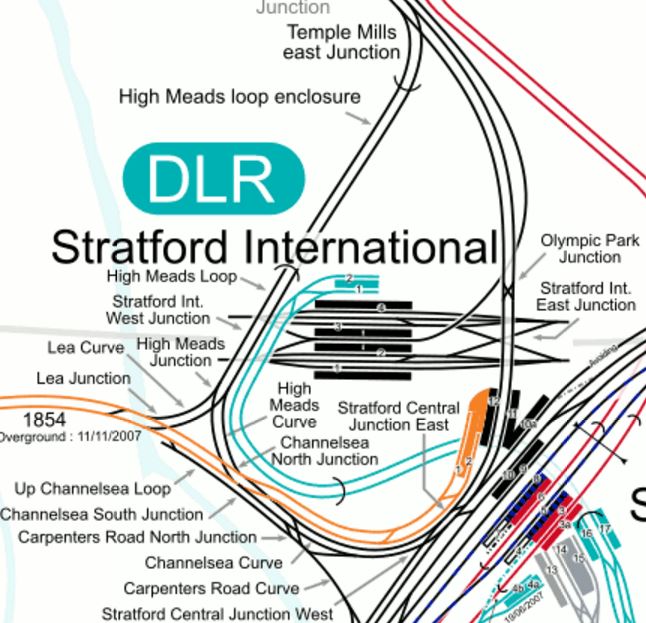
Note the double-track loop that encircles Stratford International station and goes through Platforms 11 and 12 at Stratford station.
Consider.
- Loops like this can easily handle 12 tph, as they do in Liverpool with the Wirral Line.
- Stratford is well-connected to the Central, Great Eastern Main, Jubilee and North London Lines, Crossrail and the Docklands Light Railway.
- The Loop could be connected to Stratford International station for Southeastern Highspeed services.
- There’s probably enough capacity to allow a couple of Stansted services to terminate in the loop.
- There is a massive development going on at Meridian Water, where a new station is being built.
- Liverpool Street station lacks capacity.
I can’t believe that a viable 12 tph service is not possible.
The major works would be as follows.
- Four-tracking the West Anglia Main Line into two fast and two slow lines.
- Making all stations step-free.
- Removing the level crossings.
- Creating a flyover at Coppermill Junction to connect the fast lines to Liverpool Street and prepare for Crossrail 2.
If Crossrail 2 is built in the future, the Metro service would be diverted into the central tunnel at Tottenham Hale station.
Integration With The London Overground
The Chingford, Cheshunt and Enfield Town services of the London Overground will not only offer alternative routes during the four-tracking of the West Anglia Main Line, but they could be better connected to a Lea Valley Metro.
- Tne Class 710 trains could enable four tph on each branch.
- The Class 710 trains will enable faster services on each branch.
- A reinstated Hall Farm Curve would connect Chingford and Walthamstow to Stratford.
- Creation of a step-free Cheshunt station would ease transfer between the London Overground and the Lea Valley Metro.
The new trains will be key and may open up more possibilities.
Note too, that moving services to Stratford from Liverpool Street will release capacity at Liverpool Street, that will be well-used by Greater Anglia and London Overground.
Dear Old Vicky
She’s always there when you need her and engineers keep coming up with ways to keep the Victoria Line giving more.
Currently, the frequency of trains between Walthamstow Central and Brixton is 36 tph.
I can’t believe that the engineers working on the line, don’t want to squeeze another four tph out of her, to achieve the fabulous forty.
This might be possible with the trains, tracks and signalling, but the problem is the capacity of some of the 1960s-built stations.
- Many stations have an empty space, where a third escalator could be.
- Lifts are few and far between.
- Some stations don’t have ceilings in the platform tunnels.
These stations could be improved.
Walthamstow Central Station
Walthamstow Central station gets desperate in the Peak, but it could be given a third escalator, a second entrance at the other end of the platforms and a much better step-free connection to the Chingford Branch of the Overground.
Blackhorse Road Station
Blackhorse Road station could be finished and given a third escalator to cope with the extra passengers that will transfer to and from an electrified Gospel Oak to Barking Line.
Tottenham Hale Station
Tottenham Hale station is being rebuilt to increase capacity. Will it get the missing third escalator and ceilings?
Seven Sisters Station
Seven Sisters station will be a Crossrail 2 station and will need updating to cope with an expected eight tph on the Overground. Expect a major project here.
Finsbury Park Station
Finsbury Park station is one of London’s stations designed by Topsy. Improvements are underway to cope with the extra passengers from Thameslink and an upgraded Northern City Line.
Highbury and Islington Station
Highbury and Islington station suffered worst at the hands of the Nazis and 1960s cost cutting, when the Victoria Line was built. This made it one of London’s worst stations.
However help is at hand.
- Plans are being prepared for a second entrance to the station on the other side of the Holloway Road.
- The frequency on the Northern City Line is being upgraded to twelve tph with new larger capacity Class 717 trains.
- There is space for a third escalator to be added to connect the Overgriound with the deep-level Victoria and Northern City Lines.
It should be born in mind, that Highbury and Islington station is busier than either Manchester Piccadilly or Edinburgh Waverley stations.
But with an upgrade, because it has cross-platform interchange between the Victoria and Northern City Lines, it could be an upgrade that increases the passenger capacity of the Victoria Line.
Euston Station
Euston station will be upgrqaded for HS2.
Oxford Circus Station
Oxford Circus station is desperately in need of more capacity, especially as there will be an upgrade to the Bakerloo Line in the future.
The opportunity at Oxford Circus is that some of the buildings around the junction are tired and some probably need to be replaced.
So will we see a development like Bloomberg Place, that will create a new entrance to Bank station, at Oxford Circus?
Could it also have an subterranean connection to Crossrail’s Hanover Square entrance for Bond Street station?
Victoria Station
Victoria station is in the process of being upgraded.
It certainly appears to be a case of so far so good!
South Of The River
Vauxhall and Brixton stations have rather undeveloped interchanges with the National Rail lines and these could surely be improved.
Under Possible Future Projects in the Wikipedia entry for the Victoria Line, this is said.
For many years there have been proposals to extend the line one stop southwards from Brixton to Herne Hill. Herne Hill station would be on a large reversing loop with one platform. This would remove a critical capacity restriction by eliminating the need for trains to reverse at Brixton. The Mayor of London’s 2020 Vision, published in 2013, proposed extending the Victoria line “out beyond Brixton” by 2030.
This would surely be the last upgrade to squeeze even more out of Dear Old Vicky.
Conclusion
A Lea Valley Metro can be created and eventually, it can be the Northern leg of Crossrail 2, when and if that line is built.
Before Crossrail 2 is completed, it will have great help in the following ways.
- In North East London from the London Overground.
- Across London from the Victoria Line.
Don’t underestimate how Crossrail and an updated Northern City Line will also contribute.
London’s First Underground Roller Coaster
This picture shows a cross-section of the massive Liverpool Street Crossrail station, which will connect Moorgate and Liverpool Street stations when it opens in December 2018.
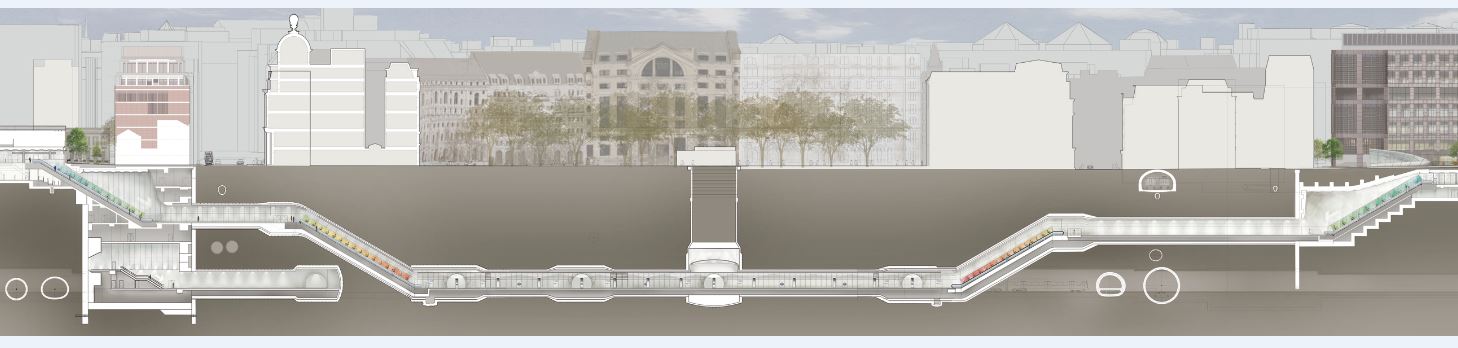
Note.
- Moorgate station is on the left.
- Liverpool Street station is on the right.
- In the middle looking like a giant juicer is the ventilation shaft in Finsbury Circus.
- The Crossrail tunnels, which consist of two running tunnels and a pedestrian walkway between them are at the deepest level.
- There are escalators and lifts all over the place.
Suppose you are walking from street level at Liverpool Street station to street level at Moorgate station in heavy rain and you don’t want to get wet.
You would take the following route.
- Enter Liverpool Street Underground station.
- Take the escalators down from street level to the intermediate level.
- Walk along the passage and take the escalators down to the Crossrail level.
- Walk along the central pedestrian walkway between the two Crossrail running tunnels.
- Take the escalators up to the Intermediate level.
- Take the escalators up to street level in Moorgate Underground station.
You would actually walk a shorter distance, than you do now, as the four escalators would carry you forward.
In Liverpool Street Crossrail Station Disentangled, I showed this schematic of the station complex.
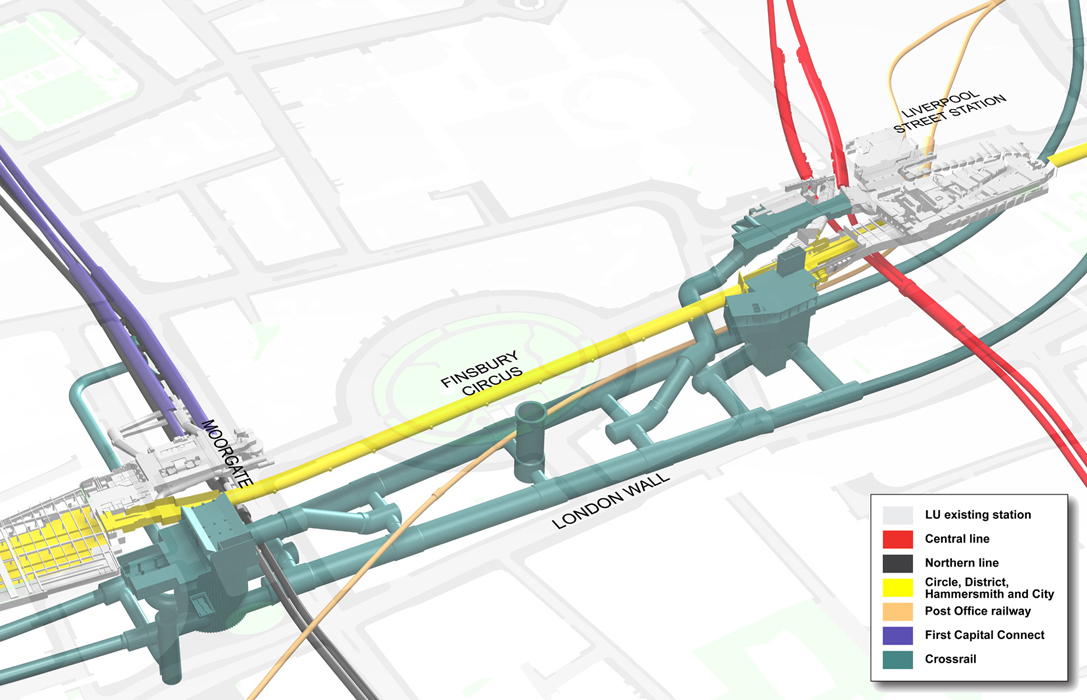
Note how the Northern Line passes through Moorgate station and the Central Line passes through Liverpool Street station, both at right-angles to Crossrail.
This image enlarged from the first shows a cross-section of Moorgate station.

Note the two circles under the escalator, which I suspect are the tunnels for the Northern Line.
There is probably some intricate spaghetti at this end of the station connecting the Bank branch of the Northern Line to Crossrail, in addition to the escalators.
But it means that if you want to go from Liverpool Street station to the Northern Line, you’ll descend to Crossrail and then ascend to the Northern Line.
This will be probably easier than the current long walk and the escalator descent at Moorgate station.
This image enlarged from the first shows a cross-section of Liverpool Street station end of the Crossrail station.
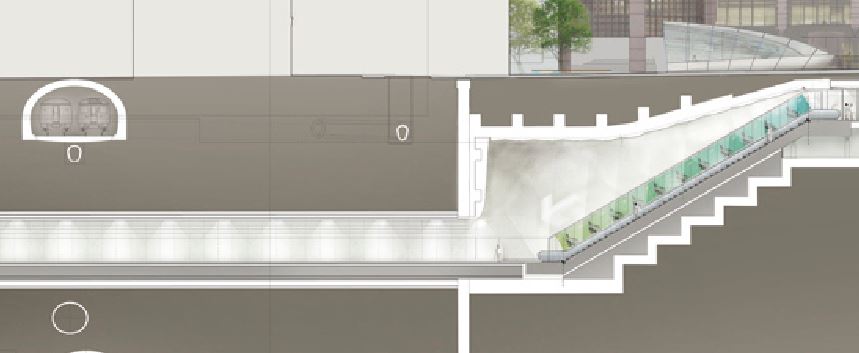
Note.
- The glazed entrance to the station.
- The Central Line tunnels.
Again, I suspect the spaghetti is intricate.
But from the schematic it would appear there’s a good link from the central tunnel to the Central Line.
Conclusion
I hope the signage and information will be good.
The East London Line Platforms At Whitechapel Station Now Appear To Be Full Length
Because of Crossrail works, Whitechapel station had to wait to get full-length platforms for the five-car Class 378 trains on the East London Line.
It at last seems the platforms are now extended.
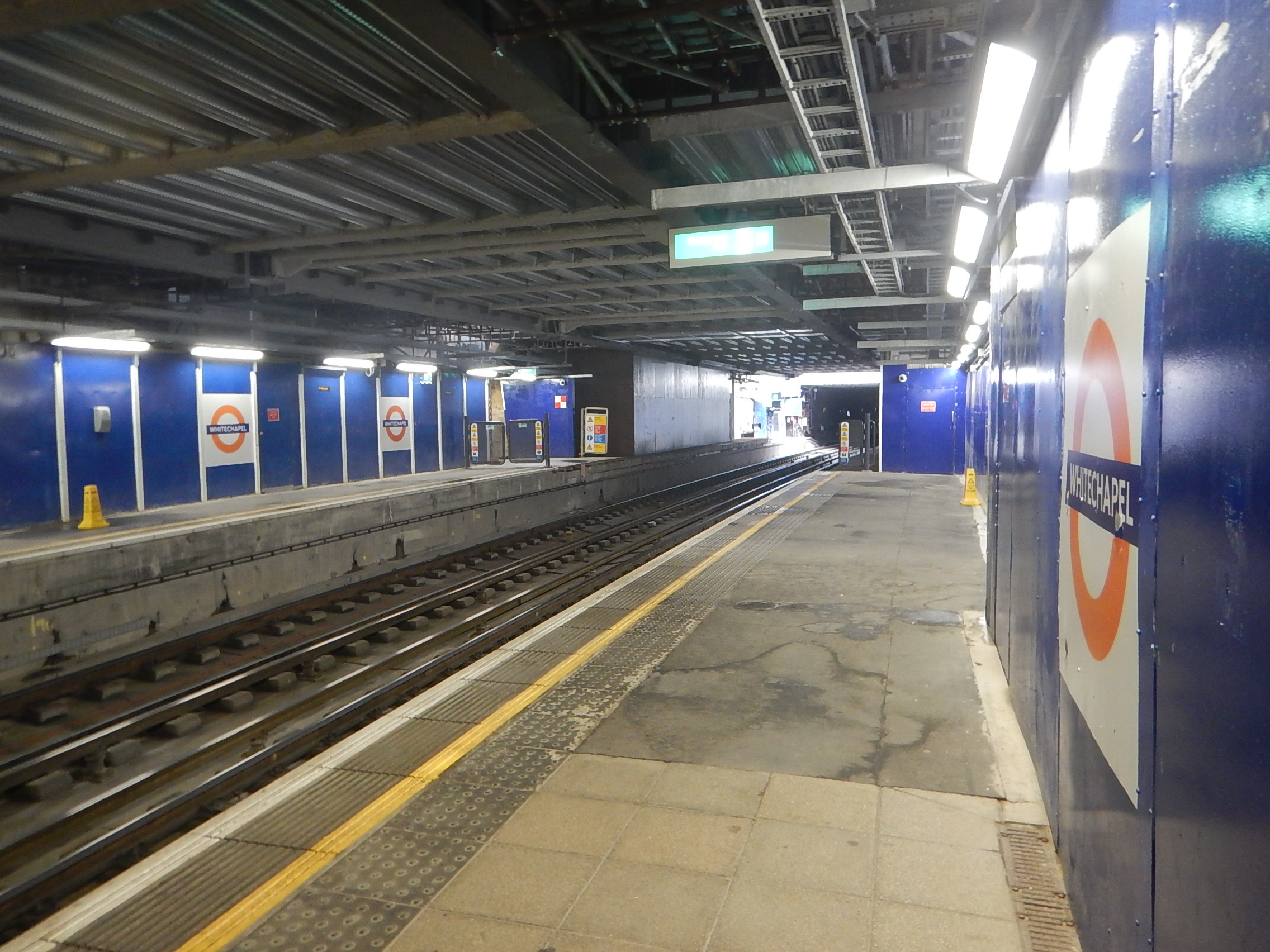
But then it is only just over a year until December 2018, when Whitechapel station opens for Crossrail services between Paddington and Abbey Wood stations.
Doubts Arise About A third Runway At Heathrow
I have always been sceptical about a third runway at Heathrow and put down my thoughts in Will The Third Runway At Heathrow Be Actually Built In The Near Future?.
Media reports are now saying that there should be more consultation, due to the election stopping the publication of updated forecasts for passengers and pollution. The Labour Party also seems to be against the idea.
By the end of 2019, Crossrail and Thameslink will be fully operational and I believe that they will push everybody including politicians, airline boses and other business leaders to seriously rethink their positions. The statements of Willie Walsh; the Chairman of the airline group;IAG seems increasingly sceptical about Heathrow’s third runway.
2019 also marks the date when Gatwick Airport can start to think about developing a second runway.
In Could Thameslink Connect To Heathrow?, I showed that it would be possible to create a high-capacity link between Heathrow and Gatwick via Thameslink.
- The link would connect Gatwick, Heathrow, HS1 and HS2.
- No expensive infrastructure would be needed.
- This link could easily accommodate four trains per hour and possibly double that, when Heathrow rebuilds its terminals to make it a greener airport, more reliant on rail.
It could be in place in 2020.
Conclusion
All of these forces will kick the third runway even further into the future.
Could Thameslink Connect To Heathrow?
This may seem an outrageous idea.
But I think it could be possible.
Can Class 345 Trains And Class 700 Trains Use The Same Tracks And Platforms?
Crossrail may use Class 345 trains and Thameslink may use Class 700 trains, but can the two trains use the same tracks and platforms?
Recently, Cambridge North station has opened and it will certainly be compatible with Class 700 trains and Greater Anglia’s Class 720 trains, which are closely related to the Crossrail trains.
Heathrow’s platforms do not have platform-edge doors.
Both trains are designed to work at high frequencies using ERTMS.
So I think the answer to my question is a solid yes!
How Would Thameslink Trains Get To Heathrow?
The original plan for Heathrow Express envisaged using both Paddington and St. Pancras as terminals in Central London.
It would have used the Dudding Hill Line as a connection between the Great Western Main Line and the Midland Main Line.
This Google Map shows the tracks to the East of Acton Main Line station.
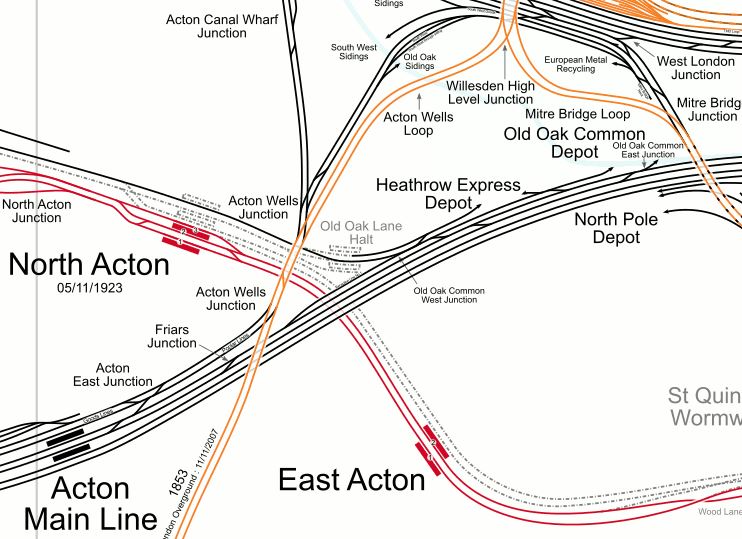
Note.
- The four tracks of the Great Western Main Line run through Acton Main Line station.
- The most Southerly pair of tracks are the fast lines, whilst the next pair are the slow lines as used by Crossrail.
- The tracks shown in orange are the North London Line.
- The two extra lines to the North of Acton Main Line station are the Goods Lines, connect at Acton Wells Junction to the North London Line, so freight trains can go across London between the Great Western Main Line and Stratford.
After crossing over the Central Line, the route splits with the North London Line going East to Stratford and the Dudding Hill Line going North through Acton Canal Wharf Junction.
To get to and from Heathrow, the services would take the same route as Crossrail to the West of Acton Main Line station.
The services would use the existing Cricklewood Curve Junction to connect with the Thameslink route to the North of Cricklewood station.
What New Infrastructure Would Be Required?
The infrastructure needed would not be of the sort of scale needed for Crossrail or Thameslink.
- The Dudding Hill Line is would need to be electrified.
- The Dudding Hill Line is double-track throughout.
- The 30 mph speed limit of the Dudding Hill Line would need to be increased.
- Would Harlesden and Dudding Hill stations be reopened or other new ones built?
- The stations at Heathrow could probably handle Class 700 trains without too much difficulty.
- There might be a need for a flyover to sort out the tangle of lines between Cricklewood and St. Pancras.
But nothing is too complicated or difficult.
What Frequency Of Thameslink Trains Would Serve Heathrow?
Currently, the following services are provided
- Heathrow Express has four tph to Terminal 5 via Heathrow Central
- There is a shuttle between Heathrow Central and Terminal 4, run by Heathrow Express.
- Heathrow Connect run two tph to Heathrow Central.
When Crossrail opens in December 2019, the service to Heathrow will be four trains per hour (tph) to Terminal 5 and two tph to Terminal 4.
Crossrail will also provide the shuttle between Heathrow Central and Terminal 4.
It is certainly not a system designed by any individual or committee with any sense of good design.
At least, both Terminal 4 and Terminal 5 stations have two terminal platforms, so the two stations should each be able to handle up to eight tph.
If they did this would mean up to sixteen tph on the Heathrow spur, which would be well within the capability of the route and trains running using ERTMS, which will handle up to 24 tph on both Crossrail and Thameslink in the few years.
Under current plans, it appears that when Crossrail opens, the stations will get the following services.
- Heathrow Central – 10 tph
- Heathrow Terminal 4 – 2 tph plus shuttles
- Heathrow Terminal 5 – 8 tph
I’m assuming that Heathrow Connect will quietly fade away.
With a bit of reorganisation of the services, it should be possible to squeeze another six tph into the airport, without building any new terminal platforms.
So I feel that say four tph Thameslink trains to Heathrow would be possible.
Could Crossrail Handle The Extra Trains?
The Thameslink trains would have to run on the Crossrail tracks between Acton Main Line station and Heathrow Airport Junction.
Currently Crossrail are proposing running 12 tph on this section, so as ERTMS can handle double this, I suspect there shouldn’t be too much of a problem.
Could Thameslink Handle The Extra Trains?
This article on Rail Engineer, which is entitled Thameslink Signalling Update, says this about possible Thameslink frequencies.
To meet the specification of 24 tph through the Thameslink core section, it is necessary to deploy Automatic Train Operation (ATO). This will provide a peak theoretical capacity of 30 tph, thereby creating a reliable 24 tph service with acceptable recovery margins.
So an extra six tph could be possible.
Would A Service Between Heathrow and Gatwick Airports Be Possible?
In my view it would be the logical service.
It would certainly be possible!
And it could also be a journey without any change of train!
Would There Be Any Other Useful Connections?
These are a few thoughts and ideas.
Same Platform Interchanges
Cross-city lines like Crossrail, Merseyrail’s Northern Line and Thameslink, have the advantage, that if you are going in the right direction, but are on a train to the wrong destination, you can just get off the train and wait for the correct train.
So if you leave Heathrow on a Gatwick train and you need to go to Maidstone East, you would get off at any of the stations in the central core and wait until the next Maidstone East train arrives.
Everybody will have their own favourite interchanges. Mine would probably be Blackfriars station, as it is above the Thames, has lots of seats and there is a large coffee shop on both platforms.
The ability to do this will mean that all stations South of West Hampstead Thameslink station will have a very easy link to and from Heathrow.
Reversing Stations
Crossrail has several stations where you can reverse your direction of travel by just walking across the platform. Whitechapel station will allow passengers to go between Abbey Wood and Shenfield stations without going up or down any steps or escalators.
Thameslink only has one reversing station at London Bridge station, although St. Pancras Thamslink has escalators and lifts to allow passengers to change direction in a short time.
West Hampstead Interchange
If plans for a West Hampstead Interchange materialise, this will link the following lines.
- Chiltern Railways
- Jubilee Line
- Metropolitan Line
- Midland Main L:ine
- North London Line
Note.
- This could be a very good interchange to be connected to Heathrow.
- West Hampstead Interchange would be a good alternative until Old Oak Common station is built.
- Passengers going between Heathrow and stations on the Midland Main Line to the North could change here.
Those like me living along the North London Line would find it a convenient way to get to and from Heathrow.
Kings Cross And St. Pancras Stations
The massive complex at Kings Cross and St. Pancras stations currently links the following lines.
- Eurostar
- Midland Main Line
- East Coast Main Line
- Southeastern Highspeed services
- Circle Line
- Hammersmith and City Line
- Metropolitan Line
- Northern Line
- Piccadilly Line
- Victoria Line
But the only way to get directly to Heathrow is a nearly hour long journey on the Piccadilly Line. Thameslink could be just over half that time, in a less cramped train.
Blackfriars Station
I use Blackfriars station a lot, as it is my the Tate Modern.
But others will use it as a same platform interchage for reasons I outlined erlier.
London Bridge Station
London Bridge station is another important interchange, with links to the following lines.
- Southeastern services to Kent
- Southern services to Surrey and Sussex.
- Jubilee Line
- Northern Line
Note.
- This new station is well-equipped and interchange is totally step-free.
- It is also a short walk to the city across London Bridge.
- This station will be a very good same platform interchange.
- The station allows passengers to reverse direction by just walking across the platform.
As with West Hampstead, this could be a very good interchange to be connected to Heathrow.
East Croydon, Orpington and Wimbledon Stations
East Croydon, Orpington and Wimbledon stations, which are important local hubs, would all be well-connected to Heathrow.
Collateral Benefits
Crossrail 2
Crossrail 2 is planning to have a Euston St. Pancras station, which is described like this in Wikipedia.
It would be a “mega station” serving the existing Euston, King’s Cross and St. Pancras main line stations. If funded and completed, it will be one of two such stations on the Crossrail 2 route (the other being Dalston).
If this station is designed properly, I am sure it will have the following.
- A step-free and convenient link to both Thameslink and Eurostar.
- Some form of high-capacity hi-tech people-mover, stretching under Euston Road, linking Kings Cross, St. Pancras and Euston stations.
I believe a station design is possible that makes the connection between HS1 and HS2 a no-hassle transfer for all passengers in less than ten minutes.
The people-mover should be in place when HS2 opens in December 2026, so that a credible HS1 to HS2 link opens at the same time.
Gatwick, Heathrow, HS1 And HS2 Will Be On One Rail Line
This could be of tremendous benefit to Londoners, travellers, tourists, rail companies and airlines, but Heathrow might not like it, as it could undermine their dominant position.
If Crossrail 2 opens around 2030, this will bring Stansted into the hub.
The Most Important Railway Station In The World
Eventually, Euston St. Pancras station will become the busiest and most important railway station in the world.
How Will Terminal Development At Heathrow Affect Crossrail And Thameslink?
Heathrow are disclosing a master-plan, for rebuilding a lot of the airport to make it more efficient and up with the best.
- There will be two main terminals; Heathrow West and Heathrow East with satellites in between handling the actual planes.
- These two terminals and the satellites will be between the two existing runways, with a passenger and baggage transport system beneath.
- Terminal Five will become Heathrow West.
- An extended Terminal Two will become Heathrow East.
- Crossrail, Heathrow Express and the Underground will serve both main terminals.
I believe that this rebuilding could start in the next few years.
Heathrow will make sure they future-proof rail access, so we could see.
- More terminal platforms at both Heathrow East and Heathrow West
- Through platforms at Heathrow West to allow trains to go West from both terminals.
- Freight shuttles bringing in provisions for the airport, the airlines and the aircraft.
This will allow Crossrail, Thameslink, Heathrow Express and other operators to have as many services as is thought necessary.
The biggest constraint will be the capacity of the Great Western Railway and the two tracks used by Crossrail.
Will Other Operastors Be Allowed Use Heathrow?
This probably depends more on politics than anything else, but technically these facts apply.
Bombardier Aventras
Bombardier have hinted that the design of an Aventra can provide commuter trains like Crossrail’s Class 345 trains and 125 mph expresses.
So it would be likely that a 125 mph Aventra of appropriate length would be able to serve Heathrow, if that were thought necessary!
All Trains Would Be Electric
I suspect that regulations would mean all trains would be electric, as you don’t want diesel or hydrogen fuels in the tunnels under Heathrow.
ERTMS
I also suspect that all trains using the eathrow stations would need to be equipped with ERTMS.
Possible Routes
Who knows what routes will become possible, but as the list of trains grows that are acceptable to Heathrow, various possibilities will arise.
- Great Western Railway to Bristol
- Great Western Railway to Cardiff
- London Overground to Clapham Junction station
- London Overground to Stratford
- South Western Railway to Southampton
- East Midlands Trains to Bedford/Kettering/Corby
- West Midlands Trains to Watford/Milton Keynes/Birmingham
After Heathrow terminals are updated to East and West, there would be scope for cross country routes going vaguely South-West to North-East calling at both terminals in Heathrow.
Will Thameslink And Crossrail Strangle Heathrow Express?
I wonder if a ink to Thameslink will be more valuable to Heathrow, than Heathrow Express.
- Abandoning Heathrow Express would release valuable platform space at Heathrow and Paddington.
- Crossrail and Thameslink together would have connections all over London, rather than just Paddington.
- Crossrail to and from Paddington would only take about five or six minutes longer.
- Heathrow Express will have to update their trains with ERTMS and to compete with Crossrail.
- Heathrow Express usually means a taxi to your hotel to and from Paddington.
- Crossrail will connect the West End, The City and Canary Wharf to Heathrow.
Convenience and cost will eventually strangle Heathrow Express.
Conclusion
The following statements would appear to be true.
- Class 345 and Class 700 trains can use the same infrastructure.
- Crossrail and Thameslink both use ERTMS.
- The stations at Heathrow,the Western section of Crossrail and the Thameslink core have spare capacity.
This means it should be possible to extend Thameslink services to Heathrow with a frequency of at least four tph, using an electrified Dudding Hill Line.
Some new infrastructure would be required, but nothing as comprehensive, as that for Crossrail and Thameslink.
The Crossrail Era Cometh
This title of this post comes from a comment on the Drapers Online web site.
It discusses the effect Crossrail is going to have on the shops in Oxford Street. This paragraph is typical of the bullish tone of the comment.
The Elizabeth Line is central to ushering in a new chapter for Oxford Street and the wider West End. The line is expected to bring an extra 60 million visits to the area each year, in addition to the current 200 million annual visits. Retailers in the West End will receive a huge boost from two new stations opening at Bond Street and Tottenham Court Road.
I wonder when a railway got such a large comment in a magazine or web site, devoted to the fashion business.
Toilets In Class 345 Trains
I visited this topic in Do Crossrail Trains Need Toilets? over two years ago, when I said this.
Surely, a much better and more affordable solution would be to update the ribbon maps in all Underground and Crossrail trains to show if the station had toilets, in the same way, they show the step free access. Some extra signs on stations showing the status and location of toilets would also be a good idea.
Incidentally on the Essex and Reading legs of Crossrail, several of the stations already have decent toilets. Getting off a train and catching the next one, to have a relaxed toilet break, is probably not a huge delay, due to the high frequency of the trains.
London has a chance to set high standards in this area, without putting toilets on any trains.
My views haven’t changed, but I do think that now the Aventra is in limited service, I can speculate further.
Walk-through Trains, First Class And Toilets
London now has five walk-through trains.
- Class 378 trains on the London Overground.
- S Stock on the London Underground
- Class 700 trains on Thameslink.
- Class 707 trains on South West Trains
- Class 345 trains on Crossrail.
In some ways the Class 700 train is the odd train out, as it has both First Class seating and toilets.
It should also be noted that Greater Anglia’s new Class 720 trains don’t have First Class, but it appears they have toilets.
Walk-through trains are an undoubted success, as any Overground or Underground passenger will confirm, after seeing the way other passengers move around the train to both get a seat and be able to make a convenient exit.
First Class causes problems, as it blocks off this passenger circulation, unless it as one end of the train. But this means that First Class passengers might have a long walk to their seat at the wrong end of the day.
I wonder if walk-through trains encourage passengers to not use First Class, as the freedom to circulate in Standard Class makes the travel experience better.
It will be interesting to see how posh commuters from Frinton take to Greater Anglia’s new Class 720 trains.
Another problem of First Class sitting at one end of the train, is that if toilet provision is made, there must be a toilet near to First Class.
So if you don’t have First Class in a train up to perhaps ten cars, you can get away with perhaps a universal access toilet and a standard one.
From comments I get, most people seem to like the Class 395 trains or Javelins, that work the Highspeed services to Kent. These trains are six-car, with no First Class and two toilets.
So are these trains setting the standard for the Greater Anglia’s Class 720 trains?
Toilets On Class 345 Trains
The initial layout of Crossrail with terminals at Abbey Wood, Heathrow, Reading and Shenfield, has a longest journey from Reading to Shenfield of 102 minutes according to the Crossrail web site. But there are toilet facilities at Reading and Shenfield.
However, there is the possibility, that Crossrail trains may serve other terminals like Gravesend, High Wycombe, Southend and Tring.
Tring to Southend would be a journey of two hours, so a toilet is probably a necessity.
The current Class 345 trains have been designed to be nine-car units, although at present they are running as seven cars because of platform length issues at Liverpool Street.
I’ve read somewhere that Crossrail has been designed so that the trains can be increased to ten cars, if there should be a need for more capacity.
- Platforms have been lengthened to at least two hundred metres.
- All stations seem to have been updated for a large number of passengers.
- Lengthening from seven to nine cars is obviously a simple matter.
- A similar lengthening of the Class 378 trains was not a major exercise.
So surely, it would be a simple matter to slot in a car with a toilet.
So perhaps we might see an extra tenth car added to Class 345 trains, that is tailored to the route, as this ability to add and remove cars, is a feature of all Aventras.
Hitachi’s Class 800 trains also have the capability, as I suspect every well-designed train has.
The Ultimate Airport Train
Imagine a tenth car on Heathrow services.
- Disabled toilet.
- Ticket machine.
- Visitor information and shop.
- Space for large luggage.
The mind boggles!
Conclusion
If an operator wanted Aventras with a disco car, I’m sure Bombardier would oblige! At a price!
The Class 345 Trains Are More Numerous
I took the train to Ipswich today to see Town host Brentford.
There were three Class 345 trains in a neat row at Ilford EMU Depot and another in Shenfield station.
Wikipedia now says that there are seven in service, but eleven are planned by September according to this article in the International Railway Journal.
Crossrail Funding Contributions From Developers Forecast To Hit £600m Target A Year Ahead Of Schedule
The title of this post is the same as that of this article in City AM.
The funding has come from the mayoral community infrastructure levy (MCIL) and Section 106 contributions.
The two biggest contributions came from |Tower Hamlets at £40m and Westminster at £34m.
What the author doesn’t point out is the collateral benefit from all this extra development. Transport for London must be getting more far revenue from more passengers going to and from the developments.
It’s certainly good news.
Are areas like Birmingham, Leeds, Liverpool, Manchester and Newcastle seening similar cast flow increases?
 The Anonymous Widower