A Walk Around Abbey Wood Station
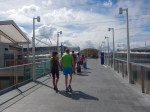
I took these pictures as I walked in a circle around Abbey Wood station.
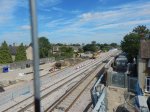

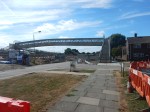
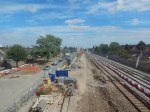
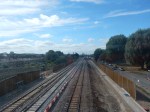
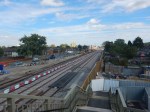
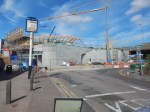
I walked along Harrow Manorway, crossed to the Sainsburys before walking along Felixstowe Road, where I walked for a couple of hundred yards towards Plumstead.
I used the new footbridge to cross the railway and then walked back through the side-streets to the station.
Not a country walk, but it does give some good views of the station and the Crossrail lines in the area.
Incidentally, the new footbridge has some clear panels to allow photographs.
Between Abbey Wood And Belvedere Stations
A couple of days ago I went to Abbey Wood station to see how the new Crossrail station was progressing. My pictures are here in Abbey Wood Station – 29th August 2016.
Those pictures made me wonder how Crossrail continued past the station and what the track was like to Belvedere station.
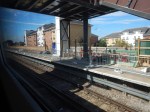
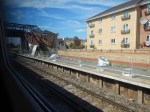
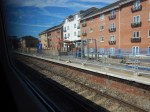
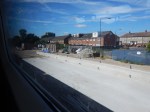
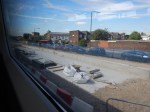
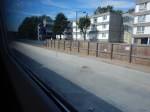
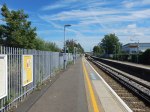
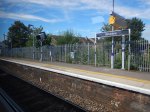
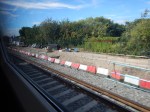
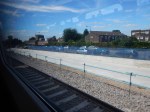
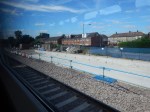
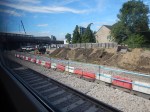
So I took a train to Belvedere and back and took these pictures.
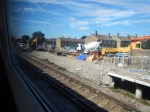










Note.
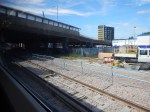
It looks like two more tracks or sidings are being created on the North side of the Southeastern tracks.
There would appear to be a concrete track-bed being built.
Belvedere station is extremely tight for space and putting another two tracks through would look to be very difficult.
I still haven’t got any definite view as to whether Abbey Wood station, will have either of these layouts.
- Platforms 1/2 is Southeastern and Platforms 3/4 are Crossrail.
- Platforms 1/2 are towards London and Platform 3/4 are away from London, with cross-platform interchange between Southerneastern and Crossrail in both directions.
One thing that surprised me, as I waited to come home, was that a Southeastern train ran through on Platform 1 without stopping.
So perhaps we may see Crossrail in the middle and Southeastern on the two outside platforms.
It would certainly allow the valuable cross-platform interchange between services.
A reversing siding or sidings for Crossrail would be to the East of Abbey Wood station, between the two Southeastern tracks.
Would the two Crossrail lines be bi-directional to platforms 2 and 3?
The only problem would be that the down Southeastern track would have to cross over the Crossrail tracks. Would it do this just to the West of the tunnel portal, so that the lines are lined up in this order from South to North?
- Up Southeastern calling at Platform 1 at Abbey Wood
- Up Crossrail calling at Platform 2 at Abbey Wood
- Down Crossrail calling at Platform 3 at Abbey Wood
- Down Southeastern calling at Platform 4 at Abbey Wood
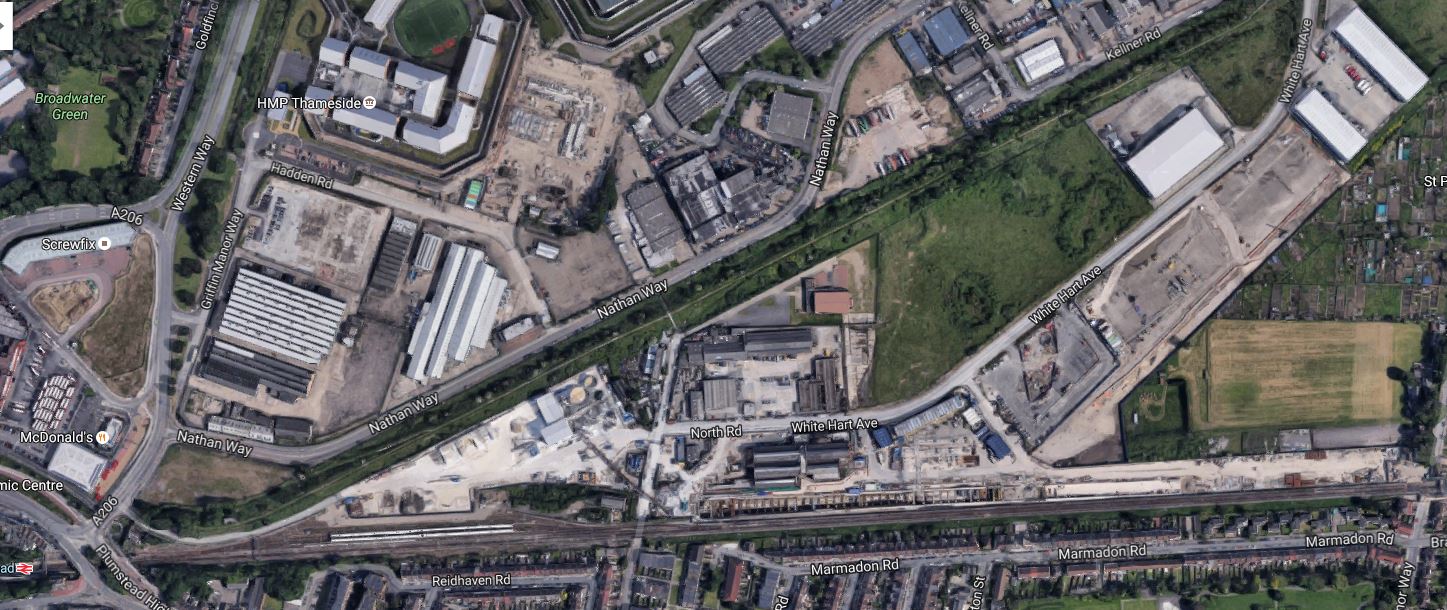
This Google Map shows Plumstead station and the various sidings in the area.
Plumstead Station And Crossrail
Plumstead station is in the South-West corner with the line to Abbey Wood station going to the East.
The Crossrail portal lies to the North of the line with the under construction Plumstead Stabling further to the North and pointing North-Easterly.
Having been through the area many times on a train, I feel that there is plenty of space around the tunnel portal and I suspect that my proposed line arrangement could be made to work.
- There is cross-platform interchange between Crossrail and Southeastern services at Abbey Wood station.
- Crossrail trains can reverse easily at Abbey Wood station.
- There are no flat junctions, where tracks cross.
- The only crossing is the down Southeastern line, which crosses over the Crossrail tracks whilst they are in the tunnel.
- Southeastern trains not stopping at Abbey Wood stations can pass straight through.
- If Crossrail is extended from Abbey Wood station, the down and up pair of lines can join and split to the East of Abbey Wood station.
If this layout is correct, it is much simpler for passengers than the interchange at Shenfield.
I will watch what happens with interest in the next few months.
Related Posts
A Design Crime – Ebbsfleet International Station
Connecting North Kent And The Medway Towns To Ebbsfleet International Station
Abbey Wood Station – 29th August 2016
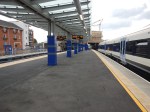
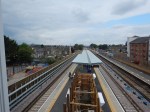
Abbey Wood Station, now appears to have two completed Southeastern platforms.

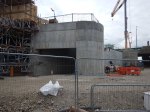
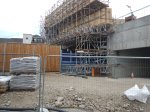
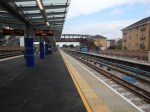
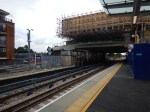
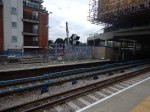
Note.
- The two Southeastern platforms form a wide island platform, which is numbered 1 and 2
- It would appear that there will be a second island platform for Crossrail. Could they be numbered 3 and 4?
- I also think, that both island platforms will be connected to the station building on the overbridge, by escalators and lifts
- It does seem to me that the space is a bit limited for the two Crossrail platforms and their overhead wires.
All pictures seem to show that the Southeastern lines are on the Southern pair of tracks and the Crossrail ones are on the Northern pair.
But under Future in the Wikipedia entry for Abbey Wood station, this is said.
Abbey Wood is being rebuilt in preparation for Crossrail, due to commence operation in 2018. Abbey Wood is the terminus of one of two eastern branches of Crossrail and will offer cross-platform interchange between terminating Crossrail services (at 12 trains per hour on new line) and existing Southeastern services (along existing tracks). This is instead of continuing services to Ebbsfleet International along existing tracks as those lines are congested and may delay Crossrail services.
Does cross-platform interchange mean that one Crossrail and one Southeastern track will share each platform?
This visualisation of the station doesn’t give any definite clues.
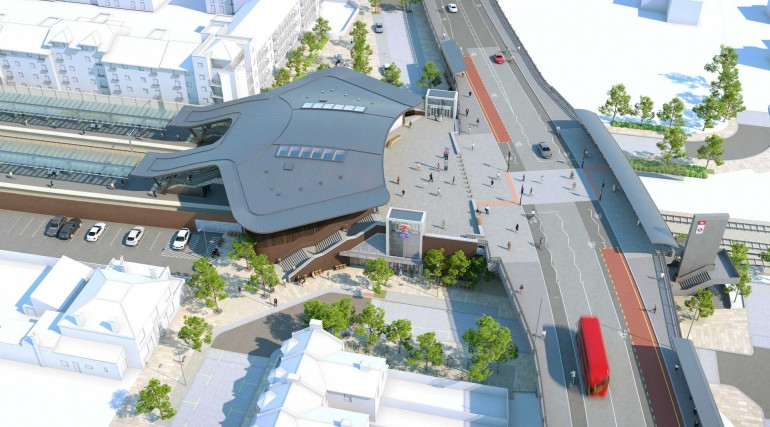
Abbey Wood Station
If we look at the morning peak and Southeastern trains turn up in Platform 1, with lots of passengers for Crossrail, surely if they’ve all got to go up one escalator and down another to get to Crossrail on the other island platform, it is a inefficient passenger flow, compared to a simple cross-platform interchange.
The reverse would happen in the evening.
So it must just be possible, that each island platform will have one Southeastern line and one Crossrail line.
Those Frenchmen at carto.metro.free.fr have this view of the lines between Plumstead and Abbey Wood stations.
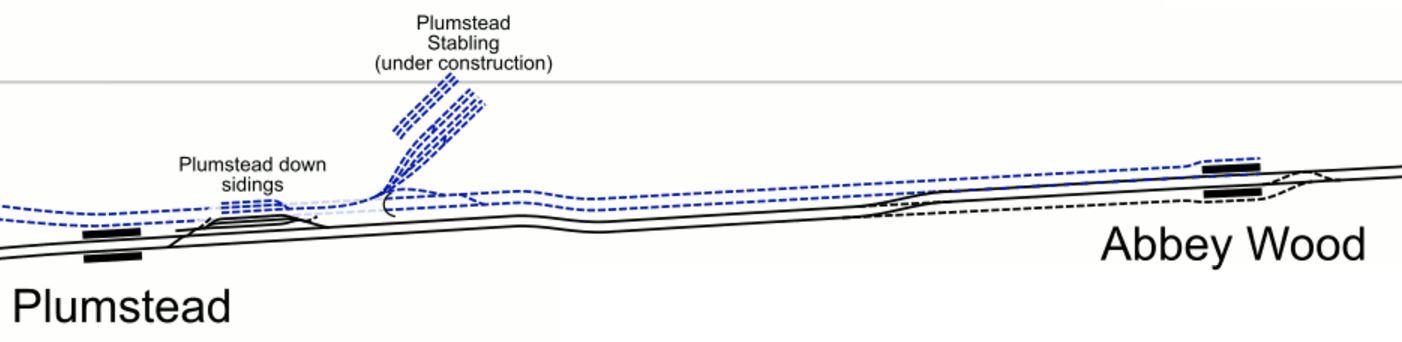
Crossrail Between Plumstead And Abbey Wood Stations
The map would appear to show the following.
- Platform 4 is a bay platform used by Crossrail and it is directly connected to the down (from London) Crossrail line.
- Platform 3 is directly connected to the up (towards London) Crossrail Line.
- There is no Crossrail lines shown to the East of Abbey Wood station.
- There is only one crossover between the two Crossrail lines, to allow trains from London to call at Platform 3 at Abbey Wood.
- The next crossovers on Crossrail, are at Custom House station.
- How do trains arriving in Platform 4 at Abbey Wood, get onto the up line through the tunnels?
- There would appear to have to be changes to the tracks, if Crossrail services are to be extended beyond Abbey Wood station.
I wonder if service levels give us any clues.
- At present there are eight Southeastern services per hour (tph) running through the station in the Off Peak.
- Six services go to and from Cannon Street and two terminate at Charing Cross.
- Wikipedia says Crossrail will run 12 tph in the Peak and 8 tph in the Off Peak.
Surely in an ideal world, if both services have an 8 tph frequency, it should be arranged that they the two services have a cross-platform interchange.
It should all be as clear as mud, in a few months.
Are The Doom-Mongers Starting Up About Crossrail?
The title of this article in the Standard is Hatton Garden jewellery district ‘faces extinction over Crossrail rent rises’
So what?
Did the owners of sweat shops in East London complain, when new clothing factories set up with more enlightened attitudes to their workers in Victorian times.
You bet they did!
But just as the City has reinvented itself with Canary Wharf, Hatton Garden will have to move on and change to survive.
Some won’t like it, but hopefully what emerges will be stronger and probably a lot more legal, with regards to tax and money laundering.
I also was accosted by a station-man at Shenfield, who said that everybody would hate the new trains, as you’ll have to stand all the way to London.
The design of the trains appears to be such, that seats will be more numerous at the ends of the trains, with metro style seating and a lot of standing in the middle.
This layout is so that when the train is running in Tube-mode between Stratford and Paddington, there is enough capacity for those wanting to do a couple of stops.
But those boarding in the suburbs will probably get a seat all the way to the centre. In the morning peak, there would appear to 16 trains per hour (tph) to Central London.
I do wonder if the RMT will have it in for the new Class 345 trains, as they have a degree of automation, never seen before in trains in the UK.
Some of this automation, will mean very different methods of working, but will be essential to obtain Crossrail’s frequency of 24 tph.
Enthusiasm For Class 345 Trains
I have read several articles on the new Class 345 trains for Crossrail.
This article from Railway Technology Magazine, which is entitled There has never been a ‘better designed’ train than Crossrail, is particularly enthusiastic.
This is said.
There has never been a train “better prepared or better designed” in the UK than theCrossrail train, London Underground’s managing director Mark Wild told RTM at a visit to Bombardier’s testing facility in Derby.
Speaking to RTM after the first Crossrail train, Class 345, was unveiled and taken for a ride across the Bombardier test track for the first time, Wild sang the many praises of the state-of-the-art vehicle, calling it a “world-class train” for passengers.
“It’s a sensational train. I’m so pleased to see it – it’s so exciting,” he said. “I’ve been lucky enough to be involved with other train procurements in my career and this is definitely the best. This will be a big success – obviously it has to be tested thoroughly, but it is already looks great.”
But of course the proof of the train, will be in the riding.
I can’t wait, until May 2017, when they will start running between Liverpool Street and Shenfield.
I think that Bombardier, Crossrail and TfL are handling the introduction of the trains into service in a way, that means they can handle any teething troubles.
Consider.
- Liverpool Street to Shenfield is a self-contained line.
- By the end of this year, Liverpool Street to Shenfield will have had the extended platforms completed and the power systems upgraded for Crossrail.
- Bombardier have a facility for servicing trains at Ilford, so the testing will be on their door-step.
Bombardier are also introducing the trains as seven cars, as the platforms at Liverpool Street are too short. But after their lengthening of the Class 378 trains on the Overground, this process probably has no fears for the company.
It will also mean, that when the platforms are lengthened, this can be done at a time, when all the trains are going through the central tunnel.
But to me, the platform lengthening at Liverpool Street has more to it.
The Services section for Crossrail in Wikipedia is saying that only four trains to Gidea Park in the Peak will use Liverpool Street.
Lengthening the platforms for just four trains does seem a lot of work just to allow the standard trains to enter Liverpool Street.
Obviously, if there is a problem like a broken-down train in the tunnel, the ability to use Liverpool Street station as an alternative destination will be valuable.
Or could it be that there are other plans to perhaps run Crossrail trains to Southend Victoria?
I feel the latter would make a lot of sense.
- The Southend Victoria route, gets much needed new trains.
- Southend Airport gets a premium service.
- The use of the upgraded Crossrail route is increased.
- These trains could perhaps just stop at Stratford, Ilford, Romford, Gidea Park and Shenfield.
- They could be mechanically and electrically identical to the Crossrail trains, but with a more appropriate interiror.
This is only the same as is happening on the Western Branch, where other services are using Crossrail’s tracks to go to Paddington.
Crossrail is going to be a lot bigger than a cross-London railway called the Elizabeth Line.
Paddington Is Operational Again
Paddington Underground station on the Bakerloo Line has now got its escalators back and getting to the station for me, is now so much easier.
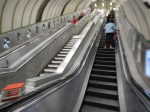
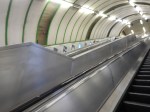
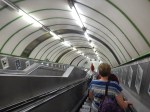


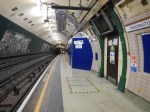
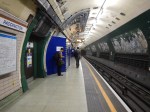


As the pictures show there seem to be quite a few new blue hoardings at platform level.
This map from carto.metro.free.fr shows the layout of the Bakerloo Line and Crossrail at Paddington.

Bakerloo Line And Crossrail At Paddington Station
Note.
- The Bakerloo Line runs roughly South-East to North-West through Paddington.
- The platform labelled 4 is the Southbound Bakerloo Line platform.
- The platform labelled 3 is the Nouthbound Bakerloo Line platform.
- The escalators run down to the platforms from the South-East
- Crossrail would appear to have an island platform between the two tracks.
There would appear to be two places on the platforms where blue hoarding have been put up to protect the works behind.
- The most obvious is the big blue wall that greets you as you come down the escalator, where some artistic tiling used to be.
- There are also blue hoardings at the London (South East) end of the platforms.
There is a pedestrian tunnel to Crossrail called the Bakerloo Line Link (BLL). A memeber of staff also told me that lifts will be installed to the Bakerloo Line.
This document on the TFL web site gives a bit more information.
Engineers will also carefully dig a new 165m tunnel underneath the station to enable passengers to interchange between the Bakerloo line and new Crossrail platforms, which will become operational from 2018. The new pedestrian link will incorporate escalators, lifts, stairs and new passageways in order to make interchanging between the Tube and Crossrail as easy as possible for passengers.
So it looks like the tunnel will go under the lines and come up between the two Bakerloo tracks. The length of one hundred and sixty-five metres would easily reach the Crossrail platforms.
I found this image on the web.
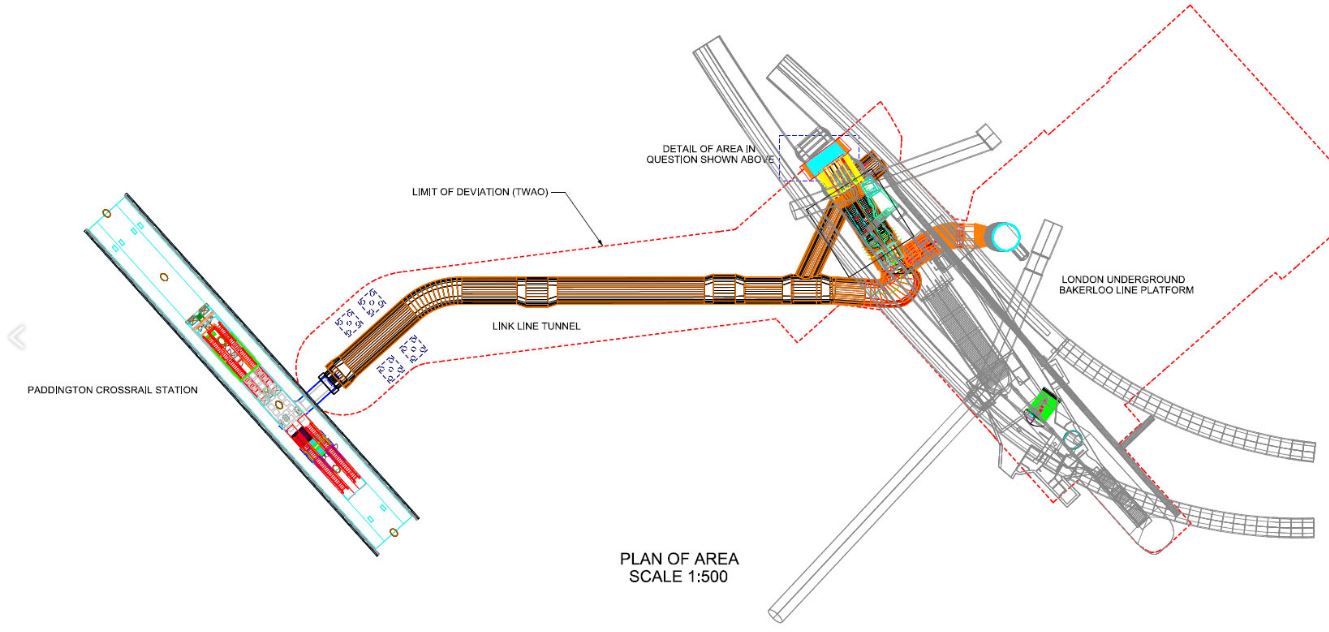
The Bakerloo Line Link At Paddington
It looks to be a very well thought out link.
- It is connected to the Crossrail station by escalators and lifts in the middle of the island platform at that station.
- The connection at the Bakerloo Line end, would appear to have lifts, stairs and escalators.
- Wll the lifts go direct to the surface as well?
- All routes seem to be direct to the central landing in the Bakerloo Line platforms.
- It may be a hundred and sixty five metres, but the design probably means most passengers will do it fairly fast.But I’m only speculating.
It will certainly be a very powerful interchange, as it will give a much needed connection to London’s least-developed Underground Line.
One good thing from the TFL document, is that it says this.
TfL will re-open the platforms in time for the Notting Hill Carnival on Sunday 28 and Monday 29 August.
So they beat their deadline by four weeks.
It certainly looks like a job well done!
Certainly, it makes my journey to the station easier.
The next thing needed is to get the Marks and Spencer reopened at the station.
Custom House Station – 24th July 2016
I took these pictures at Custom House station.




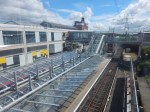
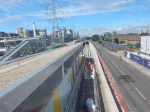
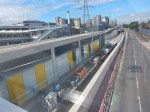
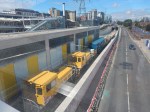
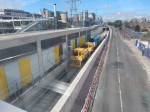
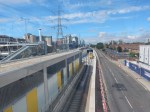


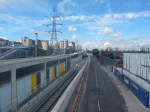
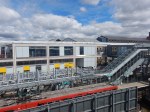
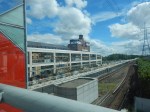
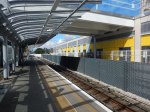
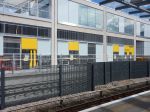
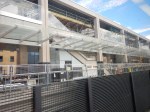




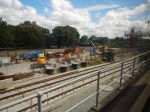
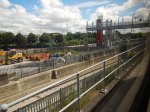

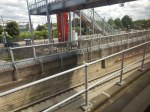

The pictures also show a work-train entering the tunnel and the Crossrail track alongside the DLR until near the Connaught Tunnel.
Sadiq Khan Backs Gatwick
This article on the BBC is entitled Sadiq Khan urges swift decision on Gatwick expansion.
Doesn’t most of those living and/or working in london and the South East?
This is said in the article.
London Mayor Sadiq Khan has urged Theresa May to make a quick decision on airport expansion in the South East.
Mr Khan said the new Prime Minister should make the final decision on whether a new runway should be built at Gatwick or Heathrow a top priority.
This decision has been kicked further into the long grass for years, ever since Harold Wilson cancelled Maplin Airport in 1971.
With Brexit on the near hotizon, what better way to say the UK and London is open for business, than by deciding on the next runway in the South East.
I don’t believe Heathrow should build another runway for the following reasons.
- Building another runway would cause endless problems as the M25 is diverted., if what happened when it was diverted for Terminal 5 is anything to go by.
- Gatwick will have better rail connections.
- Heathrow has annoyed a lot of influential and powerful people and organisations in West London.
- The site is too small, even after demolishing the odd village.
- I don’t believe they’ll solve the pollution problem.
- I don’t like approaching the airport over Central London.
- It is the more expensive option.
You can probably say similar things for Gatwick.
But at least Gatwick’s owners don’t seem to be as greedy and uncooperative as those at Heathrow.
At least Gatwick’s plans seem well advanced, as this visualisation shows.
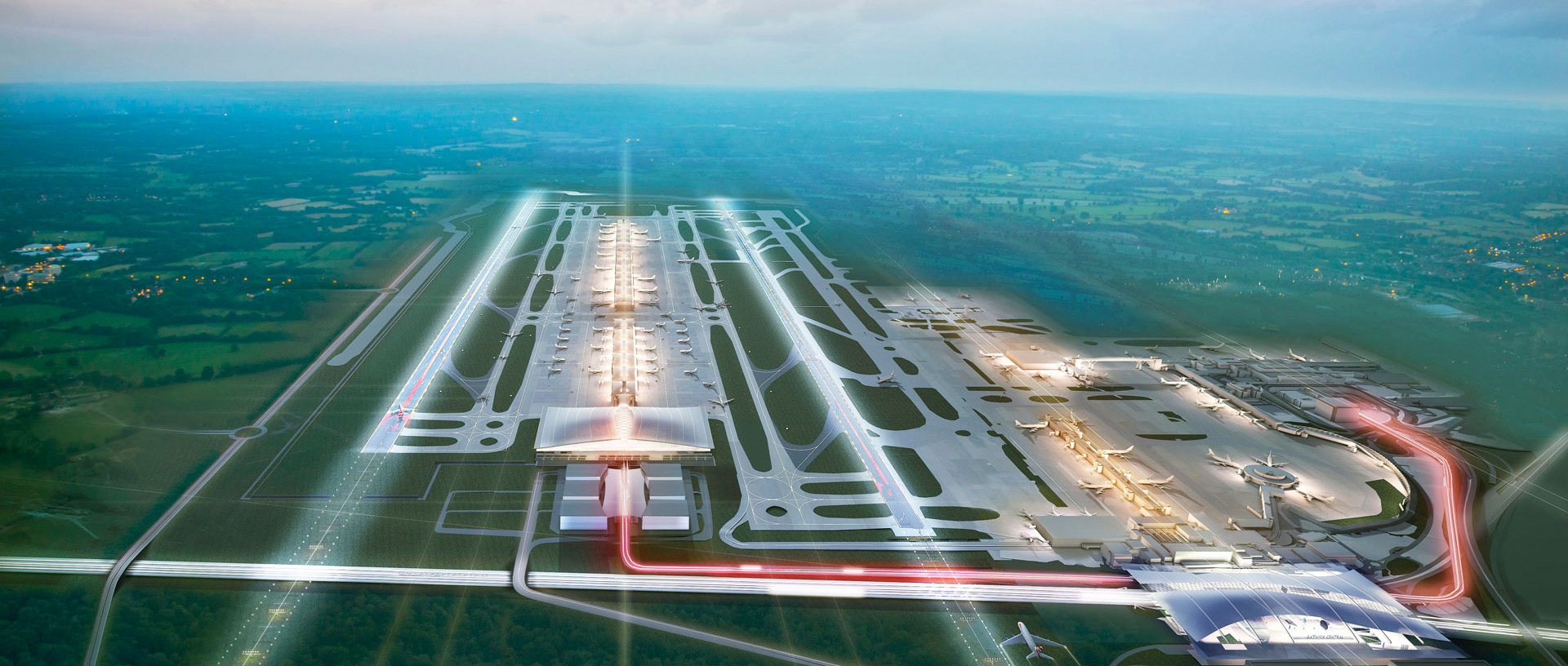
Gatwick With Two Runways
This appears to me to be a good efficient design.
- The new runway is on the left.
- It looks like the secondary North runway, used when the current main runway is under msaintenance, is still in place.
- Between the two runways is a massive new terminal.
- Note the station in the bottom right corner, with the Brighton Main Line going across.
- The red line is a shuttle, that takes passengers between the current North and Main terminals, the new terminal and the train station.
- Little demolition seems to have taken place.
But in some ways, where the runway is built is irrelevant, if Crossrail and the improved Thameslink work as they say on their tins.
These two high-capacity railways will give Heathrow and Gatwick a shared terminal called London, that unfortunately for them, they will share with Stansted, Luton, HS2 and Eurostar.
I feel though, that because of Brexit, we’ll see a decision before the end of the year and possibly in the next few weeks.
British governments have fiddled for far too long!
Could More Pedestrianisation And Better Public Transport Be A Weapon Against Terrorism?
Protecting against the sort of attack like the one in Nice last night , must be every policeman’s nightmare.
The City of London put a ring of steel around the Square Mile and there hasn’t been a serious attack since. But it caused lots of other problems.
I actually think, that we now have so many areas where large crowds congregate for work, shopping and sporting events, that we need more and more traffic restrictions like those proposed for Oxford Street.
Intriguingly, the City of London is going the same way and wants to remove a lot of traffic from the area around Bank.
So is this pedestrianisation, perhaps linked with better public transport, one of our best weapons against terrorism?
The Mind Of A Terrorist
I don’t know, as I’m at best, a poor amateur psychologist, but it strikes me there are two types of terrorist wanting to create mayhem and kill lots of people.
The first group, are those who want to leave a bomb or device and get safely away.The Bishopsgate and Baltic Exchange bombings which in today’s money together caused over a billion pounds of damage, are examples of this type, where no-one was ever prosecuted, or even publicly named.
The second group are the much-more suicide bombers, who generally strike without warning
Incidentally, I only think one Irish bomber was killed by his own bomb and we can all be thankful for that, as if suicide tactics had been employed, we would have seen many more deaths.
The City Of London’s Ring Of Steel
The City of London is protected by a so-called Ring of Steel, which is a network of barriers, check-points and 649 CCTV cameras.
It certainly seems to have protected the City from further bombings and made terrorists seek out alternative targets outside the Square Mile.
It has had one very positive effect, although at times that doesn’t seem to be as effective as it was. The City inside the ring, is now a very pleasant place to walk about and explore, as traffic is much-reduced.
Also, at weekends, the City is now a very quiet place for much of the year.
When I was still driving and needed perhaps to park a car for the evening or overnight, I would also park it prominently on a meter or legal parking space inside the ring, as I knew it would still be there in the morning.
The Future Of The City Of London
The City of London is pushing ahead with a policy of pedestrianisation, improved walking routes and better access to the Underground and rail network.
They have one great advantage compared to most other local authorities. Land is so expensive in the City and therefore fortunes are spent to create buildings that will earn billions, that if the City says to a developer, can you put an Underground entrance in your building, the answer is usually yes.
At the present time, Bloomberg are creating a new headquarters building called Walbrook Square, that will incorporate a second entrance to the Waterloo and City Line.
Other cities across the UK and the wider world are not so lucky!
Crossrail and the upgraded Thameslink will have their effects on the City, because of the positions of their stations and other factors.
- , Crossrail will have a massive double-ended station stretching from Liverpool Street in the East to Moorgate in the West.
- Thameslink will have a line of stations; Fasrringdon, City Thameslink and Blackfriars, down the West of the City.
- Crossrail and Thameslink will have their important interchange at Frarringdon.
- Crossrail will have a major interchange at Whitechapel serving the East of the City.
- Thameslink will also have a major interchange at London Bridge, just across the River from the City.
- Crossrail and Thameslink will be running two hundred metre long trains at a frequency of twenty-four trains per hour in both directions.
Add to that the existing services of the Central, Circle, District, Metropolitan and Waterloo and City Lines of the Underground and National Rail services out of Cannon Street, Fenchurch Street, Liverpool Street and Moorgate, all of which will be upgraded and I believe that at some point in the future, the City of London, will take the bold and very green step of making the whole area a pedestrian-only one, with the only vehicles allowed in the day, being approved electrical ones.
It would be a bold move, but it have several positive effects.
- Air quality would improve.
- The City would be the place to work!
- The City would become one of London’s major tourist attractions, with visitors able to walk all across from St. Pauls to the Tower and the River.
- Innovation would work to provide the services a city needed despite the restrictions.
Would terrorists realise that the sort of spectaculars they love, would be more difficult and go elsewhere?
We could see a return to suicide bombers on the Underground!
Conclusions
The City of London will reinvent itself, as it does periodically with great success.
Given that Oxford Street has said that it will pedestrianise by 2020, are we seeing a green transport revolution?
I can think of a few other cities and towns, that could follow London’s example.
What Will The Elizabeth Line Do For Oxford Street?
I have decided to use Elizabeth Line for Crossrail from now on, as most articles seem to be dropping Crossrail in favour of the operational name.
I had an e-mail from Crossrail today and they’re still using Crossrail.
I have written before about Crossrail being a line for shopping in Is Crossrail Going To Be The Shopping Line?, but today I found this article in Retail Week, which is entitled London’s Oxford Street anticipates £1bn boost from Crossrail. This is said.
The iconic London high street already generates £5 billion per year in sales and New West End Company hopes to hit an annual target of £6 billion by 2020 – two years after Crossrail’s Queen Elizabeth line is expected to completed.
With the Crossrail providing direct commutes for counties such as Berkshire, Buckinghamshire and Essex, New West End Company hopes the three-mile shopping precinct experience a 30 per cent increase in visits.
In addition, 2000 new retail jobs are expected to be created, and the nearby Bird Street will transform into a new shopping precinct thanks to private donations and £200,000 from Transport for London’s Future Street’s Incubator Scheme.
Is Brexit figured in to these calculations?
I think that we may say more changes on Oxford Street, as surely Crossrail will enable other changes.
Oxford Street will have the following stations and entrances as you proceed from East to West.
- Holborn – Central and Piccadilly
- Tottenham Court Road (Current Entrance) – Central, Elizabeth and Northern
- Tottenham Court Road (Dean Street Entrance) – Central and Elizabeth
- Oxford Circus – Bakerloo, Central and Victoria
- Bond Street – Central, Elizabeth and Jubilee
- Marble Arch – Central
So could we see much of Oxford Street being pedestrianised?
The Mayor has said he would be in favour. According to this article on the BBC, it will happen by 2020.
I think that because of the number of the number of stations just North and South of Oxford Street, I do wonder if the pedestrian area could include Tottenham Court Road, Bond Street and Soho.
The main pedestrian routes would link up.
- Green Park, Piccadilly and Shaftesbury Avenue in the South.
- The British Museum, Bloomsbury and Holborn in the East.
- Euston Road and Regents Park in the North.
- Hyde Park in the West
Where would all the buses, taxis and cars go?
I think that there will have to be a serious rethink, which could see drastic reductions in numbers of all three!
But there will be other knock-ons as Crossrail will for a few years give spare capacity, that could be used to advantage.
The Central Line Should Be Less Busy
The Central Line will have excellent connections to Crossrail at Stratford, Liverpool Street and Ealing Broadway.
It is expected that as some cross-London passengers, who now use this line, will switch to Crossrail, thus releasing capacity on the Central Line.
It would certainly create a high-speed shuttle between three of London’s main shopping centres; Westfield at Shephered’s Bush, Oxford Street and Eastfield at Stratford.
Updating The Central Stretch Of The Central Line
The central stretch of the Central Line will have two rebuilt stations with full step-free access after Crossrail opens; Tottenham Court Road and Bond Street.
Closure of the Central Line in Central London would be possible if needed fr engineering works, as the line has several turn-backs, so it could be run as an Eastern and Western section, whilst say major works were done in the centre.
This partial closure would enable the following.
- A step-free station to be created on the Central Line at Marble Arch.
- Step-free access to be created to at least the Central Line at Oxford Circus.
- Step-free access to be created to at least the Central Line at Holborn.
It is interesting to note, that during the building of Crossrail, access to the Central and Northern Lines has sometimes been restricted at Bond Street and Tottenham Court Road and Londoners didn’t moan too much.
So selective closure to get higher-capacity and step-free stations in the centre will not be the disaster it could have been, especially, if the improvements were done in a phased manner.
But all three are prime sites and there must be significant potential for over-site development.
Additionally, if you look at the railway lines on carto.metro.free.fr, this is a map of the lines between Holborn and Tottenham Court Road stations.

British Museum Station
Note the old British Museum station on the Central Line.
I wouldn’t know whether it is practical to reopen the station, but I suspect Transport for London’s route planners have looked at the possibility to give better access to one of the busiest museums in the world.
As the Central Line through Central London is effectively a loop of Crossrail, it gives the great advantage of creating a double line across Central London, that offers redundancy, if either line needs to be closed for serious engineering work.
The Central Line never had that luxury before, so expect serious improvements on any Central Line station between Stratford and Ealing Broadway.
The Outer Reaches Of The Central Line
I suspect that Crossrail will generate more traffic on the outer reches of the Central Line to Epping, Hainault and West Ruislip.
These sometimes forgotten parts of the line will undoubtedly improve and change.
Wikipedia lists some of the line’s Cancelled and Future Plans.
I think what happens could surprise everybody.
Crossrail 2
Crossrail 2 has just one interchange in the Oxford Street area at Tottenham Court Road station.
I would be very surprised in that in the massive rebuilding of the current station for Crossrail, that provision hasn’t been made to connect to Crossrail 2.
There have been surface issues around the station concerned with Crossrail 2, but given good planning of the project, I feel that the building of Crossrail 2 would only effect the area in a similar way to the replacement of a major block on Oxford Street.
Crossrail 2 will have two major effects.
- It will bring large numbers of visitors to the Oxford Street area.
- Just as Crossrail and the Central Line will work as a high-capacity pair, it will work closely with the Victoria Line to relieve that line.
This leads me to the conclusion, that the wider Oxford Street area needs to be and will be pedestrianised.
 The Anonymous Widower