Three New Battery-Only Revolution Very Light Rail Vehicles
This title of this post, is the same as that as this press release from Eversholt Rail Group.
These are the three bullet points.
- Eversholt Rail funding three brand-new Revolution Very Light Rail vehicles for passenger trials and ongoing operation.
- Manufactured in the UK by Transport Design International.
- Battery-only propulsion, providing zero-emissions operation.
These three paragraphs fill out the story.
Innovative new lightweight passenger trains that will help decarbonise Britain’s railways are to be trialled after a new deal was announced this week.
The new Revolution Very Light Rail vehicles will run entirely on battery power and could be carrying passengers within three years. A new system of lineside fast charging will mean the whole operation has zero emissions.
Some of Britain’s major rail operators are already showing interest in the RVLR vehicles as they seek to fulfil promises to make rail ‘cleaner’.
This is also said about looking for routes, to trial the new vehicles.
Eversholt Rail and TDI are working with key stakeholders across the UK rail industry to agree routes and services where operators can run passenger-carrying trials using these new vehicles. These trials will generate actual passenger demand data to support business cases for long-term deployment of RVLR vehicles as well as providing further passenger and operator feedback on their design and capabilities.
I have some thoughts and questions.
What Is The Top Speed?
A lot of questions like this are answered by this article on Rail Engineer, which is entitled Very Light Rail – A Revolution.
These can be ascertained from this comprehensive article.
- Top Speed – 65 mph
- Seats – 56
- Wheelchair space
- PRM TSI accessibility compatible
- Tare Weight – 24.8 tonnes
- USB Charging
For comparison these figures relate to a PRM-compliant Class 153 diesel train.
- Top Speed – 75 mph
- Seats – 59
- Tare Weight – 41.2 tonnes
This picture shows one of the Class 153 trains at Matlock Bath station.
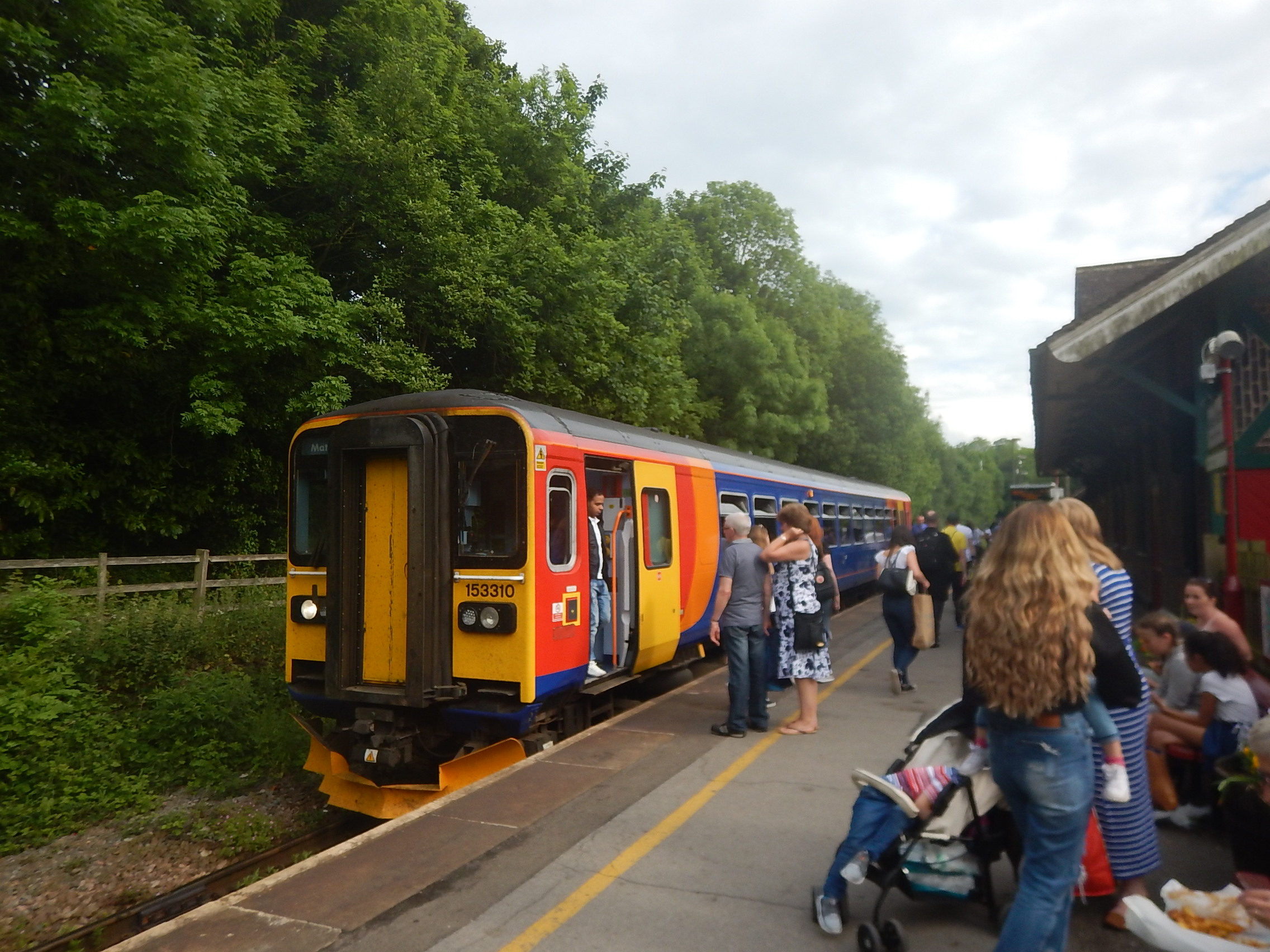
There are still around thirty in service in the UK.
Can Two Revolution VLRs Run As A Two-Car Train?
From the pictures on the web, the trains have buffers and space for a coupler, so until someone says they must always run as single units, I’ll assume they can at least run as a pair.
Can A Revolution VLR Recharge Its Batteries Using Conventional 25 KVAC Overhead Electrification?
One route, that is a possibility for running using Revolution VLR must surely be the Greenford Branch, which connects to the electrified Great Western Main Line at West Ealing station.
In this and at several other places on the network, it could be easier to charge the trains using the existing overhead electrification or an extension of it.
Another possibility; the Marston Vale Line is also electrified at both Bedford and Bletchley.
In New Mobile Rail Charging Facility For Long Marston, I talked about how Siemens are developing a mobile charger, which initially will be deployed at Long Marston.
It could be very useful for efficient operation, if the batteries on a Revolution VLR could be charged in a number of places, which included conventional electrification.
If charging only happened, whilst trains were stationary, a lightweight pantograph and appropriate electrical gubbins might be sufficient.
Can A Revolution VLR Replace A Class 153 Train?
I suspect on some routes this will be possible, but on others, the speed or hill-climbing requirements might be too stiff for the lightweight train.
But, if I was designing a train like the Revolution VLR, I’d make sure it fitted as many markets as possible.
The picture was taken at Matlock Bath station on the Derwent Valley Line, which is a single track with a fifty mph limit and an uphill climb. I suspect that the Revolution VLR would be designed to handle the uphill part of the route, but would the train be able to handle the speed of the Midland Main Line to Derby.
The Revolution VLR would probably attract more passengers, so it might be necessary to double up the service by running a pair.
Can A Pair Of Revolution VLRs Replace A Class 150 Train?
I don’t see why not!
Could The West London Orbital Use Revolution VLRs?
This might be a proposed route that could use Revolution VLRs.
The two routes would be.
- West Hampstead and Hounslow.
- Hendon and Kew Bridge.
Both services would use the Dudding Hill Line and serve Neasden, Harlesden, Old Oak Common and Acton, with a frequency of four trains per hour (tph).
Although this service could be run using conventional multiple units, it might be more affordable to use Revolution VLRs charged on sections of line that are already electrified.
Could the Greenford Branch Use Revolution VLRs?
The Greenford Branch would be a classic application and trains could be charged by fitting a charger in the bay platform at West Ealing station.
In An Automated Shuttle Train On The Greenford Branch Line, I did a rough calculation to see if an automated shuttle could achieve four tph.
Four tph might be too ambitious, but automatic trains shuttling along a branch line might be an affordable way to provide zero-carbon trains with an adequate capacity.
- The driver would drive the train using the sort of remote control used for drones.
- The driver would sit in a convenient place on the train, with CCTV to help them see everything.
- When the train was ready to leave, the driver would push a button to tell the train to move to the next station.
- On arrival at the next station, the doors will open.
- The process would repeat along the line.
If this method of operation sounds vaguely familiar, the Victoria Line has used it since 1067.
Although the Victoria Line drivers always sit in the front.
But on a line with no other trains running at the same time, all they need is a good view of the doors.
Branch lines that could be run in this way could include.
Bodmin Parkway and Bodmin General
Brockenhurst and Lymington Pier
Grove Park and Bromley North
Lancaster and Morecambe
Liskeard and Looe
Lostwithiel and Powey
Maidenhead and Marlow
March and Wisbech
Par and Newquay
Plymouth and Gunnislake
Romford and Upminster
Sittingbourne and Sheerness-on-Sea
Slough and Windsor Central
Southall and Brentford
St. Erth and St. Ives
Truro and Falmouth Docks
Twyford and Henley-on-Thames
Watford Junction and St. Albans Abbey
West Ealing and Greenford
Wickford and Southminster
Wymondham and Dereham
Discontinuous Electrification Through Derwent Valley Mills
One big problem area of electrification on the Midland Main Line could be North of Derby, where the railway runs through the World Heritage Site of the Derwent Valley Mills. There might be serious objections to electrification in this area.
But if electrification were to be installed between Leicester and Derby stations, the following would be possible.
- The Midland Main Line would be electrified at East Midlands Hub station.
- Power could be taken from High Speed Two’s supply at East Midland Hub station, even if High Speed Two is not built in full.
- Battery-electric trains could do a return trip to Nottingham from an electrified East Midlands Parkway station, as it’s only sixteen miles in total.
I am sure, that Hitachi’s Class 810 trains could be upgraded to have a of perhaps twenty-five miles on battery power, as this fits with Hitachi’s statements.
North of Derby, there would be electrification on the following sections.
- Derby station and South of the heritage-sensitive section at Belper station.
- Sheffield station and North of the heritage-sensitive section at Duffield station.
Milford Tunnel, which has Grade II Listed portals and is part of the World Heritage Site would not be electrified.
Belper and Duffield stations are 2.6 miles or 4.8 kilometres apart.
I believe it could be arranged that there would be no electrification in the sensitive section, where the Heritage Taliban might object.
The Hitachi Intercity Battery Hybrid Train
Hitachi will start testing their Intercity Battery Hybrid Train next year.
The train is described in this Hitachi infographic.
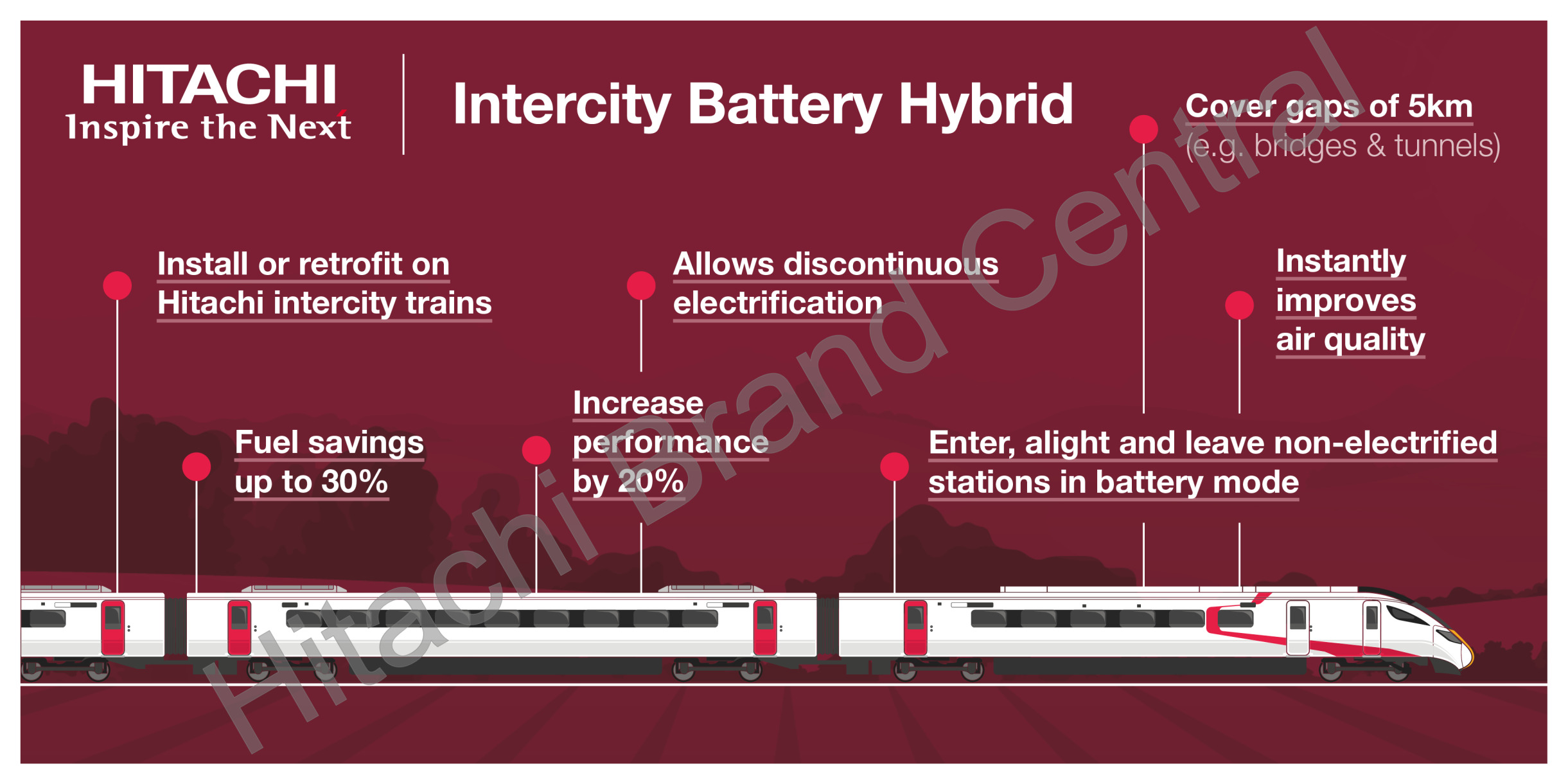
Note that is has a gap-jumping range of 5 km, which would handle the gap between Belper and Duffield stations.
CrossCountry Services Between Derby And Sheffield
CrossCountry operate the following services between Derby and Sheffield through Milford Tunnel and the World Heritage Site.
- Plymouth and Edinburgh Waverley/Glasgow Central
- Southampton/Reading and Newcastle
CrossCountry would need new trains and one of the current Hitachi Class 802 trains could handle this route and use electrification where it exists.
A five kilometre gap will be no big obstacle to designing a battery-electric train for these CrossCountry services.
Freight Trains
In Will Zero-Carbon Freight Trains Be Powered By Battery, Electric Or Hydrogen Locomotives?, I came to this conclusion.
In the title of this post, I asked if freight locomotives of the future would be battery, electric or hydrogen.
I am sure of one thing, which is that all freight locomotives must be able to use electrification and if possible, that means both 25 KVAC overhead and 750 VDC third rail. Electrification will only increase in the future, making it necessary for most if not all locomotives in the future to be able to use it.
I feel there will be both battery-electric and hydrogen-electric locomotives, with the battery-electric locomotives towards the less powerful end.
Hydrogen-electric will certainly dominate at the heavy end.
These locomotives would be able to handle the section of the Midland Main Line through Derwent Valley Mills.
Exploring The Derwent Valley Line
The Derwent Valley Line links Derby with Matlock and because it forms the Southern part of Peak Main Line discussed in Connecting The Powerhouses and it was a fine day, I had to go and take a look.

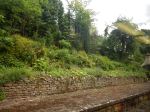
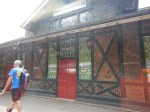
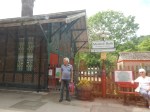
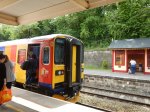

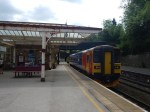


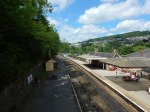

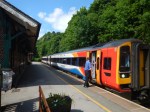
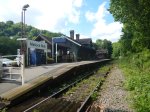
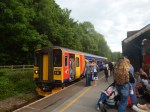
I actually did three trips along sections of the line.
The middle trip was in a totally acceptable two-car Class 158 train, but the other journeys were in jam-packed single-car Class 153 trains.
In the time I was in Derbyshire, I saw three different types of trains working the line and I get the impression, that East Midlands Trains have difficulty putting together a service to both the passengers and their own satisfaction.
Their Regional Routes, which are worked by Sprinters, look to be a collection, that need to be reorganised and probably be worked by more, better and more suitable trains.
Looking at the Derwent Valley Route, which runs trains from Matlock to Newark Castle via Derby and Nottingham, you get the following typical timings.
- Matlock to Derby – 34 minutes
- Derby to Nottingham – 30 minutes
- Nottingham to Newark – 37 minutes
Which makes a total of one hour 41 minutes or a round trip of three and a half hours.
In this schedule these things should be noted.
- There are several mines of running on the Midland Main Line, where my Class 153 attained a respectable 70 mph.
- The train takes a 2 minute break at |Derby and an eight minutes one at Nottingham.
- The other stops are scheduled for a minute or less.
- I saw lots of buggies, children and a couple of wheelchairs, which delayed train boarding.
This all adds up to a round trip of three and a half hours, which is exceeding inconvenient for running an hourly service.
I suspect that any train operator prefers a dedicated number of identical trains to run a service, as East Midlands Trains have on their London services.
But this Derby-Nottingham version of Crossrail has all the structure and organisation of a relegated football teams back four.
Looking at the hour starting at nine o’clock this morning there are just three services between Derby and Nottingham.
- 09:08 – Birmingham New Street to Nottingham
- 09:13 – Matlock to Newark Castle
- 09:40 – Cardiff Central to Nottingham
If this is typical, it is pitiful for a thirty minute journey between two large, important cities. Especially, in the rush-hour.
Suppose the service was doubled between Matlock and Newark Castle.
- This would give four trains per hour between Derby and Nottingham.
- It would give a two trains per hour service to all those stations along the route.
- It would attract many more passengers to that poor Class 153 train.
In my view, there is only one solution to this problem and that is a high-class stopping service between Matlock and Newark Castle.
- Two trains per hour.
- At least two cars in every train.
- Speeding up of the service so trains can do the round trip in three hours.
- Step-free access between train and platform at all stations to speed station stops.
This service would require six trains, which is a problem as East Midlands Trains haven’t got the rolling stock.
It would also mean that a train would have go from Ambergate Junction, where the Derwent Valley Line leaves the Midland Main Line to Matlock and back in under thirty minutes.
As a typical train takes fourteen minutes between Ambergate and Matlock stations, with a bit of judicious sorting of the train-platform interface to speed stops, I’m certain that this would be possible.
So where do East Midlands Trains get six suitable trains of at least two carriages?
- The route could be electrified. Impossible!
- They acquire some cascaded diesel unit like London Overground’s Class 172 trains.
- They acquire six Class 319 Flex trains.
The last one is probably the most realistic, as they are four-car trains with an operating speed of over 90 mph on diesel.
But why would it need the capability to run on 25 KVAC overhead electrification, as there is none near Derby or Nottingham, except on Bombardier’s test track?
So is this one of the reasons, why as I wrote in The Class 319 Flex Units To Be Class 769, Porterbrook are seriously looking at converting Class 455 trains into Flex trains?
After all both Porterbrook and East Midlands Trains are based in Derby.
The Matlock to Newark Castle route would be transformed.
- Two trains per hour.
- Four cars with quality interiors.
- Easier access for all passengers, through wide double doors.
- There could even be modified to give more space for bikes, buggies and wheelchairs.
It would be a real case of Back To The Future, as the Class 455 trains are nearly ten years older than the Class 153 trains.
 The Anonymous Widower