Improving London’s Transport In Small Ways
I feel there are two ways of getting more out of London’s crowded transport system.
The first is the obvious ones of capital projects, which at the top end is Thameslink, Crossrail and Crossrail 2, and at the bottom end it is projects of the order of small numbers of millions, which might include.
- Remodelling major junctions like Archway, Elephant and Castle, Highbury Corner and Old Street.
- Reorganising bus routes around train and Underground stations, with more shelters and better information.
- New and rebuilt stations like Crystal Palace, Deptford and Lea Bridge
- Inclined lifts like that installed at Greenford.
- Step-free access at stations like Clapham Junction, Gospel Oak, Honor Oak Park, New Cross and South Tottenham.
I’m sure that new technology epitomised by the inclined lift at Greenford, will increasingly be seen.
But with any complex system, there is always improvements to be made in small ways.
The recent extension of contactless cards to Gatwick Airport, could be the sort of improvement, that increases ridership on the trains to the airport and is very much a win for the airport, the train companies and passengers alike.
We need more small improvements to London’s transport system to squeeze more capacity and improved efficiency out of the network.
1, London’s Airports And Other Places Should Have Contactless Ticketing
Heathrow, Luton and Southend Airports will join City and Gatwick in coming within London’s contactless ticketing network.
But why stop at just airports?
I feel that within a few years, the following will be within London’s contactless ticketing area.
- Chafford Hundred for the shopping at Lakeside.
- Ebbsfleet International for trains to Europe.
- Greenhithe for the shopping at Bluewater.
- Thorpe Park and other places for the fun!
- Windsor and other places for the tourists!
The benefits to residents, tourists, business and train companies won’t be small.
I suspect that as the contactless ticketing network grows, attractions and towns outside the area, will be enthusiastic to join and might even bribe Transport for London.
2. Buses Should Trial Entry Through All Doors
The bus journey I do most commonly is to get a 38 or 56 bus between my house and the Angel, where I tend to do my food shopping.
The 38 route uses New Routemasters with three doors, all of which can be used for entrance and exit, whereas on the 56 route, standard two door buses are used, where you enter through the front door and exit through the one in the middle.
There is no question that the Routemasters get through a typical stop quicker, as drivers and passengers use their brains to get on and off the bus as fast as possible. However, on the standard buses, threading a push-chair into the middle of the bus can be difficult and time consuming.
I think that an experiment should be trialled, where in perhaps areas, where there are a lot of Routemasters, passengers can board the standard buses from the middle door and touch-in on a convenient reader.
Obviously, it would be open to fraud, which is why an experiment would have to be performed first. But from several years of watching passengers on New Routemasters, I don’t think losses would be substantial. Many a time, I’ve seen passengers collectively stare at another passenger, who didn’t touch in! It’s East London peer pressure at work!
Remember too, that the doom-mongers of the left, felt cashless buses and contactless payments would be a disaster and discriminate against the poor. Try finding an incident, where someone was severely inconvenienced by London’s contactless ticketing system!
3. All Stations Should Indicate The Train Direction
On some stations this is obvious, or can be worked out, as on heavy rail routes, trains drive on the left.
But on many Underground stations, it is not obvious from which direction your train will arrive.
Often regular passengers will know that when going to a specific station, they will need to be in a particular carriage. If I am coming North to Angel on the Northern Line, I want to be in the first or second car, as this saves the effort of walking down the platform.
A simple arrow above the sdverts say, would orient you on the platform.
Hopefully, it would distribute passengers in a better manner along the platform.
4. Some Rail |And Underground Maps Could Be Larger
The standard maps are fine, but over the years, I’ve seen some really large transport maps around the world.
There’s no doubt in my mind that with maps, big is beautiful and the bigger the better.
In many stations there is a large tiled wall, for which no-one has really found a sensible use. Often you’ll come down an escalator into the bowels of an Underground station and face such a wall.
So why not put a really large map there?
It would be out of the way too and if passengers just wanted to stand in front of it and look, no-one would bother.
5. More First Train Indicators At Terminal Stations
Some terminal stations have more than one platform from which stations start their return journeys.
At Walthamstow Central on the Victoria Line, where there are two platforms, an indicator tells you, from which platform the first train will leave.
But at other stations like Stratford on the Overground, it is difficult to ascertain which will be the first train to travel west.
All terminal platforms should be fitted with First Train Indicators.
6. Better On Board Bus Information
London’s buses have a simple display, which gives a selection of the following information.
- The route and the destination.
- The name of the next stop
- Any customer information like delays, strikes or closures.
- The time.
I know the size of the display is limited, but it is poorly arranged and could be much better.
It should also show the five-number code of the next stop, so that passengers changing there could check out their next bus.
7. All Stations Should Have TfL-Standard Rail/Tube, Bus Spider And Walking Maps
When you arrive at a Transport for London (TfL) managed station, you find the following maps prominently displayed.
- The Rail and Tube version of the iconic Underground map.
- A bus spider map for all the routes serving the area.
- A comprehensive walking map.
At most TfL stations, there is increasingly a Legible London lith.
But this is not the case at some stations in London, that are managed directly by railway companies.
All stations should be made to adhere to London’s standards.
8. Below Ground Information Needs To Be Improved
Crossrail will bring some truly labyrinthine stations to London, to add to those difficult to navigate ones like Bank, Green Park, Kings Cross St. Pancras and Waterloo.
Transport for London needs to provide more bus and walking maps on the platforms and in the passageways, so that passengers can find their way to the entrance they need to continue their journey.
9. Rail And Tube Map On All London-Bound Platforms
The need for this was illustrated at Coventry station, where two tourists were asking the Virgin station-man, how to get to Ewell West from Euston. He told me, he had asked for a London Rail and Tube Map for the station, as this would have answered a large proportion of the questions he was asked.
The map could also have full details on how to use London’s contactless ticketing, which should reduce the queues at London terminals.
The only station outside London, I’ve seen such a map is Cardiff Central.
If it’s good enough for Wales, then the map should be displayed in Amsterdam, Brussels, Cologne, Lille, Marseilles and Paris.
Obviously, with information in the correct languages!
10. There Needs To Be More And Better Ticket Machines
Increasingly, I use the Internet less and less to buy tickets for travel out from London, unless it’s a longer journey and I want to reserve a seat.
I get the best Internet price from the latest ticket machines at Dalston Junction station, where I can buy the following tickets.
- Singles and returns, for today or a date in the near future between any two stations in the UK.
- Extension tickets from the Zone 6 boundary to certain stations close to London.
I get the best Internet price, without having to sign-up to be bombarded with spam by the train or ticket company.
The Zone 6 extension tickets are often a big money saver. Recently a return to Woking cost me just £5.15 with my Senior Railcard. The Standard Class Return Ticket costs £14.10, so the saving almost paid for my lunch in Woking.
These ticket machines need to be in a lot more places and not just on the Overground.
11. Ban Diesel Trains As Much As Possible From London
Despite lots of electrification on the lines into and through London, their are still quite a few noisy and smelly diesel trains to be found in London. They fall into the following categories.
- Long-distance trains like those to the West Country, Wales and Scotland.
- Freight trains on through routes, like the North London and Gospel Oak to Barking Lines.
- Commuter services using diesel multiple units.
- Engineering trains haled by diesel locomotives.
I believe that many of these can be replaced by trains hauled by quieter and greener electric traction.
Many residents of London, especially those who live on the feight routes of North London, would back this small improvement.
Conclusion
I have detailed ten small ideas, that might be used to improve London’s transport network.
I think that only the provision of more and better ticket machines will cost serious amounts of money, but from what I see as I travel around London, I suspect it’s already being done.
If I was the London Mayor, I would ask Londoners and regular travellers for simple ideas to improve the network.
Some would be bonkers, some would be so-so, but I believe that some would be brilliant.
I also believe that those good ideas, that were worthwhile implementing, should result in a reward to the proposer.
After all, London’s transport network belongs to London and Londoners, so why shouldn’t they have a say in its design?
The Bermondsey Dive-Under
For some time I’ve been looking for a good article about the Bermondsey dive-under. This article on Ramboll’s web site is a good one. But then I think it was written by one of the designers of the scheme that is currently being built.
Two Solutions To Make Crossing A Railway Safe
On the way to football tonight in Ipswich, I went to have a drink with a friend, who lives near Thurston station on the Ipswich to Ely Line, where there is a good real ale and cyder pub. Crossing the tracks at Thurston is via a simple walk across controlled by traffic lights between the two platforms.


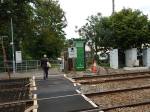
Of all the stations I use regularly, this is the only place where such a system is in use. Unless of course you count the trams at Ampere Road by the Croydon Ikea. A few hundred metres to the west of the station a bridle way and cycle path crosses the railway and Network Rail have built this bridge.


There have been reports like this one in the East Anglian Daily Times, which has a headline of Poll: £1.5m ‘monster’ railway bridge at Thurston is dubbed a ‘total waste of money’
This bridge is an interesting case of what to do where there are gated crossings of railway lines.
I think before being too critical of Network Rail we should bare these points in mind.
1. Suicide
This article on the BBC web site talks of a death at a crossing in the Thurston area. Network Rail get far too many deaths on the railway and it is a sad fact, that stepping in front of a train, is a common method of suicide.
2. The East-West Rail Link
The East-West Rail Link will use this line to get from Ipswich and Felixstowe to Cambridge and Ely. This link will be an electrified 100 mph railway that will run trains between East Anglia and the Midlands and the West. So although the line carries perhaps a couple of trains every hour each way, in perhaps ten years time, this will probably be a few times more. And as the line is pretty straight as the pictures show, the operating speed could be a lot higher.
3, Horses
If you read all the comments about the bridge no-one mentions taking a horse over the railway.
Horses are flight animals and if spooked will run fast away from the perceived danger.
Many horses too, don’t like going under high-voltage cables. Whether it is because they can sense the magnetic field generated by the electricity or they don’t like the whistling sound,I don’t know. But if the crossing is going to be used by horses, it will have to be of the size it has been built.
I’m not sure, but I think this is the only way to get a horse from one side of the railway to the other, unless you go all the way and go under the bridge by Thurston station.
4. Getting The Design Right
This bridge illustrates that getting the design right and satisfying all users and critics who never use the bridge is an almost impossible task.
Aesthetically, I don’t like the bridge, but unless they dig a subway under the railway, there is nothing else that can be done to satisfy all users and critics of the design.
Note that when the railway is upgraded to be part of the East-West Rail Link, Thurston station will have to be rebuilt and I suspect it will have a bridge over the railway, probably with lifts and a price tag well upwards of £2million.
There will be some serious discussions.
A Typical Annoying Problem Of Living Alone
I want to fit a grab rail in my bathroom and these pictures show the position and the rail.

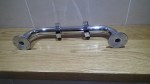
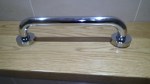

I want to put it at an angle so that I can pull myself upright safely to get out of the bath.
The first problem is positioning it in the right place. The easiest way is to lie in the empty bath whilst someone else holds it tightly to the wall.
The second problem is that the tiles are very hard to drill, so I intend to use a strong epoxy to glue the grab rail to the wall.
Mixing the epoxy and getting it in the right position is definitely a job for at least three hands.
Perhaps we need a Rent-A-Hand Agency, where someone can help you out on a barter or mutual basis.
Where is my late wife, when you desperately need her?
The First Two Shelves For My Vertical Garden
They might not look like that as they sit amongst the builders rubbish in my garage, but I’m getting ready to start assembling my vertical garden.
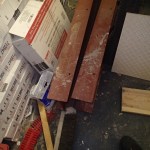
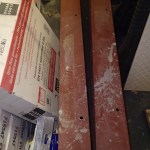

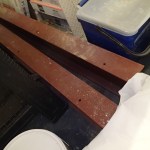
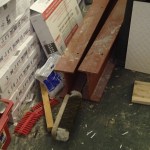
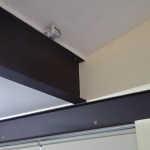




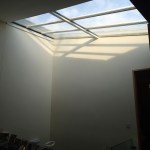
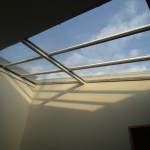
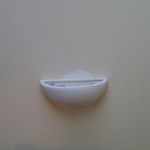
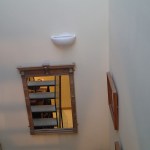
The pictures show the steel beams in their primed state, some of the beams in my house with their dark chocolate paint and brass bolts, and the large expanse of wall with the glazed roof above.
I’ve put the lights in the pictures, as I have masses of lights in this house I don’t like.
Ever since I moved here, I’ve searched for something better, but all I see is expensive crap more suitable for an Algerian brothel or an Arab’s palace in Mayfair.
So what if I got a length of steel beam about 600 mm long, painted it chocolate and bolted it to the wall with brass bolts. On top could be some LED ropelights and their driver. I could also put ornaments or flowers at each end of the light. I would use IP65 components, so that it didn’t matter if they got wet.
Someone actually pointed out to me that orchids don’t need watering.
I reckon each light would cost about a hundred quid and if I didn’t like the colour, I’d just change the flowers.,
Isn’t designing gardens in the air fun?
It’s Not About The Wheelchairs
First Bus are probably delighted that they have won the court case about whether wheelchair users have priority over babies in buggies. This is the first paragraph in the BBC web report.
Bus companies are not required by law to force parents with buggies to make way for wheelchair users in designated bays on vehicles, senior judges ruled.
I travel regularly on London’s extensive bus network. A couple of years ago, there was a wheelchair bay full of buggies and a lady in a wheelchair wanted to board. On London buses, the wheelchair bay is opposite the middle door, which is the one with the automatic ramp. So the driver asked if the bay could be cleared, as he lowered the ramp. One lady took her buggy down the ramp and another folded hers and passengers made sure they had one of the spacious double seats by the middle door. The lady in the wheelchair then pushed herself into the space and as there was enough space the first buggy was able to be squeezed in too!
It had all been a sensible dance up and down the ramp and the bus was fairly quickly on its way, after an amicable confrontation.
On new Routemasters, with their bigger space by the door, better layout and completely flat floor, I’ve never seen anything other than minor problems.
Compare London with what happened at Reading when I went to see Ipswich play in August.
Returning from the Madejsky stadium after the match, there was a long queue for the buses. In front of me in the queue was a guy in a wheelchair. As the downstairs of the almost brand-new double-decker was full, with at least ten standing in the wheelchair space, to get the wheelchair rider on the bus, meant virtually unloading the bus and starting again. A lot of fans were not happy.
If the bus had had a central door and wheelchair ramp, what took perhaps well over five minutes, would have been much easier and probably a lot quicker.
Given all the other advantages with two or more entrance buses, like faster loading and unloading and a possible reduction in the number of attacks on staff, isn’t it about time that all the city bus services of the UK, were made to follow London.
How about adding talking buses, bus maps understandable to everybody and cash ticketing to bring the rest of the country into the twenty-first century?
Return From Stratford Parkway Station
Because I thought time was short, I decided to take a taxi to Stratford upon Avon Parkway station to come home.
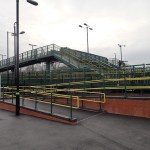
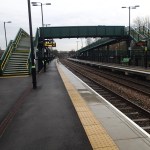
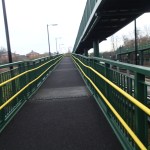
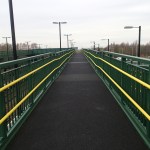

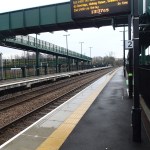
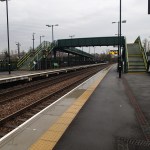
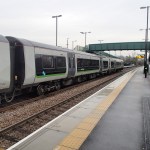
But somewhere I’d got the time wrong and had to wait an hour for my train, in a cold, unwelcoming station without a toilet. And then when I did get on the train, the main toilet was broken!
It is certainly a station that was built down to a cost, that would be unlikely to win any architectural awards.
There should be a rethink about how this station operates.
Are The Hackney Flyers The World’s First Bus-Trams?
With the publication of Boris Johnson’s vision of transport in London in 2050 , it would seem that we have the vision of transport sorted. The report’s plans for rail are detailed here in Modern Railways. Here’s a flavour.
The draft includes plans to maximise capacity of and extend Tube services, and approve Crossrail 2. ‘Further Crossrail projects may be required’ – an east-west alignment is mentioned, but with no specific proposals at this stage. Working with Network Rail, there is also huge opportunity to double capacity on the capital’s rail network, says the plan, and upgrades to main radial routes are outlined.
But all the reports and commentators seem to miss, the quiet revolution that is taking place in Hackney and several other places in London.
The most common journey I do, is get a bus from just round the corner from my house to the Angel or perhaps further. I have a choice of three buses to the Angel; the 30, 38 or 56.
When I moved here four years ago, the service wasn’t bad, but I often had to wait what seemed to be a few minutes.
A few months ago, the route 38 was converted to brand-new Routemasters and now everybody seems to choose one of these Thomas Heatherwick-designed buses if you have a choice, if say a 56 and a 38 arrive together.
Perhaps it’s because they get to the Angel faster, which they seem to do. Not that I’ve measured it! It may be just a perception. But they are definitely more comfortable and better if you’ve got shopping or parcels with you.
All buses have improved further since buses went cashless, as no longer does the driver wait whilst he sorts out passengers with cash.
The Transport Plan does mention buses, but only briefly.
However, after the experience here in Hackney, is London doing enough to use the humble bus to ease London’s transport problems?
I believe for instance, that if say you were thinking of running a tram between say Kings Cross and Elephant and Castle, you could create a dedicated bus lane and run a squadron of two-man operatord Routemasters on the route!
It would be more affordable than the tram and if say you got the route slightly wrong, all you’d need to do would be to move a few kerbs and white lines and tell the drivers about the new route. There would of course, be no construction chaos, like they had in Edinburgh.
If say you replace the route with an Underground line, the buses just get redeployed and you remove the road markings.
So did Thomas Heatherwick design the Hackney Flyer or the world’s first bus-tram?
I Wonder What The Duke Thought Of It!
Glasgow has got past the first hurdle, by opening the Commonwealth Games without any obvious hitches.
It will be interesting to see how the Duke of Edinburgh rates the ceremony amongst the dross, he has watched in his lifetime.
I would rate it fairly high up the scale, but Glasgow had two big advantages over say the Olympics in Beijing or Athens.
All the proceedings were done in a language that we and most of the spectators understand perfectly.
But perhaps more importantly, Glasgow had one of the first uses of a 96m. wide video screen, which meant instead of training masses of drummers, dancers and musicians, you just set some good programmers and video editors to work to weave some magic. You then prayed that you didn’t get a blue screen of death like Beijing did in 2008.
Perhaps it was just to save money on costumes and performers, but Glasgow kept it simple and colourful. Which worked!
But will Rio do the same for the 2016 Olympics? I hope so.
They’ll certainly use the screen or perhaps two! Without doubt it was impressive technology.
Redesigning The Ugly
There are lots of everyday common blots on the landscape, that are just downright ugly.
Take the electricity pylon. In all my years of travelling, I’ve never seen any that could be described as beautiful. If we didn’t want them to spoil the landscape, we’d bury them, as happens in most towns and cities.
However, there was a competition a few years ago with a £5,000 prize to find a better pylon. It’s all described in this report.
I’ve not seen any better ones yet!
So now it is time for the designers to look at the overhead lines used on railway lines. The thoughts and ideas are detailed here.
How many everyday objects can be improved by better design and materials?
 The Anonymous Widower