Norway’s Sovereign Wealth Fund Acquires Stake In 573 MW Race Bank Offshore Wind Farm
The title of this post, is the same as that of this article on offshoreWIND.biz.
This is the sub-heading.
A consortium made up of investment funds belonging to Australia-headquartered Macquarie Asset Management and Spring Infrastructure Capital has reached an agreement to divest a 37.5 per cent stake in the 573 MW Race Bank offshore wind farm in the UK to Norges Bank Investment Management.
These four paragraphs give more details of the deal.
The stake was sold to the Norwegian sovereign wealth fund for approximately GBP 330 million (about EUR 390.6 million).
According to Norges Bank Investment Management, the fund acquired Macquarie European Infrastructure Fund 5’s 25 per cent stake and Spring Infrastructure 1 Investment Limited Partnership’s 12.5 per cent interest in the Race Bank offshore wind farm.
A Macquarie Capital and Macquarie European Infrastructure Fund 5 consortium acquired a 50 per cent stake in Race Bank during the construction phase in 2016. Macquarie Capital divested its 25 per cent stake in the wind farm in 2017.
With the deal, Arjun Infrastructure Partners will remain co-investor for 12.5 per cent of the wind farm and Ørsted will remain a 50 per cent owner and operator of Race Bank.
These are my thoughts.
The Location of Race Bank Wind Farm
This map from the Outer Dowsing Web Site, shows Race Bank and all the other wind farms off the South Yorkshire, Lincolnshire and Norfolk coasts.
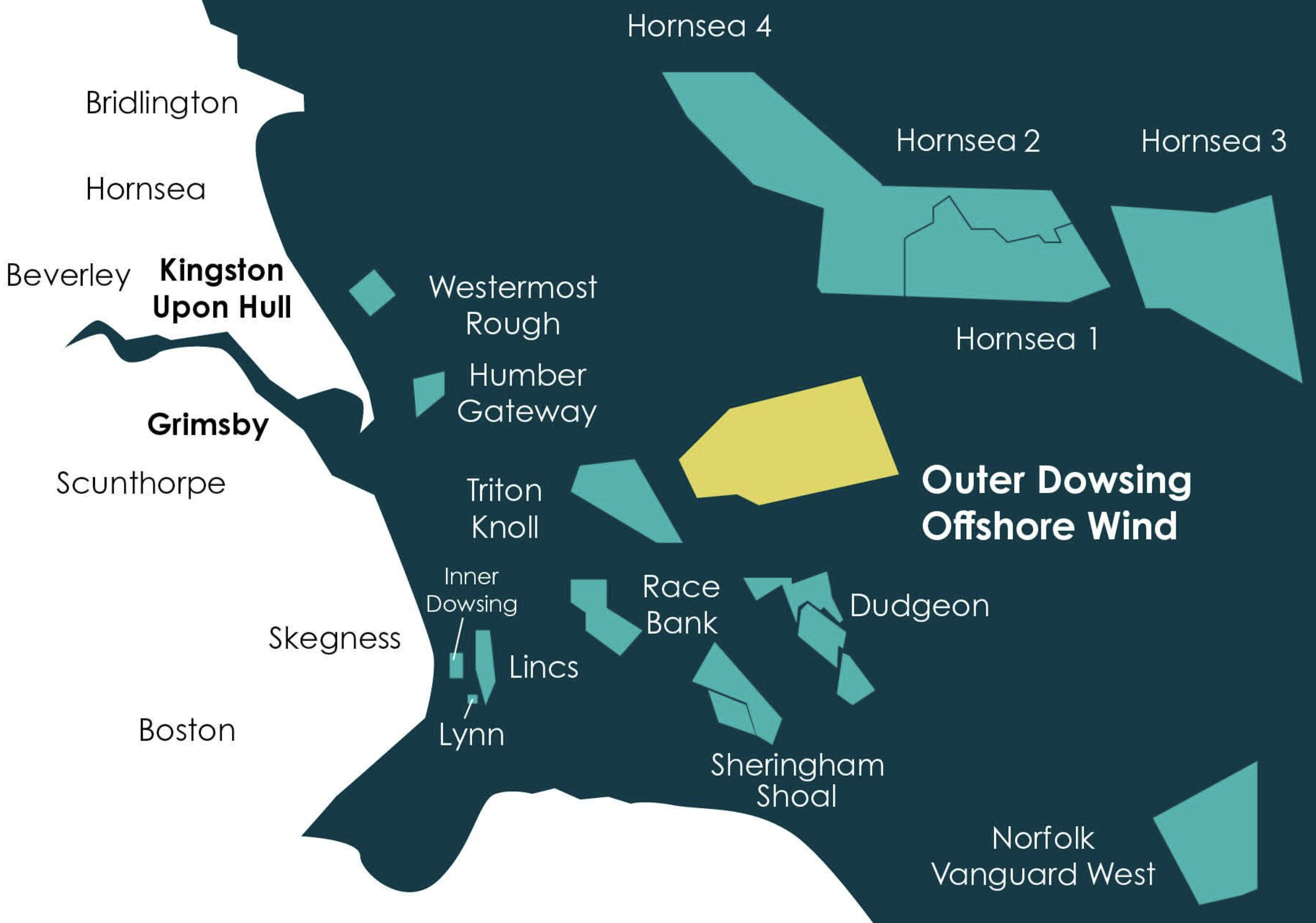
From North to South, wind farm sizes and owners are as follows.
- Hornsea 1 – 1218 MW – Ørsted, Global Infrastructure Partners
- Hornsea 2 – 1386 MW – Ørsted,Global Infrastructure Partners
- Hornsea 3 – 2852 MW – Ørsted
- Hornsea 4 – 2600 MW – Ørsted
- Westernmost Rough – 210 MW – Ørsted and Partners
- Humber Gateway – 219 MW – E.ON
- Triton Knoll – 857 MW – RWE
- Outer Dowsing – 1500 MW – Corio Generation, TotalEnergies
- Race Bank – 573 MW – Ørsted,
- Dudgeon – 402 MW – Equinor, Statkraft
- Lincs – 270 MW – Centrica, Siemens, Ørsted
- Lynn and Inner Dowsing – 194 MW – Centrica, TCW
- Sheringham Shoal – 317 MW – Equinor, Statkraft
- Norfolk Vanguard West – 1380 MW – RWE
Note.
- There is certainly a large amount of wind power on the map.
- Hornsea 1, 2 and 3 supply Humberside.
- Hornsea 4 will supply Norwich and North Norfolk.
- Norfolk Vanguard West would probably act with the other two wind farms in RWE’ Norfolk cluster.
- Ignoring Hornsea and Norfolk Vanguard West gives a total around 4.5 GW.
- There are also two 2 GW interconnectors to Scotland (Eastern Green Link 3 and Eastern Green Link 4) and the 1.4 GW Viking Link to Denmark.
I wouldn’t be surprised to see a large offshore electrolyser being built in the East Lincolnshire/West Norfolk area.
The primary purpose would be to mop up any spare wind electricity to avoid curtailing the wind turbines.
The hydrogen would have these uses.
- Provide hydrogen for small, backup and peaker power stations.
- Provide hydrogen for local industry, transport and agriculture,
- Provide hydrogen for off-gas-grid heating.
- Provide methanol for coastal shipping.
Any spare hydrogen would be exported by coastal tanker to Germany to feed H2ercules.
Do We Need Wind-Driven Hydrogen Electrolysers About Every Fifty Miles Or so Along The Coast?
I can certainly see a string along the East Coast between Humberside and Kent.
- Humberside – Being planned by SSE
- East Lincolnshire/West Norfolk – See above
- North-East Norfolk – See RWE Goes For An Additional 10 GW Of Offshore Wind In UK Waters In 2030.
- Dogger Bank – See RWE Goes For An Additional 10 GW Of Offshore Wind In UK Waters In 2030.
- Sizewell – See Sizewell C And Hydrogen.
- Herne Bay – Under construction
I can see others at possibly Freeport East and London Gateway.
Reform UK leader Richard Tice To Stand In Boston And Skegness
The title of this post, is the same as that of this article on the BBC,
This is the sub-heading.
The leader of Reform UK has announced he is to stand as a candidate in Boston and Skegness at the general election.
Anr this is the first paragraph.
Richard Tice announced his intention to stand in the Lincolnshire constituency on social media on Thursday morning.
This article on The Times is entitled What are Reform UK’s Policies — And How Is The Party Polling?
The article has these two paragraphs on energy, decarbonisation and net-zero.
Energy and net zero is another major area of focus. Tice has referred to net zero as “net stupid” and wants to accelerate the granting of oil and gas licences in the North Sea.
Reform has said all existing carbon emissions targets should be abandoned, due to what it says is an unfair burden being placed on taxpayers and consumers.
I shall do some arithmetic to give a few pointers to the constituency he hopes to win.
The Boston and Skegness constituency is a large green energy hub, where in a few years electricity from various source will be collected for distribution to East Anglia and the South of England.
Currently, in operation, under construction or in planning, are the following sources of green electricity.
- Viking Link is a 1.4 GW interconnector between Bicker Fen in Lincolnshire and Denmark.
- EGL3 is a 2 GW interconnector between Lincolnshire and Peterhead in Scotland.
- EGL4 is a 2 GW interconnector between Lincolnshire and Westfield in Scotland.
- Lincs is a 270 MW wind farm.
- Lynn and Inner Dowsing is a 194 MW wind farm.
- Outer Dowsing is a 1500 MW wind farm.
- Triton Knoll is a 857 MW wind farm.
- Race Bank is a 573 MW wind farm.
Note.
- The three interconnectors can send electricity in both directions.
- The wind farms are in North-South order.
- There would appear to be space in the sea for more wind farms.
- The 950 MW Spalding gas-fired power station is available locally, when the wind is on strike.
- The owners of Spalding power station are rumoured to be putting a large battery alongside the power station.
The totals are as follows.
- 1.4 GW – Interconnector to Denmark
- 4 GW – Interconnector to Scotland
- 3.4 GW – Wind farms
- 1 GW – Gas-fired power station.
These total up to 9.8 GW of power.
Conclusion
Consider.
- It would appear that Richard Tice of Reform UK, has decided to stand in a constancy with one of the highest levels of green energy and energy security in the UK.
- It is also likely to be a constituency, which in the future will benefit from investment and employment, as more wind farms are developed in the North Sea.
It looks to me, that he’s a politician with very little mathematical ability.
Ørsted, Simply Blue, Subsea7 Submit Application For 100 MW Scottish Floating Wind Farm
The title of this post, is the same as that of this article on offshoreWIND.biz.
This is the sub-heading.
Ørsted, Simply Blue Group and Subsea7, through their joint venture partnership in Scotland, have submitted an offshore consent application for the proposed 100 MW Salamander floating offshore wind farm, one of the 13 projects selected in Scotland’s Innovation and Targeted Oil and Gas (INTOG) leasing round.
The article starts with a map that shows the location of the Salamander floating offshore wind farm and it shows how the sea is getting very crowded 35 kilometres off Peterhead.
This map shows the various ScotWind leases, around the North of Scotland.

The numbers are Scotwind’s lease number in their documents.
These are the Scotwind wind farms to the North-East of Scotland.
- 1 – BP Alternative Energy Investments – 859 km² – 2.9 GW – Fixed
- 2 – SSE Renewables – 859 km² – 2.6 GW – Floating
- 3 – Falck Renewables Wind – 280 km² – 1.2 GW – Floating
- 4 – Shell – 860 km² – 2.0 GW – Floating
- 5 – Vattenfall – 200 km² – 0.8 GW – Floating
- 6 – DEME – 187 km² – 1.0 GW – Fixed
- 9 – Ocean Winds – 429 km² – 1.0 GW – Fixed
- 10 – Falck Renewables Wind – 134 km² – 0.5 GW – Floating
- 11 – Scottish Power Renewables – 684 km² – 3.0 GW – Floating
- 12 – BayWa r.e. UK – 330 km² – 1.0 GW – Floating
Note.
- Salamander is located to the South of wind farms 10, 11 and 12 and to the North-West of wind farm 5.
- These windfarms total up to 16 GW.
- 4.9 GW are fixed foundation wind farms.
- 11.1 GW are floating wind farms.
These are my thoughts.
The Salamander Project
In the big scheme of things, the 100 MW Salamander wind farm, is rather a tiddler of a wind farm.
On the Salamander wind farm web site, a section gives the Project Goals.
- Our innovative pre-commercial stepping-stone concept will use novel floating foundations to (i) maximise Scottish content, (ii) enable the Scottish supply chain to gear up for the future floating offshore wind commercial opportunities in ScotWind and (iii) reduce the financial, environmental and technology risks of floating offshore wind.
- The Salamander project will contribute to the Scottish Government and UK Government net-zero targets. The project can contribute to the Scottish government’s target of 11 GW of installed offshore wind by 2030, as well as the UK government’s target of 5 GW of operational floating offshore wind by the same date.
- We are dedicated to developing a sustainable and transformative project, working with the oceans, and enabling communities to benefit from Project Salamander. Therefore, we commit to having a continuous and strong stakeholder and community engagement.
It appears to me, that the Salamander project will be a pathfinder for the 11.1 GW of floating wind farms to be built off Peterhead.
Bringing The Electricity South
National Grid are building four interconnectors between Eastern Scotland and Eastern England.
- Eastern Green Link 1 – Torness and Hawthorn Pit
- Eastern Green Link 2 – Peterhead and Drax
- Eastern Green Link 3 – Westfield and Lincolnshire
- Eastern Green Link 4 – Peterhead and Lincolnshire
Note.
- All interconnectors are 2 GW.
- All interconnectors are offshore for a long part of their route.
- It also appears that National Grid are burying much of the onshore sections.
But the 4 GW of interconnectors will only be able to bring a quarter of the offshore electricity generated in the Peterhead area to the South.
What Will Happen To The Excess Electricity?
Consider.
- There could be 16 GW of planned offshore wind power around Peterhead and North-East Scotland.
- There is only 4 GW of interconnector capacity between Peterhead and Eastern England.
- There is another 6.8 GW of electricity around North-West Scotland.
- There is 2.8 GW of electricity being developed to the East of Shetland.
- The Crown Estate is thinking of increasing the size of some offshore wind farms.
It is likely, that other wind farms will be built in the seas around the North of Scotland.
It appears that the North of Scotland could have at least 20 GW of excess electricity.
Possible solutions would include.
- Developing energy intensive industries like metal refining.
- More interconnectors to Denmark, England, Ireland and Norway.
- Storage of the electricity in giant pumped storage hydroelectric power stations.
- Creation of green hydrogen for export.
Note.
- Aluminium refining has been developed in the North of Scotland before.
- More interconnectors are a possibility, especially as Scotland is developing cable manufacturing capacity.
- Some maps show extra interconnectors between West Scotland and Merseyside.
- At least 70 GWh of pumped storage hydroelectric power stations are being developed along the Great Glen.
- I suspect that the pumped storage hydroelectric power stations could be connected to the wind farms, by cables under the waters of Loch Ness.
But surely, production of green hydrogen for export would be a very good way to go.
- Extra electrolysers could be added as required.
- Because of the interconnectors down both East and West Coasts, electrolysers could be built in England, where there is a large need for hydrogen.
- Hydrogen would be exported initially by tanker ships.
- At some point in the future, it might be viable to build a hydrogen pipeline to connect to the growing European hydrogen network.
The giant pumped storage hydroelectric power stations and the hydrogen electrolysers would be sized to make sure, that no wind power is never wasted.
Conclusion
The 100 MW Salamander floating wind farm may only be small, but it will prove the technology, the manufacturing and the supply chains, so that Scotland can have a second energy boom from the North Sea.
But this boom will certainly last longer than a hundred years.
National Grid Shares Proposals For Green Electricity Projects In Lincolnshire And West Norfolk, Needed To Boost Home-Grown Energy Supplies And Progress Towards Net Zero
The title of this post, is the same as that of this press release from National Grid.
These four bullet points, act as sub-headings.
- National Grid is inviting communities in East Lindsey, Boston and South Holland in Lincolnshire, and King’s Lynn and West Norfolk, to view proposals for two new primarily offshore electricity infrastructure projects.
- National Grid will consult communities from 23 April – 17 June to introduce the proposed project and ask for local peoples’ opinions.
- Eastern Green Link 3 (EGL 3) and Eastern Green Link 4 (EGL 4) will be able to transport enough clean energy generated in Scotland to power up to four million homes in the Midlands and South of England.
- The projects form part of The Great Grid Upgrade, the largest overhaul of the grid in generations, with new infrastructure across England and Wales helping the UK to meet its net zero ambitions, reduce its reliance on fossil fuels and contribute to lower energy bills over the long-term.
These five paragraphs outline the two projects.
National Grid is inviting communities to comment on early proposals for two green electricity infrastructure projects which will help deliver the UK’s energy security strategy and net zero targets.
The eight-week initial consultation, which begins on 23 April, shares proposals for Eastern Green Link 3 (EGL 3) and Eastern Green Link 4 (EGL 4) projects – two new, primarily subsea high voltage direct current (HVDC) electricity links, with associated infrastructure, between Scotland and England.
National Grid Electricity Transmission (NGET) is jointly developing EGL 3 with SSEN Transmission (SSEN) and EGL 4 with SP Energy Networks (SPEN).
EGL 3 would run from Peterhead, Aberdeenshire, under the North Sea via marine cables to a potential landfall location on the Lincolnshire coastline, either at Theddlethorpe or Anderby Creek. EGL 4 would run from Westfield, Fife, also via marine cables under the North Sea to the same landfall location as EGL 3.
After making landfall, both projects’ cables will run underground for approximately 100km to two proposed converter stations in the Walpole, King’s Lynn and West Norfolk, area. Underground cables would then connect the converter stations to the transmission network via a new proposed substation, also within the Walpole area.
Note.
- These would appear to be early proposals.
- National Grid appear to be planning and consulting on two interconnectors at once.
- There would appear to be a lot of underground cable on land. But then the cables will be dug into good Fenland soil.
- All the electrical gubbins seem to be in the Walpole area.
These paragraphs invite people to comment.
Throughout our initial consultation, we are holding a series of face-to-face events to consult on the electrical infrastructure required in England.
Our consultation events are being held across the project area. Information about our proposals will be on display and copies of maps and technical documents will be available to view. Members of the project team will be available to talk through our proposals and answer any questions.
National Grid have also announced dates of when public information events are being held.
- Tuesday 30 April 2024 – 2pm-7pm – Dunes Complex, Central Promenade, Mablethorpe, LN12 1RG
- Wednesday 1 May 2024 – 2pm-7pm – Anderby Village Hall, Sea Road, Anderby, Skegness, PE24 5YD
- Thursday 9 May 2024 – 12:30pm – 6pm – Alford Corn Exchange, 9 Market Place, Alford, LN13 9EB
- Monday 13 May 2024 – 2pm-7pm – Leverington Village Hall, Gorefield Rd, Leverington, Wisbech, PE13 5AT
- Wednesday 15 May 2024 – 2pm-7pm – Eastville, Midville and New Leake Village Hall, Station Rd, Eastville, PE22 8LS
- Thursday 16 May 2024 – 2pm-7pm – Poachers Country Hotel, Swineshead Road, Kirton Holme, PE20 1SQ
- Monday 20 May 2024 – 2pm-7pm – Walpole Community Centre, Summer Close, Walpole St Andrew, PE14 7JW
- Wednesday 29 May 2024 – 2pm-7pm – The Holbeach Hub, Boston Rd South, Holbeach, PE12 7LR
- Wednesday 5 June 2024 – 2pm-7pm – Burgh le Marsh Village Hall, Jacksons Lane, Burgh le Marsh, Skegness, PE24 5LA
I would have hoped, that some of the venues would have been easier to get to by public transport.
I have some thoughts and observations.
What Will Be The Capacity Of Green Link 3 And Green Link 4?
I can find references to the capacity of Eastern Green Links 1-4 and it appears that all four have a capacity of 2 GW.
A Map Of Green Link 3 And Green Link 4
I have found this map of Green Link 3 and Green Link 4.

National Grid are going to be busy, as they’re also building Green Link 1 and Green Link 2.
Will Green Link 3 And Green Link 4 Share A Route Between The Coast And Walpole?
There is only one green HVDC onshore cable on the map. But surely laying two 2 GW cables in the same trench will cost less, than digging two cable routes.
Looking at the three converter stations would appear to confirm that Green Link 3 and Green Link 4 share a route.
Will Landfall Be At Theddlethorpe Or Anderby Creek?
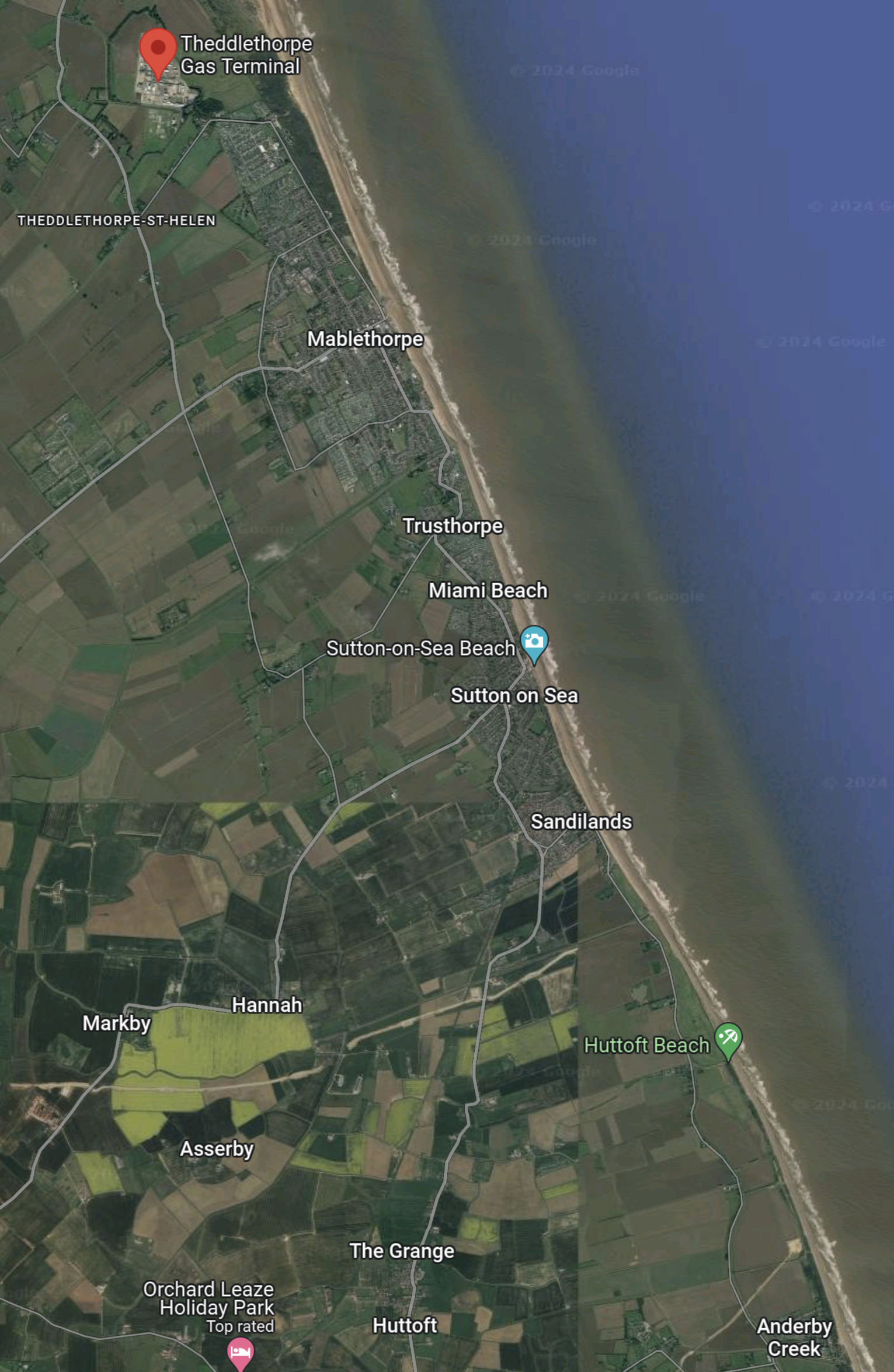
This Google Map shows the coast between Theddlethorpe and Anderby Creek.
Note.
- The decommissioned Theddlethorpe gas terminal is indicated by the red arrow.
- The seaside resort of Mablethorpe lies between the two possible landing sites.
- Anderby Creek is in the South-East corner of the map.
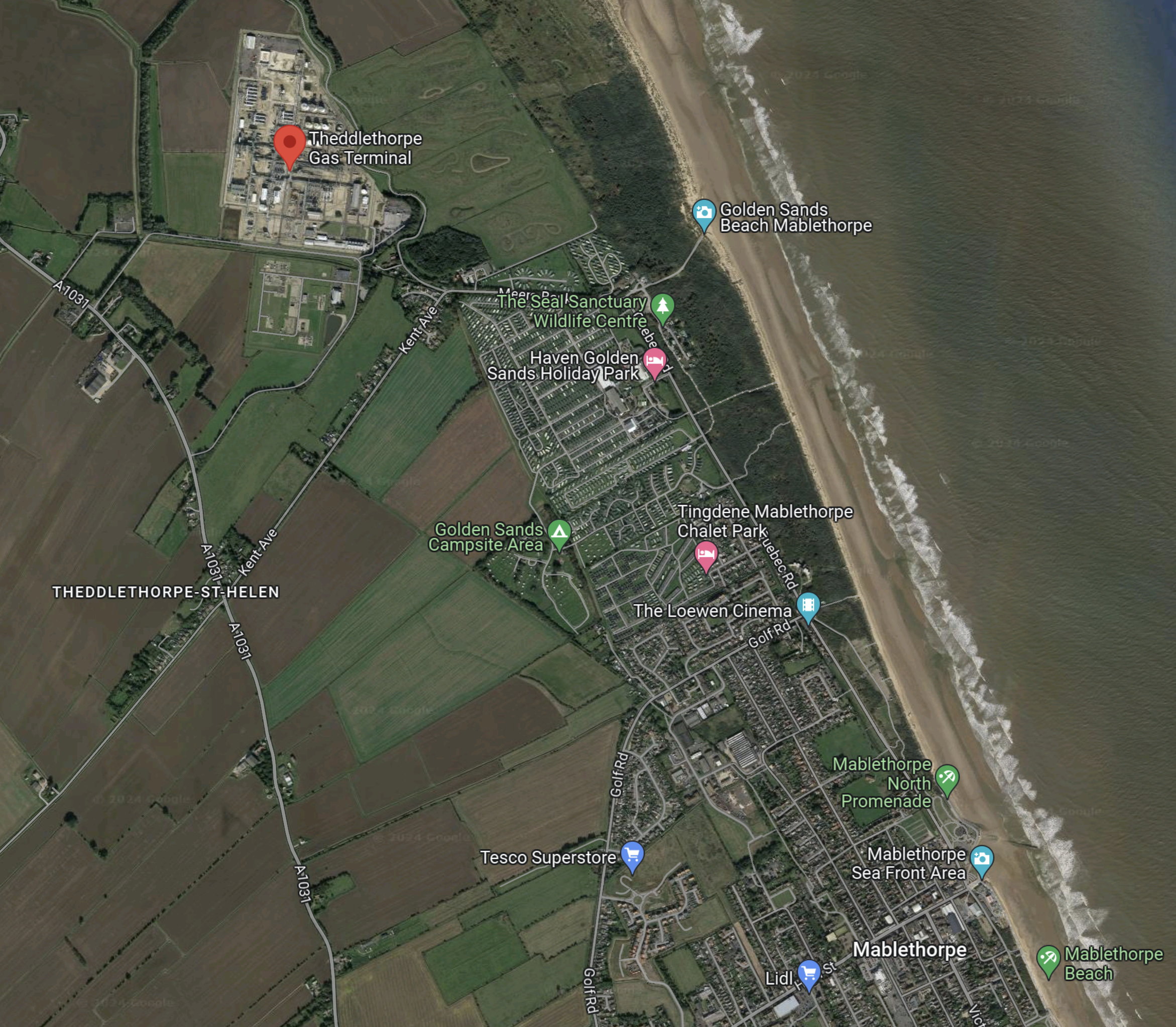
This second Google Map shows the Theddlethorpe Gas Terminal and the North of Mablethorpe.
Note.
- The decommissioned Theddlethorpe gas terminal is indicated by the red arrow.
- Mablethorpe beach appears to be on a high quality.
Both sites would appear to be strong possibilities.
Both sites have plenty of space, but the Theddlethorpe gas terminal is a large brownfield site.
The Anderby Creek site would probably be a shorter underground cable across Lincolnshire.
The Triton Knoll Wind Farm
The Wikipedia entry for the Triton Knoll wind farm starts with these two paragraphs.
Triton Knoll Wind Farm is an 857 MW round 2 offshore wind farm 33 kilometres (21 mi) off the coast of Lincolnshire, in the North Sea, England.
RWE Npower Renewables were awarded the lease to the development area in 2003. The offshore elements of the wind farm of up to 1200MW power gained planning consent in 2013; RWE reduced the scope of the wind farm to 900MW or under in 2014, to reduce cost per MW.
Note.
- The wind farm was commissioned in January 2022.
- The wind farm cables make landfall at Anderby Creek.
- They then travel underground to Bicker Fen substation.
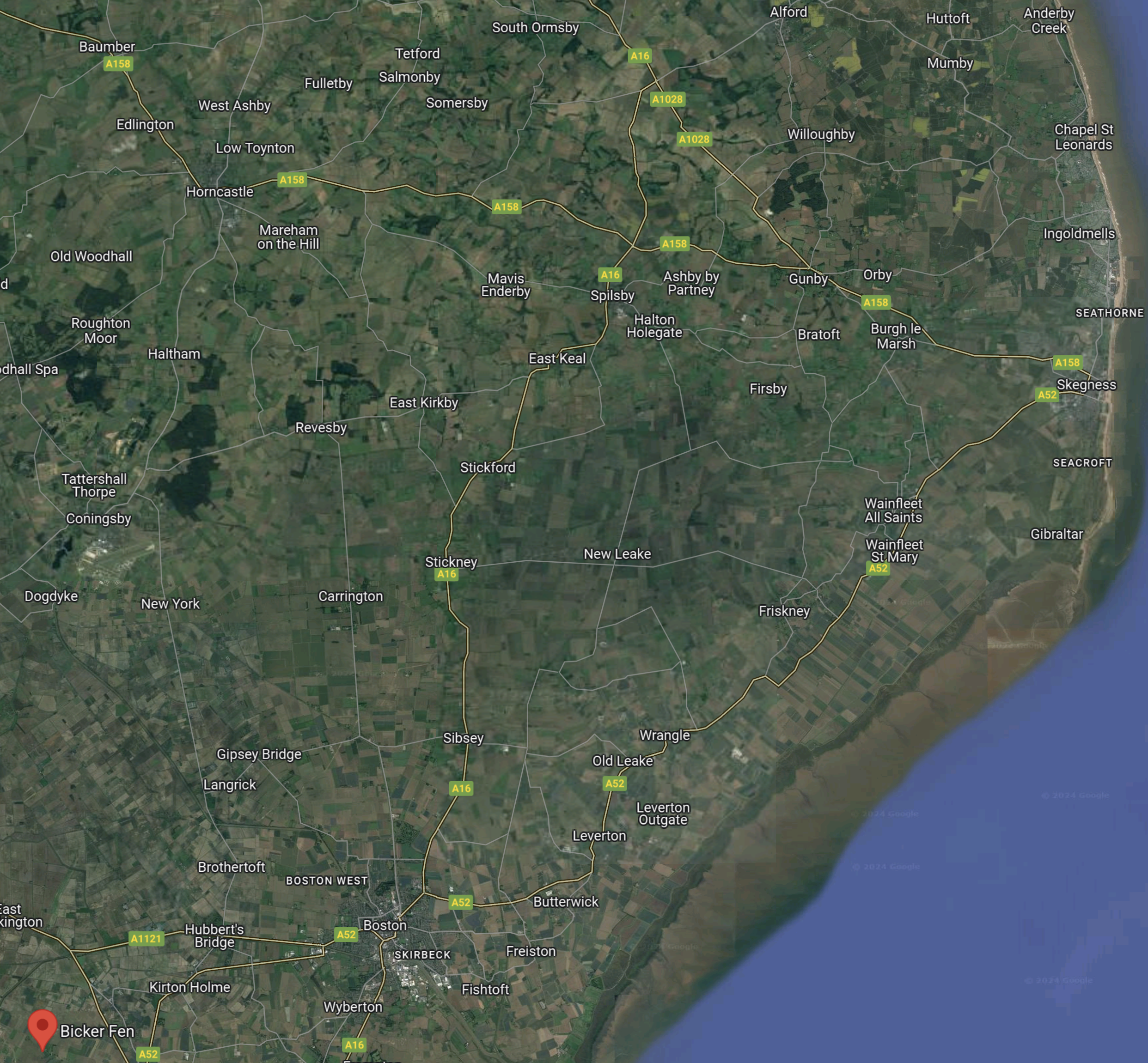
This Google Map shows Bicker Fen and Anderby Creek.
Note.
- Bicker Fen substation is in the South-West corner of the map and is indicated by a red arrow.
- Anderby Creek is in the North-East corner of the map.
- The cable is underground.
- This page on the Murphy Group website, describes the work the company did to install the cables.
- It appears from the Murphy document, that there are six cables between Anderby Creek and Bicker Fen.
This Google Map shows Anderby Creek.
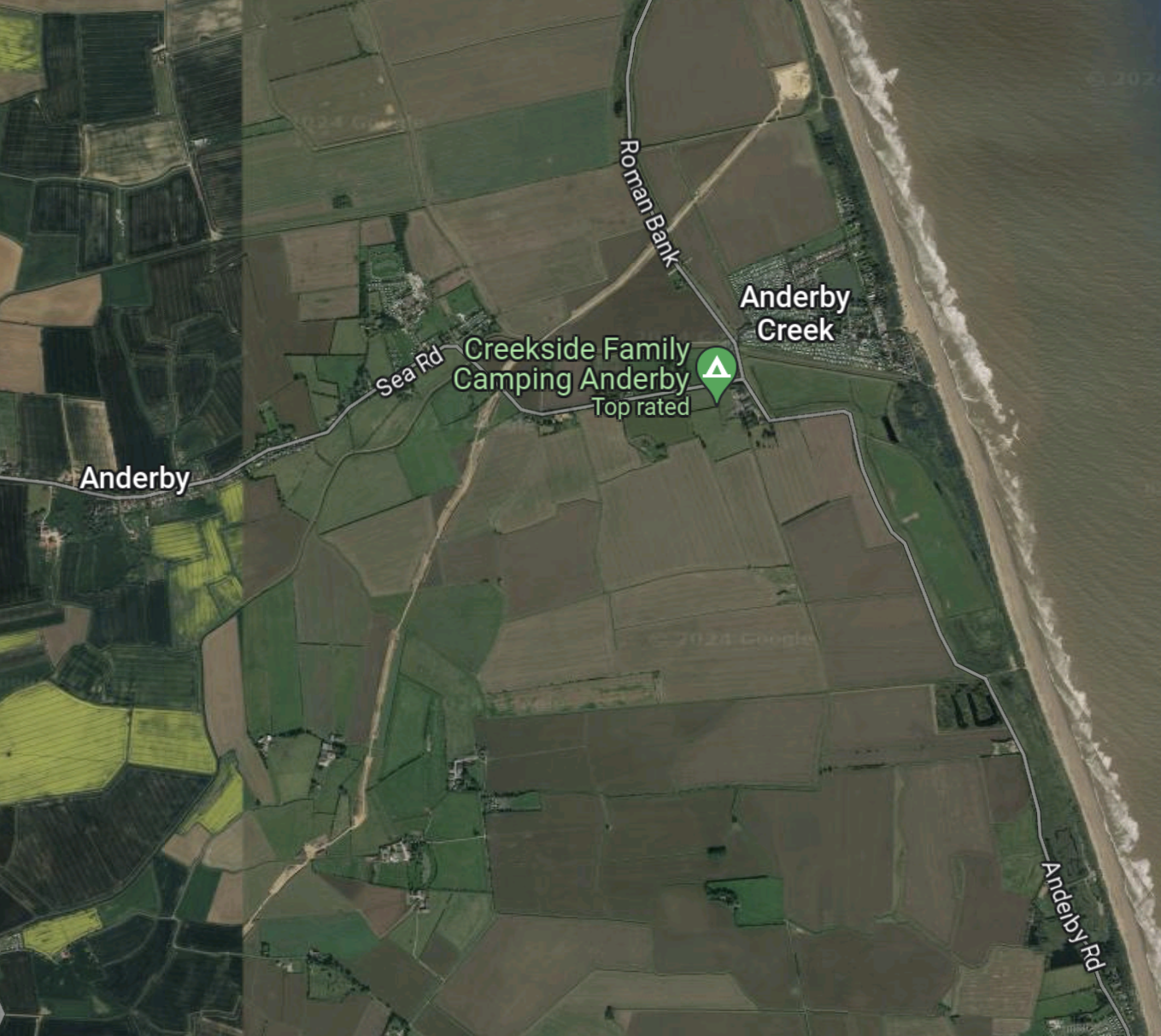
Could the scar across the land to the West of Anderby Creek, be the connection to the offshore Triton Knoll wind farm?
I think it is! And I also think that it can carry more than just the 857 MW Triton Knoll wind farm!
I am suspicious, that one of Baldrick’s ancestors has been at work and the Triton Knoll export cable system could be used to connect Green Link 3 and Green Link 4 to Bicker Fen and Walpole substations.
This would surely allow Scottish wind power to be sold to Denmark and then sold onward to Germany.
The VikingCCS Project
The VikingCCS project is a carbon capture and storage project, that is proposed to be based at the decommissioned Theddlethorpe gas terminal.
The VikingCCS project has a web site.
Would the use of the Theddlethorpe gas terminal mean that it is more likely that Green Link 3 and Green Link 4 will make a Southern landfall at Anderby Creek?
Will There Be A Connection To Viking Link?
The Viking Link is a 1400 MW at 525 KV electricity interconnector between Bicker Fen in Lincolnshire and Revsing in Jutland, Denmark.
This Google Map, shows the location of Bicker Fen, about halfway between Boston and Sleaford.

This second map shows the position of the current Walpole substation with respect to the Wash.
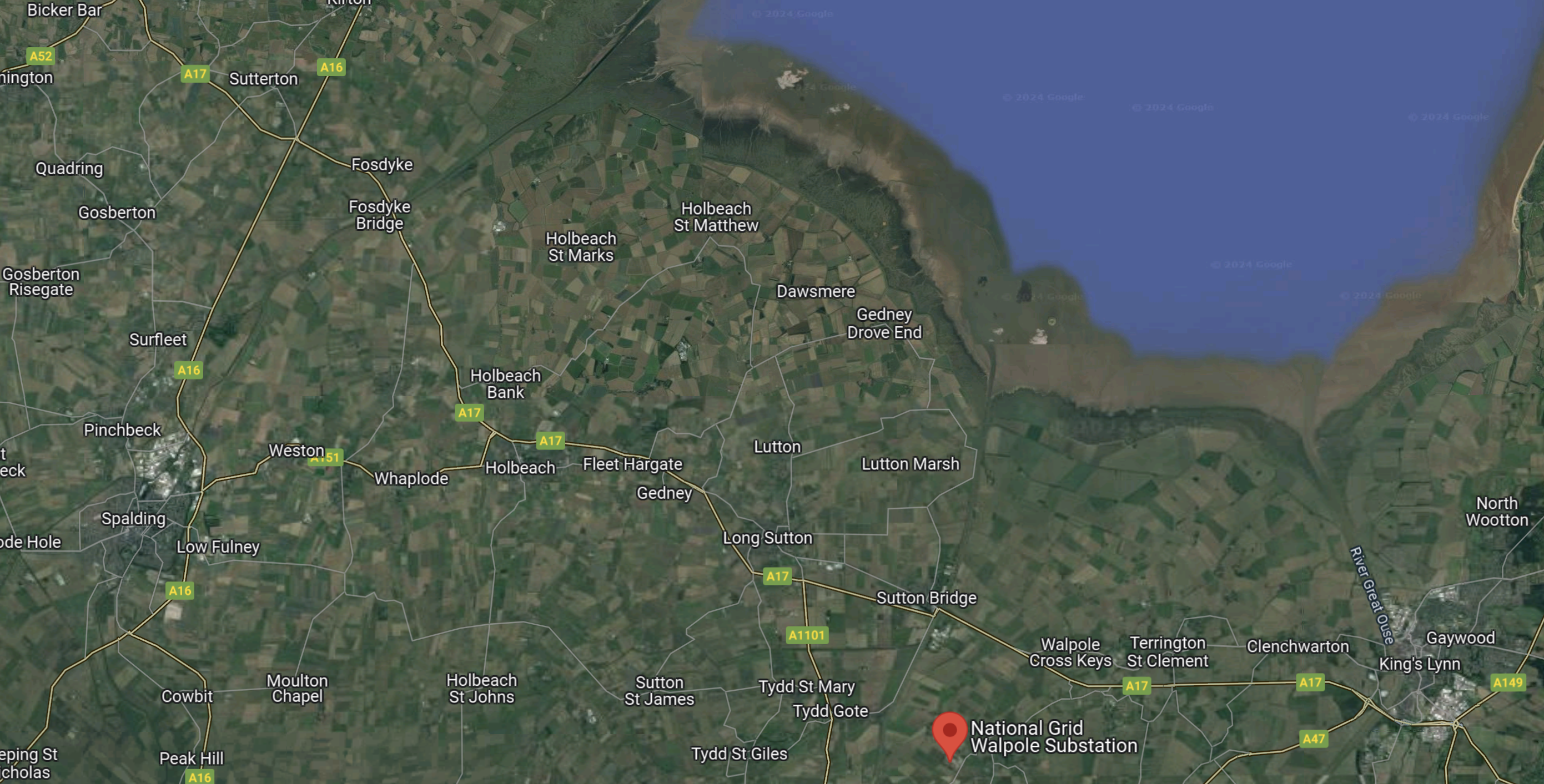
Note.
- Bicker Fen is in the North-West corner of the map.
- The current Walpole substation is marked by the red arrow.
- King’s Lynn is in the South-East corner of the map.
I suspect, if National Grid wanted to connect Green Link 3 and Green Link 4 to the Viking Link, then this would be possible.
If the Viking Link were to be connected to Green Link 3 and Green Link 4, this would allow surplus Scottish renewable energy to be sent to Denmark and on to Germany.
Green Link 3, Green Link 4 And Viking Link Appear To Be Underground In Lincolnshire
I can’t find any trace of overhead cables for the Viking Line in Lincolnshire and the press release says this about Green Link 3 and Green Link 4.
After making landfall, both projects’ cables will run underground for approximately 100km to two proposed converter stations in the Walpole, King’s Lynn and West Norfolk, area.
The connection to the Triton Knoll wuind farm is also underground.
It does appear that National Grid, are going for a Nimby-friendly approach for cables between Walpole and the coast.
Hopefully putting the cables underground will save money in legal arguments and fees.
 The Anonymous Widower