Support For Edinburgh Tram-Train Scheme
The title of this post, is the title of a third-of-a-page article in the June 2025 Edition of Modern Railways.
This is the first paragraph.
Final-Year civil engineering undergraduates at Heriot-Watt University’s Edinburgh campus have received warm support for a study in which they recommend reopening the city’s 7.5 mile South Suburban Railway, used for freight and diversions since 1962, using tram-trains.
It looks like they would start in the West at say Edinburgh Gateway or the Airport and would then turn South at Murrayfield to join the South Suburban Railway at Gorgie.
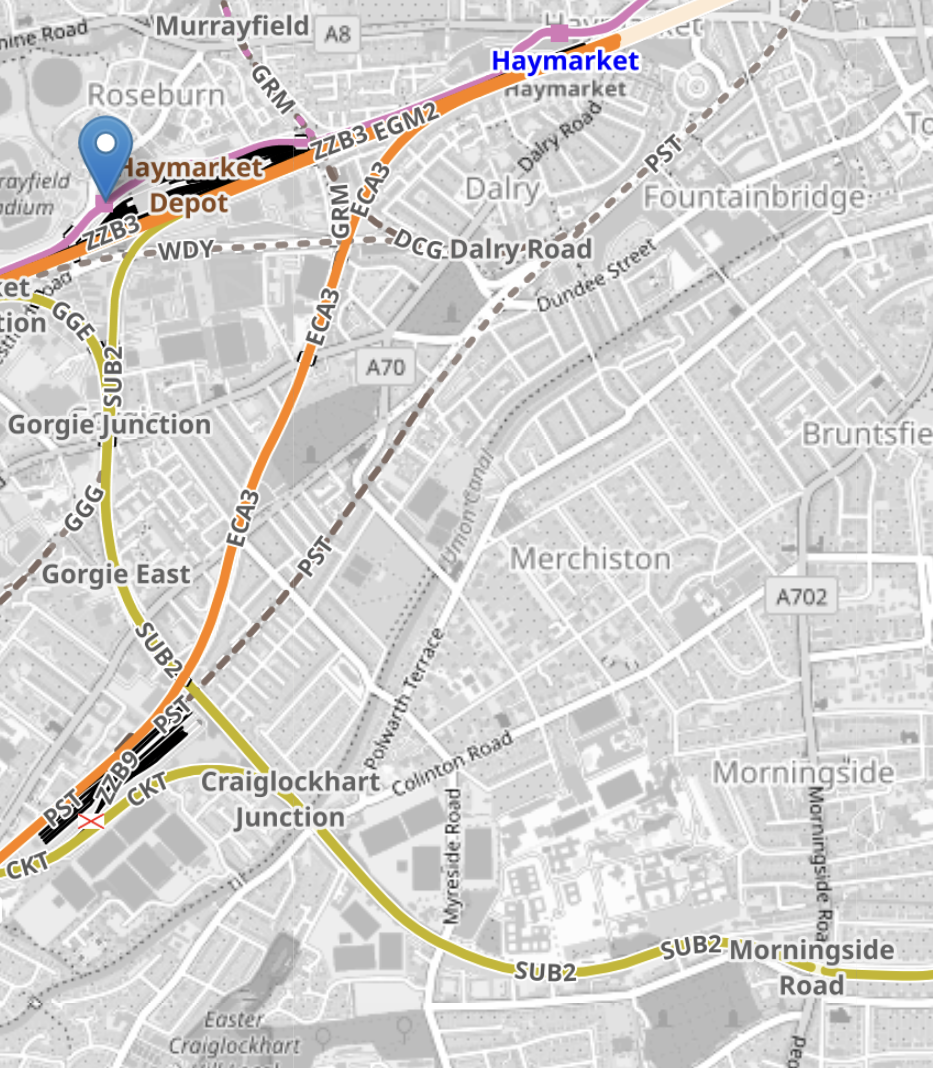
This OpenRailwayMap shows the tracks to the South of Murrayfield stadium.
Note.
- The more Westerly-oriented orange tracks lead to Glasgow.
- The orange tracks running South-Westerly are the tracks to Carstairs.
- The yellow tracks are the South Suburban Railway.
- Tram-trains could then go all the way to Brunstane on the Borders Railway.
- The blue arrow indicates the tram-stop for Murrayfield.
- I would assume that the connection to the South Suburban Railway, is to the East of this stop.
- Gorgie East, Craiglockhart and Morningside Road were stations on the South Suburban Railway.
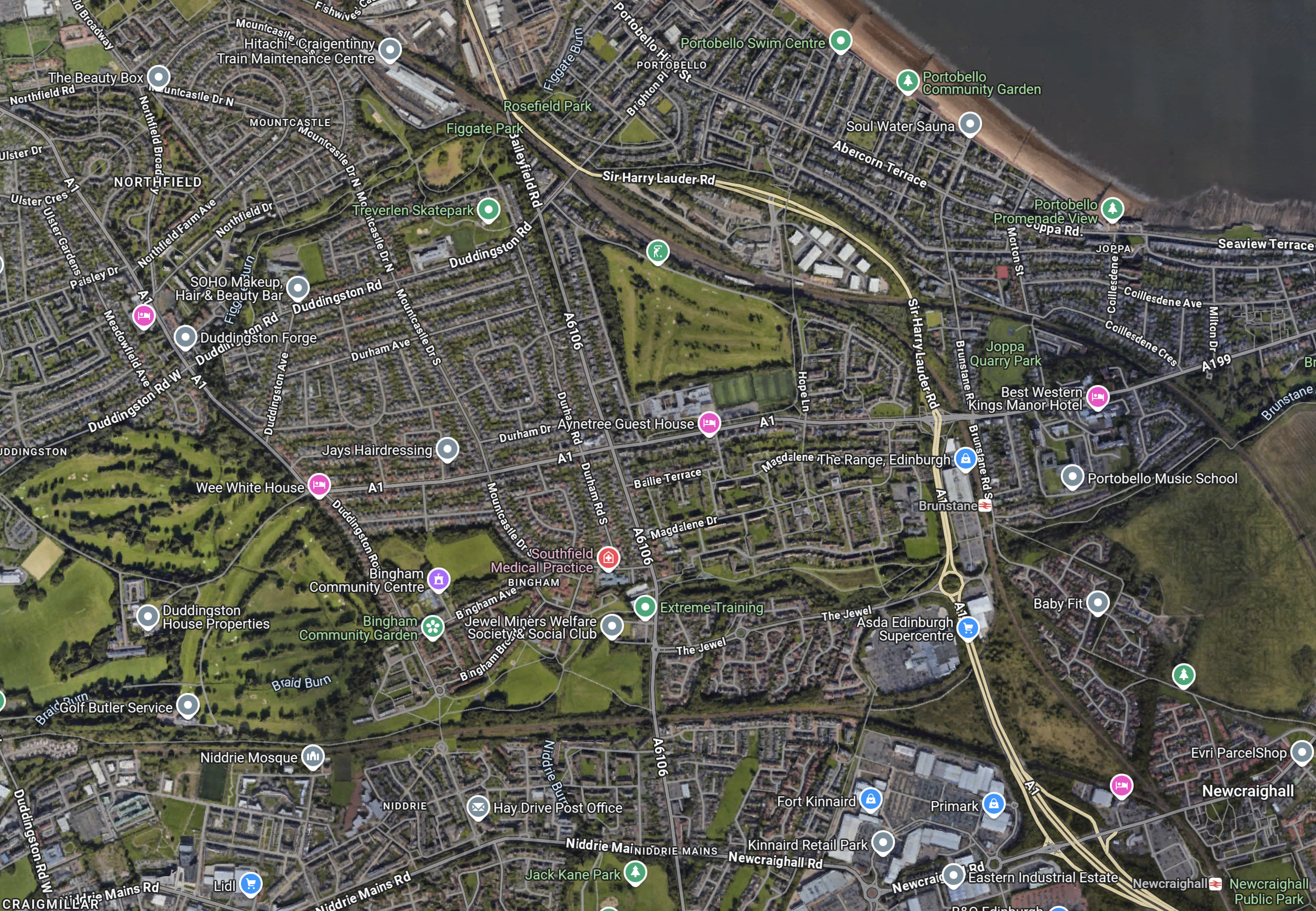
This map shows where the South Suburban and Borders Railways meet in a large triangular junction.
Note.
- Newcraighall station on the Borders Railway is in the South-East corner of the map.
- Brunstane station is to its North-West almost halfway up the map.
- The two stations are the North and South points of the triangular junction, where the South Suburban and Borders Railways meet.
- The South Suburban can be seen going West towards Gorgie and Murrayfield.
- Edinburgh’s beach at Portobello is in the North-East corner of the map.
- Between Murrayfield and Brunstane, there would be an appropriate number of tram stops and a tram-train every fifteen minutes.
Optionally, the route can be extended to Leith on a mothballed freight line.
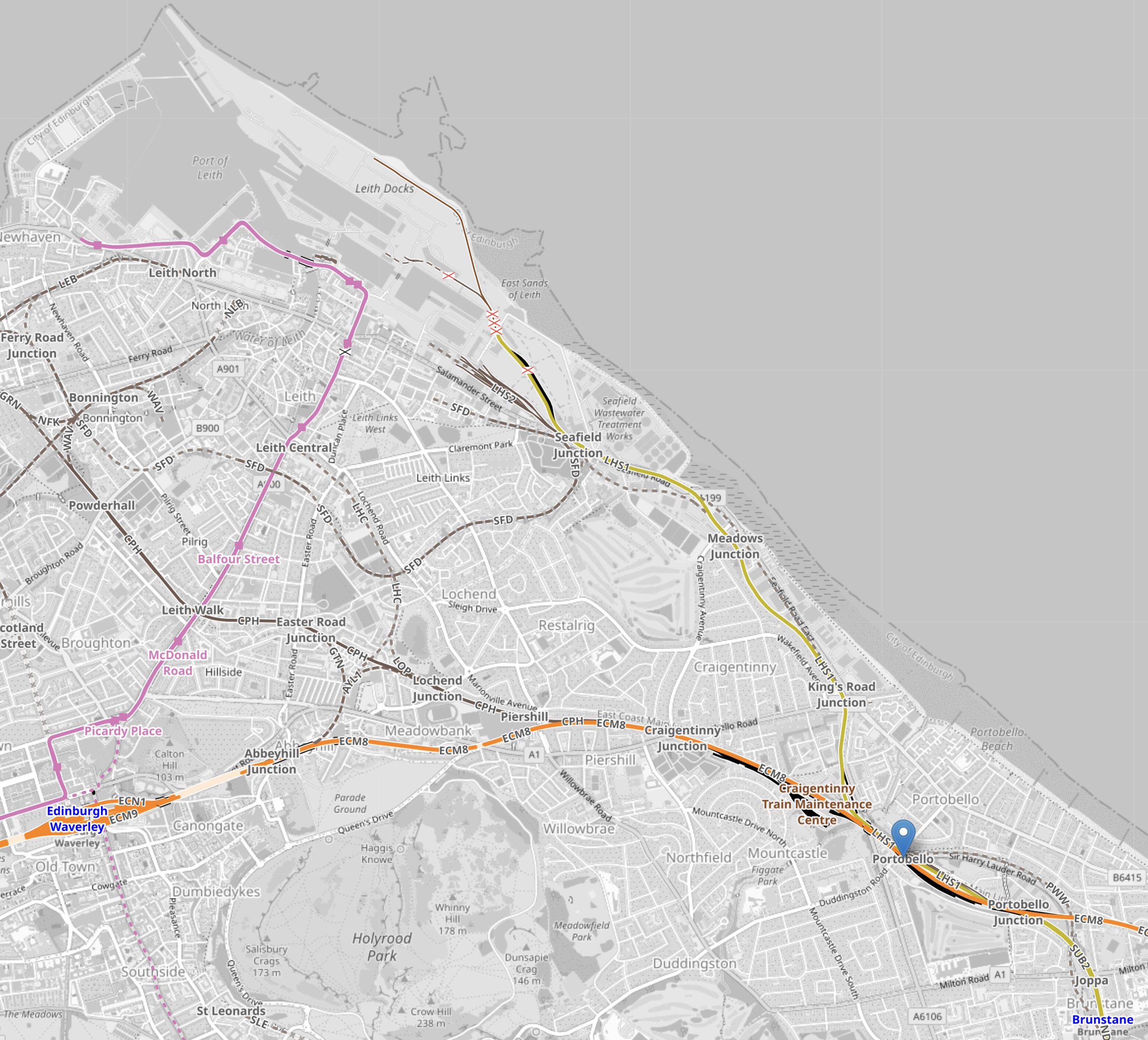
This OpenRailwayMap shows the railways and tramways of Edinburgh between Brunstane, Edinburgh Waverley and Leith.
Note.
- The orange track running across the bottom of the map is the East Coast Main Line into Edinburgh Waverley station, which is clearly marked.
- The pink track is the Edinburgh tram to Newhaven.
- Brunstane station is in the South-East corner of the map.
- The site of the former Portobello station is marked by the blue arrow.
- The yellow track from Portolbello up the coast is a mothballed freight line to Leith Docks.
The proposal suggests that the tram-train route finishes at Leith Docks. One of the reasons, is that this part of Edinburgh, is not well served by public transport.
I have some extra thoughts.
Changing Between Borders Railway and the Tram-Train At Brunstane Station
Brunstane station, is a two-track station, with only one platform, so there may need to be track modifications.
Do Edinburgh’s Urbos Trams Have A Tram-Train Variant?
They do!
Do Edinburgh’s Urbos Trams Have A Battery Variant?
Battery tram-trains charged at either end of the route will be needed.
A battery-electric Urbos 3 tram, can be seen running through the City of Birmingham in England.
Conclusion
The proposal looks feasible to me. But the devil will be in the detail.
A Day Trip To Leven From London
On Thursday, the 15th of May, I shall be taking a day trip by train from London King’s Cross to Leven in Fife.
I shall be doing it for the following reasons.
- To see the new Levenmouth Rail Link and its two new stations : Cameron Bridge and Leven.
- To prove that it is possible to do trips like these.
- To prove that it is still possible for me to do trips like these.
- To see a couple of old friends, who live North of the Border.
- I shall probably also ride the new section of the Edinburgh Tram.
I shall be leaving London on the Lumo service at 05:48 and returning on the 16:13, which gives me around six hours in Scotland.
A Bespoke Tram-Train For The UK
Trams, tram-trains, trains and anything that runs on rails is generally very expensive.
Does this partly explain, why the UK has relatively few urban tramways and railways?
In Stadler Presents Mock-Up Of Tram-Trains For German And Austrian Operators, I discussed how five German and Austrian operators had got together to create a common tram-train design, that would be suitable for all the operators.
The mayor of one of the cities involved in the joint order, said savings of the order of a million euros per vehicle may have resulted from the common design.
I would also feel that savings in operational costs, design of infrastructure, spares inventory and other costs would also result.
Identical tram-trains would make through running between networks easier.
Where Could Tram-Trains Be Used In The UK?
Consider.
- Currently, tram-trains are running in Sheffield and a battery-electric version of the same Stadler Citylink tram-train will soon be running in Cardiff.
- Cardiff, is developing a Cardiff Crossrail on tram-train principles across the city.
- Sheffield have said that they will be replacing their trams and I believe they could use developments of their excellent Stadler tram-trains.
- Sheffield is likely to extend their tram system and might include tram-trains to Doncaster.
- Cities that have talked about adding tram-trains to their tram networks include Birmingham, Blackpool, Manchester and Nottingham.
- Leeds is developing a metro system, which could be developed using tram-train principles.
- Glasgow has talked about a tram-train to Glasgow Airport for some time.
- The East-West Rail Link is proposing a tram-train link between Ipswich and Felixstowe to allow more freight trains into the Port of Felixstowe.
There could be quite a number of tram-trains being used in the UK, especially if they are used as at Felixstowe, to increase freight capacity into ports.
These are a few of my thoughts.
Battery-Electric Tram-Trains
I would envisage, that a lot of the new tram-trains would operate using batteries. Especially, as battery-electric trains are showing quite long ranges of upwards of thirty miles.
Already trams in Birmingham and trains on Merseyside, are operating using batteries and it avoids the expense of putting up catenary, if enough exists to charge the trams.
Replacement of Diesel Multiple Units By Battery-Electric Tram-Trains
There are some branch lines, where diesel multiple units run off a branch of an electrified main line.These services could be decarbonised by changing the rolling stock.
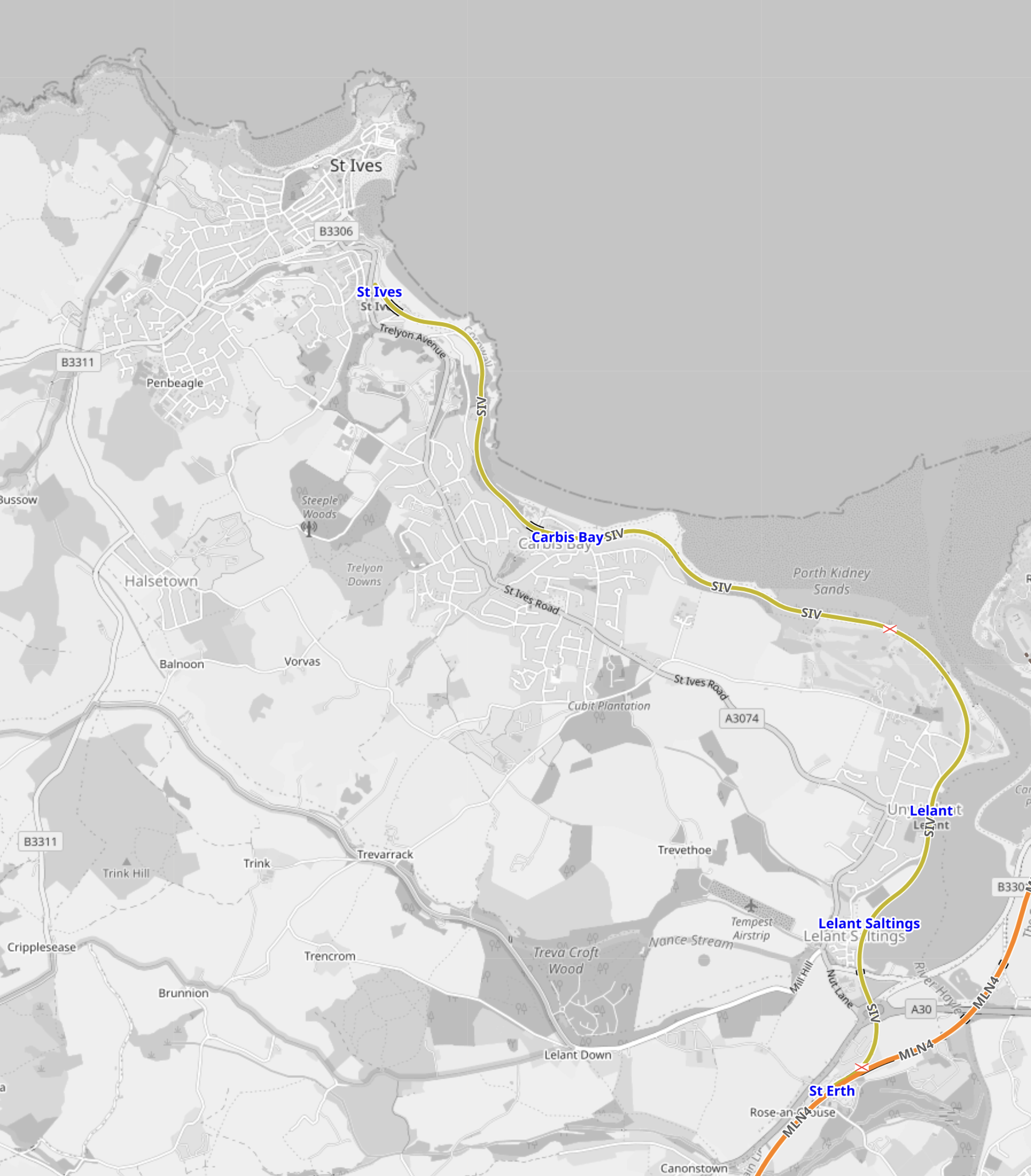
This OpenRailwayMap shows the St. I’ves Bay Line in Cornwall.
Note.
- The St. Ives Bay Line is shown in yellow.
- The Southern terminal is St. Erth station, where it connects to the Cornish Main Line, which is shown in orange.
- The Northern terminal is St. Ives station, which is towards the top of the map.
- The St. Ives Bay Line is 4.25 miles long.
- No tracks are electrified.
- There are three intermediate stations.
This second OpenRailwayMap shows St. Erth station in more detail.
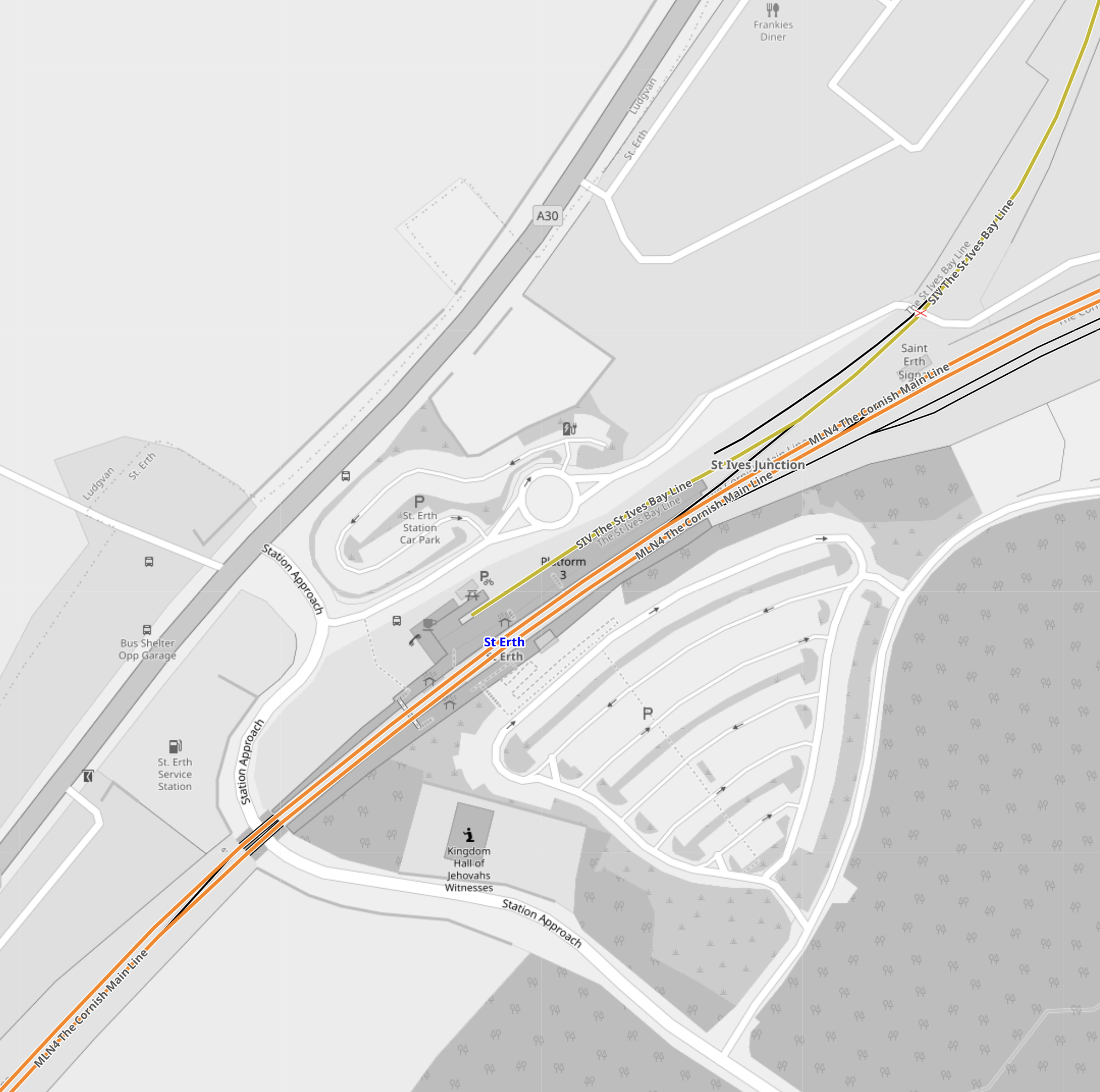
Note.
- The St. Ives Bay Line has its own platform at the side of the station.
- I am fairly certain, that some form of charging could be installed in this platform.
- At the other side of the Cornish Main Line are two sidings, which could be used for cleaning and maintenance.
A neat zero-carbon branch line could easily be created.
New Branch Lines To New Developments
In Sheffield Region Transport Plan 2019 – A New Tram-Train Route To A New Station At Waverley, I gave my view on a tram-train loop from the Sheffield-Lincoln Line to serve the Advanced Manufacturing Centre and new housing at Waverley.
The tram-train would run as a train to the branch line for the development and then run as a battery-electric tram, through the development.
As the Midland Main Line to Sheffield will be electrified, the tram-trains could be charged on the electrification in Sheffield station.
Build Them In Doncaster
Wabtec are closing Doncaster works.
Surely this would be the site to assemble the scores of tram-trains that could be needed in the UK.
Conclusion
Tram-trains could do a lot to improve the railways of the UK.
They would also help to decarbonise the existing system.
Who Needs Wires?
I went to Birmingham today to look at the recently-opened extension of the West Midlands Metro, which runs from outside Birmingham New Street station to Birmingham Library on battery power.







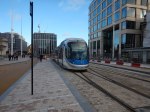


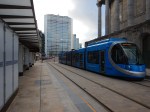

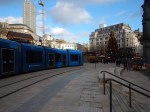
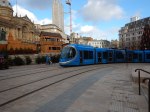






Note.
- Pavements, tram stop furniture and other details need to be finished.
- There no wires between near to New Street station and the Birmingham Library tram stop.
- The route is double-track.
- The stops all have two platforms.
- The route will be extended past Birmingham Library and on to new stops at Brinfleyplace, Five Ways and Edgbaston,
- The last three pictures show the pantograph being lowered outside New Street station.
These are my thoughts on other areas.
Battery Installation
The batteries appear to be on the roof of the two end sections of the trams.
They don’t appear to be very large, so it looks to me that CAF have taken great trouble with the design.
After all, the batteries were fitted to the trams by maintenance staff at West Midlands Metro, after one tram was converted in Spain.
Battery Operation
I observed the following.
- Birmingham Library tram stop doesn’t appear to have a charging station.
- Trams running towards Birmingham Library tram stop, drop the pantopgraph at New Street station.
- Although I didn’t see it, trams going in the other direction, probably raise the pantograh at New Street station.
- I would assume that trams leave New Street station for Birmingham Library, with full batteries, that have been charged on the way from Wolverhampton.
- Trams appear to have no problem climbing from New Street station to the Town Hall tram stop.
- If required trams could coast down the hill to New Street station.
The operation on battery power appears to be very simple.
Note that there are three other tram systems, that use these CAF Urbos 3 trams, that use batteries; Granada, Luxembourg and Seville.
There will surely be others, judging by the quality I saw in Birmingham.
Noise On Battery Power
Like other battery-powered vehicles, that I’ve ridden, they seem to be very quiet, when running on batteries. I suspect, that with the pantograph safely down in its hole, a lot of clanking and screeching doesn’t happen.
The Location Of The Temporary Terminus
The Birmingham Library tram stop makes an excellent temporary terminus.
- It is at the top of the hill, so will surely attract passengers, not wanting to walk all the way up.
- It is not far from the library, conference hall, conference centre and the restaurants on Brindleyplace.
- The tracks can be easily extended to Edgbaston.
- There is a crossover to allow trams to be turned back in either platform.
- There are also no need for wires at the tram stop.
I also think, that if there are no wires on the extension from Birmingham Library tram stop, that the building of the extension could be much simpler.
The New Extension Opened Early
I’m fairly certain, that the newly-opened section of track is completely without wires.
- Did this simplify testing and allow the extension to open a few days early, once staff training had been completed?
- It certainly allows revenue to be collected earlier.
- Have the battery modifications to the trams been designed so that the full extension can be handled on battery power?
- Does this mean that the route can be built and tested in sections, by just laying the track and testing it?
If this is the plan, it is rather elegant and could save construction costs and testing time.
Extending The Edinburgh Tram
Is a similar construction plan to be used on the Edinburgh trams for their extension?
The trams are all built by CAF, which must help..
Conclusion
Birmingham must now have one of the best City Centre tram in the world.
- The batteries are charged on the long run between Birmingham and Wolverhampton.
- The changeover between battery and overhead power happens at a busy stop, so doesn’t delay the tram.
- There is sufficient power to climb the hill from New Street station to Birmingham Library.
It’s a much better system than the MetroCentro in Seville, which was also built by CAF. But that is now twelve years old and is only about as long as Birmingham’s current section without wires.
These pictures show the charging system in Seville from my post called Seville’s Elegant Trams.



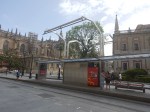
Seville’s trams have to charge the battery at every stop and I suspect the technology could be used in the West Midlands if needed.
Are we also seeing an innovative construction method for a tram system?
- An electrified core is built first.
- Battery trains can be tested on an electrified line with the pantograph down.
- The initial line is then extended, as required at the ends using plain track and battery operation.
- The extension is done gradually in sections to allow full testing.
It should be possible to save construction time and project cost.
More Innovation From CAF
CAF are noted for innovation in the design of their trains and particularly trams. I have read somewhere, that they spend a lot of money on Research and Development and it seems to show in their products.
- In Seville’s Elegant Trams, I wrote about the MetroCentro in Seville, which is catenary-free and charges the batteries of the trams at stops, through an overhead rail.
- Zaragoza trams use a similar system.
- The Midland Metro is fitting batteries to its CAF Urbos 3 trams, to extend the system in Birmingham and Wolverhampton.
- A second line for the Midland Metro could use tram-trains, so it can share the South Staffordshire Line with freight trains.
- My engineering instinct tells me that the Midland Metro system is more advanced, than that installed in Spain.
This article on Global Rail News is entitled CAF Secures New Orders In Luxembourg, Germany and Sweden.
This is an extract from the article.
Luxtram has selected CAF to supply 12 trams for the second phase of Luxembourg City’s tram network, a catenary-free line which is currently under construction.
These Urbos 3 trams will cost €40 million and be powered through a ground-level charging system at stops.
So it looks like CAF have now added a new way of charging battery trams.
Will we be seeing this technology in the extension to the Edinburgh Tram and later extensions to the Midland Metro?
Seville’s Elegant Trams
Seville’s tramway; the MetroCentro, by the cathedral is powered without using traditional overhead catenary.



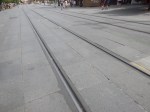




Each double-sided stop has a high electrified rail on each side.
When the tram stops, it puts up a pantograph and then for a minute or so, it charges the batteries.
Seville’s Urbos trams are the same as in Birmingham, so will the Midland Metro be using the same elegant system to charge the batteries, that are now been fitted, so trams can run to Centenary Square in Birmingham and the railway station in Wolverhampton?
|Edinburgh also has another version of Urbos trams, so if Birmingham battery trams are successful, will we be seeing them North of the Border?
There’s only one thing wrong with Seville’s trams. Every one is wrapped in advertising, which makes it difficult to see out and look at the outstanding buildings.
How Does The Battery System Work?
CAF , who built the Urbos trams, have this page on their web site, which is entitled Greentech Tram.
The system uses two methods of storing electricity.
Supercapacitor Modules
A supercapacitor has the advantage that it can be quickly charged and discharged.
So as a tram only takes perhaps fifteen seconds to stop from full speed, the fast charging allows the regenerative braking energy to be stored.
On starting again, this energy can be discharged quickly from the supercapacitor to accelerate the tram.
This charging/discharging cycle does degrade the supercapacitor and they would have to be replaced periodically.
Lithium-Ion Batteries
Lithium-ion batteries can hold greater amounts of electricity, but their charge and discharge rate is slower.
They can provide smaller amounts of power to keep the tram going at a constant speed after it has been accelerated.
A Sophisticated Control System
The page talks about a sophisticated control system that optimised the driving of the tram and the minimisation of energy.
The System Can Be Licenced From CAF
It should be noted that CAF will licence the system to other manufacturers.
Conclusion
By using two different storage systems with different characteristics, CAF are able to drive the tram along its 1.4 km route, charging at each stop.
Edinburgh Tram’s Elaborate Catenary
When I’m in Edinburgh, I always think that the overhead wires for the trams are over-elaborate and intrusive.

The picture was taken as I arrived. Compare that picture, with this one in the centre of Birmingham.
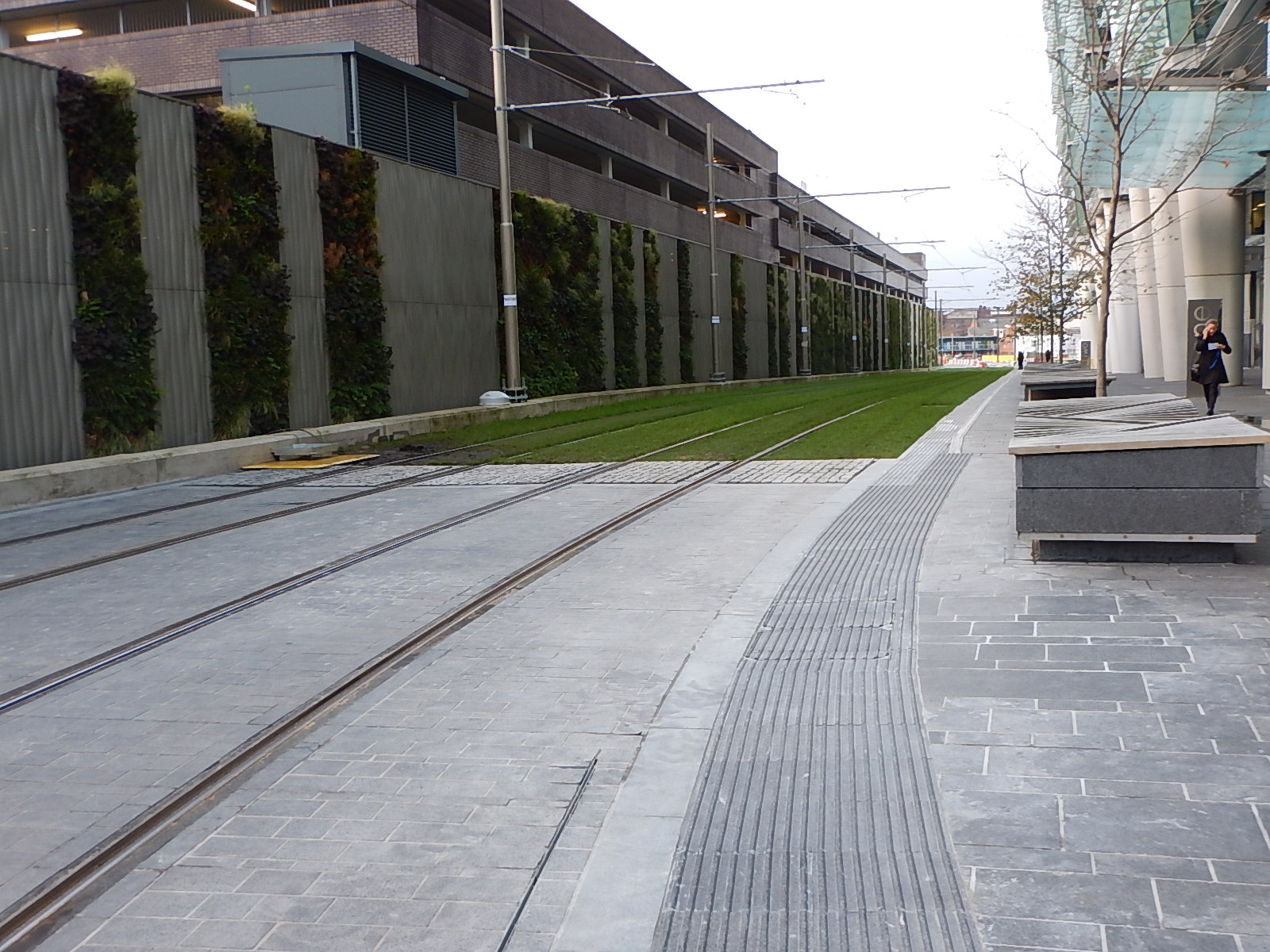
The Birmingham design is a lot simpler and as the trams are both from the same builder, you can’t say that the Midland Metro is designed to easier rules. This system could surely have been used on Princes Street, where I took this picture.
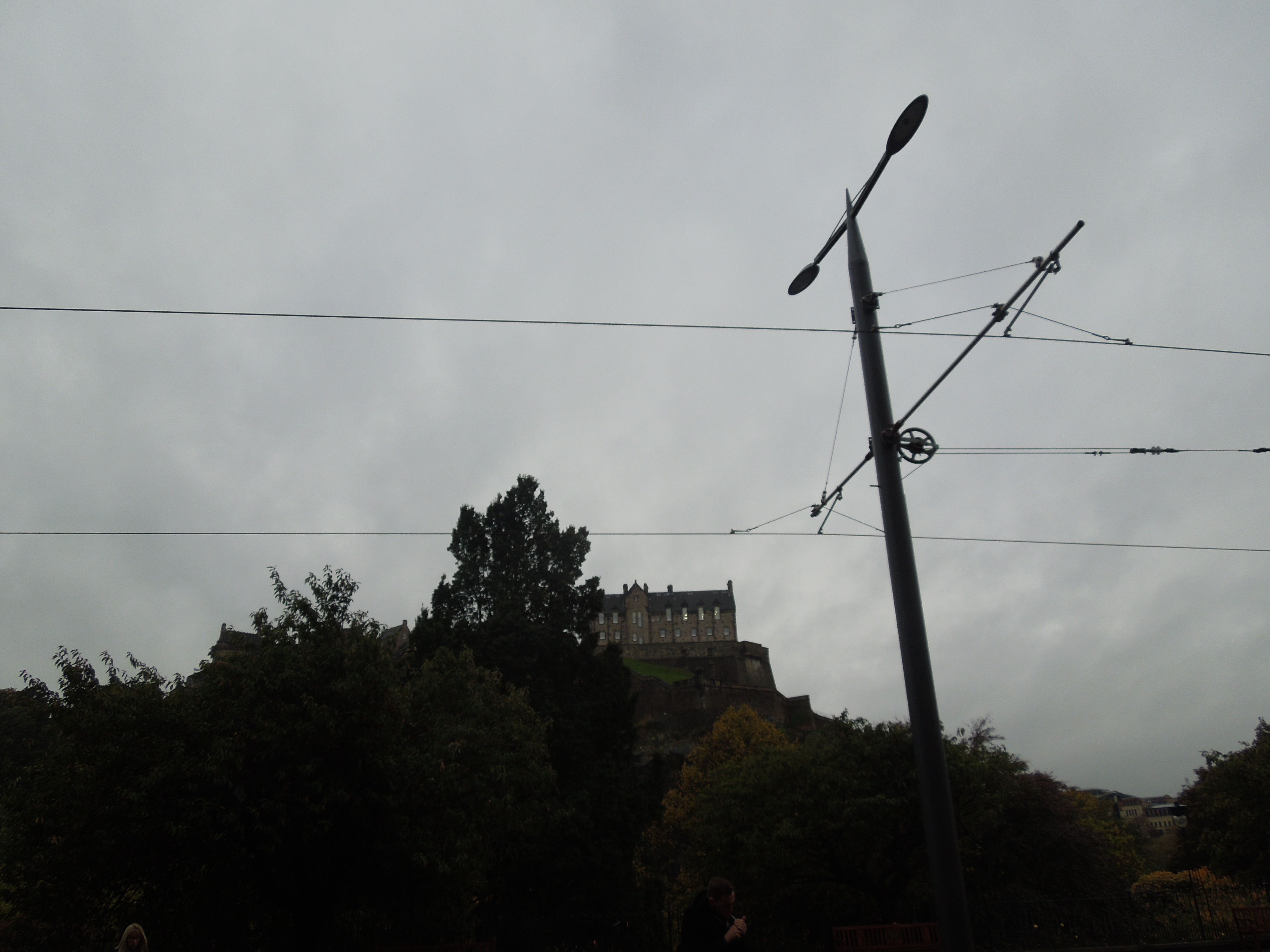
There is no excuse for bad design.
The Midland Metro is also showing the way for its extension, by using battery power through the historic centre.
Edinburgh Haymarket Station Gets It Right
Edinburgh Haymarket station is another example of Network Rail’s stations with a wide bridge over the tracks, like Leeds, Derby and most spectacularly Reading. London Bridge will join the club in the next couple of years.



As most trains stop at both Waverley and Haymarket stations in Edinburgh, I think passengers will ask themselves, why they would ever use the truly dreadful Waverley station?
- Access to the trams at Waverley means using endless steps and escalators to get to Princes Street and then an uncovered walk to the tram.
- Trams at Haymarket are just a short level walk outside.
- Taxi drop at Waverley is difficult with more steps. It’s on the level at Haymarket.
- Tickets to Edinburgh allow you to go to either station.
- Coming from the West and needing the tram, will passengers increasingly change at Edinburgh Park station?
Don’t fall into the trap of getting off at Edinburgh Waverley, which now always seems to be called just Edinburgh.
My only reservation about Haymarket is the station’s size.
Is it big enough for an important rugby match at Murrayfield, where the savvy will arrive at Haymarket and take a tram?
And will it be big enough, when the trams are extended, as they surely will be?
Is More Tram Fun On The Way In Edinburgh?
This article on the BBC web site is entitled Edinburgh trams: Plans to extend the line to Newhaven.
This is said.
Edinburgh’s tram network should be extended to Newhaven, a report to councillors has recommended.
It is estimated the three mile extension would cost £144.7m to build. The line currently stops at York Place in the city centre.
Edinburgh city council is looking into extending the tram network to Newhaven, Ocean Terminal or the foot of Leith Walk.
Councillors will vote next week.
As there are elections in Scotland in May, this could restart the saga of the building of the current Edinburgh trams, which kept Glaswegians and Sassenachs so amused.
I doubt they’ll start the extension of the tram system before the end of this decade!
Is Waverley Station Good Enough For Edinburgh?
If you arrive in London Kings Cross station, the experience has been transformed over the last few years. Instead of entering a dark concourse crowded with tired retail outlets in a wood and asbestos shed designed in the 1960s, you now have two choices. You can walk to the front of the train, through the barriers and doors and into a large square with seats, buses and entrances to the Underground. Or if the weather isn’t good, you can take an escalator or a lift to the footbridge that spans all of the platforms and enter the covered Western concourse to make your way to onward transport or to one of many cafes, most of which are upmarket.
Other stations that I know well, like Birmingham New Street, Liverpool Lime Street, Manchester Victoria, Newcastle Central and Nottingham have also been transformed into impressive gateways for their cities. Next in line for substantial upgrading are London Euston and Waterloo, Glasgow Queen Street and Cardiff.
Edinburgh Waverley station has had a bit of a tidy up and it now has a set of escalators to get you up to Princes Street, but it is still a dark, cramped station, with no quality cafes in the station.
If I was to give Kings Cross five stars, Newcastle and Nottingham would get four and Waverley scarcely deserves one.
So to answer my original question. The answer is a definite No!
Waverley And The New Borders Railway
In some ways the new Borders Railway is going to make matters worse, as if it is successful, there will be pressure for more services on the line and there may not be enough terminating platforms at the East end of the station. But at least according to the Layout section in the station’s Wikipedia entry, things are being reorganised. This is said.
Former Platforms 8 and 9, which were substantially shortened for use as a Motorail terminus, the infilled area becoming a car park; since the demise of Motorail services these platforms are used only for locomotive stabling, although the numbers 5/6 were reserved for them in the 2006 renumbering. These are to be extended as full length platforms to accommodate terminating CrossCountry and Virgin Trains East Coast services with the taxi rank closed in June 2014 to make way for these works.
On the other hand, the Borders Railway has removed the need to use one of the worst train/bus connections in the UK.
Currently, if you arrive on a train from London and want to get an express bus to the South or the Borders, this necessitates a climb up flights of steps onto the North Bridge, which with heavy bags is impossible, unless you’re stronger and fitter than most.
Now you walk to the bay platform at the East end of the station and get one of the half-hourly trains to Galahiels, where there is a short walk to the bus station to get a convenient bus to all over the Borders and even to Carlisle.
But it is still a long walk from the bay platforms at the East (3 to 6) to the platforms that go West (12 to 18). And the tram is even further to walk.
Buses And Trams At Waverley
Like many main stations in the UK, no thought has been given at Edinburgh to how to efficiently organise the interface between trains and the buses.
I would have thought that when Edinburgh trams were built that they would have reorganised public transport in the city, so that the trams served the station properly. After all in Manchester, Croydon, Sheffield, Nottingham, Liverpool and Newcastle, local light rail, underground or trams serve the main train stations. Only in Blackpool is a walk needed, but that is being remedied.
In my view there are three places for tram stops at Waverley station.
- At the top of the escalators that take you between the station and Princes Street. But would this get in the way of the posh cars taking people to and from the Balmoral Hotel?
- On Waverley Bridge in front of the station. But where would the tourist buses go to clog up next?
- There also could be a Nottingham-style solution, where the trams cross over the station on a bridge at right angles to the train lines. But this would probably be an impossibly difficult project to design and implement.
The trams do serve Haymarket station and I wonder how many visitors to Edinburgh, use that station instead.
Waverley And Princes Street Gardens
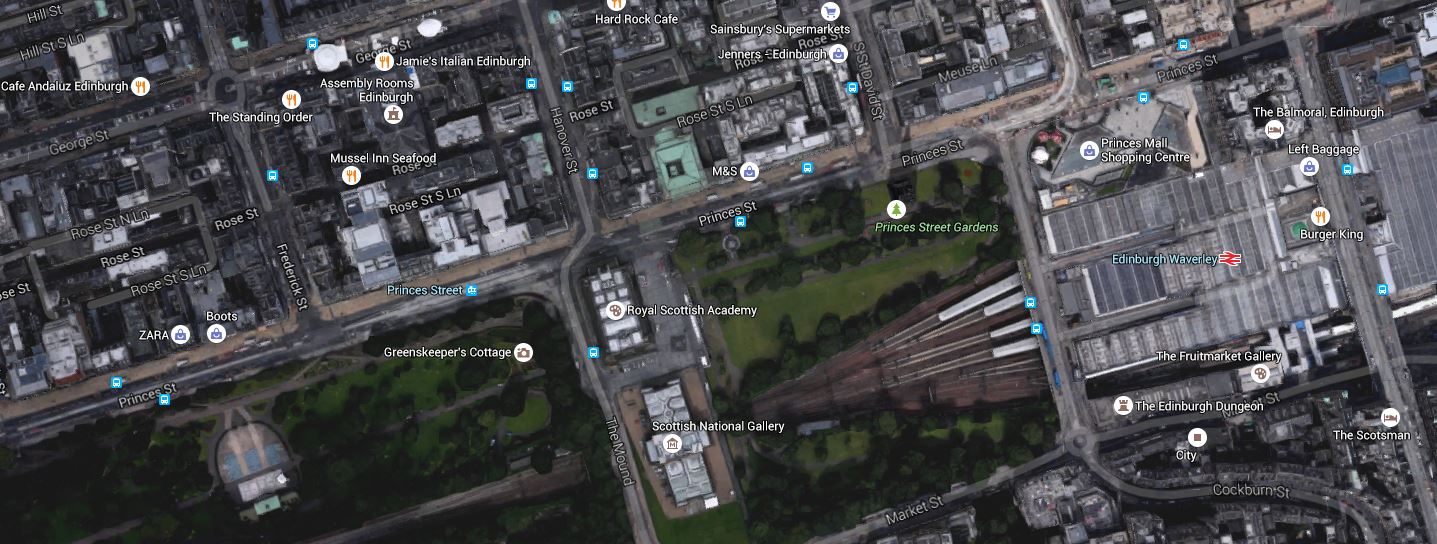
After my trip to the Borders Railway, my friend and I went for lunch in a restaurant by the Royal Scottish Academy facing out onto Princes Street Gardens.
It was not an easy walk from the station as once we’d climbed up the escalators, it took several minutes to get across the busy Waverley Bridge in front of the station to get into the civility of the Gardens. This Google Map shows where we walked.
Waverley Station And Princes Street Gardens
Over lunch, I asked my friend, who’d lived in Edinburgh nearly all her life, , why there wasn’t a subway between the gardens and the station. She didn’t know and said there never had been! So as I walked back to the station, I took some pictures.



They show no evidence of a subway that might have been closed.
But they do show that if a subway could be built, then Edinburgh could have a World Class meeting place for when the weather was good.
Sorting The Trams
Seeing the map of Waverley station and the Princes Street Gardens, I have a feeling that if they were designing the Edinburgh trams now, they would be very different.
The difference is that in the last few years, tram-trains have come into general use in Germany. The Germans are getting enthusiastic about their use and large systems are being developed in cities like Karlsruhe, Kassel and Chemnitz.
In the UK, a test line is being added to the Sheffield Supertram, but how could tram-trains help solve the problems of Waverley station?
Trams coming from Edinburgh Airport and the West stop at Murrayfield Stadium tram stop and then move onto the street to call at Haymarket before going down Princes Street. New Class 399 tram-trains, as will be used in Sheffield, would follow the same route as the trams until Murrayfield. Passengers would find the only real difference would be that they had somewhere else on the destination board.
But at Murrayfield they would join the main railway lines and running as trains, they would call at Haymarket and Waverley stations.
The tram-trains could end their journey at Waverley or they could pass through the station and perhaps go on to further destinations like Dunbar or North Berwick. There would be no infrastructure modifications needed East of Waverley station, as the tram-trains would just appear to everything to be just another type of electric train.
If you look at the map in the Proposals for the Edinburgh tram network in Wikipedia, you’ll see this map.
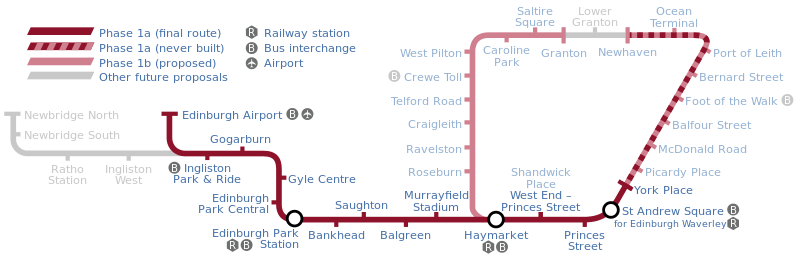
Edinburgh Tram Map
Note there is another Western destinations in addition to the airport and a loop to Newhaven and the Port of Leith. All come together at Haymarket. So services from the West could be run by trams or tram-trains as appropriate and those on the loop would probably be run by trams.
It should also be said, that the tram-trains could go anywhere to the East or West of the City, where there are electrified lines. Even Glasgow!
Edinburgh could have a lot of fun, without digging up the streets too much. Although, they’d probably need to do this, if they were going to extend the tram to Newhaven and the Port of Leith.
 The Anonymous Widower