How Will Virgin Trains East Coast Use Class 800/801 Trains?
The following two sections give Virgin Trains East Coast (VTEC) current and future fleets.
Current Fleet
VTEC have a current fleet comprising the following locomotives and coaches.
- 32 – Class 43 locomotives
- 117 – Mark 3 coaches
- 31 – Class 91 locomotives
- 302 – Mark 4 coaches
- 31 – Driving van trailers
The Class 43 locomotives and the Mark 3 coaches are formed into InterCity 125 trains.
- Two locomotives and nine coaches per set.
- 125 mph capability
- Diesel-powered
Which gives thirteen diesel trains.
The Class 91 locomotives and Mark 4 coaches are formed into InterCity 225 trains.
- One locomotive, one driving van trailer and nine coaches per set.
- 140 mph capability
- Electric-powered.
- Ability to run London to Edinburgh in under four hours.
Which gives thirty-one electric trains.
Adding the two figures together gives a total of forty-four nine-car trains.
Future Fleet
VTEC’s future fleet will include.
- 10 – Five-car Class 800 electro-diesel trains.
- 13 – Nine-car Class 800 electro-diesel trains.
- 12 – Five-car Class 801 electric trains.
- 30 – Nine-car Class 801 electric trains.
Adding these together counting the five-car trains as half gives fifty-four nine-car trains.
Or ten more nine-car trains!
In addition six to eight InterCity225 trains could be retained in service to run limited stop trains between London and Edinburgh.
This increase in capacity can only me good for passengers, with more services and destinations.
Questions About Class 800/801 Trains
What is the capacity of a nine-car Class 800/801 train?
I can’t find this on the Internet and I suspect it hasn’t been decided.
Wikipedia gives the capacity of an InterCity 225 train as 406 Standard and 129 First Class seats.
It should also be noted that the car length in a Class 800/801 is twenty-six metres, as opposed to the twenty-three metres of the InterCity 225.
I would hope good design can make excellent use of this space.
Will two Class 800/801 trains be able to work as a pair?
I suspect the answer to this is yes, as the closely-related Class 395 trains regularly do this.
The most common use would be to run two five-car trains as a ten-car set.
This would be a 260 metre long train, which is perhaps fifteen metres longer than an InterCity 225 train.
Some lengthening of platforms may be necessary, but it probably isn’t a major problem.
Will coupling and uncoupling of a pair of Class 800/801 trains be automatic?
In The Impressive Coupling And Uncoupling Of Class 395 Trains, I linked to videos of the closely-related Class 395 trains, doing just this in under a minute.
I would be very surprised if two Class 800/801 trains couldn’t do the same.
Will a Class 800 train and a Class 801 train be able to work as a pair?
There may be circumstances, where this is needed on electrified lines, so I would be very surprised if this is not possible.
At what station will a Class 800/801 train be able to call?
The nine-car trains are 234 metres long and a pair of five car trains will be 260 metres long, so platform length will mean they can’t call at a lot of smaller stations.
But a five-car train will be only 130 metres long, which will be shorter than a pair of four-car multiple-units working together, which are regularly seen on the UK’s rail network.
So the five-car trains will probably be able to serve a surprising number of stations.
Will Class 800/801 trains have a faster turn-round time?
If you look at the times of trains between London and Leeds, this things happen.
- A few minutes after a train leaves the platform at Leeds and Kings Cross, the next incoming service arrives.
- It then waits in the station for nearly half-an-hour before going back.
Effectively, an hour must be added to each Out and Back journey between London and Leeds.
This time will enable.
- Passengers to unload and load.
- Train to be prepared.
- Crew to be changed if required.
Any delay of a few minutes can hopefully be recovered.
Train preparation time will probably be better with the Class 800/801 trains, as hopefully automation and better design will speed the process.
But cutting this thirty minutes substantially would probably require passengers to be marched around like the Brigade of Guards, which is of course not possible.
Hopefully, the new trains will be designed, so that ingress and egress for all passengers will be easier and faster but at some stations like Leeds, the station layout is more of a bottleneck than the train.
A few minutes reduction in turn-round time might be possible, but nothing that would mean a train doesn’t occupy a platform for half-an-hour.
How long will A Class 801 train take between London and Edinburgh?
Currently the fastest journey time using an InterCity 225 is around four hours and twenty minutes, but they have done it in under four hours in test runs.
For marketing reasons, I suspect that VTEC would like to dip under four hours with the fastest trains.
As the Class 800/801 trains have a similar 140 mph performance to the InterCity 225, I suspect that four hours will also be possible.
But the big difference will be that the Class 800/801 trains will probably have faster stop times at any intermediate stations.
So I suspect that the average journey time between London and Edinburgh will drop.
How Will VTEC Use Class 800/801 Trains?
Returning to my original question, I’ll now attempt to answer it in the next few sections.
London-Edinburgh Services
I think we can assume the following.
- There will be at least two trains per hour (tph)
- Trains will usually be nine-car trains.
- Class 800 trains will not normally use diesel power on the route.
- Some trains could be two five-car trains running as a pair.
- A proportion of trains will do the trip in under four hours.
- Intermediate stops as now will be optimised to the passenger traffic.
- Intermediate stops will be faster.
I also think, that the InterCity 225 sets will be improved, so they can match the times of the Class 800/801 trains.
I think that once improved signalling on the East Coast Main Line is working and allowing running faster than 125 mph, we could be seeing trains being able to go from London to Edinburgh and back in under nine hours, assuming a thirty minute turn-round at both ends of the route.
This would mean that a dedicated London to Edinburgh fleet of just eighteen trains would be required to run a two tph service. Three tph would need another nine trains.
Speed up the trains so, that a round trip can be done in eight hours and sixteen trains are needed for the two tph service, with eight more trains needed to up the service to three tph.
Under Future in the Wikipedia entry for Virgin Trains East Coast, this is said.
If VTEC’s application to operate extra limited stops services to Edinburgh is successful, it is proposing to operate these by retaining six to eight InterCity 225 sets.
Interesting! So will some or all hours see a third train between London and Edinburgh.
Are the thirty-year-old InterCity 225 trains, showing the same survival instincts of their ten-year-older predecessors; the InterCity 125s?
London-Aberdeen And London-Inverness Services
Currently times on these routes from London are as follows.
- London-Aberdeen – seven hours and four minutes – three trains per day
- London-Inverness- eight hours and four minutes – one train per day
So what times could a Class 800 achieve on these routes?
Times North of Edinburgh with an InterCity 125 are as follows.
- Edinburgh to Aberdeen takes two hours and thirty-six minutes – Fastest ScotRail takes two hours sixteen minutes.
- Edinburgh to Inverness takes three hours and thirty-one minutes – Fastest ScotRail takes three hours nineteen minutes.
I suspect that a Class 800 train running on diesel power could match the InterCity 125 times and approach the ScotRail times.
But as they would be running on electric power to and from London in four hours, times could be as follows.
- London-Aberdeen – six hours and sixteen minutes
- London-Inverness – seven hours and nineteen minutes
So over half-an-hour could be saved on both routes.
Currently trains leave London at these times.
- 10:00 – Aberdeen
- 12:00 – Inverness
- 14:00 – Aberdeen
- 16:00 – Aberdeen
Note that there is probably no 18:00 train, as that would arrive in Aberdeen at 0110.
That is probably too late, but a well-driven Class 800 train, might get to Aberdeen around 00:30, which could be acceptable.
There is also the possibility of running a pair of five-car Class 800 trains to |Edinburgh, where they split with one train going to Aberdeen and the other to Inverness.
If the 16:00 train were to split, the Inverness portion would finish its journey before midnight.
A schedule like this from London could be possible.
- 10:00 – Aberdeen and Inverness
- 12:00 – Inverness
- 14:00 – Aberdeen and Inverness
- 16:00 – Aberdeen and Inverness
- 18:00 – Aberdeen
Both Northern cities would get four trains per day from London, because of two factors.
- The ability to run on electric power between London and Edinburgh, which knocks time off that section of the route.
- The ability to split and join trains at Edinburgh, which saves paths on the East Coast Main Line.
It should be noted that any electrification North from Edinburgh will help.
Stirling to Edinburgh and Glasgow could be electrified by 2019 or 2020.
- Trains would run to the South of Stirling on electric power.
- Any splitting going North and joining going South would take place at Stirling.
- Trains would still stop at Edinburgh to load and unload passengers.
- Crew change currently takes place at Edinburgh, but that could happen at Stirling.
With a well-executed stop at Stirling, electric power between Stirling and Edinburgh and a few other improvements could we see the following?
- London-Aberdeen – six hours
- London-Inverness – seven hours
It would certainly please VTEC’s Marketing Department.
Services To St. Andrews
The Open Championship was last held at St. Andrews in 2015, so by the next time it is held at the Home of Golf, it is likely that a station will have been built for the town.
This new station must be able to accept Class 800/801 trains, which during a major event might need to run to the area.
This reasoning must apply to lots of places either on or within fifty miles of the East Coast Main Line.
London-Leeds Services
Leeds is generally served by 2 tph from London in around two hours ten minutes.
These are usually nine-car InterCity 225 trains, with a couple of InterCity 125 trains, that go to places like Harrogate, which are not electrified.
As the speed limits on the East Coast Main Line are increased as trains are fitted with in-can signalling, I suspect that VTEC’s Marketing Department will be pushing for times between London and Leeds to be under two hours.
I can’t believe that VTEC will not extend services from Leeds by making use of five-car trains running to Leeds as a pair, where they would divide and join.
I am assuming that Class 800/801 trains can join as well as the closely-related Class 395 trains, which do so it in under a minute.
Places that could be served include.
- Bradford
- Harrogate
- Horsforth
- Huddersfield
- Ilkley
- Keighley
- Shipley
- Skipton
Note.
- Some stations like Harrogate and Horsforth are not electrified, so would need Class 800 electro-diesel trains.
- Five-car trains could serve a lot of stations on the Leeds-Bradford Metro network, thus opening up the possibility of services to places like Headingley for the cricket and rugby and Saltaire for the culture.
- Could a five-car Class 800 electro-diesel train run over the Settle and Carlisle Line to Carlisle and Scotland?
- Extending some services from Leeds may mean that platform space is released at the station.
I think that the possibilities to extend services from Leeds using the five-car Class 800/801 trains are large.
London-Edinburgh Via Leeds
On the West Coast Main Line, some Scottish services from London, go via Birmingham and Wolverhampton.
So if there was a fully electrified route from Leeds to York, then some Scottish trains could go via Leeds.
At present, I don’t think this is possible with an electric train, as part of the route from Leeds to York is not electrified.
The electrification should be well underway by now, but there is no sign of it.
Other Extended Services
What can be done at Leeds can surely be done at other places.
If the two trains can couple and uncouple within a minute, that means that a pair of trains can arrive in a station and go through the following sequence.
- 00:00 -A joined pair of Class 800/801 trains arrive in the station and load and unload passengers.
- 00:03 – Close the train doors
- 00:04 – Start the automatic decoupling process.
- 00:05 – The first train leaves the platform.
- 00:08 – After three minutes the second train leaves the platform.
I believe that the stop could be under ten minutes and the trains would be a safe three minutes apart, as they left the station.
So where could trains be split?
- Newark or Peterborough for Lincoln and Nottingham
- Doncaster for Hull and Sheffield
- York for Scarborough and Harrogate
- York for Middlesbrough and Sunderland
- Newcastle for Ashington and Sunderland
Note.
- Trains could go in a loop to serve several stations.
- Sunderland could be on such a loop.
- As trains would only be five cars, they could stop at most stations in need of a service.
- Stations like Peterborough, Doncaster, York and Newcastle with more than one through platform in each direction would probably be preferred stations for split and join.
- No electrification is needed away from the East Coast Main Line.
Obviously, passenger needs and traffic patterns will decide, where the trains split and join.
Conclusions
The big conclusion will be that more places will receive long distance services to London and the places in between.
But these trains will really put the squeeze on smaller operators like Hull Trains and Grand Central Trains, as VTEC will be serving their station.
Rail Sleeper Plan Between Caithness And Edinburgh
This is the headline on an article in the John O’Groats Journal.
So is this a good idea?
Some of the comments to the article are cynical it would work, but I feel that it could be a runner.
The Current Service
There are two train services from Edinburgh to Thurso during the day, both of which need a change at Inverness.
- The 08:32 from Edinburgh arrives in Thurso at 17:50.
- The 13:34 from Edinburgh arrives in Thurso at 22:20.
Both services could be summed up like this.
- The total time of the journey approaches nine hours.
- The train is something like a Class 158 diesel multiple unit.
- Both legs are between three and four hours.
- There is a long wait in Inverness.
- The second service does the second leg mainly in the dark.
- London to Thurso in a day is possible, but it would be dark and tiring.
Although there are quicker routes with more changes, I can think of better ways of spending a day, travelling North from Edinburgh to Thurso.
Coming back, there are three practical one-change services
- The 06:50 from Thurso arrives in Edinburgh at 14:22.
- The 08:34 from Thurso arrives in Edinburgh at 16:25
- The 13:01 from Thurso arrives in Edinburgh at 22:28.
These services can be summed up like this.
- The first two services are faster than the nine hours going North.
- On a good day the morning services must give good views.
- You would certainly be able to do Thurso to London by train in a day.
Certainly, as a practical train service to attract visitors, the Edinburgh-Thurso service is not a service that says you must go, like say Inverness to Kyle of Lochalsh, which I wrote about in Inverness to Kyle of Lochalsh.
The Far North Line
The Far North Line connects Inverness with Thurso and Wick. This introduction from Wikipedia, is a good summary of the line.
The Far North Line is a rural railway line entirely within the Highland area of Scotland, extending from Inverness to Thurso and Wick. It is the northernmost railway in the United Kingdom. The line has many sections of single track, mostly north of Dingwall. In common with other railway lines in the Highlands and northern Lowlands, it is not electrified and all trains are diesel-powered.
The trains are typically Class 158 trains, which provide four trains per day all the way between Inverness and Thurso. Other services give a better service on the Southern part of the line including four trains per day to Kyle of Lochalsh.
Improving The Far North Line
Wikipedia has a section on Future Expansion of the line. This is said.
For many years there have been proposals to bypass the Lairg loop with a line across the Dornoch Firth, linking Tain (via Dornoch) more directly with Golspie. This would involve building a new bridge over the Firth, or making dual-purpose the bridge[5] which now carries just the A9. Discussions have been held concerning the shortening of the Far North Line involving a bridge over the Dornoch Firth and the possible use of the trackbed of the former light railway.[6] Nothing has yet come of these ideas.
But these are expensive developments and is the traffic available.
The John O’Groats Journal has this paragraph.
I have spoken to Caledonian Sleeper and want to investigate the business case for a sleeper combination with freight.
So could Internet and other parcels traffic be a nice little earner for the line.
But then a lot of tourists venturing along the line will be heavily loaded with bicycles and heavy luggage.
Incidentally, In the 1960s, I used to work with a John Baxendale, who used to go surfing off the North Coast of Scotland, as he said it was some of the best surfing in the world.
Do surfboards feature on trains to the North, as they do on trains to Cornwall?
Trains For The North
So perhaps, this line, the Kyle of Lochalsh Line and the Inverness to Aberdeen Line need a fleet of specially configured Highland trains.
- Four carriages.
- A good buffet/restaurant car serving proper Sottish food.
- Lots of space for luggage.
- Big windows.
Abellio ScotRail are planning to refurbish twenty-six Inter-City 125s for longer routes, which fit this specification, as the rear sections of the Class 43 locomotives can be used for freight and oversized luggage.
Will we be seeing these trains on the routes out of Inverness?
Imagine a tourist day out from Inverness, where the morning train to Thurso and the evening return to Inverness offered the best breakfast, dinner and hospitality that Scotland can provide.
You never say never where Terry Miller’s iconic trains are concerned.
If ever a train will still be in main line service, a hundred years after it was built, it will be these trains.
Given their unique status, if they worked the Far North Line, they might just attract enough passengers to make line improvements worthwhile.
Factors Affecting The Edinburgh-Thurso Sleeper
In the following sections, I’ll detail a few factors that will surely affect ridership of a sleeper train between Edinburgh and Thurso.
Sleeper Trains Are Having A Revival
A few years ago, it was predicted that sleeper trains would be consigned to history in a few years.
But in the UK, the Caledonian Sleeper and the Night Riviera, seem to have ignored this advice, with the Scottish service ordering new rolling stock.
Deutsche Bahn thought sleeper trains were the past and they probably were, given the customer-unfriendly way DB ran them. But Austrian Railways are taking over the sleeper services and investing in new rolling stock.
In Sweden, there’s even their own Far North sleeper train from Stockholm to the Arctic Circle. Check out this map on the Swedish Railways web site.
The Curiosity Factor
Done properly, an Edinburgh to Thurso Sleeper would surely attract those, of which I’m probably one, who like to travel to out of the way places as some form of box-ticking.
My Reason For Using Sleeper Trains
I am one of those lucky people, who can sleep anywhere.
So if I’m coming down from a trip to Scotland, I will often have a full day and then catch the sleeper back down to Euston. If I book at the right time, I often find that my First Class sleeper ticket, is less than staying in say a Premier Inn in Edinburgh or Glasgow and buying a train ticket for the morning. I also arrive in London at a time, that hasn’t wasted half the day.
If say, I had to go to an important event in Glasgow or Edinburgh, if possible, I would take the first train to the North in the morning and then come back on that day’s sleeper.
The Edinburgh To Thurso Day Trip
If you look at the times for a train service between Edinburgh and Thurso, it would not be possible to go up and back in a day and have time for a worthwhile meeting or party.
I once drove from Ipswich to Aberdeen and back in a day, but I was in a Lotus Elan doing speeds at up to a hundred on the way.
But you couldn’t do those sorts of speeds now!
On the other hand, if there was a sleeper service between Edinburgh and Thurso, you’d arrive fresh and ready for the day or you could sleep off the Highland hospitality on the way back. Or of course vice-versa!
Why Not A Glasgow To Thurso Sleeper?
Once all the electric trains are running across the Central Belt, Glasgow to Edinburgh could be 36 minutes, with a train every 15 minutes.
So only one route would be needed, as passengers from Glasgow could just take a train across.
But for operational reasons, the sleeper service might start from anywhere in the Central Belt, like the new Edinburgh Gateway station, which is close to Edinburgh Airport.
Thurso To Edinburgh Airport
An Edinburgh-Thurso service would certainly stop at Edinburgh Gateway station, to give easy access to the Airport.
Suppose you were going on holiday or for business reasons to Caithness or somewhere on the Far North Line.
You would catch a convenient flight into Edinburgh Airport and perhaps board the Sleeper st around nine in the evening for the North.
Coming back, you’d catch the Sleeper in Thurso and arrive at Edinburgh in time for a morning flight.
Caithness Tourism
Tourism to Caithness and the North Coast of Scotland could be a big driver of passengers to an Edinburgh to Thurso Sleeper Service.
This page on the Visit Scotland web site gives more details.
There’s even pictures of surfers.
Conclusion
I feel that not next year, but once Scotland’s rail system is fully developed, with the shortened Inter-City 125s serving the longer routes and electric trains all over the Central Belt, that a Sleeper Train between Edinburgh and Thurso will be viable.
A Nation Of Shopkeepers
The phrase a nation of shopkeepers, has often been said about the British or the English in a derogatory manner by the French and others.
The Fort Kinnaird Retail Park in Edinburgh is according to Wikipedia, the second largest in the UK.
This Google Map shows the layout of Fort Kinnaird.
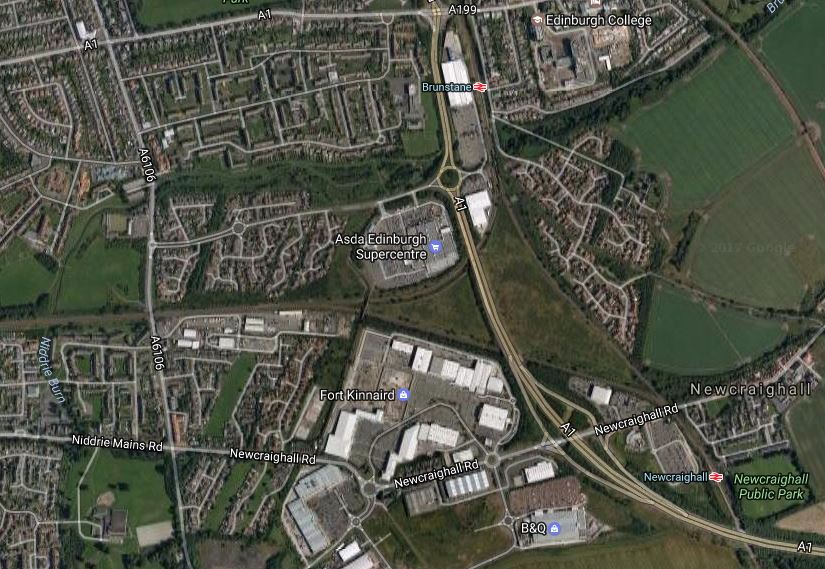
Note the two Borders Railway stations of Brunstane and Newcraighall to the East of the Park, where lines lead to to Waverley station and the Borders .respectively.
But there are other railways in the area.
- The East Coast Main Line runs North-South, just off the map to the East.
- Leading away to the West is the Edinburgh Suburban and Southside Junction Railway, which is now a freight-only link across the city.
- Links exist between the East Coast Main Line and the Junction Railway.
So it could be said that a lot of trains pass Fort Kinnaird.
Plans are in development to open up the Junction Railway to either heavy rail or trams.
Surely, it would be sensible if there were a station at Ford Kinnaird to tie it all together.
If I’m right, the Scots are surely a nation of rail-connected shopkeepers.
Network Rail Announces Electrification Of The Schotts Line
This article in Rail Technology Magazine is entitled Network Rail awards Carillion £49m Shotts electrification contract.
This is the first two paragraphs.
Network Rail has agreed a contract with Carillion Powerlines Ltd to deliver the electrification of the Shotts Line between Holytown Junction and Midcalder Junction.
The £49m contract will see the delivery of 74km of electrified railway as part of the Scottish government’s wider £169m investment in the line between Edinburgh and Glasgow.
Electrification of The Schotts Line will provide a fourth electrified line between Edinburgh and Glasgow.
From hundreds of miles to the South, it looks a good choice.
- The route is effectively in three sections, with only the central section between Holytown Junction and Midcalder Junction, needing to be wired.
- The bridges that need to be raised are already being worked on.
- The route goes to Glasgow Central rather than Glasgow Queen Street.
- The Class 385 trains needed are already being built in Newtown Aycliffe.
It certainly seems that the planning of electrification in the Scottish Lowlands is being better managed that that on the Great Western Railway.
TransPennine Express To Edinburgh
In the July 2016 Edition of Modern Railways, there is an article entitled CAF to build new TPE trains.
This is said.
Once TPE extends its services via the East Coast Main Line to Edinburgh from December 2019, it intends to use pricing and frequency to encourage journeys on this route to mitigate crowding on its West Coast Main Line services.
I don’t think the Scots will object to this competition to Virgin.
It would also appear that because of the success of the Borders Railway, that there are suggestions to add new stations on the East Coast Main Line at Reston and East Linton. These would fit in well with an increased frequency of fast passenger trains up the East Coast Main Line.
The Scottish Borders Have Caught London Overground Syndrome
The Scottish Borders would appear to be suffering from that new benign disease;London Overground Syndrome!
This disease, which is probably a modern version of the Victorian railway mania, was first identified in East London in 2011, when it was found that the newly-refurbished East London Line and North London Line were inadequate due to high passenger satisfaction and much increased usage. It has now spread across other parts of the capital, despite various eradication programs.
- Lengthening the trains from three to five cars.
- Adding step-free access or rebuilding stations like Brondesbury, Hackney Central, Hackney Wick, Hampstead Heath, Kensal Rise, West Hampstead and Whitechapel.
- Extending the system with a new branch to Clapham Junction station.
- Taking over the Lea Valley Lines to Cheshunt, Chingford and Enfield Town.
- Modernising and electrifying the Gospel Oak to Barking Line.
- Extending the Gospel Oak to Barking Line to Barking Riverside.
- Taking over the unwanted Romford to Upminster Line.
The latest pressure would seem to be to take over more of London’s suburban routes.
Londoners can’t seem to get enough of the life-improving orange.
Rail Plans For The Scottish Borders
This article on the BBC is entitled Borders Railway: Future Goals For New Routes Drawn Up.
Reading the article, it would appear that the following are proposed or are possibilities for the Borders Railway to mitigate the effect of London Overground syndrome.
- Building on the current success.
- Extending the railway to Hawick.
- Add some dynamic passing loops to increase service resilience.
- Add some more parking.
- Improve the wi-fi.
- More capacity and especially for tourism-related reasons.
- More steam trains.
- A possible branch to Peebles.
It would appear to be all well-thought out ideas, some of which will happen.
- More car parking at Tweedbank and Stow
- Longer trains with space for bicycles.
- Perhaps a longer passing loop. to enable increased and faster services.
- A turnback facility at Tweedbank to aid the running of stem trains.
- Better wi-fi.
But most of these projects are easily costed and the benefits can be calculated. So they are ones that accountants like and can fund or turn down.
Onward To Hawick
The Wikipedia entry for the Borders Railway, says this about a proposed extension to Hawick and Carlisle.
The Campaign for Borders Rail has called for the continuation of the line to Melrose and Hawick, and eventually to Carlisle. According to the group, Hawick suffered more than any other town in the Borders from the closure of the Waverley Route, and only the return of the railway could halt the area’s economic decline. At the time of the closure of the Waverley Route, Hawick was a 70-minute journey from Edinburgh. At Melrose, the southbound station platform and building exist alongside the Melrose Bypass. Network Rail has confirmed that there is nothing to prevent the extension of the line beyond Tweedbank, although commentators have remarked that the Bypass could pose problems. A major realignment of the road would be required, as well as the reinstatement of embankments and bridges.
I have traced the route of the Waverley Route beyond Tweedbank station on Google Maps and you can see a lot of the original route to Hawick, which only seems to have one viaduct at Ale Water.
Note that there appear to be a succession of viaducts to the South of Hawick, so perhaps Hawick would be a town to take a breather. I’ve also traced this section on Google Maps and if it was ever rebuilt, it would certainly be some railway.
I think that they could spend a lot of money going all the way to Carlisle, but an affordable extension to Hawick via the Borders Hospital and Melrose might be so successful as to get the politicians to allow the engineers to go all the way to Carlisle station, which as I reported in If Manchester Victoria and Birmingham New Street Were The First Two Courses, Is Carlisle The Third?, is being rebuilt to give all friendly visitors a warm welcome.
Power To The Peebles?
I’ve borrowed the corny sub-heading from a section in the BBC report, that prompted me to write this post.
The report says this.
It also recognises the success of the Borders Railway as encouraging hopes of reopening other lines.
It said some might not be suitable for redevelopment but cited the former route between Edinburgh and Peebles as one worth considering.
I think the route to Peebles is the Peebles Railway, which leaves the Borders Railway, just South of Eskbank station, goes South Westerly to Peebles and then Easterly to rejoin the Border Railway North of Galashiels station.
This sudden appearance of a plan for a Peebles Branch of the Border Railway has got my suspicions that a group of engineers have resorted to the methods of Brunel and Stephenson to solve the problem of increasing the double track on the Borders Railway.
I suspect the engineering fag packets and used envelops were produced together with a bottle of Scotland’s finest malt whisky and everybody went to the garden of a suitable hostelry, that overlooked the line and got thinking.
They looked at some of the single track sections like Newbattle Viaduct and thought that rebuilding railways in Syria might be easier.
Then they looked at the route of the Peebles Railway and felt if it was rebuilt, it would kill three birds with one stone.
- Peebles and a few other places would be connected to the rail network.
- The Borders Railway would get a much needed passing loop.
- Various tunnels and viaducts on the Borders Railway would not need to be double-tracked.
The Peebles Branch could be single or double-tracked according to the terrain and the costs.
A Second Borders Railway
It would also appear that because of the success of the Borders Railway, that there are suggestions to add new stations on the East Coast Main Line at Reston and East Linton. This is said under Future in the Wikipedia entry for East Linton station.
Proposals to reopen the station, along with the former station at Reston, have received the backing of John Lamont MSP, who has taken the case to the Scottish Parliament. A study published in 2013 proposed that East Linton and Reston stations be reopened. Since Abellio ScotRail took over the franchise in April 2015, they have now committed to reopening East Linton and Reston Stations as part of the local Berwick service by December 2016 but due to the shortage of rolling stock this will now commence in December 2018.
So it would appear there is a high chance it will happen.
This Google Map shows the location of East Linton between Dunbar and Edinburgh.

East Linton and Dunbar
East Linton is indicated by the red arrow and Dunbar is on the coast to the East.
Dunbar station is on the East Coast Main Line, with services to Edinburgh and Berwick-on-Tweed.
This Google Map shows the proposed location of Reston station, which is between Dunbar and Berwick-on-Tweed.

Reston And Berwick-on-Tweed
Reston is indicated by the red arrow. The river at the bottom is the Tweed, with Berwick on the coast and the border.
This scheme looks to be a very sensible use of an existing main line. It also follows a pattern of adding Parkway stations to main lines and the recent opening of the new Cranbrook station on the West of England Main Line.
There would appear to be a few other closed stations on the line.
As they are not mentioned with respect to East Linton and Reston stations, I would assume that there is not a great deal of pressure for reopening.
If we look at the possible opening of services to East Linton and Reston stations in 2018, when Abellio Scotrail have trains available, this will only be a year before First TransPennine extend their Newcastle services to Edinburgh.
So could this hourly service stop at other places between Newcastle and Edinburgh, other than the proposed Morpeth?
The Berwickshire Railway
When I was looking at the Wikipedia entry for Reston station, I noticed that the Berwickshire Railway linked the station to St. Boswell’s station on the Waverley Route, which could be part of the extension of the Borders Railway to Hawick.
I suspect someone has looked at this line to create a route to Galashiels from the South East via Reston, St. Boswell’s, Melrose and Tweedbank.
But this report of the Storm of 1948 probably told them to forget the idea.
Is More Tram Fun On The Way In Edinburgh?
This article on the BBC web site is entitled Edinburgh trams: Plans to extend the line to Newhaven.
This is said.
Edinburgh’s tram network should be extended to Newhaven, a report to councillors has recommended.
It is estimated the three mile extension would cost £144.7m to build. The line currently stops at York Place in the city centre.
Edinburgh city council is looking into extending the tram network to Newhaven, Ocean Terminal or the foot of Leith Walk.
Councillors will vote next week.
As there are elections in Scotland in May, this could restart the saga of the building of the current Edinburgh trams, which kept Glaswegians and Sassenachs so amused.
I doubt they’ll start the extension of the tram system before the end of this decade!
An Excellent First Month For The Borders Railway
According to this article on the BBC, which is entitled Borders Railway journeys top 125,000 in first month of operation, the Borders Railway has started with a high level of usage.
I suspect a lot of the usage in the first month is probably down to the novelty value of the railway and we won’t get a true pattern of usage until a couple of months.
But if this level of usage, is sustained, the following will happen.
- New four-car IPEMU trains will be procured for the railway, as they could handle the route with ease and would double the capacity.
- Planning will start to extend the route to Hawick and Carlisle.
Network Rail will also have to look seriously into how they calculate traffic forecasts.
Where Now For The Borders Railway?
On Monday I took a trip down the new Borders Railway to Tweedbank station.
It has been put together with care and no-one can say it will be falling apart in a couple of years.
Criticism
According to Wikipedia, there have been three major criticisms of the new line.
- Infrastructure Capability – It’s just a basic railway.
- Timetabling – Critics think they can do it better.
- Failure to continue to Melrose – New lines always have the wrong route.
I think though that you have to allow the line to bed down and allow the operator to overcome any problems that might be thrown up.
My thoughts on the three areas will now be given.
Infrastructure Capability
It is a railway that is designed to handle two trains an hour in each direction taking just under the hour for the whole journey.
Critics have said, that it should be double-tracked and electrified. But if it was, this would probably double the capacity of the line and will there be enough passengers to fill an enhanced service?
If in the future, the line suffers from overcrowded trains, to which new lines in the UK seem to be prone, there is a simple way to increase the capacity of the line. And that is to run longer trains!
I suspect that as the line has been built to take steam specials, the line will have the capability of taking diesel multiple units of four carriages.
Hopefully, there’s enough platform capacity at Waverley. But I do have a feeling that Waverley will need to be given some extra capacity, as more and more trains go to the Scottish capital, of which the Borders Railway is just one of several planned new services.
Timetabling
In a few years time, the timetable will be very different, as the current one is only an initial estimate of what is needed.
Failure To Continue To Melrose
In my view they have done something much better by creating an integrated train-bus interchange at Galashiels, which serves the whole Border region.
It may be in the future, they need to extend the line to Melrose, but if any bus route from Galashiels gets overcrowded, it is a lot easier to add a few more buses, than build a new railway line. At least if you catch the bus from Galashiels you wait in a nice comfortable bus station, rather than on top of the North Bridge in the wind and rain.
Possible Improvements
Much of the improvement to the line will be organic and small.
- Shops and kiosks will appear in and around stations, driven by the needs of passengers creating business opportunities.
- If passenger numbers increase, then the trains will gain extra carriages. Electrification of other routes in the UK, may help this, as it will release some longer trains.
- Operational problems may show up limitations in the track and signalling and small changes may improve reliability, time-keeping and may even reduce the journey time.
I am basing these conclusions on what I have seen on other new and much improved lines in the country.
But bigger improvements will be possible.
Extension To Melrose
This will only happen, if indications are positive that the service will pay for itself. But it could be an expensive line to rebuild, as the Melrose by-pass has been built over part of the line.
A positive could be that any extension to Melrose, might serve the Borders General Hospital,
Extension To Carlisle
Strangely, I think this will be more likely than an extension to just Melrose, as it will be an English project as well as it opens up a new route up the West Coast to Edinburgh, which could be used by freight trains in addition to passenger ones.
When the equivalent rail lines in the North of England are modernised, a Borders Railway to Carlisle, would open up a large area bordered by Edinburgh, Carlisle and Newcastle for rail-based tourism, with excellent links to the large centres of population in the UK.
But until we see how successful, the Borders Railway will be, extension to Carlisle is a remote possibility.
Extension To Penicuik
The creation of a branch to Penicuik is raised in Proposed Extensions in the Wikipedia entry for the Borders Railway.
At present Heriot-Watt University is looking into the proposal for Midlothian Council.
Changes At Edinburgh
There could be changes to the line at the Waverley end of the line, as Network Rail and Scotrail improve services in the capital.
At present services from Dunbar and North Berwick go across the city to destinations in the West. There must be a very small chance that services on the Borders Railway might be extended past Waverley to at least Haymarket.
Trains or trams might also run on the Edinburgh Suburban and Southside Junction Railway in a loop across the South of the City. Although this will not directly affect the Borders Railway, train times may be adjusted so they connect better.
New Stations On the Current Route
Passenger numbers and patterns of use, property development, jobs and other factors will create a need for new stations on the route.
These could be totally new or opened up at places where stations used to exist in the past. If you look at the diagram of the old Waverley Route, there are several places, where stations have not been rebuilt.
If built these will add to the passenger numbers on the line and this could create the need for other improvements, like longer trains.
Remember too, that this line was designed down to a price in the mid-2000s, based on the assumptions of the time. Since then, there has been a big change in our attitude to railways with big projects like the London Overground being created from terrible lines and being tremendous successes and smaller ones in Birmingham, Lancashire and Scotland showing good returns, Government is much more likely to fund a properly costed rail project.
So I wouldnt be surprised to see a couple of new stations in the next few years on the Borders Railway.
Electric Trains
For the last few years, electric trains don’t necessarily mean those taking current continuously from overhead lines. Bombardier’s new Aventra electric multiple unit, has a battery variant called an IPEMU. Provided it can charge the battery on a convenient overhead line, it can then run for sixty miles on the battery.
As Edinburgh to Tweedbank is about thirty-five miles, I would suspect that an IPEMU would be able to manage the journey, charging the battery on the short section of the East Coast Main Line at Edinburgh, before the train turns off onto the Borders Railway.
These IPEMU trains are modern, environmentally-friendly four-car trains, that can run on lines that are partially electrified without any modification to the lines, if they can handle diesel multiple units, like those currently running on the Borders Railway.
They may be the best way of providing a higher-capacity service, that run the route slightly faster, due to their faster acceleration.
Knock-On Effects On Other Lines
If the Borders Railway is a rip-roaring success, this will add to pressure to reopen or substantially improve rail lines all over the country.
Don’t Underestimate Engineers!
Because of the unique status of Scotland in the UK and the good publicity the new Borders Railway has received, I have a feeling that as the ultimate objective of the Scottish Government to connect to Carlisle will be fulfilled, as so many other parties like Councils in the North of England, freight companies and Network Rail will give their support for all sorts of reasons,
And a lot of engineers, architects, engineering companies and train manufacturers will come up with innovative solutions for those dreams.
After all what better showcase is there for your new construction technique, train or rail-related product?
Is Waverley Station Good Enough For Edinburgh?
If you arrive in London Kings Cross station, the experience has been transformed over the last few years. Instead of entering a dark concourse crowded with tired retail outlets in a wood and asbestos shed designed in the 1960s, you now have two choices. You can walk to the front of the train, through the barriers and doors and into a large square with seats, buses and entrances to the Underground. Or if the weather isn’t good, you can take an escalator or a lift to the footbridge that spans all of the platforms and enter the covered Western concourse to make your way to onward transport or to one of many cafes, most of which are upmarket.
Other stations that I know well, like Birmingham New Street, Liverpool Lime Street, Manchester Victoria, Newcastle Central and Nottingham have also been transformed into impressive gateways for their cities. Next in line for substantial upgrading are London Euston and Waterloo, Glasgow Queen Street and Cardiff.
Edinburgh Waverley station has had a bit of a tidy up and it now has a set of escalators to get you up to Princes Street, but it is still a dark, cramped station, with no quality cafes in the station.
If I was to give Kings Cross five stars, Newcastle and Nottingham would get four and Waverley scarcely deserves one.
So to answer my original question. The answer is a definite No!
Waverley And The New Borders Railway
In some ways the new Borders Railway is going to make matters worse, as if it is successful, there will be pressure for more services on the line and there may not be enough terminating platforms at the East end of the station. But at least according to the Layout section in the station’s Wikipedia entry, things are being reorganised. This is said.
Former Platforms 8 and 9, which were substantially shortened for use as a Motorail terminus, the infilled area becoming a car park; since the demise of Motorail services these platforms are used only for locomotive stabling, although the numbers 5/6 were reserved for them in the 2006 renumbering. These are to be extended as full length platforms to accommodate terminating CrossCountry and Virgin Trains East Coast services with the taxi rank closed in June 2014 to make way for these works.
On the other hand, the Borders Railway has removed the need to use one of the worst train/bus connections in the UK.
Currently, if you arrive on a train from London and want to get an express bus to the South or the Borders, this necessitates a climb up flights of steps onto the North Bridge, which with heavy bags is impossible, unless you’re stronger and fitter than most.
Now you walk to the bay platform at the East end of the station and get one of the half-hourly trains to Galahiels, where there is a short walk to the bus station to get a convenient bus to all over the Borders and even to Carlisle.
But it is still a long walk from the bay platforms at the East (3 to 6) to the platforms that go West (12 to 18). And the tram is even further to walk.
Buses And Trams At Waverley
Like many main stations in the UK, no thought has been given at Edinburgh to how to efficiently organise the interface between trains and the buses.
I would have thought that when Edinburgh trams were built that they would have reorganised public transport in the city, so that the trams served the station properly. After all in Manchester, Croydon, Sheffield, Nottingham, Liverpool and Newcastle, local light rail, underground or trams serve the main train stations. Only in Blackpool is a walk needed, but that is being remedied.
In my view there are three places for tram stops at Waverley station.
- At the top of the escalators that take you between the station and Princes Street. But would this get in the way of the posh cars taking people to and from the Balmoral Hotel?
- On Waverley Bridge in front of the station. But where would the tourist buses go to clog up next?
- There also could be a Nottingham-style solution, where the trams cross over the station on a bridge at right angles to the train lines. But this would probably be an impossibly difficult project to design and implement.
The trams do serve Haymarket station and I wonder how many visitors to Edinburgh, use that station instead.
Waverley And Princes Street Gardens
After my trip to the Borders Railway, my friend and I went for lunch in a restaurant by the Royal Scottish Academy facing out onto Princes Street Gardens.
It was not an easy walk from the station as once we’d climbed up the escalators, it took several minutes to get across the busy Waverley Bridge in front of the station to get into the civility of the Gardens. This Google Map shows where we walked.
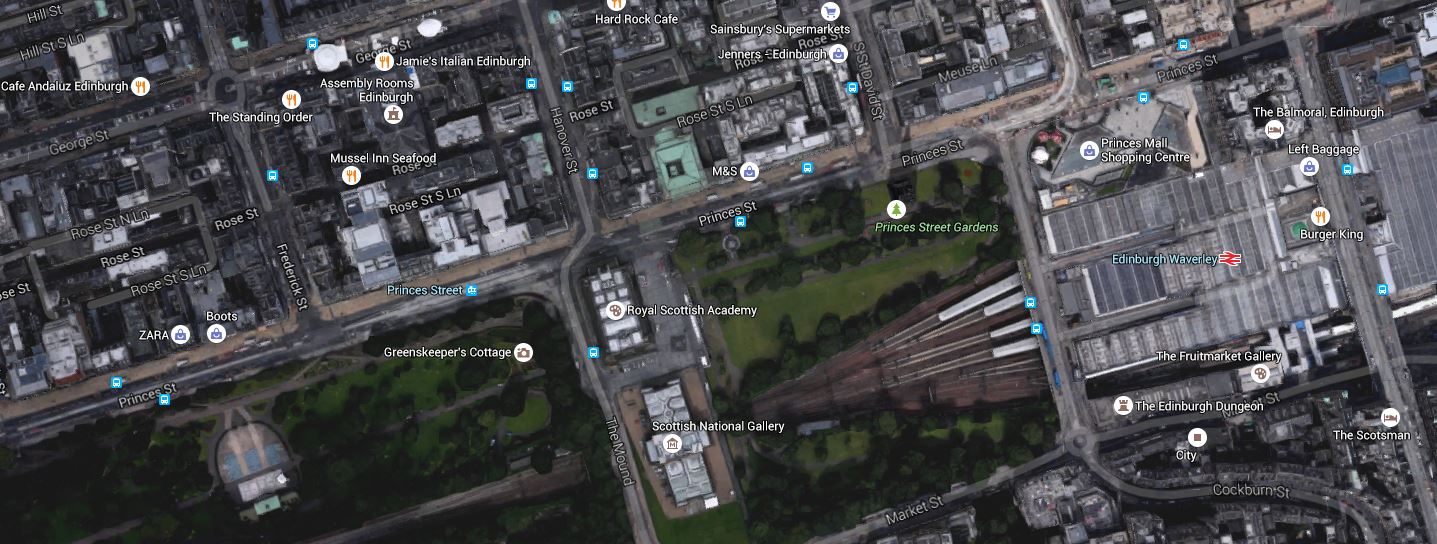
Waverley Station And Princes Street Gardens
Over lunch, I asked my friend, who’d lived in Edinburgh nearly all her life, , why there wasn’t a subway between the gardens and the station. She didn’t know and said there never had been! So as I walked back to the station, I took some pictures.



They show no evidence of a subway that might have been closed.
But they do show that if a subway could be built, then Edinburgh could have a World Class meeting place for when the weather was good.
Sorting The Trams
Seeing the map of Waverley station and the Princes Street Gardens, I have a feeling that if they were designing the Edinburgh trams now, they would be very different.
The difference is that in the last few years, tram-trains have come into general use in Germany. The Germans are getting enthusiastic about their use and large systems are being developed in cities like Karlsruhe, Kassel and Chemnitz.
In the UK, a test line is being added to the Sheffield Supertram, but how could tram-trains help solve the problems of Waverley station?
Trams coming from Edinburgh Airport and the West stop at Murrayfield Stadium tram stop and then move onto the street to call at Haymarket before going down Princes Street. New Class 399 tram-trains, as will be used in Sheffield, would follow the same route as the trams until Murrayfield. Passengers would find the only real difference would be that they had somewhere else on the destination board.
But at Murrayfield they would join the main railway lines and running as trains, they would call at Haymarket and Waverley stations.
The tram-trains could end their journey at Waverley or they could pass through the station and perhaps go on to further destinations like Dunbar or North Berwick. There would be no infrastructure modifications needed East of Waverley station, as the tram-trains would just appear to everything to be just another type of electric train.
If you look at the map in the Proposals for the Edinburgh tram network in Wikipedia, you’ll see this map.
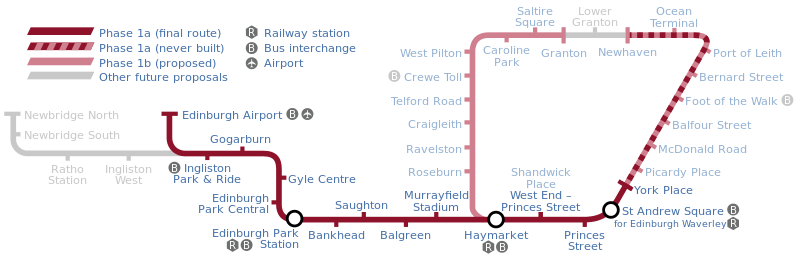
Edinburgh Tram Map
Note there is another Western destinations in addition to the airport and a loop to Newhaven and the Port of Leith. All come together at Haymarket. So services from the West could be run by trams or tram-trains as appropriate and those on the loop would probably be run by trams.
It should also be said, that the tram-trains could go anywhere to the East or West of the City, where there are electrified lines. Even Glasgow!
Edinburgh could have a lot of fun, without digging up the streets too much. Although, they’d probably need to do this, if they were going to extend the tram to Newhaven and the Port of Leith.
 The Anonymous Widower