Boost For Borders In New Report
This report on the Scottish Government web site is entitled Borders Transport Corridors – Pre-Appraisal.
It is a comprehensive report with a helpful pag of recommendations.
Recommendations that apply to rail include.
Develop Forestry Route Network
Improve network of internal forestry tracks as well as its connections to roads and railway, including ‘low-tech’ timber
pickup facilities.
This seems sensible, as some of the forests on both sides of the Scottish order are mature and need to be cut down and replanted.
Increase Park and Ride Provision
Increase capacity of existing Park-and-Ride sites and implement new Park-and-Ride schemes for all modes at strategic locations [e.g. Interchanges and Key Employment Areas]
Every part of the UK seems to need more Park-and-Ride. The Borders is no exception.
Borders Railway Extension – South/West
Extend the Borders Railway to Hawick and/or Carlisle
Will it go all the way to Carlisle?
Consider.
- The West Coast Main Line will need a capacity increase through Carlisle because of High Speed Two. These works could be combined with those on the Southern part of the Borders Railway.
- Plans exist for a large freight interchange at Longtown on the former MoD site.
- Linking the Tourist areas North and South of the Scottish Border by rail must be a good thing.
- Extension to Carlisle would give those in the Scottish Borders access to High Speed Two at Carlisle, without a long trip via Glasgow.
For these reasons, I think that the Borders Railway will go to Carlisle.
Borders Railway Extension – South/East
Extend the Borders Railway towards East Coast Main Line (ECML) via Berwick-upon-Tweed
This surprised me, but it does complete the jigsaw.
Does it offer a freight route for moving the timber out of the area?
It woulde certainly offer a scenic route between Edinburgh and Newcastle.
New Rail Stations
New rail stations on the existing Borders Railway
This is surely building on the success of the current Borders Railway.
Extension of Borders Railway Services
Link Borders Railway and Fife Circle, providing interchange at Edinburgh Gateway; West Edinburgh; and potential future link to Glasgow.
Back-to-back services across a city are always a good idea, as they cut the need for terminal platforms
- The Borders Railway and Fife Circle are both half-hourly services, so could be connected together, once suitable rolling stock is available.
- This service would also connect the Borders to the Edinburgh Airport tram at Edinburgh Gateway.
- With extra services, would the capacity of the Borders Railway will probably need to be increased?
Does the South East extension enable better services for the Borders beyond Edinburgh?
Conclusion
There are a lot of projects needing to be developed, but they will create a lot of economic activity in the Borders.
The two railway extensions to Hawick and/or Carlisle and Berwick-on-Tweed are the two most expensive projects, but both have English implications, so I don’t think Westminster will mind paying some of the cost.
Edinburgh Tourist Tax Could Be £2 Per Room, Per Night
The title of this post is the same as this article on the BBC.
Will it actually make any difference?
- I looked up the price of two nights in a Premier Inn in the City Centre for next week and they want to charge me £263.
- Glasgow was £137 and Stirling £105 for Premier Inns close to the stations.
- Will the tax apply to Airbnb?
I do think, we’re going to see some innovative tourist taxes and rewards.
For instance, all hotels in Geneva must give you a voucher for a day’s free travel on public transport. This applies for everything from a camp-site to a five-star hotel.
Some hotels in Hamburg, do something similar.
Edinburgh’s Missing Link
In Edinburgh, I’ve walked in an Easterly direction, several times through Princes Street Gardens, with the final intention of taking a train from Edinburgh station.
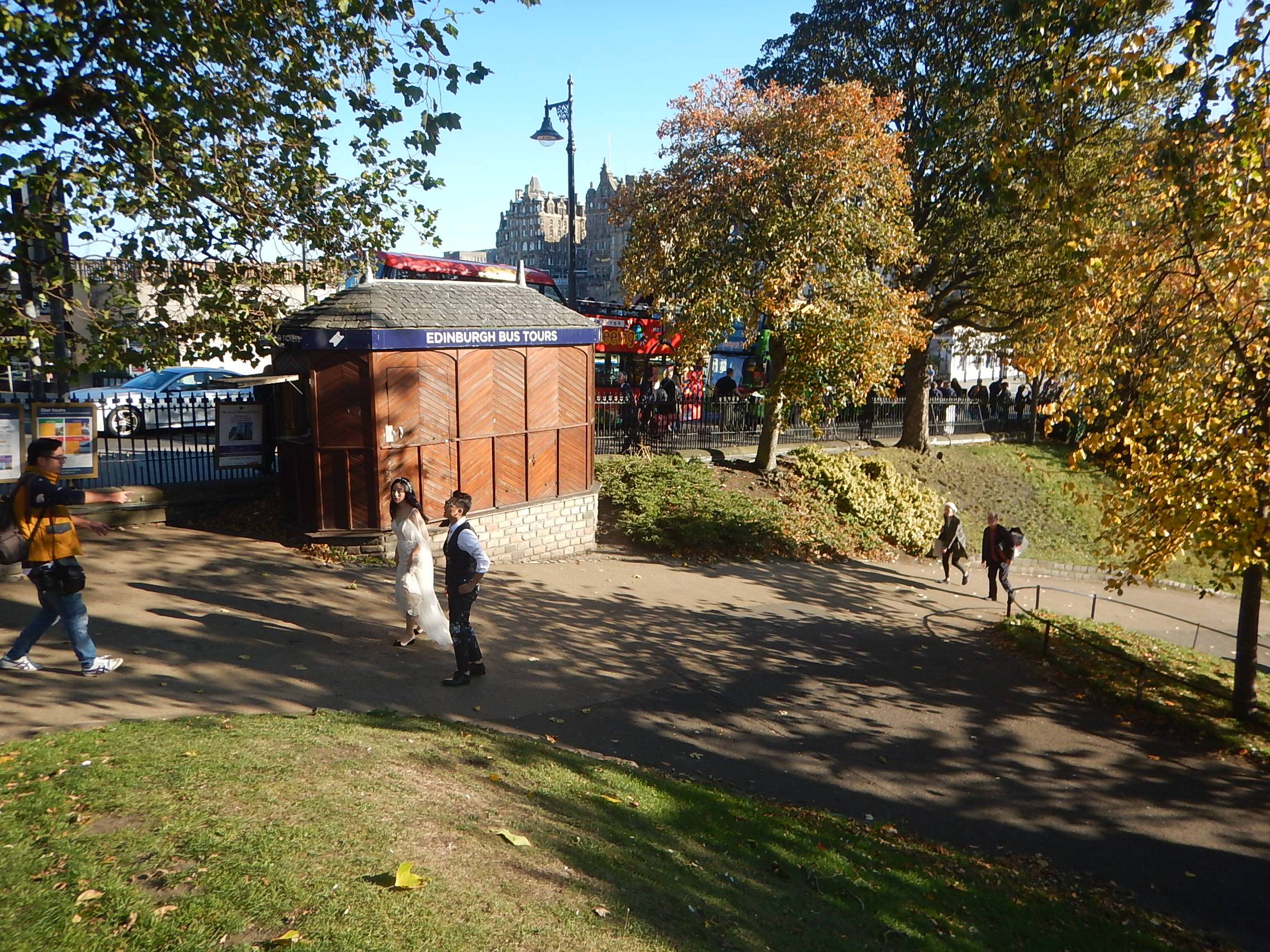
But as the pictures show, there’s no way through.
You have to walk up to the road, fight your way across a pedestrian crossing and then walk down a ramp into the station.
Why isn’t there a pedestrian tunnel?
London To Thurso Direct
According to Edition 863 of Rail Magazine, LNER are thinking of doing a demonstration run on this route to show off their new trains.
But is it such a daft idea?
In Rail Sleeper Plan Between Caithness And Edinburgh, I talked about a plan to operate a sleeper service on the route between Edinburgh and Thurso, which currently takes nine hours.
This journey time is definitely territory for those rail enthusiasts, who ride across America, Australia, Europe and Russia, but it is not for me.
But doing the route in day-long segments with a stop in a good hotel, in say Edinburgh and Inverness could open up an iconic tourism route to the Orkney Islands for an increasing number of intrepid travellers, many of whom, like me are past retirement age.
Travel on the Caledonian Sleeper to Inverness and you meet lots of foreign tourists from all over the globe.
On all days except Saturday, there are two services between Inverness and London; a day train to and from Kings Cross and a sleeper to and from Euston.
To go North on Day 1, you take eight hours on a direct train to Inverness, with after an overnight rest, you take four hours to Thurso.
Route Proving For The New Class 800 Trains
So if nothing else it is route proving for Class 800 trains on the service between Kings Cross and Inverness, which because it serves so many places on the Highland Main Line, is an important route to the area.
From the current schedule, it looks like the train will take twelve hours, so there will surely be a lot of driver training possibilities.
It surely, will be a good marketing exercise.
Highland Main Line Improvements
This archived document was produced by Transport Scotland.
This is the first paragraph.
Upgrading the Highland Main Line is one of the Scottish Government’s key priorities. The long-term goal of the project seeks to achieve a fastest journey time of 2 hours 45 minutes between Inverness and the Central Belt with an average journey time of 3 hours and an hourly service by 2025.
A time of three hours between Edinburgh and Inverness could be possible with electrification to Perth.
Far North Line Improvements
The Far North Line between Inverness and Thurso doesn’t appear to be built for speed, as it takes a train about four hours to do the journey.
- It is 167 miles from Inverness to Thurso.
- It is mainly single-track with passing places.
- There are twelve services on the line most days, with fewer on Sundays.
It should also be said, that Caledonian Sleeper are thinking of running a service between Thurso and Edinburgh and/or Glasgow, as I reported in
In the Wikipedia entry for the Far North Line, there is a section called Future Expansion, where this is said.
For many years there have been proposals to bypass the Lairg loop[note with a line across the Dornoch Firth, linking Tain (via Dornoch, more directly with Golspie. British Rail attempted to get funding for this when the road bridge was built, but the government declined.
Now this project would involve building a new bridge over the Firth, or making dual-purpose the bridge which now carries just the A9. Discussions have been held concerning the shortening of the Far North Line involving a bridge over the Dornoch Firth and the possible use of the trackbed of the former light railway. Nothing has yet come of these ideas.
If an hour could be knocked off the journey time, I suspect it would be very beneficial, to both the local population and visitors.
What Time Could Be Achieved?
I wouldn’t be surprised to see the time between London and Inverness reduced by the Class 800 trains in a couple of years, as the new trains will be able to use electricity South of Stirling and possibly Perth.
With the improvements to the Highland Main Line and better signalling on the East Coast Main Line, I could see a time between London and Inverness of under seven hours.
This would enable a civilised departure from London at say eight in the morning and still be in your castle, hotel or holiday cottage in time for dinner and a wee dram or several.
If improvements were made to the Far North Line, it might be possible to go from London to Thurso in ten hours.
Could The Class 800 Train Continue To Thurso?
A Class 800 train could continue to Thurso and LNER’s test run will probably prove whether it can or not!
It could arrive in Thurso, in time for the evening ferry to the Orkneys.
I think though, that the London service would not be extended to Thurso.
- The train would have to be fully-replenished at Thurso for the trip South.
- A nine-car train needed between London and Inverness would be too much capacity for the Inverness to Thurso section.
- The current Inverness to London service starts at eight in the morning and passengers wouldn’t be happy to leave Thurso at three to go straight through to London.
But I can see the reduced journey time between London and Inverness attracting more passengers to the route.
Enter The Shortened High Speed Train
This article on Rail Magazine is entitled ScotRail HSTs Enter Traffic On October 15.
This is the second paragraph.
Branded Inter7City as they will serve Scotland’s seven cities, the refurbished HST will run initially between Aberdeen and Edinburgh. More routes will follow as more sets arrive from refurbishment.
It also says that the refurbished HSTs will offer.
- More seats,
- Increased luggage space.
- At seat power sockets.
- Hospitality.
I would also expect wi-fi, comfortable seats, tables and big windows.
With their four or five Mark 3 coaches and two Class 43 power cars each with a diesel engine of around 2,200 bhp, these trains must have superb acceleration.
I estimate that a fully loaded four-car train carrying 250 passengers, will weigh about three hundred tonnes. This gives a power to weight ratio of 11.2 kW/tonne
By comparison, the the original 2+8 sets of the InterCity 125s have a power to weight ratio of 7.3 kW/tonne.
I will also add some other power to weight ratios.
- New Routemaster bus weighing twenty tonnes with 137 kW – 6.85 kW/tonne.
- Hummer H2 weighing 2.9 tonnes with 293 kW – 101 kW/tonne.
- Mini One weighing 1.2 tonnes with 75 kW – 62.5 kW/tonne
Incidentally, my Lotus Elan weighed about 1050 Kg when I was driving and had power of 121 kW. This gives a power to weight ration of 115 kW/tonne.
In Edinburgh to Inverness in the Cab of an HST, I described a memorable ride.
One thing I noticed, was that the driver controlled the two engines with considerable precision, to make sure, the train was on time on what must be a challenging route, as it climbed, descended and twisted through the Highlands.
With the same amount of power in a train only half the length and weight, I suspect these trains could save time effortlessly, as a good driver in a sports car can on a twisting road.
Also, don’t underestimate the contribution, the replacement of the 1970s-style slam-doors with modern powered units, will contribute at every stop.
I looked at the actual times yesterday of the 12:00 between Kings Cross and Inverness and compared to my journey in the cab, there are less stops. So services are being speeded up and I suspect ScotRail’s trains stop more often.
Transport Scotland talked about a fastest time of two hour forty-five minutes between the Central Belt and Inverness.
When the route between Inverness and Perth has been fully modernised with passing loops, I have a feeling that times will be faster.
They will not only be an iconic forty-year-old train, but a tourist attraction in their own right, like Scottish mountains, tartan food and whisky.
Get Up In London And Go To Bed In The Orkneys
If LNER have an objective in testing London to Thurso with a Class 800 train,, it must be finding a civilised way, to be able to get between London and the Orkneys, by train and ship in both directions within a single day.
Consider.
- The first train from Kings Cross to Edinburgh leaves just after 06:00.
- There has been an aim to run services between the two capitals in under four hours for as long as I can remember.
- Modern in-cab signalling is being rolled out on the East Coast Main Line to enable 140 mph running.
- The last ferry to the Orkneys leaves from Scrabster near Thurso at 19:00
With the improvements to the Highland Main Line and electrification to Perth, three hours between Edinburgh and Inverness should be possible in a Class 800 train or a well-driven shortened HST.
This would give LNER options to get to Inverness at a reasonable hour of the day.
Run An Early Train From London To Inverness
This could be timed to leave London at 06:00 and it could be in Inverness at 13:00.
This would give a fast train on the Far North Line six hours, including transfer to move passengers between Inverness and Scrabster.
It looks that ScotRail have the train for the job, in the shape of the shortened HST.
They could also serve an early Scottish dinner, to prepare tourists, for what could be a breezy crossing.
Run A Pair Of Class 800 trains To Both Aberdeen And Inverness
LNER’s Class 800 trains come in two sizes; five-cars and nine-cars.
Two five-cars can run as a ten-car train, that can split and join as required, in under two minutes in a suitable station.
So could we see a pair of five-car Class 800 trains leave Kings Cross and run together to Edinburgh, where one train went to Dundee, Montrose, Stonehaven and Aberdeen and the other went to Stirling, Perth and Inverness.
Consider.
- The first train from Kings Cross to Aberdeen leaves at 07:00 in the morning.
- The journey takes six hours.
- There are three trains per day between London and Aberdeen.
- The last direct train that is not a sleeper service leaves just before 15:00.
- As with the route to Inverness, the route to Aberdeen is not electrified.
I think this option has advantages
There would be an early morning service to Edinburgh and many of the large towns and cities in Eastern Scotland.
The service only uses one path on the East Coast Main Line between London and Edinburgh.
If traffic patterns and passenger numbers are favourable, other Aberdeen services could split and join.
Running a five-car train to Inverness earlier in the day, before the main train of the day, may be a way to provide an economic service to Thurso.
- A five-car train would probably be more affordable to run.
- The train would be stabled at Thurso overnight.
- It would leave for Inverness, Edinburgh and london about 10:00.
- At Edinburgh, it could join up with an Aberdeen train at around 16:00.
Time-tabled properly, it could result in Inverness and Aberdeen getting an extra train to and from London every day.
Change At Edinburgh
Plans by various rail companies for services include.
- LNER will continue to run two trains per hour (tph) between Edinburgh and England.
- LNER would like to run services between London and Edinburgh in under four hours.
- TransPennine Express will run more services to Edinburgh.
- ScotRail will run hourly services between the seven major cities in Scotland.
- Edinburgh to Inverness and Inverness to Thurso should both to become three hour journeys.
Edinburgh will become a very well-connected city.
If Edinburgh to Thurso could be achieved in six hours, then any service leaving Edinburgh after about 14:00 would catch the last ferry at Scrabster for the Orkneys.
When trains between London and Edinburgh, are regularly achieving the four-hour journey, there will be several trains, that will give a change in Edinburgh suitable for passengers individual preferences.
A single change at Edinburgh could be the preferable route for many.
Conclusion
Because LNER, ScotRail and other train companies now have a large fleet of very capable trains on order, there are several possibilities to create a world-class train service to connect Scotland fully both internally on the mainland and to important destinations in the islands and England.
The renaissance of the HST as a train to provide high-quality services has been astounding.
- ScotRail are creating twenty-six shortened HSTs for use within Scotland.
- GWR are creating eleven similar trains for use between Penzance and Cardiff.
I would be very surprised, if more HSTs are not refurbished to modern standards.
Germany may have the Volkwagen Beetle, but we have the High Speed Train.
Could we see them on the following routes?
- Oxford and Cambridge
- Waterloo and Exeter
- North Wales Coast Line
- Some Cross-Country services
There’s probably enough power-cars and coaches to make another fifty shortened HSTs, so if ScotRail’s trains are a success, I suspect we’ll see some imitation.
I suspect too, that just as engineers have found solutions to the problems in the coaches like the doors and the toilets, they will find a solution, that replaces the diesel engine in each power with some form of more eco-friendly hybrid power pack.
Consider.
- MTU, which is a subsidiary of Rolls-Royce, are developing hybrid power packs for diesel multiple units.
- There is a lot of space in the engine compartment of the power car.
- On most routes, 90-100 mph running will be sufficient.
Hitachi converted a power-car to work in this way ten years ago.
Moving Football From Hampden To Murrayfield Is Vandalism
The title of this post, is the same as that of this article in The Scotsman.
I’m not bothered, as I doubt, I’ll ever go to Scotland to watch an important Scottish football match, that would be played at their National Stadium.
But, I have been to Hampden Park before.
I was there fifty years ago, when Spurs and Celtic drew 3-3 in the Glasgow Cup. I also suspect that the 91,000 plus crowd was the largest, I’ve ever been part of.
And I was at Hampden to see the athletics in the 2014 Commonwealth Games.
I have no view on the historic aspects of the possible move, except that there might be an economic case.
And I also note, France, the Republic of Ireland and Wales all have a stadium, that is shared between football and rugby.
But then Germany and Italy don’t have a national stadium for football.
I can see another big argument between Edinburgh and Glasgow on this decision.
Other the last decade though, transport links between and to and from Scotland’s two major cities have changed.
- There have been extensions to the road network across Scotland.
- The rail lines are being electrified and new higher-capacity Class 385 trains are being delivered.
- Passenger numbers at both Glasgow and Edinburgh Airports have grown.
So at least getting to either stadium is becoming easier.
It will be a difficult decision to call.
Eurostar To And From Amsterdam
On Tuesday I took Eurostar to Amsterdam.
The trip took three hours and forty-one minutes with stops at Brussels and Rotterdam.
The Brussels stop allows passengers to leave and join, but Rotterdam only allows passengers to leave.
As the number of passengers grow between London and Amsterdam, could there come a time, when some or all Amsterdam services don’t need to stop at Brussels.
If so, how much time would this save?
Current stops by Eurostar take the following times.
- Ashford – 9 mins.
- Calais – 3 mins
- Ebbsfleet – 6 mins.
- Lille – 14 minutes
These times have been calculated by looking at similar services that have different stopping patterns.
Note that, Calais and Ebbsfleet are faster as they are stops on the direct route.
So I suspect that if an Amsterdam service could go through Brussels without stopping, something between 9-12 minutes could be saved.
This could bring the journey time between London and Amsterdam closer to three and a half hours.
What would that time do for sales of tickets?
Eurostar Hold A Lot Of Cards
Eurostar are in a very good position on this route.
- They could run a flagship express service twice a day for those in a hurry.
- This could be backed up by slightly slower services calling at places from or to where passengers want to go. These would include Ebbsfleet, Ashford and Antwerp.
- Immigration and security clearance is probably under thirty minutes at the start of the journey and perhaps ten at the end.
- Immigration and security times will be reduced, as procedures get better.
- St. Pancras, Rotterdam Centraal and Amsterdam Centraal are all very well-connected stations.
- Extra services can be added as demand dictates.
- Eurostar is more diabled-friendly and those in smaller scooters can drive in!
- They could extend some Brussels services to Amsterdam.
- I estimate that just under 4,000,000 people live within the North and South Circular Roads and have easy access by public transport to St. Pancras.
They can also create a very intelligent booking computer system, that optimises their services. Budget airlines have been doing this for years.
What About The Airlines?
Note the numbers of passengers who fly.
According to Skyscanner, there are upwards of two hundred flights a day between London and Amsterdam. An Airbus A320 holds 150 passengers, so if there are only a hundred per flight, that is 20,000 passengers per day.
Looking at the 6th of June, Eurostar are running nine trains between London and Brussels. As each new Class 374 train can hold 900 passengers, that is around 8,000 seats per day.
So the airlines have much more capacity than Eurostar and they can add and remove it, easier than Eurostar can?
The Comfort Factor
I haven’t travelled in steerage on the new trains, as I always pay about thirty-forty pounds extra for Premium Economy, so I get the following benefits.
- A very pleasant gluten-free meal.
- A much more spacious environment.
- It’s also rare that I don’t get a window seat.
But if I did use steerage, it would be a more pleasant experience than flying on a budget airline.
I think it’s been about ten years since I flew to a city within a two-hour flight of London, where there was a rail alternative.
I also tend to come home by rail, where I often get a connection to Brussels or Paris to catch a late Eurostar to London.
Comparing London-Amsterdam With London-Edinburgh
Both routes take about four hours by train, with the Dutch route slightly quicker.
Generally, trains operate between London and Edinburgh half-hourly for much of the day, whereas Eurostar only runs twice a day.
Amsterdam/Rotterdam/Schipol Airport is surely a much bigger market in terms of possible passengers, than the Edinburgh catchment area.
I think we’ll see the astute Dutch, using Eurostar as a marketing tool to attract more passengers to the Netherlands and London’s next airport at Schipol.
Especially, as the British seem very happy with a four-hour train ride in comfort.
Eurostar Will Grow Between London And Amsterdam
For these and other rambling reasons, I think that Eurostar to Amsterdam will grow to be a successful route.
The one thing they must do, is to make it possible to come back to London, without having to clear immigration and security in Brussels.
But Eurostar know that!
Amsterdam Is Just The Hors D’Oeuvre!
Once Eurostar and the Dutch get the route between London and the Netherlands working smoothly, I don’t think it will be long before other routes are inaugurated.
Eurostar have said these could be.
- Bordeaux
- Cologne and Frankfurt
- Geneva
The key will be getting the immigration and security smooth.
I think it will continue to improve, as it seems to do, every time I travel.
Remember, the Belgians, Dutch, French, Germans and Swiss will want it to be smooth, as they will want to market their delights to a whole new market, so suspect a lot of co-operation, despite the decision of Brexit.
But, I think that a limit on a journey time of four or five hours would cut out a lot of other destinations.
Although many of the destinations like Brussels, Cologne, Frankfurt, Geneva and Paris will be places to have an enjoyable day or two before taking another train ride further afield.
The 15:00 From Amsterdam Centraal To Berlin
This train that leaves Amsterdam Centraal just under two hours after the Eurostar arrives and can take you all the way to Berlin, arriving at 21:22.
But this train with a change at Osnabruck, gives you a stopping-off point to Bremen, Hamburg and the Northern part of Germany.
I first came across Osnabruck, when I was left there without a train by Deutsche Bahn, as I wrote about in From Hamburg To Osnabruck By Train.
But I found a delightful hotel on the station forecourt, called the Advena Hotel Hohenzollern.
Trip Advisor give it four out of five and currently say deals are available at under seventy pounds a night.
Osnabruck is not a tourist town, but it sits where the North-South and East-West rail routes cross.
Conclusion
As the network develops, I believe that a whole new form of tourism will take advantage.
The Scotsman Gives A Warm Welcome To The Class 365 Trains
This article on the Scotsman is entitled New ScotRail Trains To Ease Crush On Edinburgh-Glasgow Line.
The article also has a rather interesting picture of a lorry-mounted train negotiating heavy traffic in Glasgow.
It broadly welcomes the Class 365 trains, and this is a comment from a rail group.
Andrew Stephen, of rail lobby group RailQwest and the Cumbernauld Commuters Association, said: “The Class 365s are perfectly serviceable and comfortable trains – and it is fortunate more than a few four-car sets are available.”
The article also confirms that ten trains will be going North.
As there are a total of forty of the Class 365 trains, that will be replaced by Class 387 trains and new Class 700 trains, I wonder where the others will be deployed.
ScotRail Hires In Class 365s For Glasgow-Edinburgh Route
The title of this post, is the same as thsat of this article on Rail Magazine.
This is the first paragraph.
Three Class 365s have been leased by ScotRail, with more to follow. They will be used on an interim basis on the Edinburgh-Glasgow Queen Street via Falkirk High route while windscreen modifications are made to Class 385s
The Class 365 trains may have been delivered in 1995, but they are no scrapyard specials.
I recently rode one to Cambridge and although some things are dated, the ride is good and they are 100 mph trains, just like the Class 385 trains.
Wikipedia and others reckon that as many as ten trains will go to Crossrail.
How Do The Trains Compare?
The trains are of different generations but how do they compare?
Train Length
On the major route, between Edinburgh and Glasgow, it is intended to run Class 385 trains as seven-car trains formed by a three-car Class 385/0 train
and a four-car Class 385/1 train. As the cars are twenty-three metres long, that gives a train length of 161 metres.
Each four-car Class 365 train is 81.9 metres long, so an eight-car unit would be just under 164 metres.
I doubt that three metres would cause too many platform-length problems.
Capacity
The capacity of a three-car Class 385/0 is 206 seats, so I suspect a four-car Class 385/1 would seat around 275. This would give a total capacity for the seven-car train of 481 seats.
I can’t find the capacity of a Class 365 train, but it has 2 +2 seating and a fair sprinkling of tables, so I suspect the capacity of the two different formations is not that different.
Operating Speed
Both trains have a 100 mph operating speed.
Passenger Comfort
I suspect that the Class 385 trains will be more to the standard ciustomers expect, wth wi-fi and power sockets and probably more tables.
But the Class 365 trains are one of the better 100 mph long-distance commuter trains, rating above Thameslink’s new Class 700 trains and below the Class 387 train.
Conclusion
The Class 365 trains will make quality substitutes.
NR Set To Reach Major Shotts Electrification Milestone Over Easter
The title of this post is the same as that of this article in Rail Technology Magazine.
I’m not totally sure, but it looks like they will complete the overhead wires between Edinburgh and Glasgow along the Shotts Line.
They certainly seem to be moving on apace with electrification in Scotland, unlike around the North West of England.
Exploring The North Berwick Line
The service between Edinburgh and North Berwick stations is going to be one of the first to get the new Class 385 trains.
So I took a quick trip.














The North Berwick Line appears to be a well-maintained line with tidy, simple stations and copious car-parking.
North Berwick station shows how you can have a single-platform station handling two trains per hour (tph), where both are six cars.
The North Berwick Line is becoming increasingly busy and the six-car train I rode out of Edinburgh at ten in the morning was surprisingly busy.
New Class 385 Trains To North Berwick
The current Class 380 trains were built in 2009-2011, so why are the trains being replaced with Class 385 trains on this route?
Both trains have the following shared characteristics.
- 100 mph running.
- Three- or four-cars.
- Modern interiors.
- Ability to run in pairs with through gangways.
I think that the big difference is that the newer Hitachi trains will have wi-fi and possibly a 4G connection.
But other than that, the two trains would be interchangeable.
Glasgow To Edinburgh Services
There is also the fact that Abellio seem to be very expansive with the plans for their franchises in the UK.
As some of the North Berwick services start at Glasgow Central station, could it be that Scotrail are planning to use North Berwick as the terminal for a two tph Glasgow Central to Edinburgh via Motherwell service, in addition to all the other services going to Glasgow Queen Street station.
Effectively, by using North Berwick, they gain a much needed extra platform at Edinburgh.
ScotRail might have also decided that all Glasgow to Edinburgh services should be equipped with wi-fi and run by the new Hitachi trains.
Expansion Of Suburban Services East Of Edinburgh
Passenger numbers are rising at North Berwick station and last year there were over half a million passengers.
The single platform handling six-car Class 380 trains can probably handle several hundred passengers an hour.
But look at this Google Map of the station.

Is there enough car parking for this number of passengers?
When it is considered that with modern signalling, it might even be possible to inrease the frquency to North Berwick to three or even four tph, the platform would cope, but routes to the station probsbly wouldn’t.
There have been proposals to reopen a station at East Linton, a few miles away on the East Coast Main Line. In the Wikipedia entry for the station, this is said under The Future.
Proposals to reopen the station, along with the former station at Reston, have received the backing of John Lamont MSP, who has taken the case to the Scottish Parliament. A study published in 2013 proposed that East Linton and Reston stations be reopened. Since Abellio ScotRail took over the franchise in April 2015, they have now committed to reopening East Linton and Reston Stations as part of the local Berwick service by December 2016 but due to the shortage of rolling stock this will now commence in December 2018.
As now the extra trains are being delivered, a station at East Linton must be increasingly possible.
Would a rebuilt Reston station be used as a terminus?
This Google Map shows the village of Reston with the A1 and the East Coast Main Line.
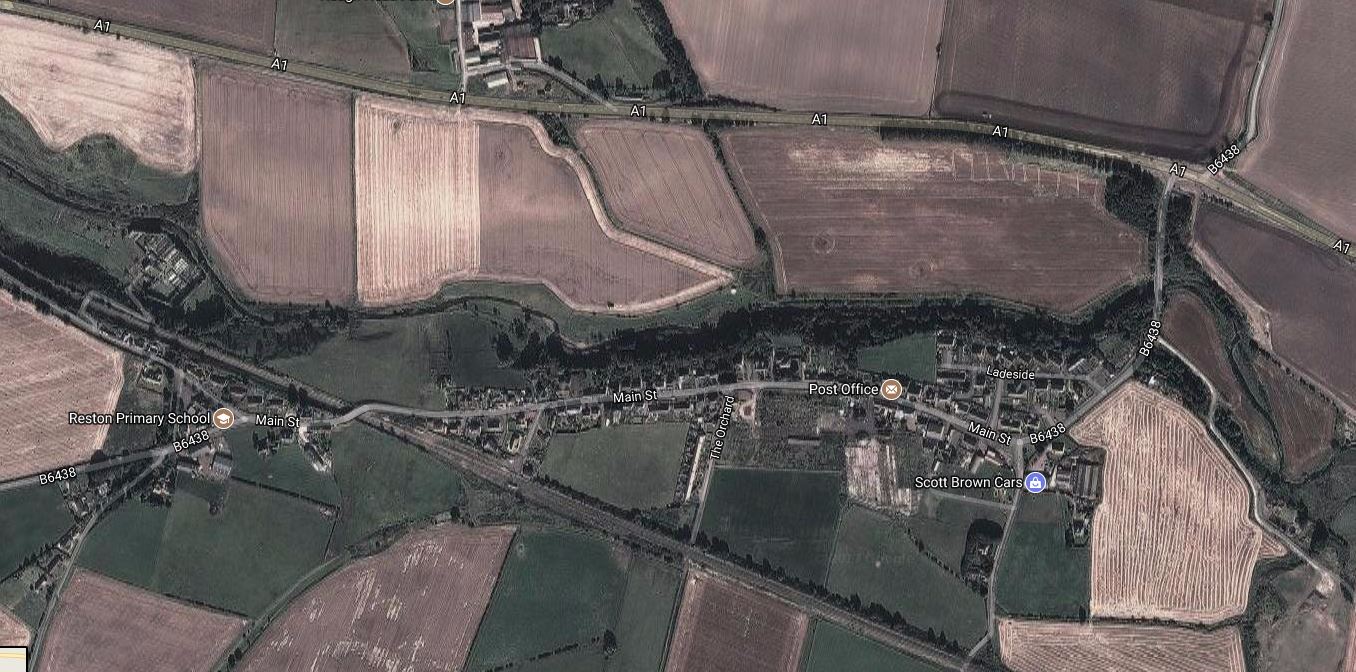
Could Reston station be rebuilt as a Park-and-Ride station with perhaps a bay platform for suburban services from Edinburgh?
Consider.
- Space doesn’t seem to be a problem.
- Drivers from the South and West might be tempted to abandon their cars and use the train.
- Reston could be a terminus for Glasgow to Edinburgh services.
Scotrail certainly have possibilities to develop an electric service between Edinburgh and Glasgow, that is a lot more than just a simple link between the two major cities.
Conclusion
The electrified Edinburgh to Glasgow service could develop into a fast and frequent Crossrail For Scotland.

