The Future Of Drax Power Station
This first paragraph from the Wikipedia entry for Drax power station gives a factual description of the power station.
Drax power station is a large biomass power station in Drax, North Yorkshire, England. It has a 2.6 GW capacity for biomass and had a 1.29 GW capacity for coal that was retired in 2021. Its name comes from the nearby village of Drax. It is situated on the River Ouse between Selby and Goole. Its generating capacity of 3,906 megawatts (MW), which includes the shut down coal units, is the highest of any power station in the United Kingdom, providing about 6% of the United Kingdom’s electricity supply.
This second extract from Wikipedia gives details of its current biomass contract and subsidy.
Drax’s subsidy scheme was scheduled to end in 2027, with Drax arguing for an extension to 2030. In February 2025, the UK government extended its operation from 2027 to 2031, but at a reduced 27% maximum load factor using 100% sustainable wood, so it would run “less than half as often as it currently does”, generally only at times of high electricity demand. Drax was given a contract for difference at £113/MWh in 2012 pounds, CPI inflation linked so about £155/MWh in 2025.
Note.
- Rishi Sunak’s Government extended the contract.
- It will now run on 100% sustainable wood, which includes sources like sawmill residues, forest thinnings and certain agricultural products.
- It has a similar type of contract to wind farms and energy storage.
I asked Google AI,”Does Drax Power Station Provide Grid Stability?, and received this answer.
Yes, Drax Power Station—along with its affiliated hydro assets—provides critical grid stability to the UK. As the UK’s power grid shifts toward intermittent renewables like wind and solar, Drax’s dispatchable generation and specialized system support services help maintain a secure electricity network.
The key stability services provided by the Drax portfolio include:
Inertia: Drax’s large spinning turbines and pumped hydro facilities provide vital inertia to the grid. This acts like a shock absorber, helping to control changes in frequency (maintaining 50Hz) and preventing power cuts.
Reactive Power: The facilities help manage voltage support and move power efficiently across different parts of the network.
Dispatchable Power: Unlike weather-dependent generation, Drax’s biomass and hydro plants can be ramped up or down on demand, providing firm capacity and flexible response to real-time grid needs.
Pumped Storage Support: Through its subsidiary Cruachan Power Station in Scotland, Drax operates a pumped hydro storage plant that actively balances supply and demand and holds specialized stability contracts with the National Grid Electricity System Operator (ESO).
So if you love or loathe the power station, it does a lot more than burn biomass to generate electricity.
Drax Power Station And Eastern Green Link Two
The Eastern Green Link Two web site is here.
This is the sub-heading
Eastern Green Link 2 (known as EGL2) is one of the most significant strategic energy infrastructure developments the UK has seen in recent years, connecting the north of Scotland to Yorkshire via the sea.
These two initial paragraphs gives more details.
EGL2 is a 505km electricity superhighway which will enable the transfer of power from Scotland to England (and vice versa) via a subsea cable. This two-gigawatt high voltage direct current (HVDC) cable is connecting Peterhead in Aberdeenshire and Drax in North Yorkshire and once operational, will carry enough electricity to power two million homes.
EGL2 will scale up the UK’s capacity to transport home-produced clean energy, predominantly from offshore wind, from where it is generated to where there is demand. By doing so it will increase the security, resilience, and stability of the UK’s transmission network.
EGL2 is the second of a planned seven interconnectors between Scotland and the South.
The first was the Western HVDC Link between Hunterston in Scotland and Flintshire Bridge in Wales, which became operational in 2013.
EGL2 will go between Peterhead in Scotland and Drax power station.
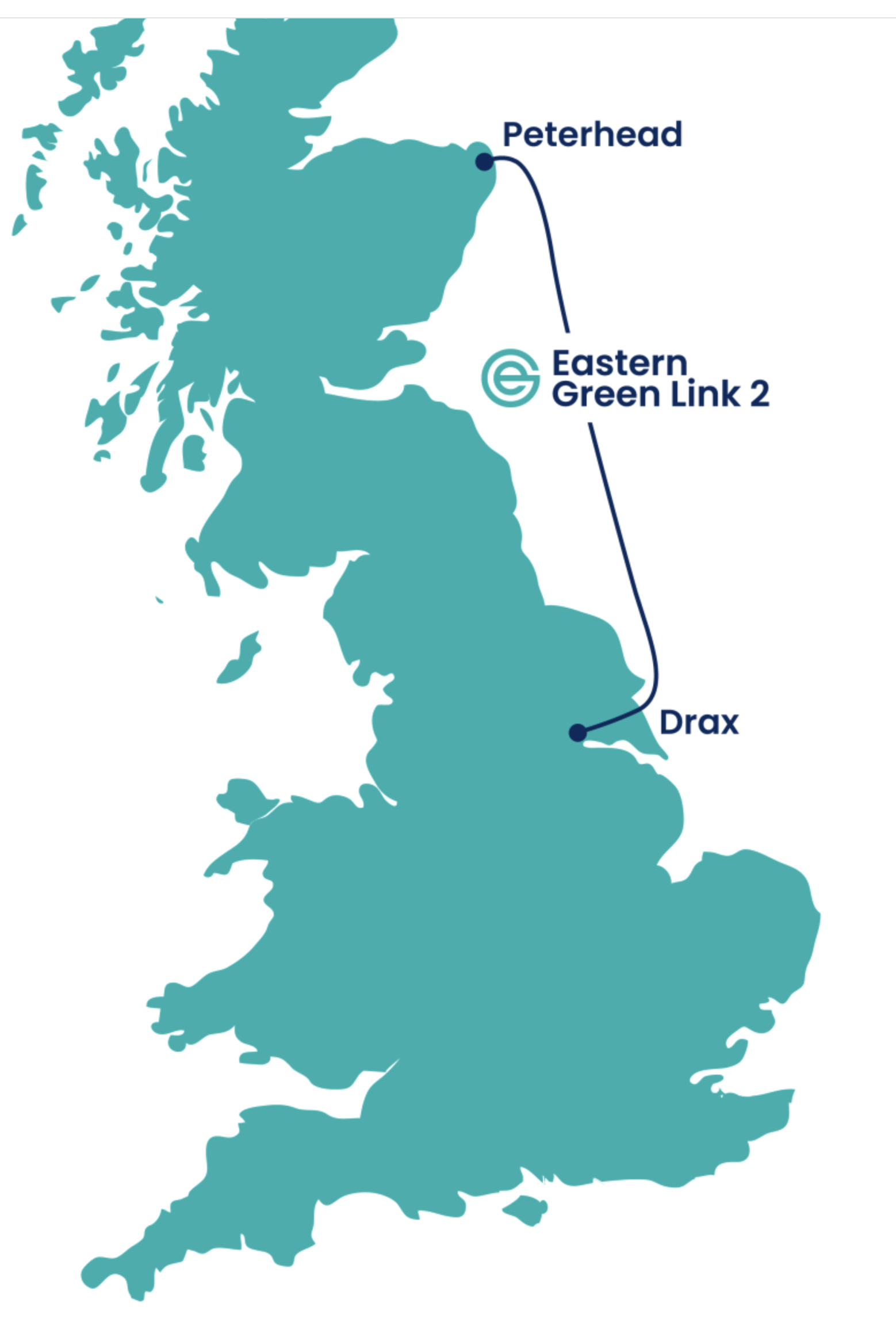
So electricity from Scotland will be able to replace up to two GW of the biomass, that Drax power station currently uses as fuel.
Drax And Solar Power
This Google Map shows Drax power station.

If Drax wanted to add solar power to the site, I’m sure it would be possible.
- There is plenty of space.
- There is a substantial connection to the electricity grid.
After the purchase of Bluefield Solar Income Fund, Drax probably are well-placed to develop as much solar-power as they need.
The Future Of Drax Power Station
Drax power station is not liked by a lot of environmentalists.
I have been thinking about the future of the power station and the public company that owns it.
Drax power station has a nameplate capacity of around 2.5 GW running on biomass.
It also will be the Southern end of EGL2, which will be an undersea electricity 2 GW superhighway distributing Scottish wind power from Peterhead in Scotland. So the dreaded biomass hated by certain groups will be relegated from the Premier League of electricity generation and replaced by Scottish wind.
As reported in various publications, Drax has signed a deal in the US, so that the biomass can be used for the production of sustainable aviation fuel (SAF)
To my mind, the Drax site could be an ideal one for one or more small modular nuclear reactors.
- The large Drax site has been producing electricity for 52 years.
- In 1986, the site produced nearly 4 GW of electricity.
- I would suspect that the substations on the site could be enlarged to distribute 4 GW of electricity.
- EGL2 will bring in 2 GW of Scottish wind-generated electricity.
- The site has excellent rail connections.
- The site has twelve cooling towers and is encircled by the River Ouse.
- Could all this water be used for cooling the small modular nuclear reactors.
I believe that perhaps three small modular nuclear reactors could be built on the Drax site to backup EGL2 and bring a reliable source of sustainable power to Yorkshire.
Drax is also only about forty miles from the vast hydrogen stores at Aldbrough and Rough, so if Drax needed, if could use excess electricity to create hydrogen for storage.
SSE is consulting on a 1+ GW hydrogen power station at Keadby, so perhaps Drax should have a similar hydrogen power station on its site?

