TRISO-X Completes Vertical Construction Of TX-1 Fuel Fabrication Facility
The title of this post, is the same as that of this news item from X-energy.
These two bullet-points act as sub-headings.
Completion of vertical construction marks major milestone for first-in-the-nation commercial scale advanced nuclear fuel fabrication facility
Project advances into interior buildout, fuel fabrication equipment installation and construction of supporting facilities
These two paragraphs add more detail.
TRISO-X, LLC (“TRISO-X” or the “Company”), a wholly-owned subsidiary of X-Energy, Inc. (Nasdaq: XE) (“X-energy”), today announced the completion of vertical construction at TX-1, its first-in-the-nation advanced nuclear fuel fabrication facility in Oak Ridge, Tennessee. The milestone completes the primary building structure of the 214,000-square-foot facility and enables the project to advance fully into its next phase of construction, including interior buildout, installation of fuel fabrication equipment and continued construction of supporting facilities.
“Completing vertical construction is a major milestone for TX-1 and another tangible demonstration of the progress our team is making in Oak Ridge,” said Joel Duling, President of TRISO-X. “We are moving from constructing the core and shell of the facility to building out the interior utilities, installing manufacturing equipment, and constructing key support capabilities. Every milestone brings us closer to establishing a new domestic source of advanced nuclear fuel and supporting the deployment of the next generation of American nuclear reactors.”
Note.
- Oak Ridge is one of the United States premier nuclear facilities.
- It would be like building a similar facility for specialist nuclear reactor fuel at Harwell in the UK.
This is without doubt a very professional start to the X-energy programme.
I also feel that the fourth paragraph has important information.
Once operational, TX-1 is expected to produce approximately 700,000 TRISO-X fuel pebbles annually, equivalent to 5 metric tons of uranium (“MTU”), with capacity to provide fuel for up to 11 Xe-100 reactors. The U.S. Nuclear Regulatory Commission (“NRC”) granted TRISO-X a 40-year Special Nuclear Material License for the facility earlier this year, the first-ever NRC Category 2 fuel fabrication license issued for the processing of high-assay low-enriched uranium. TX-1 is expected to be the first new commercial-scale advanced U.S. nuclear fuel fabrication facility built in more than 50 years.
Note.
- TX-1 will be able to support eleven Xe-100 reactors.
- Four Xe-100 reactors will be built initially at Dow’s Seadrift site.
- In Hartlepool Nuclear Reactor Moves To UK Regulatory Assessment, I said that Hartlepool will eventually be a 12-pack site.
I can envisage a fuel strategy based on TX-1, which is something like this.
TX-1 will provide the TRISO fuel for the four reactors at Dow’s Seadrift site.
TX-1 will provide the TRISO fuel for the initial reactor or reactors at a new site like Hartlepool, or for other licensees like Amazon or North Western.
TX-1 will be cloned as necessary to create TX-2, TX-3, TX-4 etc. as more Xe-100 reactors are built.
I am sure, that there is relevant expertise to make TRISO-X fuel pebbles safely in Japan, Korea and the UK of the known partners of X-energy.
The Wikipedia entry for the Dragon reactor finishes with these three paragraphs.
The choice of helium coolant was made after a long debate within the UKAEA between proponents of helium and carbon dioxide, with helium ultimately selected. Groundbreaking occurred in 1960. It operated from 1965 to 1976, and is generally considered extremely successful.
Dragon’s construction was followed by similar work in the US, leading ultimately to the much larger Fort Saint Vrain Nuclear Power Plant. This suffered from a number of problems due to corrosion and the customer soured on the design. Contracts for similar models in the US that were being signed were cancelled, and although Dragon suffered none of these issues, no orders were forthcoming in Europe either. By this time the market had largely standardized on the pressurized water reactor (PWR) for the large buildout that occurred during the 1970s and 80s, and the decision was made to shut down Dragon.
As of 2023, Dragon is being decommissioned.
Note.
- It appears only two reactors using TRISO fuel have been constructed.
- The 20 MW Dragon reactor was extremely successful.
- The 330 MW Fort Saint Vrain reactor had corrosion problems.
- Both reactors used helium gas as a coolant.
- The Wikipedia entry for the Fort Saint Vrain reactor details the corrosion problems.
- According to Google AI fuel for Fort Saint Vrain was fabricated at the General Atomic Fuel Fabrication Facility in San Diego, California.
- According to Google AI fuel for the Dragon reactor was fabricated on-site at Winfrith.
After writing these seven points, I have concluded that TRISO-fueled helium-cooled nuclear reactor designs better suited to small reactors?
What does Google AI think?
I asked Google AI “Are TRISO-fueled helium-cooled nuclear reactor designs better suited to small reactors?” and received this reply.
TRISO-fueled, helium-cooled reactor designs are exceptionally well-suited for small and micro-modular reactor applications because their physical properties scale down efficiently to provide inherent safety and high-temperature operation.
Why They Suit Small Reactors
Inherent Safety (Walk-Away Safe): Each TRISO fuel particle acts as its own tiny containment system, capable of withstanding extreme temperatures (well over 1,600°C) without melting or releasing radioactive fission products. In a small reactor design, the high surface-area-to-volume ratio allows residual decay heat to dissipate passively through the reactor vessel walls, meaning the reactor cannot suffer a catastrophic meltdown even if active cooling completely fails.
Simplified Helium Cooling: Helium is chemically inert and does not absorb neutrons or become radioactive. In smaller reactor configurations, helium’s single-phase gas state eliminates the high-pressure water loops and massive containment structures required by traditional large light-water reactors.
High-Temperature Process Heat: Because helium can operate at very high temperatures without boiling off, small TRISO-gas systems can deliver high-grade industrial heat (useful for chemical plants or hydrogen production) alongside electricity.
Compact Footprint: Small modular reactor (SMR) and microreactor developers (such as X-energy and Ultra Safe Nuclear Corporation) leverage these traits to design factory-fabricated units that can be transported and sited near urban or off-grid industrial locations.
Key Challenges
Power Density and Size: Helium has a lower volumetric heat capacity than water, meaning gas-cooled cores can be physically bulkier per megawatt than water-cooled equivalents, placing a premium on optimizing core geometry for micro-scales.
Supply Chain and Cost: High-Assay Low-Enriched Uranium (HALEU) and specialized TRISO manufacturing face immature supply chains and higher first-of-a-kind costs.
The more I read about X-energy’s technology, the more I like it.
Centrica, X-energy Advance Nuclear Plans As UK Regulators To Begin Design Review For Xe-100
The title of this post, is the same as that of this press release from Centrica.
This is the sub-heading.
On the one-year anniversary of the Centrica X-energy partnership being signed, the UK Government has directed regulators to accept the X-energy Xe-100 Advanced Modular reactor into the Generic Design Assessment, marking a significant step toward UK commercial licensing.
Under their partnership, the companies intend to deploy up to 6 GW of new nuclear capacity in the UK (10-20 Xe-100 power stations depending on size of each installation)
These first two paragraphs add some details.
Centrica and X‑Energy, Inc., a leading developer of advanced nuclear reactors and fuel technology, today announced that X‑energy’s Xe‑100 Generation IV advanced Small Modular Reactor (“SMR”) has been accepted into the United Kingdom’s Generic Design Assessment (“GDA”) process.
GDA acceptance formally triggers the process of assessing the design’s acceptability for deployment and operation ahead of the technical and environmental evaluations required for site‑specific licensing and permitting. The assessment is expected to take approximately three years and will be administered by the UK Office for Nuclear Regulation (“ONR”), the Environment Agency (EA), and Natural Resources Wales
To learn more, I asked Google AI for what it knows on the Xe-100 reactor and I received this.
The Xe-100 is an advanced Generation IV high-temperature gas-cooled pebble-bed small modular nuclear reactor developed by the American company X-energy.
Key Specifications & Design
Power Output: Generates about 80 megawatts of electricity (MWe) or 200 MW thermal per unit, and can be scaled up into a four-pack configuration yielding 320 MW.
Cooling System: Uses inert helium gas instead of water to remove heat from the core, reaching operating temperatures above 750°C.
Fuel Type: Runs on proprietary TRISO-X fuel pebbles, where each billiard-ball-sized pebble contains roughly 18,000 microscopic TRISO fuel particles that act as individual containment vessels.
Note.
- 320 MW may seem small, but you have to remember Sizewell A was two 210 MW Magnox reactors and it operated for forty years.
- I like the choice of helium for a coolant. Especially, as the gas is widely used for cooling superconducting magnets, so there must be plenty of expertise.
- Helium is also present in the atmosphere at 5.2 parts per million.
- I also like the concept of the fuel pebbles.
These are some of my questions.
Where Was TRISO Fuel Developed?
The Wikipedia entry for TRISO Fuel has a History section, which starts with this paragraph.
Coated-particle ceramic fuels were initially developed in the United Kingdom as part of the Dragon reactor project. During the development of the Dragon reactor, its designers became concerned by the need to purge gaseous fission products from the reactor core and their potential migration to other parts of the reactor This concern led to the choice of coated-particle fuel, where the fuel would be formed from small particles of uranium then coated with pyrolytic carbon. The inclusion of silicon carbide as a diffusion barrier was first suggested by D. T. Livey in 1961, in order to better retain fission products.
Note.
- The United States and Germany made contributions to the development of TRISO fuel.
- the first commercial reactor to use TRISO, was the 330 MWe Fort Saint Vrain Nuclear Power Plant
- The experimental High Temperature Test Reactor in Japan, constructed in 1998, uses prismatic UO2 TRISO fuel.
- Japan has the only TRISO-fueled reactor in commercial operation.
- Oak Ridge National Laboratory in the United States, developed the process used to make TRISO fuel.
The Wikipedia entry for the Dragon reactor is worth a read.
These are the first two paragraphs of its Wikipedia entry.
Dragon was an experimental high temperature gas-cooled reactor at Winfrith in Dorset, England, operated by the United Kingdom Atomic Energy Authority (UKAEA). Its purpose was to test fuel and materials for the European High Temperature Reactor programme, which was exploring the use of tristructural-isotropic (TRISO) fuel and gas cooling for future high-efficiency reactor designs. The project was built and managed as an Organisation for Economic Co-operation and Development/Nuclear Energy Agency international project. In total, 13 countries were involved in its design and operation during the project lifetime.
Originally conceived as a small research reactor, during the design phase it grew larger. The choice of helium coolant was made after a long debate within the UKAEA between proponents of helium and carbon dioxide, with helium ultimately selected. Groundbreaking occurred in 1960. It operated from 1965 to 1976, and is generally considered extremely successful.
Who Are The Technology Partners Of X-energy?
I had to ask Google AI this question and received this reply.
X-energy works with major technology, industrial, and energy partners to develop and deploy its advanced small modular nuclear reactors (SMRs) and TRISO-based fuel technology.
Key Technology and Strategic Partners
Amazon and AWS: A primary investor (through the Climate Pledge Fund) and customer, Amazon collaborates with X-energy on scaling nuclear energy for data centers and AI infrastructure. X-energy, Amazon Web Services (AWS), NVIDIA, and Idaho National Laboratory are founding members of Project Prometheus to apply AI to advanced nuclear deployment.
NVIDIA: A founding partner in Project Prometheus alongside AWS and Idaho National Laboratory, helping integrate AI accelerators and tools into nuclear design and operations.
Doosan Enerbility & Korea Hydro & Nuclear Power (KHNP): South Korean industrial partners collaborating to support multi-gigawatt deployments of Xe-100 reactors and manufacture key components.
Energy Northwest: A utility partner working on X-energy’s first-of-a-kind project development in Washington state.
Dow Inc.: Partnered with X-energy to deploy an initial four-unit Xe-100 plant at Dow’s Seadrift chemical manufacturing site in Texas.
Centrica: Partnered through a Joint Development Agreement to deploy Advanced Modular Reactors and pursue up to 6 gigawatts of new nuclear capacity in the United Kingdom.
IHI Corporation: Partnered to expand U.S.-Japan supply chain collaboration and commercial-scale manufacturing for reactor components.
Oak Ridge National Laboratory: Collaborates with X-energy’s fuel subsidiary, TRISO-X, on advanced nuclear fuel research.
Note.
- There are companies and organisations here from Korea, Japan, the US and the UK.
- Do Amazon and Centrica see an Xe-100 reactor as a reliable way of powering a data centre without a grid connection?
- The Korean and Japanese companies would be ideal to ensure the quality of reactor and other key compoonents.
- Chemical manufacturing sites use a lot of electricity and Dow’s contribution could define a widespread use of the Xe-100.
- Oak Ridge have been a client of mine in the past and like AWRE in England, I would trust their nuclear technology.
I also believe that if you put these companies in a joint venture, you’ll get out more ideas than you expect.
Who Are The Financial Partners Of X-energy?
I had to ask Google AI this question and received this reply.
Amazon & Climate Pledge Fund: Led major funding rounds (including a $500 million investment in 2024 and ongoing backing) and holds a significant stake in the company.
Jane Street: Led X-energy’s oversubscribed $700 million Series D financing round.
Ares Management: Provided financial backing and funds across multiple investment rounds alongside special purpose acquisition sponsorships.
Emerson Collective: Participated as a key venture capital backer across multiple funding rounds.
NGP Energy Capital Management: Contributed significant capital through multiple financing stages.
Segra Capital Management: Acted as an ongoing financial participant in major capital raises.
Other Investors: Includes ARK Invest, Point72, Galvanize, Ken Griffin (Citadel founder), XTX Ventures, Reaves Asset Management, and the University of Michigan.
Note that like the technology, the finance comes from a wide variety of sources.
This all sounds like a good positive start.
Will Centrica, X-energy Be Going For A Multi-Country Design Review For Xe-100?
There are four major countries with extensive nuclear power experience, with stakes in the Xe-100; Japan, Korea, the US and the UK.
There is also Oak Ridge in the US, which appears to be supplying the concept of the fuel.
If this group can’t convince the regulators in these four countries, that they have a safe and viable project, then they shouldn’t be in business.
Conclusion
It’s now mainly up to the regulators.
Unfortunately, you get stories with titles like this article on the BBC, which have a title of Green Party Leader Criticises Nuclear Reactor Plan.
Raft Of US-UK Nuclear Deals Ahead Of Trump Visit
The title of this post, is the same as that of this article on World Nuclear News.The article is a good summary of all the deals done between the US and UK governments concerning next-generation nuclear power.
This is the introduction.
Several agreements have been signed between UK and US companies to advance the deployment of small modular reactors and advanced reactors in both countries. The deals were signed ahead of the state visit of President Donald Trump to the UK later this week.
The whole article is a must-read.
These are my posts, that are related to the main agreement.
- Centrica And X-energy Agree To Deploy UK’s First Advanced Modular Reactors
- Nuclear Plan For Decommissioned Coal Power Station
- Rolls-Royce Welcomes Action From UK And US Governments To Usher In New ‘Golden Age’ Of Nuclear Energy
I shall finish it later.
Nuclear Plan For Decommissioned Coal Power Station
The title of this post, is the same as that of this article on the BBC.
This is the sub-heading.
Nuclear power could be generated on the site of a former coal power station in Nottinghamshire.
These first four paragraphs add details.
Cottam Power Station was decommissioned in 2019, and in August its eight 114m (375ft) cooling towers were demolished.
Three businesses – American energy firm Holtec International, EDF UK, and real estate manager Tritax – have now signed an agreement to set up a small modular reactor (SMR) to power “advanced” data centres at the 900-acre site.
Holtec said the project could create “thousands of high-skilled manufacturing and construction jobs”, as well as “long-term roles”.
The SMR at Cottam would be the second of its kind, following the creation of a plant at Palisades in Michigan, in the US.
Note.
- Cottam was a 2,000 MW power station, that could run on coal, oil and biomass.
- If a nuclear power station is built at Cottam, it will be one of the first nuclear stations not close to the coast.
I asked Google AI for details of the plant at Palisades in Michigan and received this reply.
The Palisades SMR project at the Palisades Nuclear Plant in Michigan will feature two Holtec SMR-300 units, each producing at least 300 megawatts of power, for a combined total of at least 600-640 megawatts of net power. This project aims to have the first US dual-unit SMR 300 system operational by 2030, and the SMRs are designed to produce electricity and provide steam for other industrial purposes.
It does appear that the new generation of reactors from Holtec, Rolls-Royce and X-energy are smaller than many nuclear reactors built in the last twenty years.
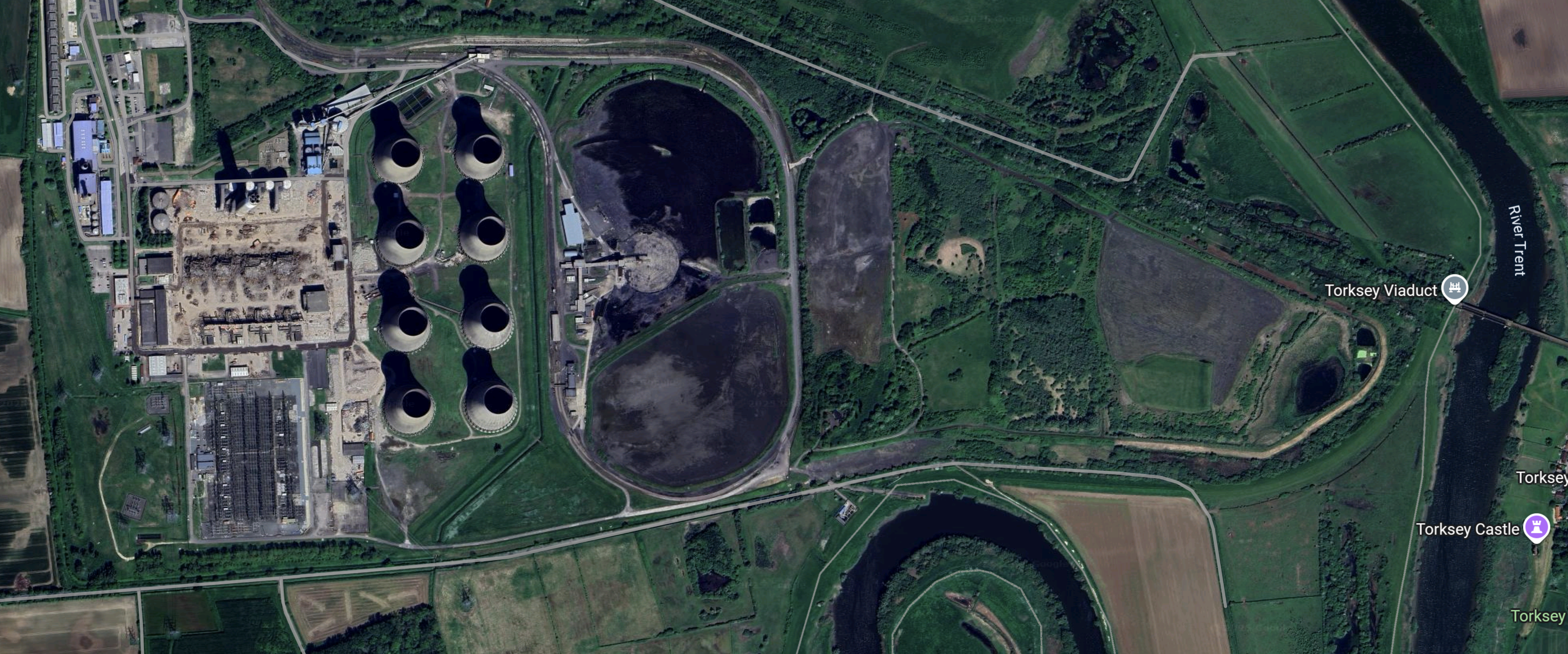
This Google Map shows the Cottam site.
Note.
- The River Trent surrounds the site.
- Could the Trent be used for cooling water?
- The cooling towers are still in place, so the image must have been taken before August.
- The sub-station is in the South-West corner of the site.
- The railway over Torksey viaduct is disused.
It would appear that there is generous space for the SMRs and a few data centres.
The Cottam Solar Project
In DCO Decision On 480MW West Burton Solar NSIP Delayed Until 2025, I wrote about three large solar projects in Eastern England.
The Cottam Solar Project was one of the projects and wants to use the Cottam site.
- The Cottam Solar Project has a web site.
- It will have a capacity of 600 MW, with a battery, with a battery with a 600 MW output and a 600 MWh capacity.
- The solar farm will use the grid connection of the former coal-powered Cottam power station.
- The project is massive and will cover 1270 hectares.
Will this solar project lease space for the SMR, so they can co-exist?
Conclusion
It does appear that there are more than one use for old coal-fired power station sites.
Centrica And X-energy Agree To Deploy UK’s First Advanced Modular Reactors
The title of this post, is the same as that of this press release from Centrica.
This is the sub-heading.
Centrica and X-Energy, LLC, a wholly-owned subsidiary of X-Energy Reactor Company, LLC, today announced their entry into a Joint Development Agreement (JDA) to deploy X-energy’s Xe-100 Advanced Modular Reactors (“AMR”) in the United Kingdom.
These three paragraphs add more details.
The companies have identified EDF and Centrica’s Hartlepool site as the preferred first site for a planned U.K. fleet of up to 6 gigawatts.
The agreement represents the first stage in a new trans-Atlantic alliance which could ultimately mobilise at least £40 billion in economic value to bring clean, safe and affordable power to thousands of homes and industries across the country and substantive work for the domestic and global supply chain.
A 12-unit Xe-100 deployment at Hartlepool could add up to 960 megawatts (“MW”) of new capacity, enough clean power for 1.5 million homes and over £12 billion in lifetime economic value. It would be developed at a site adjacent to Hartlepool’s existing nuclear power station which is currently scheduled to cease generating electricity in 2028. Following its decommissioning, new reactors would accelerate opportunities for the site and its skilled workforce. The site is already designated for new nuclear under the Government’s National Policy Statement and a new plant would also play a critical role in generating high-temperature heat that could support Teesside’s heavy industries.
This is no toe-in-the-water project, but a bold deployment of a fleet of small modular reactors to provide the power for the North-East of England for the foreseeable future.
These are my thoughts.
The Reactor Design
The Wikipedia entry for X-energy has a section called Reactor Design, where this is said.
The Xe-100 is a proposed pebble bed high-temperature gas-cooled nuclear reactor design that is planned to be smaller, simpler and safer when compared to conventional nuclear designs. Pebble bed high temperature gas-cooled reactors were first proposed in 1944. Each reactor is planned to generate 200 MWt and approximately 76 MWe. The fuel for the Xe-100 is a spherical fuel element, or pebble, that utilizes the tristructural isotropic (TRISO) particle nuclear fuel design, with high-assay LEU (HALEU) uranium fuel enriched to 20%, to allow for longer periods between refueling. X-energy claims that TRISO fuel will make nuclear meltdowns virtually impossible.
Note.
- It is not a conventional design.
- Each reactor is only about 76 MW.
- This fits with “12-unit Xe-100 deployment at Hartlepool could add up to 960 megawatts (“MW”) of new capacity” in the Centrica press release.
- The 960 MW proposed for Hartlepool is roughly twice the size of the Rolls-Rpoyce SMR, which is 470 MW .
- Safety seems to be at the forefront of the design.
- I would assume, that the modular nature of the design, makes expansion easier.
I have no reason to believe that it is not a well-designed reactor.
Will Hartlepool Be The First Site?
No!
This page on the X-energy web site, describes their site in Texas, which appears will be a 320 MW power station providing power for Dow’s large site.
There appear to be similarities between the Texas and Hartlepool sites.
- Both are supporting industry clustered close to the power station.
- Both power stations appear to be supplying heat as well as electricity, which is common practice on large industrial sites.
- Both use a fleet of small modular reactors.
But Hartlepool will use twelve reactors, as opposed to the four in Texas.
How Will The New Power Station Compare With The Current Hartlepool Nuclear Power Station?
Consider.
- The current Hartlepool nuclear power station has two units with a total capacity of 1,185 MW.
- The proposed Hartlepool nuclear power station will have twelve units with a total capacity of 960 MW.
- My instinct as a Control Engineer gives me the feeling, that more units means higher reliability.
- I suspect that offshore wind will make up the difference between the power output of the current and proposed power stations.
As the current Hartlepool nuclear power station is effectively being replaced with a slightly smaller station new station, if they get the project management right, it could be a painless exercise.
Will This Be The First Of Several Projects?
The press release has this paragraph.
Centrica will provide initial project capital for development with the goal of initiating full-scale activities in 2026. Subject to regulatory approval, the first electricity generation would be expected in the mid-2030s. Centrica and X-energy are already in discussions with additional potential equity partners, as well as leading global engineering and construction companies, with the goal of establishing a UK-based development company to develop this first and subsequent projects.
This approach is very similar to the approach being taken by Rolls-Royce for their small modular reactors.
Will Centrica Use An X-energy Fleet Of Advanced Modular Reactors At The Grain LNG Terminal?
This press release from Centrica is entitled Investment In Grain LNG Terminal.
This is one of the key highlights of the press release.
Opportunities for efficiencies to create additional near-term value, and future development options including a combined heat and power plant, bunkering, hydrogen and ammonia.
Note.
- Bunkering would be provided for ships powered by LNG, hydrogen or ammonia.
- Heat would be needed from the combined heat and power plant to gasify the LNG.
- Power would be needed from the combined heat and power plant to generate the hydrogen and ammonia and compress and/or liquify gases.
Currently, the heat and power is provided by the 1,275 MW Grain CHP gas-fired power station, but a new nuclear power station would help to decarbonise the terminal.
Replacement Of Heysham 1 Nuclear Power Station
Heysham 1 nuclear power station is part-owned by Centrica and EdF, as is Hartlepool nuclear power station.
Heysham 1 nuclear power station is a 3,000 MW nuclear power station, which is due to be decommissioned in 2028.
I don’t see why this power station can’t be replaced in the same manner as Hartlepool nuclear power station.
Replacement Of Heysham 2 Nuclear Power Station
Heysham 2 nuclear power station is part-owned by Centrica and EdF, as is Hartlepool nuclear power station.
Heysham 2 nuclear power station is a 3,100 MW nuclear power station, which is due to be decommissioned in 2030.
I don’t see why this power station can’t be replaced in the same manner as Hartlepool nuclear power station.
Replacement Of Torness Nuclear Power Station
Torness nuclear power station is part-owned by Centrica and EdF, as is Hartlepool nuclear power station.
Torness nuclear power station is a 1,290 MW nuclear power station, which is due to be decommissioned in 2030.
I don’t see why this power station can’t be replaced in the same manner as Hartlepool nuclear power station.
But the Scottish Nationalist Party may have other ideas?
What Would Be The Size Of Centrica’s And X-energy’s Fleet Of Advanced Modular Reactors?
Suppose.
- Hartlepool, Grain CHP and Torness power stations were to be replaced by identical 960 MW ADRs.
- Heysham 1 and Heysham 2 power stations were to be replaced by identical 1,500 MW ADRs.
This would give a total fleet size of 5,880 MW.
A paragraph in Centrica’s press release says this.
The companies have identified EDF and Centrica’s Hartlepool site as the preferred first site for a planned U.K. fleet of up to 6 gigawatts.
This fleet is only 120 MW short.
Centrica Secures Investment Stake In Gasrec Helping Boost UK Bio-LNG Ambitions
The title of this post, is the same as that of this press release from Centrica.
This is the sub-heading.
Centrica has secured a minority stake in Gasrec, the UK’s largest dual provider of bio-LNG (bio-Liquified Natural Gas) and bio-CNG (bio-Compressed Natural Gas) to the road transport sector,
These first two paragraphs give more details.
Gasrec says the investment will drive the next phase of its infrastructure ambitions, with plans to open a UK wide network of open-access refuelling stations supplying renewable bio-LNG for the decarbonisation of heavy goods vehicles.
Centrica is taking a 16% stake and becomes one of three major shareholders in Gasrec, alongside global integrated energy company bp and private family office 44 North.
I have some thoughts.
Does Running A Truck On bio-LNG or bio-CNG. Reduce Carbon Emissions?
This paragraph from the press release, gives the thoughts of Chris O’Shea, who is Group Chief Executive, Centrica.
Chris O’Shea, Group Chief Executive, Centrica plc, said: “Demand for bio-LNG for transport is growing fast as more HGV operators make the switch – drawn by a clean, ready-to-use fuel which slashes CO2 emissions by up to 85 per cent in comparison to diesel*. This investment in Gasrec enhances our collaboration with the leading company in the sector, and puts us in a strong position to energise a vital sector of the industry on its journey to net zero.”
As Centrica is a public company, with shareholders, who would take a dim view of Mr. O’Shea telling porkies, I suspect we can assume that the following is true.
Drawn by a clean, ready-to-use fuel which slashes CO2 emissions by up to 85 per cent in comparison to diesel.
The asterisk in the full quote, refers to this note.
Low Carbon Vehicle Partnership, Innovate UK and Office for Low Emission Vehicles, Low Emission Freight & Logistics Trial (LEFT), Key Findings, November 2020. Using specific feedstocks CO2 reductions of 200% are achievable.
Centrica could be being conservative with their claims.
Decarbonising Buses, Locomotives And Trucks
Despite what Elon Musk, would have us believe, electric trucks will not dominate the future of freight transport.
An electric truck would be the vehicle equivalent of asking Usain Bolt to run a hundred metres with a large refrigerator on his back.
Trucks are going to need a fuel without a weight penalty and with a long range.
I asked Google for information about Cummins diesel, natural gas and hydrogen engines and received this AI Overview.
Cummins offers engines powered by diesel, natural gas, and hydrogen. While diesel engines are well-established, Cummins is also developing both natural gas and hydrogen engines, particularly focusing on hydrogen as a pathway to zero-carbon solutions for various applications. Cummins utilizes a fuel-agnostic platform, meaning a common base engine can be adapted for different fuel types, including diesel, natural gas, and hydrogen.
Recently, GB Railfreight purchased thirty Class 99 locomotives from Stadler.
- They can use electrification, where it exists.
- Where electrification doesn’t exist, they can use an onboard Cummins diesel engine, which is built in Darlington.
- In electric-mode, they have 6.2 MW of power, and are the most powerful locomotives ever to run on UK railways.
- In diesel-mode, they have 1.8 MW of power, which is more than enough to haul a large container train in and out of Felixstowe.
I had thought that at some future date, Cummins would convert these locomotives to electro-hydrogen.
But now that Gasrec is providing bio-LNG and bio-CNG, GB Railfreight, have the option of converting both hydrogen and biomethane.
Similar logic can be applied to Wrightbus’s Streetdeck Ultroliner, one version of which is fitted with a Cummins engine, that can be converted to electric, hydrogen or natural gas, which of course includes biomethane. This page on the Wrightbus web site describes the bus.
Wrightbus are also going back into coach manufacture, as I wrote about in Wrightbus Goes Back To The Future As It Relaunches The Contour Coach. As with the Streetdeck Ultroliner, Cummins seem to be providing one of the power units.
It seems to me, that the zero- and low-carbon revolution in transport will generate a need for the availability of biomethane, hydrogen and natural gas fuel for transport all over the country.
Gasrec with around twenty biomethane fuelling points around the country, seem well-placed to supply the biomethane in bio-LNG or bio-CNG form.
Could Gasrec Deliver Hydrogen?
Various bus companies in the UK, have had difficulty getting the fuel for their hydrogen buses.
I believe that delivering hydrogen would be very similar to delivering LNG and if Gasrec can deliver LNG successfully and safely, they probably have the technology to do the same for hydrogen.
Centrica Seem To Be Assembling An Interesting Consortium
These are some deals, that I have reported on this blog, that involve Centrica.
- Centrica, along with Hyundai, Kia, Siemens and others have backed Hull-based hydrogen start-up; HiiROC, who can produce affordable hydrogen from any hydrocarbon gas including natural gas, where it is needed.
- Centrica have invested in Sizewell C. Will they be using their share of the electricity to make affordable pink hydrogen using HiiROC?
- In Centrica And Ryze Agree To Develop Hydrogen Pathway, I talked about how Centrica and Ryse were aiming to bring hydrogen to the masses.
- In Recurrent Energy’s Middle Road Project Sold To Centrica, I talked about a Centrica investment in solar power.
- In Aberdeen’s Exceed Secures Centrica Rough Contract, I talked about how Centrica were redeveloping the Rough gas storage site for hydrogen.
- In Lhyfe And Centrica To Develop Offshore Renewable Green Hydrogen In The UK, I talked about developing offshore hydrogen.
- In Centrica Announces Hydrogen Ready Combined Heat And Power Partnership With 2G, the title says it all.
- In Centrica Signs UK Biomethane Agreement With Yorkshire Water And SGN Commercial Services, Centrica appear to be sourcing biomethane from Yorkshire Water.
- In Centrica Invests In Renewable Energy Storage Capabilities To Boost UK’s Energy Security And Accelerate Transition To Net Zero, I talk about Centrica, Goldman Sachs and others, investment in liquid-air energy storage company; Highview Power.
- In British Gas Owner Mulls Mini-Nuke Challenge To Rolls-Royce, I talk about rumours that Centrica might invest in SMRs.
Note.
- A lot of these deals are are about hydrogen production.
- Some of these deals are about biomethane production.
- None of these deals talk about getting hydrogen and biomethane to customers.
It appears to me, that Gasrec have a model that works to get hydrogen, methane and biomethane from production and storage to the end customers.
Developing A Rural Hydrogen Network
In Developing A Rural Hydrogen Network, I talked about supplying all those millions of off-gas grid properties with hydrogen for heating, agricultural and industrial purposes, in the countryside of the UK.
Gasrec have the technology to decarbonise the countryside.
Conclusion
Gasrec would appear to be a very useful partner for Centrica.
Does Nuclear Power Not Sell Newspapers?
Five days ago, In Rolls-Royce SMR Advances To Final Stage In Swedish Nuclear Competition, I wrote about Rolls-Royce being one of two successful bids to advance to the ext stage to build Small Modular Reactors for Vatenfall in Sweden.
Since then, Rolls-Royce’s Swedish success has not featured in any newspaper in the UK, not even the Financial Times.
I can only assume, that good news stories about nuclear power, don’t sell newspapers.
British Gas Owner Mulls Mini-Nuke Challenge To Rolls-Royce
The title of this post, is the same as that of this article in The Telegraph.
This is the sub-heading.
Centrica is looking to follow Rolls-Royce in developing small modular reactors
These are the first three paragraphs.
The owner of British Gas is considering investing in mini nuclear power plants in the UK as it seeks to cash in on burgeoning demand for the technology.
Centrica is in early talks with the Government about a potential future deal that could see the energy giant participate in the development of so-called small modular reactors (SMRs).
It comes after Ed Miliband, the Energy Secretary, last month announced billions of pounds in funding for SMRs, which will form part of a new “golden age” for atomic energy.
In Centrica Really Can’t Lose At Sizewell, I looked at Centrica’s involvement in Sizewell C and in particular the financing of the nuke and what Centrica would do with their share of the electricity, that the nuke will produce.
I listed these uses for hydrogen in the East of England.
- Transport – Buses, Coaches and Trucks
- Large Construction Projects
- Rail
- Ports
- Airports
- Agriculture And The Rural Economy
- Exports
I do wonder, if Centrica made the investment in Sizewell C, when they realised that there were a lot of uses for hydrogen and producing hydrogen using the electricity from a nuclear power station was a good way to generate hydrogen.
- Sizewell B is a 1.2 GW nuclear powerstation.
- Sizewell C is a 3.2 GW nuclear powerstation.
- Their investment in HiiROC surely gives them access to the technology to generate hydrogen.
- Centrica have a lot of experience of selling natural gas to customers, who need energy.
- There were also substantial government guarantees involved.
- Hydrogen made by a nuclear reaxtor is generally referred to as pink hydrogen.
- In Westinghouse And Bloom Energy To Team Up For Pink Hydrogen, I describe how two American companies have formed a partnership to make pink hydrogen.
Before they invested in Sizewell C, they would have done detailed financial and technical due diligence.
Did Centrica then scale the calculations to see if funding a Small Modular Reactor (SMR) to make hydrogen was a viable deal?
- SMRs are typically around 400-500 MW.
- The article mentions Rolls-Royce, but other companies are developing SMRs.
- Centrica use Rolls-Royce mtu generators for some of their installations.
- Some SMR/HiiROC systems could be built close to steelworks or other high energy users.
This is a very interesting development in taking the UK to net-zero.
SNP Ban On ‘Munitions’ Funds Puts Scottish Shipbuilding On The Line
The title of this post is the same as that of this article on The Times.
This is the sub-heading.
The president of Rolls-Royce submarines says plans for a world-class welding centre on the Clyde are at risk of being cancelled within days
These three paragraphs add more details to the story.
Ambitious plans to reverse a historic decline in Scottish shipbuilding are at risk after a £2.5 million taxpayer grant was axed due to an SNP ban on “munitions” funding.
A plan to build a specialist welding centre on the banks of the Clyde is now in grave doubt after Scottish Enterprise, the national economic development agency, was accused of reneging on a pledge to fund a building for the world-class facility.
Rolls-Royce, which is ready to support the project by providing £11 million worth of specialist equipment, expressed “dismay” at the news, saying the project had been classified as a “munitions” scheme solely on the basis that it would “support the construction of naval vessels”.
Given the experience of the Scottish Government in building ferries is documented in this Wikipedia entry, which is entitled Scottish Ferry Fiasco, the SNP must know something about how not to build ships.
The comments from readers of the Times Article are scathing, with many coming from those with Scottish names.
Welding And Nuclear Power
It doesn’t mention the other big use for welding in this article and that is in the manufacture of nuclear reactors. In fact one of the members of the Rolls-Royce consortium, that will build their small modular nuclear reactors is The Welding Institute – No prizes for guessing what they do!
Does that mean that Scotland won’t have anything to do with small modular nuclear reactors? Either in their manufacture or use.
This article in New Civil Engineer is entitled UK Plans New Nuclear Plant In Scotland Despite Scottish Government Opposition.
So if the Scottish Government wants nothing to do with making expensive, quality vessels for the nuclear industry, Rolls-Royce would surely be better building the welding centre in an area of the UK that would appreciate it.
Scots In High Positions Of Power
I like Scotland and the Scots and possibly, at one time, with all the North Sea Oil and Gas, I could have thought about relocating North of the Border. But I’m very glad I didn’t!
It does seem to me though, that when some Scots get to high positions of power, that they lose all sense of reason.
I would nominate.
- Fred the Shred
- The SNP
- That half-Scot, who was lucky enough to be elected US President twice.
There must be a few others.
Chinese firm ‘Will Not Bid’ To Run Essex Nuclear Plant
The title of this post, is the same as that of this article on The Times.
This is the sub-heading.
Sources no longer expect planning applications to be submitted by China General Nuclear Power Group for Bradwell B
These three paragraphs give brief details of the current situation.
Plans for China’s state-run nuclear company to develop and operate a proposed nuclear site in Essex will no longer go ahead, The Times can reveal amid renewed focus on Chinese involvement in Britain’s critical infrastructure.
Bradwell B, the proposed nuclear power station, was earmarked for investment by China General Nuclear Power Group (CGN) in 2015. CGN is the majority investor in the proposed development alongside French energy company EDF.
But government and industry sources told The Times and Times Radio they no longer expected planning applications to be submitted by CGN for the site, and EDF will look to take back the lease from the Chinese firm at the earliest opportunity.
So what will happen to the Bradwell Site?
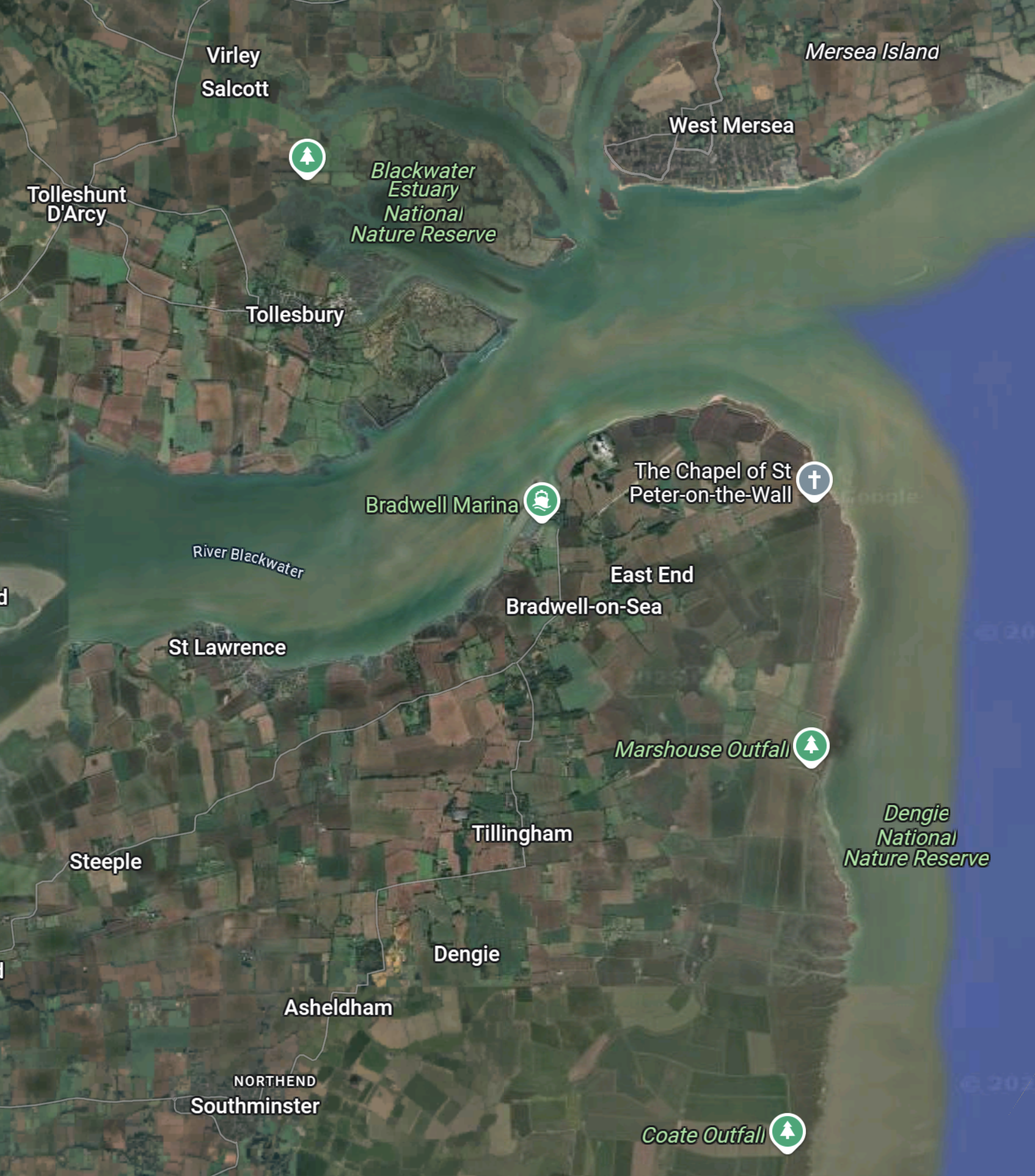
This Google Map shows the Blackwater Estuary to the North of Southend.
Note.
- The Blackwater Estuary is at the top of the map.
- Bradwell Marina and Bradwell-on-Sea can be seen on the map to the South of the Blackwater Estuary.
- Southminster has a rail connection, which was used to handle the nuclear fuel and now has a passenger service to Wickford on the Southend Victoria to London Liverpool Street Line.
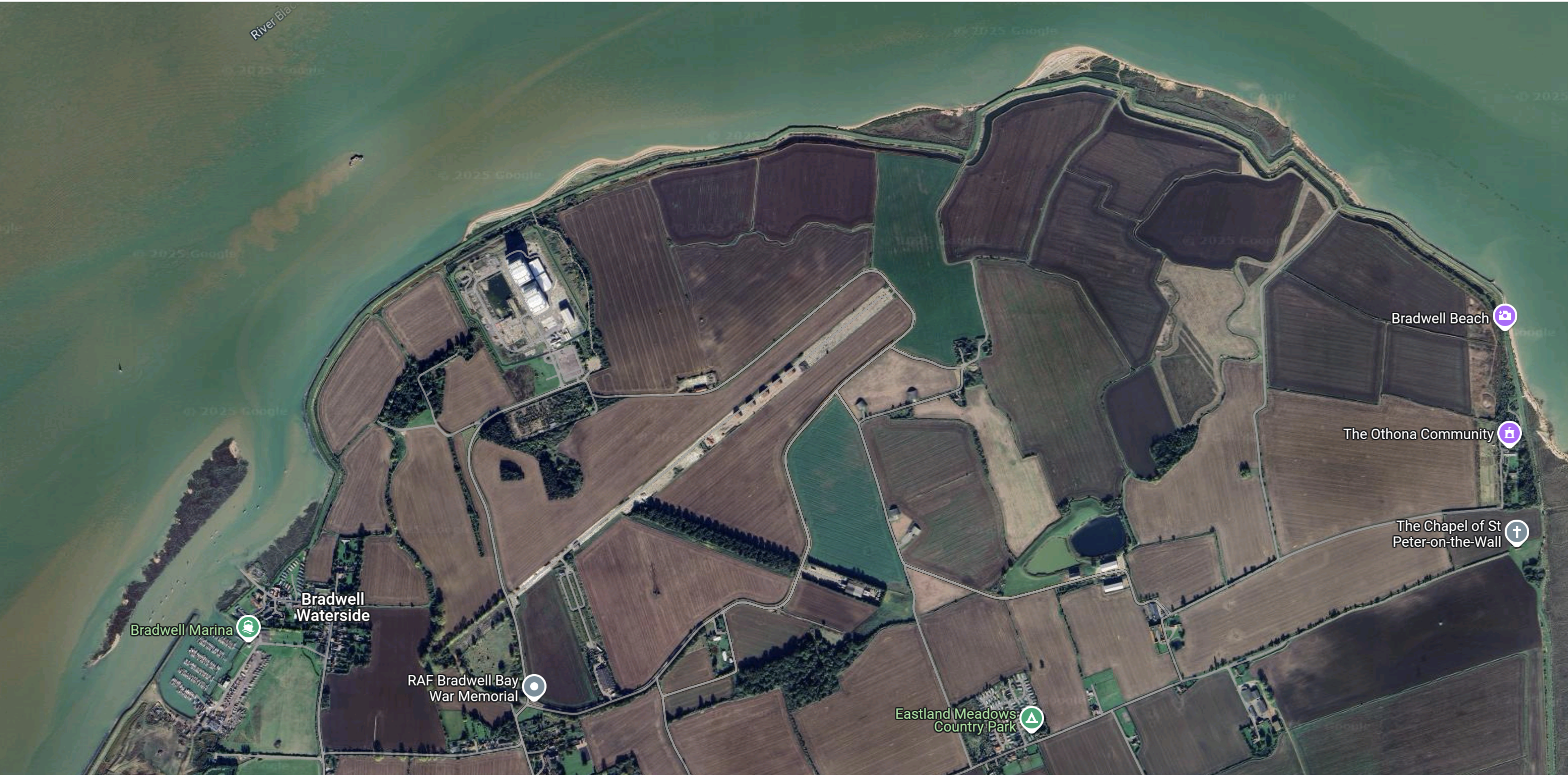
This second Google Map shows Bradwell-on-Sea and the North of the peninsular in greater detail.
Note.
- The remains of the three runways of the Second World War RAF Bradwell Bay can be picked out.
- The remains of Bradwell A nuclear power station are towards the coast to the North-West of the former runways.
- It is large site.
I wonder, if the site could be used for backup to all the offshore wind farms in the area.
This is a list of all the wind farms, that are planned in the sea to the North and East of the Bradwell site.
- The East Anglia Array is partly operational, but could grow to as much as 7.2 GW.
- Greater Gabbard is 504 MW
- Gunfleet Sands is 172 MW
- London Array is 630 MW
- North Falls is 504 MW
Note.
- That is a total of roughly 9 GW.
- There’s also plenty of space in the sea for more turbines.
All these wind turbines will need backup for when the wind goes on strike.
These are possibilities for backup.
Another Hinckley Point C Or Sizewell C
You can see why the government wants to build a big nuke on the Bradwell site.
The 3.26 GW of a power station, which would be the size of Hinckley Point C would provide more than adequate backup.
But the builders of these power stations haven’t exactly covered themselves in glory!
- Construction of Hinckley Point C started in the late 2010s and first power is expected in 2031.
- Hinckley Point C power station has all the stink of bad project management.
- The Nimbbies would also be out in force at Bradwell.
There are also all the financial problems and those with the Chinese, indicated in The Times article.
A Fleet Of Small Modular Reactors
Hinckley Point C will hopefully be a 3260 MW nuclear power station and Rolls-Royce are saying that their small modular reactors will have a capacity of 470 MW.
Simple mathematics indicate that seven Rolls-Royce SMRs could do the same job as Hinckley Point C.
The advantages of providing this capacity with a fleet of SMRs are as follows.
- Each reactor can be built separately.
- They don’t all have to be of the same type.
- The total 3260 MW capacity could also be built at a pace, that matched the need of the wind farms.
- Building could even start with one of each of the chosen two initial types, the Government has said it will order.
- I also believe that there could be advantages in the sharing of resources.
- The rail link to Southminster would enable the bringing in of the smaller components needed for SMRs by rail.
Hopefully, the power of a big nuke could be added to the grid in a shorter time.
A Number of Long Duration Energy Stores
Highview Power is building 4 x 200 MW/2.5 GWh liquid air batteries for Orsted in the UK ; 2 in Scotland and 2 in England. They are backed by the likes of Centrica, Goldman Sachs, Rio Tinto, the Lego family trust and others.
Each GWh of liquid air needs a tank about the largest size of those used to store LNG. I suspect like LNG tanks they could be partly underground to reduce the bulk.
A Hybrid System
Bradwell is a large site and could easily accommodate a pair of Highview Power batteries, two SMRs, and all the other electrical gubbins, which would total to around 1.5 GW/5 GWh. This should be sufficient backup, but there would be space to add more batteries or SMRs as needed.

