Read This Article If You’re With The Big Six Energy Companies
It surprises me how many people are still with the Big Six energy companies.
Anyone stupid enough to still be, should read this article by Stewart Dalby on the Proactive Investors web site.
His experience of changing from British Gas to Good Energy was much the same as mine when I changed from mPower to OVO. The big company used every trick in and out of the book to stop him changing.
The Big Six energy companies are a total disgrace and Stewart’s headline on his article sums up what you do.
Self-help is the only way to beat the Big Six
But remember the paraphrase of the Cat Steven’s song – The First Cut is the Deepest – The First Change is the Toughest
You may need to be extremely patient to get the change you want.
One thing I would always do, is go direct to the company to which you want to change and not use any intermeiate or comparison site. So if you have trouble changing, at least you can test out your new supplier’s customer services and if they’re any good they probably know how to shove a red-hot poker up the big company’s arse.
But once you’ve done it, you will have all the numbers available to do it again. (OVO sent me a single A4 page!) And I very much doubt that a small supplier would be as difficult to change from, as any of the Big Six.
Amber Rudd Puts Onshore Wind Out Of Its Misery
I don’t like onshore wind farms so I was pleased to see this announcement by Amber Rudd on the BBC, which is titled Earlier end to subsidies for new UK onshore wind farms.
Onshore wind blights the countryside and you have to use a lot of subsidy to make a development viable.
But, I mainly don’t like the concept of wind power, because it is too mechanical, as opposed to solar, where you put up a panel and its control system and you get electricity.
Solar’s other big advantage is just emerging and that is the ability to link it to an intelligent battery such as the Tesla Powerwall to provide an independent power system for a building or something remote that needs good clean energy.
In a few years time, I predict that all new houses will have solar panels on the roof and the next generation of storage battery in the garage. Coupled with increases in insulation quality, I also think, we’ll see the likes of Barratt advertising houses with no external gas and only a stand-by electricity connection, for use on the dullest days.
The big energy companies won’t like it! But surely this is the sign of a good idea?
My energy usage isn’t high, but when the solar/battery powerplant drops in price sufficiently, I’ll fit one!
Powered By Footsteps
These lights at Canary Wharf were on BBC yesterday morning.




The company is looking for funding on Crowdcube.
I think that this sort of technology could have its uses. But possibly more when it is integrated into a common unit!
London and other cities have thousands of entry gates for the rail systems. Think how you use these!
You walk up and as you go through the barrier you either enter your ticket in a slot and pick it up again or touch your contactless card on a reader. You may not come to a full stop, but you will check your walk and this will result in you feet pressing a bit harder on the space between the sides of the gate. Thus a pressure pad in every gate would generate a bit of electricity for the station.
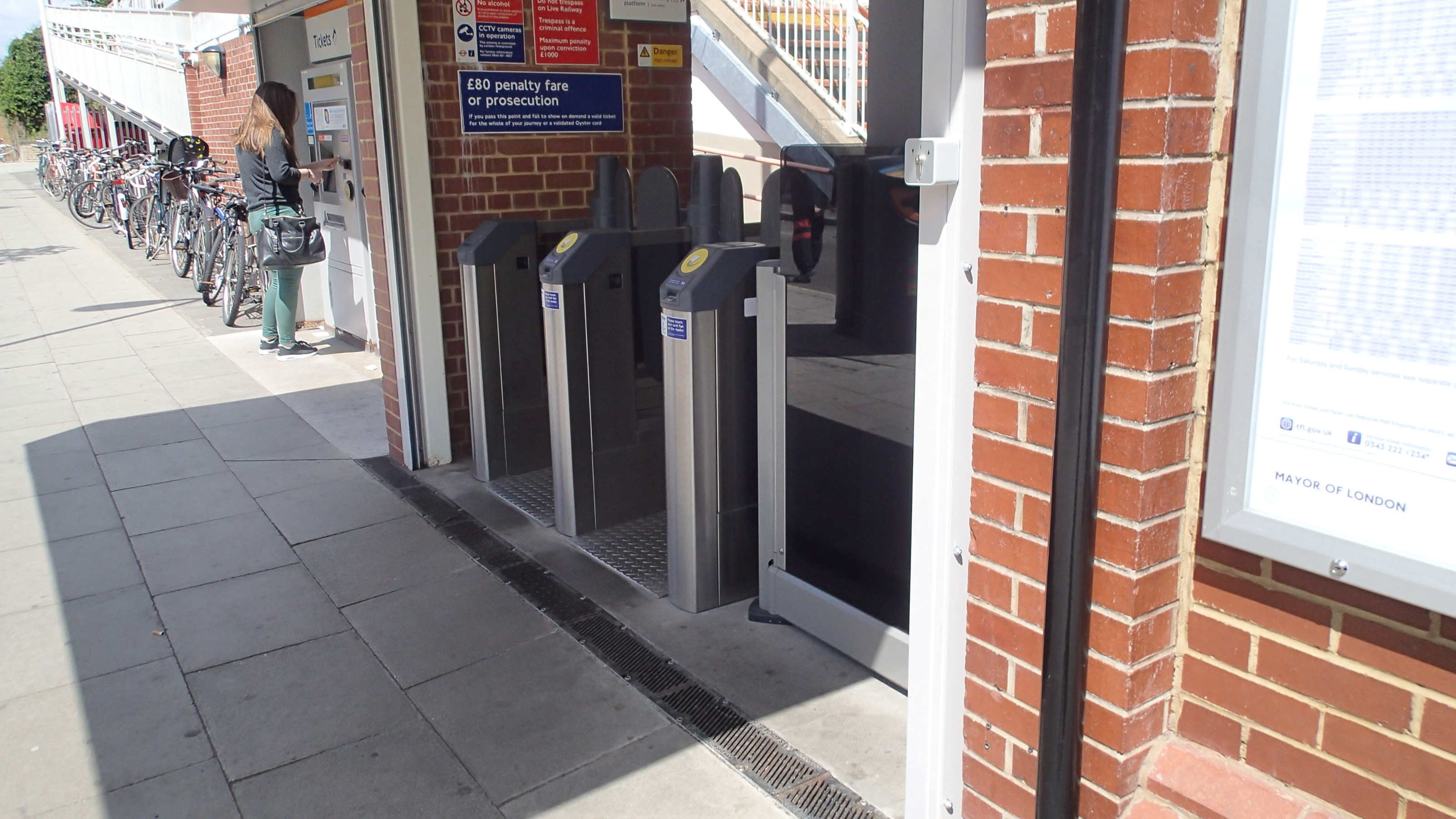
Ticket Gates At Homerton
Such an application could be part of a comprehensive energy system for a station, where the warmth from passengers, solar power from the roof and other power sources are collected to make the station less dependent on electricity from the mains. Network Rail have already used energy collection in stations like Blackfriars and the new London Bridge, so footfall collection could be another tool to help.
It could also be used in say a remote unmanned ticket gate on a station, such as where a platform is very long and some passengers need to entry and exit perhaps a hundred metres from the staff.
But although there is a large number of entry gates in the UK and worldwide, I would suspect that the gate manufacturers would develop their own systems.
I wish Pavegen well, but I don’t think I shall be investing.
The Other Big News Of The Past Few Days
With the election hogging the news, some things haven’t been given full coverage by the media.
One is Elon Musks idea of the Powerwall, which is a battery storage device for electricity, described in this article in the Guardian and another piece on uSwitch.
This may all look like an expensive toy or gimmick perhaps with a few specialist applications, but I believe it is a technology that could become commonplace in the future.
The flow is with this device and as my trip on a battery-assisted train at Manningtree showed, btteries are no longer something to power milk-floats.
Using a battery in a modern energy-efficient home or business, which perhaps has a roof covered in solar panels is an interesting way of cutting out paid-for electricity, for a hopefully one-off purchase and installation payment.
I wouldn’t buy one now, as although the Powerwall is deliverable now, improvements in battery and solar panel technology will mean that the systems available in a few years will store and generate more electricity in a more affordable manner. I also suspect, we’ll see replacement window glass units, that can either let light through or capture it for electricity.
We will also see much better control systems, although I suspect the the one Powerwall has is pretty sophisticated.
So I’m hanging back now, but I will be looking to put solar panels on my flat roof in anticipation of these better storage systems.
Musk is right, when he says that energy storage is going to revolutionise the world. But I do think that there will be a host of better or improved ways to do it.
But there is work to do, as this image of south-facing roofs in Ipswich shows, solar panels are notable by their absence.

No Solar Panels
In a few years time, this image will show lots of solar panels.
It is another case of giving the engineers the money to finish the deveopment and householders the right sort of finance for installation, so everybody can realise the dream of a house that doesn’t use any paid-for electricity.
The Future Of Pay As You Go (PAYG) Energy
Before I bought this house, it had been tenanted and because of the letters I’ve received since, I reckon that quite a few tenants skipped owing money to energy suppliers. Because of this, the house had a PAYG gas meter that used a key. I never used it for more than aa day or so, as the energy company I chose, replaced it with a normal one.
Using PAYG must be a nightmare for a family with problems, either monetary or organisational. So when I saw OVO Energy had brought in a PAYG system that worked on-line, I started following reports of the system.
Today I’ve picked up this comprehensive article from the Yorkshire Post. This is the first couple of paragraphs.
Thousands of Yorkshire customers who have been paying over the odds for their gas and electricity may be in for some relief – so long as they have a computer, email address and bank account.
British company Ovo Energy has just launched the UK’s first full-service, smart, pay-as-you-go (PAYG) energy platform, Smart PAYG+, which offers the cheapest pre-payment tariff in the country.
Eventually, this is how people with a computer, e-mail address and bank account will pay for PAYG energy.
OVO’s Smart PAYG+ system seems to be a very good design and will have applications outside of where the current key meters are used. OVO says this.
If you’re a prepayment energy customer, or even if you’re not, why not switch to OVO Smart PAYG energy? It takes away the hassle of paying for your gas and electricity. OVO gives you a choice of two ways to Pay As You Go.
I think that this technology will be used in some surprising places. I doubt I’ll be changing, but my energy use is rather erratic and sometimes I’m deep in credit with my energy supplier, who is OVO. PAYG would allow me to have a minimum credit at all times.
Passing Didcot Power Station
On the way back from Oxford, I passed Didcot Power station.




The chimney is very distinctive and there are now only three cooling towers, whereas for a long time there were six.
I’ve never visited the site, but a roommate at Liverpool University; Martin Sykes worked on the building before going to university.
Cheshire East And Southend Strike Cheaper Energy Deals With OVO
This report on the BBC tells how Cheshire East Council has done a deal with OVO to get cheaper energy for residents and businesses.
The report also says that Southend are doing something similar.
I think we’ll be seeing lots of deals like this in the future. Some might even be provided by the Big Six energy companies as they try to keep market share.
I do think though, that linking energy to a community could give a lot of advantages.
1. It creates a direct incentive for councils to bring in energy saving and local generation schemes, like the one created by Islington at Bunhill Row.
2. The philosophy might also push developers to create new offices, business premises and housing, that is less energy intensive, due to the higher profile of energy costs in the area.
3. Those not on-line or without a bank account, would gain access to cheaper energy through the council’s payments system. I can just about remember people paying for their energy in small gas and electricity offices.
4. We might even see the time, when you pay a single on-line payment to your local council for Council Tax, Resident’s Parking, gas, electricity, broadband and water.
If the system doesn’t deliver cheaper prices and better service, you can always vote the politicians out of office.
Her Majesty’s Daily Telegraph’s Guide To Energy Companies
This article in the Daily Telegraph entitled The Best Energy Companies You’ve Never Heard Of is a must read.
I swapped about fifteen months ago to OVO and don’t regret it one bit.
What nobody tells you is that to switch your energy supplier the first time, you probably spend an hour or so getting all the numbers of meters and other things you need to swap. Let’s say my big energy supplier didn’t cooperate.
But now in my profile on OVO all of those numbers are clearly displayed. So a second swap should be a piece of cake, if I needed to do it.
There are lots of these new small energy supplies out there, so when you swap choose one that suits your needs. Or perhaps one that is local to your residence or business!
BT Annoys The Big Six Energy Companies
You would think that BT would be very much in bed with the Big Six energy companies, as they probably draw their directors and advisers from the same pool of fat cats.
So I was surprised to find this guide to the quirkier small energy companies on BT’s web site.
I doubt a big broadband/telephone/mobile company would get into the energy business, as the corporate world is littered with failures of companies trying to ride two horses at once. But with smart meters coming in and all the connectivity that a broadband company has, they could offer you a free lifestyle application that calculated your energy usage and suggest how you could save money.
I can certainly see these applications being developed and when properly connected to your house or flat they could make a lot of difference to your lifestyle and how you sustain and support.
Electricity, gas, phone and broadband usage can all be precisely monitored and relayed to the app on your phone, tablet or laptop.
Much modern housing also has an activity monitor in each room of the dwelling. I have one in each room here and they are the controllers for the underfloor central heating. My ones aren’t but others exist that could be connected into the system. As the average adult is quite a large heat source of upwards of a kilowatt, they can effect the heat input to the room to maintain the required temperature.
Given to, that the Internet of things is coming, which will know what’s going on in the dishwasher, microwave, cooker and washing machine, the best apps will be able to tell you why you’re lifestyle is expensive.
And of course, I haven’t linked this to your car and credit card bills, yet!
Suppose too, you had intelligent scales that weighed you each morning and automatically took things like blood pressure and pulse.
Hopefully, these apps will nudge people to a better lifestyle.
I suppose in some ways, they will be a bit like automatic lifestyle coaches, suggesting things you might or should do.
Two Energy Stories
Two stories appeared on the BBC today.
One was entitled North Sea Oil Industry Close To Collapse and the other was a report on BBC Breakfast about how new appliances and technology are enabling domestic customers to use less electricity and gas. They showed the heating system at Pimlico.
In a compact country like the UK, which generally doesn’t get too much cold weather, where according to this report from the World Bank, eighty-two percent of the population lives in towns or cities. we have some great opportunities to cut our energy use.
- District heating schemes like Pimlico are surely easy to develop.
- Public transport like trains, trams and buses can be developed that are fast and frequent.
- Shared car ownership could be made to work well.
- People are adaptable and will change their habits to save money, so if say, the local High Street gets better and has good public transport links, they’ll use it more.
All of these and other factors will mean we require less energy.
It also means that we’ll do other things like use the trains a lot more.
I also think that the difference in energy costs and provision of public transport, will make that isolated cottage in the country much less attractive.
 The Anonymous Widower