Something To Bragg About!
A few days ago, someone asked me about the overhead wires of a railway and the pantographs, that pick up the 25,000 Volts AC current.
I can’t remember what their question was, but I said it is a difficult problem, as a train like a Virgin Class 390 Pendelino might be travelling at 125 mph in bad weather, so maintaining contact with a constant pressure between the pantograph and the overhead wire isn’t easy.
I was reading something else and found this article on the Rail Engineer web site. Research has been going on at the City University to develop a sensor that monitors the forces at the pantograph head. As you can imagine it is a particularly harsh environment and the engineers have bean using a technology called a Fibre Bragg Grating (FBG) developed in the 1990s, based on the work by the Nobel Prize-winning scientists William Lawrence Bragg and his father; William Henry Bragg.
I won’t paraphrase the article, but it is a must read. Where it will all lead to I don’t know, but I will repeat this last paragraph.
In the long term, the FBG sensor system offers the ability to detect contact forces from the entire service fleet if combined with GPS and suitable telemetry. This offers the potential of continuous real-time monitoring of the entire overhead line network. Then the Braggs’ work on X-ray diffraction of crystals a hundred years ago could well have made overhead line dewirements also a thing of the past.
Just imagine what it would mean to the operators of our increasingly electrified rail network, if delays caused by trains bringing down the overhead wires were to be reduced.
I’ve met people at Cambridge University for whom William Lawrence Bragg was their tutor and they have described him as a quiet man, who was superb in getting brilliant work out of the students, he tutored.
This tale illustrates why we must do more and more research and often that the solution to a difficult problem is unexpected, but brilliant.
Sixty-Eight Today
At the date and time of my birth in 1947, thousands of people were being slaughtered in India and Pakistan. Only the area has moved slightly, but all across the world people are fighting over warped ideologies and religions. In a very long list, I’d include places like Belfast, Ferguson and Johannesburg.
It is so pointless. And one of the reasons, why I have no religious beliefs. The main reason, is probably that two branches of my family felt that coming to England was preferable to staying put and being annihilated, because they were the wrong and more successful religion. I can personally understand, wh we have a migrant problem.
I like to think I try to follow the best humanist principles common to most of the world’s great religions. Or at least those they tend to adhere to, when they are not mistreating those who disagree on the nature of God. She would not be amused!
I also believe in and follow the established rules of mathematics, medicine and science!
In the last few weeks, I have been meaning to write something critical of the so-called Islamic State or as I prefer the Ultimate Men Behaving Badly Tendency.
Compared to others in the past they are certainly up there with the Nazis on the treatment of their opponents and minorities, but at least the Nazis preserved most art, even if they nicked it for themselves.
I doubt I’ll ever see a totally peaceful world, as in my view the only thing that will stop it, is when people see religion to be the way to exploit them, that I believe it is and science, engineering and medicine solves or mitigates the real problems we all face in this world, like war, poverty, hunger, disease and natural disasters, like floods, extreme weather and and earthquakes.
Electrification Of Britain’s Railways Isn’t Easy
There are a lot of reports in the media talking about the delays in electrifying railways in the UK, like this report in the Yorkshire Post, which talks about the Trans Pennine and Midland Main Line schemes.
I have just found this report in the Rail Engineer, which talks about a forty-four day closure of the important Winchburgh Tunnel between Edinburgh and Glasgow to prepare for electrification as part of the Edinburgh Glasgow Improvement Program. The report starts with this paragraph.
A legacy of the rapid early growth of Britain’s railway network is that the UK has one of the world’s most restrictive loading gauges. As a result, typically half of the cost of British electrification projects is the civil engineering work to adapt structures to provide clearance for wires and pantographs.
As anybody who’s ever got to grips with any old building, what it looks like on the surface is very different to what is underneath.
The project described in the article is challenging to say the least. This extract describes the building of the tunnel.
Winchburgh tunnel lies at the eastern end of a five- kilometre long cutting. It is 338 metres long and was opened in 1842, having taken two years to complete. When digging the cuttings and tunnel, the contractor, Gibb and Sons, removed 200,000 tons more rock than expected and consequently made a loss.
The tunnel was cut through dolerite rock, mudstone and shale. In the middle on the nineteenth century, these oil shale deposits once made West Lothian one of the world’s biggest oil producers. This shale was also a factor in an unfortunate accident during tunnel construction in 1839 when a man was severely burnt by firedamp.
The cutting is crossed by two streams, west of the tunnel. A twin four-foot diameter cast-iron inverted syphon was provided to carry Myers Burn under the railway. Swine Burn crosses the cutting on an aqueduct that had to be re-decked as part of the EGIP electrification works. Downstream of the aqueduct is a pumping station, which drains the cutting west of the tunnel. This is an area with significant drainage issues, some of which are addressed by the tunnel works.
So making it large enough for electrification wasn’t easy. As is typical on a project such as this, concrete slab track was used. You don’t see it much on UK railways, as where it is used is generally in tunnels and other places, where you have tight clearances.
In the Winchburgh tunnel slab track was used and they are also using an overhead rail system to get the power to the train.
In searching for a good article about slab track, I found this article on Balfour Beatty’s Rail web site, which is entitled Polyurethane Slab Track.
Balfour Beatty have worked with Herriot Watt University to create a method of using polyurethane to create a method for strengthening track in awkward places.
One example describes how a bridge was improved to cope with modern loads.
While George Stephenson was a forward thinker, even he didn’t predict freight trains running at 80mph with 25 tonne axle loads over his bridge. So he hadn’t calculated for those stresses. The bridge has done a good job of coping with them for 190 years, but it was getting a bit tired.
The article also highlights that Network Rail has 25,000 masonry arches, so you can see why there must be a need for such a technique.
The technique has also been used to increase the headrom for electrification in a tunnel on the Midland Main Line.
It’s all impressive engineering.
Why Are Some Rails Painted White And What Is Saggy Wire Syndrome?
After reading this article on the Rail Engineer web site, I did think about calling this article something like – Who’d Be A Rail Engineer?
But I just had to include Saggy Wire Syndrome.
The article is a technical article about how using steel wheels on steel rails can be a nightmare for the railways and their engineers in hot weather.
When I was a child, the rails had a length of sixty feet and they were separated by a small expansion gap and connected by fishplates. This gave the clickety-clack. Now rails are continuous for several kilometres to give a smooth ride, so occasionally they buckle. To mitigate the problem rails are made pre-stressed to their length at 27°C, so the problems kick in, when the temperature of the track gets above that temperature.
As switches (points) and crossings are particularly vulnerable in hot weather, they are often painted white in the UK, to reflect the heat.
It’s funny, but after having come across Europe through Poland, Germany and Belgium, I can’t actually remember seeing any rails painted white on my journey. Although, there was no clickety-clack indicating jointed rails. Next time, I go to Germany or Poland I must look.
So what is saggy wire syndrome?
This is where the overhead electric wire stretches in the heat and sags, because the tensioning mechanism can’t cope.
The article finishes with this paragraph.
Summer is a real problem. Roll on winter, when the rails shrink as they get cold and eventually break, earthworks get soggy causing uneven track surfaces, and S&C gets flooded and won’t work.
Who’d be a rail engineer?
All passengers should read the article!
There Is No Product That Can’t Be Improved With LEDs
In this month’s Modern Railways, there is an article by Iam Walmsley, about the re-engineering of a Class 73 locomotive for Network Rail. This is a the extract which contains the title of this post.
The cab desk is best described as ‘functional’, a flat plate of stainless steel with everything on it, enlivened by cool teal-coloured LED backlighting, further evidence that there is no product that can’t be improved with LEDs.
This is so right.
An Impressive Structure In Dresden
It may only be a shelter for a number of lines at a tram interchange in Dresden, but I like it.

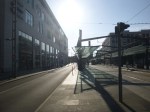

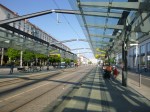
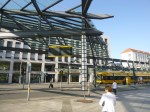

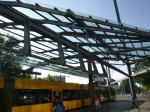
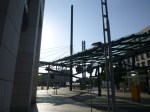
We should create more structures like this that combine engineering, art, beauty and practicality in suitable proportions.
The Other Big News Of The Past Few Days
With the election hogging the news, some things haven’t been given full coverage by the media.
One is Elon Musks idea of the Powerwall, which is a battery storage device for electricity, described in this article in the Guardian and another piece on uSwitch.
This may all look like an expensive toy or gimmick perhaps with a few specialist applications, but I believe it is a technology that could become commonplace in the future.
The flow is with this device and as my trip on a battery-assisted train at Manningtree showed, btteries are no longer something to power milk-floats.
Using a battery in a modern energy-efficient home or business, which perhaps has a roof covered in solar panels is an interesting way of cutting out paid-for electricity, for a hopefully one-off purchase and installation payment.
I wouldn’t buy one now, as although the Powerwall is deliverable now, improvements in battery and solar panel technology will mean that the systems available in a few years will store and generate more electricity in a more affordable manner. I also suspect, we’ll see replacement window glass units, that can either let light through or capture it for electricity.
We will also see much better control systems, although I suspect the the one Powerwall has is pretty sophisticated.
So I’m hanging back now, but I will be looking to put solar panels on my flat roof in anticipation of these better storage systems.
Musk is right, when he says that energy storage is going to revolutionise the world. But I do think that there will be a host of better or improved ways to do it.
But there is work to do, as this image of south-facing roofs in Ipswich shows, solar panels are notable by their absence.

No Solar Panels
In a few years time, this image will show lots of solar panels.
It is another case of giving the engineers the money to finish the deveopment and householders the right sort of finance for installation, so everybody can realise the dream of a house that doesn’t use any paid-for electricity.
How To Redesign An Everyday Object
Electricity pylons in the UK are generally made to a design that dates from the 1920s. So National Grid, who are responsible decided to have a design competition in partnership with RIBA.
According to this story on the BBC, National Grid are putting up a test line of the winner to teach engineers how to put them up.
They certainly look to be an improvement, but after nearly a hundred years, you’d expect that!
National Grid has also put up a blog.
I like the new pylons and hope to photograph them soon!
Dancing With Cranes And A Bridge With Help From Lego
I just had to put a link to this article on Rail Engineer, which is entitled Scarborough Bridge – Monte Carlo Or Bust.
It describes how the bridge that takes the York Scarborough railway line over the River Ouse in the medieval heart of York, was replaced over the half-term weekend in February, at a cost of six million pounds. This Google Earth image shows the centre of York.

York
The bridge is the one at the left of the image, with the station below it.
It was choreographed to an amazing degree and used three enormous mobile cranes squeezed into the car park by the bridge on the north bank of the river. Luckily the wind and the weather were kind and the project was completed on time. Perhaps, the most strange aspect of the project is told in this paragraph.
And then we should take our hats off to team member Eamon McAuley who literally built the bridge single-handed…albeit in Lego. It was remarkably detailed – including the track layout and little orange men with chainsaws – and could be deconstructed and rebuilt to follow the lifting sequence. Sitting as a centrepiece in the conference room, it proved more useful than a PowerPoint when explaining the challenges to visitors and stakeholders.
Anybody who said engineering isn’t fun, should hang their head in shame.
One Reason We Need More Engineers!
When I graduated in 1968,with an Upper Second Class Honours in Engineering from Liverpool University, my first job at ICI paid £1150 a year.
According to this article in The Independent, Aldi are paying trainee managers £42,000 a year or £3463.70 in 1968 money.
It is my belief that good engineers are some of the best practical problem solvers, so how many of the best engineers are lured by high salaries to non-creative jobs like being a trainee supermarket manager?
High salaries in these sorts of non-creative industries like Retail and the Civil Service, are robbing the country of its best engineers.
 The Anonymous Widower