An Impressive Structure In Dresden
It may only be a shelter for a number of lines at a tram interchange in Dresden, but I like it.

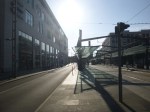
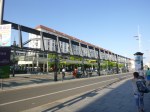
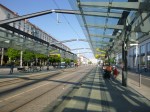
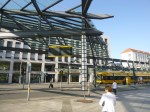
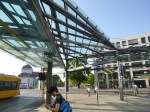
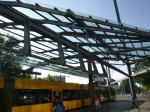
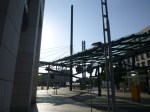
We should create more structures like this that combine engineering, art, beauty and practicality in suitable proportions.
The Other Big News Of The Past Few Days
With the election hogging the news, some things haven’t been given full coverage by the media.
One is Elon Musks idea of the Powerwall, which is a battery storage device for electricity, described in this article in the Guardian and another piece on uSwitch.
This may all look like an expensive toy or gimmick perhaps with a few specialist applications, but I believe it is a technology that could become commonplace in the future.
The flow is with this device and as my trip on a battery-assisted train at Manningtree showed, btteries are no longer something to power milk-floats.
Using a battery in a modern energy-efficient home or business, which perhaps has a roof covered in solar panels is an interesting way of cutting out paid-for electricity, for a hopefully one-off purchase and installation payment.
I wouldn’t buy one now, as although the Powerwall is deliverable now, improvements in battery and solar panel technology will mean that the systems available in a few years will store and generate more electricity in a more affordable manner. I also suspect, we’ll see replacement window glass units, that can either let light through or capture it for electricity.
We will also see much better control systems, although I suspect the the one Powerwall has is pretty sophisticated.
So I’m hanging back now, but I will be looking to put solar panels on my flat roof in anticipation of these better storage systems.
Musk is right, when he says that energy storage is going to revolutionise the world. But I do think that there will be a host of better or improved ways to do it.
But there is work to do, as this image of south-facing roofs in Ipswich shows, solar panels are notable by their absence.

No Solar Panels
In a few years time, this image will show lots of solar panels.
It is another case of giving the engineers the money to finish the deveopment and householders the right sort of finance for installation, so everybody can realise the dream of a house that doesn’t use any paid-for electricity.
How To Redesign An Everyday Object
Electricity pylons in the UK are generally made to a design that dates from the 1920s. So National Grid, who are responsible decided to have a design competition in partnership with RIBA.
According to this story on the BBC, National Grid are putting up a test line of the winner to teach engineers how to put them up.
They certainly look to be an improvement, but after nearly a hundred years, you’d expect that!
National Grid has also put up a blog.
I like the new pylons and hope to photograph them soon!
Dancing With Cranes And A Bridge With Help From Lego
I just had to put a link to this article on Rail Engineer, which is entitled Scarborough Bridge – Monte Carlo Or Bust.
It describes how the bridge that takes the York Scarborough railway line over the River Ouse in the medieval heart of York, was replaced over the half-term weekend in February, at a cost of six million pounds. This Google Earth image shows the centre of York.

York
The bridge is the one at the left of the image, with the station below it.
It was choreographed to an amazing degree and used three enormous mobile cranes squeezed into the car park by the bridge on the north bank of the river. Luckily the wind and the weather were kind and the project was completed on time. Perhaps, the most strange aspect of the project is told in this paragraph.
And then we should take our hats off to team member Eamon McAuley who literally built the bridge single-handed…albeit in Lego. It was remarkably detailed – including the track layout and little orange men with chainsaws – and could be deconstructed and rebuilt to follow the lifting sequence. Sitting as a centrepiece in the conference room, it proved more useful than a PowerPoint when explaining the challenges to visitors and stakeholders.
Anybody who said engineering isn’t fun, should hang their head in shame.
One Reason We Need More Engineers!
When I graduated in 1968,with an Upper Second Class Honours in Engineering from Liverpool University, my first job at ICI paid £1150 a year.
According to this article in The Independent, Aldi are paying trainee managers £42,000 a year or £3463.70 in 1968 money.
It is my belief that good engineers are some of the best practical problem solvers, so how many of the best engineers are lured by high salaries to non-creative jobs like being a trainee supermarket manager?
High salaries in these sorts of non-creative industries like Retail and the Civil Service, are robbing the country of its best engineers.
London’s Low-Key New Train Launch
To say that the launch of the new carriages for the London Overground on Thursday was low-key would be an understatement. I have only found one article on the web with a picture and that is in Rail Magazine. They say this.
The first five-car Class 378 for the London Overground network was unveiled at New Cross Gate depot yesterday (November 6).
All 57 EMUs in the fleet are receiving an extra carriage, as part of a £320 million investment boosting overall capacity by 25% – equivalent to an additional 170 passengers per train.
But where are the politicians in the photo?
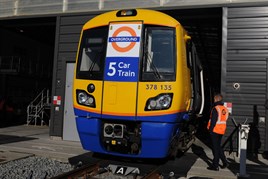
First Five-Car Class 378
It’s not like Boris to miss a photo-opportunity.
In some ways there is a very solid engineering principle behind these Class 378 trains. You should always make sure that anything you design can be adjusted to meet changing circumstances.
London Overground thought that three car trains would be enough for the limited number of passengers on the North and East London Lines. It quickly became obvious that these were inadequate. Either by good design or just plain luck, the trains had been originally built as two end cars with cabs and an unpowered trailer car in the middle. So to go from three to four they just built an extra trailer car and plugged it in, with a few small adjustments to the trains systems.
But even four cars have proved inadequate and now the process is being repeated to create five car trains. This is perhaps a little more complicated, as they have been unable to lengthen some platforms like Shadwell, so selective door opening has been implemented.
In the London Transport Infrastructure Plan for 2050, it states that these lines will have six cars at some point. So how long will it be before another car gets added?
Steel Flying Arches At Shadwell Station
These pictures show the steel flying arches at Shadwell station on the East London Line. They appear to be similar in form to the brick arches at Chorley.

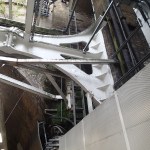
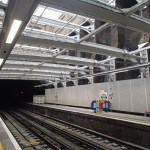
The purpose of these structures is to stop the walls of the cutting collapsing inwards.
They’re not pretty or elegant, but they seem to work!
Boring Television
It’s fascinating to read the heavyweight reviews on the BBC2 program, The Fifteen Billion Pound Railway, in the Independent and the Telegraph.
When did serious engineering programs get such coverage?
The Times has a report, if you’re a subscriber, but there’s nothing in the Guardian.
Redesigning The Ugly
There are lots of everyday common blots on the landscape, that are just downright ugly.
Take the electricity pylon. In all my years of travelling, I’ve never seen any that could be described as beautiful. If we didn’t want them to spoil the landscape, we’d bury them, as happens in most towns and cities.
However, there was a competition a few years ago with a £5,000 prize to find a better pylon. It’s all described in this report.
I’ve not seen any better ones yet!
So now it is time for the designers to look at the overhead lines used on railway lines. The thoughts and ideas are detailed here.
How many everyday objects can be improved by better design and materials?
Is This The Future Of Patient Monitoring?
As anybody who has spent time in hospital connected to a traditional heart, blood pressure, pulse and temperature monitor will know, it is not an easy process. Leads fall off, moving around is difficult and you are often in need of staff. I’ve only spent time recently in good hospitals, where they were enough staff to check on me regularly and that includes two NHS hospitals. But in one NHS hospital, I had a private room and a quick visual check as the nurse passed by wouldn’t have been possible.
In some ways the current system is like driving a car without a fuel gauge and every few miles, you have to get out to dip the tank to see if you’ve enough fuel to carry on.
But then enter the engineers!
I have just watched this story on BBC Breakfast Here’s the first three paragraphs.
The NHS is starting to test a sticking-plaster-sized patient-monitoring patch.
Placed on the chest, it wirelessly transmits data on heart rate, breathing and body-temperature while the patient is free to move around.
Independent experts say the system, developed in Britain, could ease pressure on wards and has the potential to monitor patients in their own home.
I think we all have to remember, that this is the first device. No-one would be able to predict how far this technology will go. And how a healthcare system like the will be able to use it in the future!
On the other hand, there is also this statement in the story.
But the Royal College of Nursing says there is no substitute for having enough staff.
In some ways that shows what a good system it must be, as the Luddites and Nimbys always try to stop good developments.
Read more about the company; Sensium Healthcare, behind the development here.
As it’s got one or more ultra-low power chips in there somewhere, is this another application of technology from ARM?

