Is The Sun The Future Of Energy?
I get up early and usually watch the BBC Breakfast programme.
On Sunday, this usually includes the short version of the BBC News on-line program Click.
Sometimes, it is rather wacky, but today they reported on something that will effect us all; solar power.
If you’d like to watch the short version of Click, it’s here on the BBC web site.
They have two segments that show the improvements coming in solar energy.
- In the first, the program shows how Oxford University are using better materials to improve the efficiency of panels.
- In the second, the program talked to a Swiss company called Insolight, who have developed a replacement panel that moves to focus the sun’s energy on highly-efficient tiny solar cells, which gives an efficiency of 36%.
Never underestimate the ingenuity of scientists and engineers to create a more efficient world.
Phince Philip On Crossrail
Matthew Parris , who admits he is no royalist, has an article in today’s Times entitled The Debt We Owe To A Thoroughly Modern Philip, in which he praises Prince Philip’s attitude to engineering, science and technology amongst other things.
He finishes the article like this..
Earlier this year, at 94, Prince Philip descended into the main tunnel of London’s Crossrail project to see more. They told him it would open in 2018.
“Too late foe me,” he said. Then he thought again. “Or perhaps not.”
I hope not.
I would agree with Matthew.
Network Rail’s Mobile Maintenance Train
I wrote about this train in How To Work Outdoors.
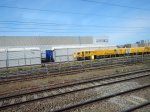
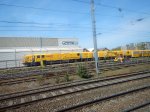

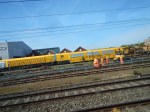
It was parked outside the Plasser depot in West Ealing.
How Not To Handle An Environmental Issue In A Large Project
On my holiday in Poland, I met someone, who lives on the route of HS2.
They told me that a million tons of tunnel spoil will be dumped on farmland in the Chilterns.
I was rather surprised to say the least, as having followed major projects for the best part of forty years, I know that project managers, engineers, architects and construction companies, don’t want hassle from what are collectively termed Nimbys, so they do their utmost to design projects, so that disruption and damage to the environment is minimised.
Crossrail had its problems early on, as Mayfair didn’t want the rsailway or the disruption of ten years of construction. So they devised a strategy based on openness and archaeology, which sold the project to Londoners, as something more than a railway. They have also been very helpful in giving access to the general public in events like Open House.
So I typed “HS2 tunnel spoil” into Google and found this article in the Bucks Free Press, which is entitled HS2 tunnel spoil to be dumped in Chilterns AONB. This is an extract from the article.
The announcement was made by HS2 Ltd’s Country South Area Manager Neil Cowie at a community forum in Little Kingshill on Tuesday.
He said it would be placed within a ‘sizeable area’ within two or three miles of the planned tunnel portal at Mantles Wood near Amersham – but he added HS2 Ltd did not want the location to be made public yet.
Mr Cowie said: “Rather than taking it longer distance along highways, we’ve taken some additional land alongside the route which we will landscape.
“When it’s finished it will be properly landscaped and will look very nice.”
I’m no diplomat, but it does seem a rather poor statement, which probably came out of a forum, where things were not up to scratch.
I’ve been to several Transport for London foums about projects like Camden Town station, Crossrail 2 and Hackney station and at each one, there has been an architect, engineer or project planner, who understands in detail what is proposed.
A later statement in the article says this.
In a later statement, HS2 Ltd said: “We will not being be depositing spoil/excavated materials from tunnelling in the AONB – it will be excavated materials from the cuttings going through the AONB. All tunnelling excavated materials from that part of the line will be taken out via the Colne Valley construction site.”
When dealing with any sensitive project from a children’s playground upwards, you must get your facts right! Once errors are in the local culture, they can only be eradicated with great difficulty and tremendous expense.
With respect to HS2, my project management and engineering instincts lead me to the conclusion, that HS2 will probably come up with an innovative and non-disruptive way to remove the tunnel spoil from the area.
If they don’t, then they don’t deserve to be building the line.
Central Masts At West Ham Station
West Ham station has been upgraded over the last couple of decades. Wikipedia says this.
In 1999 platforms were re-established on the line from Fenchurch Street, now operated by c2c.
So it would appear, that the following pictures showing the overhead electrification, which dates from around 1999.
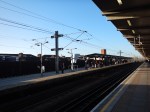
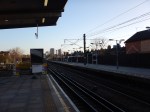
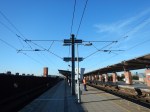
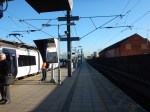
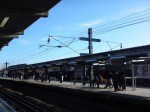
Almost uniquely for the UK rail network, the masts are in the mid-point of the two lines, with the wires cantilevered on either side.
Flimsy they are not! They have certainly been designed to survive a direct impact from a runaway Class 66 locomotive pulling several hundred tonnes of imported Chinese steel.
But as I said, the central masts probably date from 1999, so I suspect if similar structures were to be used in the electrification of the Gospel Oak to Barking Line, they would be designed to look better and probably be stronger and lighter too! I used to know a lot about using structural steel, and remember an expert telling me, that lighter structures are sometimes actually stronger.
Look at this picture from Upper Holloway station.
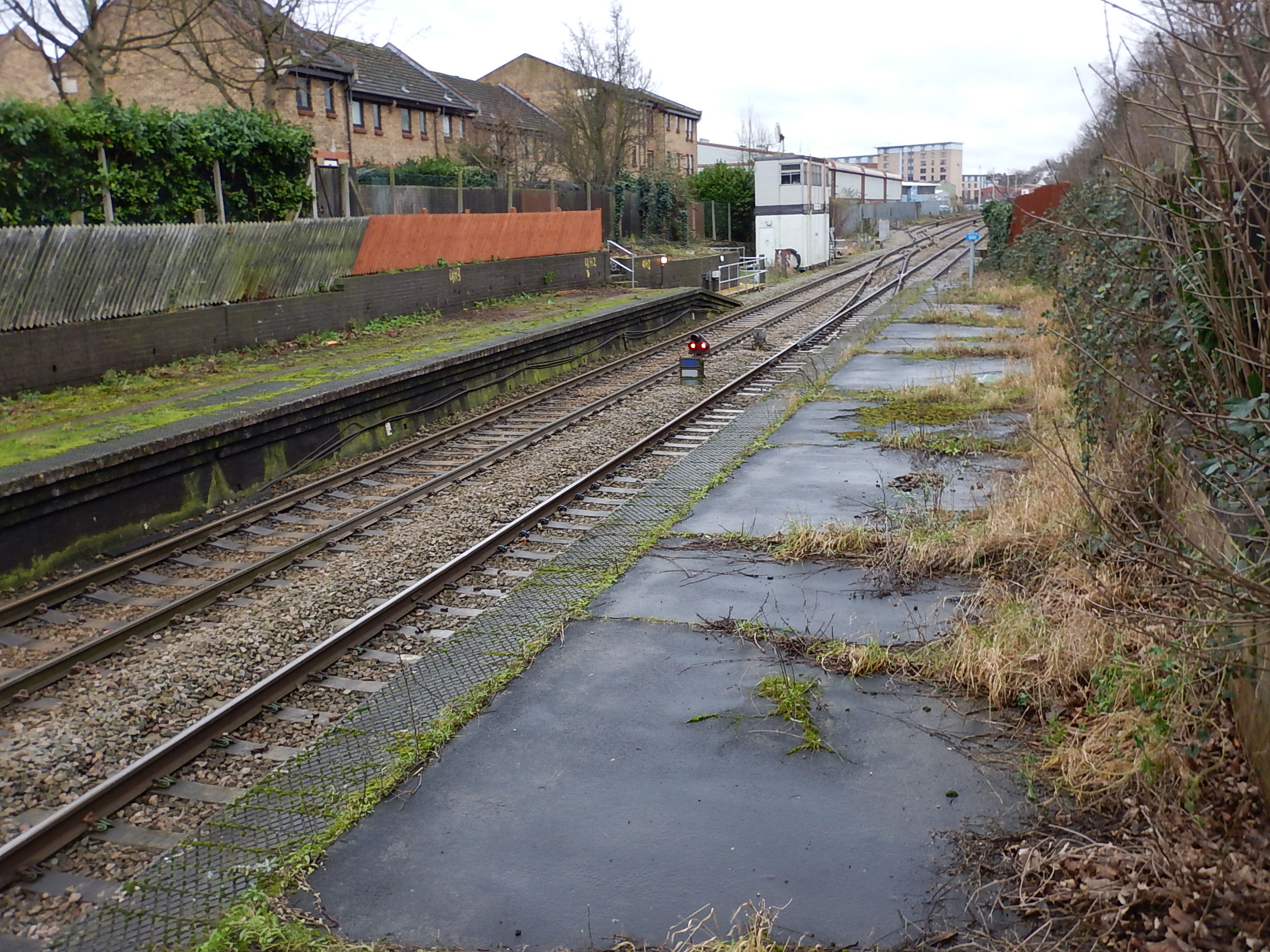
Looking West At Upper Holloway Station
It would appear that Murphys have piled around the crossing by the signal box to put a traditional portal frame across the railway to support the overhead wires. Some fifty metres behind me is a bridge that is being rebuilt over the railway.
So could the wires be installed through the station, by supporting them on the frame by the signal box, the bridge and several central masts, designed to fit between the tracks in the station area.
After seeing what was done in 1999 at West Ham station, I believe that an expert structural engineer could design a central mast to support electrification in the challenging conditions of Upper Holloway station and all the other difficult locations on the Gospel Oak to Barking Line.
There are advantages to this method.
- All of the platforms are untouched by electrification works.
- The number of piles to be driven at the side of the railway is reduced. This type of piling has caused problems in the past.
- Piles are positioned in the firm track-bed between the rails.
- Some piles will be positioned on viaducts. I suspect, that as the viaducts of the line seem sound, this would not be a very difficult problem.
- All work can probably be done by using a crane on the railway.
It does seem to me, that central masts could make the electrification easier.
How To Charge A Battery Train
There is a Twitter hashtag of #ipemu and this tweet has been posted, which describes something called a Railbaar from a well-known Swiss company called Furrer + Frey, who are very much involverd in transport electrification.

Railbaar
This could be the missing link in running IPEMU trains on branch lines, like those to Barrow, Lowestoft, Scarborough or Windermere. After pulling into the terminal, the battery is topped up to make sure the train gets all the way back.
As an example, current schedules at Windermere allow somewhere between six and fifteen minutes for the turnround, which is probably typical around the UK rail network
Could IPEMU Trains Use KERS?
I have just read this article on The Business Desk, which is entitled Torotrak’s bus KERS system gets all-clear. The article starts like this.
Torotrak, a developer and supplier of emissions reduction and fuel efficiency technology in vehicles, and Wrightbus are celebrating the successful completion of the in-service trial of the Flybrid mechanical kinetic energy recovery system (KERS) for buses.
The trial was conducted with Arriva, one of the largest bus operators in the UK.
It must have been successful, as other reports say Torotrak shares have risen and the company is expected to start production of the Flybrid KERS in 2016.
I’m probably not the only engineer, who’s wondering, whether the technology can have applications with trains.
My one regret is that I only bought a thousand pounds worth of shares in the company.
London Air Ambulance Gets A Brain Scanner
The BBC are running a story this morning about the London Air Ambulance having a portable brain scanner and that they are able to scan injured patients on the way to hospital.
I’ve had a few brain scans in my time, but I can’t imagine one of the machines that have scanned me, being air-transportable in anything less than a C-130 Hercules.
But search the Internet and you find the device. It’s called an InfraScanner. It works using the same infra-red spectrum as a television remote control.
This superb piece of medical engineering, or others based on the same technology, must end up in the bag of every A&E doctor, or those who work in areas where there is a high risk of brain injuries, like sporting events or combat zones.
Squeezing Blood Out Of A Stone On The Northern Line
The Northern Line is not the most popular or glamorous line of the London Underground.
It is a line I try to avoid for various reasons.
- It’s often too crowded.
- I have buses, Victoria Line and the London Overground as alternatives. For example, I use Camden Road station instead of Camden Town station and walk.
- In recent months, stations I want to use have been renewing escalators.
- I also want to get to stations, that are on the Charing Cross branch of the line.
I also wonder, if I’m prejudiced against the Northern Line, as I spent so much of my formative years on the Piccadilly Line.
I have just read this article on London Reconnections, which is entitled Twin Peaks: Timetable Changes On The Northern Line.
I have extracted these points from the article.
- Until mid-2014, both central sections and both northern branches of the Northern Line in the peak hours were only able to handle twenty trains per hour (tph). This compares with 30 tph on the Jubilee Line, 33 tph for the Victoria Line and 34 tph for the Central Line.
- In June 2014, with the full introduction of automatic train operation (ATO), this was raised to 22 tph.
- Engineers were working hard to improve the track to allow better speeds and from December 2014, the train frequency in the peak was raised to 24 tph.
- The line is now running at 30 tph between Kennington and Morden.
- The Off Peak service at the start of 2014 was 15-16 tph and it is now 20 tph.
All of this frequency improvement has been attained because they have got ATO working well and they’ve done a good job to allow trains to run faster on much better track.
You could say it’s all down to quality engineering. With probably the input from someone, who understands scheduling.
The article has a section entitled As Good As It Can Get For The Moment?, where this is said.
No doubt the ATO system will continue to be refined but the dramatic time reductions already achieved are unlikely to be improved on much more. Unless more available trains or speed can be coaxed of the existing fleet it is hard to see how the peak timetable can be improved until new trains arrive.
So have we got to the limit of the current lines and the 1995 Stock trains?
If you read the article, you’ll see that Transport for London are talking about peak hour services of 30 tph with new trains after the reworking of track in Summer 2020.
But given the skilful way, the frequency of this line has been ramped up over the last couple of years, I suspect, there’s more blood to come from this particular stone!
Museum de Cruquius
The Museum de Cruquius is just up the road from The Hague near Haarlem, although our journey up wasn’t the easiest, because the motorway was closed.
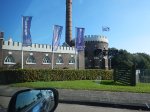

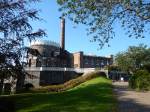
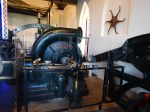
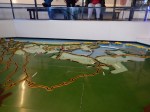
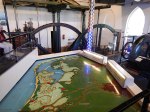
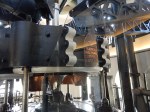
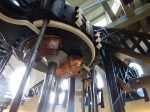
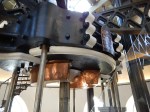
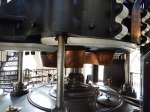
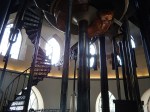
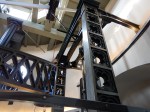
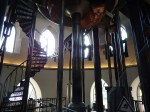
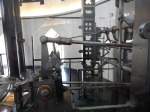
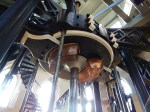
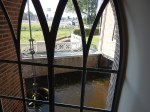
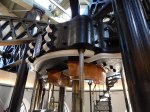

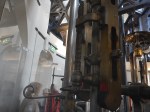
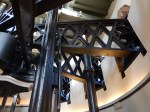
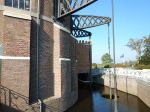
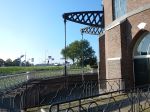
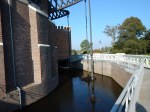

It is well worth a visit as it shows a tremendous amount about how the Dutch have kept water at bay.
The enormous steam engine, which sadly doesn’t work, was actually built in Cornwall.
When I see a museum and engine like this, I do think it sad that London’s massive sewage engines at Crossness were just filled with sand and abandoned in the 1960s.
Both sites incidentally, are about the same age!

