German Pipe Fittings
On my trip back from Stockholm, between Osnabruck and Cologne, I sat next to a German electrical engineer.
He astounded me at one point, by saying that German pipe fittings on industrial plants were in Imperial units.
I have been unable to check on the Internet, but I assume it is true and is probably down to American influence.
Would You Trust Italian Engineering?
The British Grand Prix was a bit of a farce today, as several drivers suffered tyre failures as the BBC reports.
Now Italians may be good at some things like food, parties and calendars, but it does seem that their engineering companies aren’t up to their past high standards at the moment. After all, I did report on the quality of products from AnsaldoBreda here.
I suspect that just as they have with their economy and their politics, there is a lot of rethinking to do.
Famous Cambridge Stunt Recreated
The BBC web site gives a few details here about how Cambridge students put an Austin Seven van on the roof of Senate House in 1958.
The story is actually on the web, but in their archives the BBC should have a recording of Tonight, where the whole stunt was explained to Cliff Michelmore. But then the BBC used to habitually reuse videotapes, so I suppose it’s gone.
100,000 Downloads And Still Counting
The 3D-printable gun has now been downloaded over a hundred thousand times according to this report on the BBC. Here’s part of the report.
Californian senator Leland Yee said he wanted a law passed to stop the manufacture of 3D-printed guns.
“I plan to introduce legislation that will ensure public safety and stop the manufacturing of guns that are invisible to metal detectors and that can be easily made without a background check,” he said in a statement.
According to Defense Distributed, most of the 100,000 downloads have been in the US, followed by Spain, Brazil, Germany and the UK.
The blueprint has also been uploaded to file-sharing site the Pirate Bay, where it has become the most popular file in the site’s 3D-printing category.
Calls to make such a gun illegal and stop the downloading, will fall on deaf ears. After all to create an illegal gun factory, all you need is a few thousand pounds or dollars to buy a quality 3D printer. Many aspire to have a weapon for personal protection or to settle scores with rivals or neighbours.
This gun is still crude and what worries me is not this gun, but the follow on designs, that will be possible as 3D printing gets more affordable and a lot better.
How long will it be before a crime is committed using a gun, that has been downloaded from the Internet and printed?
The Jubilee Line Bites London Again!
According to this article in the Evening Standard, the Jubilee line is being shut by the wrong kind of water.
The Jubilee line is to be shut for more than 30 days over the next two years in central London because acidic water is eating into the cast iron linings of the tunnel walls.
Services will be halted in both directions between Finchley Road and Waterloo for major repairs costing £40 million.
Why has the Jubilee line got it in for London, as when a line goes berserk, it is often that line, which was opened for the Millennium? When I use the line, there seems to be a higher chance of trouble compared to the other lines.
It would appear that the problem is in the first section of the Jubilee line that was built in the 1970s. The tunnels seem to use iron linings and it is interesting that Crossrail is manufacturing all of its linings out of concrete.
I do wonder what other problems will turn up on London’s most troublesome Underground line!
At least on the BBC News tonight, they showed how the repair techniques were being tested in the old Charing Cross platforms, which were last used for Skyfall. So hopefully, they’ll find a way to cut the closure of the line to a minimum.
And Now Thomas Heatherwick Coins A New Word
My Internet trawl for the New Bus for London, picked up this article in the Financial Times called Touched With Madeness about Thomas Heatherwick.
So many quirky ideas, may look good on paper, but can’t be made. His can, although he had a few early ones suffered from problems. But then so did Brunel’s.
Hence the idea that every idea and design should have the quality of madeness or the ability to be made.
Gasometers Don’t Exist
The title of this post is borrowed from an old copy of the Meccano Magazine.
But type gasometer into Wikipedia and you get redirected to gas holder. The origin of the name is given here in Wikipedia. It was supposedly coined by the Scot; William Murdoch.
But they do exist in Vienna and even have their own Metro station called Gasometer.






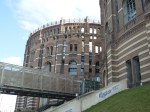

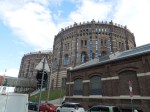
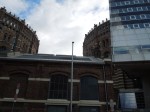
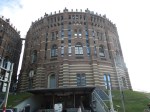

They are really one of the best examples of converting a redundant structure into something useful. There’s more about them here.
The last time I saw these structures, was when C and I came to a christening in Vienna. We wondered what the virtually derelict brick structures were as we took the train to the airport.
Spittelau
In Vienna if there is one place I had to see, it is Spittelau.
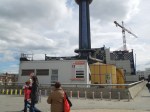

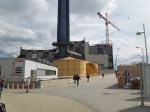

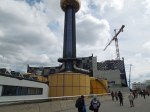

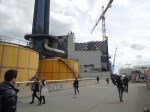
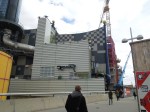
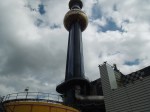



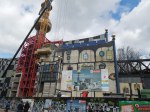


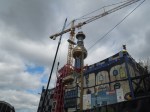
You walk out of the station of the same name and it’s there, only a kilometre or so from the centre of Vienna.
When you first see it, you think it is some weird work of art or even a chemical plant designed by a benign Devil.
It’s actually a waste incineration plant, which provides district heating and to be fair it’s more beautiful than SELCHP.
The world needs a lot more Spittelaus. As they often do, the Japanese are copying the ideas in Osaka.
It is a superb example that shows the close relationship between art, engineering and architecture.
Can you imagine the fuss, if they decided to build a plant like this at say Silvertown in East London? On the other hand, the plant shows that refuse incinerators can be good neighbours.
Every large city should have it’s Spittelau!
Is It Architecture,Engineering Or Art?
I heard good reports on the television of the rebuilt Reading station, so today, as I hadn’t anything specific to do, I decided to go to the town and have a look at the work that has been done.



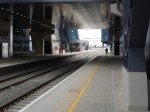


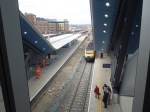
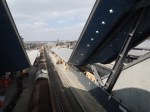
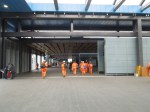


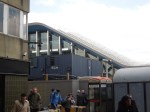


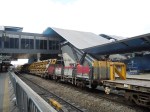




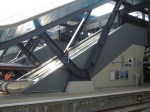

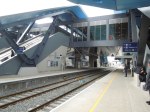




I think Isambard would have been proud of what has been done, as he rarely did boring! And the new Reading station is certainly not that!
The concept of the station is very simple. The thirty metre wide overbridge is connected to all the platforms by escalators and lifts. Then at one end there is another set of four escalators and lifts to take people to the main south entrance.
But in all my life, I’ve never seen so many people walking wide-eyed in awe around a new building or even an art gallery. One guy told me he’d come into the station specifically to photograph the building and had taken fifty pictures. Even railwaymen who’d probably seen it all, were walking around giving the new station a critical look.
There was also the teacher, who’d travelled with me from London. She was amazed at it all, especially as she had left on Thursday from the old Reading station.
Very little has been reported on the media about the design and quality of this new station. The only news seems to be stories pointing out the fact that the handover is a few days late and there’s a bit of chaos. None of the stories mention, that the project will be completed a year ahead of the original plan.
I do wonder if Reading is the shape of stations to come.
The wide overbridge concept is used in a similar, but smaller and less dramatic form at Leeds and Derby, but how many other stations could benefit from this type of design?
In the pictures, you’ll see some of Inter City 125 trains, that are used on all services from London to the West and Wales. They are genuine high speed trains capable of 200 kph, ride as smooth as silk and they are now forty years old. I doubt they’ll all ever be retired, as for running through the Highlands of Scotland and from Bristol to Cornwall, where electrification is virtually impossible, there is no other fast train, that can handle the route.
So at last, these trains have got a modern station, to complement their design.
An Alternative London End To HS2
This plan called Euston Cross, was first aired in the railway press and is a serious alternative to what is currently proposed. it’s described detail in this post in a blog.
I think it should be taken seriously, as it would appear to have a few cost advantages and it would require less demolition at Euston.
As an engineer, who helped to develop the methods and software to build large projects, I believe that we can’t ignore the lessons of the biggest and most intelligent beast in the jungle; Crossrail.
Crossrail is setting new records for tunnelling proficiency, depth under London and project management. But as we experienced in the North Sea Oil industry in the 1970s, today’s big machines are dwarves compared to what will be available in a few years.
So the idea of linking HS2 to HS1 by means of tunnels and an underground station might be easier, than anybody would dare think using today’s technology. It could also go a lot deeper and just as Crossrail is diving under the Underground, it could probably dive deeper still.
 The Anonymous Widower