Comings And Goings Of Battery-Electric Buses On Route 242 At Aldgate Bus Station – 4th September 2025
I took these pictures of 242 battery-electric buses at Aldgate bus station, last night.


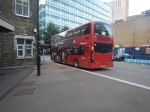

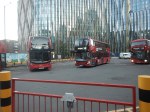
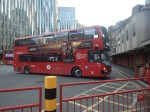
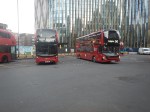
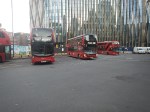












Note.
- All the buses on route 242, were Volvo BZL battery-electric buses.
- All the battery-electric buses backed onto the chargers for about ten minutes.
- Range on battery of the buses is probably about 214 miles according to Google.
- Buses arrived and left every few minutes.
- There was no indication, if the buses were charged at Aldgate bus station, although as the pictures show, some went dark for a few minutes.
If the buses were being charged, it certainly looked an efficient way to charge them.
I took these pictures of 242 battery-electric buses at Aldgate bus station and in Dalston, this morning.
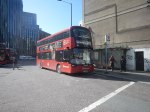

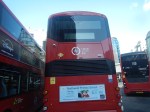





Note.
- All the electric buses are Streetlite Electroliners from Wrightbus.
- All Wrightbuses have a stylised ‘W’ on the front.
- The seventh picture shows the enlarged destination board on the back of the Streetlite bus.
Are Stagecoach running two different types of buses on the same route to ascertain the best and give the chargers a decent workout?
I have some further thoughts.
Could This Form Of Charging Be Used To Convert New Routemasters Into Electric Buses?
Consider.
- In Equipmake Hybrid To Battery Powered LT11, I show a battery-electric New Routemaster is possible.
- In Wrightbus Launches NewPower In Bicester, I write about Wrightbus’s new factory in Bicester to convert buses to battery power.
- In New Routemasters As Advertising Hoardings, I show how New Routemasters have a nice little secondary earner as advertising hoardings.
- New Routemasters have become a symbol of London.
- As pictures five to seven show, New Routemasters could share the chargers with younger battery-electric buses.
- There is still at least another dozen years left in most New Routemasters.
Converting a thousand New Routemasters must be cheaper, than buying a thousand new buses.
Could This Form Of Charging Be Used Outside London?
Most certainly, provided you can get enough power to the charger.
Aldgate doesn’t have a problem with power, as the Underground is underneath.
£77 Million Investment For UK Heavy Duty And Commercial Vehicle Projects
The title of this post is the same as that of this press release from the Advanced Propulsion Centre.
These are the projects.
Ford to design, develop, and build a fleet of 8 hydrogen fuel cell powered Transit vans, with the latest advances in technology
£8 million awarded by government, matched by industry to a total £16.3 million.
This research project will design and develop a hydrogen fuel cell-powered version of the Ford Transit van, with a Ford Dagenham estate facility re-purposed for upfitting of the vehicle. By bringing the manufacturer, vehicle operator and supply chain businesses together, this project aims to establish a business case for the wider rollout of hydrogen Light Commercial Vehicles.
Project partners include: Ocado, BP, Cygnet Texkimp, Cambustion, Viritech.
Note.
- I suspect Ocado will do the road testing.
- BP will probably supply the hydrogen.
- Cygnet Texkimp are a company based in Northwich and is a leading global provider of fibre handling and converting technology. Have they developed a machine for knitting hydrogen fuel tanks?
- Cambustion‘s Engineering Services team provides powertrain development and testing services to a range of global clients from our Cambridge, UK base.
- Viritech’s web site has a mission statement of Rewiring the DNA of Hydrogen Powertrains.
Ford seem to have assembled a team of all the talents.
Wrightbus to develop a new world-leading zero-emission battery and hydrogen fuel-cell electric, multi-axle vehicles
£6.4 million awarded by government, matched by industry to a total £12.7 million.
This project will produce a new, market-leading platform for battery and fuel cell electric driven buses. Whilst demand is growing for zero-emission vehicles, there are currently few options available for heavy, multi-axle vehicles like large buses.
Project partners include: Queens University Belfast, Grayson Thermal Systems, Hutchinson Engineering, Translink.
Note.
- Grayson Thermal Systems are based in Birmingham and specialise in providing HVAC for vehicles and especially zero-carbon ones.
- Hutchinson Engineering are based in Widnes and invest in state-of-the-art machinery and technology to give our customers the most advanced, cost-effective solutions in design, fabrication and manufacturing.
- Translink provides public transport in Northern Ireland.
It looks like Wrightbus have excellent partners.
ULEMCo creating a zero-emission hydrogen fuel cell range extender for prototype ambulance, fire engine and road sweepers
£3.9 million awarded by government, matched by industry to a total £7.9 million.
This project will develop a hydrogen fuel cell range extender for electric vehicles used for special purposes, such as ambulances, fire engines and street sweepers. The zero-emissions range extender will be based on existing, proven technology from the Toyota Mirai, and demonstrate how zero emissions vehicles can be used in a wide range of specialised and challenging settings.
Project partners include: Altair Engineering, Emergency One, Technical Services Ltd, Oxon Fire & Rescue Services
Note.
- ULEMCo are based in the Liverpool City Region and it is very much in Liverpudlian DNA to repurpose something that works. Hence the use of The Toyota technology.
- Altair Engineering is a multinational engineering and technology company.
- Emergency One is a Scottish manufacturer of fire engines and emergency vehicles.
- Technical Services Ltd, who are based in Cleckheaton, supply thermal management systems and solutions.
- Oxon Fire & Rescue Services will obviously be doing the testing.
In Hydrogen-Powered Ambulance Drives Into Glasgow Ahead Of London Trial, I wrote about a prototype hydrogen-powered ambulance, that was built by ULEMCo and industry partners, that was shown at COP26.
Is this project turning the prototype into a system, that can be manufactured in large volumes?
Bramble Energy developing a hydrogen double-deck bus, using innovative, low-cost fuel cell technology
£6.3 million awarded by government, matched by industry to a total £12.7 million.
This project will demonstrate a fuel cell/battery hybrid powertrain on a double-decker bus. This novel product will be cheaper than the equivalents currently available for large vehicles like buses and uses innovative new electronics and energy recovery technologies.
Project partners include: University of Bath, Equipmake, Aeristech
Note.
- Bramble Energy‘s Printed Circuit Board Fuel Cell (PCBFC™) is a patent protected, revolutionary design which leverages existing manufacturing routes from the printed circuit board industry to offer a cost-effective, scalable hydrogen fuel cell solution.
- Equipmake are based at Snetterton in Norfolk.
- In Equipmake Hybrid To Battery Powered LT11, I describe Equipmake’s conversion of a New Routemaster to battery operation.
- Aeristech are based in Crawley and have developed a range of award-winning compressors for Tier-1, OEMs and other customers.
- Is the compressor needed to pump a mixture of hydrogen and air through the fuel cell?
I have a feeling, that this could be a very revolutionary design.
BorgWarner developing hydrogen combustion systems for heavy-duty commercial transport
£4.9 million awarded by government, matched by industry to a total £9.8 million.
This project aims to speed up the rollout of hydrogen-burning internal combustion engines, as an alternative to diesel. Hydrogen is a clean fuel, producing only water when burned. Project Cavendish will develop new fuel and air management systems, so that existing heavy duty diesel technologies can be repurposed to use hydrogen as fuel.
Project partners include: Mahle, Cambustion, Hartridge
Note.
- BorgWarner is a large American automotive supplier.
- Mahle is a large German automotive supplier.
- Cambustion‘s Engineering Services team provides powertrain development and testing services to a range of global clients from our Cambridge, UK base.
- Since the brand formation in 1930 Hartridge, who are based in Buckingham, has become a world leader in diesel fuel injection test equipment.
- Project Cavendish is obviously named after Henry Cavendish, who discovered hydrogen.
In Ricardo Supports Industry Leaders To Develop Innovative Dedicated Hydrogen Engine, I talk about another project involving BorgWarner. Is Project Cavendish a follow-on from the original project or a new one?
Leyland Trucks scaling up the production of electric trucks through innovations in automation and advanced testing
£2.6 million awarded by government, matched by industry to a total £5.1 million.
By better use of automation and advanced testing, Leyland Trucks aim to increase productivity and step up their production of battery electric trucks. A ‘digital twin’ of the Leyland production line will be set up, meaning any changes can be run in simulation before being rolled out physically.
Project partners include: Expert Tooling, HSSMI
Note.
- Leyland Trucks is one of Britain’s leading manufacturing companies. It is PACCAR’s established centre for light and medium duty truck design, development and manufacture. The company is based in Leyland.
- Expert Technologies are specialists in delivering industrial automation solutions. The company is based in Coventry.
- HSSMI is a sustainable manufacturing consultancy.
As I have done a lot of simulation in my time, I’m very much in favour of digital twins.
JLR leading a consortium research project to develop a high-efficiency and highly integrated 800V inverter designed and built in the UK
£6.3 million awarded by government, matched by industry to a total £12.6 million.
This project will explore and develop technology for inverters – a key component in electric vehicles. As well as developing a best-in-class product, this work will support the growth of a UK supply chain in components for electric vehicles.
Project partners include: University of Bristol, Custom Interconnect Ltd, API Capacitors Ltd
Note.
- JLR is Jaguar Land Rover.
- Custom Interconnect is an advanced electronics manufacturing company, which is based in Andover.
- API Capacitors is the UK’s leading designer and manufacturer of high quality power capacitors for power electronic applications. The company is based in Great Yarmouth.
I suspect this invertor will have several applications.
Conclusion
The grants seem to have been widely spread around the UK.
Tevva Starts First Mass Production Of Electric Lorries In UK
The title of this post, is the same as that of this article on Professional Engineering.
These are the first three paragraphs.
Tevva is building its 7.5 tonne vehicles at Tilbury in Essex after it received European Community Whole Vehicle Type Approval (ECWVTA), meaning it can start producing and selling in volume across the UK and Europe.
The start-up has already started delivering its first mass-produced lorries to customers including Travis Perkins and Royal Mail. It expects to sell up to 1,000 in 2023.
Described as “ideal” for last mile and urban delivery fleets, the electric truck offers up to 227km range from its 105kWh battery on a single charge. It will be followed later in 2023 by a 7.5 tonne hydrogen-electric alternative. The hydrogen range extender will reportedly increase the range up to 570km.
That seems like a good start to me; certification, orders for a thousand and generous ranges with or without a hydrogen extender.
In Equipmake Hybrid To Battery Powered LT11, I described Equipmake’s battery-electric New Routemaster bus.
Both the battery-electric Routemaster and the Tevva truck seem to have generous ranges, so has better battery technology been developed.
Equipmake Hybrid To Battery Powered LT11
The bus in this video from Public Transport UK, may look like any of the thousand New Routemasters on the streets of London.
But it’s not, as it’s been given a transmission transplant by Equipmake of Snetterton in Norfolk.
The observant amongst you will notice, it has a refurbished interior, as I wrote about in My First Ride In A Refurbished New Routemaster.
There is also this press release from Equipmake, which is entitled Equipmake Showcases Sector-Leading Repower Technology With Fully-Electric New Routemaster Bus.
Some points from the press release.
- Equipmake’s cutting-edge Zero Emission Drivetrain (ZED), uses a 95% British-built component content.
- With pre-service trials already started in London, operated by Metroline, the electric version of the New Routemaster will continue to be assessed over the next six months.
- The repowered New Routemaster, developed by Equipmake at its base in Snetterton, Norfolk, features a 400kWh battery enabling an expected in-service range of 150 miles – more than enough for a day’s running.
- The development of the all-electric New Routemaster has come about thanks to a programme part funded by the UK Advanced Propulsion Centre (APC).
- Over the coming months, Equipmake will be trialling additional repowered buses with other bus operators across the UK.
- Featuring an advanced water-glycol cooling circuit, the system has the added benefit of providing interior heating during cold conditions with captured thermal energy.
- When the battery is depleted at the end of a complete duty cycle, it can be recharged at the depot overnight via a CSS DC charging point.
But this is the bit I really like.
Under the skin, the New Routemaster also features Equipmake’s HTM 3500 electric motor. Seamlessly integrated into the prop shaft without the need for a separate transmission, the motor is precisely engineered to meet the demanding requirements of a fully-laden double-decker bus by producing 3,500Nm torque at a motor speed of just 1,000rpm and delivering 400kW maximum power.
It sounds a bit like a modern reincarnation of a TASC unit (torque and speed control unit), which was an industrial drive from the 1960s, used to precisely control industrial machines. I never used one, but I worked in a section at Enfield Rolling Mills, that did.
One car manufacturer of the time, was using them as an automatic transmission for a small car. It might have been Hillman.
A Comparison With The Wrightbus Streetdeck Electroliner BEV
The Wrightbus Streetdeck Electroliner BEV is the company’s latest electric double decker bus and a comparison can be made.
Seats
Equipmake LT11 – 87
Electroliner BEV – 96
Battery Size
Equipmake LT11 – 400 kWh
Electroliner BEV – 340 or 454 kWh
Range
Equipmake LT11 – 150 miles
Electroliner BEV – 200 miles with 454 kWh battery.
Conclusion
This New Routemaster, is certainly no ordinary electric bus.
With the batteries on hybrid buses needing to be replaced regularly, Eqipmake’s transmission transplant could also be scheduled, when a bus needs a new battery.
With Lotus just up the road, the engineering is certainly Normal for Norfolk!
Equipmake & Beulas Join Forces With Go-Ahead London: In-Service Trials Of New Double Deck Electric Bus To Begin Q1 2022
The title of this post, is the same as that of this press release on the the Equipmake web site.
I was alerted to the bus by an item on BBC Breakfast this morning. It was before seven, so it should be easy to find on iPlayer.
These two paragraphs describe the bus.
Designed and developed in the UK, Equipmake’s Zero Emission Drivetrain (ZED) offers operators three modular battery pack options of up to 543kWh – the largest capacity battery of any two-axle double decker electric bus in the world. This delivers an unmatched electric driving range of up to 300 miles, which is more than sufficient to ensure the Jewel E can easily complete an entire duty cycle without the need to stop and recharge. Equipmake’s modular design enables operators the flexibility to scale the amount of battery throughout the life of a bus future-proofing it for a range of routes and distances.
The Jewel E is set to be manufactured in 2022 at an all-new facility in Norfolk. The vehicle body is produced by Beulas in Girona, Spain, a company with more than 87 years of experience in the sector. The vehicle chassis has been specifically designed for the Equipmake Zero Emission Drivetrain (ZED) by Agrale in Buenos Aires, Argentina, a leading truck and Bus chassis manufacturer established in 1962.
Apparently, there’s a lot of Formula One expertise in the design.
Equipmake And HiETA Developing New Motor With 20kW/kg Power Density With Additive Manufacturing
The title of this post is the same as that of this article on Green Car Congress.
This is the introductory paragraph.
UK-based electrification company, Equipmake, has teamed up with additive manufacturing organization HiETA to develop a next-generation motor as part of a project grant-funded by Innovate UK.
Additive manufacturing is 3D-printing by another name. This has come to the fore in the COVID-19, where schools, colleges and individuals have been using it to produce PPE.
Equipmake and HiETA are printing exotic alloys in intricate shapes to create the powerful motor.
Additive manufacturing is starting an amazing revolution. How many other common products can be redesigned to be more efficient and manufactured at lower cost.
Equipmake Opens New Electric Bus Factory In Snetterton
The title of this post, is the same as that of this press release from Equipmake.
This is the introductory paragraph.
Expert electrification company, Equipmake, has opened a brand-new factory in Snetterton, Norfolk, which will design and manufacture its fully-integrated electric bus chassis for an increasingly international customer base.
This paragraph sums up their marketing philosophy for their bus chassis.
Equipmake’s innovative electric bus chassis allows any bus coachbuilder to become a full electric bus manufacturer almost overnight. Such is the demand from bus makers wishing to go zero emissions that Equipmake has forged partnerships with companies in Brazil, Argentina and India and grown its UK staff from 15 employees to 52 in a little over two years.
Equipmake certainly seem to be doing something right.
- They make their own electric motors.
- They claim to make the world’s most power dense electric motors.
Perhaps, it’s all down to good design?
This paragraph from the press release gives more details of the bus chassis.
Thanks to efficient management of its onboard heating and cooling system, the bus – a 12m single deck model capable of carrying 70 passengers – will have enough electric range for one day’s running without the need for charging. To charge the vehicle, the operator simply needs access to a standard three-phase supply, which will fully charge it in around five hours.
That seems impressive to me!
 The Anonymous Widower