Walking Between St. Pancras And Euston Stations
In 2011, I wrote Getting Between Kings Cross/St. Pancras and Euston about how I walked between the stations.
This route has now been formalised with green signs.








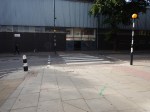



I think when they finish the roadworks, it’ll be a good route. This is cut and modified from my original post.
So how would I make it better, so that in effect we had one super station for the north?
- Perhaps, it should be marked on the ground, as a Kings Cross/St. Pancras to Euston walking route.
- You might even provide some eco-friendly transport along the route, like an electric shuttle bus or bicycle rickshaws.
- A couple of suitably placed Boris bike stations would help too.
- Shops and cafes should be developed along the road. There are some already.
I was right that this would happen.
Euston Is Getting A Balcony
At Euston station today, it was obvious that Network Rail are creating a balcony in a similar way to how they did at Manchester Piccadilly and Waterloo stations. They describe the project on this page on their web site and these are some pictures I took today of the construction work.




Hamish Kiernan, Network Rail’s Commercial Retail Director is quoted as saying this.
Our award-winning developments at King’s Cross and Waterloo showcase what can be achieved at our major stations and now as we move our focus to Euston, we are confident we can create a bigger, brighter station for everyone.
Any improvement to Euston is to be welcomed.
I wonder how many other stations could be balconied to create more space.
What Do You Do With A Problem Like Euston?
Or more particularly, how do you connect Euston station to Euston Square Underground station.
I walked between the two stations today and took these pictures.


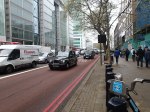





It’s a congested route and it involves at least one busy road crossing.
I had wondered if some sort of pedestrian over-bridge could be used with a moving pavement to link the two stations. But it would appear that layout of the buildings plonked in the front of Euston station would probably make this impossible.
Wikipedia does state that Network Rail devised plans in 2005 to link the two stations with a subway. This project seems to have sunk without trace.
The only thing that could possibly be done, is to put a lift to the street on the Northern side of the lines in Euston Square station, to improve access to the Eastbound platform.
I never walk between the two stations and to get to and from the station, I usually use a 30 or 73 bus, as the tube station underneath the mainline station is a dark warren of tunnels and escalators.
The trouble though with the buses, is they get stuck in the traffic on the Euston Road.
Why a proper connection between the two stations wasn’t incorporated, when they rebuilt Euston in the 1960s, only a genius of the level of Einstein could tell. But sadly he’s dead, so we’ll have to use the ouija board.
What puzzles me, is that how come the architects in the 1960s, could create two stations as bad as Manchester Piccadilly and Euston and yet leave Liverpool Lime Street as a properly working station! This section in Wikipedia offers a few clues.
Osborne Says Redevelop Euston Before HS2
There is an article in the Standard, where George Osborne says priority should be given to the redevelopment of Euston station, before HS2 is constructed.
I use the station several times a year and compared to Kings Cross, Liverpool Street, Paddington, Waterloo, Marylebone and St. Pancras, it is totally inadequate. It is even worse at the moment, than London Bridge, which is currently a building site.
What makes it so bad, is the lack of connection to the Circle line and the endless dingy walks from the other Tube lines to the station. There is no disabled access to the Underground.
There is a lot of scope to do this rebuilding right. These factors should be considered.
- The effect of the Croxley Rail Link to Watford Junction, which should be completed in 2017.
- Any development at Watford Junction, that could ease pressure on Euston.
- Could Willesden Junction be used to take passengers off the West Coast Main Line?
- Should an Old Oak Common station be built?
Properly planned, rebuilding of Euston,. adds a whole new dimension to HS2. It even questions whether HS2 terminates at Euston!
Could George Osborne’s view on Euston station be coloured, by his own personal experience and those of his constituents?
It doesn’t matter to me, as redeveloping Euston station is good sense, for all sorts of reasons!
Do We Need A Rolling HS2?
The report today by the think tank, the Institute of Economic Affairs, which says that HS2 will cost a lot more than is currently budgetted for. It’s all reported here on the BBC.
They make a lot of good points in the report.
Extra infrastructure such as trams and trains, will be needed to link other areas to the route.
Extra tunnels and other infrastructure will be needed to buy off the opposition.
The BBC summarises it like this.
The report said HS2 “and the add-on transport schemes will be heavily loss-making in commercial terms – hence the requirement for massive taxpayer support”.
As someone, who is very familiar with project management, I’ve always felt that the logic of HS2 and the way it is being implemented could and will be improved.
If we look at the current rail network, it has problems that will eventually be solved or helped by HS2.
Euston station is not fit for purpose and should be redeveloped and/or relieved. I favour a second terminus of the West Coast Main Line at Old Oak Common, as I mused here.
There are very severe capacity problems on the northern part of the West Coast Min Line between Wigan and Glasgow. This is not part of the current HS2, so perhaps it should be done to make sure the Scots get their connections to the South improved.
The East Coast Main Line to Leeds and Newcastle, has a notorious bottleneck at the Digswell Viaduct and according to this report on the BBC web site, it could be removed for under half a billion.
One problem that HS2 doesn’t solve is the bad connections across the north of England from Liverpool to Leeds and Hull. This BBC report includes an estimate of a billion plus.
So should we just define the route for HS2 and then break it into a series of manageable projects, that are implemented over the years.
We might design large stretches for say 300 kph, but most of the upgraded network would have limits of around 200 to 250 kph. Effectively large sections of the East and West Coast Main Lines can now handle 225 kph and just need resignalling.
The new Class 800 and Class 801 trains will be built to a design speed of 225 kph.
In some ways these trains may be the key to the whole of the expansion of high-speed services. I suspect, we’ll see them on London to Sheffield and Norwich for a start.
1960s Architectural Failures
Yesterday, I went to or through four stations; Highbury and Islington, Euston, Manchester Piccadilly and Huddersfield.
Huddersfield is a Grade 1 Listed Building which means it is one of the finest buildings in the country. The others are three of the worst examples of how we designed and built stations in the 1960s.
So it got me thinking about what are the worst examples of 1960s architectural design, that I’ve seen. I’ll start with the three I’ve already named.
Euston station – I probably went to Liverpool a couple of times from Euston before the current station was built and I have vague memories of catching trains there during the building in perhaps 1965 to 1967. The design shows classic “Think Small” attitudes as it was deliberately built with foundations that couldn’t support development above. Only twenty or so years later, Liverpool Street station was remodelled, which shows how good design can be applied to old buildings. Since then St. Pancras and Kings Cross have been rebuilt using similar thought processes to those used so successfully at Liverpool Street. One does wonder what would have happened at Euston, if the rebuilding had been a few years later. Euston is now to be rebuilt for HS2 and I suspect they’ll get it right this time.
Euston has another big problem, that you don’t see on the surface. The Underground station is one of the worst in London, with no step-free access, innumerable staircases and escalators and a dingy cramped ticket hall. The only good thing about Euston station is that coming off a train, it’s easy to walk to a bus, as I did last night. But try taking a heavy case on the Underground.
In some ways, Euston’s problems with the Underground should have been solved, when they built the Victoria Line, which opened at around the same time as the new Euston station. It just showed how bad project planning was in those days. The fact that the Victoria line was built on the cheap didn’t help.
Highbury and Islington station – This suffers badly because of the decision to build the Victoria Line on the cheap. Again it is not step-free and it perhaps is one of the worst stations for disabled access in the Underground, as when you get down the escalator, you then have a tunnel and a staircase to get to the platforms. At least the Overground platforms have lifts to the surface. Since I have moved to the area, the station concourse has been opened up considerably and it is not dark and cramped like it was a couple of years ago. To be fair to Transport for London, I think they’ve achieved the improvement without using tons of money. But solving the problems of access to the underground platforms will be very expensive.
Manchester Piccadilly station – This suffers in that it doesn’t have enough platforms and lines. Additionally, of all the main stations in the country, it probably has some of the worst connections to other means of transport. It makes you wonder if it was designed as a cheap stop-gap solution to accept the new electric trains from London. They are spending a fortune on the Northern Hub, but will it get rid of all the hangovers from the 1960s and all the resulting layers of sticky tape? Only time will tell, but judging by the improvement of planning in recent years, it probably will. If you want to read about planning failures in the area, read this Wikipedia topic about the Ordsall Curve, which is a crucial part of the Northern Hub. It would appear that it had the go-ahead ( and money) in 1979.
So that’s dealt with yesterday’s examples, what others can be added to this list?
Kings Cross station – Although not specifically 1960s, but a few years later, this now virtually demolished extension was best described as a wart on the face of the Mona Lisa. The man who designed it, must have had the biggest conservation stopper of all time. I can’t wait until I see the new Kings Cross plaza in the autumn.
Various stations – There were a lot of stations built in the 1960s that I don’t like, although some are listed. I would start with a short list of Harlow Town, Stevenage, and Walthamstow Central. Railways have a lot to answer for, but some of their worst excesses were reserved for buildings like this signal box in Birmingham. Many reckon that Birmingham New Street station is another bad example, but at least the operation of the station seems to be pretty good. In fact the planned reconstruction of the station; Gateway Plus, is all about greater passenger comfort. So yet another 1960s monstrosity will bite the dust. Gateway Plus has this condemnation of 1960s thinking.
The current New Street station was built to cater for 650 trains and 60,000 passengers per day, which was roughly the same usage it experienced when it was first constructed. It was believed that demand for rail travel would decrease. However, it now caters for 1,350 trains and over 120,000 passengers – twice its design capacity. Passenger usage of New Street has increased by 50% since 2000.[2] It is predicted that passenger usage of the station will increase by 57% by 2020.
We do seem to have cut corners for decades and only now the chickens are coming home to roost.
The Latest Proposal For Crossrail 2
Crossrail 2 has been around since the early days of the twentieth century, but it is only now that Crossrail is well underway, that a serious proposal for a north-east to south-west cross London railway has been brought forward. It’s here on the BBC.
Crossrail 2 will be a lot easier than Crossrail.
When we were planning North Sea Oil platforms in the 1970s, every few years the cranes, barges and drills would be a lot bigger. So for a start, the tunnelling machines available to Crossrail 2, will be an order of magnitude bigger than those for Crossrail. I suspect if you look at the map for Crossrail 2, the two machines will start at Hackney and come out at Wimbledon or vice-versa, as there is no major junction in the middle like Farringdon, where the machines will have to be extracted or turned.
The project engineers for Crossrail 2, will probably take advantage of all the tricks they have learned on the previous project.
But if they follow the design published yesterday, there is tremendous simplification in the design, with much simpler-to-build stations in Central London. One is the very large double-ended station at Euston-Kings Cross. Why we don’t have more of these, I do not know!
I think, an early start is needed.
Is Making Stratford London’s HS2 Terminus A Good Idea?
A former director of projects at British Rail has suggested that London’s HS2 terminus should be at Stratford. Read about it here on the BBC’s web site.
One of the main reasons he gives is that it would stop the demolition of 200 homes at Euston. But then Euston station is a disgrace, as I said here and rebuilding it will probably mean it requires more space. So there would be some demolition anyway.
Euston has several problems.
1. I don’t think there are actually enough platforms for the amount of traffic coming into the station without HS2, let alone, when that line is built. The 2007 proposals for the rebuilding of the station without HS2 envisaged three new platforms.
2. The concourse is typical 1960s and 1970s rubbish, that isn’t big enough for the number of passengers the station handles at present.
3. The Underground station is not really fit for purpose and needs a new booking office, platforms on the Metropolitan line and lifts everywhere.
4. If the station was to be rebuilt properly, the space above the station could be used for new developments of housing and offices.
In my view to solve the problems at Euston even without HS2, the station needs a complete rebuild. 200 homes would be demolished, but many more would be built.
So his first argument that the homes would be saved is spurious.
His proposal that HS2 terminate at Stratford is ludicrous, as there are just two spare platforms there. But HS2 would require probably an extra six very long platforms. And those two spare platforms would be ideal for the TransManche Metro, if that were to be built. After all Stratford is a good interchange now and will be better with Crossrail.
And how do you get from HS2 to Stratford? On the North London line I suppose. Although he did suggest that the trains go up the crowded Lea Valley lines and across to Biggleswade and then to Southam to link up with HS2
It’s an idea, that holds water like a collander. Shame on the BBC to give it publicity!
But those against HS2 will clutch at this weak straw.
A Good Day
Seeing Tornado was the start of a good day.
I then took a Virgin Train to Manchester Piccadilly, where I had lunch at Carluccio’s in the station before going to the Reebok stadium to see Ipswich Town at Bolton. Town won 2-1, which was a good result, just like England’s victory in the rugby over New Zealand Although a friend had his pocket picked at Twickenham.
Coming back wasn’t the best part as the train from Bolton to Manchester was just three coaches and far too crowded. This was then followed by a Virgin that was empty in First Class and nearly half-an-hour late into Euston. If you’re going to get problems coming in to London, you can generally rely on Euston to not perform.
Although I eventually found some supper there, Marks and Spencer at Euston, looked as if it had been ravaged by a plague of locusts.
I do wish that someone starts a London to Manchester service from St. Pancras after the line is electrified. But they won’t be allowed to as you mustn’t annoy Saint Richard! Although to be fair, the lateness wasn’t down to Virgin.
The day was also improved as Chelski lost! On the train and in Bolton, no-one had any sympathy for them!
Meeting A Friend At Kings Cross
On Monday, I met a friend, who was travelling from Edinburgh to her daughter’s in Buckinghamshire. A few years ago, this would have been difficult, but now we met and walked into St. Pancras for supper before taking a taxi to Marylebone.

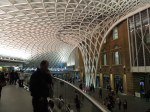
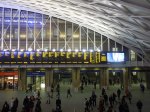
The pictures show the new ticket hall.
We could have ate in any number of places in King’s Cross, including the excellent Leon, whereas a few years ago, it would have just been sandwiches.
The one problem with meeting someone is that as the arrivals area is not finished yet, there is no obvious place to wait. But that will hopefully be sorted when the 1960s extension has been consigned to the dustbin.
London has two of the finest stations in the world sitting side-by-side on Euston Road. It all makes Euston, which is just up the road even more of a dump.
One of the ironies of all of this rebuilding, is that in ten years time, I suspect I’ll think that King’s Cross will be the better station, as it is growing into a superb fusion of the old and the modern. But then I always have a soft spot for Kings Cross as I can remember the A4 Gresley Pacifics in the station. These must be the most iconic steam engines ever produced in the UK.
 The Anonymous Widower