1960s Architectural Failures
Yesterday, I went to or through four stations; Highbury and Islington, Euston, Manchester Piccadilly and Huddersfield.
Huddersfield is a Grade 1 Listed Building which means it is one of the finest buildings in the country. The others are three of the worst examples of how we designed and built stations in the 1960s.
So it got me thinking about what are the worst examples of 1960s architectural design, that I’ve seen. I’ll start with the three I’ve already named.
Euston station – I probably went to Liverpool a couple of times from Euston before the current station was built and I have vague memories of catching trains there during the building in perhaps 1965 to 1967. The design shows classic “Think Small” attitudes as it was deliberately built with foundations that couldn’t support development above. Only twenty or so years later, Liverpool Street station was remodelled, which shows how good design can be applied to old buildings. Since then St. Pancras and Kings Cross have been rebuilt using similar thought processes to those used so successfully at Liverpool Street. One does wonder what would have happened at Euston, if the rebuilding had been a few years later. Euston is now to be rebuilt for HS2 and I suspect they’ll get it right this time.
Euston has another big problem, that you don’t see on the surface. The Underground station is one of the worst in London, with no step-free access, innumerable staircases and escalators and a dingy cramped ticket hall. The only good thing about Euston station is that coming off a train, it’s easy to walk to a bus, as I did last night. But try taking a heavy case on the Underground.
In some ways, Euston’s problems with the Underground should have been solved, when they built the Victoria Line, which opened at around the same time as the new Euston station. It just showed how bad project planning was in those days. The fact that the Victoria line was built on the cheap didn’t help.
Highbury and Islington station – This suffers badly because of the decision to build the Victoria Line on the cheap. Again it is not step-free and it perhaps is one of the worst stations for disabled access in the Underground, as when you get down the escalator, you then have a tunnel and a staircase to get to the platforms. At least the Overground platforms have lifts to the surface. Since I have moved to the area, the station concourse has been opened up considerably and it is not dark and cramped like it was a couple of years ago. To be fair to Transport for London, I think they’ve achieved the improvement without using tons of money. But solving the problems of access to the underground platforms will be very expensive.
Manchester Piccadilly station – This suffers in that it doesn’t have enough platforms and lines. Additionally, of all the main stations in the country, it probably has some of the worst connections to other means of transport. It makes you wonder if it was designed as a cheap stop-gap solution to accept the new electric trains from London. They are spending a fortune on the Northern Hub, but will it get rid of all the hangovers from the 1960s and all the resulting layers of sticky tape? Only time will tell, but judging by the improvement of planning in recent years, it probably will. If you want to read about planning failures in the area, read this Wikipedia topic about the Ordsall Curve, which is a crucial part of the Northern Hub. It would appear that it had the go-ahead ( and money) in 1979.
So that’s dealt with yesterday’s examples, what others can be added to this list?
Kings Cross station – Although not specifically 1960s, but a few years later, this now virtually demolished extension was best described as a wart on the face of the Mona Lisa. The man who designed it, must have had the biggest conservation stopper of all time. I can’t wait until I see the new Kings Cross plaza in the autumn.
Various stations – There were a lot of stations built in the 1960s that I don’t like, although some are listed. I would start with a short list of Harlow Town, Stevenage, and Walthamstow Central. Railways have a lot to answer for, but some of their worst excesses were reserved for buildings like this signal box in Birmingham. Many reckon that Birmingham New Street station is another bad example, but at least the operation of the station seems to be pretty good. In fact the planned reconstruction of the station; Gateway Plus, is all about greater passenger comfort. So yet another 1960s monstrosity will bite the dust. Gateway Plus has this condemnation of 1960s thinking.
The current New Street station was built to cater for 650 trains and 60,000 passengers per day, which was roughly the same usage it experienced when it was first constructed. It was believed that demand for rail travel would decrease. However, it now caters for 1,350 trains and over 120,000 passengers – twice its design capacity. Passenger usage of New Street has increased by 50% since 2000.[2] It is predicted that passenger usage of the station will increase by 57% by 2020.
We do seem to have cut corners for decades and only now the chickens are coming home to roost.
The Latest Proposal For Crossrail 2
Crossrail 2 has been around since the early days of the twentieth century, but it is only now that Crossrail is well underway, that a serious proposal for a north-east to south-west cross London railway has been brought forward. It’s here on the BBC.
Crossrail 2 will be a lot easier than Crossrail.
When we were planning North Sea Oil platforms in the 1970s, every few years the cranes, barges and drills would be a lot bigger. So for a start, the tunnelling machines available to Crossrail 2, will be an order of magnitude bigger than those for Crossrail. I suspect if you look at the map for Crossrail 2, the two machines will start at Hackney and come out at Wimbledon or vice-versa, as there is no major junction in the middle like Farringdon, where the machines will have to be extracted or turned.
The project engineers for Crossrail 2, will probably take advantage of all the tricks they have learned on the previous project.
But if they follow the design published yesterday, there is tremendous simplification in the design, with much simpler-to-build stations in Central London. One is the very large double-ended station at Euston-Kings Cross. Why we don’t have more of these, I do not know!
I think, an early start is needed.
Is Making Stratford London’s HS2 Terminus A Good Idea?
A former director of projects at British Rail has suggested that London’s HS2 terminus should be at Stratford. Read about it here on the BBC’s web site.
One of the main reasons he gives is that it would stop the demolition of 200 homes at Euston. But then Euston station is a disgrace, as I said here and rebuilding it will probably mean it requires more space. So there would be some demolition anyway.
Euston has several problems.
1. I don’t think there are actually enough platforms for the amount of traffic coming into the station without HS2, let alone, when that line is built. The 2007 proposals for the rebuilding of the station without HS2 envisaged three new platforms.
2. The concourse is typical 1960s and 1970s rubbish, that isn’t big enough for the number of passengers the station handles at present.
3. The Underground station is not really fit for purpose and needs a new booking office, platforms on the Metropolitan line and lifts everywhere.
4. If the station was to be rebuilt properly, the space above the station could be used for new developments of housing and offices.
In my view to solve the problems at Euston even without HS2, the station needs a complete rebuild. 200 homes would be demolished, but many more would be built.
So his first argument that the homes would be saved is spurious.
His proposal that HS2 terminate at Stratford is ludicrous, as there are just two spare platforms there. But HS2 would require probably an extra six very long platforms. And those two spare platforms would be ideal for the TransManche Metro, if that were to be built. After all Stratford is a good interchange now and will be better with Crossrail.
And how do you get from HS2 to Stratford? On the North London line I suppose. Although he did suggest that the trains go up the crowded Lea Valley lines and across to Biggleswade and then to Southam to link up with HS2
It’s an idea, that holds water like a collander. Shame on the BBC to give it publicity!
But those against HS2 will clutch at this weak straw.
A Good Day
Seeing Tornado was the start of a good day.
I then took a Virgin Train to Manchester Piccadilly, where I had lunch at Carluccio’s in the station before going to the Reebok stadium to see Ipswich Town at Bolton. Town won 2-1, which was a good result, just like England’s victory in the rugby over New Zealand Although a friend had his pocket picked at Twickenham.
Coming back wasn’t the best part as the train from Bolton to Manchester was just three coaches and far too crowded. This was then followed by a Virgin that was empty in First Class and nearly half-an-hour late into Euston. If you’re going to get problems coming in to London, you can generally rely on Euston to not perform.
Although I eventually found some supper there, Marks and Spencer at Euston, looked as if it had been ravaged by a plague of locusts.
I do wish that someone starts a London to Manchester service from St. Pancras after the line is electrified. But they won’t be allowed to as you mustn’t annoy Saint Richard! Although to be fair, the lateness wasn’t down to Virgin.
The day was also improved as Chelski lost! On the train and in Bolton, no-one had any sympathy for them!
Meeting A Friend At Kings Cross
On Monday, I met a friend, who was travelling from Edinburgh to her daughter’s in Buckinghamshire. A few years ago, this would have been difficult, but now we met and walked into St. Pancras for supper before taking a taxi to Marylebone.
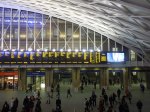

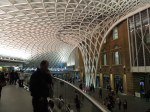
The pictures show the new ticket hall.
We could have ate in any number of places in King’s Cross, including the excellent Leon, whereas a few years ago, it would have just been sandwiches.
The one problem with meeting someone is that as the arrivals area is not finished yet, there is no obvious place to wait. But that will hopefully be sorted when the 1960s extension has been consigned to the dustbin.
London has two of the finest stations in the world sitting side-by-side on Euston Road. It all makes Euston, which is just up the road even more of a dump.
One of the ironies of all of this rebuilding, is that in ten years time, I suspect I’ll think that King’s Cross will be the better station, as it is growing into a superb fusion of the old and the modern. But then I always have a soft spot for Kings Cross as I can remember the A4 Gresley Pacifics in the station. These must be the most iconic steam engines ever produced in the UK.
Bus and Tube Information at Euston Station
When you arrive at the station in a city or town, you often need information to complete your journey to your final destination.

Bus and Tube Information at Euston Station
Most London stations have information booths like this provided by Transport for London at Euston station. I’ve never found such a booth in Manchester Piccadilly and I meant to check Liverpool Lime Street today, but forgot.
They say this about buses at Liverpool Lime Street on the National Rail website.
‘Arriva’ and ‘Stagecoach’ operate a network of daily, frequent bus routes around the city and also to nearby towns. For route maps and timetables: http://www.arrivabus.co.uk and http://www.stagecoachbus.com/merseyside
Liverpools main bus station (on Roe Street) is about 4 minutes walk from Lime Street station.
So should I assume there is no booth. How do you find out what bus company you need?
The same web site gives this for Euston.
Bus route maps are available from Transport for London’s website.
There is no mention of the excellent booth, although the link does point to bus maps for Camden.
There is also no way to contact the National Rail web site, to kick them into line. So we are just Self Loading Cargo left to our own devices.
The Rubbish Talked About HS2
I listened to some of the phone-in about HS2 on Radio 5 this morning, but gave up after most of those in the discussion, weren’t letting facts get in the way of a good selfish argument.
So here’s a few facts and my observations.
The West Coast Main Line is rather a nightmare. It is overloaded now and longer and bigger trains would probably only mop-up a small amount of the increase in passengers that will happen in the next few years. In my travels any Virgin train to or from Glasgow was severely overloaded and this section needs action now.
It was intended that the speed limit on the line would be increased, but because the line isn’t very straight, the cost would be high both in monetary terms and also in blockades whilst it was upgraded. Wikipedia says this about the reasons for the bad design of the line.
Because of opposition by landowners along the route, in places some railway lines were built so that they avoided large estates and rural towns, and to reduce construction costs the railways followed natural contours, resulting in many curves and bends. The WCML also passes through some hilly areas, such as the Chilterns (Tring cutting), the Watford Gap and Northampton uplands followed by the Trent Valley, the mountains of Cumbria with a summit at Shap, and Beattock Summit in southern Lanarkshire. This legacy of gradients and curves, and the fact that it was not originally conceived as a single trunk route, means the WCML was never ideal as a long-distance main line.
The East Coast Main Line is better, but it doesn’t solve the problem on the western side of the country.
So those who talk about increasing the capacity on the West Coast Main Line had better look at the engineering problems involved.
Christian Wolmar, a respected commentator on rail, said on television this morning, that the money for HS2 would be better spent on improving local tranport in cities and large towns, by providing trams and better bus services. He has a point, but there is one fault in his argument.
If we take Manchester as an example, where the tram system is being substantially developed, this will make it easier for long distance travellers to get to Manchester Piccadilly and the West Coast Main Line. If trams are frequent and have substantial car parking outside of the city, it may well persuade many more to take the train rather than driving.
So in fact, his plan will in the long term increase the long distance train traffic increasing the need for long distance services from Manchester and in a decade or so for HS2.
More passengers will also be brought to the line, by improvements to cross country and branch lines. Some of these like Manchester to Leeds are scheduled to be electrified and this can only attract more passengers to the fast London lines, where their local station has no connection.
One point on this is that Network Rail is investing in a special overhead line installation train, that can install a mile of overhead wiring every night with only minimal line closure. This will mean that some lines where only a marginal case exists now, will be electrified. An example is possibly from Felixstowe to Nuneaton via Peterborough, which would allow freight trains to be electric hauled all the way to the North of England and Scotland.
Another big problem is freight, which most would feel is better carried by rail to and from the ports to where it is needed. A few years ago, Felixstowe had just three freight trains a day out of the port. Now it’s a lot higher. Much of the freight will come and go through Felixstowe, Southampton and in the future the new London Gateway development and it will need to be either collected from and delivered all over the country. This would add greatly to the number of freight trains going everywhere. Many of course, will have to go up to Birmingham, the North West and Scotland.
So whatever we do we’ll have to find some way to take the freight north or alternatively free up the West Coast Main Line, by building HS2. Or do we put more trucks on the motorways and clog them up?
Those that propose upgrading the West Coast Main Line with longer and bigger trains, forget one problem, that under the current plans also applies to HS2. And that is what to do with the totally inadequate station at Euston. Of London’s main stations it is one of the worst, as I said here. It will have to be rebuilt whether we build HS2 or not. It really doesn’t have the good ongoing transport links that Kings Cross, Liverpool Street, London Bridge and Paddington have or in some cases will have after Crossrail.
In fact it could be argued that if HS2 has a station at Old Oak Common, this might be a better London terminus for that line, as it links to Crossrail, the Great Western Main Line and possibly Heathrow.
There are also a lot of technology that will make HS2 better from an engineering, environmental and passenger point of view.
For a start tunnelling technology has improved substantially in the last decade or so. If you look at the speed of building the Crossrail tunnels, I think that this shows a big increase to the similar tunnels bored for HS1. Having listened to Justine Greening’s statement in the House of Commons, this improvement is being used to put more of the line underground. We may actually be getting to the point, where tunnels are cheaper to build that lines on viaducts.
We also know a lot more about how to minimise problems when we build large projects. Crossrail for example seems to be causing a lot less problems with construction than HS1 did. Admittedly, it has caused a bit of a problem at some Central London station sites, but no more than say the average large building site or an office block.
Project management has also got a lot better over the last few decades and it is much more likely these days that a large contract is built on time and on budget. Provided the politicians and the civil servants don’t stick their oar in too much and change the specification, it will be all right in the end.
As the Sunday Times pointed out at the weekend design is getting better and the trains on HS2 could be a lot better than Eurostar. We might also see other technologies like anti-noise cutting the noise signature of the trains.
It has also been said that passengers won’t use HS2 because it will be too expensive and too much hassle. But here is where technology will help, in such things as buying tickets, where hopefully we’ll see a touch-in touch-out system like Oyster.
So the doom-mongers will continue to knock HS2, but it has a lot going for it.
The trouble with rail projects, is that if we had a referendum about spending £32 billion on rail or the same amount on roads, the public would vote for the roads. But within a few years they’d be just as gridlocked.
Getting Between Kings Cross/St. Pancras and Euston
London’s three major stations that serve the North and of course the Continent; Kings Cross, St. Pancras and Euston, are all close together on the Euston Road.
The first has been superbly rebuilt, the second is approaching the end of a major redevelopment and they now share probably the best Underground station in London. But Euston is rather isolated from the other two, with several ways to get between them.
- You can take a rather unpleasant walk along the busy Euston Road.
- You can use the Metropolitan or Circle lines, but this means a walk to or from Euston Square at the Euston end.
- You can dive into the Underground and take the Victoria or Northern lines, but it is not step free at the Euston end, and not recommended with a heavy case. Both deep stations are also easy places to get lost or confused.
- Going from Euston to Kings Cross or St. Pancras is quite easy by bus 30, 73, 205 or 476, which you catch in front of Euston station, but the reverse journey means you have to cross Euston Road twice.
- There are of course taxis. But not everyone can afford them.
As I had time to spare at Kings Cross, before I caught my train to Hartlepool, I decided to investigate and found a map which showed there was a fairly simple direct walking route that avoided the pollution and traffic of the Euston Road.
I started by walking through St. Pancras station and exited by the cab rank onto Midland Road, with the intention of going down Brill Place.
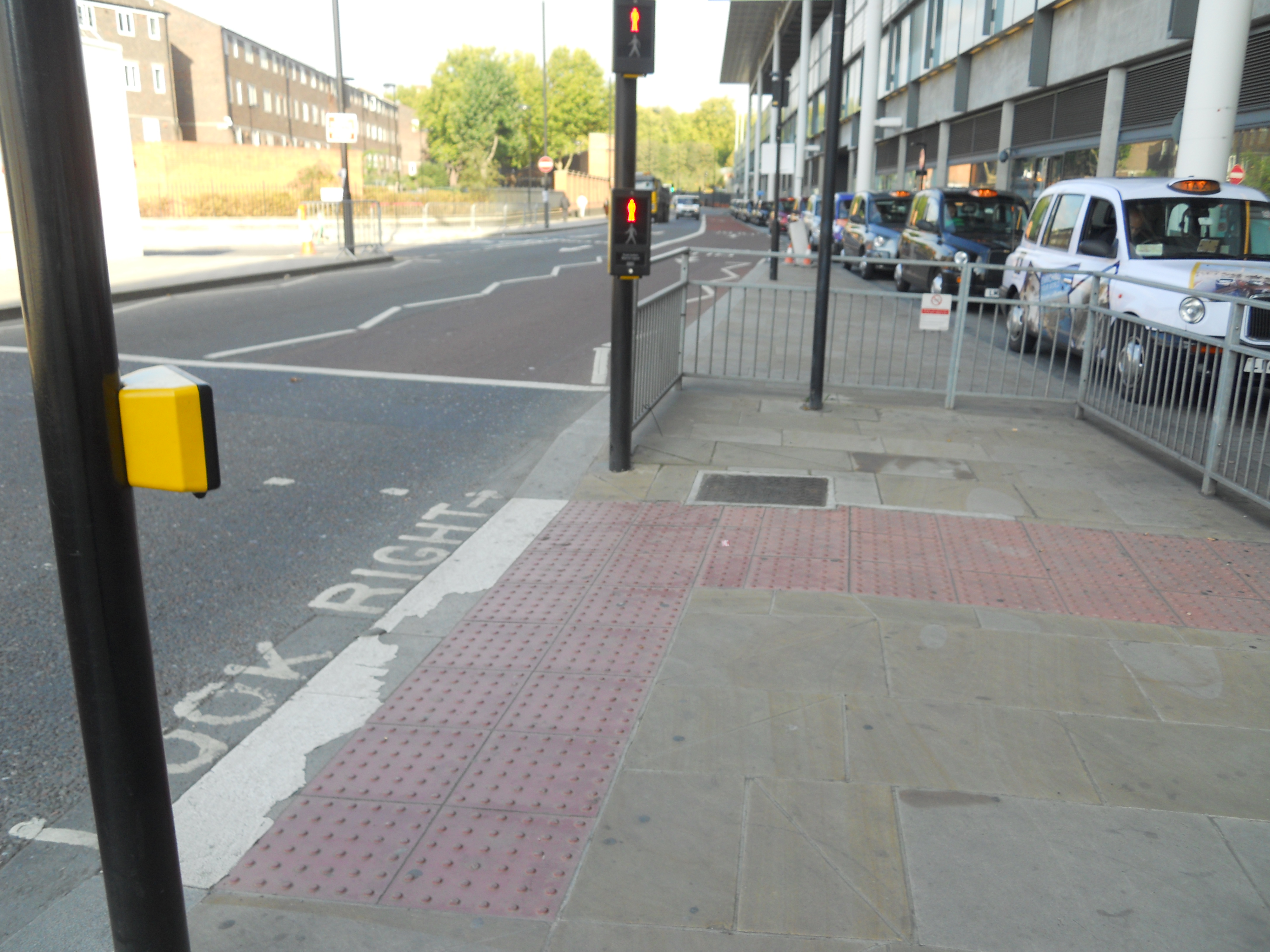
Crossing Midland Road
There is a light controlled crossing, but it is rather blocked by badly placed railings and the cab rank. Brill Place, which is the start of the road to Euston is on the left.
Brill Place is flanked on one side by the new Francis Crick Institute and on the right, there is a small pleasant park, which could provide an oasis from the crowds in the stations.
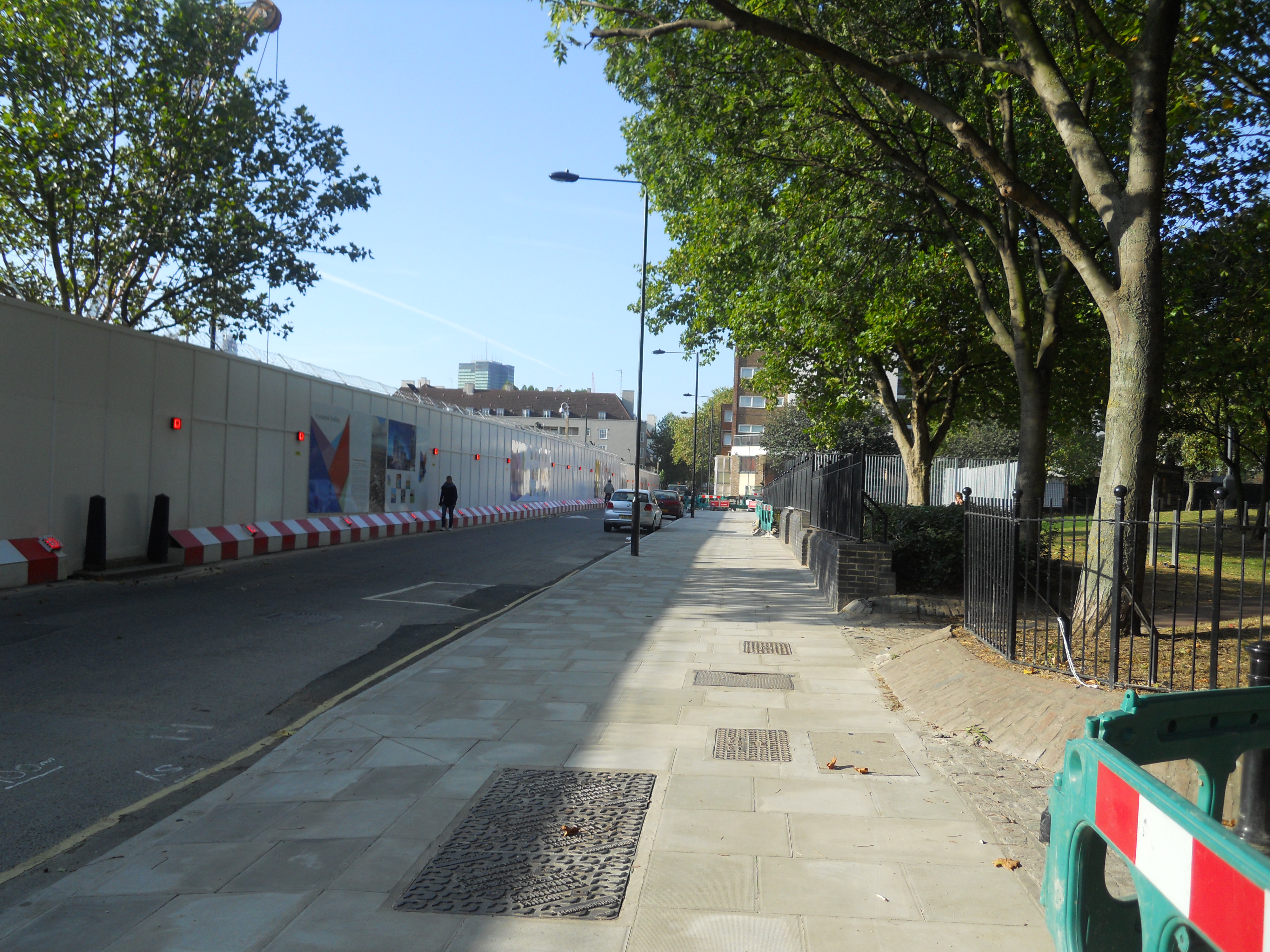
Brill Place
Brill Place itself, is not a grotty dusty road lined by parked cars, but a wide tree-lined avenue that leads on to Phoenix Road.
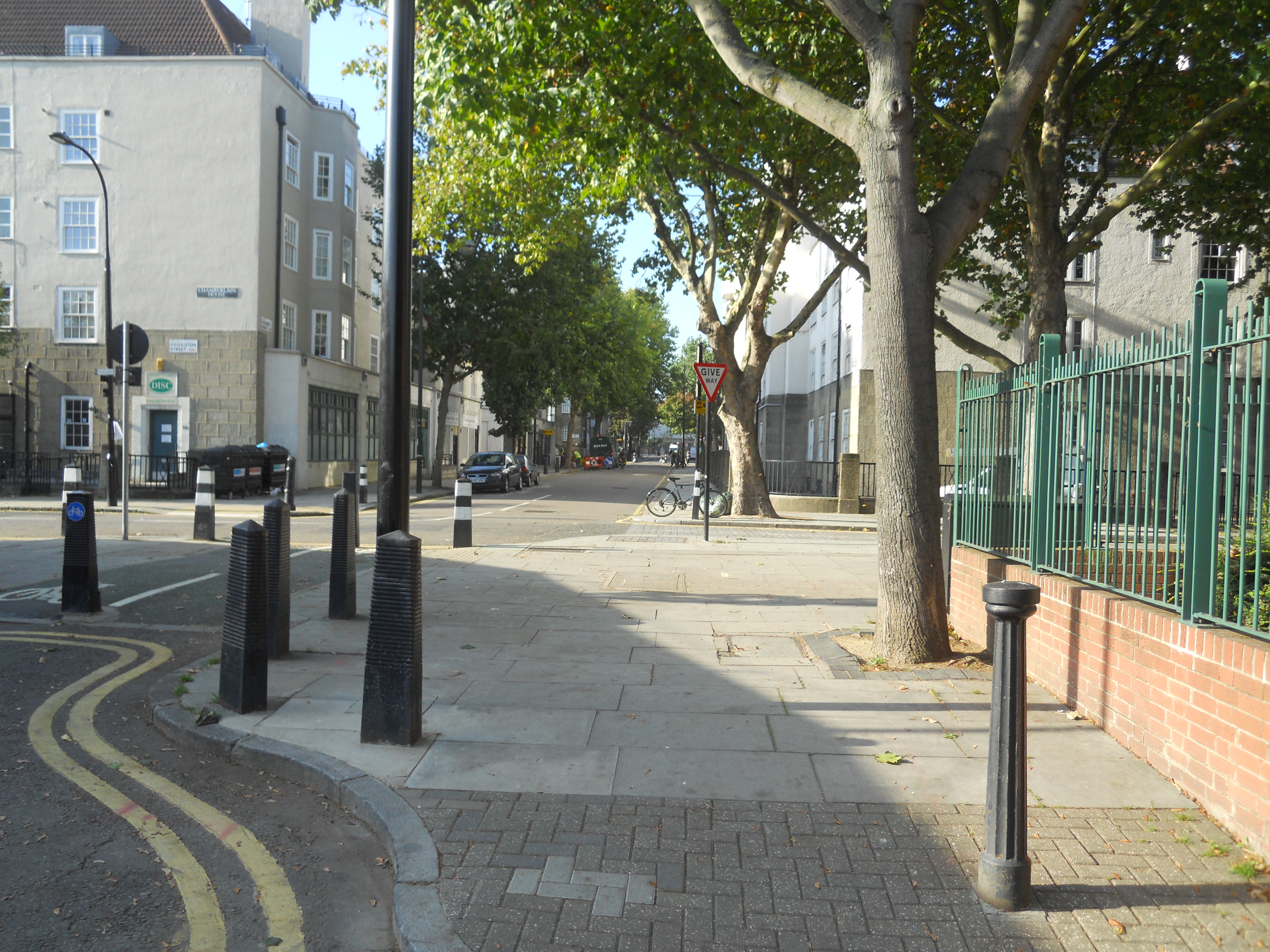
Towards Pheonix Road
At the end of Phoenix Road, you just cross Eversholt Street on one of the two pedestrian crossings and you walk down the road to Euston station.
The advantages of the route are as follows.
- The route is virtually flat.
- It would be easy trailing quite a large case.
- There are only two major roads to cross and both have light-controlled pedestrian crossings.
- There is the park, which would as I said before, be a better place to eat a packed meal than the station.
- You do pass a few shops and a reasonable-looking pub.
But there are disadvantages.
- The route is not signposted.
- The barriers at the St. Pancras end are wrongly placed.
- The side entrance to Euston station could be better.
So how would I make it better, so that in effect we had one super station for the north.
- I’d start with sign-posting. The posts are there at the St. Pancras end already.
- Perhaps, it should be marked on the ground, as a Kings Cross/St. Pancras to Euston walking route.
- You might even provide some eco-friendly transport along the route, like an electric shuttle bus or bicycle rickshaws.
- A couple of suitably placed Boris bike stations would help too.
- Shops and cafes should be developed along the road. There are some already.
To me though, this is one of those things that will happen. But probably first in a very unofficial way, as how many of those that work in the Francis Crick Institute will commute into Euston and walk there? It won’t be a small number.
It took me about fifteen minutes to do the walk and I just got a 205 bus back to Kings Cross for my train from the front of Euston station.
A Sign At Euston
I saw this sign at Euston tonight.
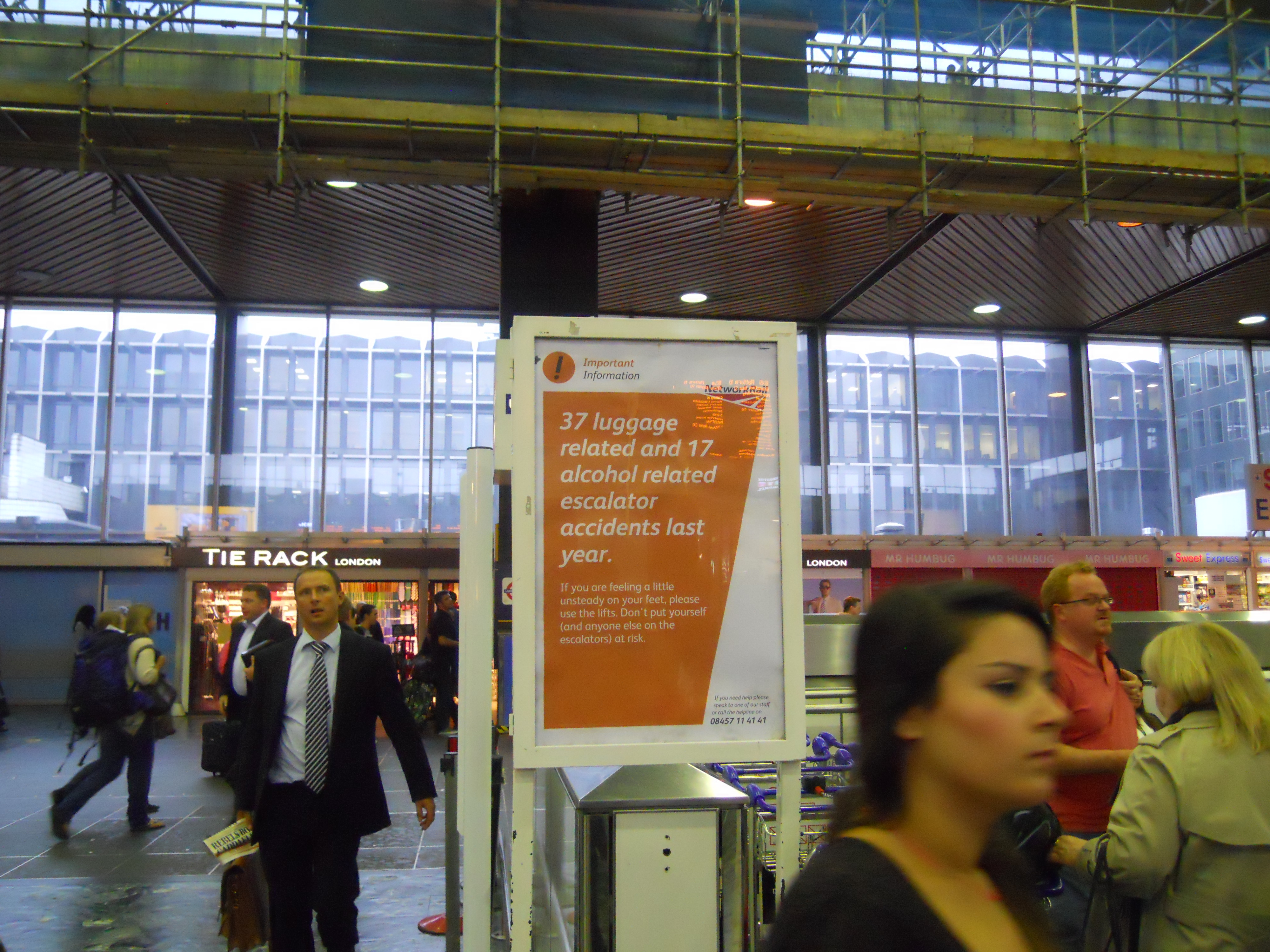
A Sign at Euston
How many of the 37 luggage related accidents, were caused by drunks carrying trays of lager?
 The Anonymous Widower