Nordhausen
Nordhausen has two stations close together.
- Nordhausen is the main Deutche Bahn station.
- Nordhausen Nord is the Southern terminus of the Harz Narrow Gauge Railways.
These pictures show the two stations, the Bahnhofsplatz that connects them, the trams and the town.

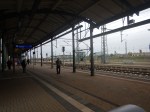


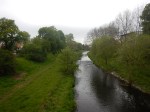
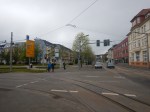


It’s certainly not difficult to get between the two stations.
I was hoping I’d find something to eat, but I couldn’t find a food shop, so had to be content with a good coffee and a banana. Although, since I’ve looked on the map and find that there is a Lidl in walking distance of the stations. I have struck lucky for gluten-free food in the former East Germany before, as I wrote about in Lunch In Chemnitz, but on this visit I wasn’t very lucky.
Along The South Harz Railway
Getting from Göttingen to Nordhausen for the Harz Narrow Gauge Railways was not the simple process it should have been.
My first attempt was to take a train changing at Eichenberg totally failed, as I wrote about in A Wasted Journey To Eichenberg.
After getting back to Göttingen, I took a direct train along what is known as the South Harz Railway.

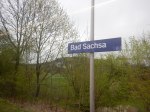
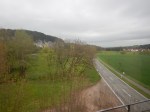

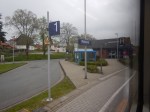
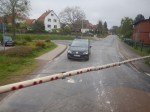

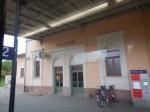
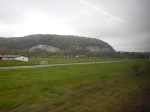
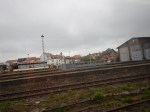
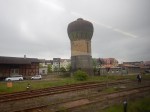
The route is not electrified and it looked like it had been improved since the reunification of Germany.
A Wasted Journey To Eichenberg
This journey illustrated a lot of the problems of Deutsche Bahn.
They may have some good trains, but they use methods, that if a train company used in the UK, would see them featuring heavily in the pages of the tabl;oids.
I wanted to get from Göttingen to Nordhausen and I just missed the hourly direct train. So the ticket machines suggested I change at Eichenberg.
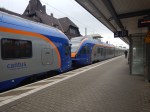
These pictures show Eichenberg station.
The train didn’t arrive and there was no announcement about what was happening. But there wasn’t any. Even the bahn.de web page gave no information on lateness. Eventually, as it was cold on the platform, I went looking for help, but the station was unmanned and totally devoid of any useful information. Whilst, I was away, the train turned up unannounced.
I then had a choice of wait two hours for the next train on a cold station or catch another train to civilisation. Luckily, it was Göttingen and I was able to restart my journey.
The moral of this story, is that if there is a direct train in Germany, then make sure you catch it. Even if you have to wait for an hour in the warm.
Göttingen
Göttingen is a German university town.

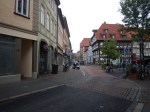


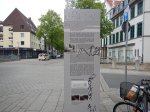
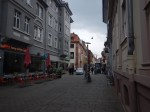








I took these pictures as I explored after a very good German gluten-free breakfast.
London To Karlsruhe Via Paris
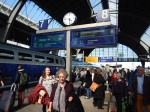
I took Eurostar and a TGV to Karlsruhe, using these trains.
- Eurostar – St. Pancras 08:19 – Paris Nord 11:47 – £115 from Eurostar
- TGV – Paris Est 13:55 – Karlsruhe 16:25 – £69.19 from Voyages SNCF
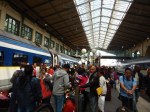
I took these pictures on the way.






Note.
- I bought both tickets on-line.
- Premium Economy in the new Eurostar trains is more cramped than the old ones.
- Eurostar’s Premium Economy gluten-free breakfast more than filled a hole.
- Paris Nord to Paris Est is just a Metro.
- I took a diversion via Republik, which was a good place to wait in the sun.
- I stayed in the Schlosshotel in Karlsruhe, which was one of several acceptable ones by the station.
I could probably have done the journey cheaper by flying, but it would have had more hassle.
German Trains With Batteries
One of my Google alerts found this article on Rail Journal, which is entitled DB to convert DMUs to bi-mode hybrid trains.
This is said.
GERMAN Rail (DB) has announced it is working with technical universities in Chemnitz and Dresden to develop bi-mode (diesel and electric) trains with lithium-ion battery storage. Between 2017 and 2021 DB intends to convert 13 existing Siemens class 642 Desiro Classic DMUs to hybrid bi-mode configuration.
It seems the Germans share my belief that trains with batteries are the future.
Snot Wars
There is no other title for a post about this article on the BBC, which is entitled Antibiotic resistance: ‘Snot wars’ study yields new class of drugs.
The research has been done at the University of Tübingen, which is one of Germany’s classical universities. Wikipedia says this.
Tübingen is one of five classical “university towns” in Germany; the other four being Marburg, Göttingen, Freiburg and Heidelberg.
It certainly sounds to me that ideas for this research, possibly started after a good academic dinner with lots of food and alcohol, if classical German universities are anything like our’s.
After all the idea has been literally up researchers noses for years.
These last two paragraphs of the BBC report describes how the antibiotic-like action was possibly created in the human body.
Prof Kim Lewis and Dr Philip Strandwitz, from the antimicrobial discovery centre at Northeastern University in the US, commented: “It may seem surprising that a member of the human microbiota – the community of bacteria that inhabits the body – produces an antibiotic.
“However, the microbiota is composed of more than a thousand species, many of which compete for space and nutrients, and the selective pressure to eliminate bacterial neighbours is high.”
So why hasn’t this new class of antibiotics been found before?
Could it be that medical research is too much about Loadsamoney and Big Pharma, rather than about ideas, seriously out-of-the-box thinking and dilligent research?
Brains are a lot easier to throw at a problem, than money. Except that good brains are much more difficult to find than good money.
Are The Railways Of Saxony A Benefit Of Communism?
Saxony is a German State with a lot of railways. This page is a list from Wikipedia.
In the UK, after the Second World War, we needed to modernise our railways and what we did was rather patchy and haphazard.
It finally, led to a lot of costs to no great benefit.
- I can remember taking over five hours on a journey to Liverpool in the 1960s.
- I always in the 1960s and 1970s, used to look at a heavy rail train and say how inferior they were to what the London Underground offered.
- Electrification was very slow to come in. I can remember Trains Illustrated saying Felixstowe will be electrified soon in the 1960s.
- Schemes like the Picc-Vic Tunnel in Manchester never saw the light of day.
Finally, the Beeching Report put a can on it.
But in the former East Germany, there were no such cost pressures in a centralised communist economy, where maintaining employment was a priority.
One thing you notice in the are is lots of signal boxes, often with an associated level crossing. Do they need them?
Whereas we would shut railways enthusiastically to cut costs, the East Germans didn’t, as it was against their politics.
So a lot of railways got preserved, where other countries would have closed them!
Now you can see a lot of railway development, as like the UK, Germany is coming round to the view that railways are what people want and they’re good for the economy.
How To Move 100,000 Containers A Year Between Germany And China
This article on Global Rail News is entitled DB and Georgian Railways to cooperate on new Silk Road rail corridor.
It described how Deutsche Bahn and Georgian Railways have signed an agreement to develop a new rail freight route between the Far East and Europe.
This map from the article, shows the various rail routes across Eurasia and how the new Silk Road will fit in.
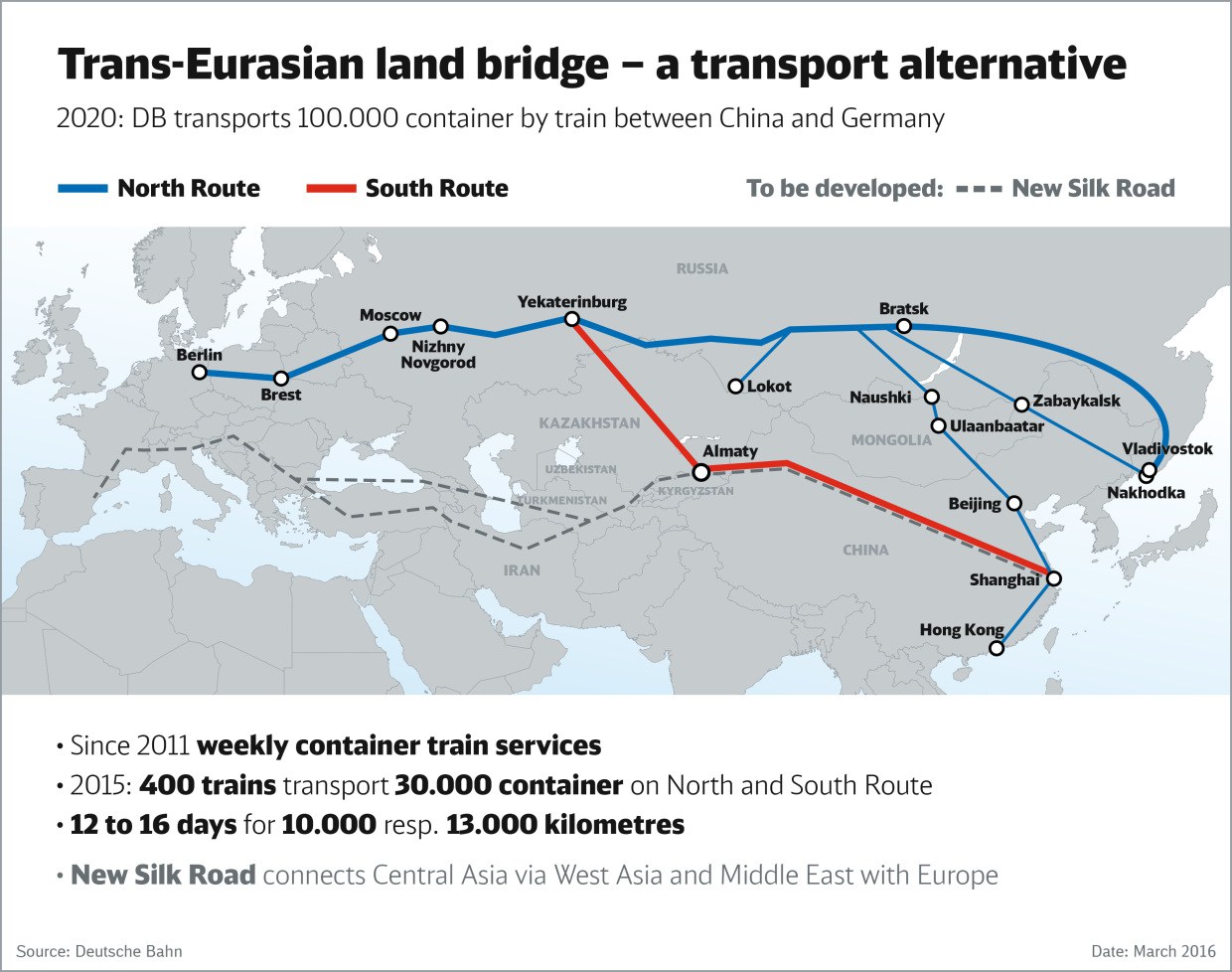
DB transports more container by train between China and Germany
I think the most interesting thing about the new route, is that it doesn’t go through Russia.
Vladimir Putin will not be amused!
If you read the Wikipedia entry for Georgian Railways, it does list a few problems, but it would appear that the route across Georgia is being upgraded to Standard Gauge all the way from the Turkish border to Almaty in Kazakhstan.
With Germany, Turkey and Europe at the Western end and China at the Eastern end both predominately Standard Gauge, I think that this route will be all the same gauge.
When this happens, trains will be able to go straight through, with perhaps just a change of locomotive.
How long will it be before, an enthusiastic entrepreneur starts to run a passenger service between Europe and China. Trans-Siberian Express eat your heart out!
Vladimir Putin will be even less amused!
If DB can build the Standard Gauge railway through to China via Georgia, it will give the following benefits.
- Services will be faster than the Russian routes.
- There will no change of gauge, which means unloading one train and loading another.
- If the line is electrified, this will make the route more efficient.
- Freight will move smoothly across Asia avoiding the pariah that is Russia.
- The route avoids the more volatile parts of the Middle East.
- Countries on the route like Serbia, Turkey, Georgia and Kazahkstan will surely benefit.
- The route will surely be more accessible to Southern European countries, than the current Russian routes.
It is undoubtedly a good plan.
TTIP Is Known About In Germany
If you were on the Clapham Omnibus or in my case the Dalston Omnibus and you did a straw poll of what TTIP was about, you probably wouldn’t find anybody who knew.
But obviously they do in Germany.

TTIP Stoppen!
Or at least they want to stoppen it!
 The Anonymous Widower