Stadler Presents A World First In Berlin
The title of this post, is the same as that of this press release from Stadler.
These are the first two paragraphs.
With the RS ZERO, the rail vehicle manufacturer is presenting the successor to the successful Regio-Shuttle RS1 model. There is a choice of two modern and environmentally friendly drive technologies: Hydrogen and battery. Both will enable CO2 emission-free operation of secondary lines in the future.
Stadler today unveiled the prototype of the new RS ZERO, the innovative successor to the successful RS1 Regio-Shuttle. The Regio-Shuttle has been one of the most popular vehicles in German regional rail transport for 28 years, with around 500 RS1 vehicles currently in operation in Germany and the Czech Republic. Stadler is building on this proven technology and integrating state-of-the-art, environmentally friendly drive systems. The RS ZERO is optionally available with a hydrogen and/or battery drive and thus not only sets new standards for environmentally friendly rail transport, but also presents a world first.
These pictures from Chemnitz Trams And The Chemnitz Model, show the Regio-Shuttle RS1.
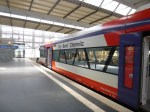
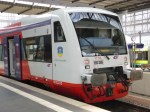
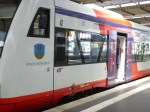
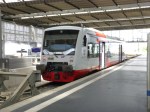
Note.
- The Regio-Shuttles can run as up to seven car trains.
- These Regio-Shuttles are electro-diesel.
- The distinctive diagonal windows.
- They can carry 170 passengers at 75 mph.
- They can run as train-trams using the Chemnitz model on compatible tram networks.
The Regio-Shuttle Wikipedia entry gives more details.
This image from the press release shows the prototype RS ZERO.
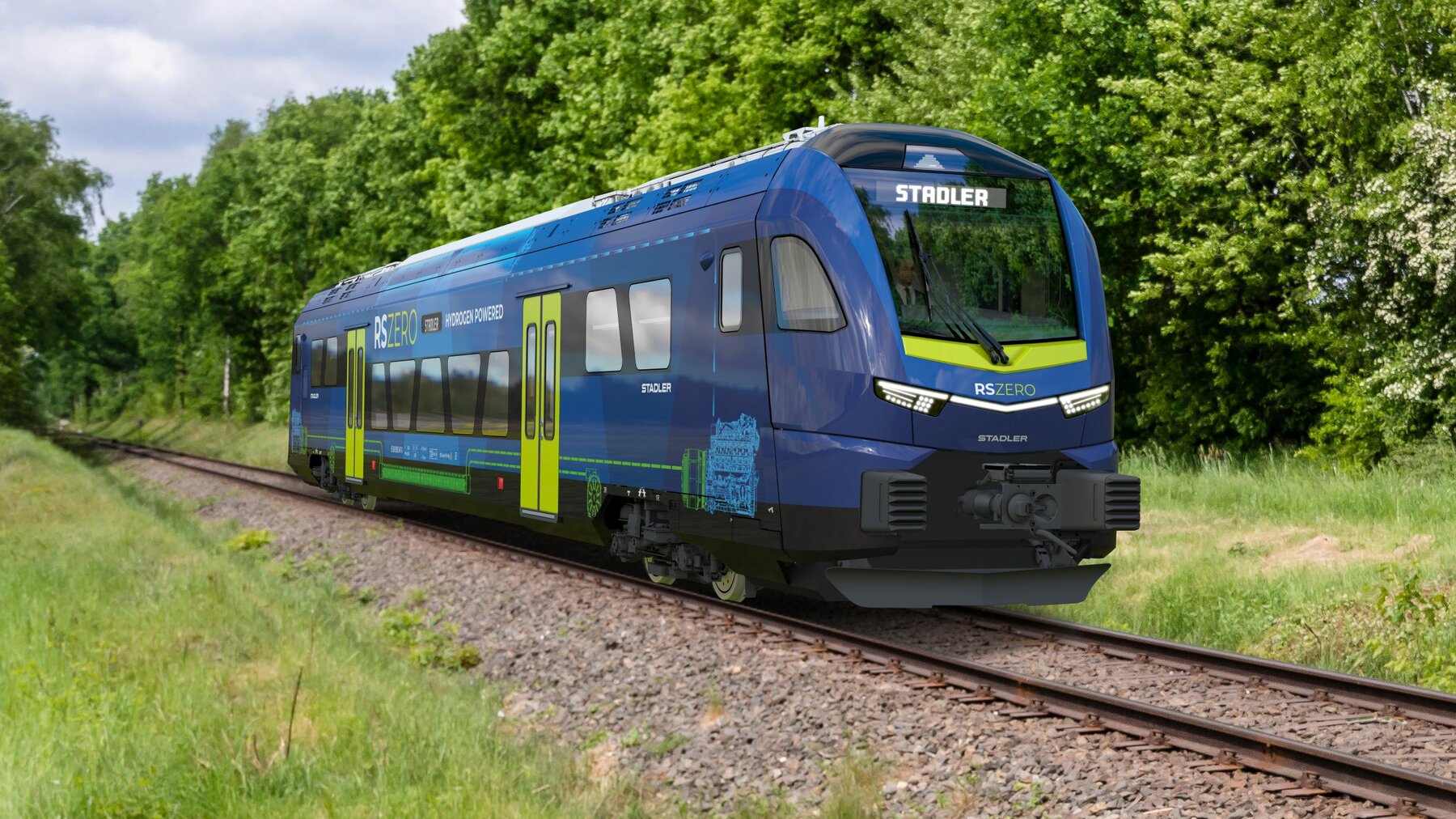
It looks very similar to my pictures from Chemnitz.
I have a few thoughts.
Comparison To A Class 150 Train
A Class 150 train can carry up to 149 seated passengers at 75 mph, which is similar to the RS ZERO.
As Stadler have built trains for Greater Anglia, Merseyrail and the Glasgow Subway, I believe that Stadler could build an RS ZERO, that would fit the UK loading gauge.
In What Train Is This?, I show the standard of interior, that can be achieved by refurbishing a Class 150 train, but unlike the RS ZERO, the train won’t be zero-carbon.
Does The RS ZERO Have A Toilet?
This is a paragraph from the press release.
The prototype of the RS ZERO presented today in Berlin is a one-car vehicle with hydrogen drive. Stadler is demonstrating the numerous design options with a multi-purpose area equipped for carrying bicycles, pushchairs and bulky luggage, lounge and comfort zones, standard and privacy seats, a wheelchair space, WC and a train office.
The train appears to be able to have what an operator might need.
What Will Be The Range Of An RS ZERO On Hydrogen?
I suspect, Stadler will provide a train, that will handle the route.
Conclusion
This could be a very handy train to decarbonise branch and secondary lines in the UK.
Zillertalbahn Hydrogen Plan Dropped In Favour Of Battery Traction
The title of this post, is the same as that of this article on Railway Gazette.
I wrote about this order in Zillertalbahn Orders Stadler Hydrogen-Powered Trains.
I didn’t blog about it but I remembered an article a few years ago about Stadler getting an order from the Zillertalbahn.
It appears the change is down to improvements in battery technology.
Narrow-gauge battery-electric multiple units must be right up Stadler’s street, as they built the new trains for the narrow gauge Glasgow Subway.
Glasgow Subway’s New Trains Enter Service
The title of this post, is the same as that of this article on the BBC.
These two paragraphs outline the story.
New modernised trains have come into passenger service on Glasgow’s subway.
The first two trains were introduced by Strathclyde Partnership for Transport (SPT) on Monday.
Note.
- Modernised is probably the wrong word. Surely, it should be modern, as the others are nearly fifty years old.
- The new trains will have wheelchair spaces and air-conditioning.
- The BBC has a video in their article.
They look good and I can’t wait to get up to Glasgow to see them.
Diesel And Battery Trains Could Be The Solution For Island Line
The title of this post is the same ass this article on the Island Echo.
The article discusses what is going to happen to the Island Line. I wrote about this line in A Trip On The Island Line.
This is said.
South Western Railway have revealed that the Island’s 80-year-old trains could be replaced with a diesel, battery or flywheel powered locomotive, a tram or even a guided bus lane.
The train operator, which took over the running of Island Line earlier this year, has stated in a consultation document published this week that the Class 483 former London Underground trains are no longer viable, with parts availability becoming an issue and limited capability of electricity. supply.
They are obviously looking for some new trains.
The Current Trains On The Island Line
The current trains on the Island Line are Class 483 trains, which started life as London Underground 1938 Stock.
The trains are 2597 mm. wide and 2883 mm. high.
Looking at the height and widths of London Underground’s 1972 Stock and 1973 Stock, these current trains are about thirty mm. wider and a few mm. higher.
So it might be possible to take some o0f these trains and remanufacture them for the Island Line.
But there are problems.
- These trains are over forty years old.
- London Underground won’t be replacing these trains for several years yet.
- London Underground probably needs all the of the trains in these classes that it’s got.
So the Island Line needs some new trains from another source.
The Trains On The Glasgow Subway
The Glasgow Subway trains were constructed in the late 1970s, by Metro-Cammell, who built the 1972 and 1973 Stock for London Underground.
The Glasgow Subway has an unusual gauge of four foot, as opposed to standard gauge of four foot eight and a half inches. So the Glasgow hauge is 220 mm. narrower than standard.
The Glasgow Subway trains also seem to be 300 mm. narrower and 240 mm. shorter than the 1972 Stock.
I wouldn’t be surprised to be told, that the Glasgow Subway trains were designed by making them slightly smaller than the 1972 and 1973 Stock that had just been built.
New Glasgow Subway trains are being designed and built by Stadler. These will obviously be designed to fit the current platforms and tunnel, as they will have to work with the current trains.
New Trains For The Island Line
Modern computer-aided-design systems can probably scale up Stadler’s Glasgow Subway design to a train that would fit the Island Line.
Standard gauge bogies would have to be fitted.
But it surely is a route to get a basic train, that could be then fitted with appropriate motive power.
How Many Trains Would Be Needed For The Island Line?
Currently, trains on the Island Line run in pairs of two-car trains. This means that to maintain the the current two trains per hour service needs four two-car trains. According to Wikipedia, there are five operational Class 483 trains, with one in store.
If the new trains were similar to the new Glasgow Subway trains, which are four cars, two trains could provide the current service.
After upgrading the Brading loop, four trains would allow a four trains per hour service.
Would a spare train be needed?
Why Would A Big Company Like Stadler Want To Supply A Small Order For The Island Line?
This question has to be asked and I’ll use an extract from this article on Rail Engineer, which is entitled Subway Revival – Glasgow to introduce UTO.
Although there had been concerns that suppliers may not be interested in an order for a small number of four-foot gauge Subway trains, this proved not to be the case. Charlie commented that the Swiss company Stadler was “quite excited at the idea” as it has a bespoke manufacturing operation and its production lines can easily be changed to produce small orders, such as 34 cars for the Berlin Underground and 10 Croydon trams.
Sixteen or twenty cars for the Island Line doesn’t seem so small!
It certainly seems, that if you are a train or tram operator and you want a vehicle that is a little bit out-of-the-ordinary, then Stadler are interested!
What Would The Stadler Trains Be Like For Passengers?
Another extract from the Rail Engineer article, describes the new trains for the Glasgow Subway.
Stadler is to supply 17 four-car articulated trains with wide walk-through connections and a standard floor height, made possible by using smaller diameter wheels. Each train will be 39.25 metres long, compared with 37.74 metres for the current three-car units. The trains have 58 km/hr maximum speed and will have capacity for 310 passengers compared with the current 270. They will also accommodate wheelchairs.
I would suspect that the Island Line trains would be slightly wider and taller, which would give welcome space.
Battery Trains For The Island Line
The Island Echo article mentions battery trains.
So would they be a good idea on the Island Line?
Regenerative Braking
I would be pretty sure that the current Class 483 trains are not fitted with regenerative braking, which saves energy and cuts the electricity bill for running the trains.
I also suspect that the electrical power supply, is not capable of handling the return currents generated by regenerative braking.
However, the new trains for the Glasgow Subway, which I believe could be the basis for an Island Line train, do have regenerative braking.
Putting batteries on the train is a simple way of handling the electricity generated by braking. It is just stored in the battery and then used again, when the train accelerates away.
Health And Safety
Bombardier have stated that batteries on trains can be used to move trains in depots, so the amount of electrification in depots can be reduced.
As batteries can move the train short distances, there may be other safety critical places, where removing the electrification could be recommended.
Track Maintenance Savings
Reducing the amount and complication of electrified track, must save on maintenance.
Emergency Power
Despite the best of intentions, power failures do happen and having a capability to get the train to the next station using batteries must be a good thing.
Running On Batteries
The Island Line is less than ten miles long and the possibility must exist of being able to charge the batteries at each end of the line and run between Ryde Pier Head and Shanklin on batteries.
There would be a balance to be struck between battery size and the length of electrification at each end. Perhaps electrification could be kept on the following sections.
- Ryde Pier Head to Smallbrook Junction
- Sandown to Shanklin
A lot would depend on the state and design of the line’s power network.
Route And Track Extensions
Short extensions or new track layouts could be built without electrification to save building costs.
Conclusion
On balance, battery trains would seem t0 be a useful feature for the new trains on the Island Line.
Improvements To The Island Line
The Wikipedia entry for the Island Line has a section called Future. Various improvements are put forward.
It seems there has been a lot of talk and very little action.
My thoughts follow.
Brading Loop
Wikipedia says this about a loop at Brading station.
A suggestion in early 2009 was to reinstate the loop at Brading, thus allowing a ‘Clock Face’ timetable to encourage greater use. The outcome of this is still awaited.
This Google Map shows the station.
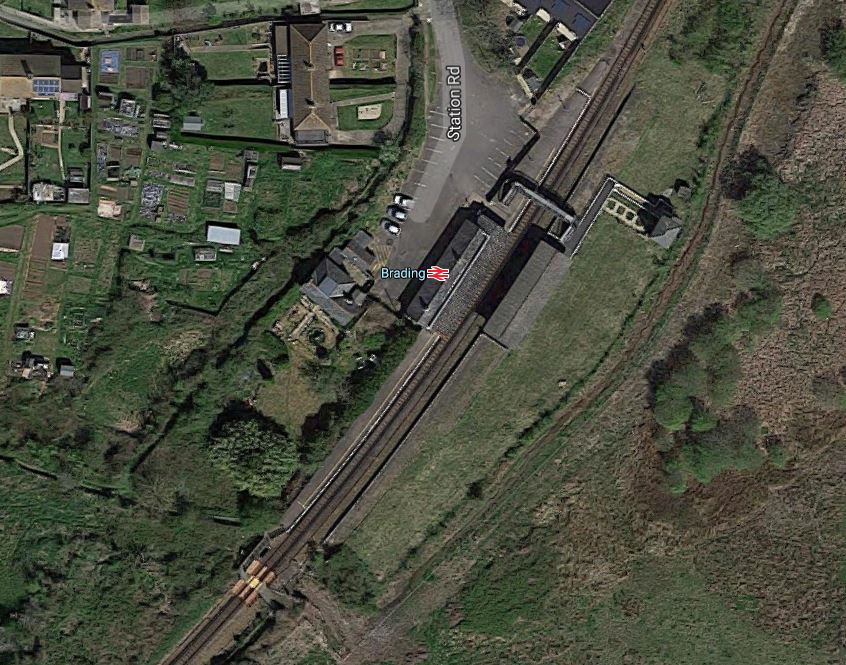
Note the loop is clearly visible to the East of the station.
Trains with a battery capability will give advantages.
- Flexibility of design.
- Simplified track layouts.
- No electrification of new track.
The much-needed loop could become affordable!
Extension to Ventnor
There have been proposals to reopen the line south of Shanklin, to the original terminus at Ventnor.
You can still trace the line on Google Map and if the need is there, trains with a battery capability would surely aid its reopening.
The line could be single track and without electrification.
Conclusion
New trains with a battery capability will give the Island Line a new lease of life.
I also believe that Stadler have the capability to build a suitable battery train, based on their design for the new trains for the Glasgow Subway.
Stadler To Build Another Special
Stadlet seem to be getting a reputation for building trains for niche markets.
This article on Global Rail News is entitled Stadler to build narrow-gauge EMUs for Stockholm’s Roslagsbanan.
Wikipedia has an entry for the Roslagsbanan.
After trains for the Glasgow Subway and Merseyrail, the Class 88 locomotives and Class 399 tram-trains, they must be one of the companies in prime position for the new Docklands Light Railway trains.
An Article On Driverless Trains That Hardly Mentions Unions
This article on Rail Engineer is entitled Subway Revival – Glasgow to introduce UTO.
In this instance UTO stands for Unattended Train Operation.
In the article, there is only one mention of a trade union. This is said.
Getting the workforce’s commitment to new working practices was an essential first step of the modernisation programme. SPT achieved this in 2012 with an agreement between UNITE and SPT for more flexible working and establishment reduction with no compulsory redundancies.
The dreaded word RMT does not appear.
Having read the whole article, it does look like, when the new trains start running in a few years time, Glasgow will have one of the best Underground lines in the world.
I particularly liked this paragraph on the procurement of the new trains.
Charlie Hoskins explained that SPT did not procure its trains on the basis of a prescriptive technical specification as this might rule out a worthwhile technology. Instead, prospective suppliers were given a concept of operation that covered general requirements such as the number of people to be carried and how SPT wished to operate the trains. A competitive dialogue then followed to develop the technical solution that offered best value. This approach was supported by Glasgow-based consultant Racon and by Systra which, with SPT key staff, formed the client’s technical, commercial and procurement team.
It looks like Glasgow said they wanted to move so many passengers and the consortium came up with a solution.
How practical! And the dreaded word Treasury wasn’t mentioned.
Also just as they are involved in East Anglia, the Swiss company; Stadler is very much involved here. They seem to be s[specialising in niches.
St. Enoch Station
St. Enoch station is on the Glasgow Subway.
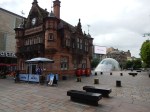
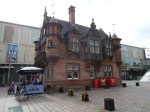
It is one of the buildings by the architect; James Miller
Riding The Clockwork Orange
My mother visited Glasgow in the 1930s and first told me about the Glasgow Subway. I know little of her trip or was it trips to Glasgow, except that she went by coach. She also told once, how a lady on the coach, put her hair in curlers to go to sleep. I don’t think I ever saw my mother with her hair that way!
Why she went, I have no idea, but the trip to Glasgow was probably the only vaguely exotic place I ever her talk of going.
My host at dinner last night, had told me that a station on the Subway was about fifteen minutes walk from my hotel. So to explore the city centre, before I took the train south, I walked to the station at Hillhead. An illustration of how times change was the Waitrose opposite the station. Only a few years ago, their furthest north store was at Newark.
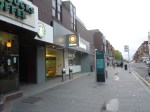
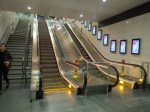
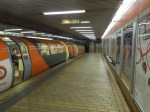
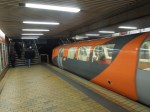
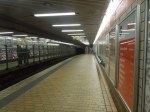
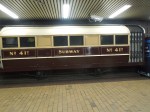

I took the train to Buchanan Street station, which was close to the main stations and shops.
Although, the stations all seemed to have a lith with a map and information outside, I don’t think I ever saw a system map inside a station or on the trains.
But then as it is effectively one line going continuously round in circles clockwise and another doing the same in an anticlockwise direction, it is about as far in concept from ninety-nine percent of the world’s metro and subway systems, as you can get. So perhaps a map would just confuse people unfamiliar with the system. I suppose that in my journey from Hillhead to Buchanan Street, I could have taken any train in either direction. This is a bit like London’s old Circle line, before they broke the circle and made it a spiral.
 The Anonymous Widower