The New Roof At Crystal Palace Station
In August 2010, I wrote A Day At Crystal Palace, after a visit to Selhurst Park to see Ipswich play. I took this picture of Crystal Palace station.

East London Line Platforms at Crystal Palace
Now compare it with these I took today.


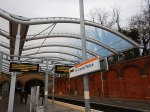
As you can see, they’ve now fitted a roof.
I like it.
The Spacious New Platforms At London Bridge Station
These pictures show some of the rebuilt terminal platforms, at London Bridge station.
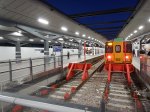


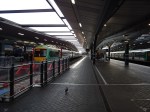

Space is much better than the London Bridge station, that I remember from before the rebuilding started.
Even the Class 455 trains, built in the 1980s, but refurbished since, doesn’t seem to show its true age.
The Proof That Good Design Doesn’t Have To Be Expensive
I’ve watched the transformation of Manchester Victoria station from a dirty dump over the last few years. These are a few posts.
- Manchester’s Disorganised Public Transport
- Victoria Gets A Posh Umbrella
- Will Manchester Victoria Station Be Promoted To The Premier League?
- Coffee And Seats At Manchester Victoria
But now as this article on the BBC shows, it’s all finished.
Compared to other station works in the UK, the title of the report is surprising – Manchester Victoria reopens after £44m upgrade
But then the best design is often not as expensive as the crap!
Long may Victoria reign in Manchester!
The Canonbury Interchange In The Wet
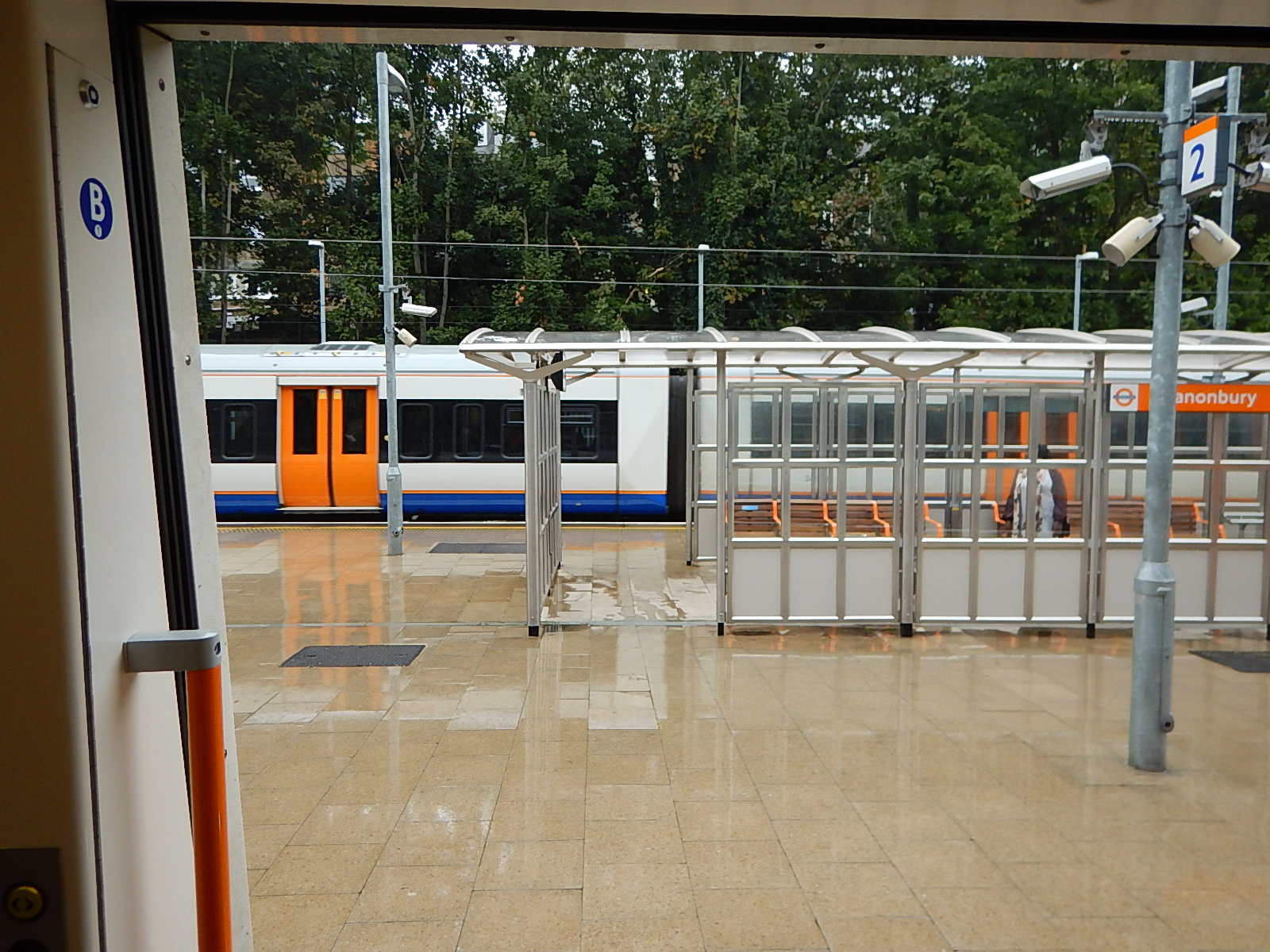
Passengers going from Stratford to stations on the East London Line, often change at Canonbury, where it is a walk across from North London Line trains going West to East London Line trains going South, which are pften timed to be in the station together. I often do the change, as after one stop to Dalston Junction station, I can get any number of buses to just around the corner from where I live and can get home without crossing any roads.
A few days ago, I did the change in the wet.
The Canonbury Interchange In The Wet
Recently, Transport for London have placed a shelter in the middle of the platform, so it was a run from the Westbound train into the shelter and after a few minutes, another run straight from the shelter into the open door of the Southbound train, from where I took the picture, just as another Westbound train was arriving.
Canonbury station is an excellent example of how good design can improve the daily lives of everybody.
So often modern designs look good, but just annoy a lot of the population, who aren’t in the designer’s age, sexual and ethnic group.
Is Vivarail True Disruptive Innovation?
Disruptive innovation is defined like this in Wikipedia.
A disruptive innovation is an innovation that helps create a new market and value network, and eventually disrupts an existing market and value network (over a few years or decades), displacing an earlier technology.
I’ve always been a great believer in this sort of innovation.
When we started Metier Management Systems and created Artemis, project management was worthy, time-consuming and if a computer was used it was an expensive mainframe. So we took a small but powerful industrial computer put it in a desk, added a VDU and a printer to do the same PERT and financial calculations much faster and often much physically closer to where the answers were needed. I have heard argued that one of our reasons for great success in the early days of North Sea Oil, was that you could find space for an Artemis system in Aberdeen, but not for a mainframe. The city was crawling with dozens of our systems.
After Artemis, project management was never the same again!
If we look at the building of trains, it is supposed to be an expensive business, with large manufacturers like Alstom, Bombardier, Hitachi and Siemens make expensive complicated trains, that are virtually computers on wheels. But at a price and to a time-scale that is such, that say a train company needs perhaps some extra four coach diesel multiple units to support say a Rugby World Cup or Open Golf venue, there is nothing that can be delivered in a short time.
Over the last few years, disruptive innovation has been alive and well in the train building industry. In the 1970s and 1980s, we built a large number of trains and electric and diesel multiple units based on the legendary Mark 3 coach. Wikipedia says this about the coach.
The Mark 3 and its derivatives are widely recognised as a safe and reliable design, and most of the surviving fleet is still in revenue service on the British railway network in 2015.
It is truly one of the great British designs. My personal view is that the ride in a Mark 3 coach, is unsurpassed for quality by any other train, I’ve ever ridden, in the UK or Europe.
A Mark 3-based multiple unit also survived the incident at Oxshott, where a 24-tonne cement mixer lorry fell on top of the train. There were injuries, but no-one was killed.
So what has the Mark 3 coach got to do with disruptive innovation?
They are like a well-built house, that constantly gets remodelled and improved by successive owners.
The structure and running gear of a Mark 3 coach is such that it is often more affordable to rebuild and improve Mark 3-based trains, rather than order new ones.
If Terry Miller and his team in Derby, had not designed the Mark 3 coach and the related InterCity 125 in the 1960s, I suspect that UK railways would be in a truly terrible state today.
These trains still remain the benchmark against which all other trains are judged. Two journeys sum up the class of a Mark 3 coach.
- Travel in First and enjoy Pullman Dining on a First Great Western service between London and Wales or the West. Is there any better rail journey available without a special ticket in the world?
- Travel in Standard on Chiltern to Birmingham and enjoy the ride and the views from the large windows, in the style that the designers envisaged for all passengers.
But the Mark 3 coach has created this industry in the UK, that can take well-built old trains and turn them into modern trains, that are often the equal of shiny new ones from the factory.
So where do Vivarail fit in all this?
London Underground has always specified the best for its railways and expected the trains to last a long time. In some ways it had to, as when it depended on Government favours for new trains, it could not predict if the replacements would ever be forthcoming.
Until the 1980s, most trains were built by Metro-Cammell in Birmingham and regularly fleets have lasted for forty or fifty years, as they were built to handle the heavy use in London, where journeys can be over an hour of full-speed running with frequent stops and often with far more passengers than the trains were designed. Take a Piccadilly Line train from say Kings Cross to Heathrow in the rush hour, if you want to see the sort of punishment that London Underground trains are built to take. The last of these Piccadilly Line trains were built in 1977 and under current plans, they will have to stay in service to 2025.
The oldest London Underground trains still in regularly passenger service, are the Class 483 trains used on the Isle of Wight. Admittedly, they are running a service in a less-stressful environment after fifty years service in London, but the trains were originally delivered to London Underground in 1939 or 1940.
The London Underground D78 Stock, that has been purchased by Vivarail for conversion into the D-train, were first delivered in 1980, so they have only taken about thirty-five years of London’s punishment.
The trains were also extensively refurbished in the mid-2000s.
It also has to be born in mind, that although London works its Underground trains very hard, they also get first class servicing.
Several factors have all come together to create an opportunity for Vivarail.
- There is a desperate shortage of diesel multiple units all over the UK. Partly, this is because of a need to replace the ageing Pacers, but mainly because of the growth in passenger numbers and the reluctant of Government in the 2000s to invest in much-needed new diesel trains.
- Network Rail’s well-publicised problems with electrification, only makes the need for more diesel trains more important.
- A lot of trains will have to be taken out of service as they don’t meet the disability regulations.
- The UK’s world-class train refurbishment business, which has honed its skills on creating new trains from old for forty years, is ready for a new project.
- There is now a supply of well-maintained, corrosion-free D78 Stock, that may not be sexy, but are as tough as teak, that are surplus to requirements.
It should also be said, that train operators and passengers want more flexible and better specified train services on difficult lines that are unlikely to be electrified in the near future and are difficult lines on which to provid a decent reliable train service.
Read any of the serious literature about the D-Train and it shows that the engineers are taking the project very seriously and are thinking very much outside the box.
- Power units are based on Ford Duratorq diesel engines mounted on rafts under the train, with two to each power car.
- These rafts can be changed using a fork lift at a remote location.
- Flexibility of interior layout to suit the route.
- Extensive use of LED lighting, Wi-fi and other modern technology.
- The crash test has been released as a video. How often do you see that?
But perhaps this article from Rail Magazine entitled Catering for VivaRail’s rebuilt D-Stock, illustrates their innovative thinking better than ever.
The more I read about the D-train, the more I think it will surprise everybody.
It is true world class disruptive technology. And British technology too!
Birmingham’s Four-Poster Station
When I put forward the concept of a Four Poster Station, I was kite flying and didn’t know one had already been built.
Smethwick Galton Bridge station has been built where the electrified New Street to Wolverhampton Line crosses the Snow Hill to Worcester Line. This is a Google Map of the station.
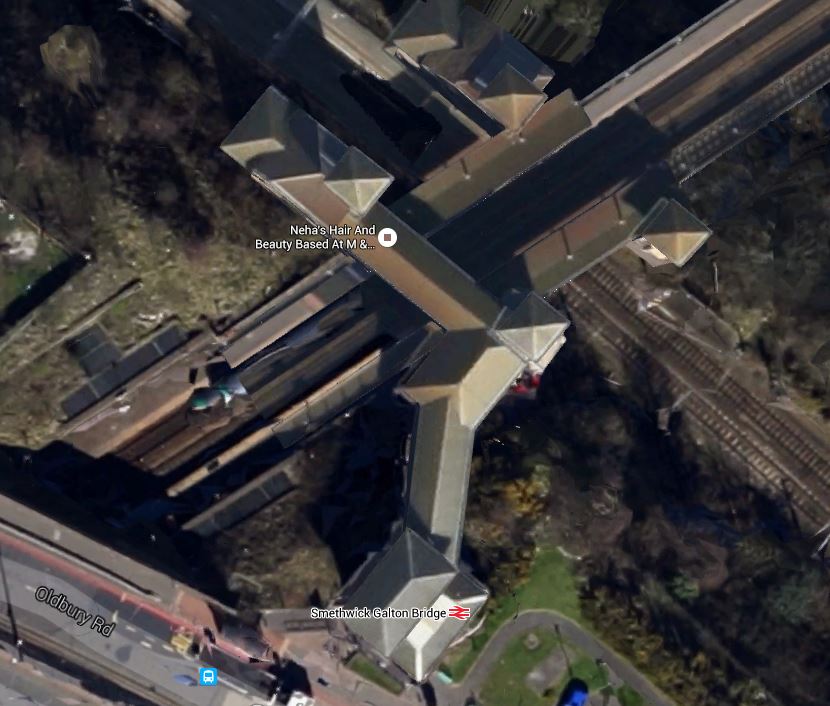
Smethwick Galton Bridge Station
Note the pyramids on top of each of the four lifts.
New Street is towards the South East, with Wolverhampton to the North West.
Worcester is to the South West with Snow Hill to the North East
I just had to go and see the station and took these pictures.
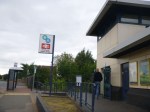


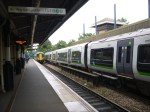
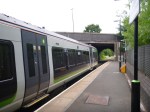
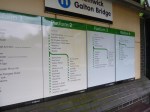

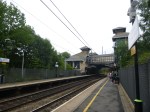
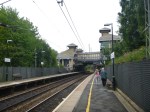
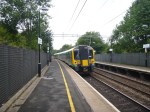
Considering it was opened in 1995, it was pretty radical for the time.
But it seemed to be working well, when I saw the station in the middle of the rush hour.
I do think, if they were building a station like this today, the various platforms and walkways would be made wider and if one was on the London Overground, they would leave spaces to put coffee stalls, passenger shelters and staff refuges. It probably illustrates how much more people friendly new stations are compared with twenty years ago.
I have a feeling that the design principles used here might be used at Brockley, Brixton and Penge.
But how many other places in the UK and perhaps the wider world could copy the basically simple design principles used here in Smethwick.
Custom House Station – 5th July 2015
Custom House station has been progressing and now even has some glass in the windows.
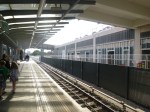
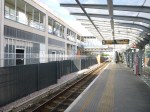
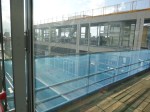
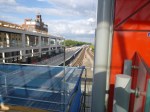


You can also see that the Crossrail trains will go either side of the central building. It now appears that this is the preferred way to design a new station.
At Custom House station it will mean that passengers arriving at the station from Excel or on the DLR, would appear to go to the same platform, which will have two faces; one for Central London and one for Kent.
When you consider that London Underground deep-level stations since the 1930s have been designed this way with a central platform, it puzzles me, why we have such uninspiring recent station designs like the Thameslink platforms at St. Pancras.
Where you have a two-track railway, the layout must be more affordable, as you only need one set of lifts/escalators/stairs and other services.
On the other hand, you need a bridge over the tracks or a subway beneath them, where the railway is on the surface. Obviously in some places the geography of the area, will make this easier. For example if a station is in a cutting or there is a road bridge.
At Custom House a large proportion of passengers will arrive at First Floor level either from Excel or after taking a short escalator up from the DLR, so there will only need to be access from the street up to the First Floor circulation area, from where I took these pictures. At present the DLR uses steps and a lift. I’m sure the completed station will use an elegant solution with probably escalators instead of stairs.
A Large Map With Seats
This double-sided map with seats was close to a busy intersection in Krakow.
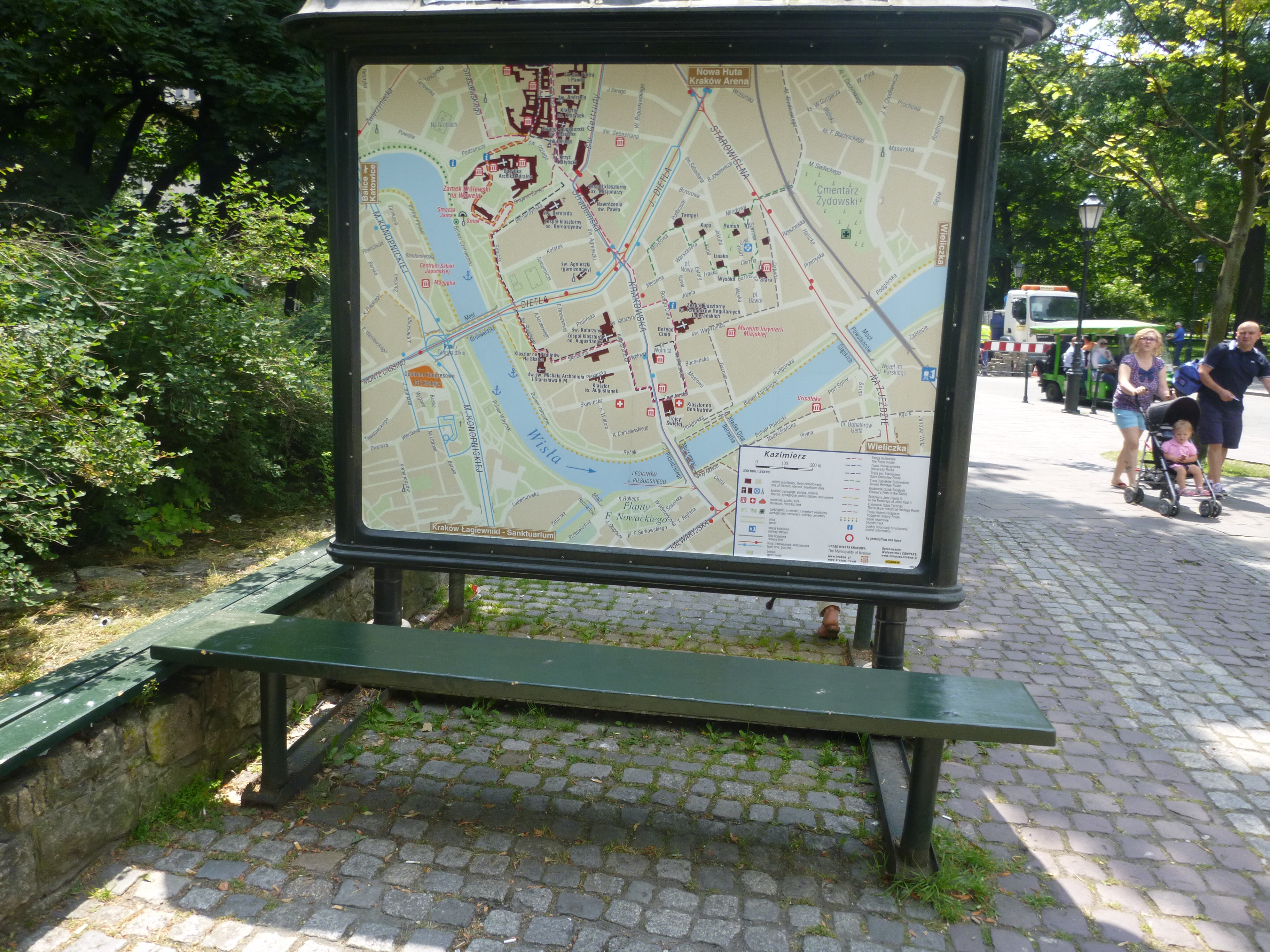
A Large Map With Seats
I don’t think it was the only one.
I like this and it helps to solve the problem of maps in a busy city centre. It looks like the map is also not necessarily permanent, so could be easily moved to a more important location or taken away to a workshop to be refurbished and fitted with a new map.
The map and seats doesn’t look particularly new, so it probably says that sometimes the old proven ideas are the best.
Incidentally, the map, as nearly all in Krakow, was very easy to understand.
Bins With Roofs On
These seemed to be unique to Krakow.



But surely to stop birds emptying bins they are a good idea.
Liège-Guillemins Station
As I wandered my way back to Brussels for the Eurostar, I just had to stop of at Liège-Guillemins station and take some pictures.
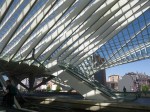
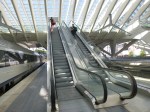
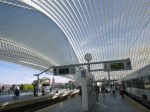
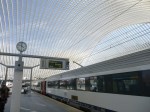
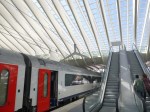
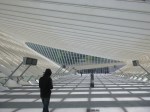

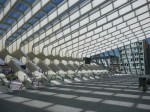



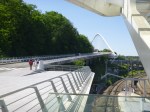


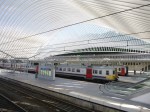


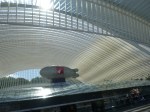



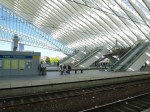
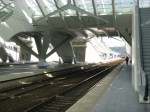
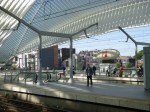
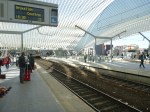
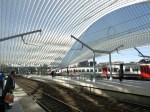
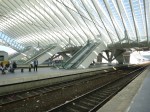
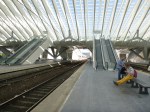
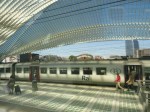
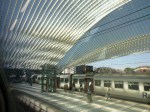
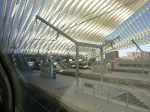
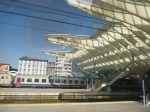
Is there another station like it in the world? This Google Map shows the layout.
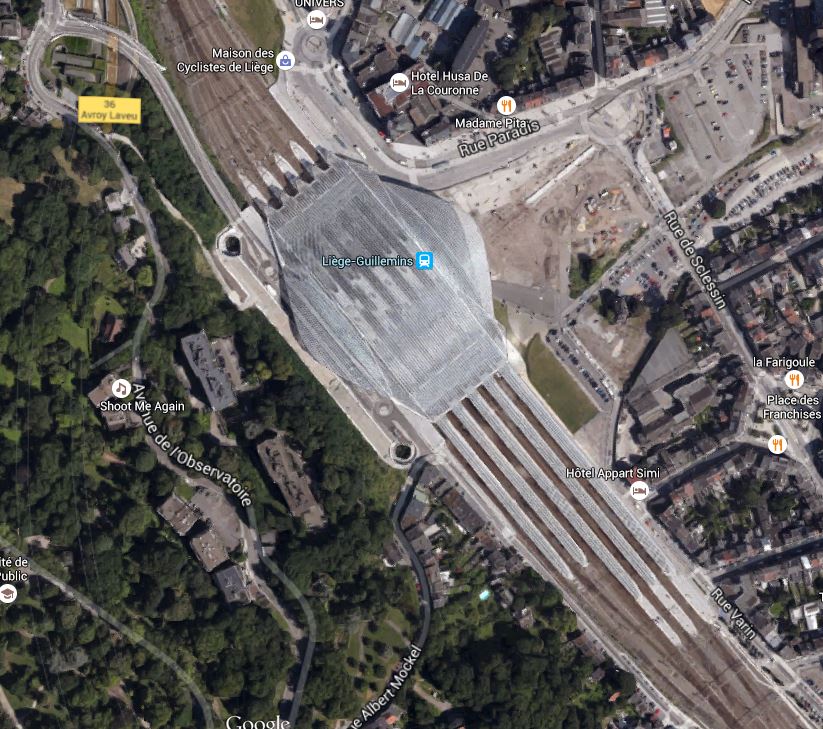
It is a design by Santiago Calatrava. Let’s hope that the Belgians did a good job on building this station. In 2007, I saw some of his buildings in Valencia and the concrete hadn’t worn well!
The totally new station cost €312million, which compares with £500million for the restoration and extension of Kings Cross station. Compare these figures with the reported £44million for the restoration of Manchester Victoria station, the complete reconstruction of Reading and Birmingham New Street stations.
Direct comparisons are difficult, but I cam’t help feeling, that in terms of cost, Manchester Victoria station is out of line with the others. It just shows that god design is often cheaper than bad.
One difference between the British projects and Liège-Guillemins station, is that the British ones are or were updating of existing stations, whereas the Belgian one was a new station built a short distance away.
Perhaps in some ways, to combine rebuilding with moving the station is a better plan, as both Reading and Birmingham New Street could be thought expensive compared to Liège-Guillemins.
So with all the problems there have been during the rebuilding of London Bridge station, would it have been better to have put the rail lines through in an optimal manner for operational purposes and perhaps created a new station further South.
London Bridge station was and still is a difficult problem, but hopefully it’ll be spot on when it opens.
 The Anonymous Widower