Innovative Engineering To Recycle Trains
I often refer to Pacers; Class 142 and Class 144 as scrapyard specials. They were built in the late 1980s and some units will be thirty years old next year. They have not worn well and they don’t meet the modern disability regulations.
The London Underground D78 Stock is a few years older and after a major refurbishment a few years ago, the trains are still running on the District Line. I travel on them regularly and although they are not as nice as the new S Stock, they still provide an adequate and reliable service across London.
It wouldn’t seem logical to replace the elderly Pacers with rebuilt D78 Stock that was even older.
On the other hand, a group of very experienced railway personnel who feel that these 75 third rail electric trains can with the addition of a couple of automotive diesel engines be converted into diesel multiple-units.
It sounds crazy, but the realisations on the Vivarail website of what they have called the D-train look good. They also don’t look like a D78 to those who don’t know them well. They will even have wi-fi!
To paraphrase one of my own sayings.
Politicians have a theory and try and prove it, engineers have a problem and solve it.
Roger Ford in Modern Railways for December is reporting that in six months time, there will be a demonstrator. He says this.
If anyone can make D78 stock conversion commercially viable, it is this battle-hardened bunch of veterans.
As Roger also reports they have spent a seven figure sum on buying the trains, I have a feeling that we’ll be seeing at least some of these trains for a long time.
In the article and the Vivarail web site, what I see as a big advantage of the trains is not mentioned.
Some estimates say that we need upwards of fifty replacement trains for the Pacers. And that is about the size of the fleet that could be created.
With George Osborne needing an affordable project that benefits many different areas of the country, it would appear that the D-train has arrived exactly on time.
The biggest problem could be getting the public to believe that re-manufactured nearly forty year old trains are up to the job. But at least, as with the Parry People Mover, it’s a train that can be put into service on a real railway to charm the public.
In the same magazine, there is also an article about rescuing some Class 56 locomotives and returning them to active service.
In the UK, we have a shortage of diesel locomotives for freight. We’ve even used a preserved Class 55 Deltic to haul commercial bauxite trains and you sometimes see pairs of Class 20 locomotives like this doing real work. The article explains how new locomotives get used on the premium high-value trains, but for pulling things like engineering and work trains, they are expensive.
A company called UK Rail Leasing has acquired fifteen and intend to return some to service. There is talk in the article about fitting modern engines. But then they did that with that other relic of the 1970s the InterCity125.
Both of these stories are in some ways a tribute to our rail engineering skills of thirty years and more ago.
Solihull Station
To get to Stratford, I changed at Solihull station.
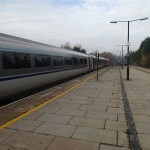
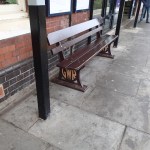
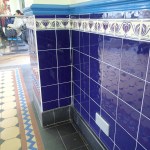
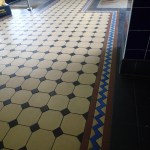

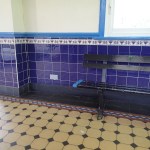
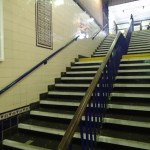
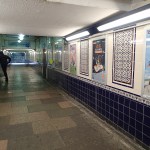
The pictures show what an excellent job has been done in creating a modern station, with nice details and what looked like a proper buffet.
Using The Strange Property Of Water To Advantage
Most people, except perhaps those, who live in hot climates, know from their personal experience that ice floats on water. But most people don’t know that water is at its densest at 4°C. So water at this temperature sinks, but it rises at all others.
I once heard somebody use the existence of this property as a reason why God exists. He argued that if it didn’t, then life would have been impossible in water. It was all a bit contrived, but it is still as a strange property.
This morning, I was listening to Wake Up To Money, when a company called SureChill was mentioned. So I looked them up and found that they are using this property to create a new type of refrigerator. This page explains it all. This section describes the solution.
Sure Chill is a brand new kind of cooling system. It doesn’t need a constant power source. In an on-grid situation with intermittent power, it works perfectly well. In an off-grid situation, where a solar panel may be used, a Sure Chill powered refrigerator doesn’t even need a rechargeable battery. It shouldn’t work but it does. And it works beautifully.
Water surrounds a Sure Chill refrigeration compartment. When it has power, the water cools and forms ice above the compartment leaving only water at four degrees cooling the contents. When the power is switched off, the water warms and rises while the ice begins to melt, keeping only four-degree water cooling the contents of the compartment. So it has its own internal and entirely natural energy store that maintains a completely steady temperature. The system can operate like this, without power, for days and weeks.
People think physics is boring. Outside of Metier, I’ve done well in my career and made quite a bit of money by understanding the laws of physics that govern our lives.
My surprise at this idea, is that the technique could have been implemented in a refrigeration system decades ago. Artificial refrigeration was first performed by William Cullen in 1755. My bible; Nelkon amd Parker says that the maximum density of water was first measured by Thomas Charles Hope in 1804.
That is a long time from experimental proof to reality!
The Clapham Kiss – Where East Meets West
I took these two pictures, as I went from Shepherds Bush to Dalston Junction stations this afternoon on the London Overground.
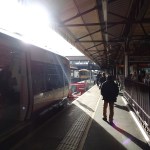
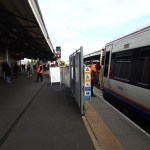
Normally, I’d take a northbound train at Shepherds Bush direct to Highbury and Islington or Canonbury, where I would use the footbridge to crossover to get on a train for Dalston Junction. The reason I like to end up in Dalston Junction station, is that there are lots of buses down the Balls Pond Road to my house and they mean, I don’t have to cross any roads.
But at Shepherds Bush, this would have meant waiting nearly ten minutes for a northbound train, so I took the first train to Clapham Junction. A factor that influenced my choice was that to change between the two trains, is just a short walk up the platform.
I spoke to the driver, who was very pleased, as they don’t always meet as precisely as this, although that is what’s intended.
But the whole layout at Clapham Junction shows that a little bit of innovative thinking can often make things better for all concerned.
A Well-Designed City Centre Hotel
On my trip to Sheffield to see Ipswich at Hillsborough, I had to stay overnight, as there is no return train after the match.
So I booked into the Leopold Hotel, mainly because it was in the city centre and by a tram stop. I booked the room without breakfast for just £85.50 on Late Rooms.



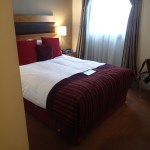
It is one of the best designed hotels, I’ve stayed in ever.
The bath and shower didn’t need a Master’s Degree in plumbing and your glasses to understand, the tea and coffee making in the room was one of the best and the bed was comfortable.
My only niggles, were that the TV wasn’t a Freeview one giving radio as well and they could do better and remove some of the clutter, like magazines and the radio/alarm, from the room.
Wi-fi was free, as it should be.
I would certainly stay in the hotel again, but I doubt I’ll get it at £85.50 again.
On Trip Advisor, people are complaining that it is a ten minute walk to get your car.
They are missing the point.
This hotel is one of those city centre hotels, where you come by train and use public ytransport for your stay. If you want car parking, stay on the M1 in a Premier Inn.
At the present time, that will be more expensive!
Every city needs at least one hotel like the Leopold or the Hope Street in Liverpool.
Thomas Heatherwick Goes Global
Thomas Heatherwick is going on a tour of the US and Asia, to show his iconic designs to the world.
He may leave a legacy of designs, but his biggest legacy, will be that he has shown how if architects, designers and engineers think outside conventional norms, you create the wonder factor and inspire others to do the same. Hence we all get a better world.
If we take the design of Thomas and his company, that I know best, the New Routemaster, every time you use one, you notice something that is different to and better than most current buses. Yesterday, as I got off after travelling home from the Angel, I realised that the walk to the centre exit was all clean lines and hand-holds in the right places, with no messy strap-hangers out-of-reach of short people and children, that seem to be an omnipresent feature of all other buses.
That is good design, and would Londoners accept a new bus without things like a totally-flat floor and well-positioned hand holds in the future?
The Orange Tickets Fight On
It’s the first time, that I’ve noticed it, but this orange rail ticket, I bought at Kings Cross on Saturday has one of those square bar codes.

The Orange Tickets Fight On
As you can see it wasn’t used by any ticket inspector to get to Rutland, as one used a Mark 1 pen and the other some stamp.
It just shows how the original ticket was such a good design from 1986.
I suspect that the basic design of the ticket will outlive me, by a good few years.
Peterborough Station’s Litter Bins
I came across these bins, when I changed trains at Peterborough.
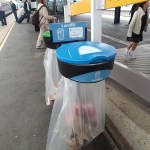
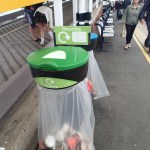
What a wonderful example of simple, good design.
If this doesn’t nudge people to put their rubbish in the right bag then nothing will.
A Well-Designed Transport Interchange
Golders Green is not an area I go to often. Years ago, C and myself used to go there to buy shoes for the children, at a shop I think was called Brians. I wonder if it is still there!
But yesterday, I needed to go there to get some extra keys for my new Banham lock. It is not a difficult journey, as I just got a train up the Northern line from the Angel to Golders Green station.


There are numerous buses to places all over North London from the station as this map shows.
It’s also a stop for a lot of National Express coaches.
We need more well-designed simple interchanges everywhere, so that train passengers can easily get to their ultimate destination.
From the station, it was just a short walk to Banham’s shop.
A Good Simple Design For A Seat
Everywhere on public transport these days you seem to see uncomfortable, ugly and hard metal or plastic seating.
I saw this seat on Harlesden station this morning.
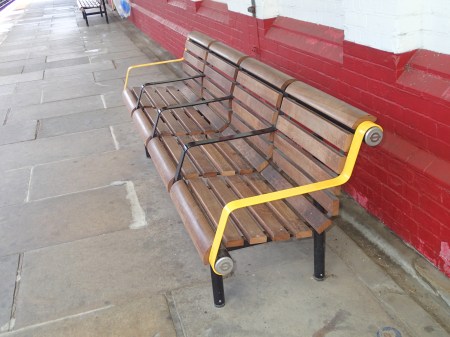
A Good Simple Design For A Seat
It’s certainly a lot better and more pleasing on the eye.
It’s also got the roundels
 The Anonymous Widower