Dublin Energy Start-up Targets $2 trillion Offshore Wind Sector
The title of this post, is the same as that of this article on the Irish Times.
The article gives a few clues, as to what Gazelle Wind Power are about.
This is the sub-title.
Gazelle Wind Power raises $4m to develop its hybrid floating offshore wind platform
What is a hybrid floating offshore wind platform?
I have form in the subject of large floating structures, as I did the calculations for a Cambridge-based company called Balaena Structures, that was proposing floating oil production platforms.
The company failed and I got paid, but their ideas returned to obscurity.
However, from that brief interlude in my life, I believe that there are innovative floating designs that could benefit the wind power industry.
This paragraph sums up the platform.
Overall the company estimates its solution costs half the price of other platforms to manufacture and 60 per cent less in terms of installation fees, while providing savings well above €1 million per megawatt.
I’ll go along with that, as the Balaena was very affordable and very stable.
The company has also recruited some powerful advisors, as this paragraph shows.
Gazelle recently named an elite group of energy industry veterans to its board of directors that includes Dr Javier Cavada, chief executive of Highview Power, Pierpaolo Mazza, a former general sales manager at GE Power, and Connie Hedegaard, former minister of environment to Denmark.
I have a feeling Gazelle Wind Power could be on to something.
Does the presence of the chief executive of Highview Power mean they are developing a floating platform with energy storage?
I remember that Balaena’s platform was very stable and as it was for oil and gas production, it had plenty of processing equipment on top.
Certainly, a wind turbine in the megawatt range with power storage would be a useful system.
MAN And Highview Power Sign World-First LAES Project Contract
The title of this post, is the same as that of this article on gasworld.
This first paragraph fills out the title and explains the acronyms.
A contract has been signed between the two companies for MAN Energy Solutions (MAN) to provide Highview Power’s (Highview) CRYOBattery facility with its liquid-air energy-storage (LAES) turbomachinery solution.
This contract may apply to only the 50MW/250MWh system at Carrington, near Manchester, but if this system is successful, as Highview have sold nearly a dozen systems worldwide and MAN most certainly has a worldwide support network, it is probably not a small deal for a company like MAN.
Last night, I had a drink with a friend who is the Operations Director for one of London’s largest bus companies. His company is looking seriously at batteries to ease charging of electric buses.
As MAN Energy Solutions are part of the Volkswagen Group could MAN’s interest in Highview’s technology be partly driven by Volkswagen’s need to provide a charging solution for all of the fleets of battery buses, cars, trucks and vans, that they hope to sell in the next few years.
It must surely help in the selling of thousands of electric vans to a company like Amazon, if you can sell them a charging solution, that includes a large eco-friendly battery, that can be fitted into the average site.
How Long-Duration Energy Storage Will Accelerate The Renewable Energy Transition
The title of this post, is the same as that of this article on Renew Economy, which is an Australian publication.
It is very much a must-read and although it was part-written by the President of Hydrostor, who are a Canadian long duration energy storage company, who store energy by compressing air in underground caverns.
The article gives some details on how investment is flowing into long duration energy storage.
We’re also seeing significant and sustained levels of investment in long-duration energy storage happen beyond Australia’s borders.
For example; Saudi Aramco Energy Ventures invested in Energy Vault to accelerate its global deployment of its energy storage solution; Bill Gates and Jeff Bezos invested in iron-flow batteries via Breakthrough Energy Ventures; Sumitomo Corporation invested in UK-start up Highview Power and their cryogenic liquified air storage system; and our team at Hydrostor closed a financing round including a strategic partnership with infrastructure investor Meridiam.
Big players like these, generally don’t back losers. Or at least they pour in more money and expertise, to make sure they succeed.
This paragraph also describes Hydrostor’s sale to Australia.
In 2020, Hydrostor’s 200 MW and 8 hours (or 1,600 MWh) A-CAES system was selected by New South Wales’ Transmission Network Service Provider, TransGrid, as the preferred option in its RIT-T process for reliable supply for Broken Hill.
They are also developing a large system in California.
With Highview Power having sold perhaps ten systems around the world, it does appear that long duration energy storage is taking off for Highview and Hydrostor, who both use that most eco-friendly of storage mediums – air.
The article is fairly scathing about developing more of the most common form of long duration energy storage – pumped storage using water. Especially in Australia, where water can be scarce. But with the world getting warmer, I don’t think we need to design systems, where all our stored energy can evaporate.
Conclusion
I agree very much with the writers of the article, that more long duration energy storage is needed, but that pumped storage is not the long term answer.
The Power Of Solar With A Large Battery
This post is based on this press release from Highview Power, which is entitled Highview Enlasa Developing 50MW/500MWh Liquid Air Energy Storage Facility In The Atacama Region Of Chile.
This is the first paragraph.
Highview Enlasa, the 50/50 joint venture between Highview Power, a global leader in long duration energy storage solutions, and Energía Latina S.A.-Enlasa, the largest backup power generation provider in Chile, is pleased to announce that it is developing the first liquid air long duration energy storage project in Chile. This 50MW/500MWh (10 hours) CRYOBattery™, which represents an estimated investment of USD $150 million, will be located in Diego de Almagro in the Atacama Region.
Ican deduce these points from this paragraph.
The power output of 50 MW appears to be standard for all of Highview Power’s CRYOBatteries, which is not surprising as the centre of each system appears to be a standard turbomachinery solution from MAN Energy Solutions, as I wrote about in MAN Energy Partners With Highview Power On Liquid-Air Energy-Storage Project.
But whereas the first system at Carrington, near Manchester, can only store 250 MWh, this plant in Chile is twice the size and can provide 50 MW of electricity for ten hours. The Chile plant will just have twice the number of storage tanks for liquid air.
I can no reason, why if Carrington needed to store more electricity, that more tanks couldn’t be added.
This Google Map shows the area around the city of Diego de Almagro.
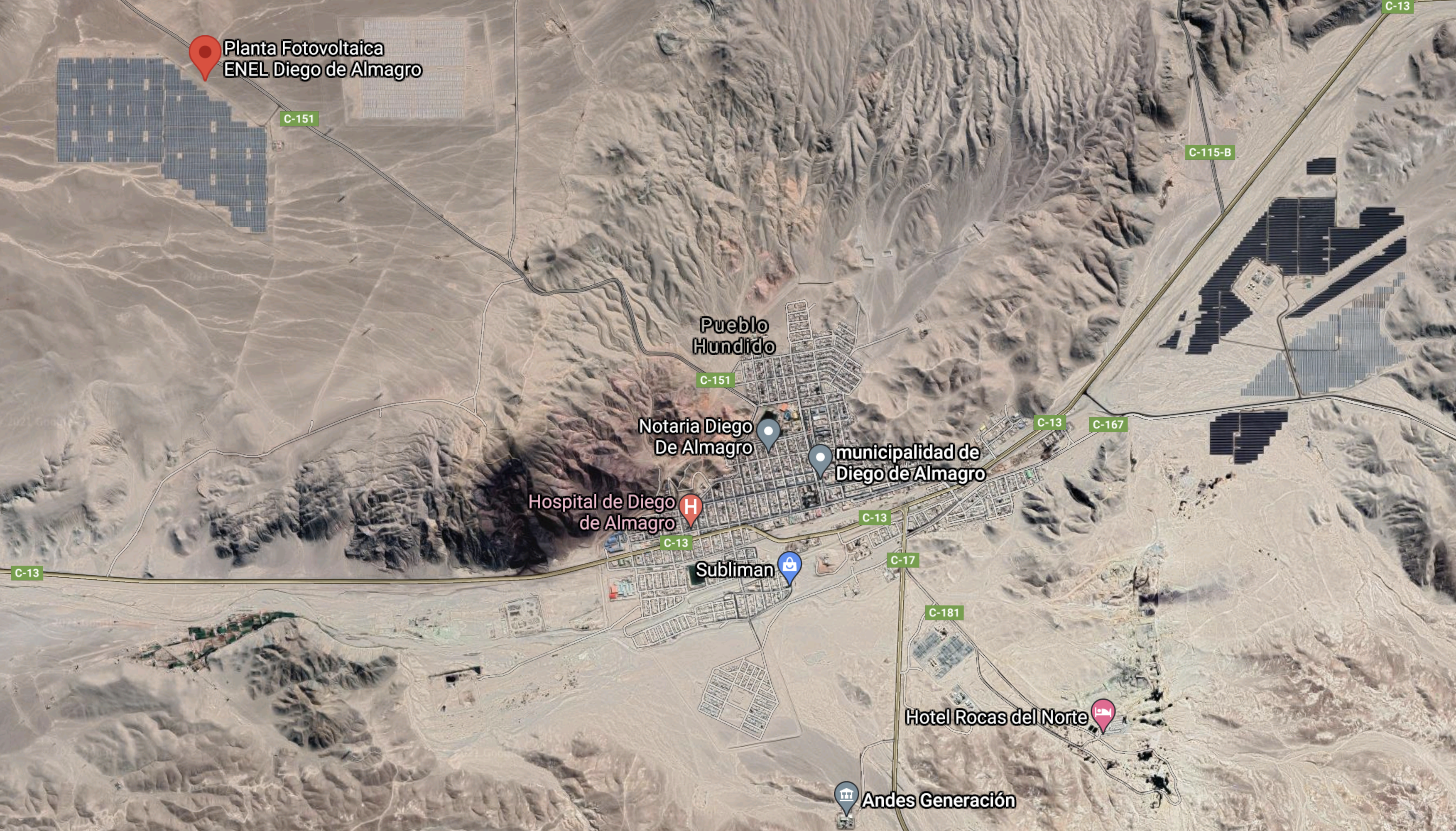
Note.
- The city of Diego de Almagro is in the centre of the map.
- In the North-Western corner is the Planta Fotovoltaica ENEL Diego de Almagro, which even my rudimentary Spanish, identifies as a solar power plant.
- In the North-Eastern corner of the map, is appears that a second solar power plant is under construction.
The city is surrounded by the large Atacama Desert.
This second Google Map shows the location of Diego de Almagro, with respect to the Chilean Coast.
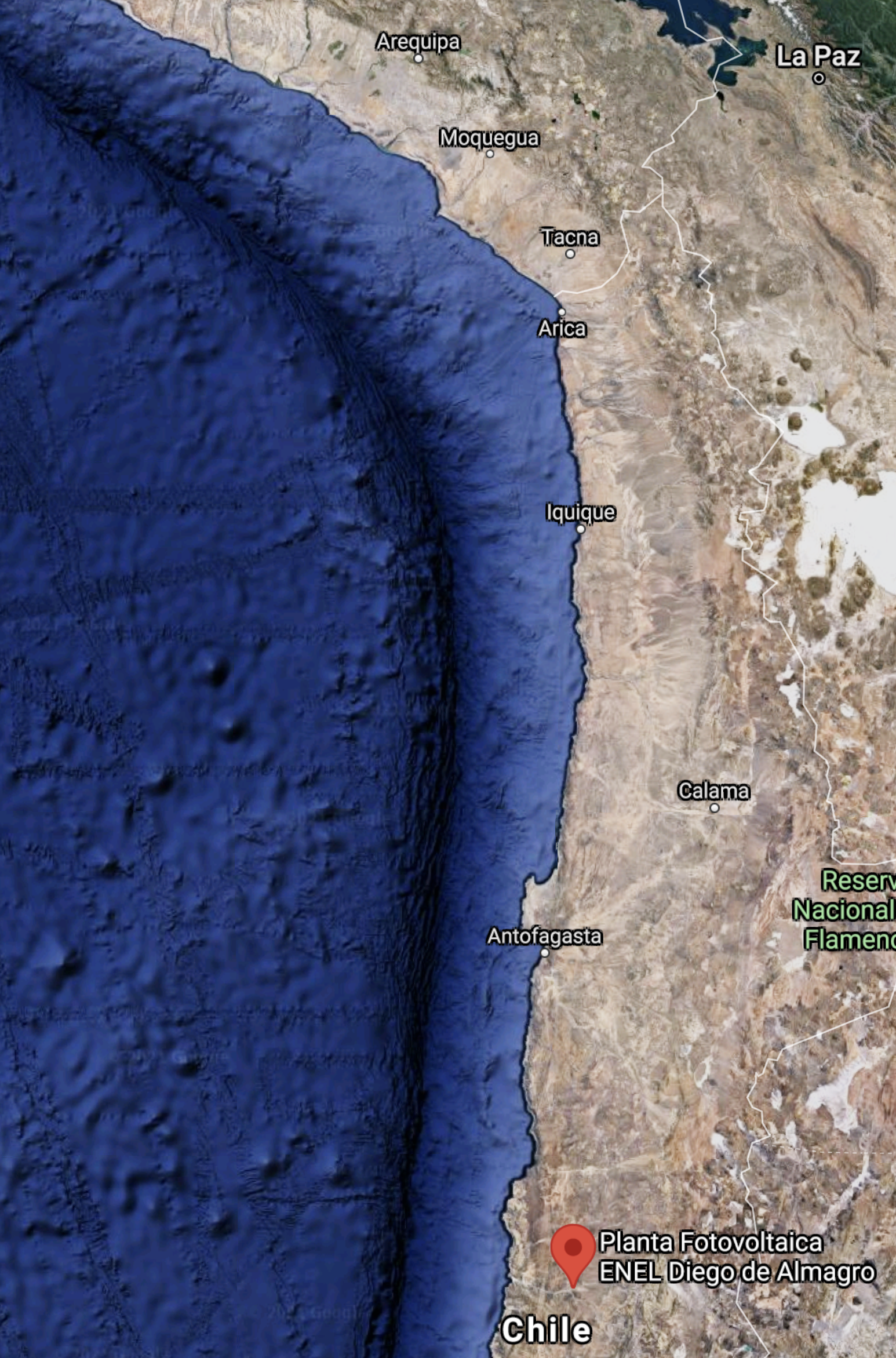
Note.
- The red arrow indicates the solar powerplant at Diego de Almagro.
- La Paz in Bolivia is in the North-East corner of the map.
- The sandy-beige colour indicates the Atacama Desert.
The area would appear not to lack sun.
This extract is from the press release.
With one of the highest solar irradiations in the world, the Atacama Region has the potential to generate all the country’s electricity. By pairing solar with cryogenic energy storage, Chile can benefit from 24/7, 100% renewable energy.
The Wiukipedia entry for Solar Power In Chile, is not as optimistic as the press release, but does show the rapid growth in the amount of solar power.
Conclusion
Solar power installed with large batteries, will transform the electricity supply in countries like Australia, Chile and India and those in Africa and other places, where there are large hot deserts.
In Europe, Spain is investing heavily in solar power and is a big innovator in solar technology.
A CRYOBattery For Chile
This article on pv Magazine is entitled Latin America’s First Liquid Air Storage Project.
This is the first paragraph.
The 50 MW Highview Enlasa project will be located in Diego de Almagro, in Chile’s Atacama Region.
It looks like it is a similar size to their other projects at Carrington in Manchester and in Vermont and Spain.
Diego de Almagro is a city in the North of Chile.
All You Want To Know About Highview Power
This article on Power is entitled Market Prospects Heating Up for Cryogenic Energy Storage.
It talks in detail about the technology, financing and market prospects for Highview Power and their CRYOBattery.
- Their batteries store energy by liquifying air and storing it in large tanks.
- To recover the energy, the air is encouraged to go to a gaseous phase and put through an air turbine.
- Their first commercial system is being built at Carrington near Manchester.
- The Carrington system will have an output of 50 MW and be able to store up to 250 MWh.
- Other systems are under development for Vermont and Spain.
- The systems are built like Leho from readily available components from the oil and gas industry.
One of my regrets in life, is that I missed the crowdfunding for this company!
Read the article as you might find one of Highview Power’s CRYOBatteries coming to a site near you.
Power’s article is the best yet on describing the technology.
How Siemens Gamesa Could Give Coal Plants a Second Life
This article on Greentech Media is a must-read as it makes you think. This is the sub-title.
The ETES thermal battery can offer coal plants a new life as heat and power storage hubs. The first customer for a full-size version could be on-board as early as next year.
It talks about the philosophy of reusing coal-fired power station sites and some of their equipment like turbines.
It is an idea much more applicable to countries like the US and Germany rather than the UK, as they still have lots of operational coal-fired power stations and and we only have a few.
I first came across this idea, when Highview Power were talking about their 50/MW/400 MWh installation in Vermont, which was to be built on the site of a demolished coal-fired power station. The utility company and Highview were in that case just reusing the grid connection.
But then I’ve heard of other energy storage systems using old power station sites.
And not to forget that Highview Power’s installation at Carrington is close to a gas-fired power station.
Highview Power Unveils $1bn Of Liquid-Air Energy Storage Projects In Spain
The title of this post, is the same as that of this article on Recharge Magazine.
The article is based on this press release from Highview Power, which is entitled Highview Power Developing 2 GWh of Liquid Air Long Duration Energy Storage Projects in Spain.
This is the introductory paragraph from the press release.
Highview Power, a global leader in long duration energy storage solutions, announced today it is developing up to 2 GWh of long duration, liquid air energy storage projects across Spain for an estimated investment of around $1 billion. These projects will enable several Spanish regions to move towards their net zero emissions target.
The press release also says this about location and size.
Highview Power is planning to develop up to seven CRYOBattery™ projects ranging from 50 MW/300 MWh in Asturias, Cantabria, Castilla y Leon, and the Canary Islands.
Three of these areas are in Northern Spain and the other is a group of islands.
As Spain has at least two large pumped storage systems, perhaps geography rules this proven technology out in these areas.
System Modularity
According to the Wikipedia entry for Highview Power, the two current CRYOBatteries under development are sized as follows.
- Carrington, Manchester, UK – 50 MW/250 MWh – Under construction
- Vermont, USA – 50 MW/400 MWh – Under development
Do the figures indicate that several systems will share the same 50 MW core power system, with a number of liquid air tanks to give the appropriate capacity?
I have extensively modelled chemical plants in my past to see, how different sizes work and I am fairly certain, that Highview Power have developed a design, that is extremely flexible.
It looks like if initial calculations show that a system capable of supplying 50 MW for five hours is needed, but operation proves that a capacity of six hours would be better, that all Highview Power need to do is add another 50 MWh tank.
This is surely an operator’s dream, as if say a developer builds a thousand dwellings and/or a windfarm nearby and more energy storage is needed, an appropriate number of extra tanks can be added.
Sourcing The 50 MW Core Power System
I talked about how the first system at Carrington will use a system from MAN Energy Solutions in MAN Energy Partners With Highview Power On Liquid-Air Energy-Storage Project.
This surely is an approach that minimises risk.
Sourcing The Storage Tanks
I have been searching the Internet for manufacturers of cryogenic gas tanks and I’ve found them in countries like Australia, Brazil, Germany, India, South Africa, Spain, the UK and the US.
But then most hospitals have one for their liquid oxygen.
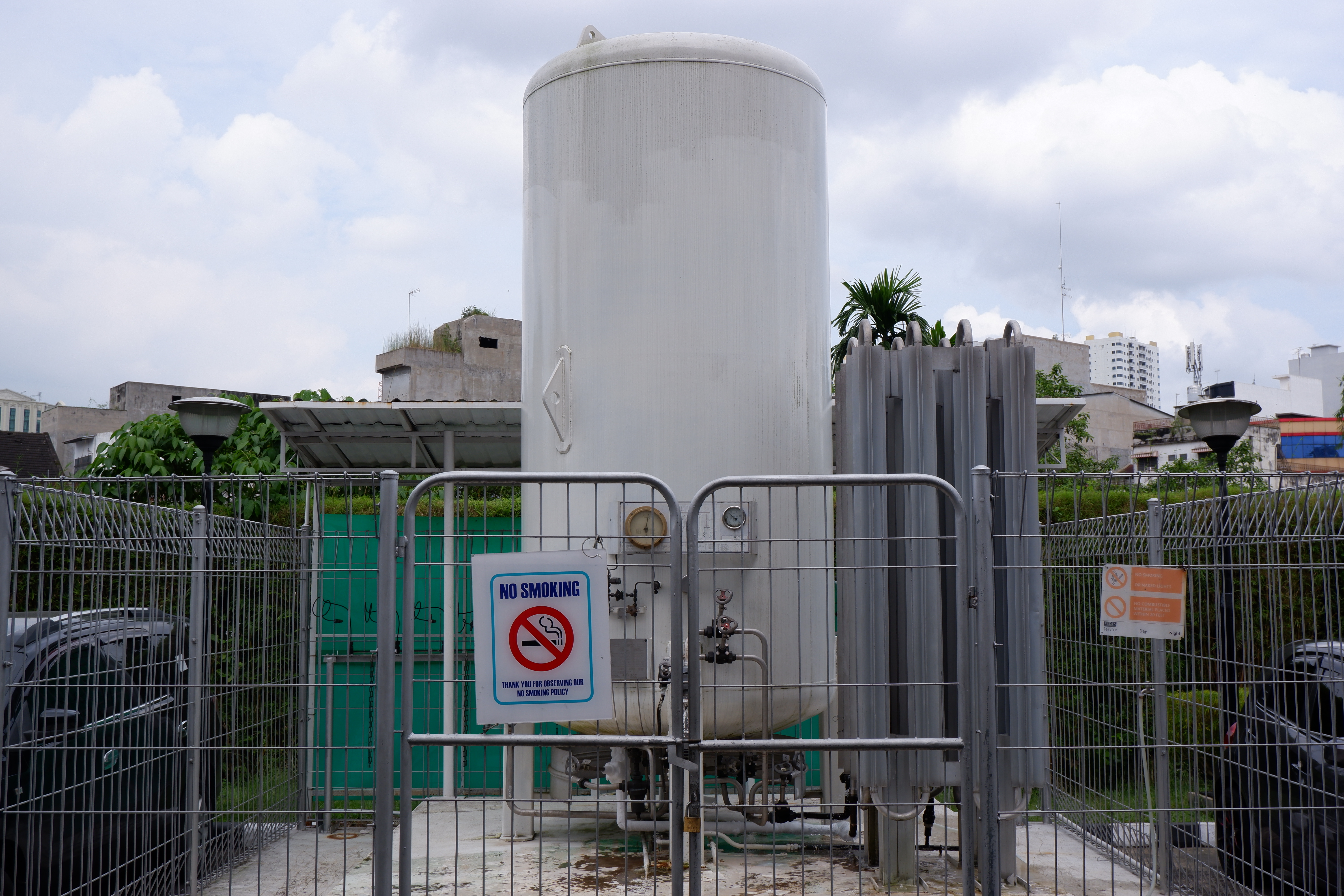
This image was from shutterstock.
They are not difficult to find.
Spain And Renewable Energy
Spain is a large producer of renewable energy and also a leader in wind and solar power technology.
See Renewable Energy in Spain on Wikipedia for more details.
Siemens Gamesa, which was created by a merger of a German and a Spanish company and is headquartered at Zamudio in Spain, have also developed the Siemens Gamesa ETES, which is a volcanic rock-based energy storage system about the same size of Highview Power’s CRYOBattery.
Conclusion
It looks to me, that Highview Power have closed a good sale.
Albannach Island: Multi-Million Pound Green Energy Plans Would Create 300 Construction Jobs
The title of this post, is the same as that of this article on the Aberdeen Press and Journal.
This is the introductory paragraphs.
A multi-million pound green energy power venture – called Albannach Island – would give a much-needed jobs boost to Caithness.
Highview Power is behind the plans to build a liquid air energy storage plant in a disused part of a quarry in Spittal, adjoining the most northerly stretch of the A9.
The plant appears to be a 50MW/250 MWh CRYOBattery, that is probably similar in size to the one currently being built by Highview Power at Carrington, near Manchester.
This Google map of the North-East corner of Scotland, shows the location.
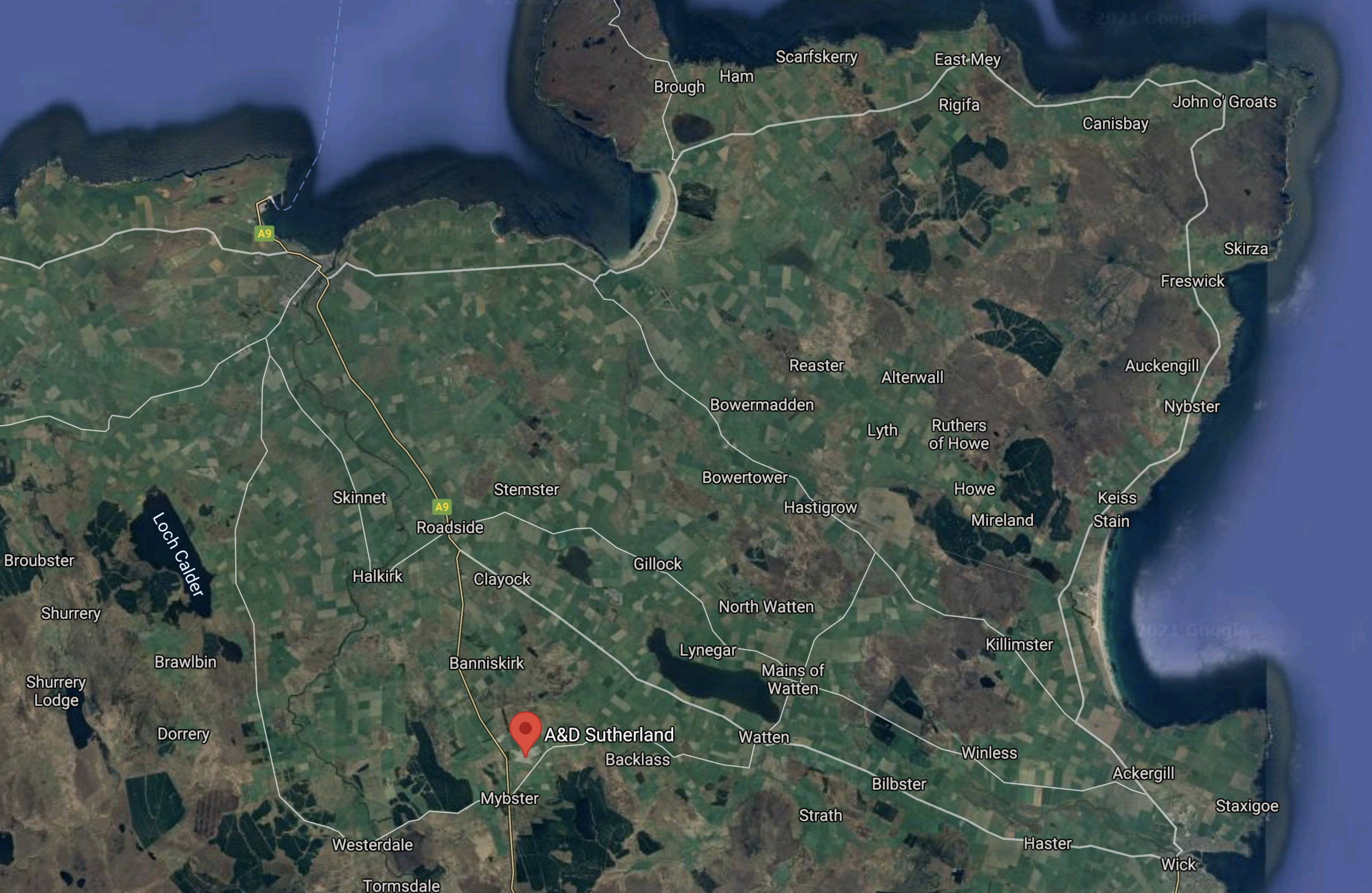
Note.
- John O’Groats is in the North-East corner of the map.
- The red arrow shows the location of the A & D Sutherland quarry, where the Highview Power’s CRYOBattery will be located.
This second Google map shows the location in more detail.
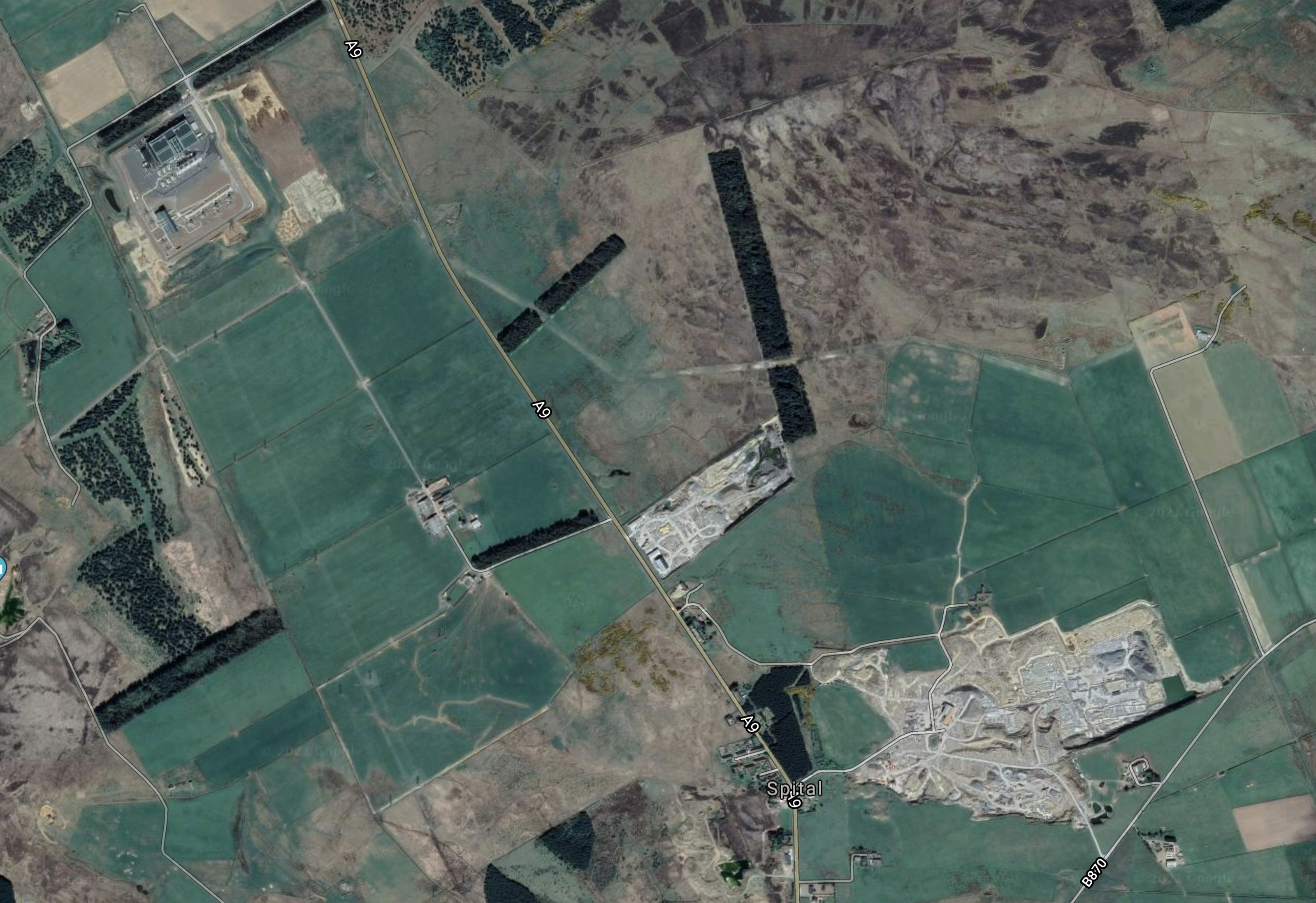
Note.
- The A & D Sutherland quarry is in the South-East corner of the map.
- The CRYOBattery will use five acres at the North of the quarry site.
- In the North-West corner of the map is the Spittal sub-station.
The Spital sub-station is described like this on the Scottish and Southern Electricity Networks web site.
Spittal is a new electricity convertor station and is part of the £1.1bn Caithness-Moray project which represents the largest investment in the north of Scotland’s electricity network since the hydro development era of the 1950s and is the largest capital investment project undertaken by the SSE Group to date. It is also the largest Living Wage contract ever awarded in the UK, demonstrating SSEN’s strong commitment to ensure all employees working on its sites get a fair day’s pay for a fair day’s work.
It looks like the CRYOBattery will be the cherry on top of the very billion pound cake of the Caithness-Moray Link.
Conclusion
We’ll be seeing more battery installations like this to stabilise power.
Nothing is said in the article, about who is paying for the battery. The only clue is it talks about Highview as a London-based conglomerate.
I wonder, if the company has formed a partnership with one of the energy trusts or a battery site developer.
Bring Africa Out Of The Dark
The title of this post, is the same as that of this article on the Zimbabwean.
The article has been written by Humphrey Kariuki, who is a Kenyan businessman, who is on a mission to bring electricity to Africa.
He has teamed up with Highview Power to do it using batteries.
Read the article.
 The Anonymous Widower