How Will Highview Power Affect The Lithium-Ion Grid Battery Market?
In this article on the Telegraph, Rupert Pearce, who is Highview’s chief executive and ex-head of the satellite company Inmarsat, discloses this.
Highview is well beyond the pilot phase and is developing its first large UK plant in Humberside, today Britain’s top hub for North Sea wind. It will offer 2.5GW for over 12 hours, or 0.5GW for over 60 hours, and so forth, and should be up and running by late 2024.
The Humberside plant is new to me, as it has not been previously announced by Highview Power.
- If it is built it will be megahuge with a storage capacity of 30 GWh and a maximum output of 2.5 GW.
- Humberside with its connections to North Sea Wind, will be an ideal location for a huge CRYOBattery.
- The world’s largest battery is at Ouarzazate Solar Power Station in Morocco and it is 3 GWh.
- The world’s largest pumped storage power station is Fengning Pumped Storage Power Station in China and it is 40 GWh.
The proposed Humberside battery also has a smaller sibling under construction at Carrington in Manchester.
This will have a storage capacity of 250 MWh and a maximum output of 50 MW.
Factors Affecting The Choice
Several factors will affect the choice between lithium-ion batteries and Highview Power’s CRYOBattery.
Reliability
Reliability is paramount and whilst lithium-ion batteries batteries have a high level of reliability, there probably needs to be more development and quality assurance before CRYOBatteries have a similar level of reliability.
Size
The largest lithium-ion battery, that has been proposed in the UK, is the 320 MW/640 MWh battery that will be installed at the Gateway Energy Centre in Essex.
This size of CRYOBattery should be possible, but this size is probably in range of both lithium-ion and CRYOBatteries.
Safety
The Wikipedia entry for Battery Storage Power Station has this to say about Safety.
Some batteries operating at high temperatures (sodium–sulfur battery) or using corrosive components are subject to calendar ageing, or failure even if not used. Other technologies suffer from cycle ageing, or deterioration caused by charge-discharge cycles. This deterioration is generally higher at high charging rates. These two types of ageing cause a loss of performance (capacity or voltage decrease), overheating, and may eventually lead to critical failure (electrolyte leaks, fire, explosion).
An example of the latter was a Tesla Megapack in Geelong which caught fire, fire and subsequent explosion of battery farm in Arizona, fire of Moss Landing battery farm. Concerns about possible fire and explosion of a battery module were also raised during residential protests against Cleve Hill solar farm in United Kingdom. Battery fire in Illinois resulted in “thousands of residents” being evacuated, and there were 23 battery farm fires in South Korea over the period of two years. Battery fires may release a number of dangerous gases, including highly corrosive and toxic hydrogen fluoride.
The long term safety of a CRYOBattery is probably not yet known in detail, but I suspect in some applications, CRYOBatteries could be safer than chemical batteries.
Environmental Factors
I suspect that CRYOBatteries can be built without any hard-to-mine or environmentally-unfriendly materials like lithium.
Cost
The article in The Telegraph, says this about costs.
Mr Pearce said Highview’s levelised cost of energy (LCOE) would start at $140-$150, below lithium, and then slide on a “glide path” to $100 with over time.
It does look that the all important factor of cost could be the clincher in the choice between the two systems.
For larger batteries, the CRYOBattery will probably have a larger advantage.
Conclusion
I can see Highview Power and their CRYOBatteries putting up a good fight against lithium-ion batteries, especially with larger batteries, where they have a larger cost advantage.
In the UK, we will know they have won an advantage, if the two big battery-storage funds; Gore Street and Gresham House, start to install CRYOBatteries.
Britain Will Soon Have A Glut Of Cheap Power, And World-Leading Batteries To Store It
The title of this post, is the same as that of this article on the Telegraph.
This is the first four paragraphs.
Today’s electricity price shock is the last crisis of the old order. Britain will soon have far more power at times of peak production than it can absorb. The logistical headache will be abundance.
Wind and solar provided almost 60pc of the UK’s power for substantial stretches last weekend, briefly peaking at 66pc. This is not to make a propaganda point about green energy, although this home-made power is self-evidently displacing liquefied natural gas (LNG) imported right now at nosebleed prices.
It is a point about the mathematical implications of the UK’s gargantuan push for renewables. Offshore wind capacity is going to increase from 11 to 50 gigawatts (GW) by 2030 under the Government’s latest fast-track plans.
RenewableUK says this country currently has a total of 86GW in the project pipeline. This the most ambitious rollout of offshore wind in the world, ahead of China at 78GW, and the US at 48GW.
The article goes on to give a comprehensive account of where we are with renewables, where we are going and how we will handle things, when the wind doesn’t blow.
Dogger Bank
The article says this about the Dogger Bank wind farm, which is being developed by SSE.
The giant hi-tech turbines to be erected on the Dogger Bank, where wind conditions are superb, bear no resemblance to the low-tech, low-yield dwarves of yesteryear. The “capacity factor” is approaching 60pc, which entirely changes the energy equation.
A capacity factor of 60 % seems a bit high to me and is what can be expected with the latest floating turbines. But these are fixed to the sea floor.
The Wikipedia entry for the Dogger Bank wind farm, says this about the building of the the first two sections of the massive wind farm.
On 21 September 2020, it was announced that Dogger Bank A and B will use 190 GE Haliade-X 13 MW offshore wind turbines over both sites, meaning that 95 turbines will be used on each site.[19] The availability of upgraded Haliade-X turbines rated at 13 MW rather than 12 MW means that each site will be capable of generating up to 1.235 GW, for a total of 2.47 GW. Turbines will be pre-assembled at Able Seaton Port in Hartlepool, an activity that will lead to the creation of 120 skilled jobs at the port during construction. Turbine installation is expected to commence in 2023 at Dogger Bank A.[20] Power Purchase Agreements (PPA) for 15 years were signed in November 2020. Offshore cable laying started in April 2022. Installation of the turbine foundations was started in July 2022.
This GE data sheet about the Haliade-X offshore wind turbine, says this about capacity factor.
it also features a 60-64% capacity factor above industry standard. Capacity factor compares how much energy was generated against the maximum that could have been produced at continuous full power operation during a specific period of time.
A 60-64% capacity factor is exceptional.
Current plans for Dogger Bank indicate that 3.6 GW will be installed and operational by 2024/25.
Could that mean that Dogger Bank will be able to deliver 2.16 GW almost continuously, on GE’s figures? Sizewell B is only 1.25 GW.
Sofia Wind Farm
There was going to be a fourth section to Dogger Bank, but this is now the separate Sofia wind farm.
- It is being developed by RWE.
- The first phase of three has a capacity of 1.4 MW. Does that mean Sofia will eventually be a 4.2 GW wind farm?
- RWE seem to be putting in a very large offshore substation. Could this support a lot more turbines?
- The wind farm seems to be using high-specification SiemensGamesa 14MW SG 14-222 DD wind turbines, which have a Power Boost facility to deliver up to 15 MW.
- I can’t find anything about capacity factor.
Wikipedia gives a delivery date of 2023 for the first phase of Sofia.
Storing Electricity
The article says this about storing electricity.
Much of the power will have to be stored for days or weeks at a time. Lithium batteries cannot do the job: their sweet spot is two hours, and they are expensive. You need “long duration” storage at a cost that must ultimately fall below $100 (£82) per megawatt hour (MWh), the global benchmark of commercial viability.
That is now in sight, and one of the world leaders is a British start-up. Highview Power has refined a beautifully simple technology using liquid air stored in insulated steel towers at low pressure.
I have had Highview Power on my radar for some time.
Highview Power
What is there not to like about Highview Power?
- The original idea was developed in a shed in Bishop’s Stortford, by a lone inventor.
- Sumitomo are one of their backers.
- They are also backed by English Universities and the UK Government.
- They have run a successful pilot plant in Bury.
- They are now building their first full-size 50 MW/250 MWh commercial plant at Carrington near Manchester.
- Much of the equipment they use to build their batteries is standard equipment from world-class companies like MAN.
- There are no exotic and expensive materials used.
The writer of the article has obviously had a long chat with Rupert Pearce, who is Highview’s chief executive and ex-head of the satellite company Inmarsat.
Pearce happily discloses this monster.
Highview is well beyond the pilot phase and is developing its first large UK plant in Humberside, today Britain’s top hub for North Sea wind. It will offer 2.5GW for over 12 hours, or 0.5GW for over 60 hours, and so forth, and should be up and running by late 2024.
Note.
- The world’s largest battery is at Ouarzazate Solar Power Station in Morocco and it is 3 GWh.
- Highview’s Humberside battery is megahuge at 30 GWh.
- The world’s largest pumped storage power station is Fengning Pumped Storage Power Station in China and it is 40 GWh.
- My experience of doing the calculations for large reaction vessels and other structures, tells me, that Highview should be able to construct huge systems.
I suspect that it will be easier and more affordable to build the Humberside battery.
This is another pair of paragraphs.
Mr Pearce said Highview’s levelised cost of energy (LCOE) would start at $140-$150, below lithium, and then slide on a “glide path” to $100 with over time. The company has parallel projects in Spain and Australia but Britain is the showroom.
“The UK is a fantastic place to do this. It has one of the most innovative grids in the world and an open, fair, liquid, market mechanism with absolute visibility,” he said.
It looks to me, that Rupert Pearce has taken Highview Power to a different level, in his short tenure at the company.
The world will soon be very familiar with the name of Highview Power.
Cleve Hill Solar Park
This document from the Department of Business, Industry and Industrial Strategy lists all the Contracts for Difference Allocation Round 4 results for the supply of zero-carbon electricity that were announced yesterday.
There were sixty-six solar power projects, that totalled up to 2.2 GW, which gives an average size of 33.3 MW.
I looked at the list and found the following.
- All contracts had the same strike price of £45.99 per MWh.
The largest solar farm with a contract is Cleve Hill Solar Park.
- ,Cleve Hill Solar Park received a contract for 112 MW.
- According to Wikipedia, the solar park will have a battery of 700 MWh.
- Will the battery enable the solar park to supply 112 MW on a twenty-four seven basis?
- According to Wikipedia, solar farms have a capacity factor of about 10 % in the UK.
- The Cleve Hill Solar Park will have a capacity of 350 MW.
- On a typical day, it will generate 350 * 24 *0.1 = 840 MWh
- The Contract for Difference mechanism means they get the strike price for each MWh of electricity up to the level in the contract, which is 112 MW.
- I suspect that for several months of the year, the solar park will be able to supply 112 MW to the grid.
- I do feel that overnight and on sunless winter days, the system will provide a lot less electricity.
- This page on the EMR web site explains Contract for Difference mechanism.
This extract from Wikipedia, describes, the solar park’s connection to the National Grid.
Across the marsh run the 400kV powerlines of the national grid. They are supported by eight 40m pylons. There is a large 150/400kV electricity substation at Cleve Hill, serving the London Array offshore wind farm that lies to the north beyond the mouth of the Thames Estuary. The output from the Solar Farm will use this substation to connect to the grid. Here, a battery array will placed, that will charge from the sunlight during the day and release the energy at night when it is needed.
I can build a table showing the earnings on a per day and per year basis, against average output.
- 20 MW – £22,076.20 per day – £8,057,448 per year
- 50 MW – £55,188 per day – £20,143,620 per year
- 70 MW – £77,263.20 per day – £28,201,068 per year
- 100 MW – £110,376 per day – £40,287,240 per year
- 112 MW – £123,621.12 per day – £45,121,708.80 per year
Note.
- I have assumed the year is 365 days.
- As a time-expired Control Engineer, I know that the battery can be optimised to supply the electricity, when it is needed and the price is highest.
- I wouldn’t be surprised to see co-operation between the London Array and Cleve Hill Solar Farm, as on a sunless but windy day, there may be scope to store excess wind energy in the battery for later release.
On this brief look, it appears that owning a solar farm, can be a nice little-earner.
Thoughts On The Battery
Consider.
- According to Wikipedia, the solar park will have a battery of 700 MWh.
- One of the largest lithium batteries in the UK is the one at Clay Tye in Essex, which is just under 200 MWh.
I suspect that lithium ion batteries will not be used.
Highview Power are building a 250 MWh battery in Manchester.
- This battery will be able to supply 50 MW.
- The batteries use liquid air as an energy storage medium.
- The company says the design can be extended up to a GWh by adding more tanks for the liquid air.
- The only fossil fuels used in Highview’s batteries is probably some lubricating oil.
I feel that a Highview battery or something similar would be an ideal solution at Cleve Hill Solar Farm.
I should be noted that the London Array is a 630 MW wind farm, so the London Array and Cleve Hill Solar Farm have a combined nameplate capacity of 980 MW.
I feel there is a case for a larger battery at the substation, to give the grid an almost-guaranteed GW all day.
It would be large than most if not all gas-fired power stations.
It could be used to balance the grid.
The controlling software would optimise the finances by buying and selling electricity at the right time.
Intriguing “Frozen Air” Energy Storage In Vermont Gets Canned
The title of this post, is the same as that of this article on the Concord Monitor.
This is the first paragraph.
Alas, the company Highview Power has given up on a plan I wrote about in 2019 to develop a long-term energy storage project in northern Vermont that freezes and unfreezes air.
The author had asked Highview Power for an update and received this statement.
As a UK-based company our primary focus right now is on our Carrington project in the North of England. This will be our first commercial plant in the wider development of a 45GWh, £10 billion programme in the UK. While the Vermont project no longer remains in our current plans, we are developing a longer-term portfolio of projects in Spain, Australia, and the U.S and we look forward to pushing forward with these after we achieve our primary UK projects.
It sounds to me that the new CEO; Rupert Pearce, is simplifying the company’s operations and aiming to get the important Carrington plant working as a priority.
Wind And Solar Boom Will Bring Energy Surplus
The title of this post, is the same as that of this article on The Times.
Under the picture, is this sub-title.
The government has set a target of 50 gigawatts of offshore wind farms by 2030, up from about 10 gigawatts at present.
According to this Wikipedia list of offshore wind farms, the UK currently has 2180 offshore turbines with a capacity of 8113 MW.
These wind farms appear to be planned.
Hornsea
The Hornsea wind farm is currently supplying 1.2 GW to the grid, but it is planned to be expanded to 6 GW, which is another 4.8 GW.
East Anglia Array
The East Anglia Array is currently supplying 0.7 GW to the grid, but it is planned to be expanded to 7.2 GW, which is another 6.5 GW.
Sofia
The Sofia wind farm will supply 1.4 GW from 2026.
Moray East
The Moray East wind farm will supply 0.95 GW from 2022.
Neart Na Gaoithe
The Neart Na Gaoithe wind farm will supply 0.45 GW from 2023.
Triton Knoll
The Triton Knoll wind farm will supply 0.86 GW from 2022.
Seagreen
The Seagreen wind farm will supply 1.1 GW from 2023.
Dogger Bank
The Dogger Bank wind farm will supply 3.6 GW from 2025.
Moray West
The Moray West wind farm will supply 1.2 GW from 2025.
Rampion 2
The Rampion 2 wind farm will supply 1.2 GW before 2030.
Norfolk Boreas
The Norfolk Boreas wind farm will supply 1.8 GW before 2030
Norfolk Vanguard
The Norfolk Vanguard wind farm will supply 1.8 GW before 2030
These wind farms total up to 31.1 GW
Morgan And Mona
The Morgan and Mona wind farms will supply 3 GW from 2028.
ScotWind
This map shows the wind farms in the latest round of leasing in Scotland.

These wind farms should be providing 24.8 GW by 2030.
Celtic Sea
In Two More Floating Wind Projects In The Celtic Sea, I give details of six wind farms to be developed in the Celtic Sea, that will produce a total of 1.2 GW.
All should be delivered by 2030.
Northern Horizons
In Is This The World’s Most Ambitious Green Energy Solution?, I talk about Northern Horizons, which will produce 10 GW of wind energy from 2030.
An Armada Of Wind Farms
As many of these wind farms will be floating and wind-powered, the collective noun must surely be an armada.
These are some figures.
- The size is certainly spectacular at 70.1 GW.
- As the UK electricity consumption in 2020-2021 was 265.4 TWh, the average hourly production throughout the year is 30.3 GW.
- As I write this post, the UK is generating 30.1 GW.
As the best offshore wind farms have a capacity factor of around fifty percent, we should be able to power the UK with wind power alone.
So when The Times says this in the first two paragraphs of the article.
Britain will have excess electricity supplies for more than half of the year by 2030 as a huge expansion of wind and solar power transforms the energy system, a new analysis suggests.
Energy storage technologies, including batteries and electrolysers to make hydrogen, will need to be deployed at massive scale to prevent this surplus electricity going to waste, according to LCP, a consultancy.
The article would appear to correct.
The Need For Energy Storage
If we look at energy production at the current time, energy production is as follows.
- Biomass – 0.5 GW
- Gas – 17 GW
- Nuclear – 5 GW
- Onshore Wind – 12 GW with 20 % capacity factor – 2.4 GW
- Offshore Wind – 8.1 GW with 30 % capacity factor – 2.4 GW
- Interconnects – 0.4 GW
- Others – 0.5 GW
This totals up to 28.2 GW.
In 2030, energy production could be as follows.
- Biomass – 0.5 GW
- Nuclear – 5 GW
- Onshore Wind – 12 GW with 20 % capacity factor – 2.4 GW
- Offshore Wind – 30 GW with 30 % capacity factor – 9 GW
- Floating Offshore Wind – 40 GW with 50 % capacity factor – 20 GW
- Others – 0.5 GW
This totals up to 37.4 GW.
So if you take a typical day, where on average throughout the day we are producing around 7 GW more of electricity than we need, we will actually produce around 7 * 24 GWh = 168 GWh of excess electricity
Whichever was you look at it, we have got to do something concrete with a large amount of electricity.
- Store it in batteries of various types from lithium ion, through new types of batteries like those being developed by Highview Power and Gravitricity to pumped hydro storage.
- Store the energy in the batteries of electric cars, vans, buses, trucks, trains and ships.
- Store the energy in Norwegian pumped hydro storage.
- Convert it to hydrogen using an electrolyser and blend the hydrogen with the natural gas supply.
- Convert it to hydrogen using an electrolyser and use the hydrogen to make zero-carbon steel, concrete and chemicals.
- Convert it to hydrogen using an electrolyser and develop new zero-carbon industries.
- Convert it to hydrogen using an electrolyser and store the hydrogen in a depleted gas field.
- Sell it to Europe, either as electricity or hydrogen.
Note.
- We are going to have to build a lot of batteries and I suspect they will be distributed all round the country.
- We are going to have to build a lot of hydrogen electrolysers.
- We have world class battery and electrolyser companies.
We should also fund the following.
- Developments of technology, that makes better batteries, electrolysers, boilers and heat pumps.
- I would also do a lot of work to increase the capacity factor of wind farms.
I also believe that if we have masses of electricity and hydrogen, we might find as a country, it’s very beneficial in terms of jobs, exports and a healthier economy to invest in certain industries.
Conclusion
The future is rosy.
Highview Chief Rupert Pearce On The Cold Batteries That Could Save The Planet
The title of this post, is the same as that of this article on The Sunday Times.
It is an article very much worth a read, as it talks about former Inmarsat boss; Rupert Pearce and his new position as boss at Highview Power.
I have followed Highview Power for a few years.
I first wrote about the company in British Start-Up Beats World To Holy Grail Of Cheap Energy Storage For Wind And Solar, after reading about the company in the Daily Telegraph in August 2019.
They seem to have had good press in the last three years and have generated a steady stream of orders from Spain, Chile and Scotland.
But progress seems to have been slow to get the first full-size system at Carrington completed.
It does seem , that Rupert Pearce could be the professional boss they need?
Highview Power ‘s CRYOBatteries certainly have potential.
Highview Power CRYOBatteries Compared To Lithium-Ion Batteries
Highview Power ‘s CRYOBatteries do not use any exotic metals or materials, that are not readily available, whereas lithium-ion batteries use lots of rare metals and electricity in their manufacture.
CRYOBatteries can also be expanded in capacity by just adding more liquid-air tanks.
Highview Power CRYOBatteries Typically Cost £500 Million
This figure is disclosed in the Sunday Times article.
For that you probably get a power station, with these characteristics.
- 50 MW Output.
- Five to eight hour storage.
- No emissions.
- Well-understood maintenance.
- An environmentally-friendly plant.
- Long battery life.
But my experience tells me, that like large lithium-ion batteries used for grid storage, that CRYOBatteries could be an asset that will appeal to large financial companies.
- At present, Highview Power have not run a 50 MW CRYOBattery, but once they show high reliability, I can envisage the energy storage funds taking a good look.
- At £500 million a throw, they are a good size with probably a decent return for insurance companies and pension funds.
See World’s Largest Wind Farm Attracts Huge Backing From Insurance Giant for Aviva’s view on investing in massive green infrastructure.
I very much feel, that with his City connections and experience, that Rupert Pearce might be the right person to arrange financing for CRYOBatteries.
I will add a story from the financing of Artemis, which was the project management system, that I wrote in the 1970s.
Normally we leased or rented the systems, but some companies wanted to buy them outright, so we came up with a price of something like £125,000. Our bank were happy to fund these systems, when the purchaser was someone like BP, Shell, Bechtel, Brown & Root or British Aerospace. Later on, the bank would package together several systems and get us a better deal.
Intriguingly, £125,000 in the late 1970s is about half a billion now. I suspect, I’m being naive to suggest that Highview’s problem of funding multiple sales is similar to the one we had fifty years ago.
Highview Power CRYOBatteries And Wind And Solar Farms
I discussed the use of CRYOBatteries with solar power in The Power Of Solar With A Large Battery.
As the Highview Power press release, on which I based the article has now been deleted, I would assume that that project has fallen through. But the principles still apply!
But surely, a wind farm paired with an appropriately-sized CRYOBattery would ensure a steady supply of power?
Could CRYOBatteries Be Used With Floating Offshore Wind Farms?
In ScotWind N3 Offshore Wind Farm, I described an unusual wind farm proposed by Magnora ASA.
- This page on their web site outlines their project.
- It will be technology agnostic, with 15MW turbines and a total capacity of 500MW
- It will use floating offshore wind with a concrete floater
- It is estimated, that it will have a capacity factor of 56 %.
- The water depth will be an astonishing 106-125m
- The construction and operation will use local facilities at Stornoway and Kishorn Ports.
- The floater will have local and Scottish content.
The floater will be key to the whole wind farm.
- It will certainly have an offshore substation to connect the wind turbines to the cable to the shore.
- Magnora may be proposing to add a hydrogen electrolyser.
- Tanks within the concrete floater can be used to store gases.
I wonder if CRYOBatteries could be installed on the concrete floaters, that would be used to smooth the electrical output of the wind farm?
Note that in the past, concrete semi-submersible concrete structures have been used to host all kinds of gas and oil processing equipment.
Conclusion
I feel that Highview Power have made a good choice of Chief Executive and I have high hopes he can awaken a company with masses of potential.
Highview Power Names Rupert Pearce Chief Executive Officer
The title of this post, is the same as that of this article on business wire.
This is the first paragraph.
Highview Power, a global leader in providing long duration energy storage and essential grid services, has named Rupert Pearce as its new CEO. In this role, Pearce will leverage his expertise in guiding technology companies through significant transformation and globalisation to position Highview Power as a leader in accelerating the energy transition.
He certainly seems to be type of CEO, that Highview needs to succeed.
Ministerial Roundtable Seeks To Unlock Investment In UK Energy Storage
The title of this post, is the same as that of this press release from Drax.
These are the first two paragraphs.
Business leaders have met with UK Energy Minister the Rt Hon Greg Hands MP to discuss how the government could unlock significant investment in vital energy storage technologies needed to decarbonise the power sector and help ensure greater energy independence.
The meeting was organised by the Long-Duration Electricity Storage Alliance, a new association of companies, progressing plans across a range of technologies to be first of their kind to be developed in the UK for decades.
This press release, which I found on the Drax website, has obviously been produced by the four companies; Drax, Highview Power, Invinity Energy Systems and SSE Renewables.
Greg Hands MP, who is the Minister of State for Business, Energy and Clean Growth said this.
The Long-Duration Electricity Storage Alliance is a key part of our plan to get the full benefit from our world-class renewables sector. Government have already committed £68 million of funding toward the development of these technologies.
“This will support the UK as we shift towards domestically-produced renewable energy that will boost our energy security and create jobs and investment.
The three CEOs and a director from SSE, make statements about what they are doing and what they need from Government, which are all worth reading.
- Drax still needs planning permission for its flagship project at Cruachan, that is called Cruachan 2.
- SSE are saying that the massive 30 GWh Coire Glas pumped hydro scheme has full planning permission and is shovel-ready.
- Drax and SSE appear to be in favour of Cap and Floor regimes to support long term energy storage.
- Highview Power and Invinity Energy Systems appear very optimistic.
- Finance for capital cost is not mentioned. As billions will be needed for some of these schemes and the returns are very predictable, I assume that it has been promised.
After reading this press release fully, I too am optimistic.
Conclusion
I feel sure, that a sensible plan will evolve fairly soon, which will involve these four companies and possibly some others.
Giant Batteries Will Provide Surge Of Electricity Storage
The title of this post, is the same as that of this article on The Times.
These are the first two paragraphs.
Britain’s capacity to store electricity in giant batteries is set to double after dozens of new projects won contracts through a government scheme to keep the lights on.
Developers of battery storage projects with a total output capacity of at least 3.3 gigawatts won contracts to operate from winter 2025-26 through the government’s “capacity market” auction, according to Cornwall Insight, the consultancy.
Note that Hinckley Point C is only 3.26 GW.
The biggest battery in these contracts is a giant that Intergen will be building at the London Gateway.
When the battery got planning permission in November 2020, Intergen published this press release, which is entitled InterGen Gains Consent To Build One Of The World’s Largest Battery Projects In Essex.
These are three bullet points at the head of the press release.
- Edinburgh-headquartered energy company InterGen has been granted planning consent to build the UK’s largest battery storage project at DP World London Gateway on the Thames Estuary.
- £200m project is set to provide at least 320MW/640MWh of capacity, with the potential to expand to 1.3GWh – more than ten times the size of the largest battery currently in operation in the UK and set to be one of the world’s largest.
- The battery will provide fast-reacting power and system balancing with an initial two-hour duration, and is a significant piece of infrastructure on the UK’s journey to net zero.
As Cilla might have said. “What a lorra lorra lot of lithium!”
But it’s not just lithium-ion batteries that are getting large.
In The Power Of Solar With A Large Battery, I talked about a Highview Power CRYOBattery with a capacity of 50MW/500MWh, that is being built in the Atacama desert in Chile.
The Essex battery is a giant battery and it’s bigger than the one in Chile, but I’m fairly sure Highview Power could build a battery bigger than the one InterGen are building. You just add more liquid air tanks and turbomachinery.
Dogger Bank C In UK Offshore Wind First To Provide Reactive Power Capability
The title of this post, is the same as that of this press release from the Dogger Bank wind farm.
This paragraph gives an explanation.
Dogger Bank Wind Farm has secured a UK power first by becoming the first offshore wind farm project to win a tender from National Grid ESO to provide reactive power capability. The sector-first contract will help deliver a greener grid, maintain a stable voltage power supply, and help drive down UK consumer costs by millions of pounds.
Note that the three Dogger Bank wind farms; A, B and C will each have a capacity of 1.2 GW and that Hartlepool nuclear power station has a capacity of 1.32 GW. The latter is due to be decommissioned in 2024.
So the wind farms will effectively replace the nuclear power station.
This paragraph describes the contract.
Under new £22.5m Pennines Voltage Pathfinder contracts announced today, National Grid ESO has awarded a 10-year power contract to Dogger Bank C that will see its onshore converter station at Lazenby in the North-East of England provide 200 MVAr* of reactive power capability between 2024 and 2034. This marks the first time that an offshore wind transmission asset has been awarded a contract through a reactive power tender by National Grid ESO.
I suspect that there will need to be some form of energy storage added to the system somewhere, either at Lazenby or could we see a system like one of Highview Power’s CRYOBattery installed offshore?
It should be noted that CRYOBatteries are no more complicated, than some of the equipment installed on offshore gas and oil platforms.
The Lackenby Substation
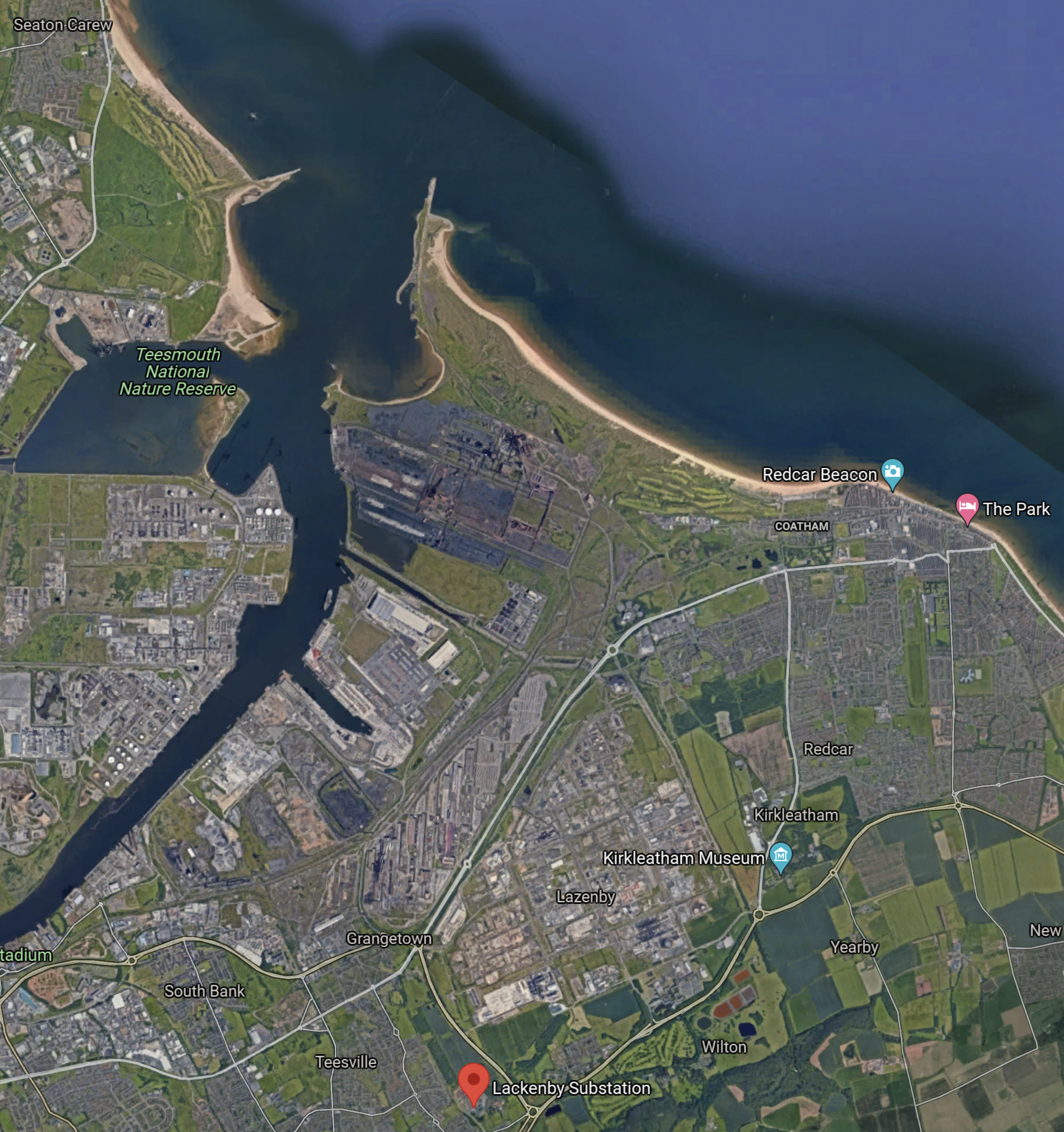
It does seem that there has been a mix-up between the two nearby villages of Lazenby and Lackenby.
I can’t find a Lazenby substation, but I can find one at Lackenby.
This Google Map shows that the location of the Lackenby substation.
This second map shows the substation in more detail.
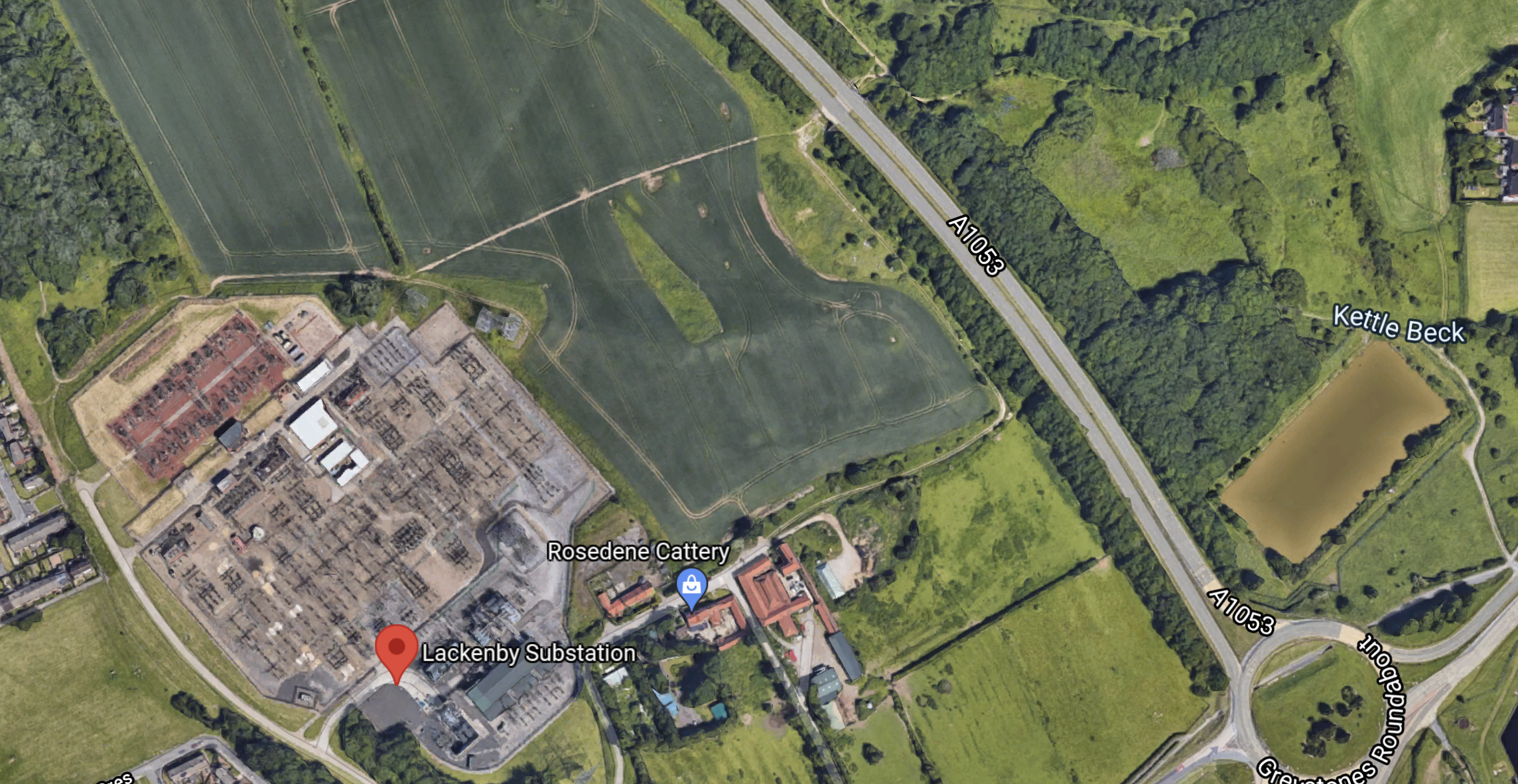
Note.
- There are a lot of large chemical works on both banks of the Tees.
- I can find nothing on the route of the cable from Dogger Bank C to Lackenby substation.
- Perhaps, it’s planned to go up the River Tees or it could come ashore South of the mouth of the River Tees.
Plans must be published soon, so that the substation can be updated before the wind farm is commissioned.

