Mooir Vannin Offshore Wind Farm
This is a wind farm off the Isle of Man, that I missed as it is not on Wikipedia’s List of Offshore Wind Farms In The United Kingdom.
But it does have a web site, which has this handy map.
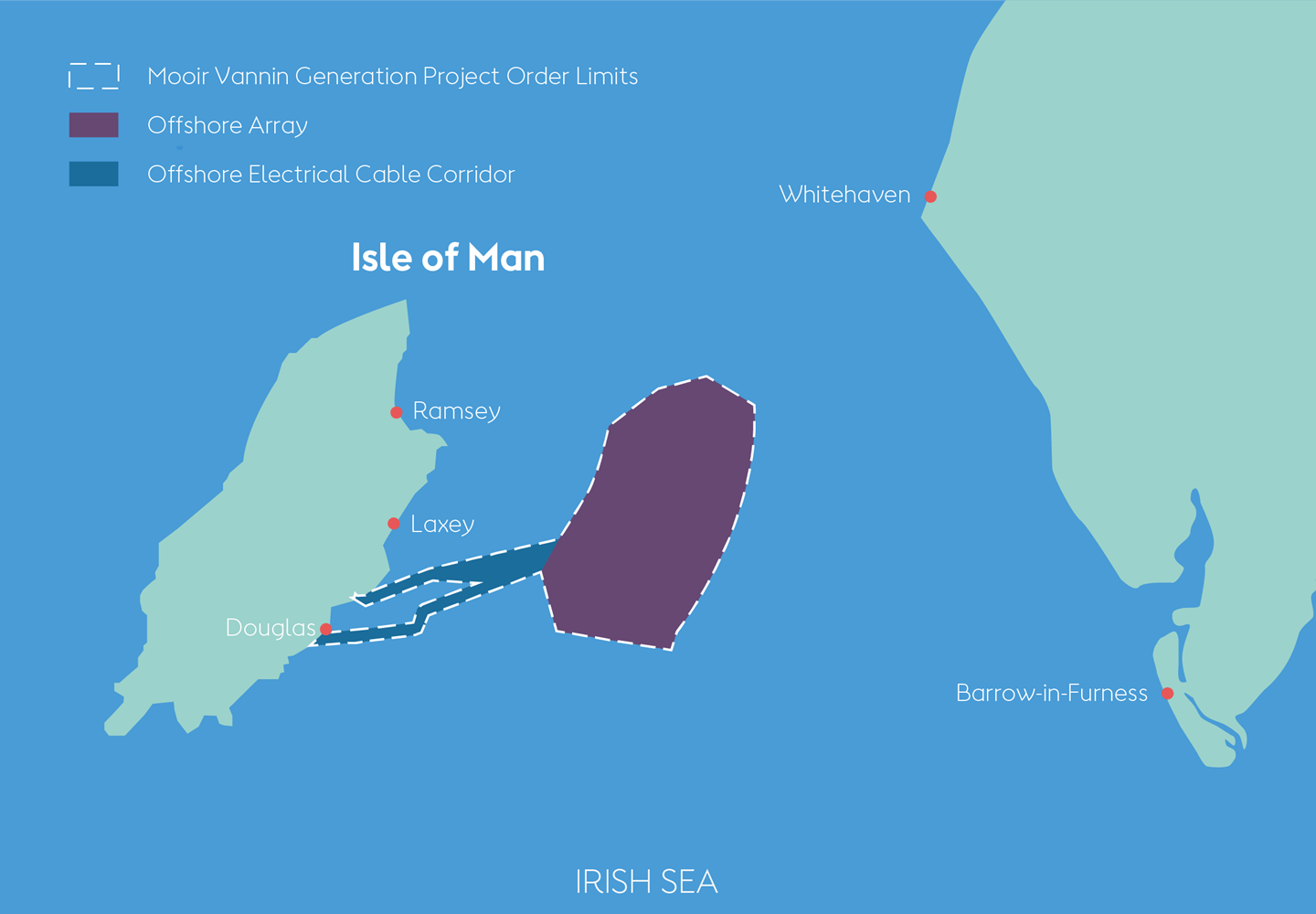
Note.
- The wind farm will have a capacity of 1.4 GW.
- Ørsted is building the web farm.
- It has planning permission.
- The operations base for the proposed Mooir Vannin Offshore Wind Farm will be located at Douglas Harbour on the Isle of Man.
- The Port is Owned By The Isle Of Man Government.
- Anticipated operational start date is the mid 2030s. I’ll assume 2035.
- According to the web site, connection will be to Douglas on the Isle of Man and Penwortham, Lancashire in the UK.
- Penwortham is part of Preston.
- Penwortham substation already has a 50 MW/50 MWh BESS and may get a bigger one.
- Current fossil-fuel power stations on the Isle of Man, include a number of diesel power stations and a 64 MW CCGT. They also have a 23 MW steam generator.
It looks like Mooir Vannin is large enough to give the island a carbon-free energy supply, backed up, by the UK National Grid at Penwortham.
I asked Google AI, “If The Isle of Man Was Going Into The Data Centre Business”, and received this reply.
The Isle of Man is actively positioning itself as a premier hub for data centres, tech firms, and AI companies. The government is utilizing its robust infrastructure, strong regulatory environment, and competitive tax policies to attract high-value data businesses to the island.
It also looks like they have a water system, that has a hydro-electric power-station.
Ørsted Is Danish
Ørsted is Danish and all of those countries to the North East of the UK have lots of islands.
So I asked Google AI, this question.”Does Denmark Have Any Islands With Power Stations?”, and received this comprehensive answer.
Yes, Denmark has several islands with power stations, ranging from natural islands utilizing large wind and biomass facilities to massive, pioneering “Energy Islands” built specifically as offshore power hubs.
Key Examples Include:
Bornholm (Baltic Sea): Designated as a major green “Energy Island” hub. It functions as a massive collection and distribution point for surrounding offshore wind farms, routing renewable energy to both the Danish grid and neighboring countries like Germany.
SamsØ (Kattegat strait): Known globally as a renewable energy island.
It is entirely powered by local onshore and offshore wind turbines and uses a mix of solar and battery storage systems to manage its energy needs, including marina charging.
North Sea Energy Island (VindØ): This is a colossal artificial island project (located roughly 80–100 km off the coast of Jutland) designed to act as an offshore power plant.
It acts as a hub to harvest and convert wind energy from hundreds of surrounding turbines.
Are Ørsted and Highview Power Still Talking?
In Highview Power, Ørsted Find Value In Integrating Offshore Wind With Liquid Air Energy Storage, it appeared that they still were.
As it appears that Highview Power’s Liquid Air Energy Storage can be sized to the application, I wouldn’t be surprised to see one of their batteries on an island powered by Danish wind turbines.
In Is Sumitomo Heavy Industries Highview Power Energy Storage System On Line At Hiroshima?, I describe how a Highview Power application, that uses cold, solar panels and a small Highview Power battery to increase the efficiency of a CNG Terminal.
How Many Of The UK’s Power Stations Are On Islands?
I asked Google AI this question and I received this answer.
There are three major, conventional thermal power stations on the UK’s offshore islands (two in Scotland and one in the Channel Islands), alongside several small-scale community-owned renewable plants that operate entirely off-grid.
The main island-based power stations include:
Lerwick Power Station (Shetland): A 66-73 MW diesel-fired plant commissioned in 1953. It provides a baseline of electricity for the Shetland mainland.
Sullom Voe Terminal Power Station (Shetland): An independent gas-fired station (roughly 92 MW capacity).
Its primary purpose is to serve the Sullom Voe gas terminal, but it also supplies the Shetland grid.
Queen’s Road Power Station (Jersey): A multi-engine facility in the Channel Islands that uses a mix of gas turbines and diesel generators to maintain island capacity.
(Note: Major UK islands, like the Isle of Wight, Anglesey, and the Isle of Skye, are physically connected to the mainland electricity grid via subsea cables, so they do not house their own large-scale, standalone power stations).
Beyond these conventional thermal stations, several smaller Scottish islands run on micro-grid, renewable-only power stations.
For instance:The Isle of Eigg: Powered entirely by a micro-grid of hydro, wind, and solar, completely disconnected from the UK grid.
It looks to me, that the Isle of Man, Shetland and Jersey, are the three most likely islands to get upgraded power systems and it also looks like Ørsted have the experience to make a good fist of it.
Conclusion
I have asked the question, I asked for the UK for a range of countries and I have received some interesting answers from Google AI. But the general trend seems to be to use appropriately-size medium-size and upwards, zero-carbon power stations with microgrids as on the Island of Eigg in the UK.
But I do believe that applying the technology that Ørsted, Highview Power and others are rolling out, that we can give the remote islands and places of Buckminster Fuller’s Spaceship Earth, the zero carbon power they need.
1 GW Wind Farm Proposed Offshore Jersey
The title of this post, is the same as that of this article on offshoreWIND.biz.
This is the sub-heading.
Jersey’s Council of Ministers has proposed to build a 1 GW offshore wind farm in the southwest of the island’s territorial waters that would produce enough electricity to meet its needs, with the remainder to be exported.
This first paragraph gives more details.
It is proposed that the offshore wind farm should be privately funded and designed, and delivered by a consortium with substantial experience of similar development elsewhere, according to the government.
I would have thought that Jersey would have been one of those places, that would have been too conservative for offshore wind.
But then, this is the last paragraph of the article.
In a 2019 Island Plan consultation, 85 per cent of respondents agreed or strongly agreed the plan should continue to encourage the development of offshore wind and tidal energy, according to the government.
But as the wind farm will export the surplus surplus, it could be a nice little earner.
This Google Map shows the Channel Islands.
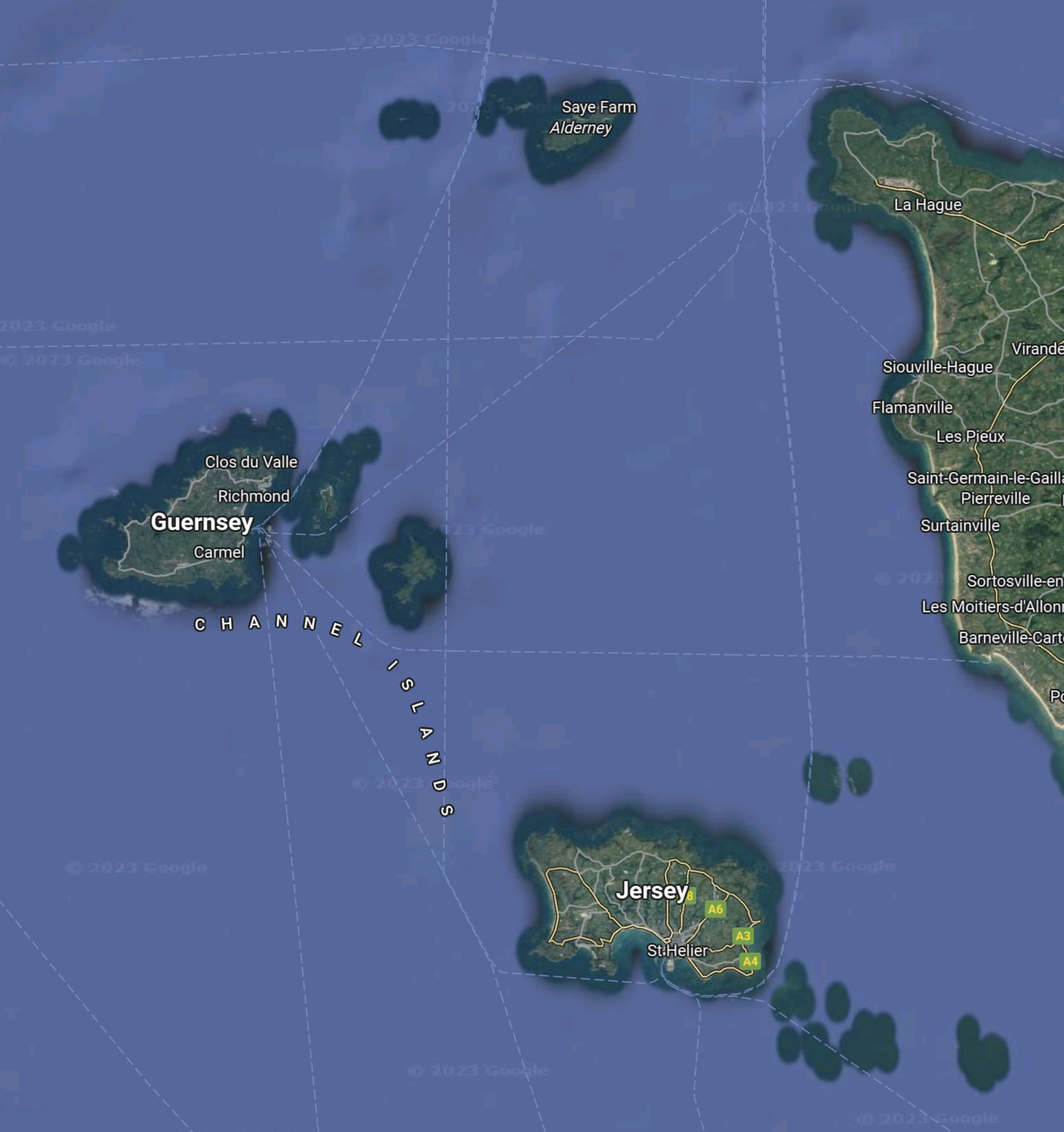
This article on the BBC is entitled Islands Could Work Together On Wind Farm Plans.
These three bullet points sum up the article.
-
Guernsey and Jersey may work together to create a wind farm
-
Both States are hoping to create the wind farm off Jersey’s south-west coast
-
It could generate enough energy for both islands.
This looks like a sound way to reap the wind!
Channel Islands To France Tunnel Would ‘Cost £5.6bn’
The title of this post is the same as that of this article on Construction News.
The tunnel would be built as follows.
- Phase One would be a 28 km. rail tunnel between Jersey and Guernsey.
- Phase Two would be a 32 km rail tunnel between Jersey and Normandy.
- Both journey times would be around fifteen minutes.
- The tunnels would take ten years to build.
- It is claimed they would double the GDP of the islands in a decade.
- The Governments of Guernsey and Jersey are supporting the idea.
One factor driving the idea, seems to be the ageing population of the Channel Islands, which means they will need a commuting population to provide services.
There is also an article on the Jersey Evening Post, which is entitled Jersey-Guernsey-France Tunnel Proposed, that gives a few more details of the proposals.
- The tunnel will start in St Sampson’s in Guernsey and travel under Herm and Sark.
- An artificial island would also be built between Sark and Jersey which could house a combined Channel Island’s airport, hospital, prison and university.
These are a few of my thoughts.
The Route
This Google Map shows the Channel Islands.

Note.
- Herm is shown by the red arrow.
- Sark is llabelled as La Rade.
- The coast of the Cherbourg Peninsular is shown in the East.
From this map it appears that the distance of the two phases of construction would be similar.
Operating Speed
Both tunnels are proposed to be around twenty miles in length, so if the journey time is fifteen minutes, that means an average speed of eighty mph.
For comparison, the Channel Tunnel is just over thirty miles long and has a safety speed limit of 99 mph.
So it would appear that with good design, the timings are possible.
I also think that we could see speeds like these.
- 200 kph (125 mph) on the surface in France.
- At least 100 mph between France and Jersey.
- 80 mph between Jersey and Guernsey, where there are three stops.
Timings of sub-forty-five minutes would be possible.
Single Or Double Track
I feel it would be possible to build each phase of the railway as a single-track tunnel, both of which would be paired with a service tunnel. There would be a double-track section in Jersey, so that trains could pass.
This would allow a four trains per hour (tph) service between Guernsey and France, with the services passing under Jersey.
This frequency would be a Turn-Up-And-Go service.
The article doesn’t say, whether a single or double track tunnel would be built.
As the tunnel would only be built once and probably never increased in capacity, the design must be right first time.
Tunnel Loading Gauge
Would the tunnel be built to take UK-sized trains or the bigger Continental-sized trains?
Consider.
- The trains will probably terminate on the French side in a station.
- The larger the tunnel, the more costly it would be to bore.
- The tunnel would have to incorporate electrification.
I feel that the size of the tunnel will end up as a compromise between cost, convenience and compatibility with French railway standards.
Freight
Consider.
- If the tunnel was the right diameter some freight could be transferred through the tunnel.
- Parcels and smaller freight could also be carried on a shuttle train based on a passenger train.
- A larger tunnel would increase the cost.
- If freight were to be carried on the railway, then a freight terminal would be needed on the surface on Jersey and Guernsey where space is at a premium.
- As less passengers would be using the ferries, this might mean money invested in new ferries between the islands and France and the UK for freight and road vehicles, would give a better return.
I think on balance, that building the rail link, so that it could handle freight trains, other than perhaps a parcel shuttle would not be a viable idea.
Rail Link Power Supply
I think there are two possible power sources for the trains on the rail link; electrification or battery.
Electrification would certainly be possible and would probably use the French (and UK!) system of 25 KVAC overhead electrification.
As it is a tunnel, an overhead rail would probably be used as on Crossrail and other similar railways.
|As a battery range of eighty files would be needed for a round trip and hundred percent reliability would be desirable, I think it would be unlikely, that batteries would be the primary source of power.
But batteries could be fitted to handle regenerative braking and provide a back-up power source.
Connection To French Railways
The nearest French railway is the main Cherbourg and Paris railway, which is electrified using 25 KVAC overhead.
It would seem sensible to allow trains from the Channel Islands to terminate at Cherbourg.
- It is a municipality of 80,000 people.
- It is a major port.
- It has a station with what looks to be a large capacity.
- It has a rail service to Paris, where passengers can change for London.
- There is probably space in Cherbourg station to incorporate a platform with passenger, freight and Immigration and Customs facilities.
- Trains could probably run between Cherbourg and the Channel Islands Rail Link in less than thirty minutes.
- France plans to start a TGV service between Paris and Cherbourg, which would have connections to Eurostar.
- Cherbourg would probably be an ideal place for a depot.
It looks like that about thirty kilometres of new railway would be needed to connect the Channel Island tunnel to the Paris and Cherbourg Line.
Rail Link Signalling
As the trains would be running in France, the whole route would be signalled to the French standards, that are used on any shared track.
The Artificial Island
Consider.
- The artificial island would contain an airport, a hospital, a prison a university and possibly other important facilities.
- It would release land on Jersey and Guernsey for development.
- It is not far from halfway between Guernsey and France.
I like this concept and I also think, that it could ease the construction of the railway.
A fair-sized site will be needed to insert the tunnel boring machines and deal with the spoil they bring to the surface.
I believe that using modern construction techniques, that creating the perimeter of the artificial island first and then boring the tunnels from the new land would be possible.
Tunnel spoil could be used to build up the island or taken away by ship for use elsewhere.
Electricity For The Channel Islands
Much of the electricity for the Channel Islands is produced by La Collette Power Station on Jersey, which is powered by fossil fuel and waste.
If as I believe the rail link would be built with a service tunnel, then would it not be better to import zero-carbon energy from France and distribute it to other islands, using an interconnector cable in the service tunnel?
My electrical engineering is basic from over fifty years ago, but I suspect that if the rail link used 25 KVAC overhead electrification, that the electrification could be used to supply the islands with power.
Hospital Access
There is no point in building a world-class hospital on the artificial island, if patients die because they take too long to get there.
Seriously-ill patients will take forever, if they have to go in an ambulance by ferry and although a helicopter is quick, these are too expensive, especially if you have to keep enough on standby to handle every eventuality.
But the artificial island is less than fifteen minutes from Jersey and Guernsey by train. As trains could be fifteen minutes apart, that means a patient could always be in hospital thirty minutes after being picked up.
But it would need the following.
- A mini-A & E unit in all four stations, where patients could be triaged and admitted or treated, after being brought in by ambulance.
- The ability to take a hospital trolley on all trains.
- The ability to take a patient in a wheelchair on all trains.
I am pretty sure, that an efficient system can be devised.
The Stations
All the stations would be underground, including the terminal at St Sampson’s station on Guernsey.
- Surface access would be by lifts, escalators and stairs.
- Platform-edge doors would be fitted.
- Al stations would be able to handle a hospital trolley.
- Guernsey, Artificial Island and Jersey would probably have two platforms.
- Other stations would probably only need a single bi-directional platform.
- I doubt there would be a second station other than Cherbourg in France, as this would require Customs and Immigration.
I would also make the platforms long.
- Crossrail’s platforms are over two hundred metres long and even London’s suburban platforms are often this length.
- They could have separate sections for passengers and freight.
- They would be difficult to extend in the future, so make them long enough for any possible future needs.
This would enable capacity increases to be made by just lengthening the trains.
The Trains
I have left the trains to last, as I wanted to lay out everything else first, so anything effecting the train design will have been covered.
- An operating speed of 125 mph or 200 kph would be desirable to make maximum use of the infrastructure, especial in France.
- The ability to run a round trip between Cherbourg and Guernsey in under two hours.
- Trains could be either separate passenger and light freight versions or a combi version that could handle both passengers and light freight.
- Trains could be built to a lower height than a typical French train, to allow for a smaller and more affordable tunnel to be bored.
- A long-reach pantograph would be used to reach the higher French electrification.
- All access between train and platform would be level for bags, bikes, buggies and wheelchairs.
- All passenger trains must have the ability to take a hospital trolley, so urgent patients can be rushed to hospital.
My design would be based on a train like a Stadler Flirt, Bombadier Aventra or Siemens Desiro, built to a UK-loading gauge.
- The train would have an ambulance car in the middle to get the best ride quality.
- On one side of the ambulance car would be a passenger section and on the other side would be a light freight or parcel section.
- Trains and stations would be designed together to minimise loading and unloading times.
I’m certain Stadler could build a version of the Class 745 train, that would fit the application.
TGVs To Cherbourg
The French have plans to run TGVs to Cherbourg, which will link up with Eurostar in Paris.
This will improve journey times to Cherbourg and then to the islands, if the Channel Islands rail link terminates in Cherbourg.
But I doubt TGVs would ever run to the Channel Islands.
- It would need large tunnels that would cost a lot more.
- TGVs would have to be designed to work with platform-edge doors.
- It would be difficult to schedule four or more Channel Islands Rail Link trains per hour and the occasionally TGV through the tunnels.
- Two tunnels would probably be needed.
- TGVs are large trains and could need longer platforms in Jersey and Guernsey and other places they call.
- TGVs would take several minutes to rurn round in Guernsey, whereas the Channel Islands Rail Link trains would turn in under five minutes.
There would probably only be a need for a couple of trains per day and a frequent shuttle to Cherbourg would give a much more customer-friendly service. Especially if the TGV service between Paris and Cherbourg was an hourly service.
Electric Airliners
A large proportion of the flights from Jersey and Guernsey airports would be suitable for electric airliners, which I’m certain will be flying before the earliest date the new combined Channel Islands Airport opened.
This would mean that to get to the Channel Islands from say Edinburgh, Frankfurt, Geneva, London or Rotterdam can be done faster in a zero-carbon electric airliner.
The Channel Islands could provide the necessary infrastructure for electric airliners and say all airlines must use them for services to the new airport.
What would it do for Channel Islands tourism to have the world’s first zero-carbon airport?
Surely, with the Channel Islands Rail Link, the airport could be the preferred one for passengers in the area, wanting to travel to the UK and Ireland.
What’s In It For The French?
France will be a beneficiary of the project.
- The French build tunnel boring machines.
- The Channel Tunnel Rail Link will create job opportunities in the Cherbourg area.
- If economic activity increases around Cherbourg, the case for the TGV to Cherbourg gets better.
- The French get a new modern airport for the Cherbourg area.
- The French could get an increased market for their nuclear electricity.
I can see the French liking this project.
Conclusion
I think the Channel Tunnel Rail Link is a good idea and could transform the economy of the Channel Islands.
It will also be good for the surrounding area of France.

