Never Underestimate Scousers With Ambition
I was looking up something at Liverpool University and came across the Liverpool Knowledge Quarter, which is a project to do what it says in the name.
One development is Paddington Village.
This is said.
Paddington Village is a £1bn flagship expansion site sitting at the eastern gateway to the city centre and has been earmarked as 1.8m sq ft of science, technology, education and health space.
In November 2016 a draft masterplan was published, outlining the plans for the site, which will be developed in three phases: Paddington Central, Paddington South and Paddington North, with phase one due to commence in the coming months.
At 30 acres, Paddington is a sizeable urban village, inspired by the sense of community you’d find in the likes of Greenwich Village in New York. Not only will it be a great place to live but a great place to work, discover and socialise, with state-of-the art workspace, labs, cafés, restaurants, shops, accommodation, a hotel and teaching, examination and events space.
The sites first two anchor tenants have already been announce and will see as new Northern Centre of Excellence for the Royal College of Physicians and a new 45,000 sq ft education and learning facilities and 262 residential bed spaces for Liverpool International College. There are also plans in place for a new train station, making this phase two of the Paddington Village development key to the new transport infrastructure for the area.
I also found some more about the Paddington Square station in other places.
This news item in the Liverpool Echo says or implies the following.
- The new station would use some existing tunneling like the Edge Hill Spur.
- The new station would connect to the City, Northern and Wirral Lines.
- The new station would be close to the new Royal Liverpool Hospital.
- The vision is to have in built in five years.
I talked about Merseyrail’s new trains in Thoughts On Merseyrail’s New Trains.
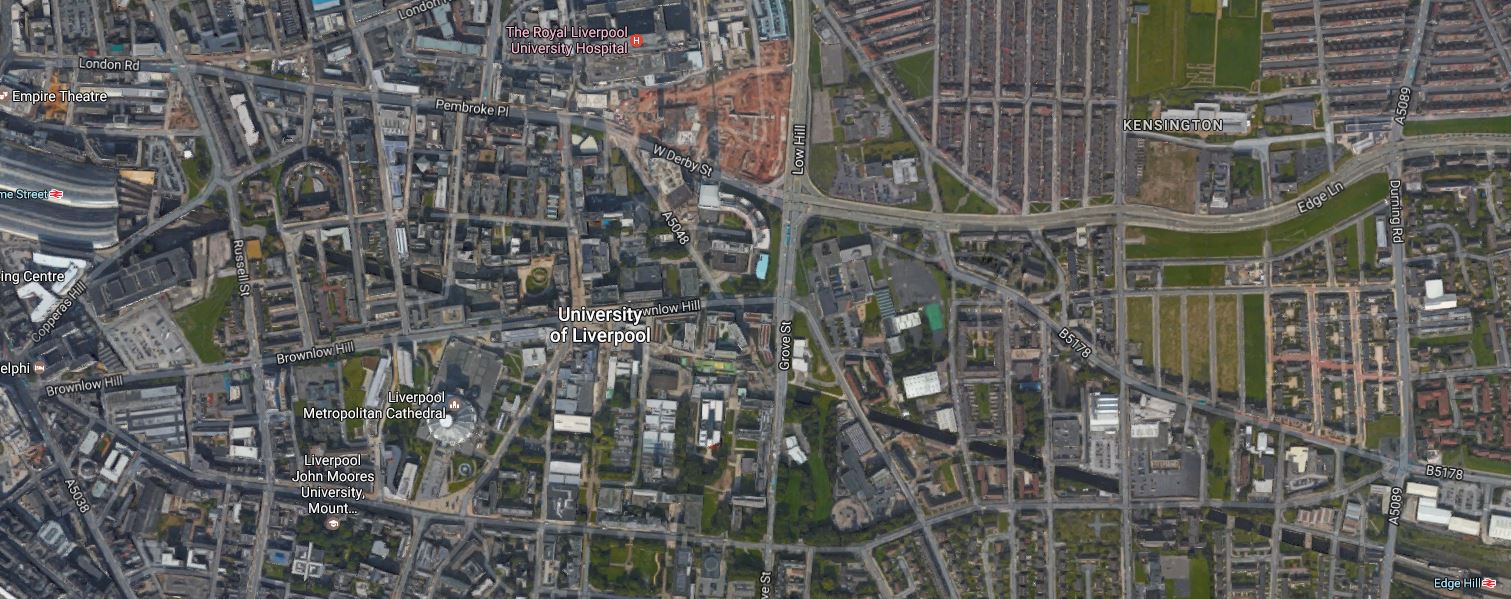
This Google Map shows the area.
Note.
- Lime Street station is at the West and Edge Hill station is in the East.
- The lines into Lime Street are a dark scar between the two stations.
- The Royal Liverpool Hospital is at the top of the map and I think the triangular site to the East will be Paddington Village with Paddington Square station.
Note that there are three abandoned freight tunnels leading from the Docks to Edge Hill station.
On which one will Paddington Square station be built?
I talked about Merseyrail’s new trains in Thoughts On Merseyrail’s New Trains.
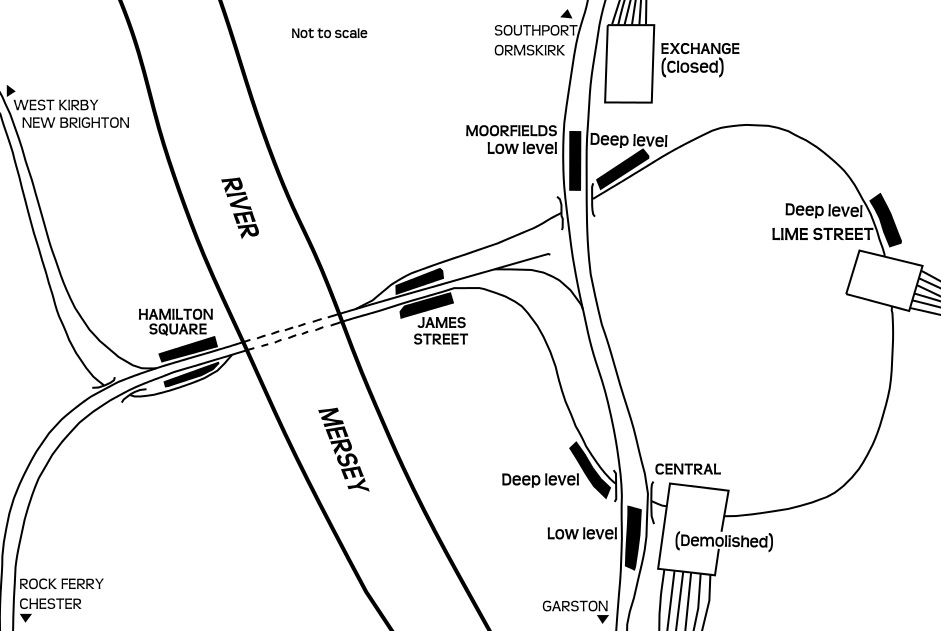
This map from Wikipedia, shows the Loop Line under the Centre of Liverpool.
Liverpool Loop Line
Could trains come in from the East and feed into this loop?
At present 12 trains per hour (tph) come in from the Wirral Line and after stopping at James Street, Moorfields, Lime Street, Central and James Street again, they go back under the Mersey to Birkenhead.
So could trains from Edge Hill join the loop and go through Lime Street, Central and Morrfield stations before going back to Edge Hill?
If the loop was running under Automatic Train Operation (ATO) with the new Stadler trains, I suspect that the Loop could probably handle upwards of the current 12 tph. Perhaps even 24 tph, which could give.
- 4 tph to Manchester via Warrington
- 4 tph to Wigan
- 4 tph to Chester via Runcorn and the Halton Curve.
Or whatever Merseyrail thought was the correct service.
Liverpool would have a unique underground railway.
It could be a superb urban railway, with services to the following destinations, from all stations in the Loop.
- Chester
- Ellesmere Port
- Hunts Cross
- Kirkby
- Liverpool Airport
- Manchester
- Manchester Airport
- New Brighton
- Ormskirk
- Preston
- Rock Ferry
- Southport
- Warrington
- Wigan
- West Kirby
- Wrexham
Passengers going between say Chester and Wigan would get off at Moorfields and wait for the next Wigan train.
These tunnels were only built in 1977 and the loop is due for updating in the first half of 2017, so at least the tunnellers will know where everything is buried.
One advantage is putting all the suburban services in the basement, is that this would release platforms for services to Glasgow, across the Pennines and for HS2.
It certainly seems to be a project that can be realised.
It is an ambitious project, but then who can forget four lads from Liverpool in the 1960s, who had ambition and just imagined?
I’ve Listened To The Tape
I went to Liverpool University in the Autumn of 1964.
The University in those days had a Rag \Week, which in Liverpool was called Panto Week.
This link to the University of Liverpool web site, gives a flavour.
There used to be a debate in the Mountford Hall of the Guild of Undergraduates and usually someone locally famous was invited. In 1965, it was The Scaffold.
I don’t know how I got there, but a few days after seeing the Scaffold, I ended up in a Hall of Residence listening to a tape of the debate of the previous year.
It was a virtuoso performance by Ken Dodd and it went on for hours.
I wonder, if that tape still exists!
Remembering A Relative Or Friend
In seven days it would have been my late wife’s sixty-eighth birthday.
C gave her body for medical research and we had a private cremation a year or so later.
In her memory and also in that of my son, who died of pancreatic cancer in 2010, I helped to fund in a very small way some research into the disease at my mine and my late wife’s university of Liverpool.
I wrote about the research in There’s More To Liverpool Than Football And The Beatles!
In some ways, the successful outcome of the research, gave me an enormous lift and now when I think of my son, I sometimes think, that others will hopefully not have to go through, what he and his family did!
Serious research can do that!
So I got to thinking, that perhaps when a friend or relative dies, we should start a fund and give the money to an appropriate charity, that funds research into whatever was the cause of their death.
My funding of Liverpool University’s Pancreatic Cancer research that came about because I asked Alumni Relations at the University to suggest a suitable research project for my donation.
The Devil must have blessed the donation and the research produced a positive result.
But not everyone can be so lucky.
So why not, when someone close to you dies, collect an appropriate amount of money and ask the major charity or perhaps as I did, your old University to find a project to help fund?
I would think that it could be best to go to a central charity like Cancer Research UK or the British Heart Foundation, as they might now something that was very suitable, based in a University of research institution convenient to where you live!
I feel that selecting a well-run and well-respected central charity is that they know the ropes and that the world is littered with charitable failures, set up by individuals with the best of intentions.
Liverpool University Strikes Again!
In the latest alumni newsletter from my old University, there is a link to this page on the University web site, which is entitled Cancer Drug Trial Success.
This is said.
The University of Liverpool has led a successful trial of a drug trial aimed at developing new therapeutic approaches to cancer.
The trial (APR-246) aimed to test the effects of a novel compound on a specific protein, p53, found to be mutated in more than 50% of all cancers.
The p53 gene is from a class of genes called tumour suppressors which are mutated in all cases of one form of ovarian cancer (high grade serous), but have proved difficult to target in the past.
This research was also done in the Institute of Translational Medicine, where the pancreatic cancer research I wrote about in There’s More To Liverpool Than Football And The Beatles! was carried out.
It certainly would appear that something is being done correctly!
My Mid-Life Crisis
They were talking midlife crises on Radio 5 yesterday, so I sent in a text, which was broadcast.
My mid-life crisis was caused by the death of my wife and our youngest son to cancer smd then my stroke at 63. But I survived and raised money for pancreatic research at mine and my late wife’s University of Liverpool. Yesterday, I visited the unit and left feeling that there is now some hope for people suffering from this awful cancer. My mid-life crisis seemed to be receding as I took the train home.
Hopefully, life can only get better!
Incidentally, since my visit to Liverpool, I’ve spoken to three or four people, who have been affected by pancreatic cancer and I hope my attitude has given them a bit of strength to face the future.
Why I Support Cancer Research UK
In yesterday’s post; There’s More To Liverpool Than Football And The Beatles, I talked about how researchers at Liverpool University had developed a better prostate cancer treatment. I posted this from an An article in The Guardian.
The ESPAC trials, which began publishing findings in 2004, showed that chemotherapy with gemcitabine brings five-year survival up to 15-17%, doubling the rate of survival with surgery alone. The latest research, presented at theAmerican Society of Clinical Oncology meeting in Chicago, showed the two-drug combination nearly doubles the survival rate again to 29%.
It showed, said Neoptolemos, that chemotherapy does work in pancreatic cancer, even though most attention in cancer research is now focused onimmunotherapy, and precision or targeted medicine.
But the trial would not have happened without funding from the charity CancerResearch UK (CRUK), because both drugs are old and off-patent, meaning they can be made by any generic drug manufacturer and are consequently cheap. Drug companies would not foot the bill for such a trial because the profits to be made are small.
“This is an academic-led presentation,” said Neoptolemos. “This shows the enormous value of CRUK. Without them, none of this would have happened. There is a lot of pressure [on doctors] to do drug company trials because you get £2,000 to £3,000 a patient. For something like this, you don’t get anything. It has been quite tough to do.”
That is a very strong endorsement of Cancer Research UK.
Today, there is this story on the BBC web site, which is entitled Bowel cancer: Stents ‘may prevent need for colostomy bags’. This is said.
Bowel cancer patients may avoid the need for colostomy bags if they are first treated by having an expandable tube inserted at the site of their blockage, cancer doctors have said.
The new approach, presented at the world’s biggest cancer conference, showed that the tube, or stent, cut the risk of complications from surgery.
The trial took place at Central Manchester University Hospitals! And who funded the trial? Cancer Research UK!
So I shall keep supporting the work of Cancer Research UK!
There’s More To Liverpool Than Football And The Beatles!
This morning, this story on the BBC web site entitled ‘Major Win’ In Pancreatic Cancer Fight is one of the top stories. This is said.
A new combination of chemotherapy drugs should become the main therapy for pancreatic cancer, say UK researchers.
The disease is so hard to treat that survival rates have barely changed for decades.
But data, presented at the world’s biggest cancer conference, showed long-term survival could be increased from 16% to 29%.
The findings have been described as a “major win”, “incredibly exciting” and as offering new hope to patients.
I must admit that I feel a touch of pride, as the study was led by Professor John Neoptolemos at Liverpool University, which was where my late wife and I met when we were both students at the University.
But I also feel a touch of relief for others, who might get this awful cancer in the future, as now they may stand a better chance of survival, than did our youngest son; George, who survived just a few months after diagnosis.
I also raised a small sum of money for the research by visiting all 92 English and Welsh football clubs in alphabetical order by public transport. The main funding for the research included Cancer Research UK and I think some EU money!
The BBC story also says this.
The trial on 732 patients – in hospitals in the UK, Sweden, France and Germany – compared the standard chemotherapy drug gemcitabine against a combination of gemcitabine and capecitabine.
I’ve looked up the two drugs mentioned and both are on the WHO Model List of Essential Medicines, which are the most important drugs needed in a basic health system.
An article in The Guardian is also illuminating. This is said.
The ESPAC trials, which began publishing findings in 2004, showed that chemotherapy with gemcitabine brings five-year survival up to 15-17%, doubling the rate of survival with surgery alone. The latest research, presented at the American Society of Clinical Oncology meeting in Chicago, showed the two-drug combination nearly doubles the survival rate again to 29%.
It showed, said Neoptolemos, that chemotherapy does work in pancreatic cancer, even though most attention in cancer research is now focused on immunotherapy, and precision or targeted medicine.
But the trial would not have happened without funding from the charity CancerResearch UK (CRUK), because both drugs are old and off-patent, meaning they can be made by any generic drug manufacturer and are consequently cheap. Drug companies would not foot the bill for such a trial because the profits to be made are small.
“This is an academic-led presentation,” said Neoptolemos. “This shows the enormous value of CRUK. Without them, none of this would have happened. There is a lot of pressure [on doctors] to do drug company trials because you get £2,000 to £3,000 a patient. For something like this, you don’t get anything. It has been quite tough to do.”
So this is not some elite drug for the rich, famous and powerful, but one that might even be applied everywhere.
I must admit, that I’ve shed the odd tear this morning!
One Reason We Need More Engineers!
When I graduated in 1968,with an Upper Second Class Honours in Engineering from Liverpool University, my first job at ICI paid £1150 a year.
According to this article in The Independent, Aldi are paying trainee managers £42,000 a year or £3463.70 in 1968 money.
It is my belief that good engineers are some of the best practical problem solvers, so how many of the best engineers are lured by high salaries to non-creative jobs like being a trainee supermarket manager?
High salaries in these sorts of non-creative industries like Retail and the Civil Service, are robbing the country of its best engineers.
Progress Is A Lot Of Small Steps
In Liverpool University’s Insight magazine, there is an article entitled A Surprising New Use For Tofu Ingredient. The details are here on the University’s web site, This is the first paragraph.
The chemical used to make tofu and bath salts could also replace a highly toxic and expensive substance used to make solar cells, a University study published in the journal Nature has revealed.
It appears that a researcher has found that you can replace expensive and highly toxic cadium chloride in solar cells with cheap and safe magnesium chloride.
Small developments like this make me think that the day when I fit solar panels to my flat roof a bit closer.
Liverpool Resurgent Or Phred!
Jacob Epstein‘s sculpture entitled Liverpool Resurgent sits on the front of the Lewis’s Department Store in Liverpool.




When I was at Liverpool University in the 1960s, during Panto or Rag Week, we used to walk down Brownlow Hill to pay homage to the sculpture, who was always known colloquially as Phred.
 The Anonymous Widower