Ambitious £3bn Pumped Hydro Project At Loch Ness Moves Forward
The title of this post is the same as that of this article on Sustainable Times.
These are the two introductory paragraphs.
A £3 billion pumped storage hydro (PSH) project near Scotland’s iconic Loch Ness is one step closer to becoming a reality. Glen Earrach Energy (GEE) confirmed on April 25th that it has officially submitted the planning application for its ambitious 2gw scheme.
If greenlit, this project would represent nearly three-quarters of the total PSH capacity planned for Loch Ness, contributing 34 GWh of the region’s 46 GWh storage goal. But it’s not just the storage that stands out. This development would also account for two-thirds of the generating capacity, all while using just half of the water previously considered. To put it into perspective, the project’s capacity would be on par with the combined output of around 800 onshore wind turbines scattered throughout the Highland Council area.
Note.
- The generating and pumping capacity for this ambitious scheme is given as 2 GW. Only three in China and one in the United States are larger.
- The storage capacity of 34 GWh will make it the largest in the UK, possibly the second largest in Europe to Ulla-Førre in Norway and one of the ten largest in the world.
- A projected 10% reduction in the UK grid’s carbon footprint is claimed.
- The cost of three billion is high, but compare that with the tens of billions quoted for the 3.26 GW Hinckley Point C.
The Glen Earrach scheme is not short on superlatives and the article in Sustainable Times is worth a thorough read.
Fifth Hydro Project Proposed At Loch Ness, is based on a BBC article of the same name.
These were my thoughts in the related post.
The Existing Hydro Schemes On Loch Ness
According to the BBC article, there are two existing hydro schemes on Loch Ness.
- Foyers is described on this web site and is a reasonably modern 305 MW/6.3 GWh pumped storage hydroelectric power station, that was built by SSE Renewables in the last fifty years.
- Glendoe is described on this web site and is a modern 106.5 MW conventional hydroelectric power station, that was built by SSE Renewables in the last twenty years.
Foyers and Glendoe may not be the biggest hydroelectric power stations, but they’re up there in size with most solar and onshore wind farms. Perhaps we should look for sites to develop 100 MW hydroelectric power stations?
The Proposed Hydro Schemes On Loch Ness
According to the BBC article, there are four proposed hydro schemes on Loch Ness.
- Coire Glas is described on this web site and will be a 1.5GW/30 GWh pumped storage hydroelectric power station, that is being developed by SSE Renewables.
- Fearna is described on this web site and will be a 1.8GW/37 GWh pumped storage hydroelectric power station, that is being developed by Gilkes Energy.
- Loch Kemp is described on this web site and will be a 600MW/9 GWh pumped storage hydroelectric power station, that is being developed by Statera.
- Loch Na Cathrach is described on this web site and will be a 450MW/2.8 GWh pumped storage hydroelectric power station, that is being developed by Statktaft.
In addition there is, there is the recently announced Glen Earrach.
- Glen Earrach is described on this web site and will be a 2GW/34 GWh pumped storage hydroelectric power station, that is being developed by Glen Earrach Energy.
Note.
- The total power of the seven pumped storage hydroelectric power stations is 4.76 GW.
- The total storage capacity is 89.1 GWh.
- The storage capacity is enough to run all turbines flat out for nearly nineteen hours.
I estimate that if 2 GW/34 GWh of pumped storage will cost £3 billion, then 4.76 GW/89.1 GWh of pumped storage will cost around £7-8 billion.
Earba 1.8GW Pumped Storage Hydro Project Secures Approval
The title of this post, is the same as that of this article on the Solar Power Portal.
These three paragraphs introduce the article.
Gilkes Energy has been awarded planning consent for its Earba Pumped Storage Hydro (PSH) scheme.
The Earba PSH scheme is set to be the largest project of its kind in the UK, with an installed capacity of 1.8GW and a storage capacity of 40GWh, meaning that it can provide 22 hours of storage at full power. The planning application for the project was submitted to the Scottish government in early March 2024.
The project will be located at Loch Earba in the Scottish central Highlands. Gilkes Energy states that this location was chosen because the area has an ideal combination of geology and topography, which the firm states will make it one of the most economically viable PSH projects under development in the UK.
In Gilkes Reveals 900MW Scottish Pumped Storage Plan, I said that Loch Earba was a 900 MW/33 MWh PSH scheme, but now it appears a it is 1.8 GW/40 GWh scheme, which will probably put it in the largest twenty PSH schemes in the world.
It will be one of four PSH schemes under development in Scotland.
- Coire Glas – 1.3 GW/30 GWh
- Loch Earba – 1.8 GW/40 GWh
- Loch na Cathrach (formerly known as Red John) – 450 MW/2.8 GWh
- Loch Sloy – 160 MW/16 GWh
In addition.
- Cruachan is being extended to 1 GW/7 GWh.
- Highview Power are planning to build two 200 MW/2.5 GWh of their liquid air batteries in Scotland.
Everything totals up to 5.1 GW/100.8 GWh, which compares with a UK electricity production as I write this article of just under 29.5 GW.
I wouldn’t be surprised to see some high-energy industries moving to Scotland because of all this renewable and hopefully reliable power.
Scottish Ministers Approve 200MW Battery Storage Project
The title of this post is the same as that as this article on Solar Power Portal.
These three paragraphs add further meat to the story.
Developer Intelligent Land Investments (ILI) Group has received planning consent for a 200MW battery energy storage system (BESS).
The BESS will be adjacent to the Easterhouse substation near Gartcosh, Glasgow, at Whitehill Farm. ILI Group received Section 36 planning consent, meaning that the BESS is classed as a change to the existing consent granted to the generating substation.
Consent from Ministers follows support for the project from both the Glasgow City Council and North Lanarkshire Council.
ILI seem to be doing well, as they regularly appear in my data searches.
The article sums up ILI Group’s portfolio like this.
ILI Group has a portfolio of over 4.7 GW energy storage projects, including 2.5 GW of utility-scale battery storage and 2.5 GW pumped storage hydro.
They must be doing something right.
ILI Group’s biggest success to date would appear to be developing the Red John pumped hydro power station, which they sold to Statkraft, as I reported in Statkraft To Acquire Major Loch Ness Pumped Storage Hydro Project From Intelligent Land Investments Group.
Conclusion
The batteries and the pumped storage keeps coming in Scotland.
It appears Scotland will not only generate the renewable energy, but store it until it is needed.
As a Control Engineer, my nose is telling me, that Scotland is going to need a few more interconnectors to sell the energy to those, who need it.
Alternatively, it will attract industries, that will need a lot of electricity.
The MailOnline’s View Of Pumped Storage Hydroelectricity
The MailOnline gives their view on Pumped Storage Hydroelectricity on the front page of their web site today.
This is the bold title.
Scotland is littered with windfarms. Now the impact of billion-pound hydro projects to store energy they produce threatens our scenic landscapes… and led critics to brand the plans – The Loch Ness Monstrosity
To my mind, the site’s language leaves no doubt that they are not keen on either windfarms or the hydro projects to store energy.
Calling the plans the Loch Ness Monstrosity, is an insult to the engineers, who have devised the plans.
The journalist, who wrote the article has made the same mistake, that many do when they write about any form of energy storage – They only give the output of the battery and not the output and the storage capacity.
Thus Red John Pumped Hydro is described in the article like this.
The £550million Loch na Cathrach venture (formerly known as Red John, after a popular local lochan), is one of the biggest renewable energy projects in the North and was granted consent by the Scottish Government in June 2021 despite strong objections from campaigners and Highland Council but has yet to be built in the hills near Dores.
The 450MW project owned by Norwegian state firm Statkraft hopes to start construction next year and be operational by 2030.
Note.
- Red John is a 450 MW project with a storage capacity of 2,800 MWh, which is conventionally shown as a 450 MW/2,800 MWh battery.
- A battery of this size can supply 450 MW for 6.2 hours, which is more than a lithium-ion battery of the same cost could manage.
- 450 MW is about the average size of a gas-fired power station.
Where the geography is suitable, pumped storage hydroelectric stations may be able to replace gas-fired power stations.
- There would be no cooling towers.
- There would be no chimneys or associated pollution.
- The electrical gubbins to connect to the grid would be the same and could probably be refurbished.
The new lake could be used for water-based activities like fishing, sailing skiing and swimming.
Conclusion
Obviously, playing the Nimby-card sells newspapers.
Fifth Hydro Project Proposed At Loch Ness
The title of this post. is the same as that of this article on the BBC.
This is the sub-heading.
The local community is to be asked for its views next week on plans for a new hydro-electric scheme at Loch Ness.
These three paragraphs introduce the new scheme.
Glen Earrach Energy’s, external (GEE) pumped storage hydro project is the fifth hydro scheme proposed for the Loch Ness area.
The company said its project on Balmacaan Estate would create clean energy while protecting the environment, and create 600 on-site jobs.
But concerns have been raised about the number of planned schemes, with Ness District Salmon Fishery Board worried about the effect on wild fish.
The project has a web site, which has a section entitled About The Project, where this is said.
Glen Earrach Energy, which means “Valley of Spring” in Gaelic, stands at the forefront of energy innovation. The Pumped Storage Hydro (PSH) project, located at Balmacaan Estate, Scotland, is a critical component for achieving a net-zero grid by 2030.
The project prioritises environmental preservation and biodiversity enhancement while achieving outstanding efficiency in energy storage and generation.
This ensures a healthier and more sustainable balance between harnessing natural energy resources and the maintenance and reinforcement of the surrounding ecosystem.
Note.
- It doesn’t say, but it looks like Glen Earrach Energy aim to complete the project by 2030.
- Glen Earrach Energy also seem to be playing a strong environmental card.
But nothing is said about the size of the project.
This article on Business Insider, which is entitled £3 billion Loch Ness Hydro Project Plans Unveiled, does give some details.
- Potential Investment – More than £2 billion
- Output – 2 GW
- Storage Capacity – 30 GWh
- The project could create at least 600 on-site construction jobs in Scotland over a six-year period, plus many thousands more locally in the supply chain.
It is larger, than SSE’s flagship Coire Glas pumped storage hydroelectric power station, which is planned to be a 1.5 GW/30 GWh station, at the other end of the Great Glen.
I have some thoughts.
The Existing Hydro Schemes On Loch Ness
According to the BBC article, there are two existing hydro schemes on Loch Ness.
- Foyers is described on this web site and is a reasonably modern 305 MW/6.3 GWh pumped storage hydroelectric power station, that was built by SSE Renewables in the last fifty years.
- Glendoe is described on this web site and is a modern 106.5 MW conventional hydroelectric power station, that was built by SSE Renewables in the last twenty years.
Foyers and Glendoe may not be the biggest hydroelectric power stations, but they’re up there in size with most solar and onshore wind farms. Perhaps we should look for sites to develop 100 MW hydroelectric power stations?
The Proposed Hydro Schemes On Loch Ness
According to the BBC article, there are four proposed hydro schemes on Loch Ness.
- Coire Glas is described on this web site and will be a 1.5GW/30 GWh pumped storage hydroelectric power station, that is being developed by SSE Renewables.
- Fearna is described on this web site and will be a 1.8GW/37 GWh pumped storage hydroelectric power station, that is being developed by Gilkes Energy.
- Loch Kemp is described on this web site and will be a 600MW/9 GWh pumped storage hydroelectric power station, that is being developed by Statera.
- Loch Na Cathrach is described on this web site and will be a 450MW/2.8 GWh pumped storage hydroelectric power station, that is being developed by Statktaft.
In addition there is, there is the recently announced Glen Earrach.
- Glen Earrach is described on this web site and will be a 2GW/30 GWh pumped storage hydroelectric power station, that is being developed by Glen Earrach Energy.
Note.
- The total power of the seven pumped storage hydroelectric power stations is 4.76 GW.
- The total storage capacity is 85.1 GWh.
The storage capacity is enough to run all turbines flat out for nearly five hours.
Could Glendoe Be Updated To Pumped Storage?
The Wikipedia entry for the Glendoe Hydro Scheme mentions pumped storage several times.
In Glendoe Hydro Power Station, I estimate that a Glendoe pumped storage scheme could be perhaps 50 % bigger than the system at Foyers.
I feel that if more storage capacity is needed in the Highlands, then Glendoe could be converted to pumped storage.
Gresham House BESS Fund Energises 50MWh Asset
The title of this post, is the same as that of this article on Solar Power Portal.
These three paragraphs detail the project.
Gresham House Energy Storage Fund has energised a 50MW/50MWh battery energy storage system (BESS) in Lancashire.
Situated in Penwortham, south-west of the county capital Preston, the 1-hour duration BESS is set to be expanded to 2-hours in the summer, meaning its capacity would be 50MW/100MWh.
With the commencement of this new BESS, Gresham House Energy Storage Fund’s operational capacity has now reached 790MW/926MWh. The project is the fund’s 25th operational asset since IPO.
Note.
- The battery will be upgraded to a two-hour battery in the summer.
- The average battery would appear to be 32 MW/37 MWh.
- The average full-power duration for all Gresham House’s batteries appears to be around 70 minutes.
This Google Map shows the battery, which is located next to National Grid’s Penwortham substation.
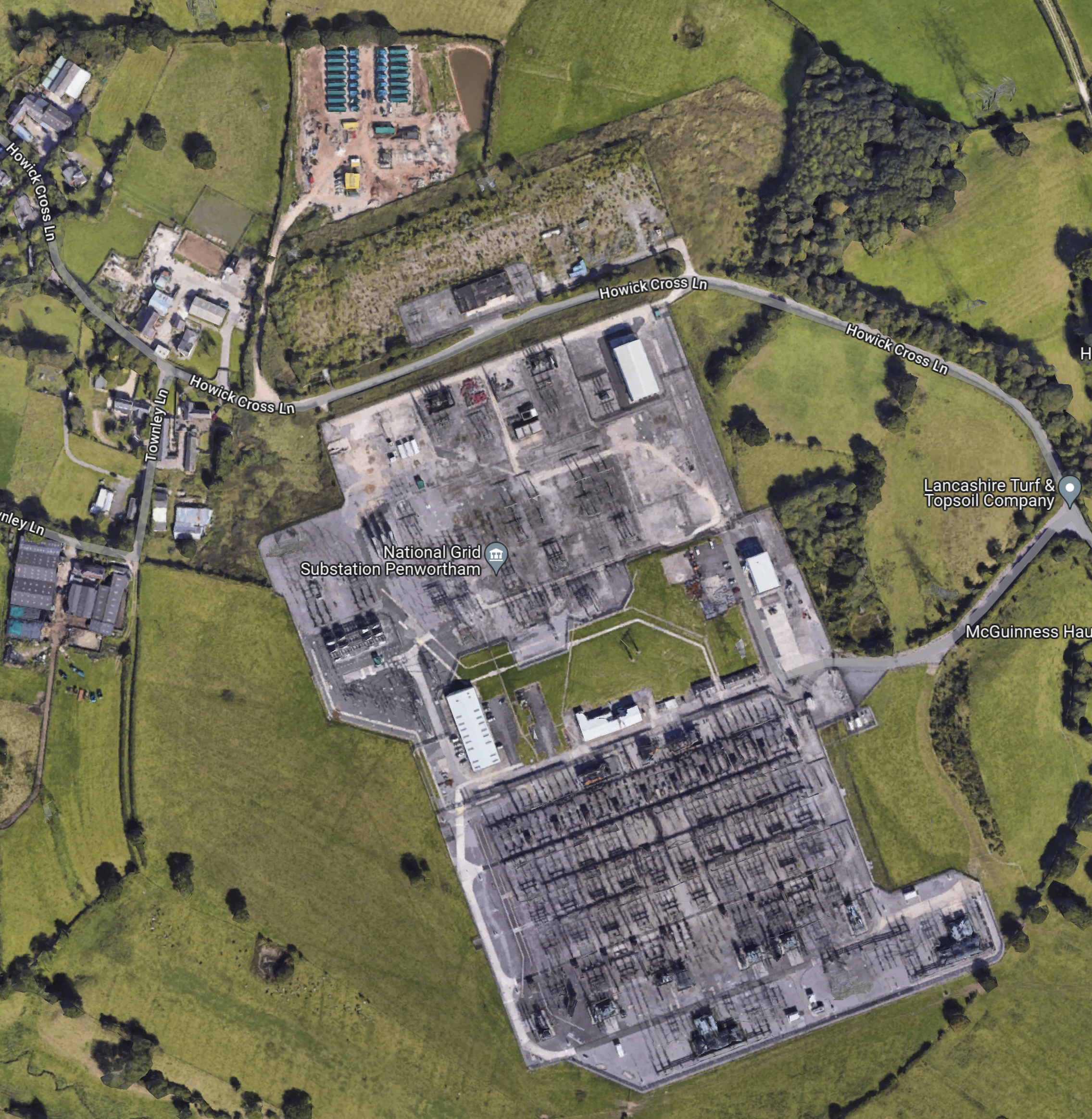
Note.
- The battery is the two rows of green containers at the top of the map.
- The substation appears to be large.
Co-location like this, must surely bring design, construction and operational advantages.
This page on the National Grid web site is entitled Network And Infrastructure, where this is said.
We own the national electricity transmission system in England and Wales. The system consists of approximately 4,500 miles of overhead line, over 900 miles of underground cable and over 300 substations.
If every substation in the UK were to be fitted with a 32 MW/64 MWh two hour battery, these would have a total capacity of 9.6 GW/19.2 GWh.
Compare that with these operational batteries and pumped-storage systems in the UK.
- Cruachan – 1000 MW/7.1 GWh – Pumped Storage
- Dinorwig – 1800 MW/9.1 GWh – Pumped Storage
- Ffestiniog – 360 MW/1.44 GWh – Pumped Storage
- Minety -150 MW/266 MWh – BESS
- Pillswood – 98 MW/196 MWh – BESS
And these systems are under development
- Coire Glas – 1.5GW/30 GWh – Pumped Storage
- Loch Na Cathrach/Red John – 450 MW/2.8 GWh – Pumped Storage
- London Gateway – 320 MW/640 MWh – BESS
There are at least another four substantial pumped storage systems under development.
Conclusion
A twin-track approach of grid-batteries at sub-stations and a few larger grid batteries and pumped storage hydroelectric schemes should be able to provide enough storage.
The UK’s Pumped Storage Hydroelectricity
This post is a simple list of the UK’s pumped storage hydroelectricity.
- Balliemeanoch – 1500 MW/45 GWh – In Development
- Coire Glas – 1500 MW/30 GWh – Under Construction
- Corrievarkie – 600 MW/14.5 GWh – In Development
- Cruachan – 1000 MW/7.1 GWh – In Operation
- Fearn – 1800 MW/37 GWh – In Development
- Dinorwig – 1800 MW/9.1 GWh – In Operation
- Earba – 900 MW/33 GWh – In Development
- Foyers – 305 MW/10 GWh – In Operation
- Ffestiniog – 360 MW/1.44 GWh – In Operation
- Loch Kemp – 600 MW/9 GWh – In Development
- Loch Sloy – 152.5 MW/25 GWh – In Operation
- Red John – 450 MW/2.8 GWh – Under Construction
Note.
- Cruachan is only 440 MW and is being upgraded.
- The storage capacity at Foyers may be wrong, as I can’t find my original source.
When fully developed the total will be 10969.3 MW/223.94 GWh.
Price Framework Paves Way For Vast Electricity Storage Scheme
The title of this post, is the same as that of this article on The Times.
This is the sub-heading.
SSE welcomes step forward in plans to build the £1.5bn Coire Glas hydroelectric project
These two paragraphs outline the article.
Ministers have provisionally agreed to a power pricing framework that could pave the way for more pumped storage hydroelectricity projects in Britain, including a gigantic £1.5 billion scheme from SSE that is starting to take shape in the Scottish Highlands.
The Department for Energy Security and Net Zero said it intended to develop a “cap and floor” pricing mechanism that would advance the Coire Glas storage project being developed by SSE, the energy company, and could unlock further pumped storage power stations.
Coire Glas will be one of the largest renewable power projects ever built in the UK.
- It will have a power output of 1.5 GW, which is comparable with some of the large wind farms in the North Sea or four gas-fired power station or Rolls-Royce SMRs.
- It will be able to store 30 GWh of electricity and provide 1.5 GW for twenty hours.
- Coire Glas has a web site.
- Coire Glas will more than double pumped storage hydroelectric capacity in the UK.
Bath County Pumped Storage Station in Virginia, US claims to be the world’s largest battery, but Coire Glas will be able to store more electricity.
You wait decades for one of these monsters to come along in the UK and SSE also have another on the way.
- Loch Sloy hydroelectric power station is the largest conventional hydroelectric power station in the UK.
- It has an output of 152 MW.
- It opened in 1950 and was largely built by German and Italian prisoners-of-war.
SSE plan to convert Loch Sloy power station into a pumped storage hydroelectric power station.
- It will be able to store 25 GWh of electricity.
- Loch Sloy will be the upper lake.
- Loch Lomond will be the lower lake.
- The existing dam, upper lake, pipes and powerhouse will be retained.
- The developments have a web page.
The project is aimed at a commissioning date of 2028.
This paragraph explains how the ‘cap and floor’ mechanism works.
In the scheme, operators would be guaranteed a minimum level of revenue, while consumers would be protected by a price ceiling, above which surplus revenue would be returned to them.
And these two paragraphs give SSE’s reaction.
Finlay McCutcheon, 46, director of onshore Europe at SSE, said the pricing framework was welcome news. He said that a deal for Coire Glas was needed by the end of this year to secure a firm investment decision by early 2026. Planning for the project started in 2007.
“Given the time taken to reach this point, much work is now needed to ensure an effective mechanism is finalised and put in place as early as possible to enable Coire Glas to take final investment decisions and move into construction,” he said.
I believe that the negotiations between the Government and SSE will lead to a monster on Loch Lochy and another one on Loch Lomond.
Conclusion
There are also these pumped storage hydroelectric schemes under development.
- Balliemeanoch Pumped Hydro – 1.5 GW/45 GWh
- Balmacaan Pumped Hydro – 600 MW/15-20 GWh
- Corrievarkie Pumped Hydro – 1.5 GW/14.5 GWh
- Fearna Pumped Hydro – 1.8 GW/37 GWh
- Glenmuckloch Pumped Hydro – 400 MW/1.6 GWh
- Loch Earba Pumped Storage Hydro – 900MW/33 GWh
- Loch Kemp Pumped Storage Hydro – 300MW/9 GWh
- Loch Na Cargeach/Red John Pumped Storage Hydro – 450 MW/2.8 GWh
These total up to 7.4 GW/100+ GWh.
This page on the Strathclyde University web site, gives these GWh figures for the possible amounts of pumped-storage that can be added to existing schemes.
- Errochty – 16
- Glasgarnock – 23
- Luichart – 38
- Clunie – 40
- Fannich – 70
- Rannoch – 41
- Fasnakyle – 78
- Tummel – 38
- Ben Lawers – 12
- Nant – 48
- Invermoriston – 22
- Invergarry – 41
- Quoich – 27
- Sloy – 20
That is a total of 514 GWh.
Scotland will be the Saudi Arabia of energy storage.
Statkraft To Acquire Major Loch Ness Pumped Storage Hydro Project From Intelligent Land Investments Group
The title of this post, is the same as that of this press release from Statkraft.
This is the sub-heading.
The acquisition demonstrates Statkraft’s latest commitment to helping Scotland meet its renewable energy targets and strengthening UK energy security
These two paragraphed outline Red John and the deal.
Statkraft, Europe’s largest renewable power generator, has agreed to acquire the Red John Pumped Storage Hydro Scheme, from Intelligent Land Investments Group (ILI).
The 450MW scheme, first conceived in 2015, was granted consent by Scottish Government ministers in June 2021. The acquisition demonstrates Statkraft’s latest commitment to helping Scotland meet its renewable energy targets and strengthening UK energy security.
Note.
I wrote about Red John in Red John Pumped Storage Hydro Project.
I have also found a web site for the project, where this is said.
- The scheme has an output of 450 MW.
- The storage capacity is 2,800 MWh or 2.8 GWh.
- The scheme has planning consent.
- The project is budgeted to cost £550 million.
- The construction program indicates that the scheme will be completed by the end of 2025.
It looks to me, that the ILI Group have done all the hard work in getting the project shovel-ready and are passing the project to a bigger developer.
Scotland’s 25 GWh Energy Storage Arriving By Stealth
In SSE Unveils Redevelopment Plans For Sloy Hydro-Electric Power Station, I introduced SSE Renewable’s plan to convert the UK’s largest hydro-electric power station into a pumped storage hydroelectric station, that can store 25 GWh of electricity and generate 152.5 MW of electricity.
After a public consultation in July, which unfortunately, I was unable to get to, SSE have now published a comprehensive document, which details their plans.
These are some points from the document.
- There will be no increase in the generating capacity of 152.5 MW, which is about half the size of a gas-fired power station.
- SSE designed a similar scheme for Sloy in 2009.
- Pumped storage systems need a lot of water. The Loch Sloy scheme has Loch Lomond.
- The development of pumped storage at Sloy would only require construction work to be carried out in the grounds of the existing power station.
- No permanent new works would be required at Sloy Dam or outside of the existing station boundary.
- A new above ground structure would be required which would contain a main hall with vehicular access, laydown areas, an overhead travelling crane, electrical switchgear and control systems.
- A new underground pump hall would be required to house two pumps. This would link to the intake structure and would be approximately 20m below the existing ground level.
- The existing tailrace to Loch Lomond, will be used to bring water to the pumps.
- Construction could start in 2025, with completion in 2027.
This redevelopment is a much less complex construction project, than building the original power station in the 1950s.
It also looks like the construction will not cause much disruption in the local area.
Hence my view, that this storage is arriving by stealth and won’t be noticed by those passing the power station.
After reading this SSE document, I wonder how many similar 1950s hydroelectric power stations have been upgraded to pumped storage stations in the last few years.
Also, if their Sloy scheme is successful, will SSE be looking for other hydroelectric power stations to convert to pumped storage?
This article on renews.biz is entitled Vattenfall Plans To Build 730MW Of Swedish Hydro Power, where this is a paragraph.
Vattenfall is also conducting a pilot study to investigate reinstating the Juktan power station on the Storjuktan lake adjacent to the Umeälven river in Västerbotten, to a pumped storage plant with a capacity of up to 380MW.
Note.
- Juktan power station was built as a pumped storage station and converted to a standard one.
- It has a web page.
- As the paragraph says it could be converted back!
So other companies and countries are thinking the same way!
Strathclyde University’s Prediction
This page on the Strathclyde University web site, gives these figures in GWh for the possible amounts of pumped storage that can be added to existing schemes.
- Errochty – 16
- Glasgarnock – 23
- Luichart – 38
- Clunie – 40
- Fannich – 70
- Rannoch – 41
- Fasnakyle – 78
- Tummel – 38
- Ben Lawers – 12
- Nant – 48
- Invermoriston – 22
- Invergarry – 41
- Quoich – 27
- Sloy – 20
That is a total of 514 GWh.
These figures must give SSE food for thought.
These new schemes are also being planned.
- Balliemeanoch – 1.5GW/45 GWh
- Coire Glas – 1.5 GW/30 GWh
- Corrievarkie – 600 MW/14.5 GWh
- Fearna – 1.8 GW/37 GWh
- Loch Earba – 900 MW/33 GWh
- Loch Kemp – 300 MW/9 GWh
- Loch Na Cathrach/Red John – 450 MW/2.8 GWh
These could bring the potential pumped storage in Scotland to 685.3 GWh.
 The Anonymous Widower