Hackney On The Rise
BBC Radio 5 asks this morning about views on the economy. I sent them this text.
Three years ago, I retired to Dalston after a stroke stopped me driving. Every month the area gets better and a lot is down to the London Overground, which takes people to jobs, shopping and leisure activities. It shows how investment in transport can improve the lot for us all! Next year Tottenham gets the overground. We live in interesting times.
So has the Overground really improved things?
I first rode the Overground towards the Olympic Park in July 2010, before I moved here in December of that year. Since that first short run, the system has expanded. but gone are the dingy stationsa, dirty trains and lack of staff of the pre-Overground era. The Class 378 trains, started as three cars, but as they couldn’t handle the demand, they were lengthened to four cars and now they’re going to five. Have we ever built a railway, for which much-need extra capacity can be provided so easily?
But the capacity is needed, as more and more people use the line contributing to the affluence and well-being of the areas it serves, like Hackney.
You could call the Overground a rebranding exercise, but that would be unfair. Give a railway line, better clean stations, reliable frequent trains, visible staff and a simple ticketing system and the passengers will arrive. Visitors will also come and bring prosperity to an area.
London will use the Overground to run trains on the Lea Valley Lines to Tottenham, Enfield, Cheshunt and Chingford. North East London will surely be on the up.
One of the great things about the way the Overground is implemented, as effectively a rebuilt, resignalled and fully-staffed train line first with a deep clear of trains and stations and Oyster ticketing, means that the concept can be brought in, in affordable stages.
I suspect that the Lea Valley lines have a good enough line and signalling for a few years, so it’ll be the grotty and unstaffed stations, and the ticketing, that get the most attention at first. As new Cl;ass 378 trains are delivered, they can of course be run in combination with the ageing Class 315 trains on the lines at present, as their bigger brother, the Class 379 does already. Dripping new trains in surely gives passengers hope that something is happening to improve their dismal line.
With a grand project like Crossrail, you only see the improvement, when the line opens. With the Overground, the upgrade is continuous and now the London boroughs seem to be getting involved in the development of the stations, many of which are on prime sites.
I suspect that the way the Overground has been implemented could be applied to various train lines around the country. The Cambridge to Ipswich line, which I know well could benefit, especially if the main line was electrified for freight and the various councils got involved, to facilitate the development of the stations. Bury St. Edmunds station, is a classic, where a good architect could create a mixed housing and commercial development that did justice to the town.
I believe that if you get the railway right, then the investment and development around stations will follow.
Will The New Overground Lines Get New Trains?
News is starting to filter out about the takeover of the Lea Valley lines by TfL and the London Overground. The Standard had a big article yesterday. The new map is also starting to appear in the media.
This is an extract from the Standard article.
When TfL acquires the West Anglia inner suburban services it will replace the 30-year-old carriages with 30 new four-car electric units, as well as procuring electric trains for the Gospel Oak to Barking line of the Overground.
There are also plans to upgrade 23 Overground stations by 2016.
At present the lines are served by Class 315 and Class 317 trains. It looks like the numerous Class 315 trains will be moved on, but the Class 317 trains are being refurbished. So some Class 317 trains might be retained.
But this means that there will have to be some new trains to replace the Class 315, which will probably be London Overground’s Class 378. I would suspect, there’s a cost saving on having only one class of trains on the Overground. Politicians will think it looks nicer too and gives better photo opportunities.
I like the Class 378 trains and I said so in this post. Here’s the relevant bit.
In some ways , the stars of the line are the Class 378 trains. You rarely hear of train failures and the interiors still seem pristine after nearly four years of service. And now, because of their design, they’re being extended by the simple addition of a fifth carriage in the middle.
And of course they were all designed and built in Derby!
Derby will be pleased at the thought of 120 new carriages! But will some bean counter buy too few!
My prudent ancestry says that to convert a few Class 317 trains to look like Class 378 to passengers and use them selectively might be an attractive alternative to some of the new trains. Provided of course the non-standard fleet didn’t come with a large maintenance penalty. Remember though, that we’re very good at train refurbishment and updating in this country and underneath the grubby exterior of the current Class 317s, a set of legendary Mark 3 coaches, are struggling to get out.
The Paper First With The News
I have an Internet trawl looking for stories about the Overground and particularly its expansion by taking over the Lea Valley lines. It found this story from the Docklands and East London Advertiser this morning. Here’s the first two paragraphs.
Part of the Liverpool Street suburban rail network in east London is being incorporated into the London Overground.
The Chingford and Enfield lines through Bethnal Green and Hackney will appear on the Underground map for the first time from 2015, it has been revealed in Transport for London’s latest business plan.
So it would seem that something at last is moving on London’s newest train line. How long it will be before yesterday’s nightmare trip is easier, I do not know.
From Canary Wharf To Walthamstow Central
On a quick examination, Canary Wharf and Walthamstow Central, are both important transport hubs in their parts of London and probably there is significant commuter traffic between the two stations.
After my trip on the cable car, I took the Jubilee line to Canary Wharf, where I had a coffee.
After looking at some other things, I found I was running a bit late for lunch in Walthamstow.
I suspect the fastest way is usually to take the Jubilee line to Green Park and then change to the Victoria line. Using my mother’s rule on seventeen stations and one change gives 39 minutes. but there was one flaw, the Jerrylee line wasn’t running past Waterloo. At least, I wouldn’t have to walk miles in the tunnels at Green Park.
The obvious choice seemed to be to take a DLR or the Jerrylee line to Stratford and then get a bus. I chose the DLR, as I was nearer, and after a few minutes wait, I was on my way.
It was then that I made the wrong choice. The first bus to arrive was a 257, which treated me to a mystery tour of Leyton and parts of Epping Forest.
When I arrived late at my lunch, I’d taken quite a bit over an hour.
So what does the Tfl Journey Planner say?
It did suggest one all Underground route via London Bridge and Kings Cross, which was fourteen stations and two changes. Or 38 minutes according to my mother!
the others suggested were verging on the exotic, in that they generally involved taking a Central line train to Leyton or Leytonstone and then getting a bus. One even suggested getting off the bus and taking the Overground.
I think all of this illustrates the problem of going north and south in East London, unless you can use the Northern line or the East London line.
Crossrail might improve the journey a bit, as you should be able to reach Bond Street a minute or two quicker. But will the change to the Victoria line, require superhuman stamina?
What might help though, is if the services to Walthamstow are improved, when the Lea Valley lines come under the control of the London Overground. If the Hall Farm Curve is rebuilt, services from Walthamstow to Stratford could be of the order of twelve minutes, giving a time of Canary Wharf to Walthamstow Central of about twenty five minutes.
Tfl have the figures for the traffic, but surely creating a good service between Chingford via Walthamstow to Stratford would relieve the Victoria line, by giving those in Waltham Forest, an alternative route to Central London.
TfL haven’t published any plans for the Lea Valley lines and I’m waiting to see what they propose. If I judge them on the current Overground, it’ll have a few surprises and innovations.
Work Starts On A Bigger Overground
I found this article about work at Clapham Junction station to prepare for longer trains on the London Overground at the end of 2014.
You don’t hear or read many complaints about London’s newest railway, from passengers or even moans from staff. In many ways this is a tribute to the engineers and architects, who’ve turned a very shabby almost-derelict railway into a superstar.
There are a lot of lessons to be learned from how Transport for London has created the Overground, that should be applied to transport projects throughout the world.
In some ways , the stars of the line are the Class 378 trains. You rarely hear of train failures and the interiors still seem pristine after nearly four years of service. And now, because of their design, they’re being extended by the simple addition of a fifth carriage in the middle.
And of course they were all designed and built in Derby!
Gradually, the stations are being improved and in a few years, some of the grubbier will be up to the standard of the best.
On a personal note, as well as giving me a lot of transport options, in common with many others who live along the line, the Overground has probably contributed to the rise in the value of my house.
TfL’s Big Problem For 2015
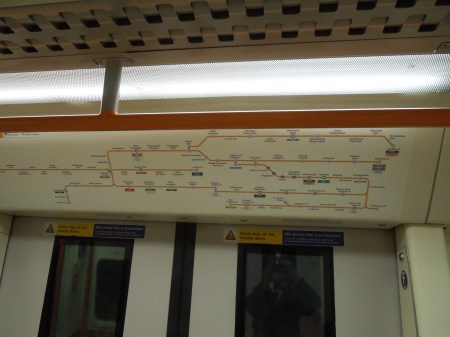
look at this map for the London Overground.
TfL’s Big Problem For 2015
When the Lea Valley Lines come under the control of TfL in 2015, it’s going to give them a terrible problem about how they incorporate them into the maps.
But that’s only the start, as Crossrail will appear in 2018. But that has already shown on a map.

The picture shows the short-lived Lego version at Kings Cross station, this summer.
they’ve also got the problem of what to call Crossrail, if they do change the name. there has been some talk of calling it the Queen Elizabeth line, by such as Boris Johnson. I suspect, it’ll be called Crossrail or something similar like Across or EastWest line, if Boris doesn’t get his way.
If we called it Across, then Crossrail 2 could be called the Diagnonal line!
Of all the wonderful feats I have performed, I think yesterday I performed the most wonderful. I produced unanimity among 15 men who were all quarrelling about that most ticklish subject — taste
I think Brunel would have loved this problem, judging by this quote from the engineer.
It’s not a problem, I would like to have to solve.
Clapham Junction To Clapham High Street
I got the Overground back from Clapham Junction, rather than struggle from Waterloo, which was suffering from engineering works.
what surprised me, was that the train virtually emptied at Clapham High Street station. I would have thought that a bus would have been quicker on this short journey, especially, as you often wait ten minutes for a train.
But the Overground takes eight minutes and the 345 bus takes twenty four. The man on the Clapham Overground isn’t stupid!
The TfL Journey Planner Knows Best
Yesterday, I went to see Ipswich at Bournemouth, who play within walking distance of Pokesdown station.
That area is served from Waterloo, and if there is a difficult station to get to from Dalston, it is Waterloo. In fact it’s difficult for anybody, who doesn’t start their journey on the Bakerloo line, Jubilee line or some parts of the Northern line. I usually use a bus or buses to get to the station, or bypass it totally and pick up the train from Clapham Junction, after getting there on the Overground.
But, yesterday, I thought, I’d see what the TfL journey Planner recommended.
It recommended taking the Overground from Dalston Junction to Canada Water station, and then using the Jubilee line to get across to Waterloo.
It seemed a bit of a roundabout way, but it does appear to be quickest.
Whilst waiting for my Overground train, I told a driver, waiting for his train to arrive, what the Journey Planner had recommended.
He was as surprised as I was!
One of the other things about the Overground/Jubilee route, is that it is step-free, at all stations.
Dalston Junction As An Interchange On The London Overground
Last night, I came back to Dalston Junction from Highbury and Islington, on an Overground train with a friend, who was going on to Anerley in the Deep South.
They needed a West Croydon train and were going to pick one up at Canada Water later on.
I’ve remarked about interchanges on the London Overground before in this post, but I’ve never investigated Dalson Junction, as I usually get on the Overground there, rather than chsnge trains.
I hadn’t realised that to get on a West Croydon train at Dalston Junction, you always go to Platform 3, which is alongside Platform 4, where the trains from Highbury and Islington arrive.
So it has been laid out to make things easy.
Trains going south, start at the following places.
West Croydon – Platform 3 at Dalston Junction
Crystal Palace – Platform 1 at Highbury and Islington
Clapham Junction – Platform 2 at Highbury and Islington
Roll On Crossrail
Yesterday was a day, when Crossrail would have been more than handy.
I went to Exeter to see an old friend and his wife and had booked myself out of Paddington on the 09:07 train.
From Hackney, getting to Paddington is not easy and I usually take the Metropolitan line to the western end of the station and walk in to the trains from the bridge. Since the new Underground station has been built, this is the easiest way to get a train for Wales and West.
Paddington station for me also presents a gluten-free breakfast problem, in that there is nowhere I would trust in the station. So I took a bus to Kings Cross station, where there is both Leon and Carluccio’s, who both do excellent gluten-free breakfasts. Yesterday, it was Leon’s turn and I left myself thirty seven minutes to get to Paddington, after finishing my egg, chorizo and beans.
But that was my downfall, as there was signalling problems on the Metropolitan line and the trains were very infrequent and crammed solid.
So I tried a taxi and the queue was hundreds long and there wasn’t a taxi in sight.
In the end I found a bus to take me up to Euston Square station, where after a wait, I got on a train to Paddington.
But I missed the train by about five minutes.
Normally, the journey takes ten minutes from Kings Cross to Paddington, but it had taken me forty-five. The Metropolitan line, which is normally one of the most reliable had let me down.
It’s on journeys like this, that Crossrail will really benefit people like me, who live in the eastern part of the capital.
I should have a choice of buses to various Crossrail stations, or I could even take the Overground to Whitechapel from Dalston Junction station, just up the road from my house.
Crossrail is going to change the east of London dramatically and not just the places, which have a station on the line.
 The Anonymous Widower