Could East Midlands Railway Run A St. Pancras And Leeds Service?
East Midlands Railway’s new Class 810 trains have been designed, so that a pair will fit into one platform at St. Pancras.
If we assume one platform at St. Pancras is used for the Corby and Luton Airport Express services, that leaves three platforms for pairs of Class 810 trains to run expresses to the East Midlands.
This could be as many as twelve pairs of five-car trains per hour.
Where wioll they all terminate in the North?
Leeds station must be the obvious new destination.
- Leeds has the largest population and is the largest commercial and finance centre in Yorkshire and the North-East.
- Leeds would have gained three trains per hour (tph) from London, two tph from Birmingham and four tph from the East Midlands Hub at Nottinham.
- Leeds is getting a brand new metro.
- Leeds is a fully-electrified station, so it could charge the trains before they return to Sheffield, Leicester, Wigston junction and St. Pancras.
- Leeds and Wigston junction is 107.8 miles, which should be within the range of a battery-electric Class 810 train. If it is too far, an extended stop could be taken at Sheffield to top up the batteries.
- Note that Stadler hold the Guinness World Record for the greatest distance covered on one charge at 139 miles. Hitachi Rail, who are partnered with JCB’s battery-maker in Sunderland, should be able to smash that.
The Rail Minister; Lord Peter Hendy went to Leeds University.
Which Route Would The Trains Take Between Sheffield And Leeds?
Consider.
- The fastest trains between Sheffield and Leeds, go via Meadowhall, Barnsley and Wakefield Kirkgate stations.
- Trains take about an hour.
- The current frequency is two tph.
- The distance is 41.1 miles with no electrification.
A frequency of two additional tph between St. Pancras and Leeds would give the following.
- A nice round four tph between Yorkshire’s two most important cities.
- Four fast tph between Meadowhall, Barnsley and Wakefield Kirkgate stations, and Leeds and Sheffield.
- Two direct trains between Meadowhall, Barnsley and Wakefield Kirkgate, and Chesterfield, Derby, Long Eaton, East Midlands Parkway, Loughborough, Leicester and St. Pancras.
It would be complimentary to any Leeds Metro.
Could East Midlands Railways Also Serve Huddersfield?
Consider.
- Huddersfield is 36.4 miles further than Sheffield on the Penistone Line, which is not electrified.
- Wigston junctionand Huddersfield station is 105.3 miles.
- Huddersfield is a Grade I Listed station with two pubs in the middle of the town.
- Huddersfield station is being fully-electrified in connection with the TransPennine Upgrade.
- All trains from Sheffield, that use the Penistone Line terminate in Platform 2 at Huddersfield station.
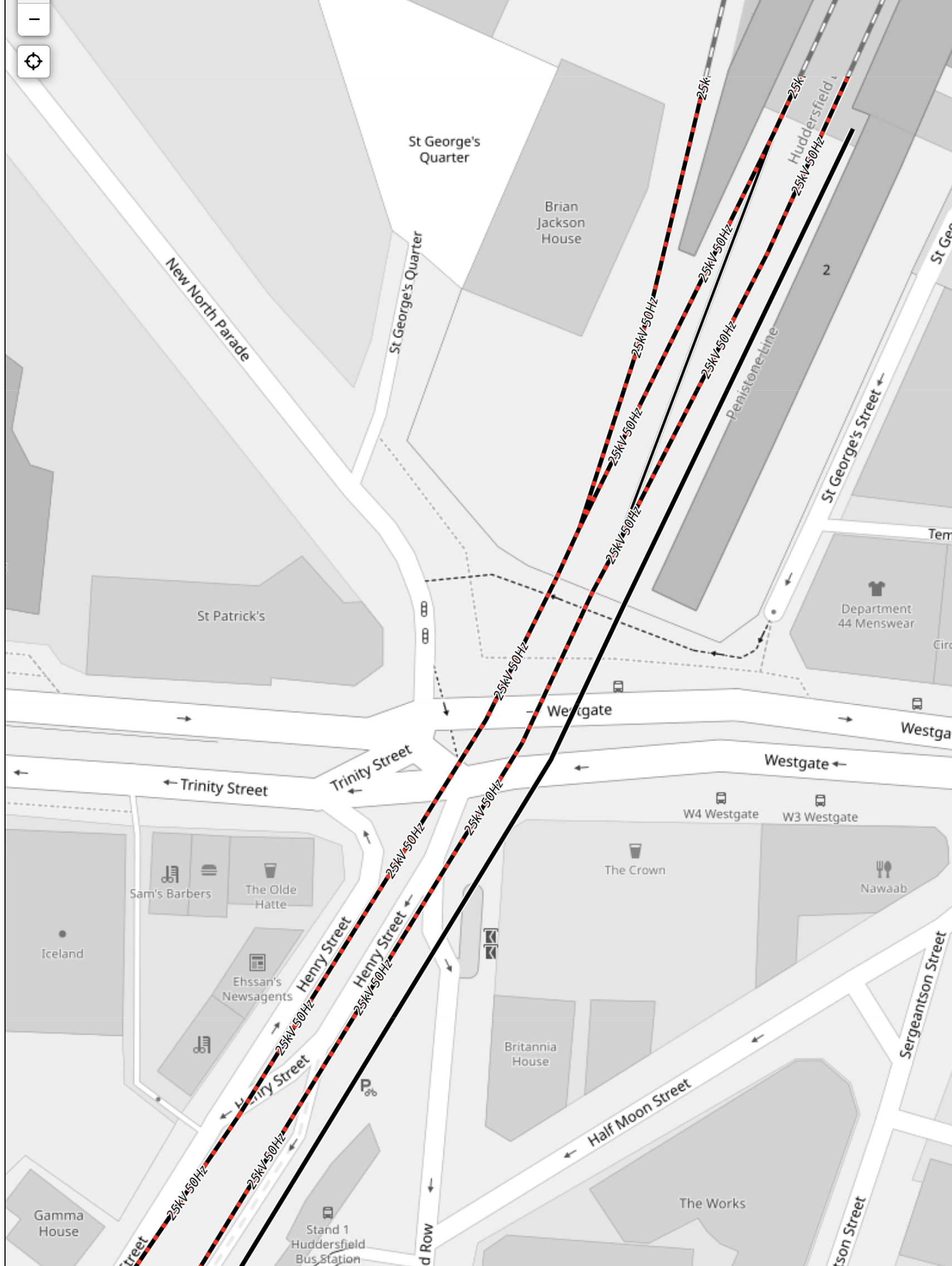
This OpenRailwayMap shows the position of Platform 2 in the station.
Note.
- The red-and-black dotted tracks are being electrified.
- The black tracks are not going to be electrified.
- Platform 2 is marked 2 in the top-right corner of the map.
- Platform 2 looks to be about 90 metres long.
- Five-car Class 810 trains are 120 metres long.
- From the map, it looks like the platform could be lengthened by the required thirty metres.
I suspect that some form of charger can be squeezed into the available space. After all, you don’t often get the chance to put charging into one of the most grand stations in Europe. Power supply would not be a problem, because of the electrification.
A frequency of twotph between St. Pancras and Huddersfield would give the following.
- Two fast tph between Meadowhall, and Barnsley, and Huddersfield and Sheffield.
- Two extra direct trains between Meadowhall and Barnsley, and Chesterfield, Derby, Long Eaton, East Midlands Parkway, Loughborough, Leicester and St. Pancras.
It would connect many stations to the TransPennine Route at Huddersfield station.
What Could The Sheffield and St. Pancras Look Like?
Consider that currently.
- There are two tph.
- Trains stop at Leicester, Loughborough (1tph), East Midlands Parkway (1tph), Long Eaton (1tph), Derby and Chesterfield.
- Trains are five- or seven-cars.
The simplest solution would probably be.
- A pair of five-car trains run all services.
- Trains split and join at Sheffield with one train going to Leeds and one going to Huddersfield.
I estimate that the Class 810 trains will offer about thirty more seats in every hour.
Thoughts On The East Midlands Railway Timetable After Class 810 Trains Enter Service
East Midlands Railway will soon be replacing their diesel Class 222 trains with new bi-mode Class 810 trains.
- 32 trains will be replaced by 33 trains.
- 167 cars will be replaced by 165 cars.
- The current trains come in four, five and seven cars.
- The new trains come in five-cars only.
- The platforms at St. Pancras station can accept a pair of the new trains.
- Both Class 222 and Class 810 trains are genuine 125 mph trains.
- St. Pancras and Corby takes one hour and fifteen minutes
- St. Pancras and Nottingham takes hour and forty-five minutes
- St. Pancras and Sheffield takes two hours
The current services are as follows.
- St. Pancras and Corby via Luton Airport Parkway, Luton, Bedford, Wellingborough and Kettering
- St. Pancras and Nottingham via Kettering, Market Harborough, Leicester, Loughborough (1 tph), East Midlands Parkway (1 tph) and Beeston (1 tph).
- St. Pancras and Sheffield via Leicester, Loughborough (1 tph), East Midlands Parkway (1 tph), Long Eaton (1 tph), Derby and Chesterfield.
Note.
All services are two trains per hour (tph)
If all services were run by single trains, the following number of trains would be needed for each service.
- St. Pancras and Corby – 6 trains
- St. Pancras and Nottingham – 8 trains
- St. Pancras and Sheffield – 9 trains
Note.
- This means a total of twenty-three trains.
- I am assuming, that trains can turn round in fifteen minutes at each end of the journey.
- If pairs of trains run, then the numbers can be doubled to forty-six trains.
These are my thoughts.
Do The Luton Airport Express Services Need Pairs Of Trains?
The Corby service is now branded as the Luton Airport Express.
This picture shows a packed Luton Airport Express at Luton Airport Parkway station.

After seeing this, I believe that a pair of trains must run to Corby to pick up passengers, who want a fast service to and from Luton Airport.
Will The Class 810 Trains Replace The Class 360 Trains To Corby?
If all services are run by single Class 810 trains, the following would apply.
- The current service pattern would need 23 trains.
- All stations would get the same number of trains to and from St. Pancras.
- All East Midlands Railway out of St. Pancras would use the same 125 mph electric trains and services could probably be speeded up.
- The Class 810 train has 2.94 MW on diesel and the Class 360 train has 1.55 MW on electric, so I suspect that the Class 810 train has the faster acceleration.
- Bedford, Kettering, Luton, Luton Airport Parkway, Market Harborough and Wellingborough would have 125 mph electric commuter services to and from London.
- Corby and Luton Airport Parkway services would have marginally more seats, if Corby services were pairs of trains.
There would be ten spare trains, if the Class 360 trains were replaced or four spare trains, if pairs of trains ran to Corby.
Would Class 810 Trains Running On Electric Execute Stops Faster?
This document on Rail Engineer gives these figures for total power on electric of Class 802 trains.
- Five-car – 2712 kW
- Nine-car – 4520 kW
Note.
- These figures are based on a Hitachi figure of 226 kW for the power of a traction motor.
- The five-car train has twelve motors and the nine-car has twenty.
- As a five-car train has three powered cars and a nine-car train has five, it looks like each powered car has four traction motors.
- The document also says that the power to weight ratio on electric is thirty percent more than on diesel.
This document on the Hitachi web site provides this schematic of the traction system.

Note that four traction motors are confirmed.
Consider the power of the various trains, that run or will run on the Midland Main Line.
- Four-car Class 180 train has one 559 kW diesel engine per car.
- Four, five and seven-car Class 222 train has one 559 kW diesel engine per car.
- Four-car Class 360 train has 1.55 MW on electric – 387 kW per car.
- Five-car Class 810 train has 2.94 MW on diesel – 588 kW per car.
- Five-car Class 810 train has 2.94 MW on electric – 588 kW per car.
Note.
- The Class 810 train will out-accelerate the Class 360 train as it has at least 40 percent more power on electric.
- The Class 810 train has pantographs on both driving cars.
- The Class 810 train has two powered cars; numbers 2 and 4.
- I have assumed that if the Class 810 train can handle 2.94 MW on both diesel and electric.
- With eight traction motors, they would need to be 367.5 kW.
- The Class 810 train should out-accelerate the Class 180 train and Class 222 train as it has at five percent more power on both diesel and electric.
I think it is also relevant that the order for the Class 810 trains was placed in August 2019 and Hitachi announced their collaboration with Eversholt Rail Group to develop the battery-electric versions of the Class 802 trains only sixteen months later. As the Class 810 appears to be an revolution of the Class 802 train, I suspect that Hitachi were working hard on battery design, as this train’s design evolved.
These are the five cars of the Class 810 train.
- 1 – DPTS – Driver-Pantograph-Trailer-Standard with Generator Unit
- 2 – MS – Motored-Standard with Generator Unit
- 3 – TS – Trailer-Standard with Transformer
- 4 – MC – Motored-Composite with Generator Unit
- 5 – DPTF – Driver-Pantograph-Trailer-First with Generator Unit
Note.
- Generator Unit is a diesel generator.
- Motored means the car has four traction motors.
- Composite means a car with both First and Standard accommodation.
- Cars 1-2, and 4-5, form two power units with two generator units, four traction motors and a pantograph, at each end of the train. Cables would connect them to the transformer in car 3.
It looks a neat solution, which probably has high reliability.
I can envisage the two generator units under cars 2 and 4 could be replaced by battery packs.
- The battery packs would mimic the function of the generator units.
- Noise in cars 2 and 4 would be reduced.
- Carbon emissions would be reduced.
- The battery packs would be charged, when running under the wires or possibly from chargers or short length of overhead wires at terminal stations.
- The battery packs would handle regenerative braking.
- Adding battery packs would allow the trains to jump gaps left in the electrification.
At some point in the future, the other two generator units could be removed or replaced with battery packs, depending on whether full electrification happens on the Midland Main Line.
These meanderings convince me that the Class 810 trains will be able to save time in the stops on the Midland Main Line.
Because of these savings, I can see East Midlands Railway, reorganising stops on the electrified section of the route, as although the stop will add a minute or two, this lost time will be picked up on savings at existing stops and by more 125 mph running.
Could The Nottingham And Sheffield Services Be Combined?
These are the current services to Nottingham and Sheffield.
- St. Pancras and Nottingham via Kettering, Market Harborough, Leicester, Loughborough (1 tph), East Midlands Parkway (1 tph) and Beeston (1 tph).
- St. Pancras and Sheffield via Leicester, Loughborough (1 tph), East Midlands Parkway (1 tph), Long Eaton (1 tph), Derby and Chesterfield.
Note.
- Both services call at Leicester , Loughborough and East Midlands Parkway.
- Some trains call at Luton Airport Parkway, Luton, Bedford, Wellingborough, Kettering and Market Harborough on the section of the Midland Main Line, which is currently being electrified between Kettering and Wigston.
- A lot of money has been spent on the Luton DART and it only has two fast trains from St. Pancras. Four tph would be ideal.
Suppose the Sheffield and Nottingham trains operated like this.
- A pair of Class 810 trains would leave St. Pancras.
- South of Leicester, they would call at one or two stations, as defined in the timetable.
- They would then call at Leicester , Loughborough and East Midlands Parkway.
- At East Midlands Parkway, the two trains would split.
- One train would go to Sheffield and the other would go to Nottingham, stopping as defined in the timetable.
Note.
- Because of the trains superior performance, they would be doing quicker calls at stations, which should allow the existing timetable to be maintained or even improved.
- Hitachi trains can split and join in around two minutes.
- These trains would call at Luton Airport Parkway, to give that station four tph from St. Pancras, Luton and Bedford.
I calculated earlier that a 2 tph Sheffield service would need nine trains. So if it served both Nottingham and Sheffield it would need another nine trains. This would give a total of eighteen trains.
- If the St.Pancras and Corby service were to be run by pairs of Class 810 trains, this would require twelve trains.
- Adding the two services together would require thirty trains. Would three trains be enough for backup and in maintenance?
I suspect splitting and joining at East Midlands Parkway could be beneficial.
Could Four tph Be Run To Nottingham And Sheffield?
Consider.
- Bristol, Cardiff, Edinburgh, Leeds, Liverpool, Manchester, Newcastle, Norwich, Southampton and York all get two tph from London.
- Some closer stations like Birmingham, Cambridge, Ipswich, Leicester, Oxford and Reading get more.
- Most of these routes are electrified and run modern trains.
I wouldn’t say never, but adding two tph to both Nottingham and Sheffield services would require.
- Two more hourly train paths on both between St. Pancras and Nottingham, and St. Pancras and Sheffield.
- Eighteen extra trains.
But as a sub-two hour service would be running on both routes, it would probably be possible to accurately predict, when more trains were needed.
Electrification Through Leicester
As more electrification is added, this should result in faster journeys, that reduce carbon emissions.
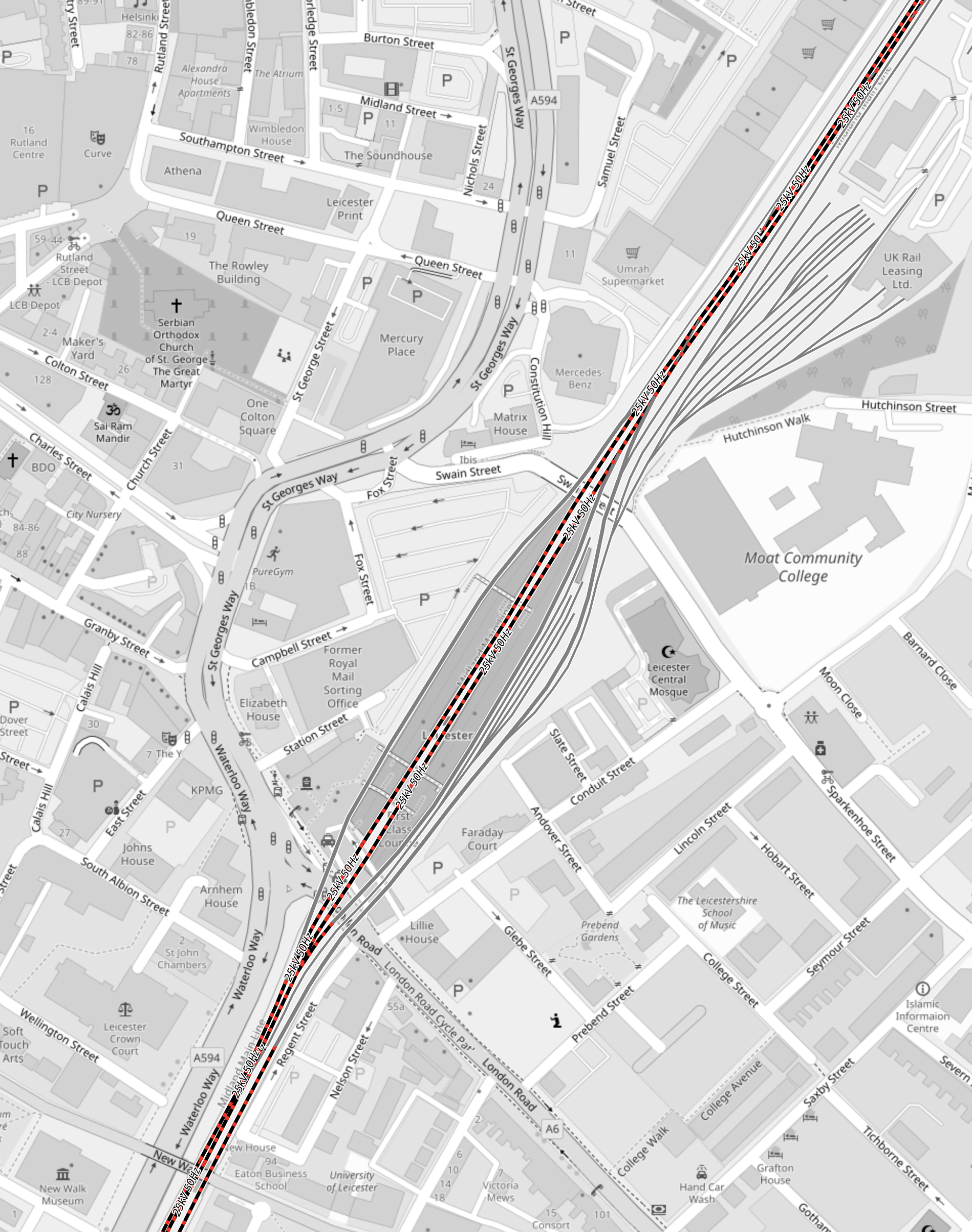
OpenRailwayMap is now showing the electrification as dotted lines on the Midland Main Line.
This map shows the electrification scheme through Leicester.
Note.
- Only the two main lines in the centre of the station seem to be going to be electrified.
- These lines are used by East Midlands Railway’s through trains and surprisingly some freight trains.
- Terminating services from places like Birmingham, Grimsby and Lincoln seem to stop in the outer platforms.
This picture shows the platforms from the Northern footbridge.

This picture shows the platforms from the Northern footbridge.
At the Southern end of the station, the tracks go under the London Road bridge. This map shows the tracks there.

Note.
- The two main tracks of the Midland Main Line appear that they will be electrified.
- But the lines at each side are not electrified.
Some years ago I came back to London from Leicester with a group of drivers. At one point, the conversation turned to electrification and they said that they had met a Network Rail engineer, who had told them, that the bridge was rather low for electrification and the track couldn’t be lowered because Leicester’s main sewer was underneath the railway.
It looks like Network Rail have found a way to squeeze two electrified tracks through the middle of the bridge and then use diesel, battery or other self-powered trains on lines without electrification on either side.
East-West Rail: Bedford’s Mayoral Candidates Split On Rail Project
The title of this post, is the same as that of this article on the BBC.
This is the first sentence.
Part of the route of the controversial East-West Rail project will not be decided before we know the winner of Bedford’s mayoral elections.
Unfortunately, the four candidates for Mayor all seem to have different ideas for East-West Railway through the town.
I have a few thoughts and observations.
Thameslink
Thameslink has the following connections to the East West Railway.
- Four tph at Bedford.
- Three tph at Cambridge.
Note.
- tph is trains per hour.
- All Bedford trains terminate at Bedford.
- The half-hourly Luton Airport Express between London St. Pancras and Corby stops at Luton Airport Parkway, Luton, Bedford, Wellingborough and Kettering.
- Cambridge trains may extend to Cambridge North station.
- Cambridge has additional through services between London King’s Cross and Ely and/or King’s Lynn.
Both Bedford and Cambridge will be busy stations.
Extra Tracks At Bedford
Bedford station has four tracks; two which are generally used by Thameslink services and two main lines used by through trains.
- The fast lines must accommodate the following trains.
- East Midlands Railway – 6 tph in both directions. Two tph stop in Bedford station.
- Freight Trains – 2 tph in both directions.
- East West Railway – 2 tph in both directions. All trains will stop in Bedford station.
It strikes me, that the station may need at least one and possibly two extra tracks.
If there are extra tracks, there will need to be some demolition of houses.
Freight Trains
In Roaming Around East Anglia – Newmarket Station, I wrote this about the plans of the East West Rail Consortium in the area.
In this document on the East-West Rail Consortium web site, this is said.
Note that doubling of Warren Hill Tunnel at Newmarket and
redoubling between Coldham Lane Junction and Chippenham Junction is included
in the infrastructure requirements. It is assumed that most freight would operate
via Newmarket, with a new north chord at Coldham Lane Junction, rather than
pursuing further doubling of the route via Soham.
So would it be possible to create a double-track railway through Newmarket station?
In the related post, I came to this conclusion.
Newmarket can benefit from East West Rail, but the two parties must agree objectives that don’t cause problems for the other.
But I do think, that Newmarket will not welcome the building of a double-track railway through the town.
I do wonder, if the East West Rail Consortium plan to run freight trains between Felixstowe and South Wales and the West of England through Bedford and Oxford.
Four freight tph, through Bedford would certainly need extra tracks and the demolition of houses in the centre of Bedford.
Electrification
Two of the candidates for Bedford’s mayor, think that the line needs to be electrified.
As the route is full or partially-electrified at Didcot, Bletchley, Bedford and Cambridge, I believe that battery-electric trains could handle the route.
But then there are no plans to purchase any passenger trains of this type.
Freight trains would still need to be diesel hauled, unless more progress is made fairly quickly in the development of hydrogen-powered freight locomotives.
The Cambridge Effect
Cambridge is one of the most important cities in the world, because of its strength in innovation in high technology industries.
But Cambridge is bursting at the seams and needs more space for laboratories, advanced manufacturing and housing.
A fully-developed double-track and electrified East West Railway would open up Bletchley, Milton Keynes, Bedford, Newmarket, Bury St. Edmunds and Ipswich to act as satellites to help Cambridge build a shared and successful future.
The Felixstowe Effect
If Cambridge will stimulate the growth of passenger traffic, then Felixstowe will promote the growth of East-West freight traffic.
Conclusion
It may not be initially built that way, but probably by 2040, the East West Railway will be a fully-electrified double-track railway between Didcot and Felixstowe.
Extra tracks will also be needed through Bedford. This will mean demolition of houses.
 The Anonymous Widower