Walking Manchester Metrolink’s Second City Crossing
I took these pictures when I walked the route of Manchester Metrolink‘s Second City Crossing (2CC).
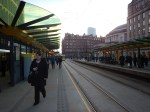

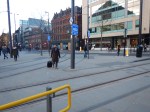



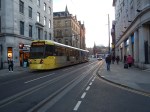
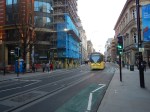


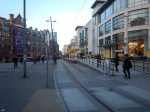
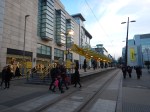
I think it could be more interesting than just a second route across the City Centre for the trams.
This Google Map shows the train and tram lines through Deansgate station and Deansgate-Castlefield tram-stop,
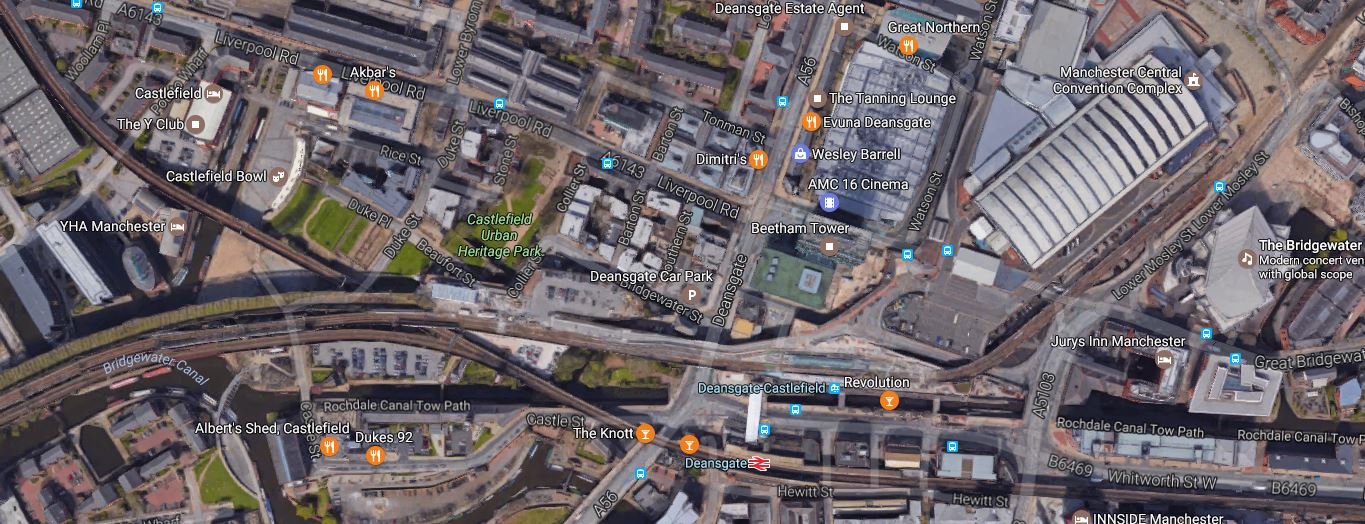
Note.
- St. Peter’s Square tram-stop, which is the Western end of the 2CC, is the next one to the East from Deansgate-Castlefield.
- The rail and tram lines run close together to the West of Deansgate station.
- The rail line runs to Trafford Park, Warrington Central and then on to Liverpool.
This Google Map shows the train and tram lines to the immediate East of Manchester Victoria station.
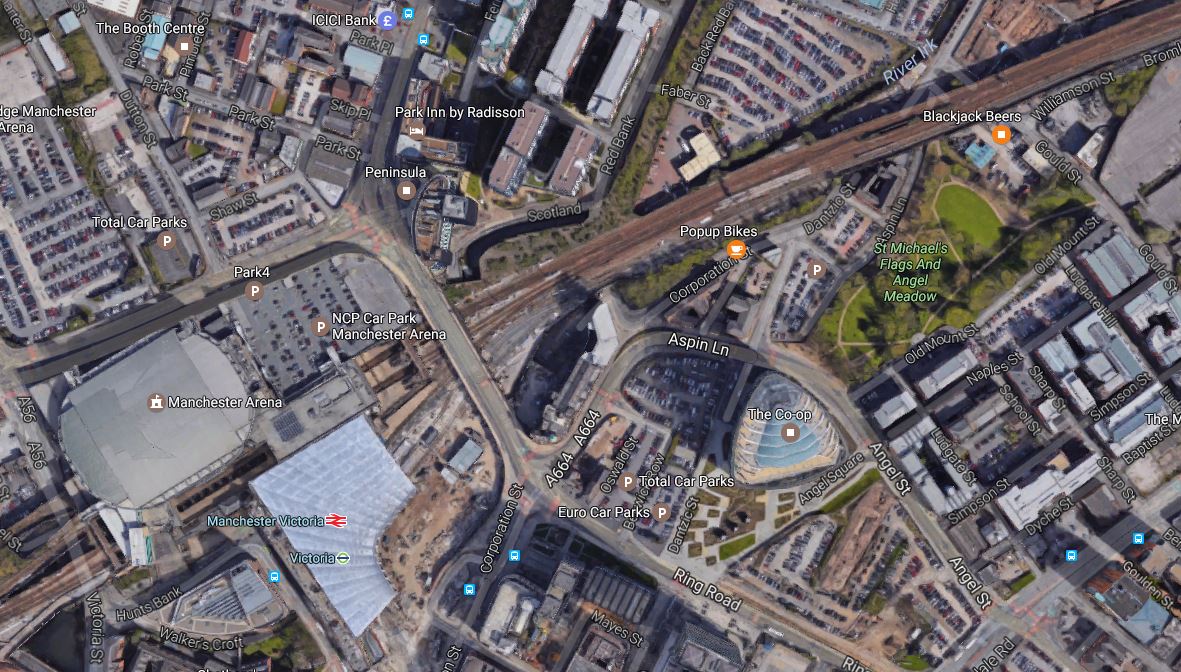
Note.
- Victoria station is the Eastern end of the 2CC.
- The rail and tram lines run close together to the East of Victoria station.
- The rail lines run to Rochdale, Burnley, Hebden Bridge and Ashton-under-Lyme.
I can’t believe that the 2CC wasn’t designed without thinking about incorporating it as part of a tram-train route across the City.
Consider the Class 399 tram-train being trialled in Sheffield.
- It can work as a standard tram on a tram network, running under tram rules.
- It can work as 62 mph train on an electrified rail line.
- It can run on both 25 KVAC and 1500 VDC overhead electrification.
- On rail lines it can share with any train, like for instance a Class 319 pr Class 185 train.
It would probably need to be a version tailored to Manchester’s tram standards, but once the Manchester to Liverpool Line via Warrington and the Calder Valley Line are electrified, a Class 399 tram-train could work the following route.
- Starting from Liverpool Lime Street it would run as a train until just before Deansgate station.
- It would then switch to the tram lines and take the 2CC to Manchester Victoria station, running as a tram.
- To the East of Victoria station, the tram-train would switch to the Calder Valley Line and run as a tram, perhaps to Burnley or Hebdeb Bridge.
You have to remember that tram-trains are a bit like 4x4s and if there is a route on which they can run, then they can take it given that track, electrification and signalling are in place.
There would be no reason, why once at Burnley say, the tram-train could not go walkabout around the town.
Conclusion
On a quick look, it would appear that the Second City Crossing (2CC) has been built so that tram-trains across the city centre have not been ruled out.
Two Tram Routes Start Construction In A Week
On The 14th of January I wrote Work Start’s On Extending Manchester Metrolink To The Trafford Centre, about a new line on the Manchester Metrolink.
Today, this article on Global Rail News, which is entitled Midland Metro begins prepping route of extension to Brierley Hill, has been published.
So it would appear, that what’s good for Manchester, is also good for Birmingham.
Admittedly, all Birmingham is doing at the moment is clearing the South Staffordshire Line of vegetation to assess the route, prior to the start of construction in 2019 for opening in 2023, which is probably a couple of years behind the Trafford Line.
Work Starts On Extending Manchester Metrolink To The Trafford Centre
This article on the BBC gives some more details.
The Manchester Metrolink seems to be expanding fast and the Trafford Park Line would appear to be planned to be open by 2020. The BBC says this.
The line is expected to open in 2020, increasing the size of the Metrolink network to more than 106.5km (66 miles).
The Trafford Park line will call at six new tram stops – Wharfside, Imperial War Museum, Village, Parkway, EventCity and the Trafford Centre.
There is no word about continuing the expansion to Port Salford. But then there’s no news about sorting out the bridge over the Irwell, that the contractors dropped.
Will Platforms 15 And 16 At Manchester Piccadilly Ever Be Built?
I ask this question, as I have read this article on the Manchester Evening News, which is entitled Doubts cast over plans for two new platforms at Manchester Piccadilly train station.
This is said.
A shadow of doubt is looming over plans to expand Manchester Piccadilly after Network Rail’s boss admitted they are looking at the ‘cost-benefit ratio’.
The words of Mark Carne, chief executive at Network Rail, will raise fears of delay – or even cancellation – of the building of platforms 15 and 16.
For myself, I dread when I see my train is leaving or arriving at the current Platforms 13 or 14 at Manchester Piccadilly station.
The architect who designed this mess was a total idiot.
- Access is terrible.
- There needs to be escalator and lift access between the platforms and the street below.
- The platform is not wide enough for safety.
I just wonder if there could be an interim solution to Platforms 15 and 16 at Manchester Piccadilly.
- Rebuild Platforms 13 and 14 to a modern safe standard.
- Provide a second access route to the platforms from the main station.
- Provide direct access to the platforms from the street.
- Provide direct escalator access to the trams.
- Future-proof Platforms 13 and 14 for decent access from the proposed HS2 platforms.
Obviously, a design would be used, that can be expanded to add Platforms 15 and 16.
To be fair, since the platforms were built in 1960, station and railway design has moved on.
In London, we have Thameslink, that will handle 24 main line trains per hour (tph) at four stations in Central London. Soon, Thameslink will be joined by Crossrail, which will handle the same frequency of trains on an East-West axis across London.
I’ve stood on that crowded island platform at Manchester Piccadilly, many times and certainly the frequency of trains is nowhere near 24 tph and perhaps just half that figure.
If they can do it on Thameslink and Crossrail, then surely they can do it on Platforms 13 and 14 at Manchester Piccadilly.
To accommodate, an increased number of trains would require.
- Rebuilding of Platforms 13 and 14 to a modern standard with better access to the main station, the street and the Metrolink.
- Updating of Oxford Road and Deansgate stations to safely handle the increased number of trains and passengers.
- Installation of Automatic Train Control (ATO) as on Thameslink and Crossrail, through Piccadilly, Oxford Road and Deansgate.
Get it right and it could bring more than just the obvious benefits of more capacity, less cost, earlier implementation and future-proofing.
Could Platforms 13 And 14 Become A Separate Station?
I ask this question, as Platforms 13 and 14 have a similar relationship to the main Piccadilly station, as Waterloo East station has to Waterloo station.
Waterloo East station is certainly nor perfect, but after the installation of the balcony at Waterloo and a better bridge between the two stations, it is getting there.
In my view Waterloo East still needs.
- Direct access to and from street level.
- Better access to Waterloo tube station.
Perhaps it could all be funded by sympathetic development on top of a new station.
I can’t see why a similar approach couldn’t be taken at Platform 13 and 14 at Manchester Piccadilly.
The new station would have.
- Walk-in access from the street.
- Easy access from the Metrolink.
- A ticket hall.
- Step-free access to the platforms.
- Appropriate oversite development,like perhaps a hotel, offices and housing.
I shall call it Manchester Piccadilly South in the rest of this post.
I think that making the station separate could be the best way to go. Especially, if the developer of the oversite development could be persuaded to contribute to the station.
A Station For Manchester Airport
Most of the current nine trains per hour ( tph) to and from Manchester Airport use Platforms 13 and 14.
So if a Manchester Piccadilly South station is created, this would make it easier for travellers using the train to get to the airport.
It would also be more convenient if all Manchester Airport services called at these platforms.
Through Trains Only
Some trains appear to start from Platform 13B at Manchester Piccadilly..
If services were reorganised, surely this will stop, as you don’t use through platforms to terminate services.
Could The Development Of Platforms 13 and 14 Be Done Without Halting Train Services?
I suspect, that Network Rail’s contractors have a lot of experience of rebuilding platforms like these, whilst keeping the trains running.
Conclusion
I can certainly understand Network Rail’s thinking on perhaps cancelling Platforms 15 and 16.
Manchester Metrolink Will Be Going To The Trafford Centre
According to this article on Global Rail News, the Manchester Metrolink has been given permission and funding to build the Trafford Park Line.
This is a map of the line.
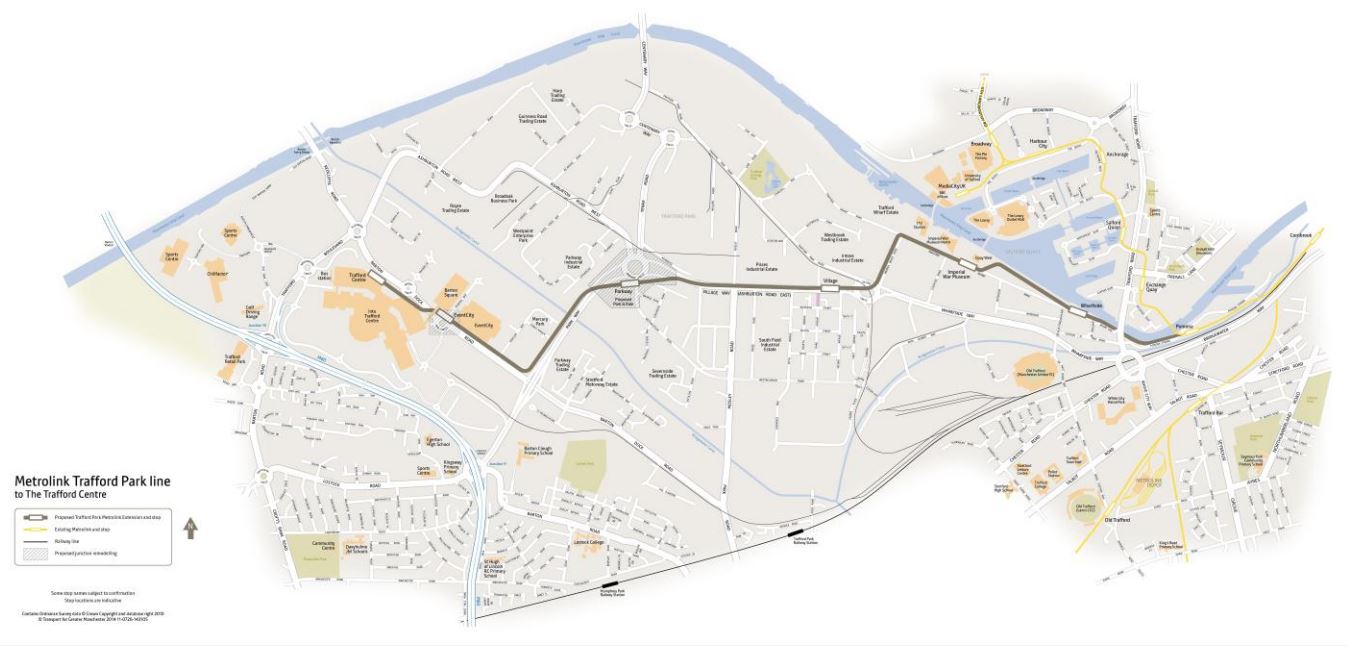
Trafford Park Line
It calls at these stops.
Pomona
This Google Map shows Pomona tram stop.
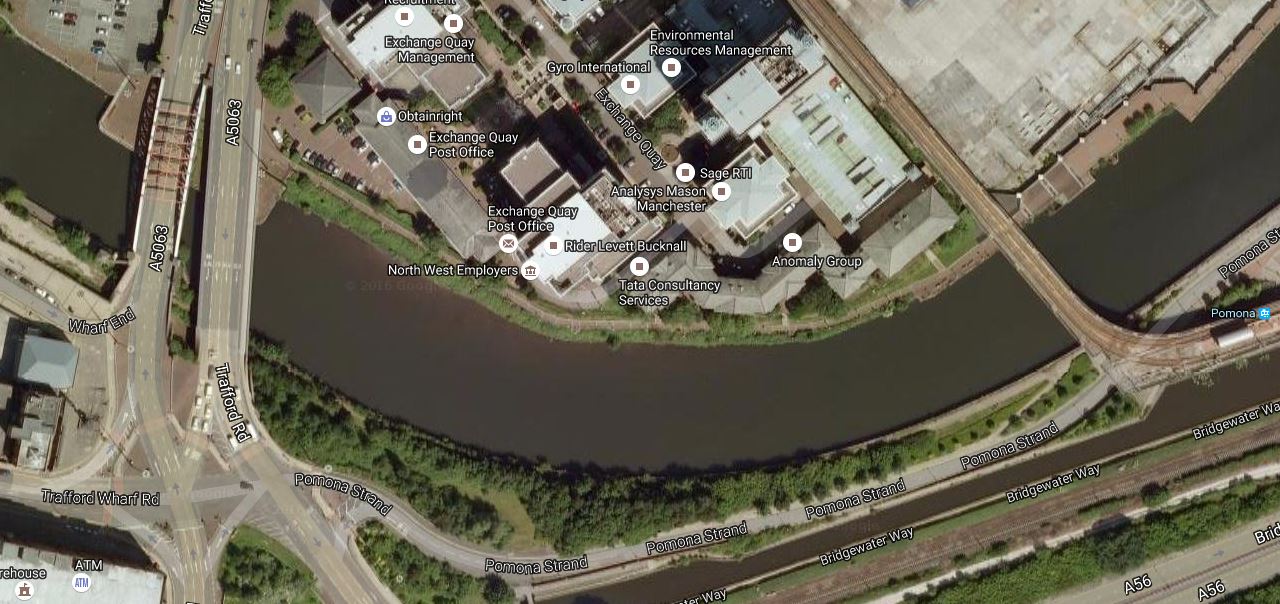
Pmona Tram Stop
The stop is at the far right and the rightmost bridge carries the tram over the water.
This second Google Map shows Note how the stop has been built to allow a junction with the Trafford Park Line.
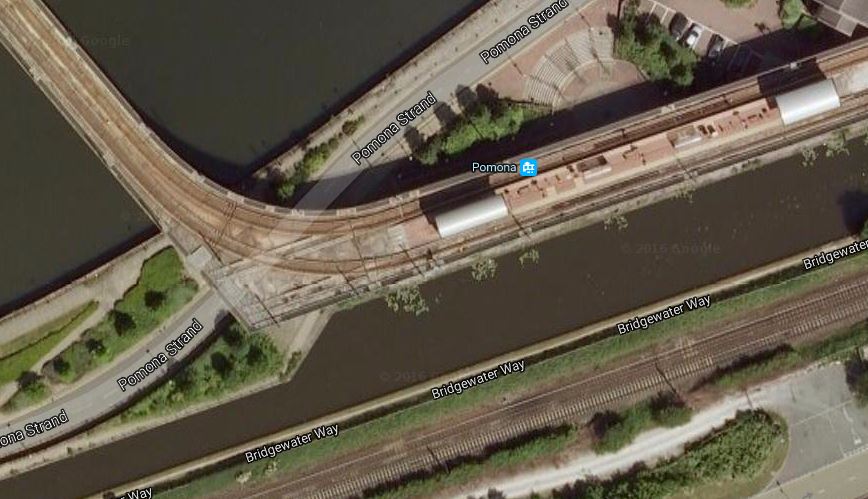
Pomona Tram Stop In Detail
The Trafford Park Line appears to continue along the edge of the water.
Wharfside
This Google Map shopws the location of the Wharfside tram stop close to Old Trafford.
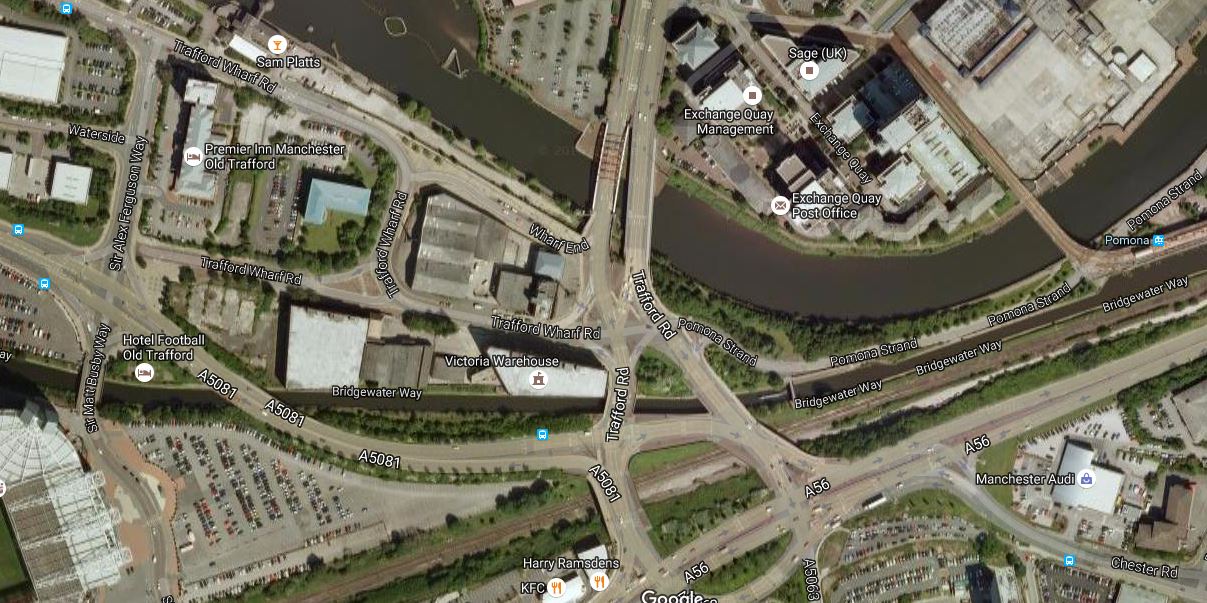
Wharfside Tram Stop
It is on Trafford Park Road, probably between the water and the Premier Inn.
Note Old Trafford in the bottom-left corner.
Imperial War Museum
ThisGoogle Map shows the route between Wharfside and the Imperial War Museum tram stop.
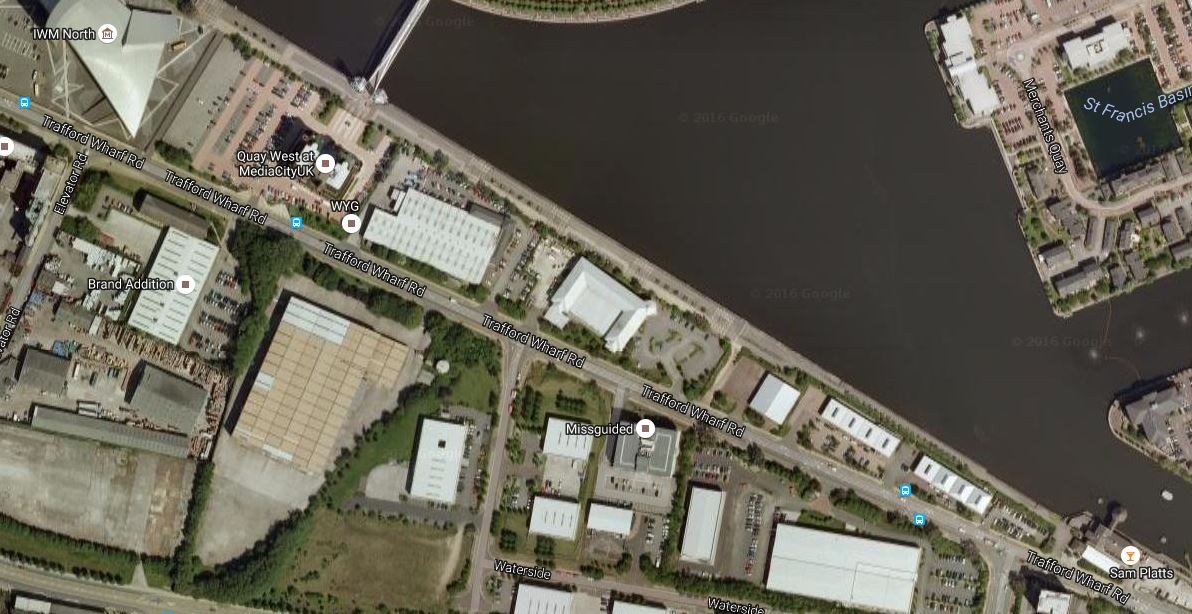
Imperial War Museum Tram Stop
The stop appears to be on Trafford Park Road, by the footbridge at the top of the map..
Village
This Google Map shows the route between the Imperial War Museum and the Village tram stop.
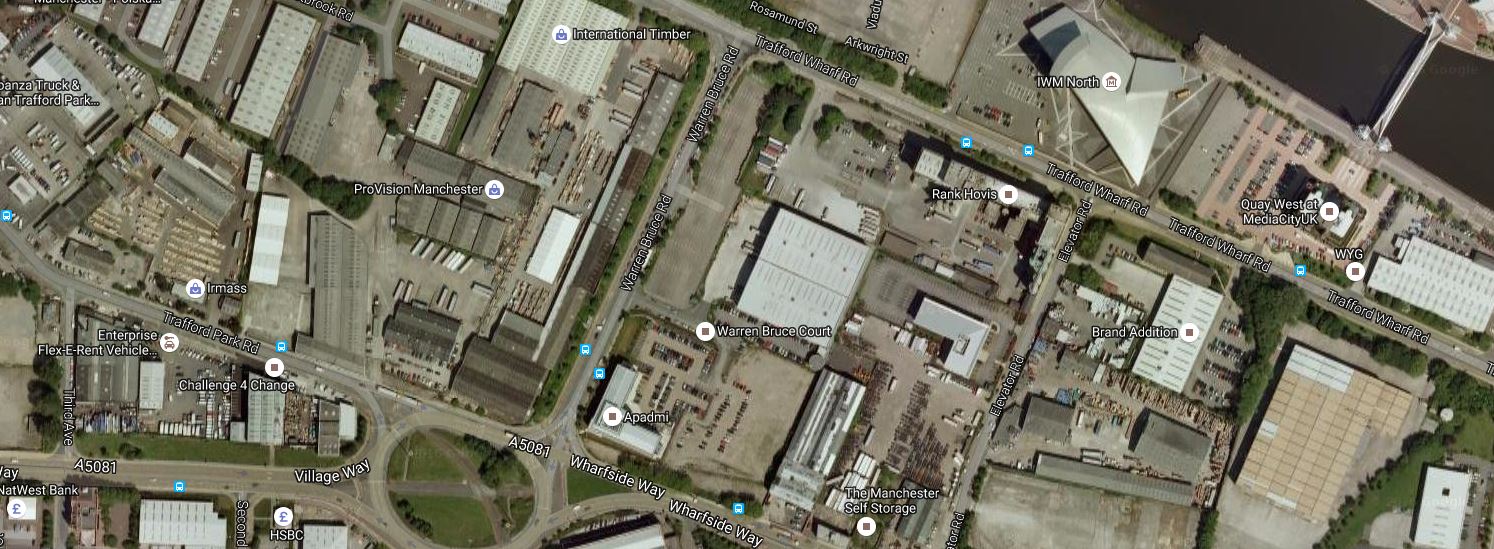
Village Tram Stop
The Imperial War Museum is at the top of the map and the Village tram stop will be on the road leading .West from the rpundabout at the bottom.
Parkway
This Google Map shows the route between Village and the Parkway tram stop.
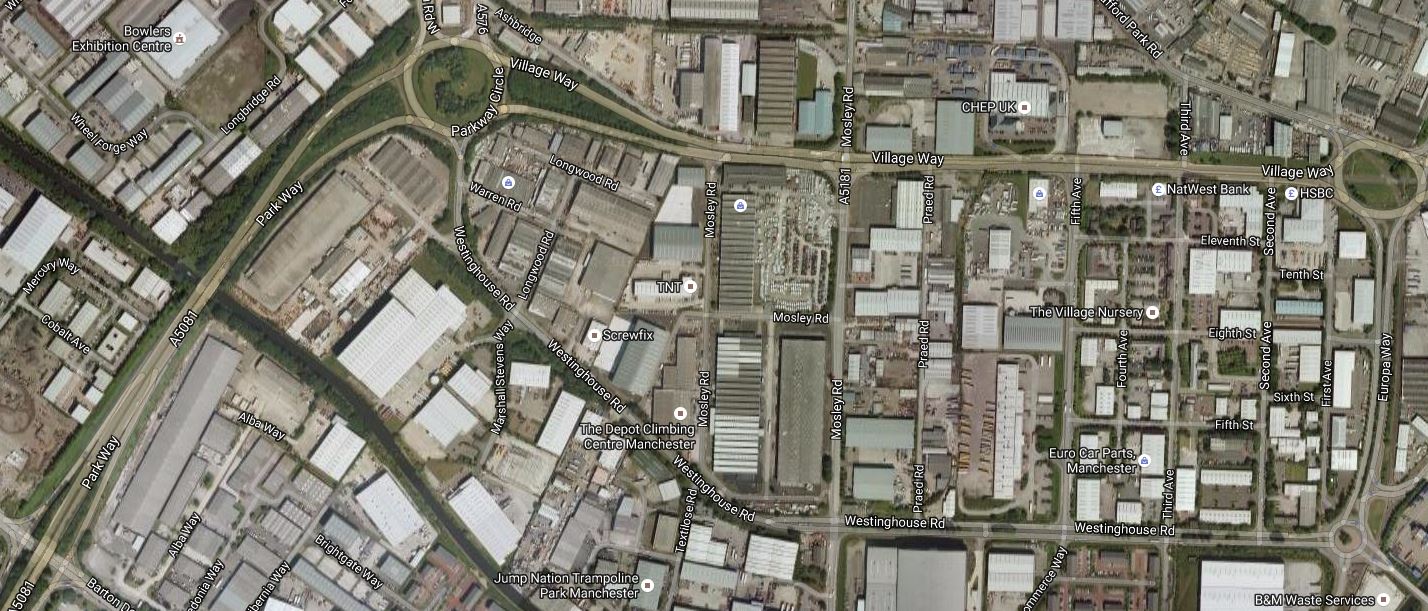
Parkway Tram Stop
The Parkway stop is in towards the Southern side of Parkway Circle, which is the circle at the top towards the left.
Village tram stop is to the West of the other circle and the tram line goes along Village Way to Parkway Circle before going South West.
A Park-and-Ride could be built at this stop.
EventCity
This Google Map shows the route from Parkway to the Trafford Centre.
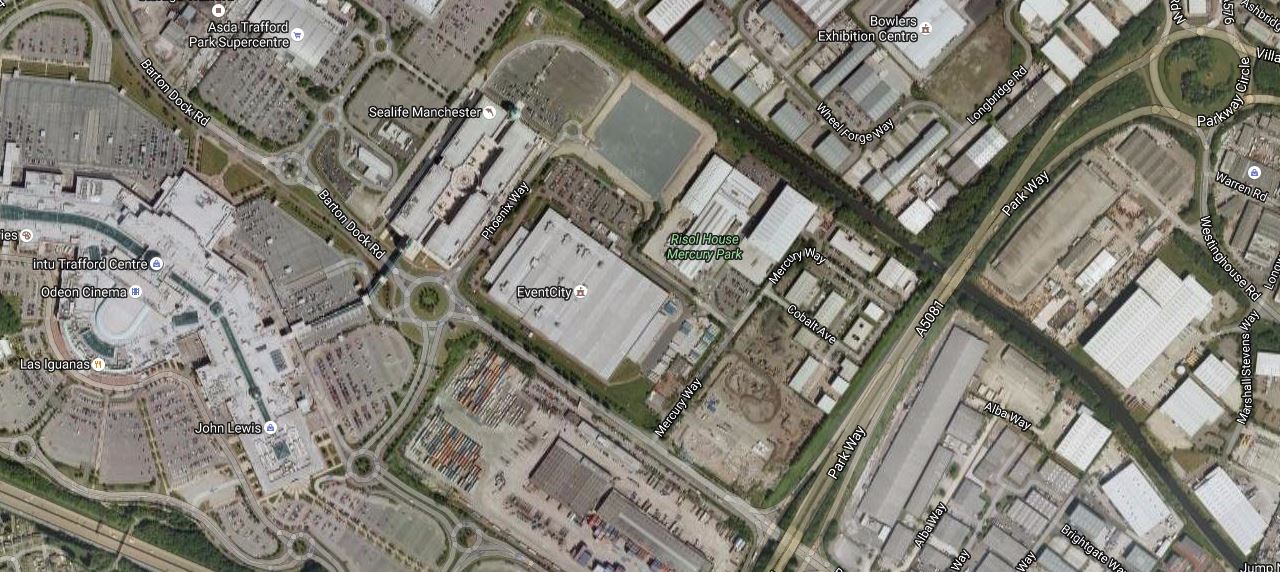
From Parkway To The Trafford Centre
The EventCity tram stop is I suspect by EventCity, which is the big building in the centre of the map.
Trafford Centre
Finally, according to current plans the tram goes on to the Trafford Centre stop.
On To Trafford Waters
This article in the Manchester Evening News is entitled Huge £1bn Trafford Waters development on banks of Manchester Ship Canal given go-ahead.
This Google Map includes Trafford Waters, which is between the Trafford Centre and Manchester Ship Canal.

Trafford Waters
According to Wikipedia there will be a Trafford quays tram stop, to serve the new development.
Finally To Salford Reds And Port Salford
These two final tram stops; Salford Reds and Port Salford are named on Wikipedia..
This Google Map shows the location of these two stops.
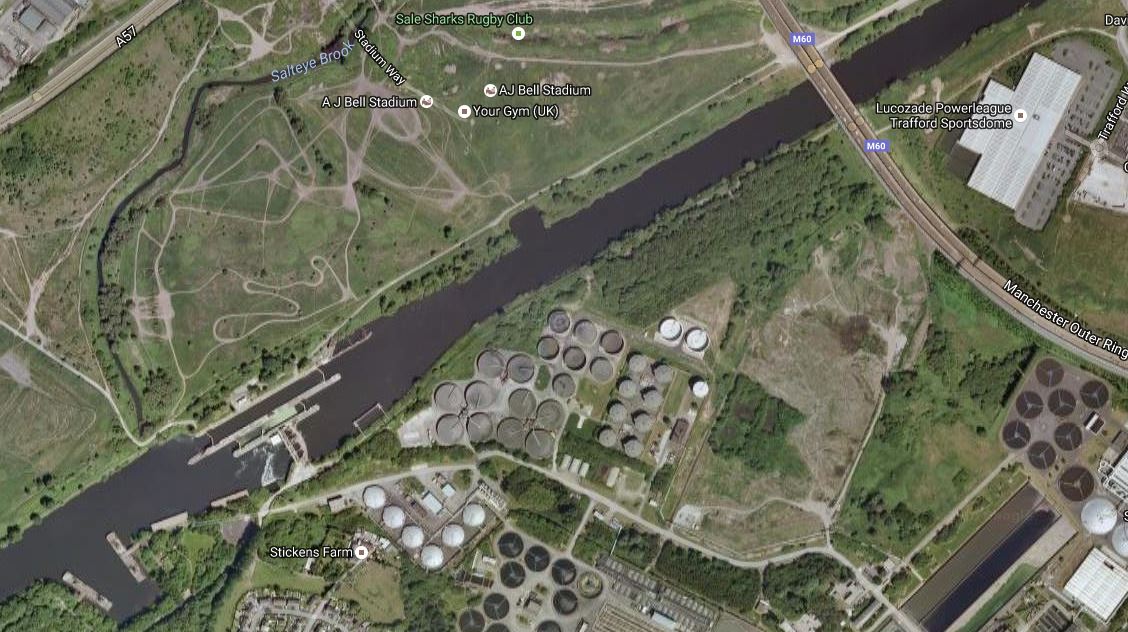
Salford Reds And Port Salford Tram Stops
Salford Reds is on the North Bank of the Manchester Ship Canal, to the West of the M6 Motorway.
Fort Salford is a freight terminal on the banks of the canal.
This is said on the FAQ page of Port Salford web site in answer to the question What are the plans to bring Metrolink to Port Salford?
Transport for Greater Manchester (TfGM) who manage the Metrolink infrastructure, aspire to build a new Metrolink line to the AJ Bell stadium and potentially beyond to Port Salford, via Trafford Park and Trafford Centre. Therefore, the new dual carriageway and lift-bridge have been future proofed to eventually accommodate a Metrolink tram line.
That certainly gives one way for the Trafford Park Line to cross the Manchester Ship Canal.
Western Gateway Infrastructure Scheme
The Western Gateway Infrastructure Scheme is designed to bring better connectivity between Port Salford on the North side of the Manchester Ship Canal and Trafford and Trafford Park on the other side. Wikpedia says this.
As part of the Western Gateway Infrastructure Scheme (WGIS), a new link road was constructed in connection with the Port. The existing A57 road was redirected closer to the Salford City Stadium, and a mile-long new dual carriageway link to Trafford Way and a new lift bridge over the Manchester Ship Canal was constructed to the east of the M60 bridge.
This video shows more.
But all is not going well as this report from the Manchester Evening News shows.
Conclusions
These are my thoughts on what has been published.
- There is a lot of development going on along the Manchester Ship Canal.
- There will probably have to be at least one tram crossing of the Manchester Ship Canal between Trafford Centre and Port Salford.
- The design of the tram route hasn’t be finalised yet and changes can be expected.
I am also surprised that the rail link from the North into Port Salford doesn’t include a rail station.
This would allow travellers from the West to have access to the Trafford Park Line, without going all the way to Manchester Piccadilly.
If you look around the UK and Europe, it is probably important that there is a good interface between the tram network and trains, cars and bicycles.
Manchester Metrolink has some good interchanges to rail, but it needs more.
For completeness this Google Map shows Trafford Park from Port Salford in the West to Pomona in the East.

The waterway curving across the map is the Manchester Ship Canal.
Both Port Salford and Pomona are at the edges of the map.
It’ll be interesting to see how this project develops.
Developments on the Trafford Park Line can now be followed on the line’s own Wikipedia entry.
Exchange Square Metrolink Stop
The new Exchange Square Metrolink stop on the Metrolink Second City Crossing has opened.


Where’s the map at the stop?
I don’t know Manchester City Centre that well, so I need help, without getting my smart phone out.
Tram-Trains In Stockport
In the Proposed Systems section for the United Kingdom in the Wikipedia entry for tram-trains, there is a reference to tram-trains being proposed for Manchester to Marple.
I have also found this report on the Stockport Council web site, which is entitled Stockport Rail Strategy. The strategy has been developed by respected engineers; WSAtkins.
Search the report for tram-train and you get 35 hits, including references to Manchester to Marple.
The report also has this helpful map of tram-train routes in the Stockport area.
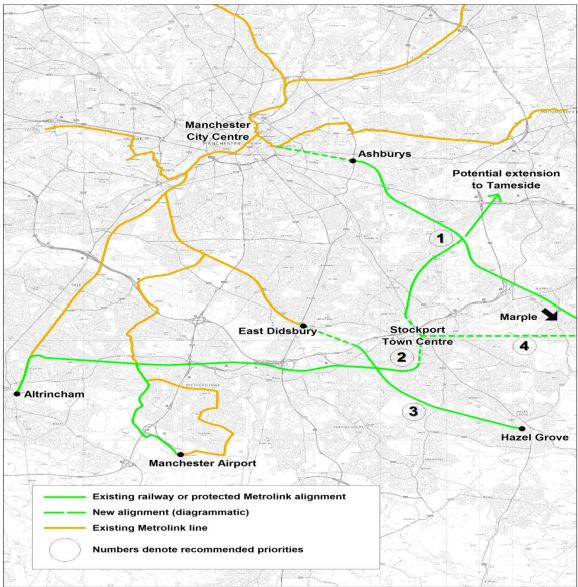
Possible Stockport Tram-Train Routes
I’ll look at some of the routes.
Manchester to Marple
Note that Manchester to Marple is given the highest priority of 1.
In Section 5.5.1 of the report, this is said about the Manchester to Marple route.
Manchester – Marple Metrolink would replace local rail services on the Manchester – Marple via Bredbury line with a more frequent service that would access the heart of Manchester City Centre. A further benefit of the scheme is that it contributes to relieving platform capacity constraints to Manchester Piccadilly, since the scheme would enter Piccadilly via the Metrolink platforms.
It also says it won’t go through Stockport Town Centre.
As the map shows the Manchester to Marple route goes via Ashburys station, which is to the South of the Etihad Stadium.as this Google Map shows.
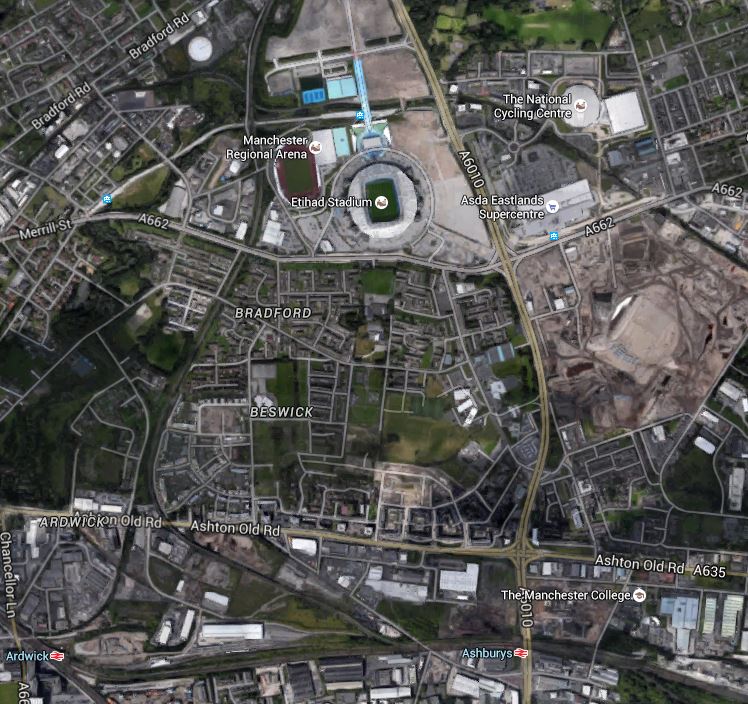
Ashburys And Etihad Stadium
Note Ardwick and Ashburys stations on the line used by trains between Manchester Piccadilly and Rose Hill Msrple Marple stations.
A second Google Map shows the Etihad Campus tram stop, surrounded by various stadia, centres and arenas.

Etihad Campus
Note in both maps there is a rail line that leaves the rail line to the west of Ashburys station and goes north to the west of Etihad Campus.
This is one route that could be used to get tram-trains into the Manchester Metrolink.
In the Wikipedia entry for Ashburys station, this route is also proposed.
Significant new infrastructure works would be required between Piccadilly and Ashburys station, known as ‘Piccadilly Link’. It would be incorporated within a major mixed-use development by Grangefield Estates, known as ‘Chancellor Place’, around the former Mayfield Station site.
It would appear that both routes have their advantages.
But surely, the Etihad route has these specific ones.
- ,It would only need a connection between the rail line and the tram line to Etihad Campus.
- It doesn’t rely on the ever-changing fortunes and minds of large property companies to deliver the infrastructure on the Mayfield Station site.
- The route would not interfere with the addition of the two new platforms proposed for Manchester Piccadilly.
- The trams end up under Piccadilly station from where they could continue to any number of destinations.
- Manchester to Marple services are removed from the crowded Piccadilly station.
- A station or tram stop could be provided to the west of the Etihad Stadium, if that was required.
- Delivery of the scheme would be down mainly to Manchester Metrolink, Network Rail and the various councils, with perhaps some input from the owners of the Etihad Campus.
On a rough analysis, I suspect that going the Etihad route would be more affordable and a lot easier to bring to fruition.
The WSAtlins report also suggests this for tram-trains between Manchester and Marple.
Stockport station could be served by using the Stockport to Stalybridge Line.
- A proposed service would be five trains per hour from Manchester City Centre to both Stockport and Rose Hill Marple.
- There would be a tram-train every six minutes on the busiest part of the route between Reddish North and Manchester.
- Other services between Manchester and Marple would go via Hyde.
Obviously, there are questions to be asked.
- The tram-trains get to Manchester City Centre, but where do they go from there?
- Could we see a tram and tram-train interchange in Piccadilly Gardens, just as I saw in the centre of Kassel and wrote about in The Trams And Tram-Trains Of Kassel?
- Could Manchester’s tram network be used by a Class 399 tram-train, as is being trialled in Sheffield?
I can understand why the Manchester to Marple route was offered as a place to do the tram-train trial!
It strikes me, that if the costs add up, then it would be a good proposal.
Stockport To Tameside
The WSAtlins report says this about a link from Stockport to Tameside.
A further possibility utilising the proposed section of Metrolink route between Stockport and Reddish would be a direct link from Stockport to Tameside, possibly terminating in Ashton Town Centre.
Note the following.
- This would use the Stockport to Stalybridge Line, which currently has only one train a week on a Friday morning.
- The report gives this line a priority of 2.
- Tram-trains to Ashton Town Centre would go via Reddish South, Denton and Guide Bridge.
- There was also a station at Ashton Park Parade to the South of Ashton Town Centre.
- Ashton Town Centre has Ashton-under-Lyne station to the North.
- Ashton-under-Lyne Metrolink station is the terminus of the East Manchester Line and it has five trams per hour to Manchester City Centre.
- Stalybridge station, which is another natural terminus for tram-trains from Stockport, is served by services from Manchester Victoria to Huddersfield and the East.
This Google Map shows Ashton Town Centre.
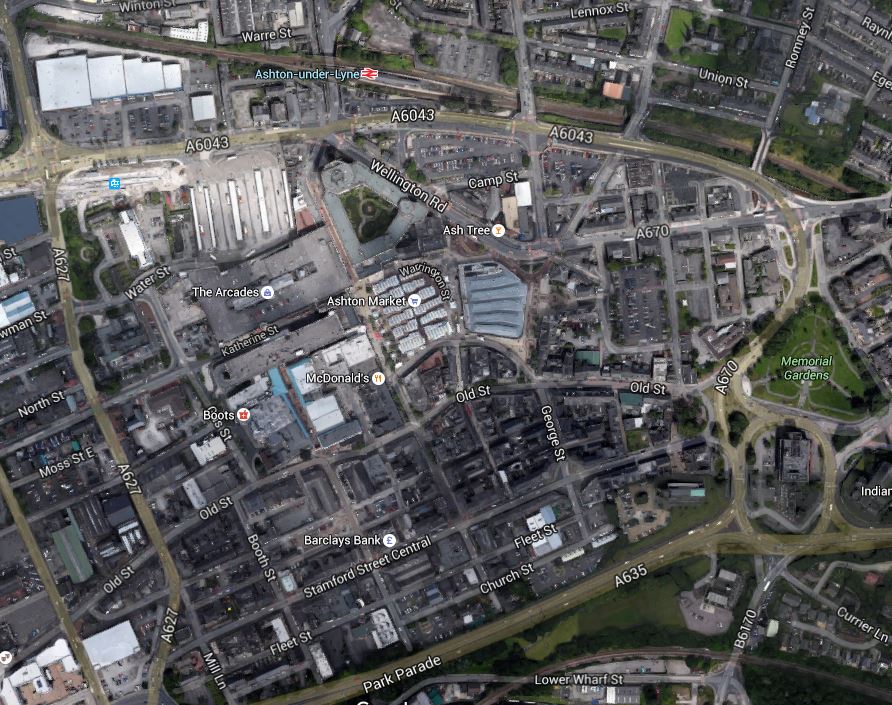
Ashton Town Centre
Note.
- The Stockport to Stalybridge Line at the bottom of the map.
- Park Parade is shown and I suspect Ashton Park Parade was in this area.
- Ashton-under-Lyne station at the top.
- Ashton-under-Lyne Metrolink station is in the top left of the map.
- Ashton-under-Lyne has a five trams per hour service to Manchester City Centre.
In my view, there are lots of possibilities to improve the transport links in Ashton Town Centre.
West of Stockport
The WSAtlins report discusses routes to the west of Stockport.
This group of routes would utilise the Stockport – Altrincham railway line west of Stockport Town Centre, which would be restored to a double-track formation with new stops being added in residential areas.
This Google Map shows Stockport station and Edgeley Junction.
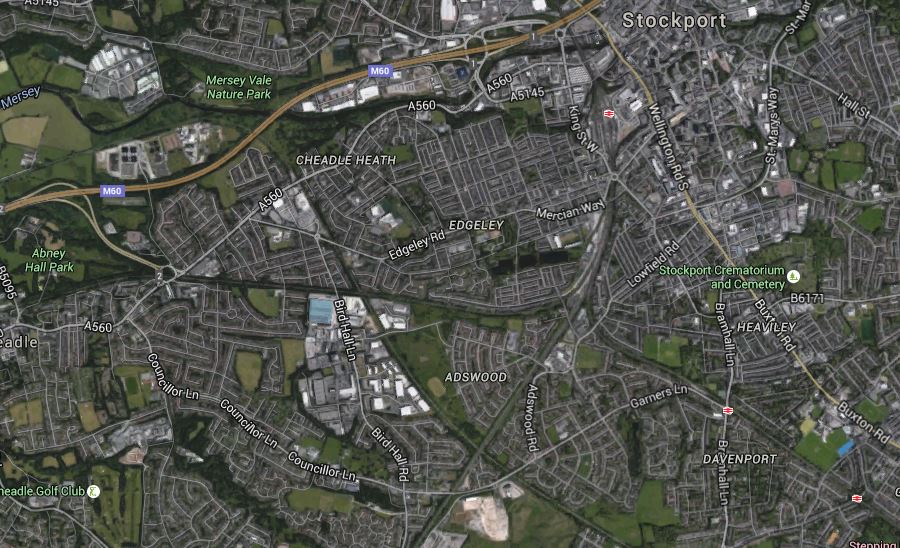
Stockport Station And Edgley Junction
The Mid-Cheshire Line, that goes between Stockport and Altrincham goes off to the west, passing south of Abney Hall Park and the Buxton Line goes to the south east, with stations at Davenport and Woodsmoor being visible.
The report also says this.
A new section of Metrolink route would be created from Stockport Interchange to the start of the Stockport – Altrincham railway line immediately south of Edgeley Junction. That would include a new stop adjacent to Stockport Station, fulfilling a long-held aspiration to provide a direct public transport link between Stockport Station and Stockport Interchange.
This Google Map shows the location of Stockport Interchange with respect to Stockport station.
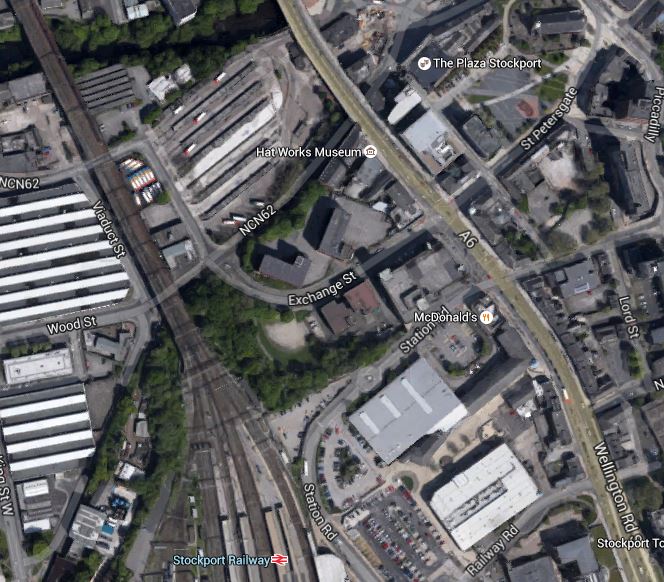
Stockport Bus AndTrain Stations
Stockport Interchange is between the railway and the A6 towards the top and Stockport station is towards the bottom.
I suspect that given the layout of the Town Centre and the various modes of transport to connect, that an innovative solution will be needed.
- Stockport Interchange and Stockport station are about four hundred metres apart.
- Stockport station is on the thirty-three metre high, Grade 2* Listed Stockport Viaduct.
- Tram-trains from Manchester will come and go to the North.
- There could be five tram-trains per hour to each of Ashton and Manchester City Centre.
- Tram-trains from the Mid-Cheshire Line will come and go to the South.
- Was the new Platform 0 built to make the station more suitable for tram-train services?
A good design probably won’t be easy.
One solution would be to cut Platforms 0 and 1 in half, with the Northern ends accepting tram-trains from the North and the Southern ones, those from the South.
The area in between the two halves could be made into a small courtyard with seats, a coffee stall and a kiosk, so passengers arriving from the North would just walk to the court and wait for the appropriate tram-train to the south and vice-versa.
The tram-train platforms would also have level step-free access to Platform 2 for the expresses going South through Stockport.
Stockport to Manchester Airport
The WSAtkins report has a lot to say about the value of this route.
The main driver for the Stockport – Airport route is the expected transformation of Manchester Airport and its surrounding area into a multi-purpose regional economic hub. That will require a step-change in the proportion of trips to/from the area using non-car modes. A high proportion of trips travel to the area is from distances greater than 8km, for which stopping bus services cannot usually provide an attractive alternative to car travel, even with ambitious bus priority measures. TfGM indicated that there are many trips to the Airport that currently originate in or near Stockport.
It also says this about the route.
The route to the Airport would be achieved by a new curve at Baguley linking the Stockport – Altrincham line with the planned Manchester Airport Western Loop Metrolink line. TfGM has indicated that it expects many trips accessing the Manchester Airport area would interchange onto Metrolink from bus and heavy rail in Stockport Town Centre. The route would also facilitate access from its residential catchment to the national rail network at Stockport Station and at the proposed HS2 Station near Manchester Airport.
This Google Map shows the area to the north of Baguley Metrolink station.
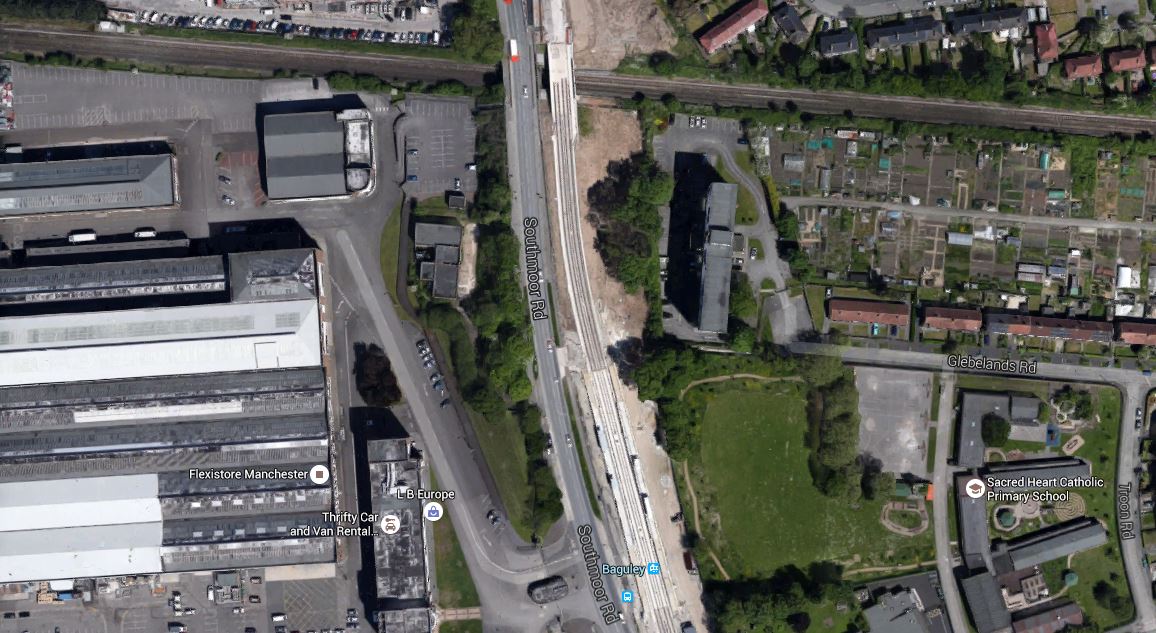
The Baguley Curve
The Stockport to Altrincham Line runs across the top and the scar down the middle is now the Airport Branch of the Manchester Metrolink.
Building a curve shows one of the useful advantages of tram-trains, which can turn tighter than a standard train.
The question has to be asked if tram-trains would run to the airport from both Althincham ans Stockport!
Stockport To Altrincham
The WSAtkins report has this to say about the route.
A Stockport – Altrincham service would connect residential areas on the Stockport – Altrincham corridor with both of their main local centres. The residential areas expected to benefit from new stops include Adswood, Cheadle Heath, Cheadle, and Gatley. The service would also improve the link between Altrincham and Stockport and its onward inter-urban rail connections.
I would assume that as nothing is menbtioned about the terminus at Althincham, this is not considered to have any issues.
Stockport To East Didsbury
Plans for this route have existed since the late 1990s. But following a southern raoute, rather than one along the Mersey could offer cost savings. The WSAtkins report has this to say about the new route.
This southern route from Stockport to East Didsbury would join the Hazel Grove to Sharston freight line via a new junction at Cheadle Heath, and then cross the River Mersey via a new alignment to East Didsbury. This has the potential to provide a new stop at Gorsey Bank, providing sustainable transport access to the proposed new development site. This route would provide Metrolink services to Manchester City Centre from the Edgeley and Adswood areas, and would provide much-improved connections from Stockport to Didsbury, Chorlton and Salford Quays and Trafford Park.
This Google Map shows the routes of the Stockport to Altrincham Line, the freight line from Hazel Grove to Sharston, the M60 Motporway and the River Mersey in the west of Stockport.
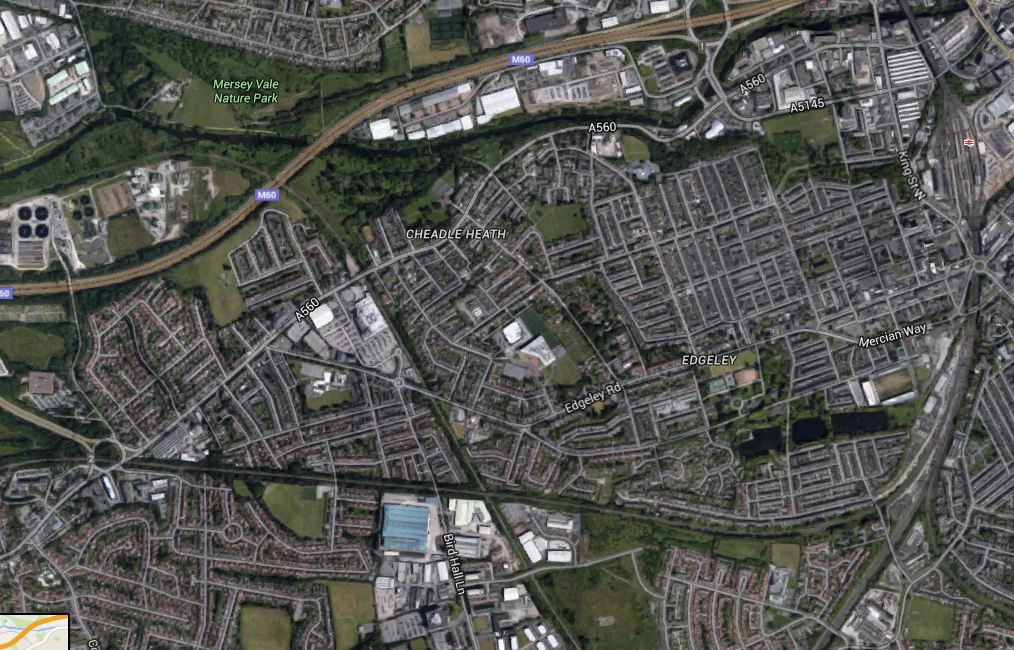
Stockport To East Didsbury
Note.
Stockport Station and Edgeley Junction in the East.
The Stockport to Altrincham Line runs horizontally across the map.
The freight line crosses the motorway, just to the right of the blue M60 label.
Towards A Circular Metrolink
The WSAtkins report says this.
With both the Manchester – Belle Vue – Marple/ Stockport and Stockport West routes built, a Manchester – Belle Vue – Stockport – Airport service could operate. This route would combine radial and orbital elements and could potentially be developed in the longer term into a more extensive orbital Metrolink system, for example by extending northwards beyond Reddish to Ashton-under-Lyne.
I suspect Manchester feels rather pleased that all those old railway lines across and around the city, weren’t dug up for housing and motorways.
Hazel Grove to East Didsbury
The WSAtkins report says this about running tram-trains betwen Hazel Grove station and East Didsbury Metrolink station.
The Hazel Grove to East Didsbury tram-train route would form an extension to the Manchester to East Didsbury Metrolink line, and would result in a Manchester – Hazel Grove Metrolink service.
It would utilise the following rail/ Metrolink lines.
- New Metrolink line from East Didsbury to Gorsey Bank, crossing the river Mersey to join the rail (presently freight only) line at a point north of the M60.
- Existing rail (presently freight only Sharston to Hazel Grove line) redoubled from Gorsey Bank to Hazel Grove.
The report also says this about the route.
It is envisaged that new stops would be provided at Gorsey Bank, Edgeley Lane, Davenport and Woodsmoor. The section of the scheme between East Didsbury and the existing Stockport-Altrincham rail line is identical to that proposed in the Stockport West group of routes, offering cost savings if both schemes were progressed. This service would not replace the existing heavy rail service but further work would be needed to define the appropriate mix of Metrolink and local rail services between Manchester and Hazel Grove.
So it looks like to create improved connectivity from East Didsbury can be delivered by tram-trains, some doubling of lines, electrification, signalling and devising a better timetable.
Tram-Trains Running On Manchester Metrolink
The WSAtkins report says this about possible constraints on running tram-trains on the Manchester Metrolink.
In Greater Manchester Metrolink has been developed by converting existing railway lines and disused rail alignments and building new on-street embedded rails. Metrolink therefore currently runs on a separate network to heavy rail, with an operating system managed on behalf of TfGM. The concept of a Metrolink type service utilising currently active heavy rail lines, which would continue to be used by trains as well as a Metrolink service, has been discussed for a number of years. This type of operation is referred to as ‘tramtrain’.
Tram-train is currently used in several locations in mainland Europe, and a pilot project in Sheffield was commissioned by the Department of Transport to consider the potential of adopting this approach in the United Kingdom. The pilot project is considering the technical issues but the actual running of a tram on a rail way has been delayed several times. The most recent timescale is to start running sometime in 2016.
The Greater Manchester Metrolink vehicles are of a different design to the Sheffield trams as they were designed to operate on converted heavy rail lines. As such, it is anticipated there may be fewer technical issues associated with tram-train operation in Greater Manchester. The outcome of the pilot is expected to influence the prospects for tram-train elsewhere in the UK.
I would hope that the Manchester Metrolink and the Sheffield Supertram, both decide to use the same tram-trains, as this would enable tram-trains to start in the centre of Sheffield and then run on the Hope Valley Line to Srockport and Manchester City Centre.
Conclusion
In my view, if the use of tram-trains happens in around Stockport, it would be a good thing for the area.
I would hope that the Manchester Metrolink and the Sheffield Supertram, both decide to use the same tram-train, as this would enable tram-trains to start in the centre of Sheffield and then run on the Hope Valley Line to Srockport and Manchester City Centre.
If the concept works and the tram-train tril is successful, Sheffield, Manchester and a lot of other places in the UK, are going to have tremendous fun with tram-trains.
T
Manchester United 3 – Ipswich 0
These pictures document the match.















It was all very disappointing, but then Mick has his priorities of getting out of the Championship.
Old Trafford is not the sort of stadium, I thought it would be. It had a rather tired air and compared to the Emirates or the Amex at Brighton, it was very second-rate.
Manchester’s Ticketing In Disarray
According to this article on Global Rail News, Manchester’s plans for smart ticketing have gone down the pan.
Could the failure of this system be caused, by not using the same successful system as London?
After all the minimum requirements of any smart electronic ticketing must include :-
- A Smart card like Oyster
- The ability to use contactless bank cards from all over the world.
- The ability to use ApplePay and the future AndroidPay.
London isn’t quite there yet, but when AndroidPay arrives and they can accept any contactless bank card, they will have set the global standard, to which all transport ticketing systems must aspire.
Any city or region, that doesn’t have a system that matches London, will lose out on the independent visitors.
The biggest benefits of contactless ticketing on buses, trams and trains are.
- Cash money and its associated costs and problems are taken out of the system.
- Attacks on staff are reduced.
- Boarding is quicker, so services are faster.
- Ridership increases.
- I have a feeling that by analysing the enormous amounts of joirney data generated, prediction of where new and improved services should go is very much better.
- The book is open on fare evasion, but I think it has dropped.
So come on Manchester, join the twenty-first century!
Could Tram-Trains Be Used To Advantage North Of Manchester?
In A Plea For Help From Lancashire, I said this about creating a better service to Rossendale.
Perhaps one way to do create a service would be use Class 399 tram-trains to extend the Metrolink from Bury, if they are proven to work successfully between Sheffield and Rotherham in the next few years. After all, the first phase of the Manchester Metrolink to Bury was built by converting the old East Lancashire Railway,
I also said that I feel that the Germans and the French would use tram-trains in the area.
So how feasible would it be to extend the trams from Bury? This is a Google Earth image of the centre of Bury around the end of the Metrolink line from Manchester.
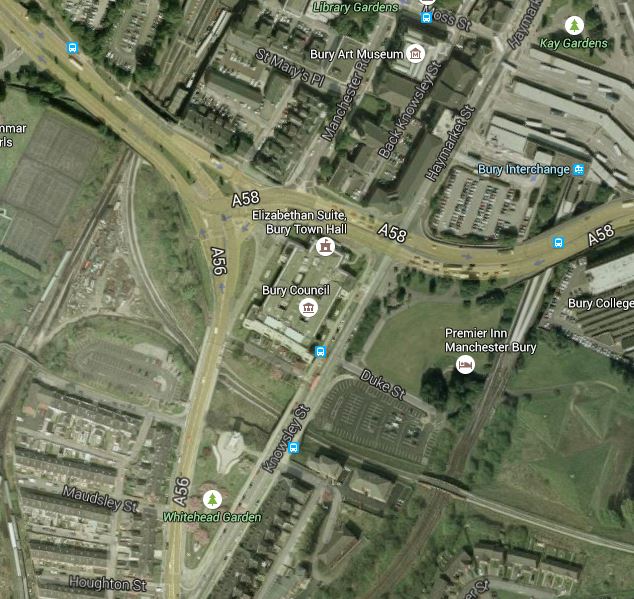
Bury Interchange
Note how the East Lancashire Railway from Bolton Street station passes under the A58 and turns east to continue to its next station at Heywood. The Metrolink stop is marked by the blue symbol labelled Bury Interchange and the tram line goes south passing under the A58 and the rail line.
I clipped this route diagram from the Wikipedia entry for the East Lancashire Line.
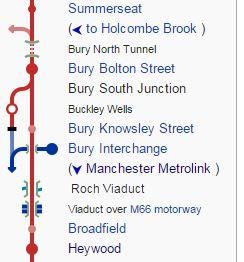
Bury Rail Lines
My untrained eye says that it wouldn’t be that difficult to have some tram-trains go via Bury South Junction and then up the East Lancashire Railway. A Buckley Wells Metrolink stop and Park and Ride has been proposed and the site is already owned by Transport for Greater Manchester. Although, I would suspect that the lines would run differently to those shown.
If Class 399 tram-trains or similar going up the East Lancashire Railway were to be proposed, it would certainly result in at least two additional stops in Bury at Buckley Wells and Bolton Street. The biggest problem would be to decide how far the trams would go. Originally the electric trains on the Bury Line as it then was, went to Rawtenstall station. Wikipedia says this.
The Association of Train Operating Companies have identified that the community of Rawtenstall on the East Lancashire Railway Heritage Railway could benefit from services connecting the station to the National Network.
So perhaps this could be a possibility.
One of the advantages of using tram-trains to add a commuter service to the East Lancashire Railway, is that it would reduce the need to find heavy rail platforms at Manchester Victoria. There may be a problem though in the capacity of the current Bury Line, which has a double tram every six minutes. But then a second crossing of the city centre is being built and there are proposals to add all sorts of extensions to the Metrolink network.
Tram-trains are remarkably flexible vehicles in that provided the loading gauge, platform height and track is correct, there is a power supply and signalling system they can use, they can go a vast number of places on the rail and tram network. As an example, here’s one of Karlsruhe’s tram-trains in a platform in the main station alongside a TGV.
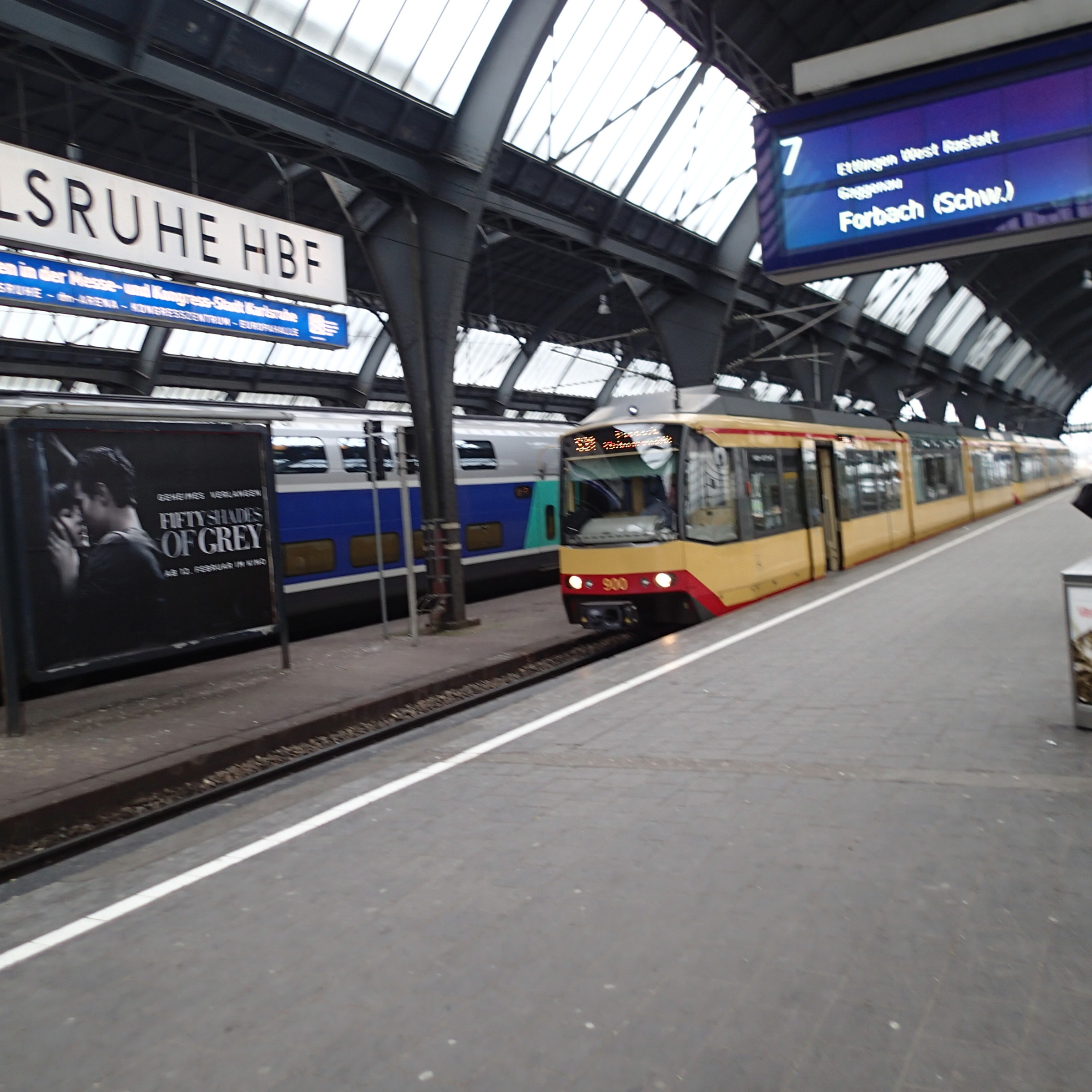
So the only thing that limits their use is the correct certification for a route and the training of the staff. Tram-trains also have the advantage that they can run at slowish tram speeds in city centres and at much faster speeds on rail lines designed for such.
In my view all this means that to expand the Metrolink outside of its current network, you need to get a tram-train that can run on the central network in the city centre and then gradually equip and certify all of the branches out of the city for the chosen tram-train.
It would be nice to think in my view, that we could come up with one specification for a tram-train, that could be used everywhere in the country.
To show how tram-trains could be used, I’ll use the example of the new service around the Todmorden Curve from Manchester Victoria to Burnley and Blackburn.
The Caldervale Line through Blackburn, Accrington and Burnley is going to be electrified in the next few years, so it would only be necessary to additionally electrify the line from Rochdale to the Todmorden Curve.
Rochdale where the train and tram lines are close together as this Google Earth image shows, gives two possibilities.
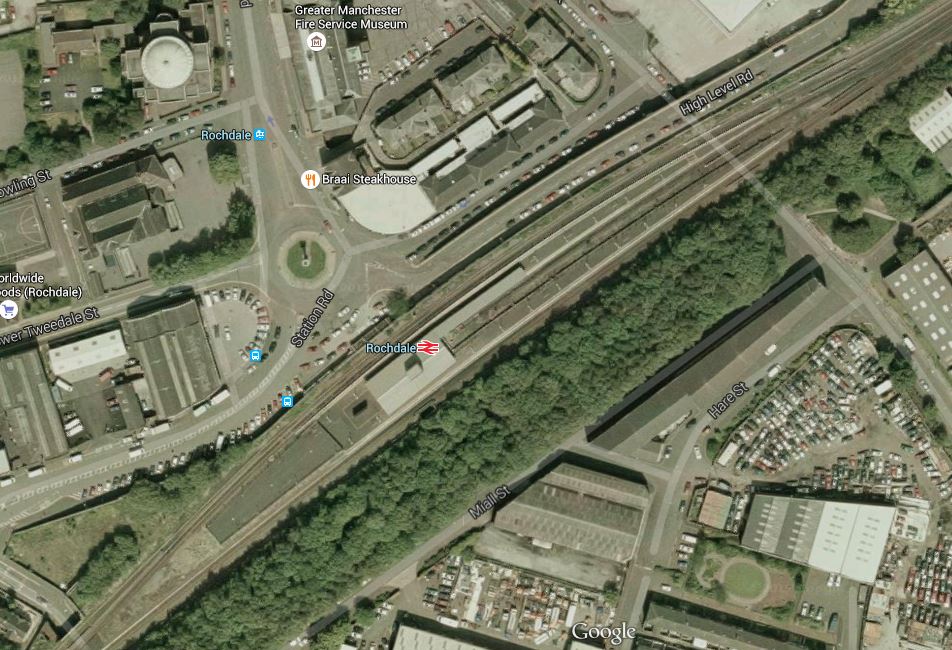
Rochdale Interchange
The tram-train could either go on the current route into Manchester Victoria, provided of course it was electrified or it could run to the city centre on the tram lines.
You pays your money and takes your choice depending on what optimises the network best for the passengers.
 The Anonymous Widower