The Ultimate Capacity Of The Moorgate Line
The Moorgate Line is an important commuter line to and from its terminus at Moorgate station within easy walking distance of the City of London.
I use the line regularly to travel between my house and Moorgate station for breakfast at Leon, followed by shopping in Marks & Spencer on Finsbury Pavement.
- I catch a 38 or 56 bus from close to my house to Essex Road station.
- I then take the Northern City Line two stops to Moorgate station.
After my breakfast and shopping, I generally get a 141 bus home, as it means less road crossings to get to my house.
A Useful Line That Needs Improvement
It is a useful and well-used line, that needs improvement in various areas, some of which is already being done or is either in planning or fully planned.
The New Class 717 Trains
The new Class 717 trains are now all running up and down without too many problems.
The trains have been designed for the route, so hopefully they have the following features.
- Fast and automatic voltage changeover between 25 KVAC overhead and 750 VDC third-rail at Drayton Park station.
- Ready for ERTMS signalling.
- 100 mph running, so they don’t get in the way of Thameslink trains on the East Coast Main Line (ECML).
- Fast acceleration and regenerative braking to batteries for fast station stops and train recovery, when power fails.
- Optimisation for fast entry and exit to the trains.
I am afraid that they don’t fully meet the last three points, but they should!
It will be interesting to compare these trains, with Stadler’s new Class 777 trains for Merseyrail, which are also replacing similar BR units.
I believe that regenerative braking to batteries is important for trains in tunnels, and as far as I can determine, only Bombardier’s Class 345 trains for Crossrail have it fitted.
- It reduces the power running in the overhead cables or third-rail in the tunnels, which generates less heat.
- Conventional braking can be avoided in tunnels.
- In case of power failure, the train can be moved to the next station for passenger evacuation.
If trains, tunnels and power supply are designed as a complete system, then surely there must be cost savings.
It is also probably true to say about these trains, that if the operator needed some more trains, then Siemens would probably oblige.
Upgrading The Route
The complete route consists of three separate parts.
- The Northern City Line between Moorgate and Finsbury Park stations.
- The slow lines of the East Coast Main Line to the South of Welwyn Garden City station.
- The Hertford Loop Line between Stevenage and Alexandra Palace stations
The big upgrade planned for the East Coast Main Line is to install ERTMS digital signalling between Doncaster and Kings Cross.
Network Rail are doing their first digital signalling design in a darkened room with no communication to the real world, but I believe if the project was designed by experienced engineers, the following will happen.
- Any train that might use the East Coast Main Line will be fitted with ERTMS signalling.
- This ERTMS roll-out must include all Class 717 trains, as these can use the East Coast Main Loop to Welwyn Garden City and at Stevenage station.
- As the Hertford Loop Line is used as a diversion for the East Coast Main Line, it would be logical to install ERTMS signalling on this route.
- Installing ERTMS signalling into Moorgate station would surely be beneficial and would surely be needed to get the best of ERTMS on the East Coast Main Line.
The outcome should be that the whole Moorgate Line will become a fully digitally signalled route.
This should increase train frequency and capacity on all the digitally signalled routes.
- The fast lines of the East Coast Main Line will become a 140 mph race track.
- The slow lines of the East Coast Main Line will allow extra services.
- If coupled with track improvements, extra capacity on the Hertford Loop Line could be used to allow services to by-pass the bottleneck of the Digswell Viaduct with its limited pair of tracks.
- The Northern and City Line could take extra trains to and from Moorgate.
There could be reorganisation of some services.
- Kings Cross and Cambridge/Ely/Kings Lynn services would be run by 140 mph trains, so they could use the fast lines on the East Coast Main Line. I feel these services could be extended to Norwich, but that’s another matter. What would Alan Partridge think of High Speed Norwich?
- Thameslink services serving Peterborough would still use the East Coast Main Line, so they could call at Welwyn North and Knebworth stations, but why not divert the four trains per hour (tph) that serve Cambridge onto the Hertford Loop Line at Stevenage, to ease pressure over the Digswell Viaduct.
Consider.
- An upgraded Hertford Loop Line with full digital signalling could be able to handle as many as the twenty-four tph of Thameslink and Crossrail,
- The grade-separated junction with the East Coast Main Line is being improved.
- There are only infrequent freight trains on the Hertford Loop Line.
- Various platform upgrades at Hertford East and Gordon Hill could allow passing and more turnbacks.
My scheduling experience says that with a well-programmed computer calling the shots, that at least twenty tph along the Hertford Loop Line would be a serious possibility.
Improvements At Stevenage
The Stevenage improvements are very comprehensive and are designed so that however many trains run through the Hertford Loop, they can all stop in the station, if required.
Improvements At Alexandra Palace
If you are travelling North from Moorgate and find yourself on an East Coast Main Line service, when you need a Hertford Loop one, there is a cross-platform interchange at Alexandra Palace station, where the two routes are on either side of the platform.
It is convenient, but the platform needs better facilities, like a decent waiting room, better information screens and possibly a coffee stall and toilets.
Going South, there are two separate platforms, but this doesn’t matter, as there is no need to change.
Although surely, if all trains left from the same island, it would be easier for passengers.
The station would be improved with a properly-designed step-free bridge and information screens.
Passengers needing other than Moorgate as a final destination must change at Finsbury Park for Thameslink or the Piccadilly Line
The Knitting At Finsbury Park
This map from carto.metro.free.fr shows the tangle of lines at Finsbury Park station.
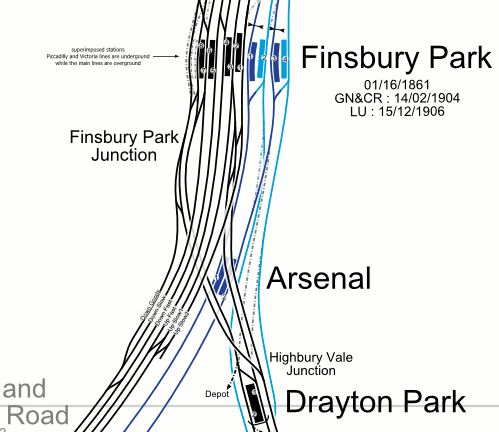
Note that the blue lines are the Victoria and Piccadilly Lines.
Improvements in the last few years have unlocked some of the station’s potential, but there is still plenty of space on the railway land to add extra tracks and possibly reinstate two more platforms.
If there are any train capacity problems, I believe that they can be solved.
The main passenger interchanges at Finsbury Park station are.
- An up-and-down interchange with the Piccadilly Line
- A cross platform interchange with Thameslink
Lifts have been added recently.
Improvements At Drayton Park Station
Drayton Park station is one of those stations, that should be given to developers with a blessing and a very detailed set of objectives and timescales enshrined in a watertight contract.
- The station sits very close to the Emirates Stadium.
- The new trains have increased passenger capacity through the station.
- It could handle much-more match day traffic.
- Large amounts of housing could be built on top.
If done well, it could provide a lot of housing and take the pressures off the other stations in the area on match days.
Improvements At Highbury & Islington Station
This map from carto.metro.free.fr shows the lines at Highbury & Islington station.
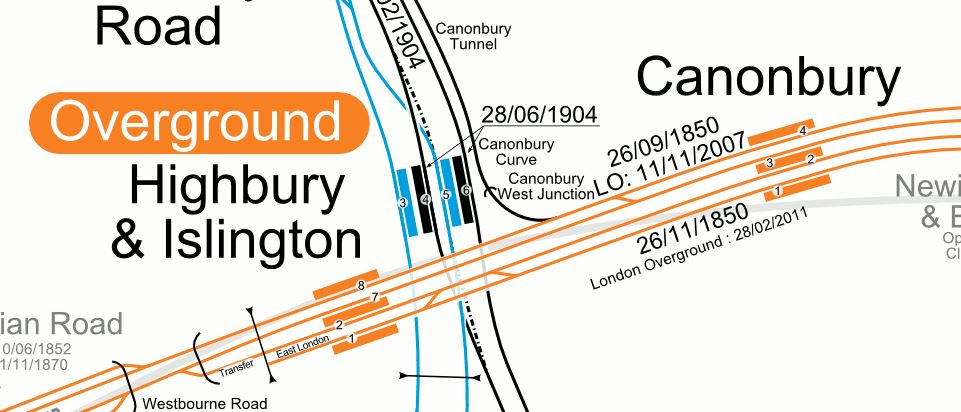
The track layout is basically sound.
The cross-platform interface between the Victoria and Moorgate Line is superb and only needs a good team of builders and lighting specialists to give it a modern finish to make it even better.
The Overground will get better too, as service frequencies increase by up to fifty percent.
The big problem at Highbury & Islington station is that access to the deep level platforms is not fit for purpose.
It is an absolute disgrace that The Mayor and Transport for London have put forward no plan to solve the problem of access to the deep level platforms.
The solution would probably involve opening up the disused station entrance on the on the side of Holloway Road and sinking an escalator and lift shaft to the four platforms. As at Drayton Park station, I believe with the right contract, it could be handed to a developer.
At least Crossrail, when it opens might give a bit of relief in the Peak. Many passengers might avoid Highbury & Islington station altogether by changing between the Overground and Crossrail at Whitechapel.
Like water, passengers tend to flow through the widest channels and find their own level.
Improvements At Essex Road Station
Essex Road station is a disgusting station, with all the charm of a Victorian slum.
As with Drayton Park station, it should be given to developers with a blessing and a very detailed set of objectives and timescales enshrined in a watertight contract.
Improvements At Old Street Station
The access to the existing Old Street station is being improved, but it seems to be taking forever.
I do hope, there is a realistic plan to create a flagship station for Silicon Roundabout.
Improvements At Moorgate Station
This station is being fully upgraded for Crossrail.
Eventually, there will be step-free access between the following lines.
- Central Line
- Circle Line
- Crossrail
- Hammersmith & City Line
- Northern Line
In addition all the National Rail lines out of Liverpool Street will be step and weather-free from all the other lines.
This can only increase the number of passengers using the Moorgate Line.
The Ultimate Frequency
I said earlier that the complete route consists of three separate parts.
- The Northern City Line between Moorgate and Finsbury Park stations.
- The slow lines of the East Coast Main Line to the South of Welwyn Garden City station.
- The Hertford Loop Line between Stevenage and Alexandra Palace stations
These are my thoughts on the capacity of each section.
Frequency Of The Northern City Line
I know Walthamstow Central station on the Victoria Line well and have observed the following.
- Thirty-six tph come and go for most of the day.
- From the time the brakes are applied after a train arrives until the time they are release when the train leaves is about two and a half minutes.
- Drivers use a procedure called stepping-up to speed the turnround. The driver leaves the arrived train and a new driver gets in at the other end, to drive it out.
- There is a lot of passenger congestion in the Peak, due to bad passenger access.
Surely, if Dear Old Vicky can handle thirty-six tph with the following.
- Two platforms,
- Modern trains
- Modern signalling
- Well-trained staff
- Not the best passenger access with just two escalators.
Then the new Class 717 trains at Moorgate with the best passenger access can handle a higher frequency than they do now!
I suspect that around twenty tph can be achieved fairly easily, but that in future , a higher frequency will be achieved.
Frequency Of The Slow Lines Of The East Coast Main Line
London has several commuter lines with frequencies of over 10 tph.
- Foremost, are Crossrail and Thameslink, which are both planned to run at 24 tph
- The East London Line is also planned to increase from 16 tph to 20 tph.
- The North London Line is planned to be increased from its current eight tph
- Waterloo and Wimbledon is upwards of 8 tph.
In addition most London Underground lines have frequencies in excess of 16 tph.
The slow lines of the East Coast Main Line to be a railway, in a few years time with the following characteristics between Finbsbury Park and Welwyn Garden City.
- At least one track in each direction.
- An operating speed of over 60 mph
- ERTMS signalling, which will be fitted to all trains on the lines.
I can’t see any reason, why the lines couldn’t be able to handle up to twenty tph in both directions, based on the experience of other lines in London, that have been operating for over a decade.
But strand on the bridge for an hour at a station like Oakleigh Park, at a busy time of day and you’ll be lucky to see ten trains.
There is a lot more capacity on the slow lines of the East Coast Main Line, to use to add extra services between London and Welwyn Garden City.
Adding services that go further North than Welwyn Garden City will need a solution to the double-track section over the Digswell Viaduct.
Frequency Of The Hertford Loop Line
I said this earlier.
My scheduling experience says that with a well-programmed computer calling the shots, that at least twenty tph along the Hertford Loop Line would be a serious possibility.
I also think that the slow lines of the East Coast Main Line can handle the same frequency, so I very much stand by my original figure.
Is There An ERTMS-based Solution To The Digswell Viaduct?
I answer that question in Is There An ERTMS-based Solution To The Digswell Viaduct?.
Some Questions
Various people over recent months have asked me questions about possible improvements to the Moorgate Line.
Could There Be A Direct Escalator Connection Between Bowes Park Station On The Hertford Loop Line and Bounds Green Station On The Piccadilly Line?
This map from carto.metro.free.fr, shows the two stations.
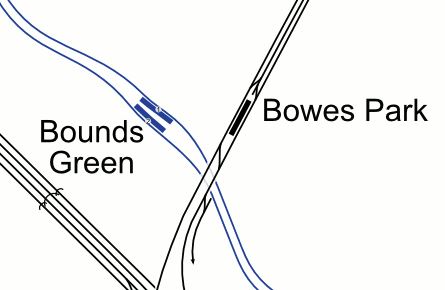
Bounds Green station is one of the Piccadilly Line’s classic stations.
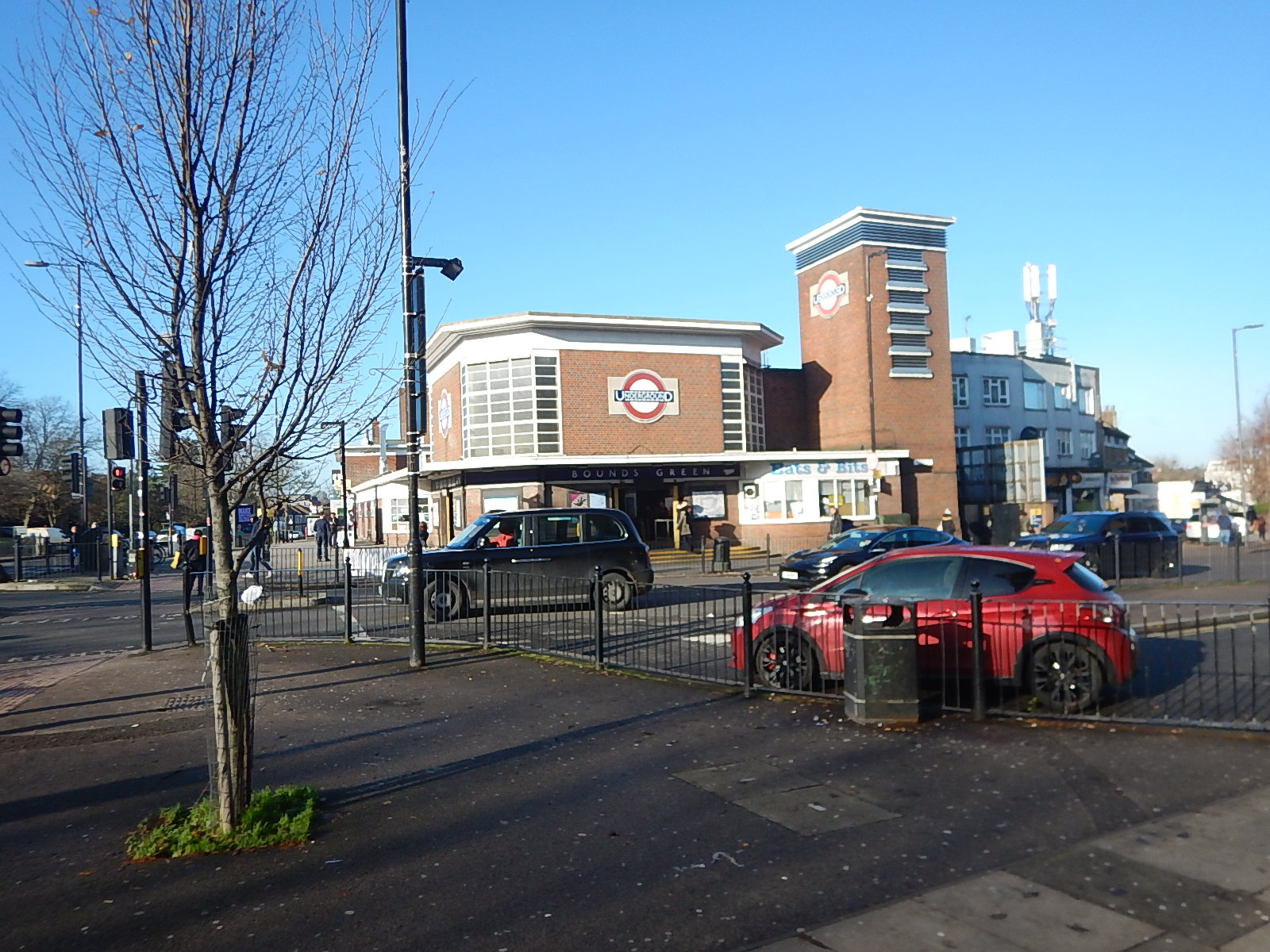
I took the picture, when I walked between the Bowes Park and Bounds Green stations
It is a level walk, that could be better signed and if the two stations were to be made step-free it would be an easier interchange than that at Finsbury Park.
In my view, improving the two stations and the local environment, would be much better value than an expensive escalator connection.
Should There Be A Second London Terminal?
Kings Cross is used as a London terminal at times, but would there be much of a necessity.
Passengers can use the following connections to get to Kings Cross and other stations along Euston Road.
- A cross-platform interchange at Finsbury Park with Thameslink
- A cross-platform interchange at Highbury & Islington with the Victoria Line
- When Crossrail opens, there will be a step-free connection with the Circle, Hammersmith & City and Metropolitan Lines at Moorgate.
Passenger numbers will decide.
Could The Moorgate Line Be Extended South To Bank Station?
The original Victorian plans for the Moorgate Line show the line extended to a station at Lothbury, which is just behind the Bank of England. This Google Map shows the area.
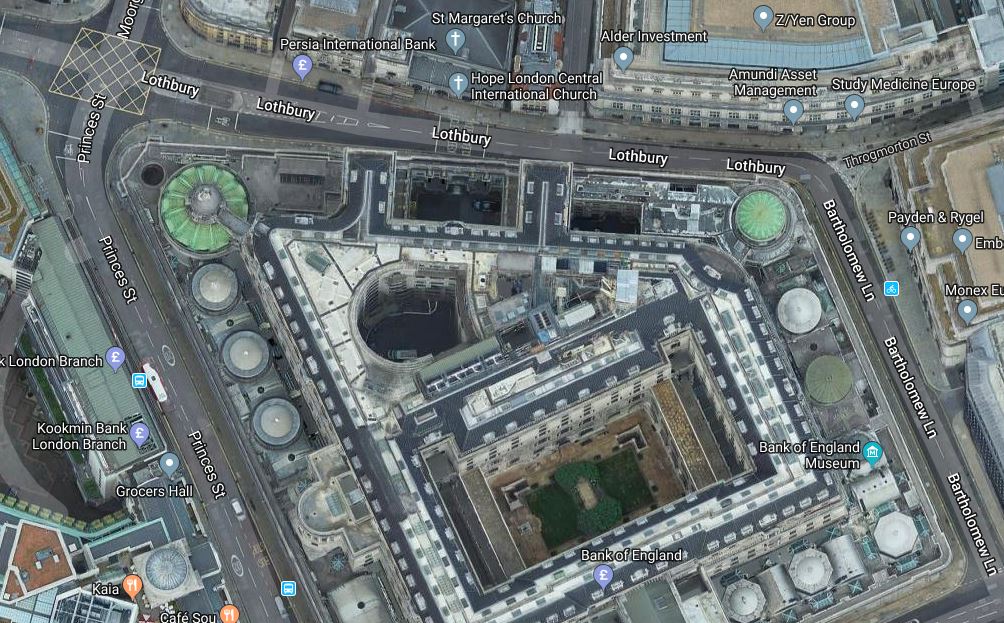
These pictures show the area, where Lothbury and Moorgate meet.



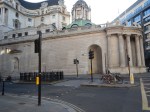
Given the difficulty of handling the logistics of all the tunnelling for the Bank station upgrade, I don’t think the City of London would look too kindly on a rail extension between Moorgate and Bank, especially, as there is already the Northern Line and even I can walk it easily.
It could be argued as Moorgate is served by Crossrail and Bank station isn’t, that there will be a high level of passenger traffic between the two stations.
Consider.
- It is only five hundred metres to walk.
- The Northern Line is jammed solid between London Bridge and Kings Cross in the Peak.
- After the completion of the massive Liverpool Street-Moorgate double-ended Crossrail station and the Bank Station Capacity Upgrade, a one stop on either the Central Line or the Northern Line will be step-free.
- The Liverpool Street-Moorgate Crossrail station will hopefully have a selection of entrances with good connections to walking routes leading South towards Bank.
- The City of London is planning to make the streets of the city more friendly to walking and cycling.
- More and taller towers are increasing employment in the City.
Will the walking routes and the Central and Northern Lines be overwhelmed?
I think they could be, but there could be other solutions.
- Opening up of more walking routes and improving the already pretty good street maps and signage.
- A redesign of the bus network with high capacity electric buses taking over the routes between Old Street and London Bridge stations.
I also wonder, if it would be possible to dig a pedestrian tunnel between the two stations under the existing roads and fit it with travelators.
The ingenuity that has been shown in the Bank Station Capacity Upgrade has probably suggested a few ideas.
But I’m absolutely sure there will be no extension of the railway pass Moorgate.
Is The Interchange With Thameslink At Finsbury Park Frequent Enough?
It seems that Thameslink will run four tph through Finsbury Park station.
- All will have cross-platform interchange with Moorgate Line services.
- All services will serve London Bridge, East Croydon and Gatwick Airport stations.
Are these enough services?
Passenger numbers will decide.
Should Some Thameslink Services Use The Hertford Loop?
I said this earlier.
Thameslink services serving Peterborough would still use the East Coast Main Line, so they could call at Welwyn North and Knebworth stations, but why not divert the four trains per hour (tph) that serve Cambridge onto the Hertford Loop Line at Stevenage, to ease pressure over the Digswell Viaduct.
It possibly is an idea, but I also believe, that ERTMS signalling could offer an elegant solution to the Digswell Viaduct problem.
Could The Moorgate Line Have Some New Park-An-Ride Stations?
There are two possibilities on the Hertford Loop Line.
This Google Map shows where the Hertford Loop Line crosses the M25, to the North of Crews Hill station.
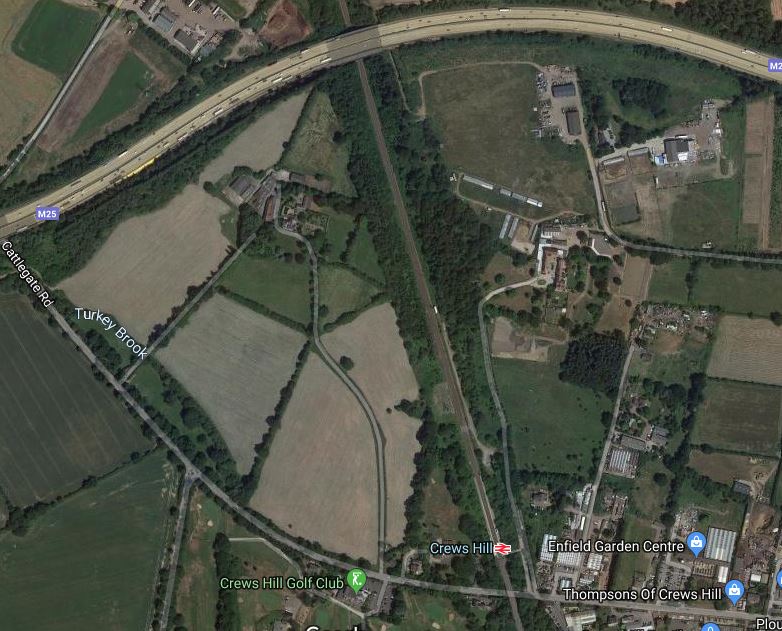
It would probably be impossible to build a Park-and-Ride station in this area now, but if the M25 had been designed in an holistic and environmentally-sympathetic manner, it could have been a place for such a facility.
There must also be the possibility of building a Park-and-Ride or more likely a Cycle-and-Ride station to the South of Stevenage, as the town develops, as it surely will in the next decade.
From my helicopter, it doesn’t look promising to add more parking except possibly at Hadley Wood station. This page from Hansard is a good summary of GNER’s original proposal in about 2000.
Should The Moorgate Line Be Taken Over By Transport for London?
Consider.
- This is certainly a desire of the London Mayor; Saddiq Khan.
- After the farce of the Metropolitan Line Extension at Watford will Greater London and Hertfordshire be able to work together over the route?
- There are twelve stations in Hertfordshire and twenty in Greater London.
- Stations are in four Greater London Boroughs; Barnet, Enfield, Haringey and Islington with Moorgate actually in the City of London.
The line might improve as part of Transport for London, but agreeing the management and development strategy for the line, with all those politicians of different colours, could be a nightmare.
Conclusion
Without doubt all of the parts of the Moorgate Line can handle at least twenty tph and possibly more, once the following conditions are met.
- Full ERTMS signalling on all lines.
- The stations are capable of handling the increased number of passengers.
- There are a few more trains.
Automatic Train Control may need to be used in certain sections, as it will be on Crossrail and Thameslink.
What Would This Mean For Passengers?
The current pattern of train services in the Off Peak is as follows.
- 4 tph – Welwyn Garden City
- 2 tph – Hertford North
- 1 tph – Watton-at-Stone
- 1 tph – Stevenage
Note.
- This is well below the future capacity of the section between Moorgate and Alexandra Palace stations
- It needs eight trains for each branch or a total of sixteen trains.
The simplest pattern would be twenty tph between Moorgate and Alexandra Palace stations, which would serve the following destinations.
- 10 tph – Welwyn Garden City
- 5 tph – Hertford North
- 5 tph – Stevenage
Note.
- Intermediate stations, like New Barnet and Cuffley would get a train every six minutes.
- The service would need forty trains.
- I doubt Great Nortern would want to finance the extra trains.
Cutting the service back to somewhere in between would also work.
- 6 tph – Welwyn Garden City
- 3 tph – Hertford North
- 3 tph – Stevenage
Note.
- Intermediate stations, like New Barnet and Cuffley would get a train every ten minutes.
- The service would need twenty-four trains.
As there are twenty-five Class 717 trains, is this Great Northern’s plan?
It looks to me like a plan designed by Great Northern’s accountants based on the least they can get away with.
An Improved Service For South Hertfordshire
Consider.
- The extra platform and remodelling at Stevenage station are ambitious and the new platform could probably handle six tph.
- Stevenage has an LN|ER service to the North of two tph.
- East Coast Trains intend to start a service linking Stevenage to Newcastle and Edinburgh.
- Healthcare in South Hertfordshire sends patients to hospitals at Barnet and Stevenage, neither of which are easy from a station like Cuffley
- Bus services across are not for the frail, elderly and impatient.
- There is no rail link between Hertford and Hatfield except with a change at Alexandra Palace station, which is not step-free.
Perhaps the Moorgate train service should be as follows.
- 8 tph – Welwyn Garden City
- 4 tph – Hertford North
- 4 tph – Stevenage
Note.
- Importantly, there would be four tph to between Alexandra Palace and Stevenage.
- The Stevenage services would link up to the improved fast services between Stevenage and the North of England and Scotland.
- Intermediate stations, like New Barnet and Cuffley would get a train every seven-eight minutes.
- The service would need thirty-two trains, which is probably another eight trains.
I also think, that Alexandra Palace station should be made step-free to ease journeys from one side of Hertfordshire to the other.
.
Crossrail Rushes To Make Bond Street Ready For Testing
The title of this post is the same as that of this article on Rail Technology Magazine.
Mark Wild, who is Crossrail’s Chief Executive, is quoted as telling the London Assembly.
Our current focus is predominantly on key areas of risk such as ensuring that Bond Street station is at the required stage of completion to allow us to commence trial running early in 2020..
The more I read about this project, the more I believe, that the projects lateness is down to two things.
- Some very optimistic project management by contractors to get some of the enormous contracts on offer.
- A lack of resources in vital areas like some trades and the testing of trains.
But then what do I know about Project Management and computer software?
Could Bond Street also be the only really late station, as it is on a very cramped site in the centre of some of the most expensive real estate on the planet?
The 3D visualisation shows the area around the station.
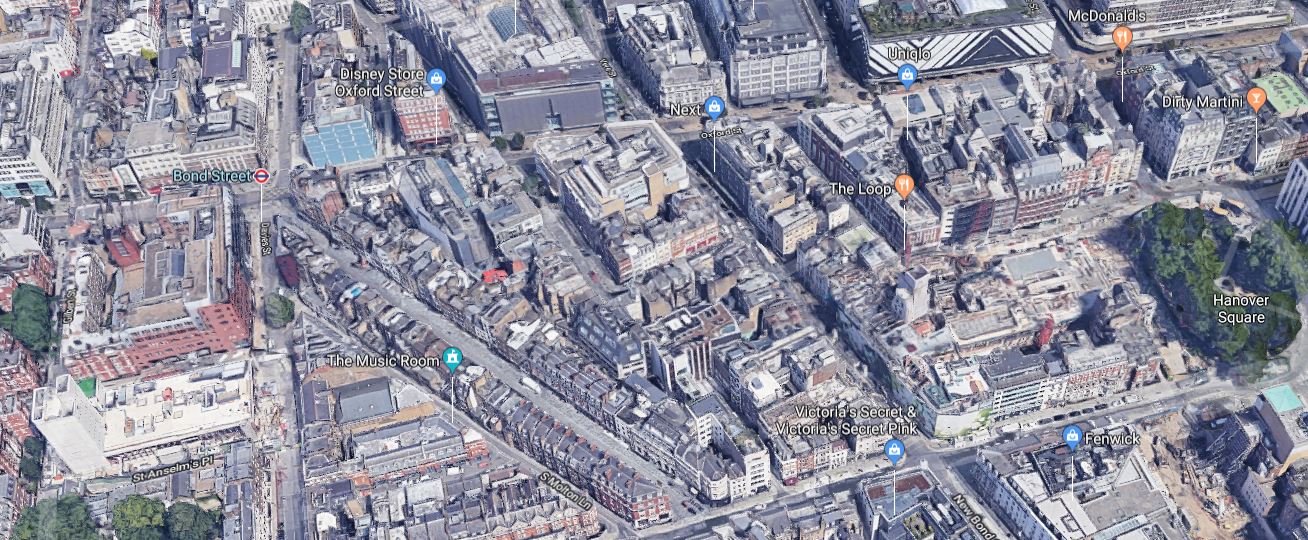
Note .
- The new Western entrance to Bond Street Crossrail station, which is the cleared site with the russet-coloured building behind.
- The new Eastern entrance, which is just to the West of Hanover Square.
- Bond Street running down from Next on Oxford Street to Fenwicks.
Surface access is not good to say the least.
The same access problem probably applies at Paddington, Tottenham Court Road, Farringdon, Moorgate and Liverpool Street stations, but at these five stations, there were buildings that could be demolished to give access for construction.
It should also be notes, that some of these stations have only a few local residents.
I’ll take a quick look at these five stations.
Paddington
This Google Map shows Paddington station.
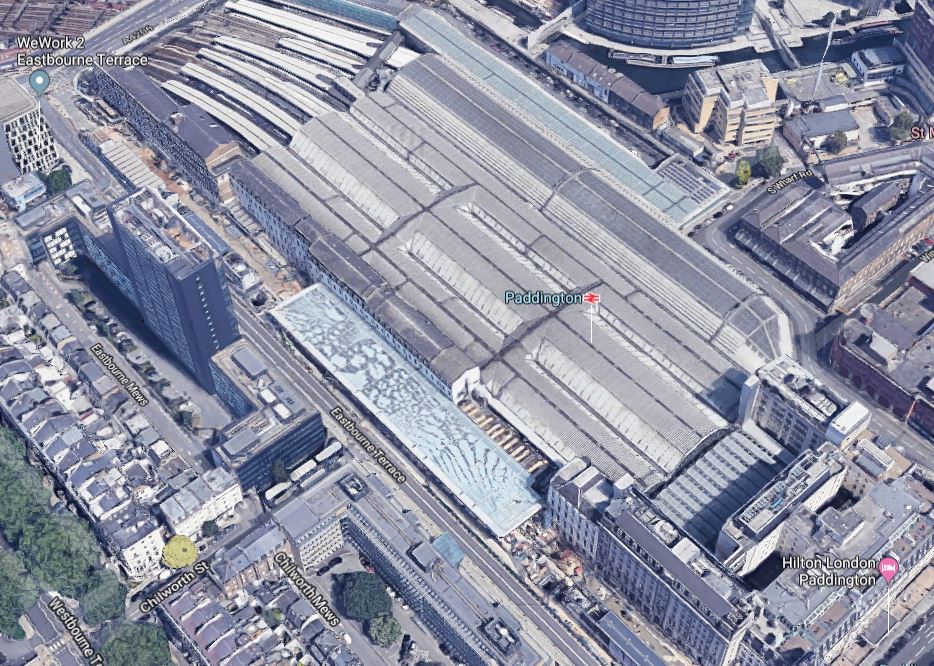
Note the Crossrail station, which has been squeezed into the old cab rank, alongside the station.
Tottenham Court Road
This Google Map shows Tottenham Court Road station.

Note the amount of cleared space around the station,
Farringdon
This Google Map shows Farringdon station.

The Crossrail station is to the West of the current station. It must have helped contractors, that the station had been redeveloped a couple of times for the construction and update of Thameslink.
Moorgate
This Google Map shows Moorgate station.
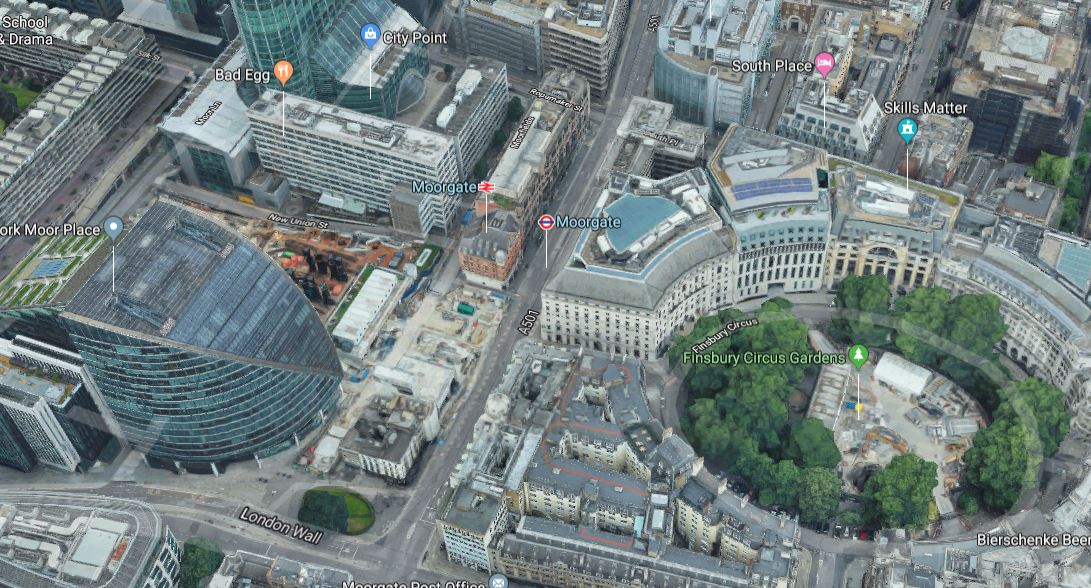
Moor House, which is the large office block behind Moorgate station, was built in 2004 and was designed to accept Crossrail in the basement.
Finsbury Circus, which is the green space in the East was used as a construction site.
Liverpool Street
This Google Map shows Liverpool Street station.
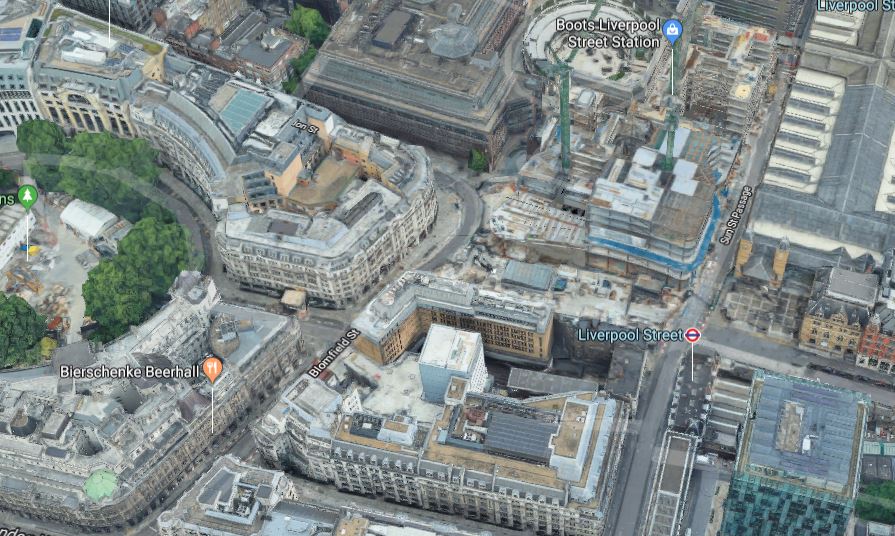
The main entrance to the Crossrail station will be in front of the Broadgate office complex, which is to the West of the station.
This section of Broadgate is also being redeveloped, which probably helps and hinders in equal measure.
Conclusion
I think lessons will be learned that can be applied to other cross-city rail projects.
- Future-planning as with Moor House should be increasingly used.
- Should stations be built in conjunction with other developments?
- Are stations in areas of high real-estate values a good idea?
- Could more innovative ways be used to bring in construction materials?
Will future projects be better?
The New Entrance To Moorgate Station
The new entrance to Moorgate station, is now more visible behind the hoardings.
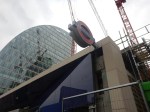
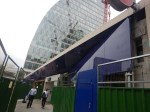
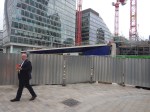
But there still appears to be a lot to do!
Aviva Investors Acquires 101 Moorgate Development Site
The title of this post is the same as that of the title of this article on Property Funds World.
This introductory paragraph says it all.
Aviva Investors, a global asset management unit of Aviva, has completed the acquisition of the long leasehold interest in 101 Moorgate, EC2, from Transport for London (TfL). Aviva Investors will develop a mixed-use retail and office site above Crossrail infrastructure and opposite the new Crossrail Liverpool Street Station western entrance.
This Google Map shows a 3D visualisation of the site.
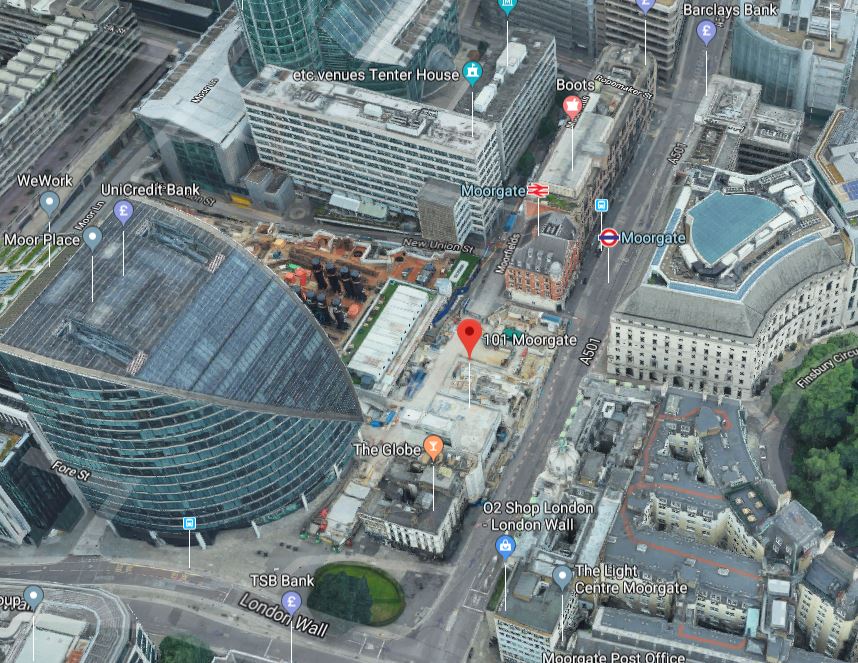
Note the site is indicated by the red arrow.
To its left is the distinctive Moor House, which as well as being a large office block, incorporates a Crossrail ventilation shaft.
Hopefully, Transport for London raised a few pennies for that deal.
The Shape Of Things To Come
Yesterday, I needed to go between Moorgate and Tottenham Hale stations.
It was just before the evening Peak and I took the escalators down to the Northern City Line platforms, where a new Class 717 train was waiting.
The increased capacity meant I got a seat and I took the train three stops to Highbury & Islington station.
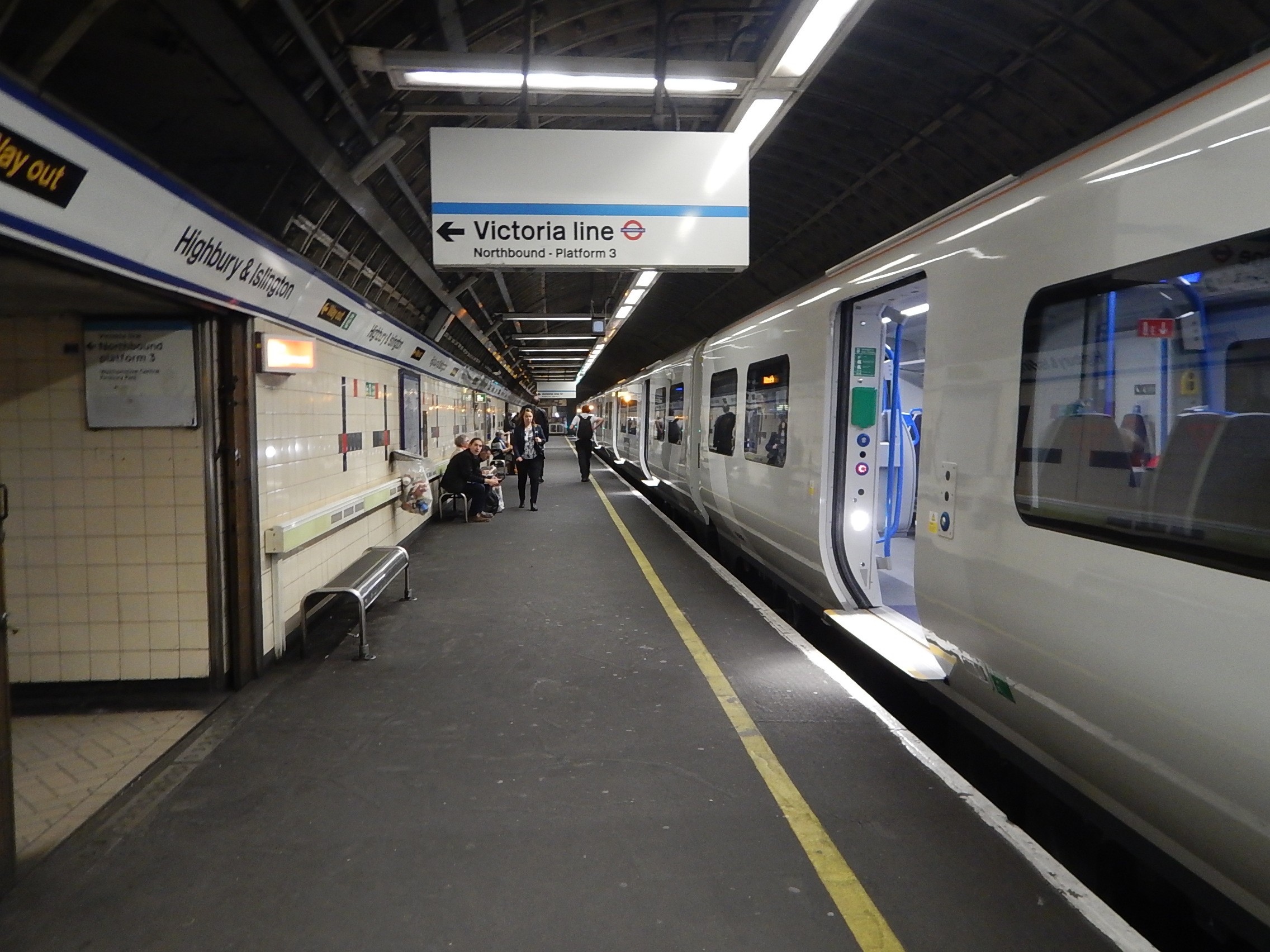
It was then just a walk through a very short tunnel to the Victoria Line and a train to Tottenham Hale.
It was so much more relaxed than squeezing into a crowded and very elderly Class 313 train.
After the timetable change in May, there will be eight trains per hour (tph), as there is now, but given the number of trains in the new fleet and signalling improvements in the pipeline, I feel that this frequency will be increased.
It should also be noted that in the Peak there are twelve tph, which in the future could be used all day.
But in the interim, trains with extra capacity will be very welcome.
From An Ugly Ducking To A Swan
These developments are either underway or planned for the next few years.
- Improved signalling on the Northern City Line.
- Full step-free interchange at Finsbury Park between Moorgate services and Thameslink, Piccadilly and Victoria Lines.
- Higher frequencies on Thameslink and the Piccadilly Line through Finsbury Park
- Full step-free access to the Northern City and Victoria Lines at Highbury & Islington station.
- Full step-free access at Old Street station.
- Hopefully, Essex Road station will be cleaned.
- Crossrail will finally arrive at Moorgate station.
North London’s ugly ducking, which has caused passengers, British Rail and London Underground, so much trouble, will finally have turned into a swan.
I always wonder if the City of London’s transport planners, wish that the Victorians had built the planned extension to a new Lothbury station, close to Bank.
What Will Be The Ultimate Frequency?
Currently the frequency between Alexandra Palace and Moorgate stations in the Peak is twelve tph.
Compare this with the following frequencies.
- Crossrail will be initially 24 tph.
- The East London Line is planned to go to 20 tph
- The Piccadilly Line is currently at 24 tph between Arnos Grove and Acton Town stations in the Peak.
- Thameslink will soon be at 24 tph
- The Victoria Line is currently at 36 tph.
I don’t think it unreasonable that a frequency of at least sixteen and possibly twenty tph between Alexandra Palace and Moorgate stations is achievable.
- Digital signalling and Automatic Train Control will be possible.
- If Dear Old Vicky can turn 36 tph at Brixton and Walthamstow Central stations, with two platforms, then surely 20 tph at Moorgate is possible, once there is better access for passengers to the platforms.
- Alexandra Palace to Moorgate is a double-track railway, that is almost exclusively used by Moorgate services.
- 16-20 tph would make the cross-platform interchange with the Victoria Line at Highbury & Islington station very efficient.
- There are two branches North of Alexandra Palace station. I’m sure each could handle 8-10 tph.
- The Hertford Loop Branch has three terminal stations; Gordon Hill, Hertford North and Stevenage stations.
- The East Coast Main Line has two terminal platforms at Welwyn Garden City station.
I could see the following frequencies.
- Moorgate and Gordon Hill – four tph
- Moorgate and Hertford North – four tph
- Moorgate and Stevenage – four tph
- Moorgate and Welwyn Garden City – four to eight tph
It will be a very high-capacity Metro into Moorgate. There could be a need for a few more trains.
But with increased speed.
Should The Northern City Line Be Shown On The Tube Map?
Increasingly, passengers will use the high-frequency Southern section of the Northern City Line between Alexandra Palace and Moorgate stations, as a new tube line.
So like Thameslink, the arguments will start as to whether this line should be on the Tube Map.
If Crossrail is to be shown, it is my view that nThameslink and the Northern City Line should be shown too!
Latest On The Class 717 Trains For The Great Northern
This is another tweet from the South East Rail Group.
Because of centre door of the cab some start signals can’t be sighted by the driver. Thus SDO will be used and trains stopped short. Once ERTMS is installed (the trains already have the in-cab signalling displays to go with it) then fixed signals and triphandles will be removed.
They also say that squiadron service is could be on March 11th.
Effect Of ERTMS
The tweet also confirms that ERTMS will be available on this line, after the first stage of installation of ERTMS on the East Coast Main Line.
Currently, the service to Moorgate station is twelve trains per hour (tph) in the Off Peak, with extra services in the Peak.
As Thameslink and Crossrail will be running twenty-four tph in a couple of years, so when ERTMS is working on the Southern part of the East Coast Main Line and on the Northern City Line into Moorgate station, how many trains per hour will be possible to Moorgate?
The current twelve tph means that turning the trains at Moorgate must be done in five minutes, which having watched the process is fairly relaxed.
Fifteen tph and a four minute turnround is certainly possible, as that is sometimes achieved in the Peak with the ancient Class 313 trains.
With a fleet of twenty-five trains, and a frequency of twenty-four tph possible under ERTMS, I suspect that twenty tph and a three minute turnround at Moorgate could be achieved all day.
Highbury & Islington Interchange With The Victoria Line
With Dear Old Vicky gamely plugging on at thirty-six tph, the typical maximum wait in a cross-platform interchange will be as follows.
- Victoria to Northern City – three minutes
- Northern City to Victoria – one minute and forty seconds.
How many passengers will use this route to the City rather than use the London Overground?
Interchange With Crossrail At Moorgate
The Northern City will be my link to Crossrail, as I can walk or get a bus to Essex Road station.
The interchange between Crossrail and the Northern City Lines will be high capacity, feature a lot of escalators and be fully step-free.
Conclusion
London’s forgotten underground line with its tragic history of the Moorgate Tube Crash, will become a new star in the broad firmament of London’s railways.
It just needs some improvements to some of the stations.
5,120 Tonne Loading Test Above Moorgate Tube Station
The title of this post is the same as that of this article on IanVisits.
Ian’s article is a fascinating insight into how the foundations of some new tower blocks will be tested.
It is a must-read.
Pan Up And Pan Down At Drayton Park Station
The years and decades go by and the new Class 717 trains, just like their predecessors; the Class 313 trains, continue to change between 25 KVAC overhead and 750 VDC third rail electrification at Drayton Park station.




There appears to have been little noticeable development in the forty years since the Class 313 reains were introduced. But the operation of the Class 717 trains appears smoother and quieter.
I would have thought, that for safety reasons, the new trains would have used battery power between Drayton Park and Moorgate stations.
After all it’s only two and a half miles, that is run using third-rail electrification.
I’d be very interested to see how much power is used by the new Class 717 trains South of Drayton Park.
In Weight And Configuration Of A Class 717 Train, I showed that the kinetic energy of a jam-packed Class 717 train at 85 mph is 56.15 kWh.
- I doubt that this sort of speed is achieved in the tunnels.
- At 60 mph, the energy would be 28 kWh
- At 40 mph, the energy would be just 12 kWh.
Obviously, hotel power for air-conditioning and lights will be needed for the train, but even at 5 kWh per car per mile, that would only be 150 kWh.
To carry 200 kWh of batteries on a six-car train is a very practical proposition.
- Vivarail have done it in a three-car train.
- There could be a short length of third-rail electrification to top up the batteries at Moorgate station, if required.
- Battery power could be used in depots to move trains, which would mean depots could have less electrification.
- Trains could be moved to the next station, if the electrification should fail.
The route between Moorgate and Drayton Park stations, is probably one of the best and easiest in the UK for battery operation.
Has The Possibility Been Created For A Pedestrian Tunnel Between Bank And Moorgate Stations?
This visualisation shows the Bank Station Upgrade at Bank station, which is now underway to sort out the station’s problems of capacity and poor step-free access.
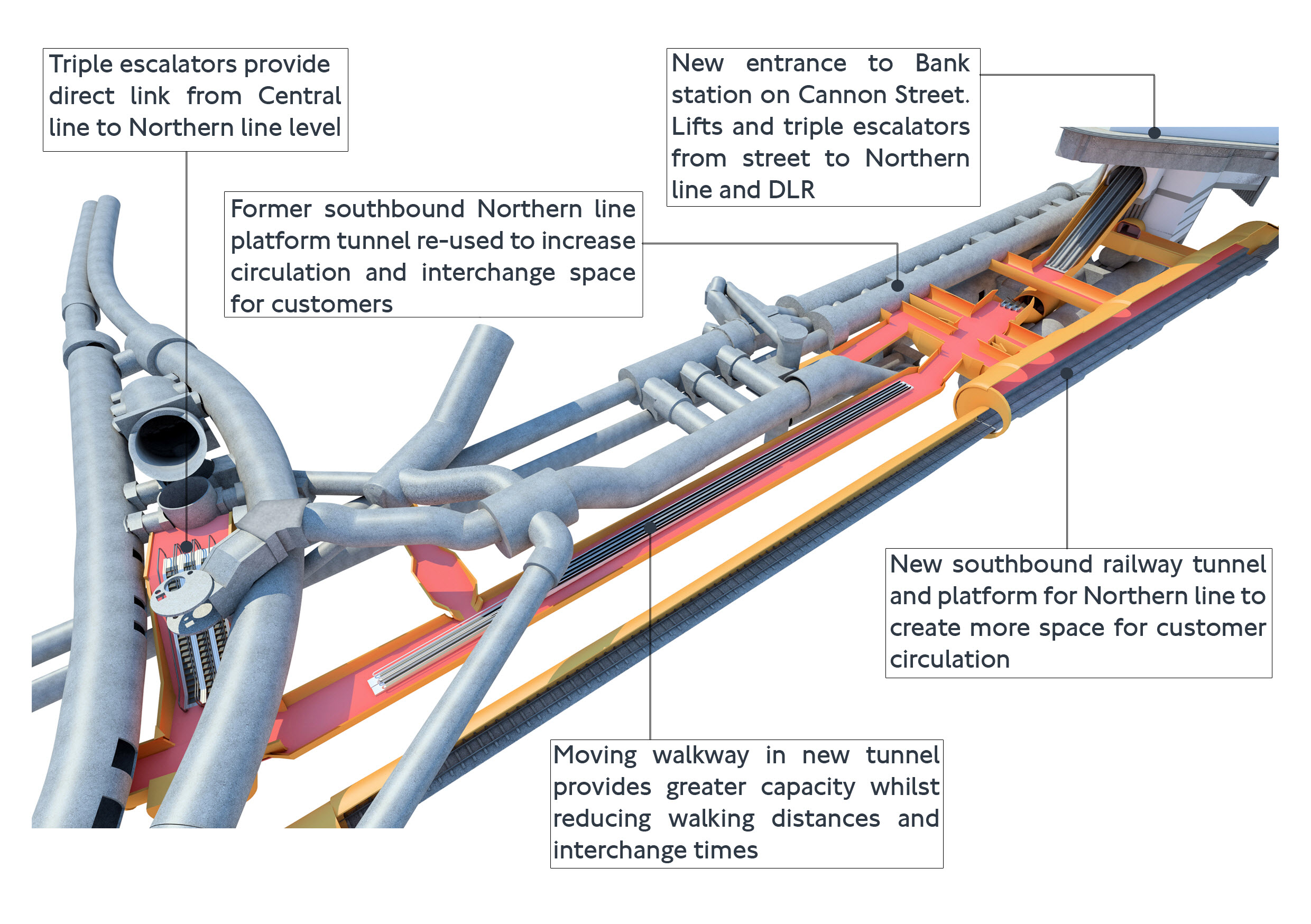
This is the bottom-left corner of the visualisation.
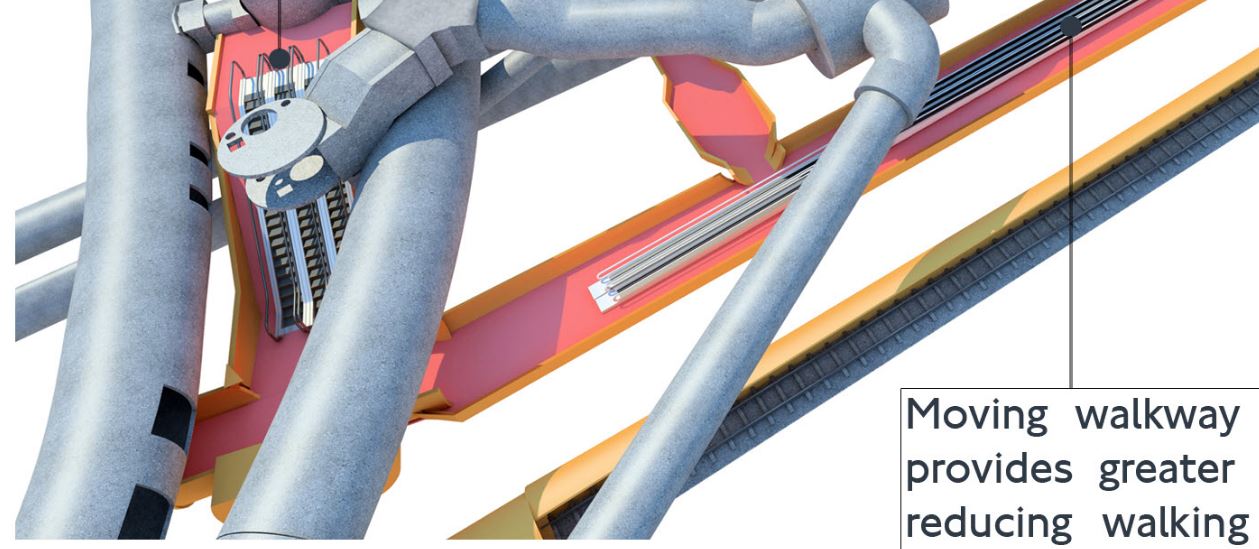
Notice that there are two fat tunnels running top to Bottom across the visualisation, which are the Central Line tunnels, with the Eastbound on the left and the Westbound on the right.
There are also four tunnels running left to right across the visualisation.
The top two, which are sticking out to the left of the Eastbound Central Line tunnel, are the current Northern Line running tunnels
- The top one is the Northbound tunnel going to Moorgate station.
- The other one is the current Southbound tunnel, which under the plans for Bank station will be closed to trains and used to improve passenger access to the Northbound platform. If you go to the Northern Line platforms, there are tell-tale blue hoardings, indicating where better access will be created.
These pictures show the current state of the current Southbound tunnel.
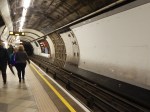
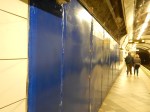
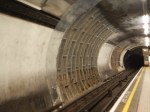
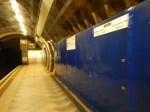
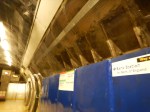
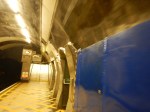
It looks like at least three sections of the wall between the two platforms will be removed.
The third tunnel, which is shown pink in the visualisations is the connecting tunnel between the Central Line and the new entrance to the station on Cannon Street.
Note the following.
- It has a travelator.
- it connects to a lobby, where there are triple escalators to the Central Line.
- It appears to come to a stop under the Eastbound Central Line platform.
What lies at the Northern end of this tunnel?
The fourth tunnel, which is the new Southbound running tunnel for the Northern Line, has been helpfully drawn with a rail track inside.
This is the top-right corner of the visualisation.
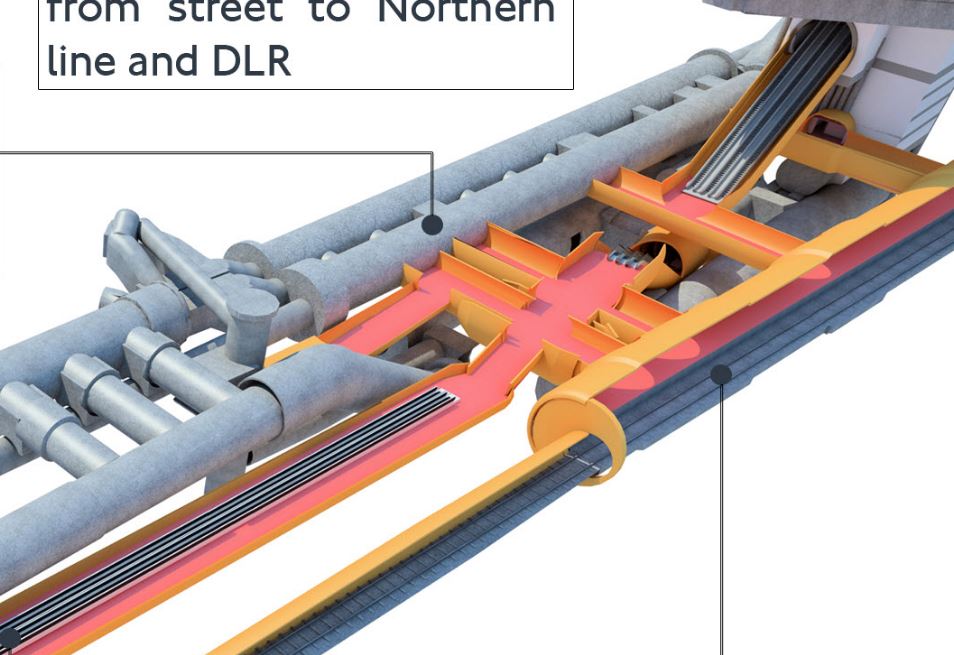
Note.
- There are three cross passages between the two running tunnels, just as there appears to be three blue hoardings in the existing Southbound running tunnel.
- The Northbound running tunnel now has a wide platform, which has been built inside the existing Southbound tunnel.
- The new Southbound running tunnel will be built with a wide platform.
- There are three escalators leading to the new Cannon Street entrance.
- There are three escalators leading down to the Docklands Light Railway (DLR) platforms
This map from carto.metro.free.fr, shows the layout of lines at Bank station and between Bank and Moorgate stations.
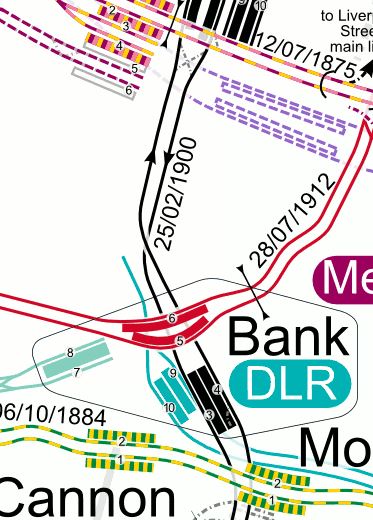
Note.
- The Central Line is shown in red.
- The Northern Line is shown in black.
- The DLR is shown in turquoise.
- The two Northern Line tracks cross to the North of Bank station.
- The lines at Moorgate station are shown at the top of the map.
- Crossrail is shown in violet.
The new Southbound tunnel will be created to the West of the DLR platforms.
This article on IanVisits is entitled Behind The Scenes At London Underground’s Bank Tube Station upgrade.
I suggest you read the article and I feel, you will get the impression the Bank Station Upgrade is a very difficult project, that is being achieved in an innovative manner by the contractors.
In one section, the article describes how they are actually building the new Southbound tunnel, through the piled foundations of existing buildings.
A Travelator Between Bank and Moorgate Stations
I now feel I can answer the question in the title of this post.
The Route
If the route started at the Northern end of the long connection tunnel with the travelator at Bank station, a route could probably be found on the West side of the Northern Line to break-in to the basement of the Crossrail station at Moorgate station.
This image shows a cross-section through the Moorgate Crossrail station.
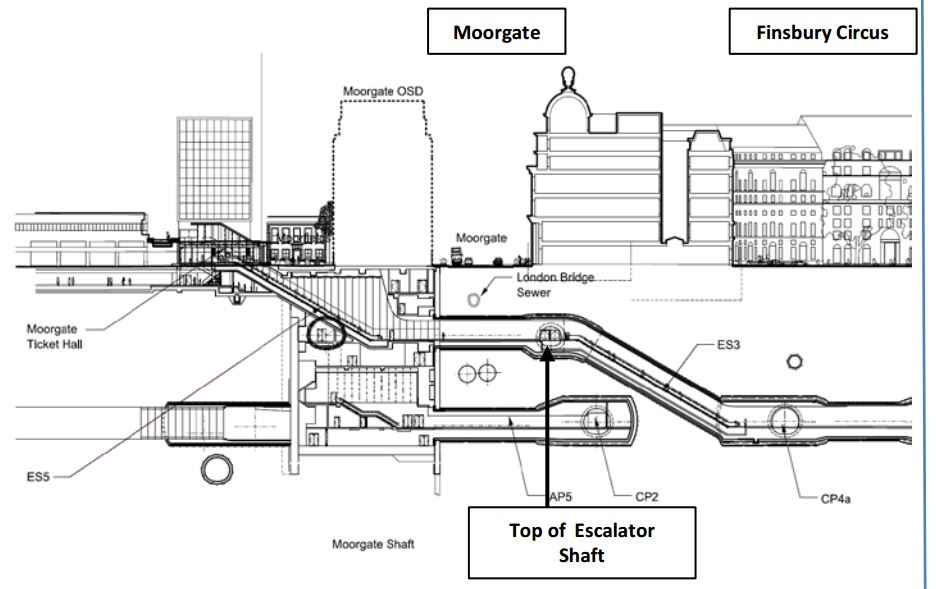
Note that under the escalators leading down from the Moorgate Ticket Hall to Crossrail, are a pair of circles.
- These are the Northern Line running tunnels.
- A travelator tunnel would be at this level but perhaps twenty or more metres to the West (left in the cross-section).
With modern design and construction techniques, I would expect that a connection could be made.
The Length
I estimate that the travelator would be between three and four hundred metres long.
As there are longer travelators either built or in planning in the world, I suspect, the length wouldn’t be a problem.
By comparison, these are example travelators in London.
- Jubilee to Northern/Bakerloo Lines at Waterloo – 140 metres.
- Sloping travelators to Waterloo and City Line at Bank – 76 metres
- Proposed Central to Northern Lines at Bank – 94 metres
A travelator between Bank and Moorgate stations would probably be, the longest in London.
Building The Tunnel
If you read the IanVisits article, it details how the new Northern Line and travelator tunnels at Bank station were excavated.
I suspect similar techniques could be used to build the new tunnel.
The biggest problem would be removing the tunnel spoil and I suspect that if the tunnel were to be built, when a building on the route needed to be replaced, this would make construction a lot easier.
Why The Tunnel Should Be Built
The main argument for building the tunnel is that it would connect Bank station directly to Crossrail.
Why The Tunnel May Not Be Needed
There are various reasons, why the travelator may not be needed.
Pedestrianisation
The City of London is in favour of pedestrianisation and has already disclosed plans to make Bishopsgate, which is one of the most important North-South arteries through the Square Mile, much more pedestrian friendly.
I would expect more initiatives like this to follow.
So many travellers will use their feet on the surface, between Crossrail and Bank, when the two stations are completed.
Improved Northern Line Connections
The connections to the Northern Line will be improved at both Moorgate and Bank stations, when Crossrail and the Bank Station Upgrade are completed.
So those travellers needing or wishing to do a one-stop transfer, will find it easy.
Connectivity between Crossrail And The Central Line
Crossrail and the Central Line have good connectivity.
- Stratford – A cross-platform interchange.
- Liverpool Street – A step-free connection
- Tottenham Court Road – A step-free connection
- Bond Street – A step-free connection
- Ealing Broadway – A step-free connection.
If travellers need Bank and they are coming from either direction on Crossrail, they can change at a convenient station.
Given that Bank station will have a large number of step-free entrances after the Bank Station Upgrade is completed, I suspect many Crossrail passengers will transfer to the Central Line to avoid the walk from Moorgate or Liverpool Street stations.
Conclusion
It may be feasible to build a trevelator between Bank and Moorgate stations, but developments already in hand, may give the project a very bad financial case.
 The Anonymous Widower