Echoes of Orde Wingate
In The Times today, there is an obituary of Major-General David Tyacke. The first two paragraphs talk about how he worked for Orde Wingate.
David Tyacke was the last officer on the staff of the Chindit HQ at Sylhet in Assam to see General Orde Wingate on the morning he left to fly to “Broadway” and “White City”, the jungle bases of 77 and 111 Brigades attacking the Japanese lines of communication in Burma.
Writing in old age, Tyacke described how, when Wingate’s aircraft was first reported overdue, a strange euphoria spread among the HQ staff as they realised that the general would not be keeping them on tenterhooks that evening. But it was soon replaced by a grim foreboding that their eccentric but visionary leader was dead.
Somewhere my father must have met Wingate, or perhaps someone he knew had served with him. But he was one of my father’s heroes.
I have read quite a bit about Wingate and feel that although some of his views were questionable, on the whole his was the right sort of thinking in difficult times. Wingate definitely was not a conservative thinker. The trouble today is that we have far too many of those.
Return to White Hart Lane
The last time I went to White Hart Lane to see Spurs play was when my two eldest children were perhaps eight and seven. I spoke to the younger today and he didn’t remember, and as I can’t recall who Spurs played that day, it must have been a truly memorable match.
Last night, as I was in London, I decided to get a ticket for the FA Cup replay against Bolton. I deliberately chose to sit in Block D of the upper deck of the East Stand, as that was where my father used to take me as a child.

The View from Block D in the Upper East Stand
I can remember a few matches from those years in the mid-50s, but one in particular stands out. It was against Newcastle, for whom the formidable Jackie Milburn was playing up front. The first half was very one-sided with Spurs being completely outplayed and if it hadn’t been for the heroic goalkeeping of Ted Ditchburn, the match would have been all over. He was so dominant, that Milburn actually missed a penalty. Since then, I’ve seen a lot of good goalkeepers, but never a display to match. In the end Spurs got their act together and won 3-1.
Little has changed in that East Stand over those fifty and more years. The views are still good, as they would be because the stand was designed by Archibald Leitch. In fact, they have probably improved, as the roof has been remodelled. But the stairs are still the same as as this picture of the back of the stand shows, it’s still as it was built well before the Second World War.
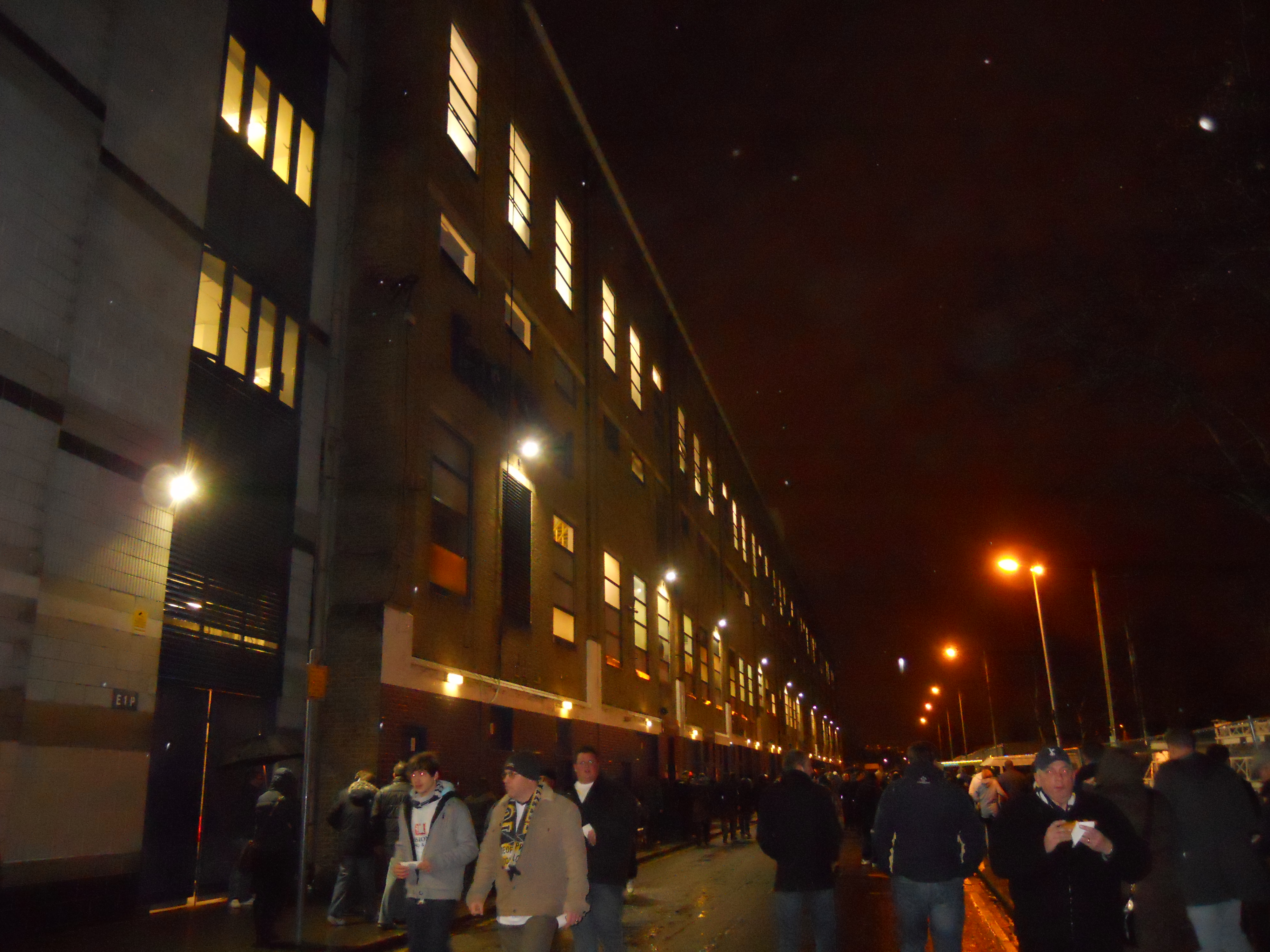
White Hart Lane, East Stand
I can remember queueing behind that stand to get tickets for European matches in the early 1960s.
Those were the days for Spurs.
I probably went and stood in the bottom of the East Stand about fifty times.
I’d usually cycle from where I lived at Cockfosters and park my bike at a garage near by, for a charge of a shilling or so. I remember, I could usually get home quicker than someone who braved the horrendous jams in a car. Sometimes though I’d take a bus to Enfield Town and then take the train to White Hart Lane. That was great fun, in that to avoid the bus queues coming home you’d alight from the train at your fastest running speed, so that you overtook everyone as the train slowed. The joys of slam doors.
I saw the famous double side of 1960-61; Brown, Baker, Henry, Blanchflower, Norman, Mackay, Jones, White, Smith, Allen and Dyson, Jimmy Greaves in his pomp, the antics of Tommy Harmer, the emergence of Pat Jennings, as after that one performance of Ditchburn, the best and most consistent goalkeeper I’ve ever seen, Terry Venables, who we always slagged off for some reason, Ron Henry’s only goal against Manchester United and many other great players and incidents of the 1960s.
Those truly were the days for Spurs.
And to complete a good evening Spurs won by four goals to nil.
Exclamation Marks
If anybody has read much of this blog, you will notice that I use a lot of exclamation marks.
Why? I just like them!
My father was a fan too. But as someone who has set letterpress type, I can appreciate how some letters are favourites and others you just hate. Try spotting the difference between full-stops and commas in something like 6 or 8 point type. It’s not easy.
But the exclamation mark is always instantly recognisable. So do I use it, as I have this hatred of full-stops?
Simon Mayo asked a question on his radio show, as to whether there were any places other than Westward Ho!, that contained exclamation marks. This prompted a search of Wikipedia and the answer was duly e-mailed in and read out. (Simon must have read out upwards of a dozen of my e-mails, but then his father taught me geography at school.)
Hence this post.
Here’s the e-mail.
The English town of Westward Ho!, named after the novel by Charles Kingsley, is the only place-name in the United Kingdom that officially contains an exclamation mark. There is a town in Quebec called Saint-Louis-du-Ha! Ha!, which is spelled with two exclamation marks. The city of Hamilton, Ohio changed its name to Hamilton! in 1986.
Now reading Wikipedia about exclamation marks, observes that computer programmers like me call them shrieks. I do but not because of that.
My father did too! As a printer he was supposed to call them bangs.
Stories of Lady Houston
I’m just watching James May’s Toy Stories about building an Airfix Spitfire.
May has got a few facts wrong about the Battle of Britain, where the Hawker Hurricane was more numerous and was more influential in the Battle of Britain. (To the French, we are too selfish in calling that battle that name. They made a documentary to commemorate the 25th anniversary and said it was the Battle of Europe. If our aerial knights had lost, it would have given Hitler everything he wanted. But the rest, as they say is history!)
I have to put one story that happened to me concerning a Hurricane. I was flying my Piper Arrow from Staverton airport to Ipswich and to do this I had to transit the USAF base at Upper Heyford. Just as I’d received my clearance to cross the zone, I heard a clipped accent say something like this. ‘Heyford Tower, this is Hurricane One, request transit your zone.’ The voice was all very wizard prang and the call-sign was that of the Battle of Britain Memorial Flight.
The reply was American and slightly worried. ‘Say again call-sign and aircraft type’.
The clipped accent replied. ‘Heyford Tower, this is Hurricane One, request transit your zone.’
The American still had no idea what aircraft he had and repeated his request for call-sign and aircraft type. It was at this time, that another American voice broke in. ‘Hurricane One, this is Heyford Tower, permission to transit the zone. That’s a mighty fine aircraft you have there. Any chance of a pass of the tower.’
‘Hurricane One. Wilco!’
Even some Americans know how significant Sidney Camm‘s design is in the history of the UK. Sir Sidney also laid down the design of the Harrier, which had tremendous influence in the outcome of the Falklands War. Has any other designer helped his country in a major way in two wars forty years apart?
I didn’t see the Hurricane that day, but I have stopped by Duxford and seen one doing aerobatic practice on a crisp morning. As someone born just after the Second World War, I felt a lump in my throat. Do children today understand the significance of the Hurricane and the Spitfire?
But why is Lady Houston the title of this post?
Dame Fanny Lucy Houston was one of the first five Dames of the British Empire. She was given that title for looking after tired nurses in the First World War. In Wikipedia she is described as an “English benefactor, philanthropist, adventuress and patriot”.
They also describe her relationship to Robert Houston.
Her third and final marriage, on December 12, 1924, was to Sir Robert Paterson Houston, 1st Bt., member of parliament for West Toxteth, and a shipping magnate. Robert Houston is described in the Oxford Dictionary of National Biography as “a hard, ruthless, unpleasant bachelor”. They lived as tax exiles on the island of Jersey.
When Sir Robert showed her his will, Lucy tore it up telling him that one million pounds was not good enough. Sir Robert then suffered a series of mental disorders and Lucy employed a food-taster to ensure that he was not being poisoned. Even so Sir Robert mysteriously died on his yacht Liberty on 14 April 1926, leaving his widow roughly £5.5 million.
She was described as paranoid with religious delusions and declared mentally unfit to manage her own affairs, but she left Jersey in the Liberty. She then negotiated with the British Government the payment of £1.6 million in death duties. Her political opinions were extreme (she supported Mussolini). According to the Oxford Dictionary of National Biography “she paid for nine by-election meetings by the British National Government to be disrupted”.
Yes! I suspect we’d say she was a couple of bricks short of a full load.
But!
She used her fortune to fund the defence of the Schneider Trophy in 1931. But her gift had long-lasting affects according to Wikipedia.
The gift gave Lucy Houston an opportunity to attack the Labour government, with the declaration: “Every true Briton would rather sell his last shirt than admit that England could not afford to defend herself.” The Prime Minister could not ignore the patriotic fervour that she generated and so yielded.
There were only nine months to prepare and so Supermarine’s designer Reginald Mitchell could only update the existing airframes. Rolls-Royce increased the power of the R-Type engine by 400 hp to 2,300 hp. The improved aircraft Supermarine S.6B won the trophy, though the technical achievement is slightly tarnished by the fact two S6Bs and an S6 were the only participants. (One S6B later broke the air speed record.)
Lady Houston’s gift provided a valuable impetus to the development of engine technology that would ultimately vital in the Second World War in particular the Battle of Britain. The lessons learned in building racing seaplanes also helped Reginald Mitchell to develop the Supermarine Spitfire. As Arthur Sidgreaves, the managing director of Rolls Royce, commented at the time: “It is not too much to say that research for the Schneider Trophy contest over the past two years is what our aero-engine department would otherwise have taken six to 10 years to learn.”
So every Merlin engine that powered the Spitfire, Hurricane, Mosquito and many other aircraft owed a debt to an eccentric English woman.
Would the Battle of Britain have been won, without her gift?
I’ve stood on the Fourth Plinth in Trafalgar Square, but who should be there are Lady Houston, Sydney Camm, R. J. Mitchell and Henry Royce. Three of them were dead before the Second World War, but without them Britain would have lost its most desperate battle.
We think of Royce as the second half of Rolls-Royce, but he was a self-educated engineer of genius. Wikipedia tells this tale, about the successor to the “R” Type engine, that powered the seaplanes.
Following the success of the “R” engine, it was clear that they had an engine that would be of use to the Royal Air Force. As no Government assistance was forthcoming at first, in the national interest, they went ahead with development of what was called the “P.V.12” engine (P.V. standing for Private Venture). The idea was to produce an engine of about the same performance as the “R”, albeit with a much longer life. Royce launched the PV12 in October 1932 but unfortunately did not live to see its completion. The engine completed its first test in 1934, the year after he died. Later, the PV12 became the Rolls-Royce Merlin engine and the man who had once humbly signed the visitors’ book at the RAF Calshot seaplane base as “F.H. Royce – Mechanic” would never know how his engines would go on to change the course of the Second World War.
Most will think of Rolls-Royce as a car manufacturer, but how many know that Royce was one of the most influential men of the twentieth century for what he did in the final years of his life.
But to return to Lady Houston.
My father met her and he described her as mad. She was in bed, with red, white and blue curtains and a Union Flag bedspread. What he was doing, I don’t know and I can’t ask him, but my father was a man who dabbled in left-wing Tory politics and somehow this may have led him to Lady Houston.
I may not have agreed with some of her politics, but…
Well Done Eddie!
Eddie Izzard has now completed his feat of running forty-three marathons in fifty one days for Comic Relief.
In finishing he proved what many thought was an impossible task: that a 47-year-old cross-dresser with no sporting inclination could complete an endeavour usually reserved for a small band of endurance athletes and masochists.
So well done, Eddie!
I have given a small amount to Comic Relief and I hope that others will do so. This link does it and it’s very painless.
I have a confession to make though about Eddie. Much as I like him as a person and find him very funny, when he appears in interviews on the radio and television. But my late wife and I went to see him at the Corn Exchange in Cambridge and walked out at halfway. It could have been that I am going a little deaf or the bad acoustics of the theatre, but we just didn’t get it!
But, it’s still well done to Eddie!
I also have a rather tenuous connection to Eddie.
I have said in previous posts like Letterpress Rules OK, that my father was a printer. One of his employees was a lovely Scot called Frank Black. He actually taught me to drive in the Triumph Herald Estate that the company used for deliveries. But his main job was actually to cut paper on the modern Grieg guillotine. Hence the reason my father always referred to him as “Mac the Knife”.
In a previous job, Frank had run a company in partnership with an Izzard called Angel Electric. I think that they used to provide all sorts of pumps, heaters and other accessories for tropical fish tanks. Hence the name!
The Izzard family were fairly well-known in North London and another was a television producer who used to do a very respected program called Travellers Tales. In one, they were in Iran and they needed to get access to some caves where people had lived many centuries ago. It was thought that no-one had been there since the Middle Ages. So they called up Joe Brown, who at that time was one of the best rock-climbers in the world. (Checking his Wikipedia entry says that Joe is still with us and will be 79 in ten days time!)
Joe just walked up the wall and they were in!
It was fascinating television.
Whenever I read of Eddie and his achievements, I just think of the connections and remember Frank Black, who was a really good bloke.
Seventy Years Ago Today
It was seventy years ago today, when the Second World War was declared when Britain and France decided that enough was enough with the Nazis. The radio was lively this morning with some fascinating stories on Nicky Campbell’s phone-in on Radio 5. It is very good that some of these stories have now been preserved for our descendants.
Do I have any tales from my parents, family and friends?
Surprisingly few, as my parents didn’t really talk about it.
There was my great aunt Alice, who was a psychic. It was claimed that she knew where the bombs would fall, and a couple of times she turned up on friends or relatives and then found she had been bombed herself. Whether it was true or, I haven’t a clue.
My father wasn’t in the Armed Forces and I really don’t know what he did. He did tell tales about how he helped to organise factories so that they would be ready if the Germans landed and that he was an advisor in the Ministry of Aircraft Production. I think too, that he had been briefed by Churchill. But not much is known or remembered. But then he ended up in the latter part of the war working as a toolmaker in a factory in Cheltenham.
So perhaps he had annoyed someone.
Or it may have been he decided he needed a change after the break-up of his first marriage.
My family was also lucky, in that I don’t know of anyone on either side, who was killed, injured or spent some time in a prisoner of war camp.
It was just all rather boring really.
But as time goes on and I get older, I am drawn towards my ancestry, Jewish on my father’s side, albeit a long way back and Huguenot on my mother’s.
Today, I’ve been thinking of all those poor people who died in the Second World War and especially those German or East European Jewish relatives of mine who didn’t survive.
Perhaps I Should Get a Sewing Machine
They’ve just announced that the “Make Do and Mend” culture is returning, with John Lewis reporting an increase in the sale of sewing machines. The department store has also brought out a guide with the same name.
You may ask, why a sixty-two year old man would buy a sewing machine. I probably won’t, but I used to be very handy with one, having been taught how to sew by my mother.
When we were first married, I used to make some of my wife’s clothes. I can remember making several dresses and a long brown coat. In fact, somewhere in this house is a short maternity dress, that I made in 1969 out of some red Dorcas fabric.
My father also taught me how to do proper carpentry, service cars, hang wallpaper and of course everything there is to know about real letterpress printing.
I don’t think we taught our children such a wide range of skills. And I think that these days kids learn even less from their parents.
Missing Apostrophes
There has been a lot of talk lately about missing apostrophes. One guy in Royal Tunbridge Wells has gone as far as painting them in where he lives. It provokes this piece in the Telegraph, from the wonderfully named Harry de Quetteville.
But leaving punctuation out of road signs is not new. Look at this one from Ipswich, which has been there for some years.
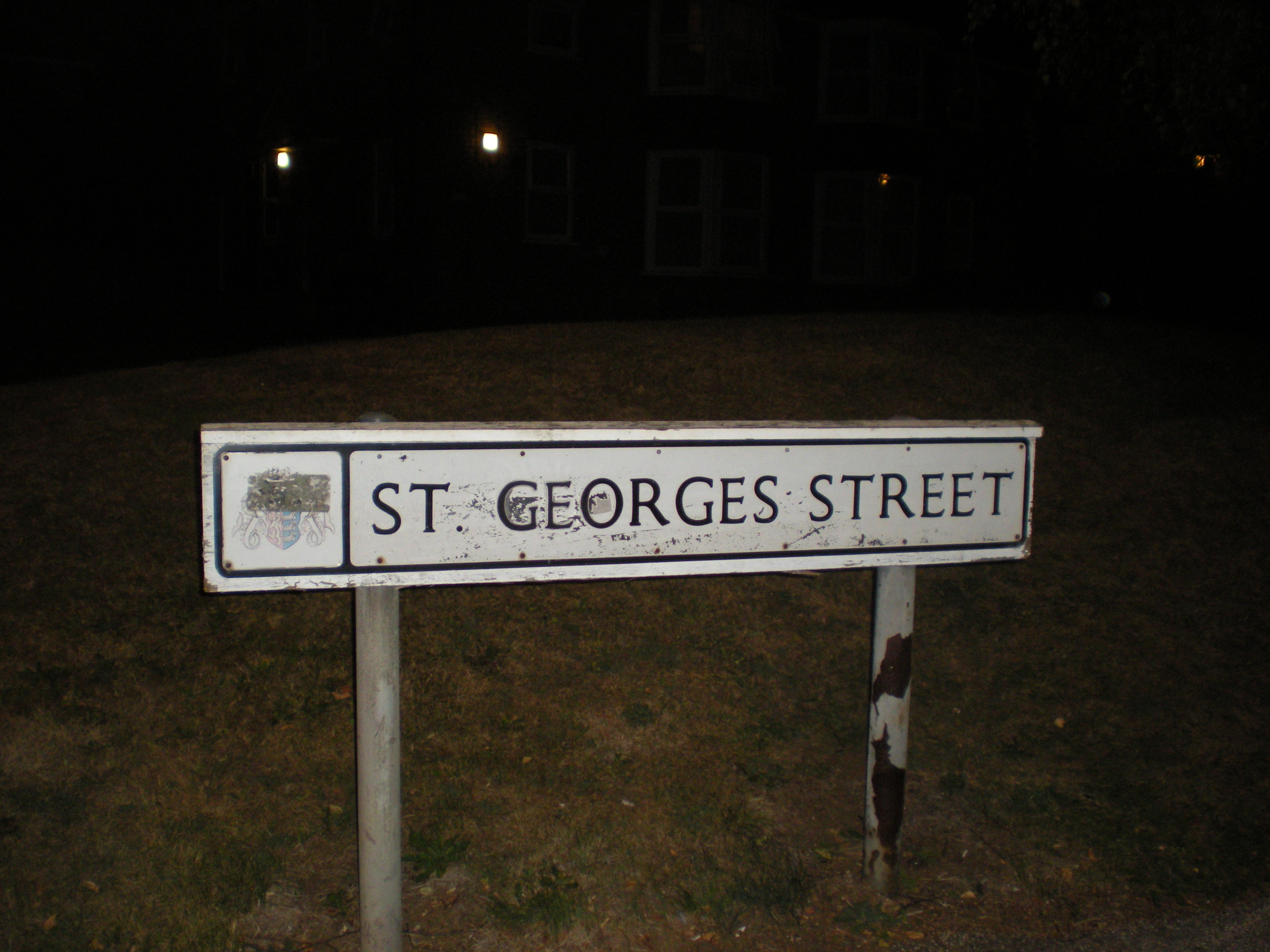
St. George’s Street, Ipswich
This sign is actually a lot newer than the one at the other end of the road, which was one of the old-fashioned cast ones.
My father was always hot on punctuation. But then he was a printer and was always having arguments with customers about it. Although not specifically punctuation, the thing that really got his goat was when to use the plural form of verbs.
So which is correct.
The Chairman and the Board of Directors request your pleasure at the opening of their new factory.
Or.
The Chairman and the Board of Directors requests your pleasure at the opening of their new factory.
You can argue that in the first, there are more than one of them, so it’s request, but in the second they are a single entity, so it’s request.
Do we have a pedant out there, who can tell me what is correct?
In addition I am a stickler for layout. Nothing annoys me more than when I get a document or read a web page, which is poorly laid out. My father was the same.
There is no excuse for bad design.
What Would Oswald Mosley Have Thought?
Just watching the Holland-England game on the box.
One of the odd things of this match is that Holland are playing in all plain orange and England are playing in plain white. You don’t see that often these days, as marketeers think that fancy strips sell better. The new England strip says that they don’t, as it is selling well. I suspect that something plain is acceptable in many more places like decent restaurants and clubs!
It’s interesting to look at the England side and see how many players are not your average white bloke.
They started with Green, Johnson, Ashley Cole, Ferdinand, Terry, Barry, Beckham, Lampard, Young, Heskey, Rooney. Only Green, Terry, Barry, Beckham, Lampard and Rooney would fall into Mosley’s preferred racial group.
Look at who Fabio Capello would have preferred to play like David James and who he used as substitutes and you might have an England team that line is as James, Johnson, Ashley Cole, Ferdinand, Terry, Barry, Wright-Phillips, Lampard, Young, Heskey, Defoe. Here it’s only Terry, Barry and Lampard.
Does anybody care?
I don’t!
My father wouldn’t have either.
He told me he was there at the Battle of Cable Street, when a coalition of Jews, communists and anti-fascists opposed Oswald Mosley and his supporters marching through the East End of London. But my father wasn’t a communist, although he did have Jewish ancestry, but a left-wing member of the Tory party. That may seem strange today, but race and religion often wasn’t a problem for a lot of Edwardians. It certainly wasn’t for my father, who I never heard say anything racist.
As I get to know my father more from people who met him, I suspect that he was there and his claim that he hit Mosley with a tomato may well be true.
Diphthongs
My father was a printer and he was a great believer in dipthongs. In letterpress type they are actually double characters, so they have a nice heavy feel.
So in the last post on Coventry Cathedral, I have spelt mediaeval with an extra “a”.
 The Anonymous Widower