OLE Upgrades Complete At Anglia As Part Of £46m Transformation
The title of this article, is the same as that of this article on Rail Technology Magazine.
I hope this is actually the case.
- I’ve had enough of rail replacement buses, when trying to get to football at Ipswich on a Saturday.
- For at least the last three years, I’ve probably seen more away matches, than those at Portman Road.
- Three hours each way to Ipswich, effectively means, the only pleasurable thing you do is see the match.
- This work has probably hit attendances at both Norwich and Ipswich.
- I’ve renewed my season ticket fort next season, but if it is as thin on home matches as this one has been, it will be my last season of travel.
What puzzles me, is why can’t Network Rail adjust their work schedule, so that at least important matches like the two Derbies have trains?
But then you wouldn’t rate Network Rail highly for Project Management!
High-Speed Handbacks Could Save NR £250,000 A Week
The title of this post is the same as that, of this article on Rail Technology Magazine.
The article described how by using a more sophisticated tamping machine, Network Rail are able to hand the track back faster after maintenance.
Many businesses, as Network Rail do here, use outdated processes to do regular tasks.
Often by using an improved procedure, companies can save money.
In this instance, Network Rail are saving enough in a year to perhaps build a small station.
Can you be sure, you use the best processes in your business?
Hitachi Battery Trains On The Great Western Railway
The slow pace of the electrification on the Great Western Main Line has become a big stick with which to beat Network Rail.
But are rolling stock engineers going to pull Network Rail out of their hole?
On page 79 of the January 2018 Edition of Modern Railways, Nick Hughes, who is the Sales Director of Hitachi Rail Europe outlines how the manufacturer is embracing the development of battery technology.
He is remarkably open.
I discuss what he says in detail in Hitachi’s Thoughts On Battery Trains.
But here’s an extract.
Nick Hughes follows his description of the DENCHA; a Japanese battery train, with this prediction.
I can picture a future when these sorts of trains are carrying out similar types of journeys in the UK, perhaps by installing battery technology in our Class 395s to connect to Hastings via the non-electrified Marshlink Line from Ashford for example.
This would massively slice the journey time and heklp overcome the issue of electrification and infrastructure cases not stacking up. There are a large number of similar routes like this all across the country.
It is a prediction, with which I could agree.
I conclude the post with this conclusion.
It is the most positive article about battery trains, that I have read so far!
As it comes direct from one of the train manufacturers in a respected journal, I would rate it high on quality reporting.
Hitachi Battery Train Technology And Their UK-Built Trains
The section without electrification on the Marshlink Line between Ashford International and Ore stations has the following characteristics.
- It is under twenty-five miles long.
- It is a mixture of double and single-track railway.
- It has nine stations.
- It has a sixty mph operating speed.
As the line is across the flat terrain of Romney Marsh, I don’t think that the power requirements would be excessive.
In the Modern Railway article, Nick Hughes suggests that battery technology could be installed in Class 395 trains.
The Class 395 train is part of a family of trains, Hitachi calls A-trains. The family includes.
- Class 800 trains as ordered by GWR and Virgin Trains East Coast.
- Class 801 trains as ordered by GWR and Virgin Trains East Coast
- Class 802 trains as ordered by GWR, Hull Trains and TransPennine Express
- Class 385 trains as ordered by ScotRail.
In Japan, another member of the family is the BEC819, which is the DENCHA, that is mentioned in the Modern Railways article.
As a time-expired electrical engineer, I would think, that if Hitachi’s engineers have done their jobs to a reasonable standard, that it would not be impossible to fit batteries to all of the A-train family of trains, which would include all train types, built at Newton Aycliffe for the UK.
In Japan the DENCHAs run on the Chikuhō Main Line, which has three sections.
- Wakamatsu Line – Wakamatsu–Orio, 10.8 km
- Fukuhoku Yutaka Line – Orio–Keisen, 34.5 km
- Haruda Line – Keisen–Haruda, 20.8 km
Only the middle section is electrified.
It looks to me, that the Japanese have chosen a very simple route, where they can run on electrification for a lot of the way and just use batteries at each end.
Bombardier used a similar low-risk test in their BEMU Trial with a Class 379 train in 2015.
So How Will Battery Trains Be used On the Great Western?
On the Great Western Main Line, all long distance trains and some shorter-distance ones will be Class 80x trains.
The size of battery in the DENCHA can be estimated using a rule, given by Ian Walmsley.
In an article in the October 2017 Edition of Modern Railways, which is entitled Celling England By The Pound, Ian Walmsley says this in relation to trains running on the Uckfield Branch.
A modern EMU needs between 3 and 5 kWh per vehicle mile for this sort of service.
So the energy needed to power the DENCHA, which is a two-car battery train on the just under twenty miles without electrification of the Chikuhō Main Line in a one way trip would be between 112 and 187 kWh.
A Battery-Powered Class 801 Train
The Class 801 train is Hitachi’s all-electric train, of which Great Western Railway have ordered thirty-six of the closely-related five-car Class 800 train and twenty-one of the nine-car units.
The difference between the two classes of train, is only the number of generator units fitted.
- Trains can be converted from Class 800 to Class 801 by removing generator units.
- Bi-mode Class 800 trains have a generator unit for each powered car.
- The all-electric Class 801 train has a single generator unit, in case of electrical power failure.
- When trains couple and uncouple, the train’s computer system determines the formation of the new train and drives and manages the train accordingly.
If I was designing the train, I would design a battery module, that replaced a generator unit
This leads me to think, that a five-car Class 801 train, could have one generator unit and up to four battery modules.
- The computer would decide what it’s got and control the train accordingly.
- The generator unit and battery power could be used together to accelerate the train or at other times where high power is needed.
- If the batteries failed, the generator unit would limp the train to a safe place.
- The number of battery units would depend on the needs of the route.
It would be a true tri-mode train; electric, diesel and battery.
I will now look at some routes, that could see possible applications of a battery version of Class 80x trains.
Cardiff To Swansea
I’ll start with the most controversial and political of the cutbacks in electrification.
At present plans exist to take the electrification on the Great Western as far as Cardiff Central station, by the end of 2018.
The distance between Cardiff Central and Swansea stations is forty-six miles, so applying the Ian Walmsley formula and assuming the train is five-cars, we have an energy usage for a one-way trip between the two cities of between 690 and 1150 kWh.
As the Class 80x trains are a modern efficient design, I suspect that a figure towards the lower end of the range will apply.
But various techniques can be used to stretch the range of the train on battery power.
- From London to Cardiff, the line will be fully-electrified, so on arrival in the Welsh capital, the batteries could be fully charged.
- The electrification can be continued for a few miles past Cardiff Central station, so that acceleration to line speed can be achieved using overhead wires.
- Electrification could also be installed on the short stretch of track between Swansea station and the South Wales Main Line.
- There are three stops between Cardiff and Swansea and regenerative braking can be used to charge the batteries.
- The single generator unit could be used to help accelerate the train if necessary.
- There are only two tph on the route, so efficient driving and signalling could probably smooth the path and save energy.
- Less necessary equipment can be switched off, when running on batteries.
Note. that the power/weight and power/size ratios of batteries will also increase, as engineers find better ways to build batteries.
The trains would need to be charged at Swansea, but Hitachi are building a depot in the city, which is shown in these pictures.


It looks like they are electrifying the depot.
Surely, enough electrification can be put up at Swansea to charge the trains and help them back to the South Wales Main Line..
The mathematics show what is possible.
Suppose the following.
- Hitachi can reduce the train’s average energy consumption to 2 kWh per carriage-mile, when running on battery power.
- Electrification at Cardiff and Swansea reduces the length of battery use to forty miles.
This would reduce the battery size needed to 400 kWh, which could mean that on a five-car train with four battery modules, each battery module would be just 100 kWh. This compares well with the 75 kWh battery in a New Routemaster bus.
Will it happen?
We are probably not talking about any serious risk to passengers, as the worst that can happen to any train, is that it breaks down or runs out of power in the middle of nowhere. But then using the single generator unit, the train will limp to the nearest station.
But think of all the wonderful publicity for Hitachi and everybody involved, if the world’s first battery high speed train, runs twice an hour between Paddington and Swansea.
Surely, that is an example of the Can-Do attitude of Isambard Kingdom Brunel?
Paddington To Oxford
The route between Paddington and Oxford stations is electrified as far as Didcot Parkway station.
The distance between Didcot Parkway and Oxford stations is about ten miles, so applying the Ian Walmsley formula and assuming the train is five-cars, we have an energy usage for the return trip to Oxford from Didcot of between 300 and 500 kWh.
If the five-car train has one generator unit,four battery modules and has an energy usage to the low end, then each battery module would need to handle under 100 kWh.
There are plans to develop a South-facing bay platform at Oxford station and to save wasting energy reversing the train by running up and down to sidings North of the station, I suspect that this platform must be built before battery trains can be introduced to Oxford.
If it’s not, the train could use the diesel generator to change platforms.
The platform could also be fitted with a system to charge the battery during turnround.
Paddington To Bedwyn
The route between Paddington and Bedwyn is electrified as far as Reading station, but there are plans to electrify as far as Newbury station.
The distance between Newbury and Bedwyn stations is about thirteen miles, so applying the Ian Walmsley formula and assuming the train is five-cars, we have an energy usage for the return trip to Bedwyn from Newbury of between 390 and 520 kWh.
As with Paddington to Oxford, the required battery size wouldn’t be excessive.
Paddington To Henley-on-Thames
The route between Paddington and Henley-on-Thames station is probably one of those routes, where electric trains must be run for political reasons.
The Henley Branch Line is only four miles long.
It would probably only require one battery module and would be a superb test route for the new train.
Paddington To Weston-super-Mare
Some Paddington to Bristol trains extend to Weston-super-Mare station.
Weston-super-Mare to the soon-to-be-electrified Bristol Temple Meads station is less than twenty miles, so if Swansea can be reached on battery power, then I’m certain that Weston can be reached in a similar way.
Other Routes
Most of the other routes don’t have enough electrification to benefit from trains with a battery capability.
One possibility though is Paddington to Cheltenham and Gloucester along the Golden Valley Line. The length of the section without electrification is forty-two miles, but unless a means to charge the train quickly at Cheltenham station is found, it is probably not feasible.
It could be possible though to create a real tri-mode train with a mix of diesel generator units and battery modules.
This train might have the following characteristics.
- Five cars.
- A mix of generator units and battery modules.
- Enough generator units to power the train on the stiffest lines without electrification.
- Ability to collect power from 25 KVAC overhead electrification
- Ability to collect power from 750 VDC third-rail electrification.
Note.
- The battery modules would be used for regenerative braking in all power modes.
- The ability to use third rail electrification would be useful when running to Brighton, Exeter, Portsmouth and Weymouth.
The train could also have a sophisticated computer system, that would choose power source according to route,timetable, train loading, traffic conditions and battery energy level.
The objective would be to run routes like Paddington to Cheltenham, Gloucester to Weymouth and Cardiff to Portsmouth Harbour, as efficiently as possible.
Collateral Advantages
Several of the routes out of Paddington could easily be worked using bi-mode Class 800 trains.
- But using battery trains to places like Bedwyn, Henley, Oxford and Weston-super-Mare is obviously better for the environment and probably for ticket sales too!
- If places like Bedwyn, Henley and Oxford are served by Class 801 trains with a battery option, it could mean that they could just join the throng of 125 mph trains going in and out of London.
- Battery trains would save money on electrification.
I also suspect, that the running costs of a battery train are less than those of using a bi-mode or diesel trains.
Conclusion
Hitachi seem to have the technology, whereby their A-train family can be fitted with batteries, as they have done it in Japan and their Sales Director in the UK, has said it can be done on a Class 395 train to use the Marshlink Line.
We may not see Hitachi trains using batteries for a couple of years, but it certainly isn’t fantasy.
Great Western Railway certainly need them!
This Year’s Engineers Christmas Party Is At Highbury And Islington Station
Three year’s ago, I wrote VolkerFitzpatrick Are Having A Christmas Party At South Tottenham.
This year’s Engineers Chrismas Party is at Highbury and Islington station, where they are replacing the bridge on the Holloway Road over the North London Line.
These pictures were taken on the 20th of December.
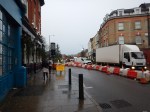
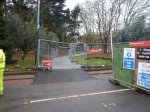
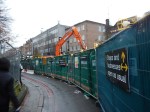


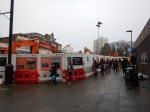
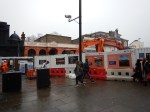
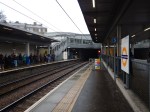
The first action of the rebuilding of the bridge was the shutting of the Post Office outside the station, which I wrote about in Highbury And Islington Post Office Is Now Shut.
That post dates from July 2014 and signs around the station say the bridge will be replaced by Summer 2018.
Four years to rebuild a bridge. Are Network Rail looking for an entry in the Guinness Book Of Records?
But then Network Rail has form with bridges in North London.
On the Gospel Oak to Barking Line, they forgot to rebuild the bridges at Wightman Road and Crouch Hill.
These pictures were taken on the 22nd of December.

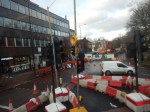

These pictures were taken on the 28th of December.




These pictures were taken on the 31st of December.


The large cranes have gone.
The 8th of January marked the reopening of the roads.

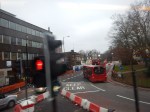
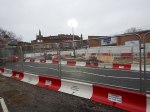
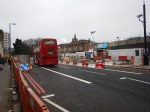
I think the bridge will be fully completed in the Summer.
Progress On The Sheffield-Rotherham Tram-Train
I took these pictures in Sheffield and Rotherham, whilst trying to take pictures of Class 399 tram-trains.
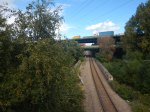
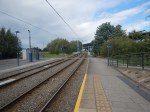
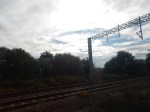


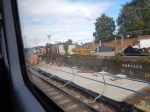
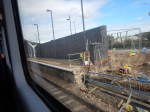
Note.
- The heavy-weight gantries for the electrification, which I suspect would support 25 KVAC electrification.
- It appears simple bi-level platforms are being built at Rotherham Central station.
- Could a stop being put at the New York stadium?
It certainly doesn’t seem to be an expensive system.
Single Or Double Track Electrified At 25 KVAC
The heavy rail route which is both single and double-track is electrified using standard 25 KVAC electrification.
Simple Voltage Changeover
In Karlsruhe, a ceramic rod is used to connect the overhead wires of different voltages. The pantograph of the tram-train runs on this rod, as the vehicle passes between the two voltages.
The different voltages would be handled automatically on the tram-train.
Kinetic energy or a battery will take the tram-train over the very short dead section.
I didn’t see it, but I suspect a similar system is used on the Tinsley Chord in Sheffield, where the two voltage systems meet.
The advantage of this simple system, is that voltage changeover can be completely automatic, with the driver only monitoring the changeover.
Simple Bi-Level Platform Extensions
This technique is used in Karlsruhe, where they have myriad problems due to various classes of tram-trains and conventional trains.
Modern construction methods will certainly help here.
How Did Network Rail Manage To Spend So Much Money?
The only feasible positive explanation is that this tram-train trial is being very comprehensive and covers all possible UK operations.
- The tram-trains are tested on 25 KVAC at Rotherham.
- Single and double-track.
- The tram-trains are tested on 750 VDC all over Sheffield.
- The tram-trains are tested on sharp curves and climbing hills on the Sheffield Supertram network.
- The voltage changeover is thoroughly tested on the Tinsley Chord.
- Platform designs get a rigorous test.
If the tram-train passes these tests and the regulators and operators like it, it’ll be passed for the UK network.
Is The Rotherham Trial A Tram-Train Or A Train-Tram?
When going from Sheffield to Rotherham, the Class 399 train, starts as a tram and changes to a train on the Tinsley Chord.
But when going from Rotherham to Sheffield, the vehicle starts as a train and changes to a tram.
So I suppose it’s both and it changes over where the voltage changes on the Tinsley Chord.
But just as in the Rotherham trial, provided there is an overhead wire with an acceptable voltage, the Class 399 tram-trains can run on any track, be it for trams or trains.
On What Routes Could A Class 399 Train Run?
There are several possibilities.
Extending An Existing Tram Network On A Heavy Rail Line
The tram-train runs normally on a standard tram line and then the route is extended on a heavy rail line, which is electrified with 25 KVAC overhead wires.
This is what is being done at Rotherham.
More possibilities exist in Sheffield and probably on other systems like Birmingham, Blackpool, Edinburgh, Manchester and Nottingham.
Creating A Tram Link Across A Town Or City
Suppose a town or city has two electrified stations on opposite sides. Perhaps one handles trains from the West and the other handles trains from the East.
If a tram route can be created between the two stations, which is connected to the lines at the station, then tram-trains can run across the town or city.
This has been done in Karlsruhe and other European cities, but I doubt we’ll see a cross-city link like this in the UK for a decade or two.
Creating A Tram Link Between Two Electrified Lines
This is similar to the previous application, except that the tram route might be in a rural area.
One possibility might be from Cambridge to Marks Tey along a rebuilt Stour Valley Railway.
Running A Branch On A Heavy Rail Line As A Tram
Creating a branch line to tram standards should be cheaper than creating it to heavy rail standards.
The proposed Glasgow Airport Tram-Train could be built this way, by building a tram track from the Inverclyde Line to the Airport.
The branch would have the following characteristics.
- Segregated single-track from the Inverclyde Line
- 750 VDC overhead electrification.
- Low floor tram-trains.
- Simple stations.
The tram-trains could run as normal electric trains from Glasgow Central station to West of Paisley St. James station, where they would take to the branch line and run as trams to the Airport.
As the performance of a Class 399 tram-train is not much slower than the current Class 314 trains that work some services on the Inverclyde Line, I feel that fitting the tram-train service into the service pattern on the line would be possible.
I estimate that a round trip from Glasgow Central to the Airport could be done within an hour, which would mean that to provide an adequate four tram-trains per hour, would require four vehicles.
Two other airports could be served in this way; Leeds and Liverpool
- Leeds Airport would require electrifying as far as Horsforth station, where a tram track would lead to the Airport.
- I suspect that the tram-trains could not only connect Leeds to the Airport, but Bradford as well.
- Liverpool Airport from Liverpool Lime Street services would change to a tram at Liverpool South Parkway station.
I think we’ll be seeing tram-trains used for services like these.
Consider these points.
- A suitable station on the electrified network is needed as a terminus.
- A suitable junction must be possible between the branch and the electrified network.
- Any number of stops could be built on the branch.
- Simple tram-style 750 VDC overhead wires can be used, which would be less visually intrusive.
Some schemes will be simple like perhaps the Slough to Windsor and Eton Line and others would be more complicated.
Conclusion
In a year or so’s time, we’ll know if tram-trains are another method of expanding and improving the UK’s rail network.
The Halton Curve: Small Piece Of Track, Big Rail Ambitions
The title of this post is the same as that of an article on the Rail Technology Magazine web site.
The Halton Curve will create a link between Liverpool and North Wales. This page on the Network Rail web site gives more details.
Work has started on the 1.5 miles of rail track, known as the ‘Halton Curve,’ that will unlock leisure and business opportunities between the Liverpool City Region, its airport, Cheshire and North Wales.
Vital upgrades to signalling and track will enable new services between Liverpool and Chester, serving Liverpool Lime Street, Liverpool South Parkway (for Liverpool John Lennon Airport) Runcorn, Frodsham and Helsby.
The existing line, which currently only runs a one-way passenger service once a week in the summer, will be upgraded to provide an hourly service in each direction from December 2018 with the potential for connections to North Wales in the future.
Restoring the Halton Curve is similar to a number of smaller projects that have been executed in the last few years, to improve connectivity and efficiency in the UK rail network.
- Allington Chord – A short section of track removed a bottleneck at Grantham on the East Coast Main Line.
- Bacon Factory Curve – A 1,415 metre link at Ipswich, that improves the operation of freight trains to and from the Port of Felixstowe and speeds up services on the Great Eastern Main Line.
- Hitchin Flyover – A flyover at Cambridge Junction on the East Coast Main Line, that cut delays to expresses on the East Coast Main Line.
- North Doncaster Chord – A flyover to take freight trains between Immingham and Drax over the East Coast Main Line.
- Todmorden Curve – Four hundred metres of reinstated railway, that now allows direct services between Burnley Manchester Road and Manchester Victoria stations.
Most seem to have been worthwhile. But look back a couple of decades and it was unlikely that some of these projects would ever be needed.
As the economy grows, freight moves from road to rail and more people travel a lot more by rail, it is very difficult to predict what will happen in the future. I feel we should address the following.
If we remove a railway line, we should not destroy the ability to reinstate the line. Rebuilding the Waverley Route and the Varsity Line would be a lot easier, if this rule had been followed.
Network Rail appear to have a tendency to kick smaller projects into the future. A simple example is the creation of a bay platform at Stevenage station to turn back services on the Hertford Loop Line which seems to have been pushed back until after the new Class 717 trains arrive.
Waterloo Upgrade August 2017 – Waterloo To Sevenoaks
During this week Network Rail are working on the OverJubilee or the lines between London Bridge, Waterloo East and Charing Cross, so capacity from places like Sevenoaks station is reduced.
To compensate Southeastern are running a two trains per hour (tph) service between Sevenoaks and Platform 22 at Waterloo station.
- One train goes to Dover Priory station and the other goes to Ramsgate station.
- The trains take the old Eurostar route into Waterloo station over the Waterloo Curve or the Nine Elms Flyover.
So I thought I’d have a look, hoping to perhaps have a lunch in Sevenoaks.
These are a few pictures I took.












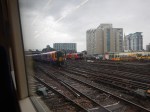
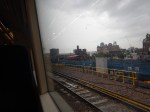

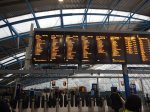
There would have been more, but it was chucking it down and the ones I took were terrible.
The Linford Street Junction And The Waterloo Curve
This map from carto.metro.free.fr shows the Linford Street Junction and the Waterloo Curve.
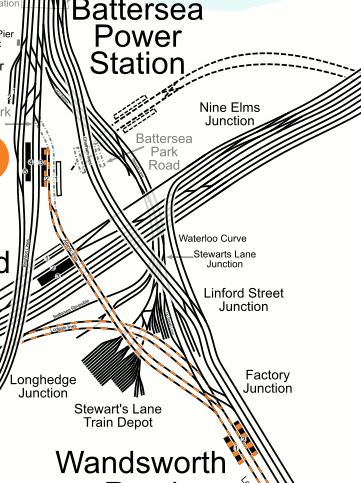
The Junction and the Curve are used by trains to connect from Waterloo in the North East, to the lines from Victoria that go across South London via Denmark Hill and Peckham Rye stations.
Note how the train going into Waterloo and the train coming out passed on the flyover. I assume this was for safety so that trains could leave and join the lines to Victoria at Linford Street Junction.
These pictures of the flyover were taken on another journey to Clapham Junction station.



The flyover is recent and was built for Eurostar and completed in May 1993. There’s a page called Nine Elms Flyover on the Kent Rail website, which gives a detailed history of the flyover.
The Route Between Waterloo And Sevenoaks
The journey between Waterloo And Sevenoaks passed through the following stations without stopping.
- Vauxhall
- Wandsworth Road
- Clapham High Street
- Denmark Hill
- Peckham Rye
- Nunhead
- Lewisham
- Hither Green
- Grove Park
- Elmstead Woods
- Chislehurst
- Petts Wood
- Orpington
- Chelsfield
- Knockholt
- Dunton Green
From Lewisham station onwards the route is on the South Eastern Main Line.
Overall Impressions
The route seemed to work well, although between Waterloo and Lewisham, the train was rather slow, with a slight delay joining the lines out of Victoria.
The journey was timed at 47 minutes, with the fastest normal services between London and Sevenoaks being around ten minutes faster.
It certainly seems to be providing an extra two tph between London and Sevenoaks. In Eurostar days, it handled up to six tph.
I also suspect it could handle twelve-car trains, although my journey was in an eight-car train.
Future Developments Along The Route
There are going to be more developments to rail services along the route and also into Kent. Many will be driven, by the bidding for the new Southeastern Franchise.
Ashford International Station
In Kent On The Cusp Of Change – Ashford Spurs, I talked about the completed upgrading of Ashford International station, so that more Eurostar and other Continental services can call.
As the station is going to get more Highspeed services, I can envisage some innovative ways to make more and better use of this station.
Bakerloo Line Extension To Lewisham
The Bakerloo Line Extension will provide passengers with the option of using the Underground from Lewisham to access Central and North London.
Brockley Lane Station
The Lewisham Line runs between Peckham Rye and Lewisham stations and is used by Southeastern trains from both Victoria and Waterloo.
There used to be a Brockley Lane station, where the route crosses the current London Overground’s East London Line, close to Brockley station.
This is said under Future in the Wikipedia entry for the station.
According to the Department for Transport and the Transport for London rail prospectus report released in 2016, it has been listed as one of the Southeastern franchise planned improvements in the document entitled “New interchange at Brockley”, suggesting that there might be a case to reopen the station.
Creating an interchange here would certainly open up lots of travel opportunities.
It should be noted that Brockley station will from 2020, have a ten tph service to Canada Water and Whitechapel stations, with all their Crossrail and Underground connections.
Charing Cross Station
Charing Cross station is bursting at the seams, with typically fourteen and more trains in each hour.
This extract comes from Network’s Kent Route Study.
Charing Cross has just six 12-car platforms and Platforms 4, 5 and 6 are very narrow, leading to operational restrictions.
Class 465 units cannot operate in 12-car into these platforms and selective door operation is used on Class 375 units.
A major rebuild of the station could allow it to be extended south over the river, like Blackfriars, providing compliant platforms and greater passenger circulation.
At concept level, a new link to Waterloo from a southern entrance to Charing Cross may supersede Waterloo East allowing the station area to be used for additional track capacity, but there are likely to be many issues with a project on this scale.
One of the many issues would be how to keep services running during the rebuild of the station.
I suspect that Waterloo could have a role to play in handling some of the services.
Fawkham Junction Link
In Kent On The Cusp Of Change – Fawkham Junction Link, I talked about the proposal to reopen the Fawkham Junction Link, which was originally used to allow Eurostar trains to get to Waterloo station.
If this link were to be reopened, coupled with what has been happening between Waterloo and Sevenoaks, this would enable extra Southeastern HighSpeed services to Thanet to be run to either Victoria or Waterloo.
Victoria Station
Victoria station will periodically need work and might even be subject to a major upgrade project.
As with Charing Cross, I’m sure Waterloo could be used as an alternative terminus for a few trains.
Could Southeastern Services Into Waterloo Become Permanent?
I suspect that as has been successfully shown this week, that it is a feasible proposition.
But whether it actually happens would be up to the train operators.
Consider.
- Eurostar used to run a 6 tph service on this route.
- A single well-designed platform can handle 4 tph.
- The new platforms can handle twelve-car trains.
But most importantly, the train operators will have all the passenger data!
Conclusion
Southeastern and Network Rail have certainly shown it is possible to run a two tph service successfully between Sevenoaks and Waterloo.
If nothing else, it could prove to be a useful alternative route during engineering works or other diversions.
Electrification ‘Very Unlikely’ To Come Back Into EWR Scheme
The title of this post is the same as this article on Rail Technology Magazine.
This is a quote from Andy Free, who is head of engineering of the alliance that is building the East West Rail Link.
The steer from the DfT is that wherever the Alliance is building a new structure it needs to be clear and suitable for electrification, “and we must do nothing that hinders future electrification, but it is not on the short- or medium-term horizon.
Given the developments in bi-mode trains in recent years, I suspect this is a sensible policy.
Electrification is probably cheaper to fit to a train in a nice warm factory in Derby or Newton Aycliffe, than at a remote location in the pouring rain and the howling wind.
In the case of the East West Rail Link, where sections of the route are well defined, as they are existing rail alignments, building the route would involve.
- Raising any over-bridges to be clear of future electrification.
- Building any bridges or flyovers, where the new railway crosses over roads and other railways.
- Preparing the track bed.
- Laying the track.
- Building or rebuilding the stations.
Note I have ignored signalling, as ideally that will be in-cab by radio.
Building the line without electrification must give advantages.
- Network Rail seem to find it impossible to do electrification projects to time and budget.
- Stations without electrification are safer places and easier to design and build.
- There is less visual intrusion for Nimbys to complain about.
- The cost of connecting the electrification to the National Grid is zero.
- There is less copper cable to steal.
In Is A Bi-Mode Aventra A Silly Idea?, I outlined what I believe the ultimate bi-mode train will be like.
A bi-mode Aventra would be a sophisticated train with the following characteristics.
- Electric drive
- Regenerative braking.
- 25 KVAC overhead and 750 VDC third rail capability.
- Automatic pantograph deployment.
- Onboard energy storage.
- Automatic power source selection.
- Diesel or hydrogen power-pack
The first four are probably already in service in the Class 345 train.
A train going from between Reading and Bedford on the East West Rail Link, would charge its energy storage at the terminals and then use this power along the route. If the train detected that the stored energy was running low, the diesel or hydrogen power-pack would cut in and charge the energy storage.
Conclusion
It is my view, that if you are building a new rail line that is not high speed or high frequency, that there is no need to electrify the line, as intelligent bi-mode trains will be able to work the route economically and without the noise, pollution and vibration problems of their diesel engines working all the time.
The West Midlands And Chilterns Route Study
This document on the Internet is the West Midlands And Chilterns Route Study.
 The Anonymous Widower