The NHS And Disruptive Innovation
I’m a great fan of disruptive innovation. It summed up in Wikipedia as follows.
A disruptive innovation is an innovation that helps create a new market and value network, and eventually goes on to disrupt an existing market and value network (over a few years or decades), displacing an earlier technology.
In some ways the classic disruptive innovation is iTunes, where Apple changed the music industry totally.
I, of course, would be a fan, because my first great success was Artemis, which took the project management industry out of the domain of large mainframe computers and cumbersome management structures into a computer that fitted under a desk.
But I have given this post, the title I have, as the NHS and other health systems is coming under pressure from disruptive innovation.
My other big innvation success was also disruptive innovation.
I was one of the backers of the technology that led to Respimat, a metered-dose inhaler.
That device seems to be too disruptive, as despite many years of development, I don’t think it is in general use.
It doesn’t use any batteries, compressed gases, nasty chemicals and is affordable to be throwaway. But despite their HCFC propellants, the incumbents in the healthcare industry, have not given market share.
But I have the satisfaction, that because of my scientific knowledge and practical experience, I spotted that the guys I backed could do something special. At least too, when I sold my share, I was well rewarded.
I do feel though that the NHS doesn’t do things in the same way as perhaps John Lewis would, when it comes to handling new methods of working.
As an example I was talking to my excellent GP about how having my cholesterol results on my blog, helped the doctors in Hong Kong when I had my stroke. I said it would be great if all our medical records were searchable on line. We were also discussing a small operation I had on my nose ten years ago and wondering if it should be done again to stop the nose bleeds I sometimes get.
We then both said that computerisation had been an expensive farce, but we were both agreed it would be a good thing, especially if like me you travel a lot. He did say Google launched something called Google Health, but that has now been discontinued. Read about it here.
So did the general conservatism of health professionals and a lot of the general public kill the project. Google don’t have many failures.
Reading about it, it seems that it would have been something I would have used.
If I look too at my Coaguchek, that is classic disruptive innovation. I don’t know how many use the device in the UK, but I suspect it’s not a large proportion of those who could benefit from such a device.
I suspect though that in a few years this device and its probably simpler successors will be as accepted as the monitors used by diabetics.
Small personal patient used technology like this will become more common. After all, we now have a population, who love their gadgets and what better gadget is there, than one that helps you improve your health.
The NHS is going to have to get used to new technology and especially where that technology shows substantial cost savings. But a lot of it, will mean changes in methods and management structures.
Disruptive innovation will improve the NHS, but it will be an NHS with a different number and type of hospitals, and staff not always deployed as they are now.
Is It Goodbye To Trafford General Hospital?
Trafford General Hospital is going to be downgraded in phases according to this report. Here’s the first three paragraphs.
Campaigners fighting to save a hospital A&E department where the first NHS patient was treated say they will challenge the decision in court.
Health secretary Jeremy Hunt said on Thursday that Trafford General Hospital was to be downgraded in phases.
He said the decision had been taken because there were too few patients using the department.
My son was in that hospital several times, a few months before he died and they had no idea he had pancreatic cancer.
I certainly won’t miss its passing and I suspect as it seems to be suffering from Stafford Syndrome, with a lack of patients, neither will any of the people who live near the hospital.
But then as long as I can remember, NHS patients have always chosen to go to a better hospital a few miles away. When I lived in Suffolk, my local hospital was at Bury St. Edmunds, but I always drove to Addenbrooke’s at Cambridge. I suspect the good people of Trafford, go to somewhere in Central Manchester.
But then the first sentence in the BBC report says it all. It treated the first NHS patient. But we don’t want to keep hospitals as museums!
Is The NHS The Cause Of Our Bad Health?
Reports such as this one on the BBC web site, show that our health is getting worse.
I have no complaints about the way, I’ve been treated in the last few years and the NHS was very good in their treating of my wife and son, and especially my granddaughter.
But I do wonder if this good service is the problem and contributes to our bad health.
How many smokers, drinkers and obese believe that the NHS will sort their problems out and of course at no cost to themselves or their families? If I had had a pound for every smoker, who said his father smoked all of his life and then he died at 90, I’d be a truly rich man.
If we had to pay directly for our health care, we might take more care of our health. Not that I’m advocating it, but we should all perhaps get a statement each year from our GP about our health and how much we’ve cost the NHS.
An aside here, is that for the last thirty years, I’ve had private health insurance, which I haven’t used much. Because the NHS is so good round here, with two world-class hospitals a short bus ride away, I have now discontinued it. If though say, I had a small inconvenient problem like a damaged finger that needed an operation, I would probably pay to jump the queue. But the cost would be well within what I saved on the insurance.
Call To Scrap Gluten-Free Food Prescriptions
This article on the BBC’s web site, talks about a call in a learned journal for gluten-free prescriptions to be stopped on the NHS.
I have had gluten-free prescriptions in the past, but quite frankly, living where I do now, to take them would be a waste of my time and the NHS’s money.
So what specific gluten-free foods do I buy?
1. A few ginger cakes from Waitrose, as I find they help my dry throat. I can’t make cakes any more and to be fair, I haven’t got any cake tins.
2. I usually have one loaf of Genius bread a week, which I can buy from any number of outlets locally, like Waitrose, Sainsbury or the Co-op.
3. I’m not much of a biscuit person, but I probably eat one pack a fortnight. I actually prefer genius toast with Benecol and jam.
4. As you see from this blog, I do buy the odd ready-meal like the venison from Marks and Spencer. But these are the standard product.
5. I buy some of the EatNatural gluten-free breakfast cereal. I get through about a packet a week.
6. I do buy a specialist gluten-free beer called Celia over the Internet.
If I take out the beers, which are £2.10 each, I probably spend under ten pounds a week on specific gluten-free food. Although of course, I do spend quite a bit more on quality fish, meat, vegetables and fruit.
If I had to get gluten free food on prescription, it would mean going to the surgery and back. Probably I’d walk, which would be good for me, but I have better things to do with my time. I’d then have to go to the pharmacy to collect it.
So for people like me, this would be no inconvenience at all.
Obviously, for those on a very limited income, it might be more of a problem.
But the real key to a successful gluten-free diet is to eat lots of natural foods like meat, fish, fruit and vegetables. None of these cost more if you are a coeliac, as they’re all naturally gluten free.
The expensive gluten-free items to buy are bread, biscuits, cakes, sandwiches and beer. But it could be argued that most people eat too much of these anyway.
If gluten-free food was stopped on the NHS, the only people who would complain, would be the chattering classes, who are probably allergic to nuclear power, HS2, fracking, the Supersewer, the Congestion Charge and using public transport. Many though, like me, will probably have their lunches in upmarket cafes like Carluccio’s.
I would apply the money saved in the NHS, by using it to subsidise the cost of quality gluten-free bread, pasta and perhaps some cakes and biscuits. So for example a gluten-free loaf would then cost very much the same as a quality gluten-rich one.
That way all coeliacs would benefit.
It would also create jobs. Just think of the quality sandwich shop, where the owner makes his own sandwiches to order. So you want gluten-free bread? – No problem!
We don’t have a coeliac health problem over diet in this country. We have a health problem over diet. So let’s solve them all together with a proper integrated policy to get everybody eating well.
You won’t get everyone to eat better, but at least you’ll get some avoiding the problems of a bad diet.
Afore Ye Go
When I was in my teens, I used to mark up newspapers at this shop, which then was owned by a Mr. Shaw.
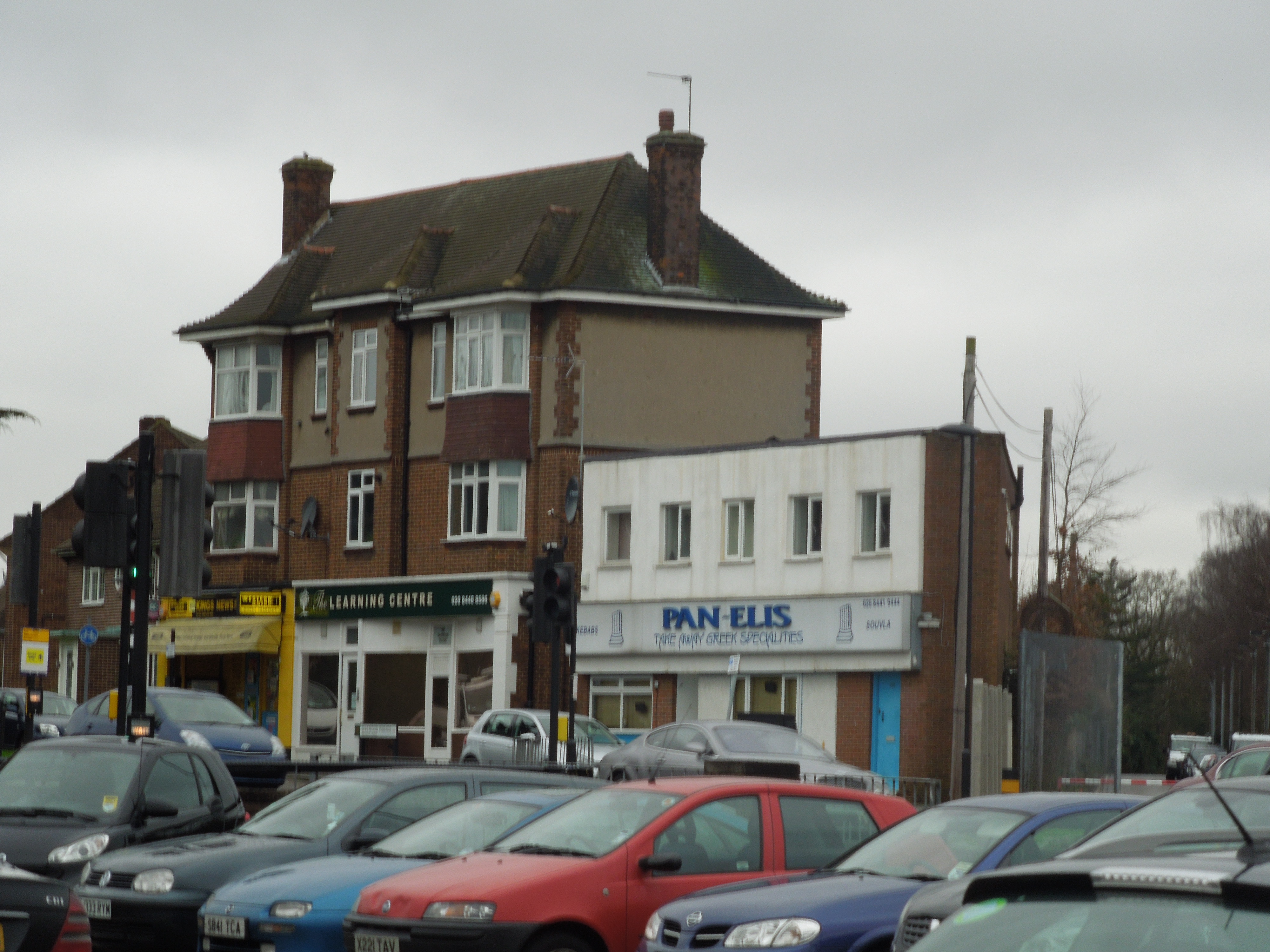
The Paper Shop at Oakwood
I’d get in at 5:30 in the morning, if I didn’t oversleep, mark up all the newspapers for the delivery boys and girls to distribute an hour or so later. I do wonder, if that routine, which I did for a couple of years, set me into my routine of always getting up early and working.
The flats in the background of this picture had a tale about one of the shop’s customers.
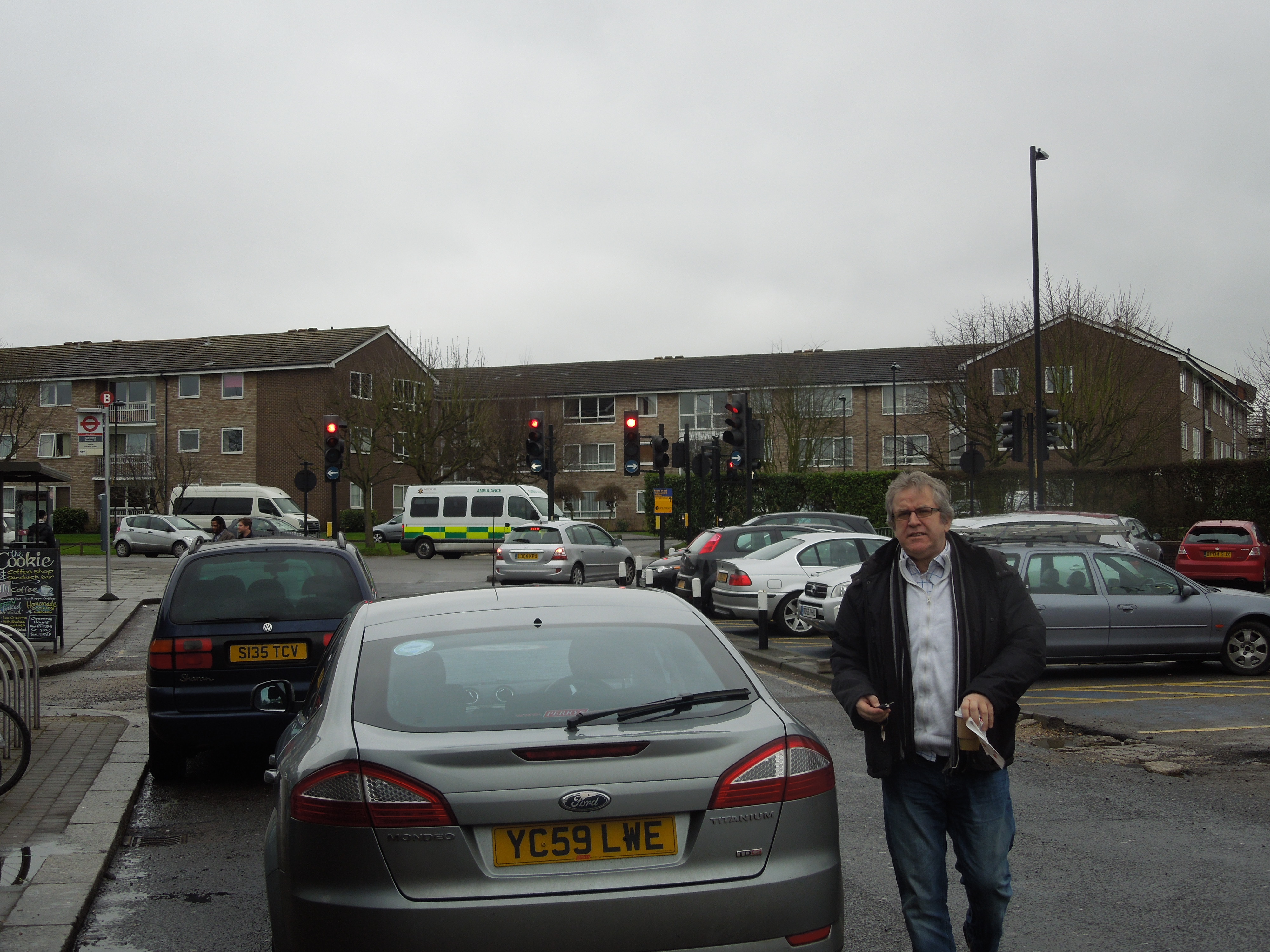
Flats With A Tale
He was the owner of a well-known department store in North London. he was also a dedicated alcoholic and when he went into the local hospital, he was on a bottle of Scotch whisky courtesy of the NHS.
I don’t know the end of that story, but a pharmacist friend has provided a post script. Years ago, the ward rounds in hospital often offered a top of whisky to those, who wanted it. They found it funny, that each bottle of the Bell’s whisky, they used to serve, had “Afore ye go” on the bottle.
It still does!
Whiplash
I don’t drive anymore, as my eyesight deteriorated badly due to a stroke.
I object to all the money that is wasted by the NHS in dealing with so many of these non-existent lawyer-driven whiplash claims.
People should just drive a bit more carefully!
Or use public transport like I do! The great thing about public transport in many parts of London and especially this one, is staff and fellow passengers often make it a friendly experience. Perhaps, Transport for London, should sell silly hats like this one, in aid of charity!
Katie Gets It Right
I like this article by Katie Hopkins on the BBC’s web site. She feels that free healthcare on the NHS should come with responsibility to look after yourself. This is the first few paragraphs.
Former Apprentice contestant Katie Hopkins argues that people who eat, drink and smoke more than is good for them should pay more towards the NHS health care they need, as she sets out her calls for additional payments for some health services.
A strange and particularly British trait is revealed when things are free at the point of use.
Just like all-inclusive holidays, or theme-park tickets, once you have handed over the money, the cost seems instantly forgotten.
The ability to have as much as you want whenever you want it, or to go on as many rides as you can whenever you like, is all that matters.
Somehow, everything in this new land of plenty is free. The NHS is rather like this.
I hope that I do the best to make sure, I’m not too much of a burden on the NHS.
Politicians interfere Too Much In Health Care
Not me that said that, but the view of Dame Ruth Carnall in this article about stroke care in London. This is an extract.
She went on to criticise politicians for interfering too much in health changes.
She said: “Politicians too often reduce complex medical arguments to soundbites.
“Compromise is a mistake but is hard to resist. There is a political aversion to major changes as we’ve seen with the debate over A&Es.”
But then politicians love to interfere and the sooner we get more politicians who are caring people first and politicians second, the better.
The trouble with healthcare is that for serious problems, there just isn’t the money to have super-duper unit for that problem at every hospital. So especially in places like London, cutting the number of units for each speciality is a good thing.
I would also say do we want to go back to the 1950s and 1960s, where there were loads of local general hospitals, which did everything and usually did it in a less than perfect way. I can’t remember anyone in those days, who was totally pleased with the service they got from the local hospitals in Barnet and Enfield. I, myself, have a gammy arm, which may well have been caused by substandard treatment when it was broken by the school bully.
Surely, the wonderful outcome of the Fabrice Muamba case, should be a lesson to everybody. He was probably saved by the absolutely top-class emergency treatment he revived on the pitch by a cardiologist who happened to be in the crowd and a swift removal to a cardiac hospital.
According to Dame Ruth, London now has eight major stroke units and the political delays cost seven hundred lives.
Access To Medical Records for Research Purposes
The Times today has an article entitled, NHS red tape ‘is strangling life-saving medical research’, which says it all.
If you consider that Richard Doll, proved the link between smoking and lung cancer using medical records, you realise how important this is, especially as the NHS database is the largest medical database in the world.
I don’t care what any researcher does with my medical records, provided what they do is morally acceptable.
Surely what you do is allow researchers to run queries on the database, provided the research has been approved by the NHS.
 The Anonymous Widower