World’s First Semi-Submersible Floating Offshore Wind Farm Tops Production Expectations
The title of this post, is the same as that of this article on offshoreWIND.biz.
This is the sub-heading.
In its four years of operation, the world’s first semi-submersible floating offshore wind farm, WindFloat Atlantic, has surpassed anticipated production figures, achieving a total cumulative output of 320 GWh.
These first three paragraphs give more detail.
Connected to the grid by the end of 2019 and fully commissioned in 2020, the floating offshore wind farm was developed by the Windplus consortium formed by Ocean Winds, a 50:50 joint venture between EDPR and ENGIE, Repsol, and Principle Power.
The pioneer wind farm consists of three platforms, each supporting one 8.4-MW Vestas turbine, which are anchored with chains to the seabed and connected to the onshore substation in the Portuguese municipality of Viana do Castelo through a 20-kilometre cable.
It has been reported that the project’s electricity production has steadily increased each year, reaching 78 GWh in 2022 and 80 GWh in 2023.
It certainly appears that floating wind power, is living up to and above its expectations.
There Are Only Three Large Offshore Wind Farms In Contracts for Difference Allocation Round 6
This document from the Department of Business, Industry and Industrial Strategy lists all the Contracts for Difference Allocation Round 6 results for the supply of zero-carbon electricity.
The wind farms are.
- Green Volt – 400 MW – Floating – Claims to be “The first commercial-scale floating offshore windfarm in Europe”.
- Hornsea Four – 2,400 MW – Fixed – Ørsted
- East Anglia Two – 963 MW – Fixed – Iberdrola
Is this what misgovernment expected, when they raised the budget in July 2024, as I wrote about in UK Boosts Sixth CfD Auction Budget, Earmarks GBP 1.1 Billion For Offshore Wind.
Perhaps, some developers held back until government policy is clearer?
Global Offshore Wind To Top 520 GW By 2040, Floating Wind To Play Major Role – Rystad Energy
The title of this post, is the same as that of this article on offshoreWIND.biz.
This is the sub-heading.
According to Rystad Energy, global offshore wind capacity will surpass 520 GW by 2040, with floating wind installations nearing 90 GW by that time
These are the first three paragraphs.
In 2023, the offshore wind sector saw a seven per cent increase in new capacity additions compared to the previous year, said Rystad Energy. This momentum is expected to accelerate this year, with new capacity additions expected to grow by nine per cent to over 11 GW by the end of the year.
By 2040, Europe is expected to account for more than 70 per cent of global floating wind installations. Although some project delays beyond 2030 are anticipated, there will likely be a strong push to accelerate deployment, according to Rystad Energy.
As a result, floating wind capacity is projected to approach 90 GW by 2040, led by the UK, France, and Portugal, with Asia (excluding mainland China) expected to account for 20 per cent of global installations.
Note, that Rystad Energy is an independent energy research and business intelligence company headquartered in Oslo, Norway.
Implications For Energy Storage
In Grid Powers Up With One Of Europe’s Biggest Battery Storage Sites, I talk about how the 2.9 GW Hornsea Three wind farm will have a connection to the grid, that incorporates a 300 MW/600 MWh battery.
With 520 GW of offshore wind to be installed by 2040, I suspect that energy storage companies and funds will do well.
If the 520 GW of offshore wind were fitted with batteries like the 2.9 GW Hornsea Three wind farm, there would be a need for around 60 GW of battery output, with a capacity of around 120 GWh.
I doubt, there would be enough lithium for all those batteries.
Some countries like Norway, the United States, Australia, France, Spain, Japan, India, China and others will be able to develop large pumped storage hydroelectricity systems, but others will have to rely on newer, developing technologies.
The UK will be well-placed with around 80 GWh of pumped storage hydroelectricity under development and several promising developing storage technologies.
‘Windiest Part Of The UK’ Could Power Nearly 500,000 Homes
The title of this post, is the same as that of this article on the BBC.
This is the sub-heading.
Power is flowing from the Shetland Isles to mainland Britain for the first time as the UK’s most productive onshore windfarm comes on stream.
These are the first two paragraphs.
SSE says its 103-turbine project, known as Viking, can generate 443 megawatts (MW) of electricity, enough to power nearly 500,000 homes.
Shetland is the windiest part of the UK, which means it will be rare for the blades, which reach a massive 155m at their tip, not to be spinning.
Note.
- SSE has built a 160-mile long undersea cable to carry the power from Viking to Noss Head, near Wick, on the Scottish mainland.
- The company said it has invested more than £1bn in the windfarm and cable projects.
- SSE plans to plough another £20bn into renewables by the end of the decade.
Companies don’t invest billions and banks don’t lend billions, unless they know they’ll get a return, so the finance for this billion pound project must be sound.
A simple calculation, shows why they do.
- According to Google, the electricity for the average house costs £1926.24 per year.
- 500,000 houses would spend £963,120,000 per year.
Google says this about the life of a wind farm.
The average operational lifespan of a wind turbine is 20–25 years, but some turbines can last up to 30 years.
If the wind farm lasts 25 years, then it will generate something like £24 billion over its lifetime.
It looks to me, that SSE have borrowed a billion and will get almost as much as that back every year.
SSE also have the experience to keep the turbines turning and the distribution network sending electricity to the Scottish mainland.
I have some further thoughts.
What Happens If Scotland Can Get Cheaper Electricity From Its Own Wind Farms?
Shetland’s turbines can be switched off, but that is effectively throwing away electricity that can be generated.
Any spare electricity can also be diverted to an electrolyser, so that the following is produced.
- Hydrogen for transport, rocket fuel for SaxaVord Spaceport and to decarbonise houses and businesses.
- Oxygen for rocket fuel for SaxaVord Spaceport and for fish farms.
Hydrogen may also be exported to those that need it.
Project Orion
Project Orion is Shetland’s master plan to bring all the energy in and around the Shetland Islands together.
This document on the APSE web site is entitled Future Hydrogen Production In Shetland.
This diagram from the report shows the flow of electricity and hydrogen around the islands, terminals and platforms.
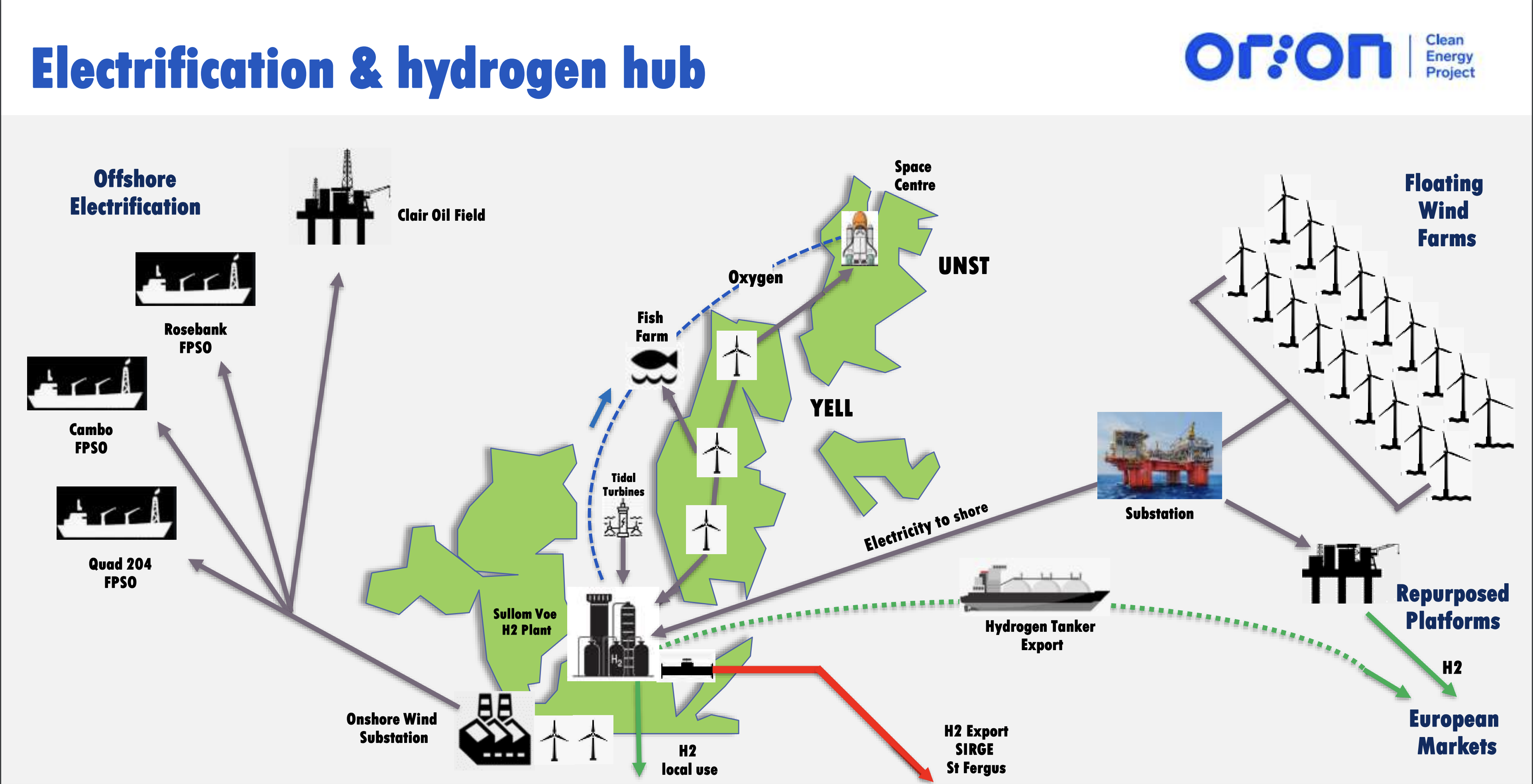
Note these points about what the Shetlanders call the Orion Project.
- Offshore installations are electrified.
- There are wind turbines on the islands
- Hydrogen is provided for local energy uses like transport and shipping.
- Oxygen is provided for the fish farms and a future space centre.
- There is tidal power between the islands.
- There are armadas of floating wind turbines to the East of the islands.
- Repurposed oil platforms are used to generate hydrogen.
- Hydrogen can be exported by pipeline to St. Fergus near Aberdeen, which is a distance of about 200 miles.
- Hydrogen can be exported by pipeline to Rotterdam, which is a distance of about 600 miles.
- Hydrogen can be exported by tanker to Rotterdam and other parts of Europe.
It looks a very comprehensive plan, which will turn the islands into a massive hydrogen producer.
Orion And AquaVentus
This video shows the structure of AquaVentus, which is the German North Sea network to collect hydrogen for H2ercules.
I clipped this map from the video.

Note.
- There is a link to Denmark.
- There appears to be a undeveloped link to Norway.
- There appears to be a link to Peterhead in Scotland.
- There appears to be a link to just North of the Humber in England.
- Just North of the Humber are the two massive gas storage sites of Aldbrough owned by SSE and Rough owned by Centrica.
- There appear to be small ships sailing up and down the East Coast of the UK. Are these small coastal tankers distributing the hydrogen to where it is needed?
In the last century, the oil industry, built a substantial oil and gas network in the North Sea. It appears now the Germans are leading the building of a substantial hydrogen network.
This map is only the start and I feel, there would be nothing to stop the connection of the Orion and AquaVentus networks.
SaxaVord Spaceport
SaxaVord Spaceport is now a reality, in that it licensed and tests are being undertaken.
‘World’s First’ O&M Campaign Using Heavy-Lift Cargo Drones Underway At Dutch Offshore Wind Farm
The title of this post, is the same as that of this article on offshoreWIND.biz.
This is the sub-heading.
Ørsted has deployed heavy-lift cargo drones (HLCDs) for maintenance work at the Borssele 1&2 offshore wind farm in the Netherlands. This is the first time heavy-lift cargo drones are being used in an operational campaign, according to the company which tested the concept in 2023 at its Hornsea One offshore wind farm in the UK.
These are the first two paragraphs.
At the 752 MW Dutch offshore wind farm that has been in operation since 2020, the 70-kilogram drones will transport cargo of up to 100 kilograms from a vessel to all 94 wind turbines. The campaign now underway at Borssele 1&2 is being performed to update some critical evacuation and safety equipment in each of the turbines.
A drone can complete a task that typically takes several hours in minutes, according to Ørsted.
Note.
- The article claims, a lot of time is saved.
- I suspect we’ll be seeing the use of drones for multiple deliveries, a lot more in the future.
I like the concept, where deliveries to a number of sites are made by drone, rather than in a traditional way perhaps by a ship or truck with a crane.
AquaVentus
I suggest, that you read this page on the RWE web site called AquaVentus.
The page starts with this RWE graphic.
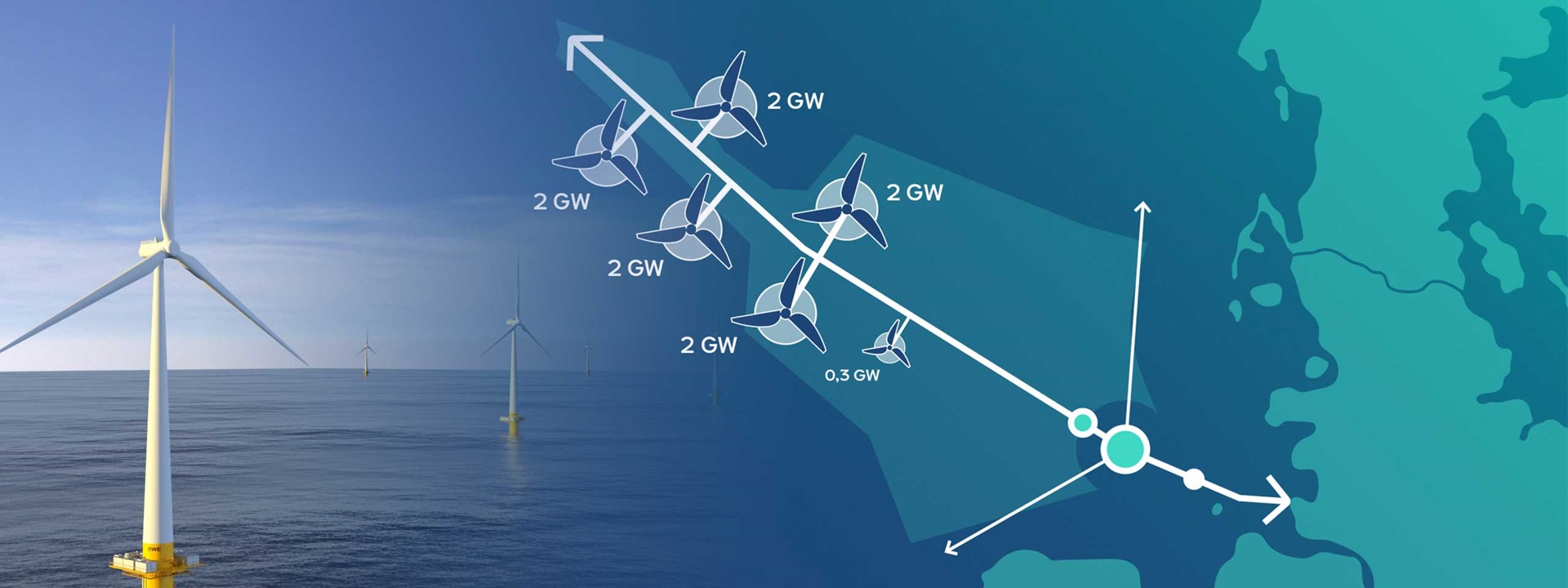
It appears that 10.3 GW of hydrogen will be created by offshore wind farms and piped to North-West Germany.
These two paragraphs outline the AquaVentus initiative .
Hydrogen is considered the great hope of decarbonisation in all sectors that cannot be electrified, e.g. industrial manufacturing, aviation and shipping. Massive investments in the expansion of renewable energy are needed to enable carbon-neutral hydrogen production. After all, wind, solar and hydroelectric power form the basis of climate-friendly hydrogen.
In its quest for climate-friendly hydrogen production, the AquaVentus initiative has set its sights on one renewable energy generation technology: offshore wind. The initiative aims to use electricity from offshore wind farms to operate electrolysers also installed at sea on an industrial scale. Plans envisage setting up electrolysis units in the North Sea with a total capacity of 10 gigawatts, enough to produce 1 million metric tons of green hydrogen.
The page also gives these numbers.
- Total Capacity – 10 GW
- Tonnes Of Green Hydrogen – 1 million
- Members – 100 +
The web site says this about commissioning.
Commissioning is currently scheduled for early/mid 2030s.
The Germans can’t be accused of lacking ambition.
Conclusion
AquaVentus will bring the Germans all the hydrogen they need.
I suspect AquaVentus can be expanded into the waters of other countries surrounding the German territorial waters.
UK Boosts Sixth CfD Auction Budget, Earmarks GBP 1.1 Billion For Offshore Wind
The title of this post, is the same as that of this article on offshoreWIND.biz.
This is the sub-heading.
The UK government has decided to increase the budget for the next Allocation Round 6 (AR6) to GBP 1.5 billion, including GBP 1.1 billion for offshore wind. The funding uplift represents more than a 50 per cent increase on the budget previously set in March this year.
These are the first three paragraphs.
At the beginning of this year, the UK government revealed a budget of GBP 1 billion for this year’s Contracts for Difference (CfD) AR6 with the majority of it, GBP 800 million, earmarked for offshore wind.
However, the new budget, announced on 31 July by the UK’s Secretary of State for Energy Security and Net Zero, Ed Miliband, marks a GBP 500 million increase over the funding set by the previous Conservative government.
The scheme’s design means the central government’s budget will not be impacted, following findings from a Treasury spending audit revealed GBP 22 billion of unfunded pledges inherited from the previous government, according to the press release.
I do find it interesting, that despite blaming some dubious funding from the previous government, that more of the same will be used to develop some more wind farms.
Welcoming GB Energy And Its Mission To Make Britain A Clean Energy Superpower
The title of this post, is the same as that of this press release from SSE.
This is the sub-heading.
Making Britain a clean energy superpower by 2030 is one of the new government’s five missions. The UK Government and Crown Estate have announced plans to join forces to create a new publicly owned energy firm. GB Energy will invest in homegrown, clean energy.
These are the first two paragraphs of SSE’s response to the announcement.
We welcome the focus of GB Energy on earlier stage technologies, such as carbon capture and storage (CCS), where the Government can de-risk projects and help accelerate the clean energy transition.
In areas such as offshore wind, where industry is already delivering mission-critical infrastructure, the biggest impact will be on delivering policies that speed up the build out of these essential projects.
It looks like SSE, see Great British Energy as a positive development.
UK Company Unveils Mooring Solution For Floating Offshore Wind
The title of this post, is the same as that of this article on offshoreWIND.biz.
This is the sub-heading.
UK-based Blackfish Engineering has unveiled a mooring system, called C-Dart, which eliminates the direct handling of heavy mooring lines by operational personnel. The system is designed to rapidly connect various floating structures and assets, including wave and tidal energy converters, offshore wind, floating solar platforms, aquaculture, and more, according to the company.
These three paragraphs give a few details.
By utilising the principles of gravity, buoyancy, and rope tension, the C-Dart system facilitates a contact-free, automated connection process that secures equipment securely and swiftly, Blackfish said.
The system’s rapid connect and disconnect capability is said to cut down the time typically required for offshore operations which is vital in reducing the overall operational costs and downtime, particularly in the high-stakes environment of renewable energy projects.
Constructed from high-tensile, corrosion-resistant materials, the C-Dart system could withstand harsh oceanic environments, extending its service life while minimising maintenance requirements.
There is also this excellent video.
These are my thoughts.
The Companies Involved
The companies, organisations involved are listed on the C-Dart product page.
Skua Marine Ltd, Morek Ltd, Flowave, Underwater Trials Centre, Offshore Simulation Centre, National Decommissioning Centre, Bureau Veritas, Queen Mary University, The Waves Group, KML, Alex Alliston, Arnbjorn Joensen
Note.
- Blackfish Engineering are in Bristol.
- Bureau Veritas is a French company specialized in testing, inspection and certification founded in 1828.
- Queen Mary University is in London.
- The Underwater Trials Centre is in Fort William.
- The National Decommissioning Centre is in Aberdeen.
- The Offshore Simulation Centre, is in Norway.
Funding came from the Scottish Government.
Good Design And Improved Safety
It does look in this product that good design and improved safety go together.
Conclusion
This peoduct could be a real winner.
3 GW Dogger Bank South Offshore Wind Farms Reach New Development Stage
The title of this post, is the same as that of this article on offshoreWIND.biz.
This is the sub-heading.
The UK Planning Inspectorate has accepted into the examination phase the Development Consent Order (DCO) application for the Dogger Bank South (DBS) Offshore Wind Farms developed by RWE and Masdar.
The first two paragraphs give a brief description of the wind Farm.
The DBS East and DBS West offshore wind farms, which could provide electricity for up to three million typical UK homes, are located in shallow waters on the Dogger Bank over 100 kilometres off the northeast coast of England. The acceptance of the DCO application moves the projects into the pre-examination phase, which will become subject to a public examination later in 2024.
Together, the projects will have up to 200 turbines with a combined estimated capacity of 3 GW. Investment by RWE and Masdar during development and construction is predicted to deliver an economic contribution (Gross Value Added) to the UK of almost GBP 1 billion, including GBP 400 million in the Humber region.
There is a detailed map in the article on offshoreWIND.biz.
The Next Steps
These are given in the article.
The next steps for the projects, following a successful Development Consent Order, would be to secure Contracts for Difference (CfD), followed by financing and construction, the developers said.
It certainly looks like the 3 GW Dogger South Bank Wind Farm is on its way.
These are my thoughts about the project.
The Turbines To Be Used
The article says this about the turbines.
Together, the projects will have up to 200 turbines with a combined estimated capacity of 3 GW.
This means that the turbines will be 15 MW.
In RWE Orders 15 MW Nordseecluster Offshore Wind Turbines At Vestas, I said this.
Does this mean that the Vestas V236-15.0 MW offshore wind turbine, is now RWE’s standard offshore turbine?
This would surely have manufacturing, installation, operation and maintenance advantages.
There would surely be advantages for all parties to use a standard turbine.
It’s A Long Way Between Yorkshire And The Dogger Bank
The article says it’s a hundred kilometres between the wind farm and the coast of Yorkshire.
Welcome To The Age Of Hydrogen
This is the title of this page of the RWE web site.
The page starts with this paragraph.
RWE is actively involved in the development of innovative hydrogen projects. The H2 molecule is considered to be an important future building block of a successful energy transition. RWE is a partner in over 30 H2 projects and is working on solutions for decarbonising the industry with associations and corporations like Shell, BASF and OGE. Hydrogen projects are comprehensively supported in the separate Hydrogen department of the subsidiary RWE Generation.
AquaVentus
I also suggest, that you read this page on the RWE web site called AquaVentus.
The page starts with this RWE graphic.
It appears that 10.3 GW of hydrogen will be created by wind farms and piped to North-West Germany.
These two paragraphs outline the AquaVentus initiative .
Hydrogen is considered the great hope of decarbonisation in all sectors that cannot be electrified, e.g. industrial manufacturing, aviation and shipping. Massive investments in the expansion of renewable energy are needed to enable carbon-neutral hydrogen production. After all, wind, solar and hydroelectric power form the basis of climate-friendly hydrogen.
In its quest for climate-friendly hydrogen production, the AquaVentus initiative has set its sights on one renewable energy generation technology: offshore wind. The initiative aims to use electricity from offshore wind farms to operate electrolysers also installed at sea on an industrial scale. Plans envisage setting up electrolysis units in the North Sea with a total capacity of 10 gigawatts, enough to produce 1 million metric tons of green hydrogen.
The page also gives these numbers.
- Total Capacity – 10 GW
- Tonnes Of Green Hydrogen – 1 million
- Members – 100 +
The web site says this about commissioning.
Commissioning is currently scheduled for early/mid 2030s.
The Germans can’t be accused of lacking ambition.
AquaVentus And The UK
This video shows the structure of AquaVentus.
I clipped this map from the video.
Note.
- There is a link to Denmark.
- There appears to be a undeveloped link to Norway.
- There appears to be a link to Peterhead in Scotland.
- There appears to be a link to just North of the Humber in England.
- Just North of the Humber are the two massive gas storage sites of Aldbrough owned by SSE and Brough owned by Centrica.
- There appear to be small ships sailing up and down the East Coast of the UK. Are these small coastal tankers distributing the hydrogen to where it is needed?
In the last century, the oil industry, built a substantial oil and gas network in the North Sea. It appears now the Germans are leading the building of a substantial hydrogen network.
AquaVentus And Aldbrough And Rough Gas Storage
Consider.
- In The Massive Hydrogen Project, That Appears To Be Under The Radar, I describe the Aldbrough Gas Storage.
- In Wood To Optimise Hydrogen Storage For Centrica’s Rough Field, I describe Centrica’s plans to turn Rough Gas Storage into the world’s largest hydrogen store.
- There is a small amount of hydrogen storage at Wilhelmshaven.
It looks like the East Riding Hydrogen Bank, will be playing a large part in ensuring the continuity and reliability of AquaVentus.
Dogger Bank South And AquaVentus
This Google Map shows the North Sea South of Sunderland and the Danish/German border.
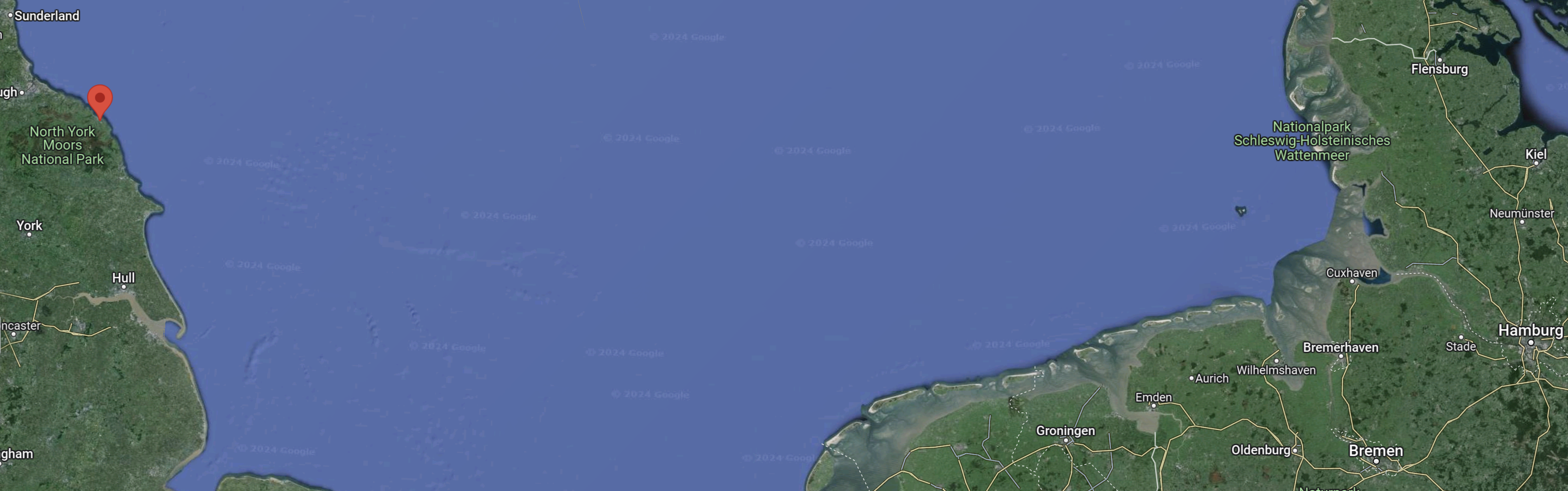
Note.
- Sunderland is in the top-left hand corner of the map.
- A white line in the top-right corner of the map is the Danish/German border.
- Hamburg and Bremen are in the bottom-right hand corner of the map.
If you lay the AquaVentus map over this map, I believe that Dogger Bank South wind farm could be one of the three 2 GW wind farms on the South-Western side of the AquaVentus main pipeline.
- Two GW would be converted to hydrogen and fed into the AquaVentus main pipeline.
- One GW of electricity would be sent to the UK.
But this is only one of many possibilities.
Hopefully, everything will be a bit clearer, when RWE publish more details.
Conclusion
I believe, that some or all of the Dogger Bank South electricity, will be converted to hydrogen and fed into the AquaVentus main pipeline.
I also believe, that the hydrogen stores in the East Riding of Yorkshire, will form an important part of AquaVentus.
 The Anonymous Widower