Andy Burnham Set For Clash With MPs Over North Sea Oil And Gas
The title of this post, is the same as that of this article in The Times.
This is the sub-heading.
The prime minister must decide whether to approve the Rosebank oilfield and Jackdaw gasfield but will face opposition from backbenchers if he goes ahead
These are the first three paragraphs.
Andy Burnham faces a potential showdown with Labour MPs after suggesting faster extraction of North Sea oil and gas could help pay for the transition to clean energy.
The prime minister is preparing to decide whether to approve the Rosebank oilfield and Jackdaw gasfield after consultations on both projects closed.
Industry sources have told The Times they believe Burnham will approve Jackdaw but may resist calls to go ahead with Rosebank because of opposition from MPs.
These are my thoughts.
My Boiler, Gas And Jackdaw
Consider.
- This year my boiler died. So I spent several thousand pounds, but I did get a new gas boiler with a 12-year guarantee.
- I am now 79, so can this government, or any for that matter, give me a guarantee, that I will live to 91 to get value from my boiler?
- I know enough about heating, as I have installed a couple of systems for myself, to know that my current house is not suitable for a heat pump.
- But it may be suitable for some type of electric data centre boiler like heata, which was invented by British Gas Research. But, I’m not hopeful yet!
- Meanwhile, Centrica have done a large hand-full of deals to keep the country in enough gas to power us through the winter.
- Some of these are MiQ-certified, which is a bit like Organic for methane, except that emissions are kept to a minimum.
- I covered MiQ-certification in What Is MiQ-Certification?.
So provided we don’t get an extreme-left scientifically-incorrect government, led by someone like the lady with pink hair in Hackney, I should be able to keep myself warm in winter.
But would I vote for any party, that was going to cut off my gas supply?
But Centrica have been clever.
- They have plenty of gas storage at Rough.
- Their press releases show they are buying gas according to MiQ.
- Grain LNG Terminal, which they bought last year has an export facility, so any spare gas they have can be exported to a country to replace coal or Russian gas.
- MiQ-certified gas probably fetches a higher price.
- Centrica would be an obvious purchaser for any North Sea gas.
This gives some dates of the players and Jackdaw
- BG Group and Centrica were demerged from British Gas plc in 1997.
- BG Group discovered Jackdaw in 2005.
- BG Group were taken over by Shell in 2015.
If I was the owner of Jackdaw, I would make sure that my gas had the highest MiQ possible.
If I was energy minister, I’d enforce it.
Will Jackdaw Be A Tie-Back To Shearwater?
I’ve read that it might be, so I asked Google AI and received this answer.
Yes, Jackdaw is designed and developed as a 30-kilometer (approx. 18.5 miles) subsea tie-back to the existing Shearwater platform in the central North Sea.
Project Connection Details
Infrastructure: A multi-phase subsea pipeline links the unstaffed Jackdaw wellhead platform directly to the Shearwater hub.
Processing: Hydrocarbons extracted from Jackdaw will be processed and routed through Shearwater before final export onshore to the St Fergus terminal.
Distance: The subsea pipeline spans roughly 30 kilometers (18.5 miles) northwest from the Jackdaw field to the Shearwater installation.
I also found this detailed article on the Chemical Engineer which is entitled Shell To Invest In Shearwater Gas Infrastructure Hub.
Shell certainly seem to be doing comprehensive planning to bring the gas from Jackdaw to the mainland.
- Currently, gas from the Shearwater hub is sent to Bacton in Norfolk.
- After, Jackdaw is connected to Shearwater, the gas will be sent to St. Fergus, which is North of Aberdeen.
- Google AI says that The Shearwater hub is located approximately 140 miles (225 kilometers) east of Aberdeen in the Central North Sea.
It’s probably all in a day’s work for engineers in the North Sea, but it doesn’t sound to be the easiest project to me.
Will The Jackdaw Gas Field Be Used For CO2 Storage?
I felt this could be a possibility, so I asked Google AI, the question and received this answer.
No, the Jackdaw gas field will not be used for CO2 storage.It is an active natural gas extraction project in the North Sea, though CO2 separated from its extracted gas may eventually be routed to external storage.
Field Status and CO2 Handling
Extraction only: The underground reservoirs at Jackdaw contain natural gas and high-pressure/high-temperature hydrocarbons rather than being purposed for carbon storage.
Onshore processing: Gas from the field comes ashore at St Fergus, where carbon dioxide mixed into the raw gas stream is removed during processing.
Broader CCS links: While Jackdaw itself is a producing asset, its operations tie into Shell’s broader involvement with the regional Acorn Carbon Capture and Storage project, which aims to pipe and sequester CO2 elsewhere.
That was a definite no, that Jackdaw will not be used for Carbon Capture and Storage, but the carbon dioxide in the gas may be stored in the Acorn Carbon Capture and Storage project.
Will Centrica Be Applying Just-in-Time-Delivery To Gas Cargoes?
One of the jobs, I was involved in was scheduling container ships for OCL, in the 1970s.
- I’m fairly certain, that ships were speeded up and slowed down, so that ports weren’t overloaded.
- It was all done with my PERT7 project management software, which ran on Time Sharing at Great Portland Street.
I can envisage a clever programmer at Centrica writing a large simulation of all their natural gas deals and calling off gas cargoes, when required.
- Gas tankers would be constantly sailing between the gas fields in the Americas and LNG Terminals like Grain, where the cargo was needed.
- It would be nice to have a local supply of natural gas to fill in the gaps between cargoes, but delaying and speeding up of deliveries would have the same effect.
- I also suspect cargoes could be diverted to Germany, Poland or the highest bidder, when there is a glut of gas.
It could be a classic example of advanced control engineering, but very similar to what OCL were doing fifty years ago.
By applying just-in-time-delivery to gas cargoes, Centrica would reduce the need for storage in the UK.
At least gas doesn’t have a sell-by date!
How Much Liquid Natural Gas Storage Is There At The Grain LNG Terminal?
Google AI gave me this answer to the question in the title of this section.
The Grain LNG terminal on the Isle of Grain in Kent has a total liquid natural gas (LNG) storage capacity of 1.2 million cubic metres (1,200,000 m³) following recent site expansions.
Terminal Storage Overview
Total Capacity: 1.2 million m³ of cryogenic tank space (increased from the original 1.0 million m³ capacity).
Tank Configuration: Consists of massive full-containment cryogenic storage tanks (such as the 190,000 m³ tanks added in phases).
System Throughput: The facility can process up to 15 million tonnes per annum (mtpa), meeting a significant share of the UK’s total gas demand.
It should be remembered that storing gas as liquid reduces the space needed.
What Is The Capacity Of A Typical LNG Carrier?
Google AI gave me this answer to the question in the title of this section.
A typical modern liquefied natural gas (LNG) carrier has a cargo capacity of approximately 174,000 cubic meters (m³).
This size has become the conventional standard for new builds, balancing port compatibility with transport scale, though global fleet capacities range widely from small-scale vessels to massive ultra-large ships.
Vessel Size Categories
Small-scale carriers: Hold roughly 1,000 m³ to 40,000 m³, used for regional distribution and bunkering.
Medium-scale carriers: Range from 40,000 m³ to 80,000 m³.
Conventional large carriers: Standard modern designs cluster around 140,000 m³ to 180,000 m³, with 174,000 m³ dominating recent ship orders.
Maxi-size carriers (Q-Flex and Q-Max): Specialized ultra-large vessels reach capacities between 210,000 m³ and 266,000 m³, primarily built to service long-distance routes out of Qatar.
Grain LNG Terminal can hold about four cargoes from the largest LNG Carriers.
My extensive experience of writing scheduling algorithms, which go back to one I wrote at ICI Mond in 1968, feels that by scheduling the arrival of the ships, there may well be enough storage at Grain LNG Terminal to keep the UK in gas.
I wonder, if for some time, Centrica have known, that they don’t need Rough for natural gas storage, which is why they have ambitions to turn it into hydrogen storage.
JERA Nex BP, EnBW Submit Morven Offshore Wind Farm Application
The title of this post, is the same as that of this article on offshoreWIND.biz.
This is the sub-heading.
A joint venture between JERA Nex BP and EnBW has submitted Section 36 consent applications for the Morven offshore wind farm to the Scottish government
These two paragraphs add a few details.
The developer secured the seabed rights for the Morven offshore wind farm as a single project in the ScotWind Leasing Round in 2022 and split it into two separate projects during the early development phase.
Located around 60 kilometres off the coast of Aberdeenshire at its closest point, the site is planned to house Morven North and Morven South, which would have a combined installed capacity of up to 3 GW and around 190 wind turbines in total.
Morven Offshore Wind Farm now has a comprehensive web site.
The web site says that the electricity will be brought ashore at Hawthorn Pit.
This Google Map shows the location of Hawthorn Pit.
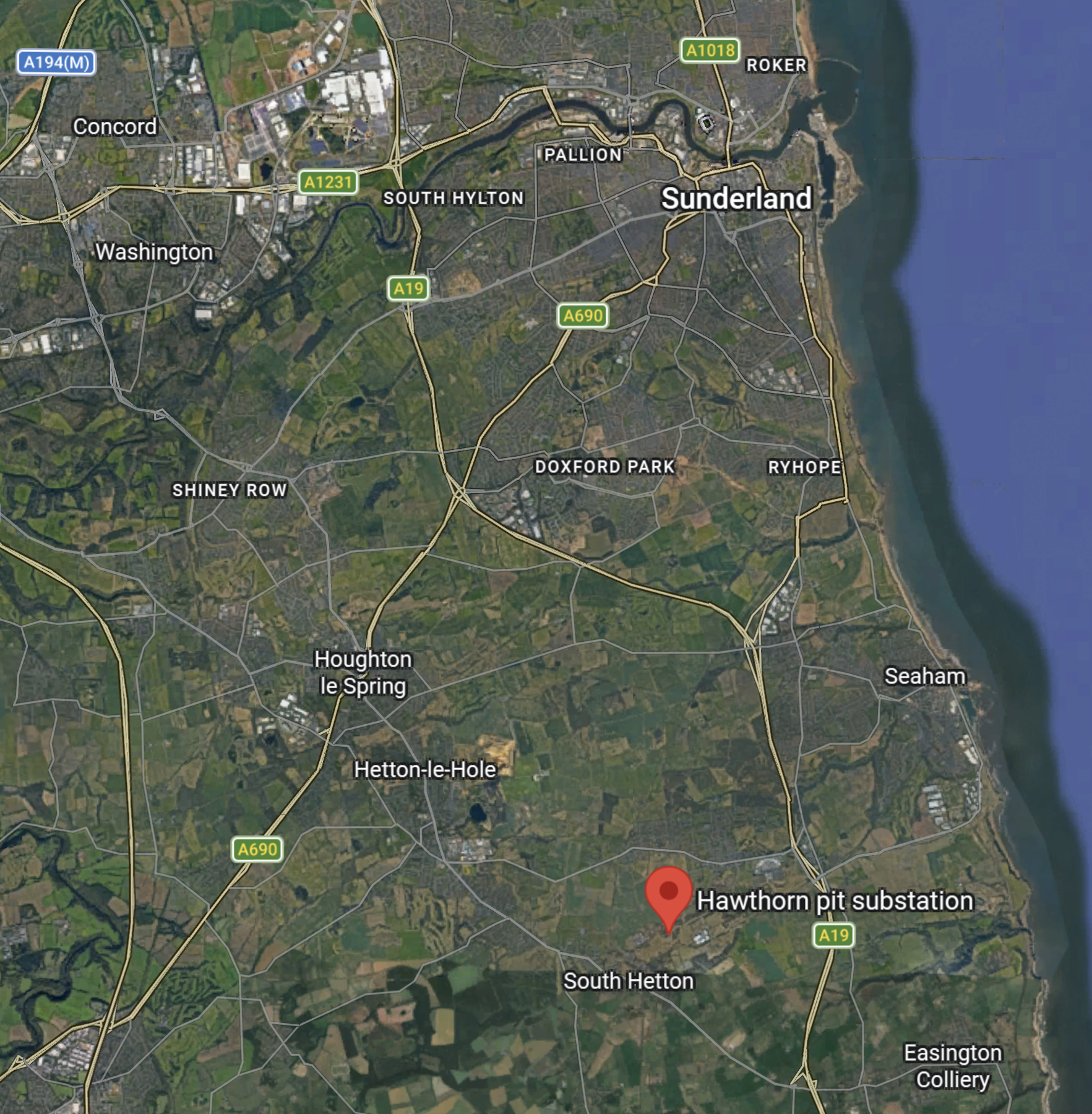
Note.
- Hawthorn Pit is indicated by the red arrow.
- Sunderland is at the top of the map on the coast.
- Aura Power has already obtained planning permission for Hawthorn Pit solar farm, which will be up to 49.9 MW.
- Zenobe are developing a battery-energy-storage-system(BESS) 1.5 km to the South-East of the new Hawthorn Pit substation, which will have an output of 300 MW. Sloppily, there is no detail on capacity, but Google AI indicates, it is a 300 MW/600 MWh battery.
- Hawthorn Pit substation is also the expected to be the Southern end of Eastern Green Link 1, which will help to bring Scottish wind power to England, which will be a 2 GW undersea interconnector to Torness.
In Murphy Starts Work On £2.5bn Eastern Green Link 1, I detail the start of building of Eastern Green Link 1 and say it should be operational by 2029.
When Is The Morven Offshore Wind Farm Expected To Be Commissioned?
I asked Google AI the question above and received this answer.
The 2.9 GW Morven offshore wind farm is expected to be fully commissioned and operational between 2031 and 2035, with initial grid connections and power export potentially starting as early as 2030.
The timeline for full deployment of the Morven Offshore Wind Farm remains somewhat flexible as it depends on final planning approvals and connection offers from the National Energy System Operator (NESO).
The Cables For The Morven Offshore Wind Farm And Eastern Green Link 1
This map clipped from the Morven Offshore Wind Farm web site, shows the locations of Aberdeen, Hawthorn Pit and the Morven Offshore Wind Farm.
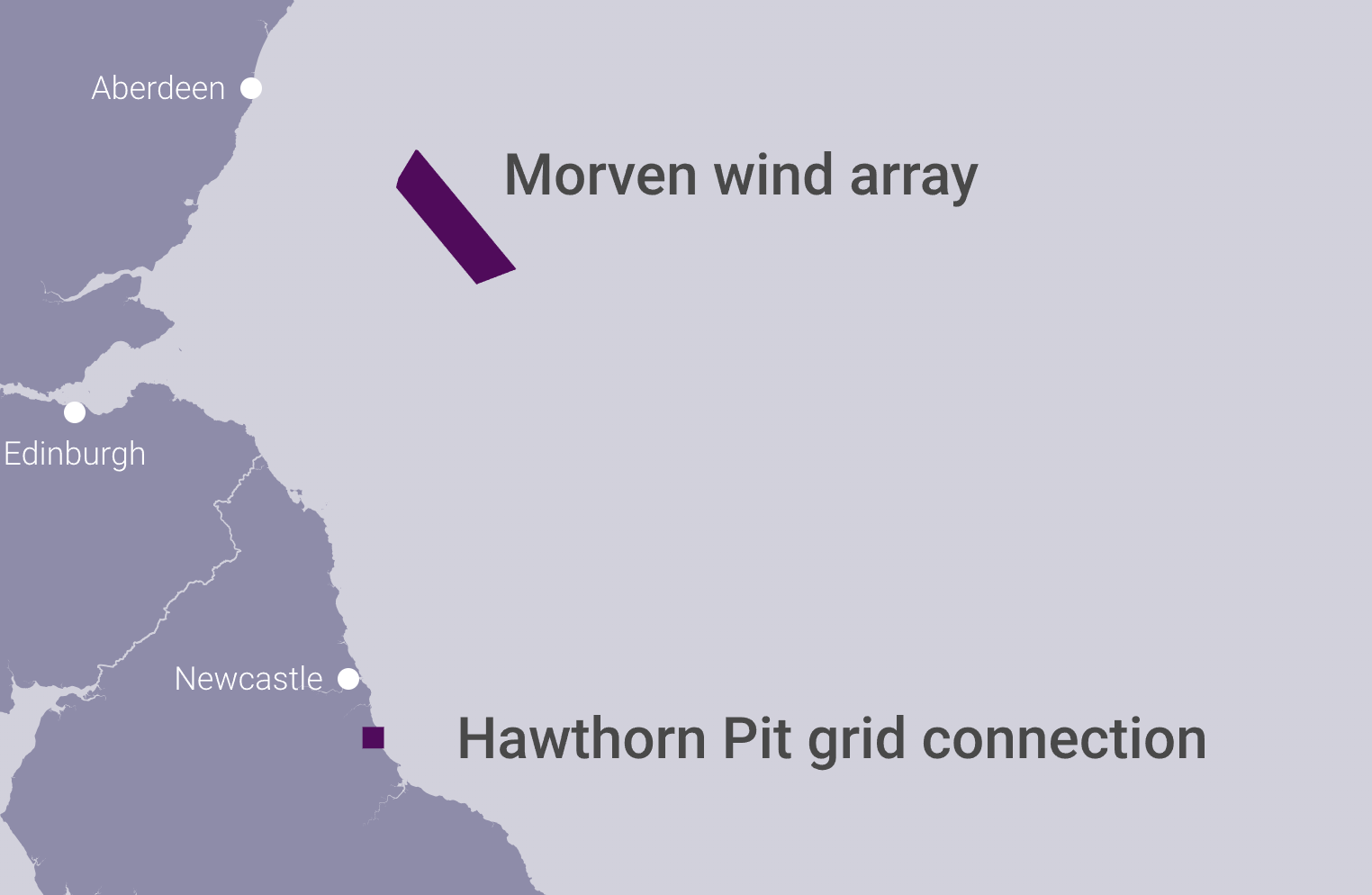
Note.
- The location of the Morven wind array was first mentioned in June 2020, as part of ScotWind by Crown Estate Scotland.
- The development of Eastern Green Link 1 was first mentioned in May 2021, by National Grid.
- Torness is to the East of Edinburgh.
- Eastern Green Link 1 connects Torness and Hawthorn Pit.
- the Morven wind array connects to England at Hawthorn Pit.
Over the last few years National Grid and other companies have been developing a technique called offshore hybrid assets, which I describe in What Are Offshore Hybrid Assets?.
An offshore hybrid asset typically connects two countries via a large offshore wind farm, which can then send electricity to both countries.
In a traditional design, there would need to be.
- A 2 GW cable between Torness and Hawthorn Pit.
- A 2.9 GW cable between Morven and Hawthorn Pit.
In the Offshore Hybrid Asset design, there would need to be.
- A 2 GW cable between Torness and Morven
- A 2.9 GW cable between Morven and Hawthorn Pit.
I suspect cable would be saved.
This map shows the position of each ScotWind Leasing wind farm.

Note.
- The numbers are Scotwind’s lease number in their documents.
- Morven is ScotWind lease number 1.
- Eastern Green Link 1 is one of four interconnectors down the East Coast of the UK.
- I have added up the ScotWind lease numbers 1-6 and they total 10.5 GW.
That would be a lot of power to capture just by converting the four Eastern Green Link interconnectors into offshore hybrid assets.
How Will Aquaventus Connect To Aberdeen?
This is RWE’s description of AquaVentus, which is sub-titled Hydrogen Production In The North Sea.
Hydrogen is considered the great hope of decarbonisation in all sectors that cannot be electrified, e.g. industrial manufacturing, aviation and shipping. Massive investments in the expansion of renewable energy are needed to enable carbon-neutral hydrogen production. After all, wind, solar and hydroelectric power form the basis of climate-friendly hydrogen.
In its quest for climate-friendly hydrogen production, the AquaVentus initiative has set its sights on one renewable energy generation technology: offshore wind. The initiative aims to use electricity from offshore wind farms to operate electrolysers also installed at sea on an industrial scale. Plans envisage setting up electrolysis units in the North Sea with a total capacity of 10 gigawatts, enough to produce 1 million metric tons of green hydrogen.
RWE have also put this AquaVentus video on their web site.
Note, that in the video AquaVentus connects Germany to Denmark, Norway, The Netherlands and Aberdeen and Humberside in the UK.
I asked Google AI, the question in the title of this section, and received this answer.
AquaVentus connects to Aberdeen through a strategic infrastructure partnership with Hydrogen Scotland. The two organizations are integrating offshore wind power, offshore electrolysis, and a shared cross-border pipeline to link Scottish renewable generation with European industrial markets.
The connection strategy relies on a multi-stage approach across the North Sea:
Offshore Production & Transmission: AquaVentus aims to produce green hydrogen directly offshore. It will be transported via a pan-European pipeline network—such as the planned 400 km AquaDuctus to link offshore hubs with both the UK and mainland Europe.
Scottish-German Export Corridor: Building on previous research like the Scot2Ger study, this pipeline corridor directly connects Scotland’s abundant offshore wind resources to European demand, establishing Aberdeen as a critical origin node.
Integrated Energy Backbone: The initiative champions hybrid connection concepts (combining both power cables and hydrogen pipelines). This allows for maximum flexibility when integrating Aberdeen’s local onshore hydrogen infrastructure with broader transnational energy grids.
I will now ask Google AI some supplementary questions about AquaVentus in UK waters.
“Will AquaVentus Produce Hydrogen In UK Waters?”
Google AI gave this reply.
Yes, AquaVentus plans to produce green hydrogen in UK waters. The German-led consortium has partnered with Hydrogen Scotland to harness Scotland’s offshore wind potential for large-scale, cross-border hydrogen production and export.
Key Details of the UK-German Initiative
Production Scale: The initiative aims to install 10 gigawatts (GW) of offshore electrolysis capacity in the North Sea by 2035, producing up to 1 million metric tonnes of green hydrogen annually.
The “Pipes and Wires” Model: Offshore wind parks will be equipped with hybrid connection concepts, providing the flexibility to either send electricity directly to the grid or convert it into hydrogen via offshore electrolysers.
Transportation: The produced hydrogen will be transported to land via a shared transnational subsea pipeline corridor, linking Scottish resources to Germany and mainland Europe.The partnership is specifically aimed at creating a North Sea hydrogen corridor to boost energy security and build the foundational European Hydrogen Backbone.
“Will AquaVentus Land Hydrogen In Scotland?”
Google AI gave this reply.
Yes, the German-led AquaVentus initiative plans to land green hydrogen in Scotland as part of a coordinated North Sea energy corridor.
The cross-border initiative involves the following components:
The Pipeline Connection: A key part of the plan is the AquaDuctus offshore subsea pipeline, designed to collect green hydrogen produced from central North Sea wind farms and land it on the coast.
Scottish Partnership: Hydrogen Scotland and AquaVentus have formalized a Memorandum of Understanding to combine Scotland’s massive offshore wind potential with German infrastructure and electrolysis expertise.
Export Ambitions: Scotland aims to produce up to 3.3 Mt of green hydrogen per year by 2045, heavily relying on pipelines and networks to export this to mainland European hubs like Germany.
Offshore Facilities: The broader initiative plans to install 10 GW of offshore electrolysis capacity in the North Sea to produce up to 1 million tonnes of hydrogen annually.
Note that Google AI has told me that a Megatonne of hydrogen is currently worth around £2.5-5 billion.
“Will AquaVentus Connect To Any Of The ScotWind Leasing Wind Farms?”
Google AI gave this reply.
Yes, AquaVentus plans to link Scottish offshore wind resources (including ScotWind farms) to mainland Europe. Through an agreement with Hydrogen Scotland, AquaVentus intends to utilize hybrid “pipes and wires” infrastructure to transmit power or convert it into green hydrogen for direct pipeline transport.
The partnership serves several strategic goals:
The “Pipes & Wires” Concept: Wind farms built under the ScotWind leasing round will have the flexibility to either route electricity to the UK grid or convert it into green hydrogen via offshore electrolysers.
Cross-Border Pipelines: The hydrogen generated by Scottish offshore wind is targeted to be fed into the planned AquaDuctus pipeline, which forms a transnational energy corridor connecting the UK to Germany and the rest of Europe.
Policy Integration: AquaVentus is actively advocating for legal reforms to accommodate these cross-border hybrid connections, allowing direct pipeline integration for future offshore parks.
I believe these ScotWind Leasing wind farms could be connected to AquaVentus.
- 1 – Morven – 2.9 GW – JERA Nex BP, EnBW
- 2 – Ossian – 2.6 GW – SSE Renewables
- 3 – Bellrock – 1.2 GW – Falck Renewables
- 4 – CampionWind – 2 GW – Scottish Power, Shell
- 5 – Muir Mhòr – 0.8 GW – Vattenfall
- 6 – Bowdun – – 1 GW – Thistle Wind Partners
Note.
- All companies are major energy companies.
- The wind farms are in a cluster to the South-East of Scotland.
- Wind farms 2-5 are floating, and 1 and 6 are fixed.
- There is a maximum power of 10.5 GW.
- These wind farms would not need to be shut down, when there was too much wind, if the excess electricity could be converted into hydrogen.
- The “Pipes & Wires” Concept would allow all energy generated to be transferred to shore, either as electricity or hydrogen.
Cables would need to be laid to perform the functions of the Eastern Green Links 1-4.
- Eastern Green Link 1 – Torness and Hawthorn Pit
- Eastern Green Link 2 – Peterhead and Drax
- Eastern Green Link 3 – Westfield and Lincolnshire
- Eastern Green Link 4 – Peterhead and Lincolnshire
Eastern Green Link 5 is under development between Aberdeenshire and Lincolnshire.
“Is Anderby Creek An Important Node In The Electricity Grid?”
Google AI gave this reply.
Yes, Anderby Creek has become a highly important landfall location for the UK’s electricity grid, acting as a crucial connection point for high-capacity subsea cables bringing renewable energy from Scotland and offshore wind farms into England.
Its role in the national grid’s infrastructure centers on several major “superhighway” projects:
Eastern Green Link 5 (EGL 5): This £3bn National Grid project involves a 585km subsea High Voltage Direct Current (HVDC) cable carrying up to 2 GW of clean power (enough for two million homes) from Aberdeenshire, Scotland, to Anderby Creek.
Eastern Green Links 3 & 4 (EGL 3 / EGL 4): These are additional massive subsea cable projects that also plan to make landfall at Anderby Creek to transport Scottish wind energy down the UK coastline.
Offshore Wind Export Cables: Beyond long-distance transmission, the village already hosts export cables from local offshore wind developments like the Triton Knoll Wind Farm.
Because of the massive volume of power coming ashore, Anderby Creek serves as the starting point for significant onshore infrastructure. The cables transition underground at the beach and run roughly 8km inland to a proposed new converter station near Bilsby/Alford, where the power is converted and integrated into the broader Great Grid Upgrade.
“Will AquaVentus Have Access To The UK’s hydrogen Storage On Humberside?”
Google AI gave this reply.
Yes. Through a strategic partnership with Hydrogen Scotland, the AquaVentus initiative aims to establish cross-border offshore infrastructure that connects the central North Sea with existing and planned hydrogen networks across the UK, including those on Humberside.
The pipeline infrastructure associated with AquaVentus is envisioned to reach the UK just south of the massive hydrogen storage facilities located in East Yorkshire. While the German offshore pipeline (like AquaDuctus) is focused on landing green hydrogen into Germany, the broader AquaVentus framework is designed to integrate with British transmission networks and link to underground cavern storage in the UK.
On Humberside, major energy giants (including Centrica, Equinor, and SSE Thermal) are developing the integrated Humber Hydrogen transport and storage network. This system encompasses large-scale hydrogen storage at the Aldbrough Hydrogen Storage site and Rough Gas Storage. Because the AquaVentus UK branch connects to the Humber area’s onshore network, it positions the initiative to take advantage of these regional storage assets as a cornerstone for international trade and domestic energy resilience.
I think this is key as it gives AquaVentus access to very large hydrogen storage.
Conclusion
It almost looks to me, that National Grid and AquaVentus are combining their pipes and wires between the Southern North Sea and Aberdeen.
- Hydrogen offtake for Germany will be at Wilhelmshaven.
- Hydrogen offtake for England will be at Humberside.
- Hydrogen offtake for Scotland will be at Aberdeen.
- Electricity offtake for Germany will be at Wilhelmshaven.
- Electricity offtake for England will be at Anderby Creek.
- Electricity offtake for England will be at Hawthorn Pit.
- Electricity offtake for Scotland will be at Torness.
- Electricity offtake for Scotland will be at Aberdeen.
Note.
- There will probably be other connections to onshore locations and offshore wind farms.
- Hydrogen imports will be possible from Denmark, Norway and The Netherlands direct into AquaVentus.
New Baltic Sea Interconnector On Horizon As Lithuania, Latvia, and Germany Plan Cross-Border Link
The title of this post, is the same as that of this article on offshoreWIND.biz.
This is the sub-heading.
Lithuania, Latvia, and Germany are planning a joint offshore interconnector that would enable electricity trading between the Baltic countries and Germany and allow for the integration of up to 2 GW of offshore wind capacity in Lithuania and Latvia
These first two paragraphs add more detail to the article.
The energy ministers of the three countries signed a joint declaration of intent on 18 February, paving the way for the development of the Baltic-German PowerLink interconnector, which would, in addition to electricity trading and offshore wind capacity integration, also enable the expansion of onshore renewable energy capacity.
The Lithuanian, Latvian, and German transmission system operators (TSOs) – Litgrid, Augstsprieguma tīkls and 50Hertz – agreed to assess the feasibility of the hybrid electricity interconnection.
As Germany, has the following connections under development in the West.
- AquaVentus to Aberdeen, Humberside, Denmark, Norway and The Netherlands.
- NeuConnect to the Isle of Grain In England.
- GriffinLink, which is an offshore link to England.
The Germans seem to be putting themselves at the centre of an energy distribution system, that has the capability to stabilise European and UK electricity for thousands of years. Especially, if the network grows to include more countries.
This paragraph says this about the Baltic-German PowerLink project.
The Baltic-German PowerLink project concept developed by Litgrid, Augstsprieguma tīkls, and 50Hertz includes a 2 GW, approximately 600 kilometres long hybrid offshore connection, with the connection point in the Baltic States planned to be on the border between Lithuania and Latvia. The exact location is to be determined after technical studies.
Note.
- The interconnectors may be long, but they are not longer than anything built successfully before in European waters.
- The UK and the Island of Ireland are well-linked.
- There would appear to be no need for challenging projects like the Morocco-UK Power Project
I suspect that Germany will get the energy it needs and the British Isles will get a nice little earner.
If Europe is generating large amounts of wind and solar energy with its variable output it will need lots of energy storage.
What Countries Have The Terrain For Pumped Storage Hydro In Europe?
I asked Google AI and received this answer.
Key countries with ideal, high-elevation terrain and significant existing or planned capacity include:
Alpine Region (The Heart of European Pumped Storage):
Switzerland: Extremely high capacity due to steep, mountainous landscapes and significant water sources, hosting the world’s oldest working pumped storage plant.
Austria: Heavily mountainous, it is a major player in PSH expansion and modernization.
France: Home to one of Europe’s largest, the Grand Maison hydroelectric power station.
Italy: Holds high capacity with numerous planned projects.
Germany: Strong existing infrastructure.
Southern Europe:
Spain: Features some of Europe’s largest plants (e.g., La Muela/Cortes-La Muela).
Portugal: Significant recent investment in large-scale projects like the Tâmega complex.
Other Potential Areas:
Norway: High potential due to its mountainous, water-rich terrain.
United Kingdom: High project volume currently under construction.
Balkans & Central Europe:
Countries like Bulgaria, Romania, and the Czech Republic have suitable terrain for further development.
These countries benefit from significant hydraulic head (steep drop) and natural or artificial reservoir potential, making them ideal for storing energy for peak consumption hours.
Note.
- As expected, the Alpine region is Top of the League.
- The UK is holding its own despite its small mountains.
- There is a lot of potential to be developed.
But then Electric Mountain in Snowdonia is certainly at the top table of pumped storage systems despite being built in the 1980s.
What Countries Have The Terrain For Hydrogen Storage In Europe?
I asked Google AI and received this answer.
Key European countries with suitable geological terrain—specifically salt caverns and depleted gas fields—for large-scale, underground hydrogen storage include Germany, the Netherlands, Denmark, the United Kingdom, and France. Other significant regions for storage potential include Spain, Hungary, and Austria, which are developing porous storage facilities.
Key Regions & Terrain Types:
Salt Caverns (North-Western Europe): Germany, the Netherlands, Denmark, France, and the UK have substantial salt deposits suitable for creating caverns, identified as cost-efficient for large-scale storage.
Depleted Gas Fields (Porous Rock): The Netherlands, Germany, and parts of Central/Southern Europe (Spain, Hungary) have significant capacity in existing porous storage, particularly in the North Sea region.
Specific Projects: Germany (Uniper’s Krummhörn project), Netherlands (HyStock), and France (HYPSTER at Etrez) are active, with Spain and Denmark emerging as major hydrogen hubs.
Capacity Potential: The Netherlands, for instance, holds massive potential (35-60 TWh) due to its offshore and onshore depleted fields.
Salt cavern projects, which offer high-deliverability storage, are heavily concentrated in the North-Western European industrial corridor.
I was lucky enough have a tour of ICI’s salt mine in Cheshire, when I worked there in the 1960s and I remember these facts from those days.
- There was enough salt in the ground under Cheshire to last several thousand years.
- Most salt was extracted from boreholes, for making chlorine using electrolysis and the Castner-Kellner process.
- Hydrogen was a by-product and much of it was mixed with coal gas to raise steam for the works.
The same technique used to make boreholes to extract the salt, is used to hollow caverns in the salt to store gases like hydrogen.
Once, when they were digging salt out of the salt mine at Winsford, a worker broke into an unmarked borehole and ICI nearly lost the mine because of the water rushing in.
Two stories stand out from the rescue of the mine.
- There was a need for dry clothes for all the workers, so ICI took a truck to Marks & Spencer in Northwich and emptied it of anything they might need. I was told the story enriched with plagues of locusts.
- A Ford Transit was found to have travelled a few thousand miles underground in axle deep salt slurry. Rather, than scrap it and buy another, it was offered back to Ford, who were delighted to swap it for a new one. I heard that Ford said, that the accelerated corrosion research would have taken many years, if done on the roads.
Always think out of the box.
Development Consent Decision On 3 GW Dogger Bank South Project Postponed
The title of this post, is the same as that of this article on offshoreWIND.biz.
This is the sub-heading.
The UK Secretary of State for Energy Security and Net Zero has set a new deadline for the decision on the Development Consent Order (DCO) for Dogger Bank South, a 3 GW offshore wind project developed by RWE, which the company owns in partnership with Masdar.
These two paragraphs add more detail to the project.
The statutory deadline for the decision on the project was 10 January 2026. This has now been moved to 30 April.
According to a statement from the Minister for Energy Consumers, Martin McCluskey, the extension will allow time to request further information that was not provided for consideration during the examination period and to give all interested parties the opportunity to review and comment on such information.
I clipped this map from the Dogger Bank South web site.
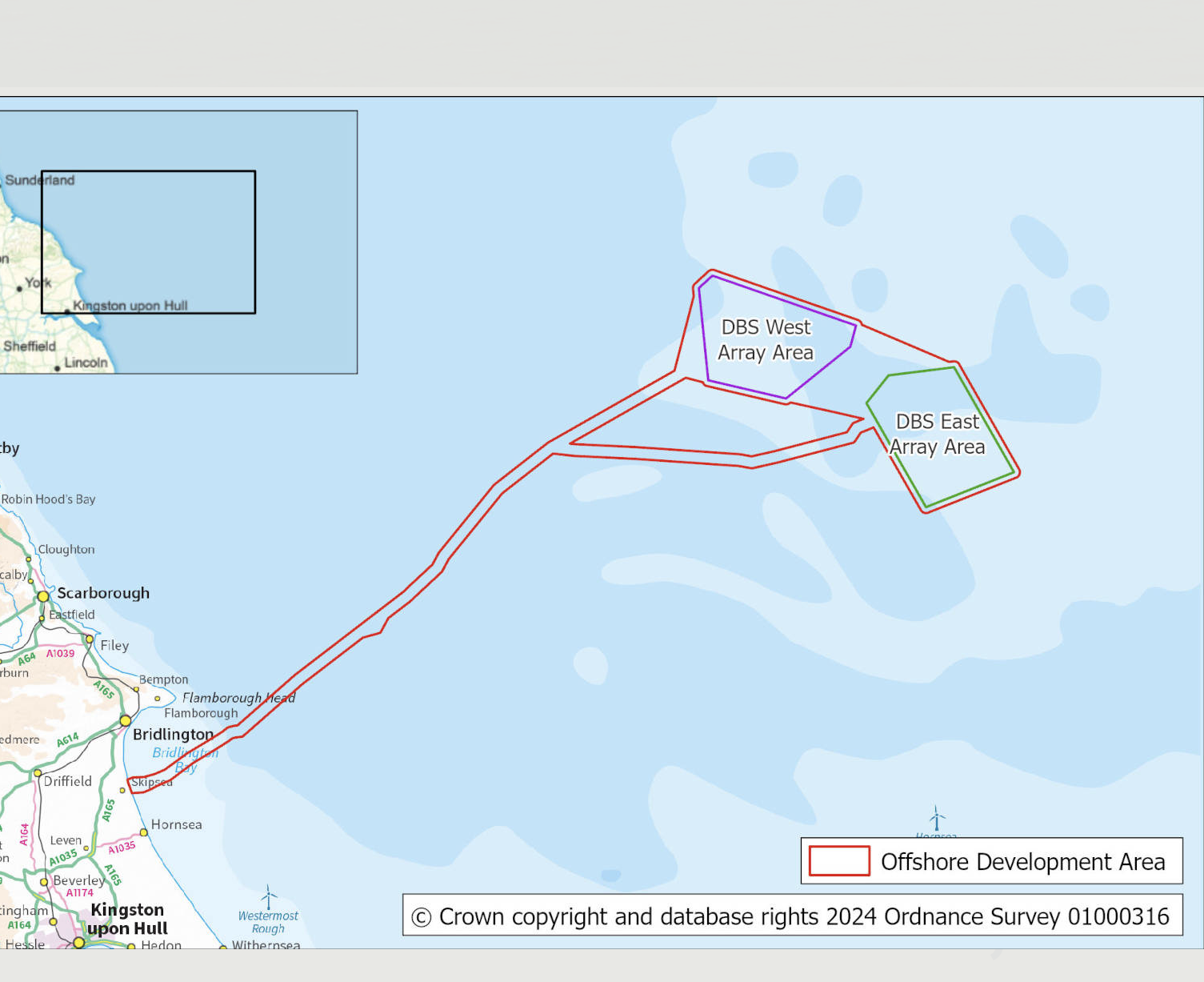
Note.
- Bridlington, Kingston-Upon-Hull and Scarborough can be picked out on the coast of East Yorkshire.
- The two wind farms and the route of the cables to the shore can be clearly seen.
I just wonder, whether the nature of the project is changing.
Consider.
- Three GW is a lot of power to move across Yorkshire to where it can be connected to the grid.
- In Consultation On Offshore Wind Reform: Hydrogen Sector Calls For Hybrid Connection Concepts And Warns Of Compensation Risks, German companies involved in the AquaVentus project are calling for more hydrogen to be produced offshore and piped to the shore.
- Could hydrogen produced in the Dogger Bank Wind farms be piped to the Northern end of the AquaVentus pipeline on the German sector of the Dogger Bank?
- A pipeline or cable could still bring energy to Yorkshire.
- The hydrogen could go to the hydrogen stores at Aldbrough and Rough.
- SSE and Centrica could play hydrogen-bankers to the Germans, as Germany is short of hydrogen storage.
- East Yorkshire is building two hydrogen power stations at Keadby and Ferrybridge.
- Support for the Dogger Bank South wind farms will probably be from RWE’S Grimsby hub.
Is this the Anglo-German co-operation, I talked about in UK And Germany Boost Offshore Renewables Ties at work?
I can see benefits for this arrangement for the UK.
- Hydrogen production is offshore.
- A lot of the onshore employment is in the UK.
- There will be a hydrogen pipeline between Germany and the vast hydrogen storage of Humberside via the German Dogger Bank and Dogger Bank South wind farms.
- Will there be a hydrogen pipeline between the North of Scotland and Humberside via the AquaVentus pipeline?
- There will also be a substantial cash flow to the UK Treasury because of all the hydrogen production in UK waters.
RWE may also be able to use a standard hydrogen production platform in German and UK waters.
This is the sort of plan, that the money men will like.
RWE, Masdar Move Forward With 3 GW Dogger Bank South Offshore Wind Farms
The title of this post, is the same as that of this article on offshoreWIND.biz.
This is the sub-heading.
The UK’s Planning Inspectorate has concluded its six-month Nationally Significant Infrastructure Project (NSIP) examination period for the Dogger Bank South (DBS) offshore wind farms, being developed by RWE and Abu Dhabi’s Masdar.
These two introductory paragraphs add more details.
Since the start of the examination this January, the Planning Inspectorate has assessed the environmental, socio-economic, and technical attributes of the DBS projects against the UK’s standards for sustainable infrastructure development.
The Inspectorate plans to prepare and submit a detailed report with recommendations to the Secretary of State for Energy Security and Net Zero within the next three months, and a consent decision is expected within the next six months.
The development of this wind farm moves on.
- The lease with the Crown Estate was signed in Jan 2023.
- In November 2023, Masdar took a 49 % stake as I reported in RWE Partners With Masdar For 3 GW Dogger Bank South Offshore Wind Projects.
But there is no completion date anywhere for the whole project, that I can find with Google.
If you type RWE offshore electrolysis into Google AI, you get this answer.
RWE is actively involved in several hydrogen projects utilizing offshore wind power for electrolysis, particularly in the Netherlands and Germany. These projects aim to produce green hydrogen, which is then used in various applications like industrial processes, transportation, and potentially for export. RWE is a major player in offshore wind and is leveraging this experience to advance hydrogen production.
Note.
- RWE are one of the largest, if not the largest electricity generator in the UK.
- In RWE Opens ‘Grimsby Hub’ For Offshore Wind Operations And Maintenance, I stated that RWE are developing almost 12 GW of offshore wind power around our shores.
So just as RWE are utilizing offshore wind power for electrolysis, particularly in the Netherlands and Germany, could they be also be planning to do the same in UK waters with the Dogger Bank South wind farm?
The hydrogen would be brought ashore in a pipeline.
There would be no need for any 3 GW overhead power lines marching across East Yorkshire and around the town of Beverley.
Two large hydrogen stores are being developed at Aldbrough and Rough in East Yorkshire.
H2ercules And AquaVentus
These are two massive German projects, that will end the country’s reliance on Russian gas and coal.
- H2ercules is a series of pipelines that will distribute the hydrogen in Southern Germany.
- AquaVentus will build a network of pipelines to bring 10.3 GW of green hydrogen from the North Sea to the German mainland for H2ercules to distribute.
Germany is embracing hydrogen in a big way.
- I introduce AquaVentus in AquaVentus, which I suggest you read.
- AquaVentus is being developed by RWE.
- AquaVentus connects to a German hydrogen network called H2ercules to actually distribute the hydrogen.
This video shows the structure of AquaVentus.
I clipped this map from the video.

Note.
- The thick white line running North-West/South-East is the spine of AquaVentus, that will deliver hydrogen to Germany.
- There is a link to Esbjerg in Denmark, that is marked DK.
- There appears to be an undeveloped link to Norway, which goes North,
- There appears to be an undeveloped link to Peterhead in Scotland, that is marked UK.
- There appears to be a link to just North of the Humber in England, that is marked UK.
- Just North of the Humber are the two massive gas storage sites of Aldbrough owned by SSE and Rough owned by Centrica.
- Aldbrough and Rough gas storage sites are being converted into two of the largest hydrogen storage sites in the world!
- There appear to be small ships sailing up and down the East Coast of the UK. Are these small coastal tankers, that are distributing the hydrogen to where it is needed?
When it is completed, AquaVentus will be a very comprehensive hydrogen network.
I believe that offshore electrolysers could be built in the area of the Hornsea 4, Dogger Bank South and other wind farms and the hydrogen generated would be taken by AquaVentus to either Germany or the UK.
- Both countries get the hydrogen they need.
- Excess hydrogen would be stored in Aldbrough and Rough.
- British Steel at Scunthorpe gets decarbonised.
- A 1.8 GW hydrogen-fired powerstation at Keadby gets the hydrogen it needs to backup the wind farms.
Germany and the UK get security in the supply of hydrogen.
Underground Hydrogen Storage Pilot Gets Funding Boost
The title of this post is the same as that of this article on Energy Live News.
This is the sub-heading.
New hydrogen storage tech could boost grid resilience and emissions cuts
These first three paragraphs add some details.
National Gas and Gravitricity have secured £500,000 from Ofgem to develop a new type of underground hydrogen storage.
The H2FlexiStore system, designed by Edinburgh-based energy storage firm Gravitricity, aims to store up to 100 tonnes of green hydrogen in lined geological shafts.
The technology, which could see a demonstrator built in 2026, is intended to offer a flexible, resilient solution to future hydrogen network needs.
The article also has an excellent graphic.
Note that it takes 55.2 MWh of electricity to generate a tonne of hydrogen, so a hundred tonnes of hydrogen would store 5.52 GWh of electricity as hydrogen.
Vallourec’s Delphy Hydrogen Storage Solution
Hydrogen can be a nuisance to store.
I have just found a YouTube video of a system called Delphy from French company Vallourec.
Delphy seems a neat solution, where hydrogen is stored vertically in a 100 metre hole, that can hold a 100 tonnes of hydrogen.
You can watch this video.
I think this would be an ideal hydrogen storage solution for a bus or coach company or a truck operator.
Cold Snap Leaves Britain With Less Than A Week’s Worth Of Gas
The title of this post, are the same as that of this article on The Times.
This is the sub-heading.
The closure of Russian pipelines through Ukraine and recent weather conditions have left gas stores ‘concerningly low’
These are the first two paragraphs.
Britain has less than a week of gas supplies in storage, the country’s largest supplier has warned after plunging temperatures and high demand.
Centrica, the owner of British Gas, said the UK’s gas storage was “concerningly low” after coming under pressure this winter.
The two largest gas storage facilities in this country are both in the Humberside area.
- Aldbrough is in salt caverns North of Hull and is owned by SSE.
- Rough is under the North Sea and is owned by Centrica
Both are being converted to store hydrogen.
Some might thing that is a bit stupid if we’re short of storage, but we need the hydrogen storage for four reasons.
- To store hydrogen created by electrolysers on Humberside, which will enable heavy gas users in the area to decarbonise.
- The hydrogen will also be burnt in a 1 GW hydrogen-fired power station at Keadby to back up the wind turbines, with zero-carbon electricity.
- The hydrogen will also be sold to the Germans to replace Putin’s blood-stained gas. It will be sent to Germany in a pipeline called AquaVentus, which will also deliver Scottish hydrogen across the North Sea. Hopefully, the Germans will pay a good price for the hydrogen.
- The hydrogen will be used for transport.
The mistake the Government is making is not to develop smaller gas fields, so that domestic gas users can continue to use natural gas, until the technology to replace it with zero-carbon sources is fully developed.
Funding Awarded For Study On Hydrogen Storage Potential In The East Midlands
The title of this post, is the same as that of this article on the British Geological Survey.
This is the sub-heading.
A new study has been awarded funding to explore the underground hydrogen storage potential in the East Midlands.
These are the first three paragraphs.
East Midlands Storage (EMstor), a consortium led by Cadent and partnered with BGS, Star Energy Group, Net Zero Strategy and the University of Edinburgh, has been awarded discovery funding by Ofgem’s Strategic Innovation Fund to undertake a new study to evaluate geological storage potential in the East Midlands.
The EMstor study is the first of its kind in the region. It will undertake a feasibility assessment of the East Midlands’ geology to evaluate its potential to host storage technologies, allowing expansion of Cadent’s proposed 100 per cent hydrogen pipeline.
The East Midlands has numerous depleted oil reservoirs, which may have potential to store hydrogen. The study will characterise the potential geological reservoir to establish if it is suitable for hydrogen storage at scale in the local area.
The oilfields of the East Midlands Oil Province have their own Wikipedia entry, which gives full details of the dozens of small oil fields in the area.
- It may not be the world’s largest oil resource, but it certainly helped us during the Second World War.
- Experienced Texan oil-men were even imported, to help boost production.
- It used to be possible to spot the occasional lonely nodding donkey, as you passed through the area.
Surely, if some of the oilfields can be converted to hydrogen stores, this would be very useful.
 The Anonymous Widower