The Robert Hooke Biodiversity Bell
I passed this work by St. Paul’s Cathedral.
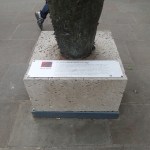
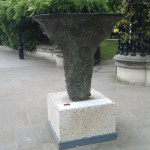
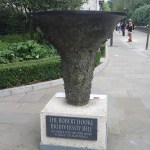
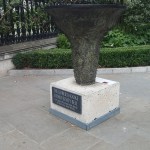
It is mentioned on many web sites, but it doesn’t seem to have a serious entry on the web. This blog gives a good explanation.
To me Robert Hooke is best known for Hooke’s Law, one of the basic laws of physics, that anybody who studied that subject will probably know. But Hooke did a lot more than find the law that bears his name.
He is one of those amazing characters that populate the history of science.
Lighting The Way Affordably
I have dabbled in the past with photoluminescence and C and myself were once enchanted by the starry ceilings of the Hotel Windsor in Nice, but up to now most of the applications have been small.
So I commend Hammersmith and Fulham Council’s plans to use the phenomenon to light up the path in William Parnell Park, as is reported here in the Evening Standard.
There are lots of places, where the proiperty of photoluminesence can be successfully used, although safety applications as detailed here predominate.
We may giggle at the idea now, but in a few years time, this type of lighting, will be used all over the place.
If you’d like to put stars on a child’s bedroom or something similar, there is this UK manufacturer in Bury.
In Search Of Lise Meitner
Lise Meitner is one of my heroes and as she was born in Vienna, I had to see if I could find her birthplace. She was supposedly born at 27, Kaiser Josef Strasse according to a web site I found.
This was the nearest I could find.
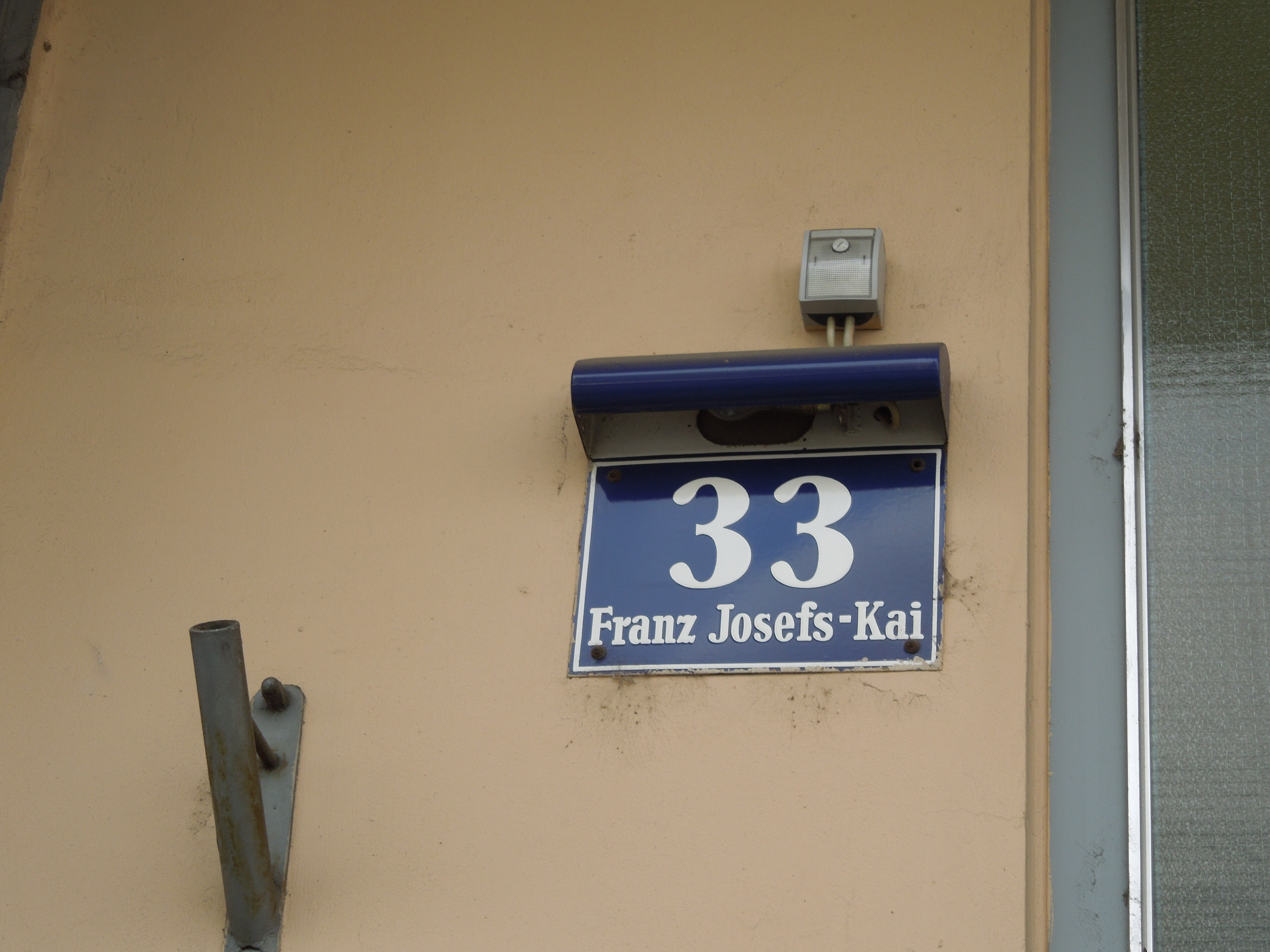
In Search Of Lise Meitner
I would assume that the house has been knocked down.
I’ve just looked from my home computer and I was looking in the wrong place.
I really should have taken it with me or searched for an Internet cafe.
The Mpemba Effect
I was alerted to this tale of a scientific curiosity by The Times.
A Tanzanian student; Erasto Mpemba, found that hot water freezes quicker than cold water, contrary to what would be expected. It is now called the Mpemba effect.
I don’t find it surprising that no-one has fully explained the phenomenon, despite it apparently being known to such as Aristotle.
I think it does show though, that sometimes anybody can make a scientific discovery with the most basic of equipment. And in most cases, to be taken seriously by the establishment.
There are some curious phenomena out there in the real world.
One is that when water freezes it expands and thus ice always floats on ponds. If it didn’t you wouldn’t get any fish in water that could freeze.
And then there is the odd property of the speed of sound in air and water. In the former it is 343.2 metres/second and in water it is 4.3 times as fast at 1484 metres/second. Now I know my physics and when asked what the speed of sound in a bubbly mixture of air and water is, I did what I thought was obvious and said somewhere in between.
I was of course wrong, as surprisingly it is less than 50 metres/second. There’s an interactive display here.
I have used this phenomenon to mix oil and water. They do mix, if you get the parameters right.
Is This The Best Microwaveable Gluten-Free Sunday Lunch?
I wasn’t feeling too well this morning, as I probably got too hot in the sun at the Paralympics yesterday. It seemed to make my hand and arm go rather cold. So I picked up one of Marks & Spencer, roast pork loin with apple & cider sauce dinners from their Fuller Longer range, as I didn’t want the hassle of cooking properly.

Roast Pork Loin With Apple & Cider Sauce
It really is rather a nice meal for something that you just put in a microwave. I wonder whether when John Randall and Harry Boot, invented the cavity magnetron in 1940 at the University of Birmingham, ever visualised, nearly everybody having one in their homes.
The Odd Physical Properties of Mixtures of Air and Water
Richard Hammond today, in his program called Engineering Connections about the Space Shuttle, showed how NASA use a wall of water droplets to protect the shuttle and the launch platform from the immense sound waves created by the rocket engines on lift off. I have seen a shuttle launch and even some miles away the noise was awesome and in some ways the most unexpected part of the event.
If I ask an averagely serious engineer or physicist to tell me the speed of sound in air and also that in water, they will give answers of 343.2 and 1497 metres per second respectvely with various conditions like dry air and pure water. So sound travels a lot faster in water than air.
So if you have a mixture of bubbles of air in water or vice-versa, a logical person would think it lies somewhere between the two.
But they would be wrong! According to this paper from 1969, by D. McWilliam and R. K. Duggins, it can be as low as 18.2 metres per second. This creates all sorts of problems and benefits. NASA’s engineers used it in one way and I invested in a company that used it to make an aerosol valve.
But it is a property that hasn’t been used to the full.
They say that oil and water do not mix.
But I have seen an experiment where bubbles of air was introduced into a mixture of water and oil and the resulting mixture was passed through a choke or restriction. A creamy liquid emerged, because the air bubbles in the restriction in trying to get into some form of steady state, mixed evetrything up.
I know that explanation isn’t very good, but who cares as the technique works.
In places like Saudi Arabia, there are large lakes of tar, that are just dumped in the desert. Perhaps by using natural gas as the gas, could this pollution be burned, whilst it is still hot?
I don’t know! But I do know that this abnormal property of mixtures of gases and liquids is not used for all the applications it can be.
Building Scientific Models with Computers
This was the title of a lecture at University College London, that I attended yesterday lunchtime.
It was an excellent lecture and in some ways it was like going back forty years to when I worked at ICI Plastics in Welwyn Garden City. In fact two topics, that were discussed by Professor Catlow, were similar to problems I tackled all of those years ago.
The first was the problems of turbulent and other flows. We had been interested in what happened inside an extruder as you used it to force plastics, such as polyethylene, polypropylene and PVC into moulds to produce the products needed. It was an intractable problem then and I suspect it might be almost as bad today. Although computers are now bigger and can handle many more nodes than the hundred or so, we could handle on our PACE 231R or with IBM 360/CSMP.
I also found his discussion of the various forms of molecules and how they could be predicted fascinating and if we’d had someone with his knowledge, we’d have got a lot farther with another problem.
When you create polymers, you create long chains of molecules like ethylene and propylene etc. which lock together like a series of odd-shaped Lego bricks. These chains then bind together to form the items we need.
At the time, ICI were trying to create an engineering plastic, which would be stronger and have a greater temperature range. I won’t name it here, as I don’t want to break any confidentiality, but suffice to say that the monomer or polymer building block, needed to be created as a straight molecule for the integrity of the plastic. It was known that several forms of monomer could be created and that there was a rather complicated separation process to extract the straight ones. Just as in Professor Catlow’s example yesterday, water in the reaction, was one of the factors, that affected the proportion of desired monomer.
Now I’m not a chemist but I was asked to look at the physics and dynamics of the reaction, with respect to removing the errant water from the reaction vessel as soon as possible after its creation, to reduce the damage it could do. In the end, I made myself very unpopular, as I often did, by finding a method that removed the water. I can remember searching Chemical Abstracts and finally found the data I wanted in a paper published by a Chinese researcher working in Canada in 1909. We don’t know how lucky we are with Google and the Internet.
I left ICI soon after I completed this work, so I don’t know the final outcome!
But to me, the exercise proved the value of using dynamic computer models based on differential equations, to understand difficult systems.
In some ways, I was able to do this work, because I was properly taught calculus and how to form differential equations at school. Would such an important subject now be taught to sixteen-year-olds as was regularly done in the 1960s at schools similar to the one I attended?
A Christmas Present for the Woman in Your Life!
I had a well-educated lady round for lunch today and she saw the book below on the counter.
Lise Meitner: A Life in Physics (California Studies in the History of Science)

In my view it is one of the best reads, if you are interested in science between the wars and especially in Germany. It also tells the story of one of the greatest women scientists of all time; Lise Meitner.
Sathnam Sanghera
Sathnam Sanghera is one of The Times columnists.
He is also someone who I try to read each week. I suppose that despite his background from an Indian family in Wolverhampton being very different to mine of a group of London mongrels, that we have a lot in common. He usually makes me laugh a bit and always makes me smile.
Take this first paragraph from his piece yesterday which was ostensibly about cats and their relationship with men.
If you’d asked me, at the age of 10, what my life would be like at the age of 33, I would have probably mentioned a semi-detached in Wolverhampton; the 2009 equivalent of a Ford Orion on the drive; a Punjabi wife of ten years or so; a couple of spoddy kids who, like me, were good at maths, but crap at English and sport; a job at a local building society; a garden; male pattern baldness, and a cat. That I have none of these things is not a cause of distress or concern — they might still come and, besides, more thrilling things, such as houseplants, have taken their place. But it does puzzle me that I still don’t own a cat.
If you’d asked me the same question at about the same age, I would have probably thought something similar, except that I’d be running my father’s printing business in Wood Green.
So we do have a lot in common.
The most interesting thing is that Sathnam says, that he was good at maths, but crap at English and sport. And here is Sathnam writing well-crafted articles in one of the world’s premier newspapers. In fact, as his column is probably syndicated, then it might be several.
I was the same! Maths good, English bad. But now, even if I say it myself that is not true. The maths and its usage is still good and that of those around me sadly gets worse. Does teaching not instill the joy of maths, physics, chemistry and the other sciences into students any more? But it is my English that has improved so much!
Why? I don’t know. Perhaps, Sathnam could tell me, as it’s probably the same reason his has improved.
I was crap at sport too. But now I play a lot of real tennis and was actually a National Champion a couple of years ago. Don’t tell anybody, that it was in my handicap group and only five people entered!
So there is hope for Sathnam’s sport too!
Refrigeration Technology
Dr. Booth taught me A-level physics in the mid-1960s and he instilled a love in the subject, that I still have. I even count Advanced Level Physics
One thing he said was that in a few years, we would be using the Peltier effect for heating and cooling. He was right about the technology, but it is only in the last few years that we have seen practical applications of the effect.
I have just purchased a Baumatic wine-cooler from Currys.
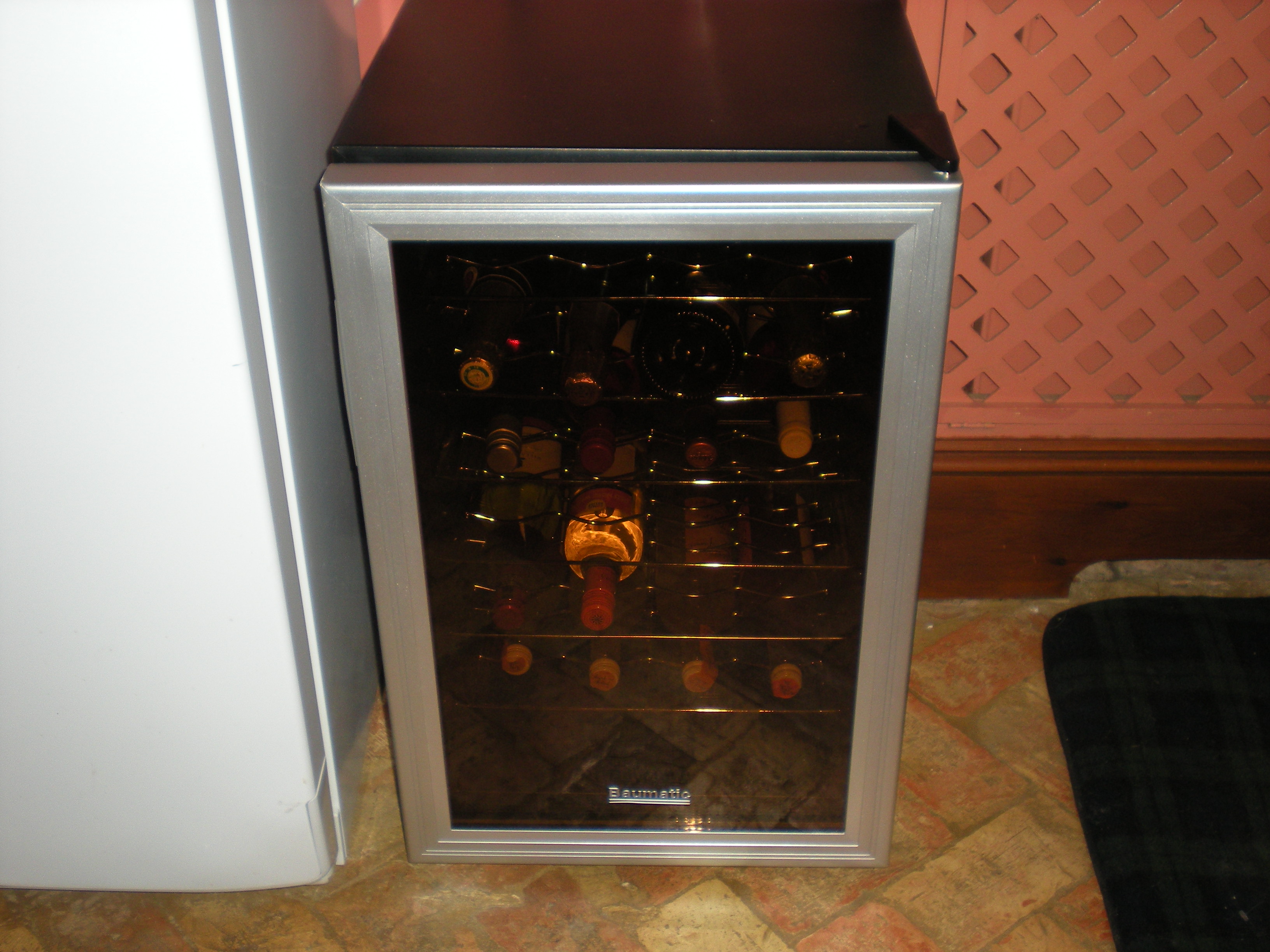
Baumatic Wine Cooler
The salesman said it was a normal fridge, working with coolant, pumps and fans. It isn’t, as it’s a Peltier effect fridge.
It will be interesting to see how it works.
One point to notice is that it is a lot cheaper than a comparable cooler working in the normal way. But does it use more or less electricity?
 The Anonymous Widower