The Heaviest Suicide Note In History
When I first saw the EdStone, I thought Miliband had not only fallen off his trolley, but crashed it in a big way and given himself a serious brain injury.
I have just found this article in the Daily Mail, which has the headline of Do you know where Ed’s stone is? Mail offers reward to person who can tell us where Miliband has hidden ‘heaviest suicide note in history’
Ed Miliband doesn’t have enough common sense to run a whelk stall!
At least the electorate, who on average have a lot more intelligence that Miliband, have consigned him and his leadership of the Labour Party to the dustbin of history.
He may have left the Labour Party in such a state, that no sane and sensible person will ever want to lead it voluntarily.
A Rum List Of Candidates
When I went to vote today, there were eleven candidates; three from the major parties, one from a one-issue party and an almost complete spectrum from the ultra-left to the far-but-not-ultra right comprising the remaining seven. Some of the last group would have been certified by some dictators and despots of the past.
One of the candidates didn’t even have a cv. Would you vote for someone, who you know nothing about?
I think the result in this constituency is a foregone conclusion, but isn’t it in hundreds of places.
Democracy is a wonderful thing, but it could be improved a lot!
A Surprising Election Leaflet
I have got quite a bit of electoral junk mail this election, but one today was different.
It was the usual A4 or A5 well-printed flyer, from a party I have voted for in the past, but my name and correct address was actually printed on the glossy paper.
Admittedly, they had used last year’s register with my incorrect name, but that was understandable, as the register was only finally corrected a couple of weeks ago.
Perhaps, we need a law to say that nothing goes through a letter box, unless it is properly addressed.
I’d probably get about four letters a week.
The Two Big Election Issues The Politicians Aren’t Addressing
The tragedy unfolding off the Libya coast, where hundreds are dying every day as they try to get to Europe is impossible to solve.
We can’t say it’s an Italian problem and put our heads in the sand, as most politicians seem to be doing. Especially, as it seems most of the migrants want to get to Northern Europe and often the UK, where the jobs are.
Suppose we just said that none of these migrants would be let into the UK, as probably the Ukippers would say. How long would it be before the rest of Europe applied policies to get us to accept our fair share?
If on the other hand, we took a selective number, then this would signal to those organising the trade, that there was a good chance you may get residence in the UK.
I haven’t a clue what you do! And neither have the politicians!
I do have some sympathy though for the migrants as three hundred years ago, my two closest male lines; one Jewish and one Huguenot, were welcomed in this country, after escaping from persecution. One was probably a tailor and the other was an engraver, so all they brought was their brains and skills. I don’t know about the Huguenot, but the Jew was probably single and converted to Christianity within a few years, so he could find a lady and get married. My two close female lines are both internal migrants from Devon and Northants. London has always been a magnet for migrants, so nothing has changed.
There is also the problem of Greece going bust, which could happen before our General Election.
It could be argued that it is nothing to do with us, as we’re outside the Euro zone!
But then we have a strong economy and a country where there are a lot of Greeks.
Certainly, if I was a Greek engineer living in Athens with a cousin in London, my savings would have been long gone.
I do wonder how much of the Greek bailout money ended up safely invested outside of Greece.
So we may not lose money, but we are probably going to suffer some collateral damage. Especially, if the various financial institutions want their money back!
It will not be as serious a problem as the Libyan migrants, but where are the politicians heads on this one?
Deep in the sand!
Removing One Hundred And Seventy Years Of Inadequate Design
The Manchester to Preston railway is san important line in the North-West of England, that was completed in 1841.
To say that is not fit for purpose is a total understatement, as it is not electrified and has a speed limit of just seventy-five miles per hour.
Finally, the line is being electrified and the speed limit will be raised to a hundred. From December 2016, hopefully refurbished Class 319 trains will be speeding from Manchester via Bolton and Preston to Blackpool and possibly Windermere.
The major problem on the line are the twin tunnels at Farnworth. They have a history of make-do-and-mend and are too small to take the overhead wires and Network Rail have come up with a practical solution, that should last several hundred years at least. This Google Earth image shows the ends of the tunnels with respect to the location of Farnworth station and the A666.
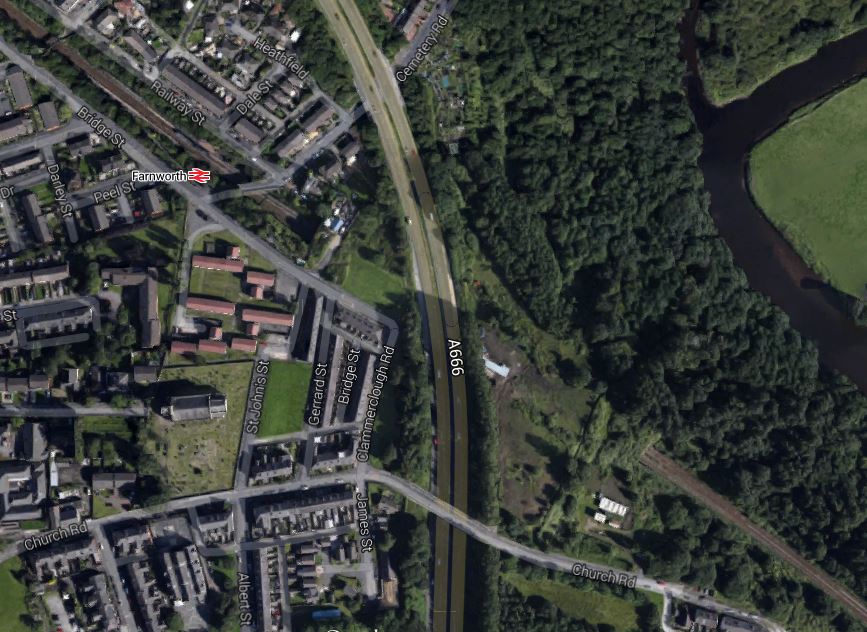
Farnworth Station And Tunnels
The smaller of the two tunnels will be refurbished and given a concrete lining, so that during the works, there will always be one track for trains. They will then bore out the larger tunnel, so that it is big enough to take two tracks and the overhead lines.
This will require that between May and October this year, there will be significant disruption to rail passengers. The whole project is described in this article in the Bolton News. It may cause a lot of disruption, but the passengers seem philosophical, as these paragraphs from the article show..
Jeff Davies, part of the newly formed Bolton Rail Users Group, said: “The station closures are the bad news, but there is good news here actually.
“It is the beginning of big investment which could take us out of the present problems and the companies have been at great pains to minimise inconvenience and ensure that Bolton people who work in Manchester will still be able to get there.
Perhaps this is because Network Rail have done their public relations well, if this YouTube video entitled Rebuilding the Farnworth Tunnel is anything to go by.
It all goes to prove that politicians should have sorted out the mess that are the railways of the North many years ago.
The Iron Lady Rides Again
I don’t think I saw Margaret Thatcher in a debate like last night’s, although I did hear her many times on the radio during Prime Minister’s Questions.
I was speaking to a Scot this morning, and we both felt that Nicola Sturgeon has a lot of Margaret Thatcher about her.
I’ll probably be sent to The Tower for treason or whatever the Scots do, for such a thought!
Last Night’s Mass Debate
The Times has a leader article entitled The SNP Challenge, where it discusses last night’s political debate between party leaders on the BBC.
It is very much a must-read and it sums the debate up like this.
There was a lot of discussion of what politicians will spend money on. There was very little on how money will be created.
I suppose that the parties, who took part last night will be borrowing it from foolish lenders!
Does Milband Want To Alienate Voters?
Ed Miliband today launched the Labour party’s manifesto in Manchester.
Knowing Liverpool as I do, I can imagine some of the chat in the pubs in that city. And probably in other cities like Birmingham, Leeds and Newcastle. And certainly, London!
Certainly, this Londoner feels it was not a good idea to launch in Manchester and perhaps the only worse place would be Scotland.
I think that the only policy you’d launch in Manchester would be one that is specific to the area. Surely, that way if you launched specific policies all over the country, you’d get the most good coverage.
The Tories Will Aim To Cut Inheritance Tax
According to this article on the BBC, a future Tory government would end Inheritance Tax on family homes up to a million pounds.
I have form in opinions in this area and had a letter published in the Financial Times in 2006 about this tax, after an article in the paper on March 31st 2006 advocated the killing off of the tax. This is the first two paragraphs of the letter.
I have been against inheritance tax for years, not because I would benefit from its abolition or because I am getting to that age, when I should start to do something about it (“Inheritance tax should be killed off”, March 31). It is just that as a control engineer by training, I think it does untold secondary damage.
Consider: how many bright minds are employed on both sides of the inheritance tax war in avoiding and collecting the tax? Abolish it and they would have to do a proper wealth-creating job.
I still believe that the Inheritance Tax should be abolished, if not totally, but substantially! I don’t have current figures but in 2006, it only raised half as much as Air Passenger Duty in that year. I’m not alone on thinking this way as this article from the Telegraph in 2013 shows. This paragraph is from the article.
Yet the tax raises just £2.9bn a year, a mere 0.18pc of GDP, a tiny sum given all of the collateral damage caused and one which could easily be recouped by accelerating the Government’s savings programme.
David Cameron’s proposals are welcome, but pretty timid and will only have a limited positive effect on the economy compared to what full abolition will have.
The tax revenue would have to be replaced and as a BBC survey showed in 2006, that people would prefer a couple of pence on Income Tax. These days other and better options exist. The problems with abolishing Inheritance Tax are all political rather than economic, as if the Tories went for full abolition, the Labour Party would have a field day, saying they were looking after their friends.
They’ll probably do that with David Cameron’s announcement, even though probably nearly half of the beneficiaries of the tax reduction will be Labour voters.
Avoiding The Real Issues In The NHS
All the political parties seem to be promising more and more to the NHS in this election, be it money, drugs, doctors, nurses or midwives.
Money could be the least of the problems, as it will probably come from improvements to the economy or some tax-the-rich measure, depending on your political point of view.
As drugs are not really a drug problem, but usually a money one, we are left with where to we get the tens of thousands of staff we need to provide health-care.
The trouble is that being a health professional, is a skill you can use anywhere in the world, as all human beings are the same under the skin, even if they come in various colours, speak different languages and have certain different diseases governed by genetics or environment. So just as we can recruit paramedics from the Antipodes, nurses from the Philippines and doctors from virtually everywhere, other countries can entice our health professionals away.
We live in an increasingly global society, and working abroad for a few years is often in many peoples desired career profile, be it in health care or not. Healthcare like certain other professions is one of those that gives you a passport to a lot of interesting places.
All manpower planning in the NHS seems to believe that those trained here, will stay here. But all good training does is hand everybody that passport to travel.
To make matters worse, good training for some professions, is an excellent grounding to starting a business or working in the private sector.
So the first issue we must face, is this one of where do we get the staff. The NHS has shown itself to be not very innovative in this area.
Some have suggested in the past, that anybody trained in the NHS must contract to work for the service for so many years. This is just cloud-cuckoo thinking.
The one positive thing that can be done to help staff is to provide better working conditions and rewards for those working in the NHS. Most of the NHS buildings, I’ve seen in the last ten years have been pretty sound, with perhaps the odd exception, so we must look at the problems of staff with respect to organisation, management, pay and pensions.
What I do find interesting is that all of the Practice Nurses I’ve met in GPs surgeries seem to be so much happier in their work than those in hospitals. It’s only a small survey, but it does say something about the difference between GP’s surgeries and hospitals.
When I’ve spent time in hospital in the past few years, it has been been twice in good NHS hospitals and once in an expensive private one in Hong Kong. There was little difference in the equipment or methods used, but as an IT professional of some years experience, I don’t believe that hospital systems are what an engineer or manager would accept if they worked in say a modern car factory in the UK.
So we must get hospital and GP health systems to the levels that patients and staff expect in their personal life.
Where is an on-line copy of my health record, that I can read to get to the bottom of my problems, that seem to occur seasonally in the Spring?
But things are changing and we must create a health communication and information system, that is an order of magnitude better than what we have today.
No political party is saying they’ll fix this important gap in the NHS.
Everything in our lives is going on to our computers or phones, but healthcare in the NHS hasn’t changed that much since I was born in 1947.
Some people rightly worry about such a computer system. But at its best it would only be like an on-line shopping system, where if you don’t see what you need on-line at your favourite store, you go and look at a physical one.
In all the politicians posturing on health, they very much ignore the users of the NHS and what they can do to improve the service and its efficiency.
I would be interested to see an analysis of how much the average patient costs the NHS. I suspect that because of the lack of a fully joined-up computer system, if I had complete access and wanted to find out how much I cost the NHS last year, no accurate value could be calculated.
Many people calculate their motoring costs to the last penny, but even if they wanted to, it’s probably impossible with healthcare, even though all the data is there.
Eventually, everybody will have this figure, as it could be a powerful tool for a GP to classify and better treat their patients and as a motivator to patients to improve their lifestyle. You’ll never change some patients, but many could be nudged in the right direction.
We must also do more to ease our load on the NHS. On a personal level, I look after my INR, by doing my own tests. A Committee of MPs has stated that all NHS patients who can, should do their own testing to save the NHS a lot of money.
How many other measurements can be taken by patients to ease the load? And are we doing enough to encourage more and better devices?
In no political party’s pontifications on the NHS, can I find anything about bringing the patient more into his or her own healthcare. But many doctors and nurses have said to me that we should take more responsibility for our own health.
After all, many of us now carry a tablet or phone, that has more computing and information accessing capability than existed anywhere ten years ago. Is this being used to give us better healthcare? Not really!
Political parties are not tackling the problems caused by our poor diet, lifestyle and environment.
Where I live, there are more unhealthy takeaways than you need to try a new one every week of the year. Not one sells any gluten-free food, so their chances of seducing me with their crap is non-existent.
Even the Sainsburys Local that I use is not a store,where you can always get the staples you need to create a healthy meal. Yesterday, I needed a couple of haddock fillets for supper, but except for some very bedraggled and unappetising cod, there was no uncoated fish. So I had to take a bus to the Angel to get some from Waitrose. Does a lack of healthy food locally mean that many don’t eat as healthily as I do? I am out and about in London most days using my Freedom Pass, so it is not difficult for me to pick up what I need on the go. But a young mother with an infant in a buggy doesn’t have that luxury. It’s not the shops’ fault, as they only stock what the shop sells!
The only positive thing government can do in this area, is to give local authorities more power to decide what shops they allow in their area.
I haven’t seen anything like this in any manifesto.
We should also do things to curb air pollution, which can get bad at times. All city centre transport, should either be electric or very low emission vehicles.
But again, no-one wants to annoy people, except the Greens, who won’t win anyway.
I suppose smoking comes into this area. Any candidate for London Mayor, who decides to ban it in public parks, squares and in the vicinity of bus stops gets my vote next time.
Perhaps candidates for the election, should have to declare if they smoke or not and what car they drive on the ballot paper!
Do we also give our children an education that will help them get through the minefield that is health? We give sex education in schools, but surely health education is just as, if not more important!
We need to think radically, about how we deliver healthcare and before we throw money at it, we should sort out the details on how it is delivered, how it interacts with patients and the fasctors that affect it.
Conservative 1940s thinking has failed and we must bring the NHS into the twenty-first century.
 The Anonymous Widower