Stuttgart Hauptbahnhof
Stuttgart Hauptbahnhof is going through a controversial rebuilding called Stuttgart 21, so I had to choose to change trains there, between Karlsruhe and Essen.
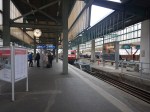
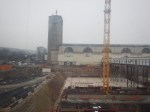
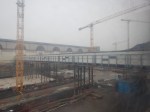
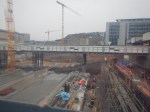
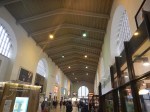
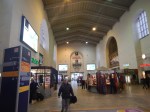
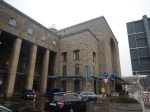

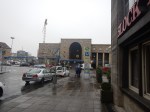
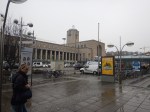
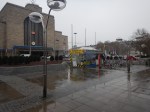
The building opened in 1922 and was designed by Paul Bonztz. So it is almost the same age as Waterloo station.
The project is also costing about the same as the Thameslink Programme.
They all make an interesting comparison.
I can’t say that I understand what all the fuss is about.
This article on Deutsche Welle is entitled Stuttgart 21 – Germany’s Other Engineering Fiasco Goes Off The Rails.
This is the first paragraph.
Everyone in Germany has heard the jokes and seen the social media memes about Berlin’s BER airport. But the Stuttgart 21 railway project has also developed into a logistical nightmare — and a sinkhole for public money.
It doesn’t look to be a happy project.
Slow Progress On Manchester-Preston Electrification
These pictures show the current state of the electrification of the Manchester-Preston Line at Bolton and Horwich Parkway stations.

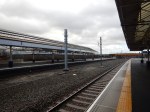
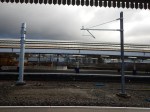
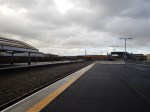
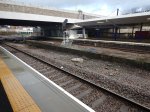
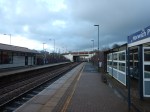
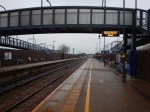
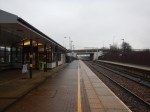
It is a sad sight, that I have seen repeated all over England, where electrification is being installed.
As on the Gospel Oak to Barking Line progress has been slow. Except that this scheme is much slower.
It also appears that something like this is happening on electrification.
- A team come along and install the foundations for the gantries.
- Then everybody takes a long break, whilst it is worked out how to install the foundations that couldn’t be installed or had just been forgotten.
- A team then comes along and puts up the gantries.
- Then everybody takes a long break, whilst they chase up the gntries that don’t fit or haven’t been delivered.
- A team then comes along and decorates the gantries with the various fitments for the overhead wires.
- Then everybody takes a long break, whilst they chase up the faults needed to be fixed before the wires to go up.
- Finally, the wires are installed.
Only now,the testing can begin!
On the Gospel Oak to Barking Line, they’ve finally got all the way to Stage 7, but it has meant two major closures of the line.
On the Manchester-Preston Line, they’re still blundering around in Stage 1.
Years ago, I used to work with the Greater London Council on various projects. The Head of the Construction Branch told me, to beware of sub-contractors, who had their fingers in lots of projects, as it inevitably led to all projects being late.
Could it be, that the electrification woes all over the UK, is that there aren’t enough competent engineers and fitters to design and erect the overhead gantries?
As the Manchester to Preston electrification was being carried out by Carillion, that wouldn’t have helped either! This probably explains the very slow progress on this project.
The competent staff are going, where they know they’ll get paid.
Network Rail’s chronic Project Management and forward planning hasn’t helped either. Crossrail has highlighted the poor state of the wires on the Great Eastern Main Line and with all the new trains due to thunder along the line in a few years time, they seem to have decided to replace all the unreliable wiring in East Anglia.
About time too!
But, this job should have been planned, resourced and carried out earlier.
So all the competent engineers and fitters are flocking to better jobs!
Conclusion
Network Rail needs to do the following.
- Have access to a competent team of engineers and fitters, either in-house or with a reliable engineering firm.
- Create a plan of new electrification and renewals for the next few years.
- Stick to it.
But politicians will not allow this!
It should be noted that if the train companies use more bi-mode, hydrogen and battery-powered trains, this will increase the need for small electrification schemes to allow the new trains to run efficiently.
Hopefully, these small schemes will be of vaguely similar natures, so installation won’t be the large scale farces, we’ve seen in recent years.
Why Has 319448 Not Been Repainted?
In the November 2017 Edition of Modern Railways, there is a picture of this Class 319 train passing behind the Ordsall Chord bridge on Page 49.

The train is on the right hand page and appears not to be in the usual Northern Electrics blue.
So why has it not been painted?
319448 Is A Class 319/4 Train
319448 is a Class 319/4 trains, which are probably the best variant of the Class 319 trains, as they have been refurbished a couple of times and have a First Class section, less 2+3 seating and a Universal Access Toilet.
These pictures which show a typical Class 319/4 train, were taken when the trains were being used on Thameslink.
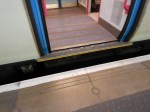
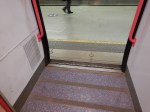
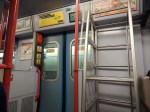
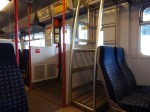
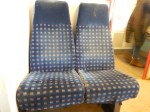
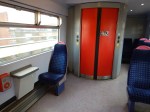
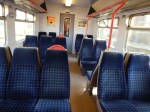

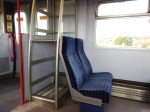
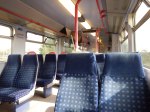

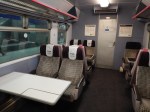


So preparing 319448 for service in the North-West was probably a lot easier, than some of the other Class 319 trains.
Northern probably needed an extra Class 319 train urgently and bringing it into service in Thameslink condition was probably acceptable to customers and their cash-flow.
The exterior painting and the tidying up of the interiors can probably be done later, when there is less pressure on stock numbers.
319448 Is Going To Be Converted To A Class 769 Bi-Mode Train
In the Wikipedia entry for the Class 769 train, the serial numbers of the Class 319 trains to be converted are given.
769424, 769431, 769434, 769442, 769448, 769450, 769456, 769458, 769???, 769???, 769???
Note.
- The first three digits identify the train class and the last three digits the train number in that class.
- After conversion 319424 will become 769424
According to Issue 834 of Rail Magazine, 319456 and 319434 are in Loughborough for the conversion.
So it looks like 319448 will be converted to 769448.
Northern’s Need For Class 769 Trains
The Wikipedia entry for the Class 769 train, says this about Northern’s initial use of the trains.
Northern have indicated that the use of these trains would be of most benefit on routes that are part electrified, whereby they would be able to use the pantograph for the main part, while being able to operate using diesel power away from the overhead lines. The first route to be confirmed by Northern for the running of Class 769 units was the Windermere branch line between Oxenholme and Windermere in North West England.
Once the current electrification program between Manchester and Blackpool, Preston and Stalybridge is complete, there are several partially-electrified routes, where Class 769 trains might be used in North West England.
- Blackpool South to Colne
- Liverpool Lime Street to Chester via Runcorn and the Halton Curve.
- Manchester Piccadilly to Buxton
- Manchester Piccadilly to Liverpool Lime Street via Warrington
- Manchester Victoria to Blackburn via Todmodern and Burnley
- Manchester Victoria to Clitheroe via Bolton and Blackburn
- Manchester Victoria to Kirkby
- Manchester Victoria to Southport
- Preston to Barrow
- Preston to Ormskirk
If the trains are a success, then surely more trains will be deployed around the electrical networks in Leeds and Newcastle.
A Possible Conversion Plan
Could the conversion of a Class 319 train to a Class 769 train be something like this multi-stage process.
1. Pre-Service Changes
The Class 319/4 trains have for several years been running without serious problems on the Thameslink route,
However, due to different operational rules, I suspect that there will be some changes that have to be carried out before the trains can run in the North. 319448 has obviously had these changes.
2, Pre-Conversion Test Running
If I’ was going to spend a lot of money converting a train, I’d give it a thorough testing with experienced drivers and engineers to make sure there wasn’t an expensive fault.
Northern have a team of drivers with lots of experience of their current fleet of thirty-two Class 319 trains.
The train could even be used in passenger service, as it is an unmodified Class 319/4 train little different to the others in Northern’s fleet.
3, Conversion To Class 769 Train
The train can then be removed from service and converted to a Class 769 train.
4, Testing And Entry Into Service
The trains can be appropriately tested.
5. Interior Refurbushment And External Painting
Doing this last is probably a lot easier, given that the Class 319/4 trains are generally in a good state cosmetically.
A Production Line Would Be Possible
I believe if you do the Project Management professionally for the conversion of the eleven trains need by Northern and the extra five for Wales, it will be possible to fit together a very orderly and efficient production line.
I can envisage that production of units getting quicker as experience is gained.
Innovation In Railway Projects
This article in Rail Technology Magazine is entitled NR routes to publish ‘pipeline’ of third party opportunities by year end. It lays out a new philosophy of how rail infrastructure projects could be handled in the future. I suggest you give the article a careful read.
Some politicians will say it is privatisation by another name. But to me it is just a way of getting a project built faster in a safe manner.
This is a paragraph.
By the end of this year, NR’s routes will publish ‘pipelines’ of projects that they want to put out to market. The infrastructure owner will also be working with government on producing a list of third-party opportunities. Initially these opportunities may be at the smaller end of the spectrum such as new stations, depots and car parks.
Take the simple example of a depot. These days fleets of new trains often mean a large increase in depot capacity as trains are longer and fleets are larger. As fleets are often bundled in with maintenance, there is a specialised multi-million pound asset that needs to be created. Big investors create office blocks, sporting venues and shopping centres and lease them to other businesses, so why shouldn’t they build the infrastructure that the railway needs?
This article in the EADT is entitled New rail depot unveiled by Greater Anglia at Brantham on Suffolk/Essex border.
The article dates from February 2017 and says that design is starting and the depot will be open by the end of 2018.
Not a bad timescale for a depot covering 22 acres with fifteen electrified tracks, two of which are under cover.
Why should the taxpayer get involved in a project like this?
Network Rail’s only involvement should be to ensure that the depot interfaces with the railway correctly.
This article on the BBC is entitled Crossrail stations in west London delayed until 2019.
I took this picture at one of the of the five stations; West Ealing, yesterday.
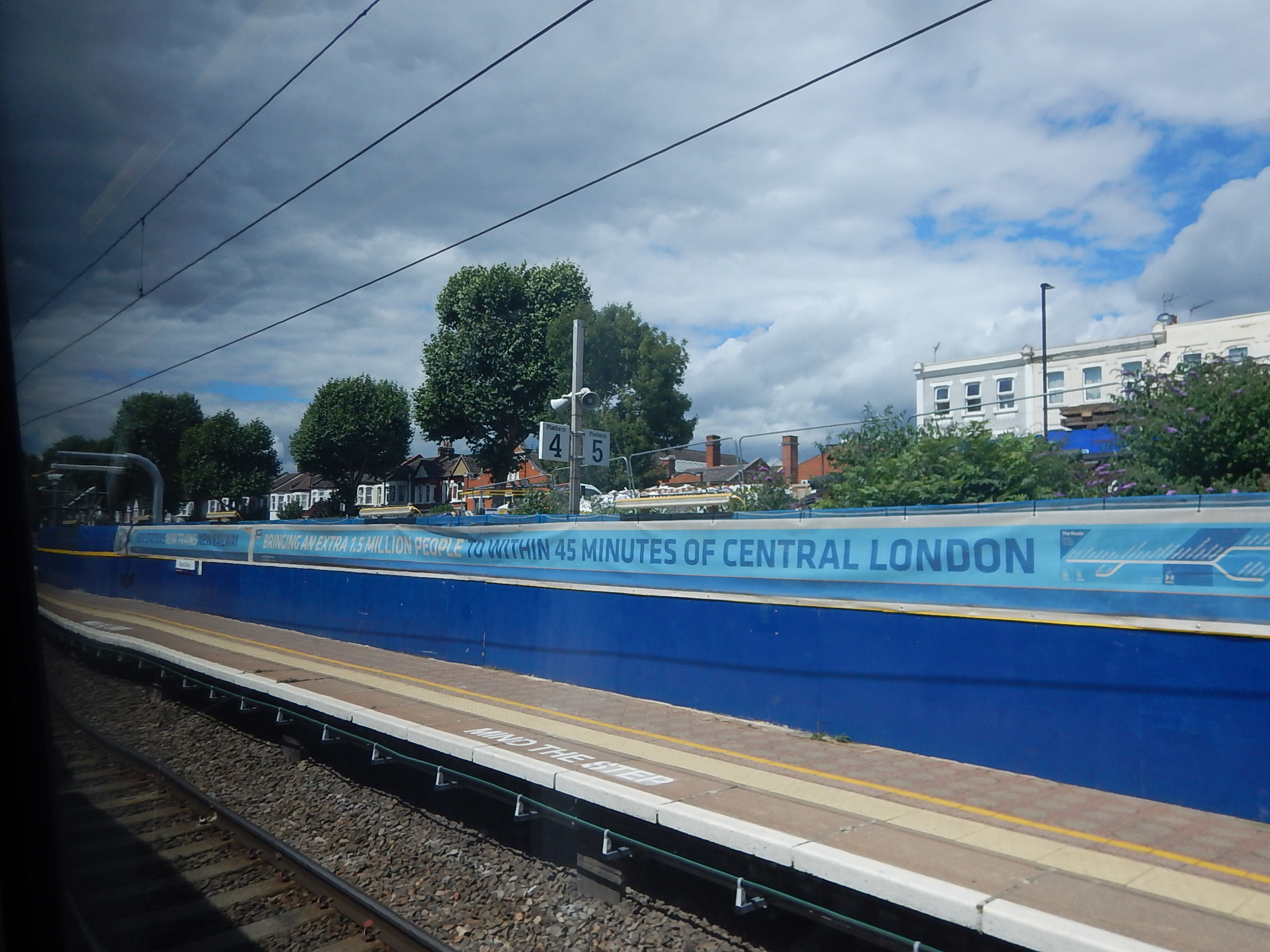
Nothing appeared to be going on, despite the fact that much of the construction is well to the side of the railway. Compare this with the situation at Abbey Wood station, that I saw a few days ago.
I suspect Crossrail wish they had taken control of the Project Management of the five West London stations themselves.
Network Rail seem to have a culture that if assets are built a few years late, it is totally acceptable.
This culture must stop!
Crossrail Expands Before It Opens
This is certainly something you don’t hear often about a new rail line.
This article in Global Rail News is entitled TfL To Order More Elizabeth Line Trains.
Four new Class 345 trains are being ordered, which will mean that in the Off Peak the following will happen.
- Trains between Whitechapel and Paddington will increase from 16 trains per hour (tph) to 20.
- Trains between Paddington and Shenfield will increase by two tph
- Trains between Paddington and Abbey Wood will increase by two tph
- Trains between Paddington and Reading will double from two tph to four.
- Trains between Paddington and Maidenhead will increase from four tph to six
- From December 2019, six tph will call at Heathrow Terminal 5.
So have Transport for London miscalculated the capacity of the line?
I suspect not!
It’s just that they wanted to be sure that the trains and the signalling can handle the frequency of twenty tph, before ordering the trains.
That has probably been ascertained by now thorough thorough testing.
This article on the BBC, is entitled Crossrail Stations In West London Delayed Until 2019.
I wonder, if this is within the float of these station builds, so that the whole project is not delayed.
Have Crossrail only announced the actual completion date, when it is certain it can be met?
If it is, these two apparently disconnected stories show Project Management at its best, where a project is delivered on the date agreed before as much as a humble spade had entered the ground.
- If it is late the client and the general public complain.
- It it is early, the construction team have probably spent too much money.
So hopefully, everybody’s happy!
I would love to see Crossrail’s schedule of announcements until December 2019.
Like the ordering of more trains mentioned in the first article, I suspect some will be pleasant surprises.
The first article also has this paragraph.
The increased service frequency will be achieved, in part, by replacing five Great Western Railway services with Elizabeth line trains.
So could we see Greater Anglia and Southeastern losing paths and becoming better integrated with Crossrail?
In Abbey Wood Station in my series of Kent On The Cusp Of Change posts, I said that it looks like the track layout allows trains to run on to Dartford, Gravesend or even Rochester, as other trains on a modern signalled North Kent Line.
At Shenfield station, provision has been made in the track layout for trains to continue from Platform 4 to Southend Victoria station and Greater Anglia trains already do it.at a frequency of three tph.
I don’t think it will happen, as the journey is too long for a train without toilets.
But if Platforms 4 and 5 at Shenfield were bi-directional, this would allow Crossrail trains to venture down the Southend Branch.
Protecting Your Company, Organisation Or Workgroup From Viruses, Ransomware And Other Malware
I am not a computer malware expert and since 1970, I have generally worked alone, with one or more computers , not connected by a network.
But after all the problems of the last few weeks with ransomware, I feel that one of my experiences of a few years ago, should be put into this blog.
A Daisy Demonstration
The Research Department of a major corporation were interested in using my software; Daisy to analyse data being collected in their local offices.
So I was summoned to their offices to the South West of London, so that they could have a proper demonstration.
I found something extremely sensible that I’d not seen before.
The Department had the usual corporate network, as you would expect, with logins, malware protection, but for my demonstration I used another computer.
The Lonely PC
We moved to a lonely PC sitting on a desk in the corner. It had the following characteristics.
- Adequate power.
- A recent version of Windows.
- Direct connection to the Internet through a landline.
- No connection to the main network.
- A directly connected printer.
- A selection of browsers.
- Microsoft Office, but no e-mail program.
The only thing, that the computer lacked was a large screen.
Uses Of The Isolated Computer
The isolated computer was used for the following.
- Demonstrations
- Checking out ideas and web sites in suspect locations.
- Testing software.
I think that after the recent ransomware attacks, emergency Internet access could probably be added to the list of uses.
Rules For Using The Computer
The Department had setup a series of rules for the use of the computer.
- The computer could be booked by anybody in the Department.
- Comprehensive data transfer rules using physical devices had been setup.
- No software could be installed on computers on the main network, without full testing on the isolated computer.
- The computer was regularly checked for any viruses or malware.
- If any nasties were found on this computer, it was immediately restored to a pristine state.
Incidentally, whether it was for my benefit or not, it was one of the cleanest corporate computers, I’ve used for a demonstration.
Benefits
I was told that since the computer had been installed, malware problems on the network had decreased.
But how much was this down to a constantly improving and rigorously updated malware-protection system for the Department’s main network?
An Ideal System
A lot would depend on the type of company and their needs.
The system I used needed a big screen, as often a demonstration needs to be seen by several people.
I also think, that with a large screen, it could be a valuable tool in Corporate Communications.
Some might think, that this type of computer, which bypasses the corporate network, could be used by those with access for nefarious purposes.
Years ago, my software; Artemis was used to do the Project Management on Chevaline. The Ministry of Defence was worried that the Russians might use some unknown technology to read the electromagnetic radiation from the cathode-ray tube of the VDU. So I suggested they put the desk-sized computer in a shielded internal room. But what about the door, they said! I suggested that they get Chubb to put one of their best locks on the door.
A few weeks later, when a software problem struck, I went home with a complete copy of the project on a disc.
I had encoded the data using a personally-designed method that I still believe is unbreakable. But that is another story! Especially, as I’ve never signed the Official Secrets Act!
As this tale illustrates, there are ways to enforce security and holes will always appear.
 The Anonymous Widower