An Alternative Approach To Provide A Local Metro Network
The UK rail industry is looking at the creation or upgrading of three local metro networks Bristol, Cardiff and Teesside. You could also argue, that they are seriously thinking about local networks out of Birmingham, Leeds, Manchester, Newcastle, Nottingham and Sheffield.
The Objectives Of A Metro Network
So what do passengers and train companies want to see in a metro?
I would say that the most successful metro lines we have created in the last few years have been the London Overground lines.
They operate under the following rules and principles.
- Quality electric trains – Quality diesels would be fine in some places
- Frequencies of four trains an hour. – Two or three trains per hour might suffice.
- Clean stations, many of which are step-free.
- A station improvement program.
- Reliable service.
- Visible staff on stations from first to last trains.
- Extensive and visible information and maps.
- Touch in and out ticketing with bank cards.
- Good links to local buses.
The major problem of the Overground is that the trains keep needing to be lengthened, as they get crowded. The Class 378 trains started at three-cars and are now five.
Birmingham, Glasgow, Leeds and Liverpool seem to be using similar principles.
So how do three proposed metro networks stack up?
Cardiff
Let’s look at the electrification of the Cardiff Valleys Lines. According to the Wikipedia, the cost of the electrification is £350million.
I just wonder, if the scheme could be made more affordable, if the project was redesigned to use Aventra IPEMUs. The trains would obviously need sufficient electrification at Cardiff and Newport, so that they would leave the coast for their trips up the valleys with a full charge. Coming down wouldn’t be a problem and as the trains have regenerative braking, they would even charge the batteries.
Extensive testing would be easy once the current is switched on at Cardiff in a couple of years time and the clincher would be if an Aventra IPEMU could take a full load of Welshmen up to Merthyr Tydfil or Ebbw Vale after an international rugby match at the Millennium Stadium.
The scope of work would be greatly reduced.
- Upgrading all stations to take a four car train.
- Upgrading of the track layout and signalling, so that four car-trains could use each branch in an efficient manner.
- There may be a need for some selective electrification, to ensure trains left fully charged, or for other operational reasons concerning diversions from the South Wales Main Line or for freight.
There are advantages to this approach.
- Passengers get shiny new four-car trains, instead of refurbished hand-me-downs.
- As money would be spent on trains, track and signalling rather than electrification, this could mean more trains and increased frequencies on the lines.
- The Aventra trains could also take over some longer distance services to Bristol, Cheltenham, Fishguard and Gloucester.
- Much of the network, probably only needs minimal upgrades to track and signalling.
- There would be little or no heavy construction work in difficult places.
- Much of the construction work on the stations has probably been completed.
- There would be few line closures during the construction phase.
- Bridges and tunnels that are not large enough to accept the overhead wires can be left as they are, unless the line is being opened up for freight traffic running to a larger gauge.
- A higher proportion of the work to do will be general construction, rather than specialist overhead line installation, where there is a chronic shortage of engineers.
- There is little scope for something to go seriously wrong.
- The major source of delay would be late delivery of the Aventra IPEMU trains, but this would only mean that the diesel trains that currently work the line, would continue to serve the line for longer.
It strikes me that this approach has only one loser – the construction companies, who have helped create the electrification fiasco we have in this country. Passengers, train companies and the Welsh economy would all benefit!
According to this article on Global Rail News, London Overground’s contract for 45 Aventra trains is worth £260million. This works out at around £5.8million for each train. If the Aventra trains could work the Cardiff Valley Lines, with a little bit extra for the batteries or other energy storage device, twenty trains would probably cost around £140million or £7million a train.
I don’t know how many four-car trains they’d need to work the Valley Lines, but surely there is a trade-off between electrification and Aventra IPEMUs.
I can’t believe that Network Rail are not looking at this alternative approach, where instead of spending money on expensive and difficult electrification, the money is spent on shiny new trains built in a nice warm factory.
Teesside
The Tees Valley Metro is rather stillborn. The only thing that happened was the creation of James Cook station.
But there are two small electrification projects that could happen in the area in the near future.
- Hitachi are building electric trains at Newton Aycliffe and this will probably mean that the Tees Valley Line will at least be electrified between the Hitachi factory and the East Coast Main Line at Darlington.
- Plans exist to electrify between Middlesbrough and the East Coast Main Line, so that the town could benefit from a much improved train service.
If say this electrification were to be sufficient so that Aventra IPEMUs could be fully charged as they travelled from say Saltburn to Bishop Auckland, Phase 1 of the proposed Tees Valley Metro would get the new trains it will need.
Improve the stations and add a few new ones and you’d have a local railway to rival any in the UK.
In some ways if Aventra IPEMUs were used to develop the Metro everything would be in the opposite order to the traditional way of rebuilding a local line.
Normally, you close a line at great inconvenience to everyone, do a lot of construction and then spend months testing the new trains or trams, before a grand opening.
Compare this to upgrading a new line to run Aventra IPEMUs,
- Any work on the line to perhaps lengthen platforms and passing loops, and update signalling would be done first.
- Provided there is enough electrification to charge the trains, Aventra IPEMUs can be introduced alongside the existing trains, as they arrive from the factory and drivers and other staff have been trained.
- Adding new stations, is just a series of small well-defined construction projects, programmed to be done at convenient times and according to the budget.
- Other existing lines can be added to the system, if they are within the capability of the train and the platforms, track and signalling can accept the new trains.
A local network can be built by stealth in a series of small steps.
In Teesside’s case, you would certainly add the Phase 2 of the proposed Teesside Metro between Nunthorpe and Hartlepool.
An interesting possibility would be the Esk Valley Line to Whitby, if the Aventra IPEMU could manage the distance. If it couldn’t a Vivarail D-train certainly could.
Looking at the map, I feel that an Aventra IPEMU could be used on the Northern Rail service from Hexham via Newcastle, Sunderland, Hartlepool and Middlesbrough to Nunthorpe. It would charge the batteries running through Middlesbrough and Newcastle, and I don’t think any of the unelectrified stretches of line are more than thirty miles.
Bristol
Bristol has plans for creating a Metro, based on the two stations at Bristol Temple Meads and Bristol Parkway, which will be electrified (hopefully!) in the near future.
There are lines going all over the place providing services from outlying suburbs and towns to the centre.
Bristol has an opportunity to create a metro in the area, by upgrading all of the lines so they can take four-car trains, with longer platforms and updated track, signalling and stations. But in common with the rest of the country, there isn’t really any sensible trains available, although services could be developed using a collection of Pacers, D-trains and dodgy diesel unit.
However, once the two main stations are electrified, when the budget allows, Aventra IPEMUs could be introduced to the network.
So instead of one massive and expensive project, the metro is created in a series of small steps that don’t inconvenience passengers or train companies.
Other Services
When I discussed Teesside, I said this.
Looking at the map, I feel that an Aventra IPEMU could be used on the Northern Rail service from Hexham via Newcastle, Sunderland, Hartlepool and Middlesbrough to Nunthorpe. It would charge the batteries running through Middlesbrough and Newcastle, and I don’t think any of the unelectrified stretches of line are more than thirty miles.
How many other lines and services fall into this category of lengths of electrified line joined by no more than a total of sixty miles of unelectrified line that can easily be bridged by an Aventra IPEMU running on batteries?
I think these lines could fit the profile.
- Blackpool South to Colne – When Blackpool electrification is finished
- Carlisle to Newcastle
- Hexham to Middlesbrough
- Liverpool and Manchester Victoria to Leeds, York and Newcastle – The gap is just 43 miles
- Liverpool Lime Street to Manchester Oxford Road via Warrington Central
Many are currently served by Pacers and others are served by diesel multiple units like Class 150 or Class 156 trains, that could in turn replace Pacers.
The most significant line is the TransPennine route from Liverpool to Newcastle, which could really transform travel by being run by four-car Aventra IPEMUs rather than inadequate three-car Class 185 diesel trains.
Someone at Bombardier has done a very good job in designing a train to circumvent the problems of electrification in the UK.
Project Costs And Cash Flows
I would be interested to see properly audited figures for the traditional electrification approach and one using Aventra IPEMUs.
There are surely various benefits that the Aventra IPEMU approach will bring to the costs.
- The costs of the trains will be just a matter of negotiation, whereas the cost of electrification is not so predictable.
- Enlarging bridges and tunnels to take the overhead wires, is an expensive process and often results in unexpected problems, that cost a fortune to solve. With the Aventra IPEMU, most infrastructure can be left untouched, unless it needs to be replaced anyway.
- Most construction to accept the new trains, will be small projects, that can be handled by any competent construction company, whereas overhead line installation is a specialist construction job.
- Electrification often seems to attract those who object to the overhead line equipment spoiling the view of an important rural landscape or cityscape. Aventra IPEMUs only need sufficient to charge the batteries.
- With the Aventra IPEMU approach some new trains could be working on the network much earlier than they would be under a traditional approach. In some projects, will this have a beneficial cash flow?
I also come to the conclusion, that the Aventra IPEMU approach is more likely to deliver an affordable project on budget to an agreed time-scale, as the risk profile of electrification is so much worse than building a train on a production line in a factory.
One of the benchmarks of good project management is being able to deliver what is agreed. I believe that an Aventra IPEMU approach is much more likely to hit targets, as there is much less to go wrong.
Railways in the UK need a succession of successful projects, that impress engineers, train companies and passengers alike.
What better way to restore their credibility than for Network Rail, to deliver a series of projects that give millions of passengers efficient new electric train services all over the country.
Is This Rail Project Going Nowhere?
There are no good vibes coming from the Coventry Arena station.
This article on the Coventry Telegraph web site is entitled Ricoh Arena station matchday fiasco could see new train operator take over Nuneaton to Coventry line. This is said.
London Midland says it will have to close the station for an hour after games and major events as it can only provide an hourly service for 75 people due to a lack of trains.
But the DfT has invested about £4.75m towards the £13.6m of improvements along the line and is keen to see the route used to its full potential.
I have used three stations regularly to go to see football in the last year; Ipswich, Norwich and Brighton. These three grounds are all about the same size as the Ricoh Arena and have nearby stations that can cope with large crowds. Both Ipswich and Norwich are commuter stations and run half-hourly eight-coach trains amongst others, away from the grounds. Brighton is a new ground and the service relies on four-coach trains going in both directions to clear the spectators. Of the three Brighton is probably the most crowded.
So I would think that it essential that at least four-car trains should be provided at the Ricoh Arena to ferry passengers to Coventry and Nuneaton.
Six car trains would be better, but as many passengers would just be ferried to Coventry, four would probably be enough.
It strikes me that whoever planned this line, never went to see football or rugby at a stadium close to a rail station. Close to Coventry, Aston Villa, Birmingham, Walsall, West Bromwich and Wolverhampton all have stadiums within walking distance of a station.
Another article in the Coventry Telegraph is entitled London Underground tube trains could be used to sort Ricoh Arena station fiasco.
These Vivarail trains may be a solution, if two three-car units can be coupled together.
But are the platforms long enough to accept a six-car train?
I have found a document entitled Coventry Arena Specific Safety Management Plans, which has been produced by Arup.
In an Appendix, the report details how the fans will be transferred between Coventry and Coventry Arena stations.
An additional shuttle service will operate between Coventry and Coventry Arena on certain event days, at 30 minute intervals. This will provide a 15 minute interval service between the two stations. All services will be scheduled to run from the Up platform at Coventry Arena and platforms 1 or 2 at Coventry (though in times of operational disruption these services can use platform 5). All services will be formed by DMU sets of a maximum of 6 cars. Platforms at Coventry Arena and Platform 5 at Coventry are configured for this length; the other platforms at Coventry can accommodate longer trains.
At least the platforms are long enough!
So it looks to me that no-one told London Midland.
Not Much Going On At Oxford Station
Oxford station is being upgraded in two ways.
A New Southern Platform
According to this section on Further Expansion in Wikipedia, a new Southern platform is to be created on the Long Stay car park to the South of the station. This is said.
The new platform was to have been brought into use during 2011.
When I last looked this morning, we are now in 2015.
Project Evergreen 3
Chiltern Railways are implementing Project Evergreen 3 to bring services from Marylebone to Oxford. Wikipedia says that this is being done at Oxford station.
The scheme also includes two new platforms at Oxford station, to be built on the site of the disused parcels depot. The new platforms would initially be five carriages in length, but provision will be made for them to be extended southwards to eight carriages.
All this should be done by 2016. This article on Modern Railways gives more details about the proposed Chiltern service.
So when I arrived at Oxford station, I expected it to be a hive of activity. These are the pictures I took.

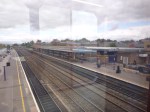
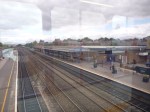
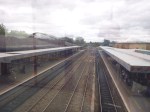

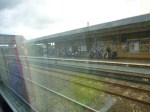
There isn’t even a man in an orange suit trying to look busy! Although the platforms were!
Perhaps this is how Oxford would like to welcome visitors? Hoping perhaps they might stay away!
I think one of the toughest jobs in the world must be a Project Manager in Network Rail. Passengers are rightly complaining that stations are cramped and need building or rebuilding and sometimes it’s impossible to get anything done for whatever reason. Then you have politicians on all sides complaining and saying it’s a total disgrace!
Hopefully Sir Peter Hendy and his new broom will go in to projects like Oxford station with all guns blazing and tell a few home truths.
I’m sure, if Oxford doesn’t want an updated station, then there are some nice projects in Birmingham, where the money would be appreciated.
A Radical Idea For The Bakerloo Line Extension
I have spent forty years involved in project management, writing software for project managers and generally listening to some of the thoughts and experiences of some of the best engineers from all over the world.
One common thread, which is best illustrated by how the size of lift possible increased in the North Sea in the 1970s, is that as time has progressed machines have got bigger and more capable, and the techniques of using them has improved immeasurably.
The Crossrail tunnel boring machines (TBM) make those used on the Jubilee Line extension or the Channel Tunnel look like toys. But not only are the TBMs bigger and faster, they have all the precision and control to go through the eye of the smallest needle.
If we look at the proposals for the Bakerloo Line Extension, there have been several differing ideas. Some envisage going under Camberwell and in others the trains terminate on the Hayes line.
Transport for London (TfL), obviously know the traffic patterns, but do we really want to take the chance of say connecting the Hayes line to the Bakerloo and then finding that it’s not the best solution?
What we should do is augment the services in the area, by providing a good alternative transport mode, that links to some of the traditional rail lines to give even more flexibility. We certainly shouldn’t repeat the grave mistake that was made at Brixton in the 1960s by not connecting the Victoria line to the surface rail lines.
This is Transport for London’s indicative map of the extension.
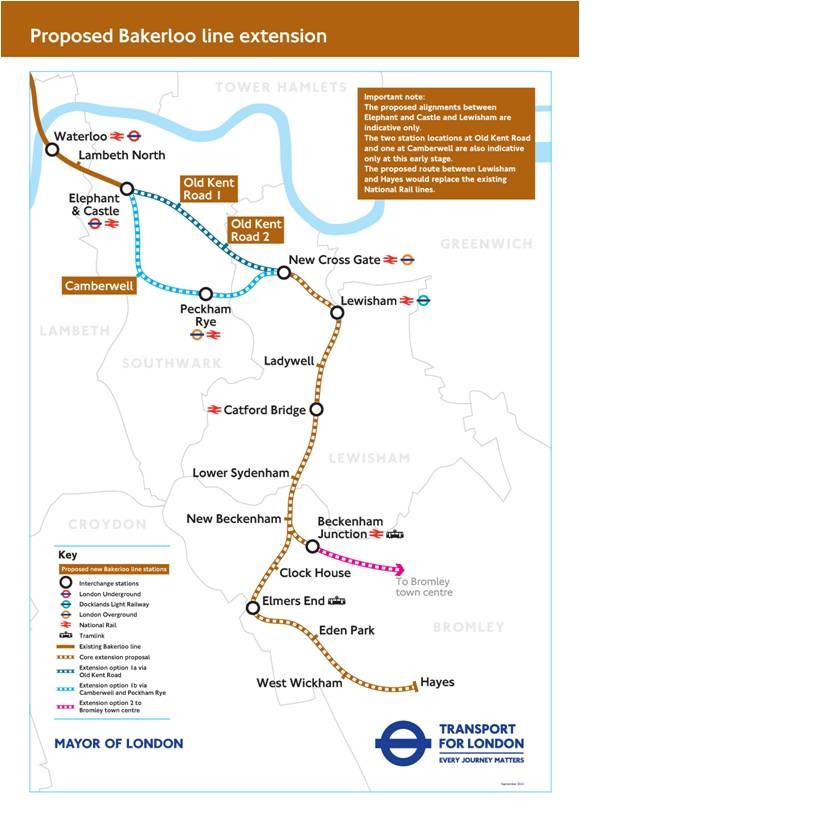
Bakerloo Line Extension Map
I have reason to believe that the Northern Line Extension may be being built as an extension to the Kennington Loop.
So could we design the Bakerloo Line Extension as a loop starting and finishing at Elephant and Castle calling at important stations?
A possible route could be.
- Elephant and Castle – Interchange with Northern Line and National Rail including Thameslink
- Old Kent Road 1 – Proposed on Map
- Old Kent Road 2 – Proposed on Map
- New Cross Gate – Interchange with London Overground and National Rail
- Lewisham – Interchange with Docklands Light Railway and National Rail including Hayes Line
- Catford Bridge – Interchange with Catford station and National Rail including Hayes Line and Thameslink
- Peckham Rye – Interchange with London Overground and National Rail
- Camberwell – Interchange with National Rail including Thameslink
- Elephant and Castle
The advantages of this simple design are.
- The tunnel would be excavated in one pass by a single TBM.
- The line could be deep under any existing infrastructure.
- Most stations would be simple one-platform affairs, with perhaps only large lifts and emergency stairs, to give unrivalled step-free access for all from the street to the train. Surely lifts exist, that are large and fast enough to dispense with escalators.
- For safety, passenger convenience and flows, and other reasons, the stations could have two entrances, at opposite ends of the platform.
- The simple station entrances would be much easier to position on the surface, as they wouldn’t need to be much bigger than the area demanded by the lifts.
- A single loop would only need half the number of platform edge doors.
- At stations like New Cross Gate, Lewisham, Catford and Peckham Rye the lifts would surface within the confines of the existing surface stations.
- The route has interchanges with the Brighton Main Line, East London Line, Hayes Link, Thameslink and other services, so this would give lots of travel possibilities.
- Trains do not need a terminal platform, as they just keep going on back to Elephant and Castle.
- The loop would be operationally very simple, with no points to go wrong. TfL have aspirations to run twenty-seven trains per hour on the Bakerloo and a simple reversing loop , which would mean the driver didn’t have to change ends, must certainly help this. It would probably be a lot more difficult to get this capacity at the northern end of the line,where Harrow and Wealdstone doesn’t have the required capacity and the only possibility for a reversing loop would be north of Stonebridge Park.
- Elephant and Castle would need little or no modification. Although it would be nice to have lifts to the Bakerloo Line.
- Somewhere over two billion pounds has been quoted for the extension. A single loop with simple stations must be more affordable.
The main disadvantage is that the loop is only one-way.
But making even part of the loop two-way would create all the operational difficulties of scheduling the trains. It would probably be better, less costly and easier to make the trains go round the loop faster and more frequently.
But if a passenger went round the loop the wrong way and changed direction at Elephant and Castle that would probably only take a dozen minutes or so.
Alternatively, I’m sure some New Routemasters would step up to the plate and provide service in the other direction between the stations.
Are There Any Other Places Where A Loop Extension With Stations Can Be Built?
I said this in my piece on the Northern Line Extension.
Reversing loops with stations are not unknown in the UK. Terminal 4 at Heathrow is served by the Piccadilly Line in this way and the Merseyrail Loop Line, is a larger example, that reverses and provides several stations for the Wirral Line. It could also be argued that Bank station on the Docklands Light Railway is two platforms on a reversing loop.
But are there any other places, where a loop extension with stations could be built to advantage?
The great advantage of the reversing loop layout for an extension, is in the construction phase.
1. Only one continuous tunnel needs to be built, which can be built with one tunnel boring machine (TBM).
2. Crossrail has shown that TBMs can be controlled to a high-degree of accuracy, which enables optimal loop tunnels to be created, going deeper than traditionally if necessary.
3. Simple stations can be built by connecting the out and return legs of the loop together and then adding lifts and escalators to the surface.
4. Simple one-platform stations could be built on the outer reaches of the loop.
5. It might be possible to reduce the number of shafts dug to the working tunnel. This would surely help in a crowded city.
6. There is only minimal disruption to existing infrastructure during the construction.
These are some places, where the loop extension with stations might be used.
Bakerloo Line Extension
There have been lots of proposals for the route of the Bakerloo Line Extension. Some are just simple ones taking the line to Camberwell and some envisage the line taking over the Hayes branch.
I have seen discussions about the latter and some have flagged up all sorts of problems, like how do you provide a service during the construction period.
So the design of this is going to be difficult. But I wouldn’t rule out an out and return loop going via Camberwell.
This links to my proposal.
Extending The Docklands Light Railway Westwards From Bank
There have been two proposals for this.
Would these best be served by extending the loop tunnel at Bank appropriately?
Possibly, but does the DLR have enough capacity for either of these services?
Extending The Docklands Light Railway Southwards From Lewisham
There have been two proposals for this.
Perhaps an underground loop could be used to turn trains at Lewisham, that served several stations, south of the current terminus.
Jubilee Line
Extending the Jubilee Line eastwards from its orignal terminus of Charing Cross could have used the reversing loop technique to take in stations in the eastern parts of the city in a wide loop. But in the end the Jubilee Line Extension was built to Stratford.
Extending The Jubilee Line To Thamesmead
In the design of North Greenwich station on the Jubilee line, provision was left for a branch to Thamesmead.
It is not in any plans at the moment, but a reversing loop could be built covering Charlton, Plumstead, Thamesmead and Abbey Wood.
Extending the Gospel Oak to Barking Line from Barking Riverside To Abbey Wood
This is an aspiration of Transport for London. But could it be dug in a single extended loop from Barking Riverside? The biggest advantage would that incorporating a single underground platform at Abbey Wood, would be a lot easier and affordable, than creating a full terminus there.
Extending The Victoria Line Southwards To Herne Hill
This is mentioned under Possible Future Projects on Wikipedia for the Victoria line. This is said.
For many years there have been proposals to extend the line one stop southwards from Brixton to Herne Hill. Herne Hill station would be on a large reversing loop with one platform. This would remove a critical capacity restriction by eliminating the need for trains to reverse at Brixton. However, it would be expensive and cannot currently be justified on cost-benefit grounds. Because the current line is heavily overcrowded this is considered to be the only extension proposal with any realistic prospect of coming to fruition; but to have any hope of being built, it would have to be seen to be effective in reducing overcrowding (by enabling trains to run more frequently) and not to increase it.
But it strikes me that if TfL’s engineers find better ways of building these loops and their stations, perhaps it could be built to increase capacity on the Victoria line.
Outside Of London
Outside of London, I don’t know the railway infrastructure, like I do in London, but I’m sure that the concept could be used elsewhere.
It’s All Go On The Manchester Metrolink
According to this article in Global Rail News, work has now started on the Second City Crossing or 2CC. But it is the last paragraph that shows how the Manchester Metrolink is developing.
November has seen several significant milestones ticked achieved for the Metrolink system, with funding confirmed for the Trafford Centre extension and the opening of the system’s new airport line.
More projects like this should be promoted if we are going to create a powerhouse across the North.
Incidentally, with my project management hat on, I don’t think the upgrading of Manchester Victoria station and the Metrolink has been planned as the partially joint project they so obviously are.
On my travels around Manchester in the last couple of years, I have sometimes found it extremely difficult to get between the two main stations; Victoria and Piccadilly. That would have been eased by making sure there was always one reliable easy-access properly-signposted link at all times.
Heathrow and Gatwick Will Cost More
Surprise! Surprise! The BBC is reporting that the proposals for a new runway at either Heathrow or Gatwick will cost more!
The Airports Commission says a second runway at Gatwick would cost £2bn more than the bid suggests.
Two separate plans to expand Heathrow are predicted to cost £3-4bn more.
T’was, ever thus! The first real estimate of the cost of a large project is inevitably more than the back-of-a-fag-packet estimate.
Only when the designers and project engineers work out how the project is to be realised do we get a figure for the actual cost. Usually, in construction projects, this figure can generally be relied upon.
But as I’ve believed for some time, I don’t think we’ll ever build a new runway in the South East.
Tales From Artemis Times
When I was writing Artemis, I got to meet some very interesting people.
I remember being in Denver at an Artemis Users Conference at the time of the Falklands War. I was talking over drinks with three Americans; a New York banker, the project manager on the US Harrier and the another from Long Beach Naval Shipyard.
The banker with all the naivete of no experience, said that all the Navy needed in the South Atlantic was a big flat-top and some F14s and they’d be able to blow the Argies away.
Then the Harrier guy said that they were getting the weather reports and it was so bad down there, that the only aircraft you could recover to the carrier was a Harrier. The guy from Long Beach compared everything to the Arctic convoys and said it was doubtful which was worst.
The banker didn’t say anything more on the subject.
Another incident was meeting a recently retired US Army or Marine officer. I’m not sure where this was, but it was somewhere in the States. It might even have been at the same conference. On finding I was English, he said that he’d got a lot of respect for the British Army and told this tale.
The Pentagon had wanted to find out how we handled the situation in Northern Ireland from a soldier’s point-of-view and he had been asked to go to the province to observe the British Army at work. So he turned up in Belfast, as a guest of the British Army and was given a briefing by senior officers and a couple of tours around the city in a Land-Rover.
They then asked him, if he’d like to go out on a patrol.
He said he would like to go, so early the next morning he was taken to a barracks and introduced to his patrol. He said that as a white US officer, he was surprised that the patrol would be led by a black corporal. At the time in the US Army, such a patrol would always be led by an officer or at least a sergeant.
They kitted him up, so he looked like the average squaddie and off they went. He didn’t really describe the patrol, except to say that he was impressed by the professionalism and that nothing untoward or unexpected happened.
On returning to barracks and after a good lunch with his patrol, he was taken to a debriefing. There he was shown a film taken by the SAS, who had had a sniper on the roof-tops with a film camera.
He realised that the US forces had a long way to go, if they were to handle urban situations like Northern Ireland.
What’s The Opposite Of Mushroom Management?
Mushroom management is an old concept, that is a big joke in the dictionary of bad project management. It even has a Wikipedia article, which gives this short description.
keep them in the dark, feed them bullshit, watch them grow
I have on the whole not really suffered from this type of management, as I’ve been managed by some good people.
So it was with great interest that I found this document on the Transport for London web site.
It is a progress report on the various capacity improvements on the London Overground.
It certainly isn’t a document to keep everybody in the dark.
It even gives the phone number and e-mail address of the guy who is in charge of the projects.
We need more fully accessible documents like this one for public projects.
Project Managers Having Fun In The East
A lot of people moan that London and the South East get all of the rail infrastructure investment, but next time you travel up and down the country from Edinburgh or Newcastle to London, moaning why the A1 is such an inferior road or your train seems always to be held up, then you should perhaps be pleased that things might be getting a bit better due to one of the largest rail projects in the UK, that will be commissioned later this year.
The Great Northern and Great Eastern Joint Railway (GNGE) It ran from Doncaster to Cambridge via Lincoln, Sleaford and Spalding a dozen or so miles to the east of the East Coast Main line. It was built primarily as a freight line to get coal from Yorkshire to East Anglia.
Some southern parts of the line and the by-pass around Lincoln have been closed, but the rest of the line was used by passenger trains although gauge limitations meant that moving large freight trains was difficult.
One of the problems of the East Coast Main line is the number of freight trains that need to use the line. Between Peterborough and Doncaster, a lot of the line doesn’t have four tracks, so the fast express passenger trains have to mix it with much slower freight trains, which need to be passed.
This problem could have been solved by just four-tracking the main line, but Network Rail found that it would be cheaper to enable the GNGE to take all the freight traffic.
So a £230m project was started to upgrade the GNGE and provide the line with new track and signalling. As a by-product of the work tens of level crossings on the route will be eliminated.
This may seem a lot of money for essentially creating a freight by-pass from Peterborough to Doncaster, but according to this article in Rail Engineer it is a major project. Here’s what they say about the scope.
The first thing that strikes is the surprising scale of the scheme – some £330 million pounds is being spent on a stretch of railway which does not come across as particularly high profile. The changing pattern of freight has seen the route drop below the horizon and it is the resurgence in the last few years that has brought awareness of its potential to support, and help capacity, on the main East Coast route south of Doncaster. That scale can be summed up as 86 miles of route between Werrington and Doncaster and the renewal of 27% of the track and 53% of the point ends.
On top of the trackwork itself there are 49 underbridges, 19 overbridges and 82 culverts to be dealt with. There is even a tunnel where there is a 66 metre track-lowering job.
By comparison, the Borders Railway south from Edinburgh is a 50 km stretch of reopened railway from Edinburgh to Tweedbank and is budgeted to cost £348m. It should open in 2015.
The completion of the updated GNGE line later this year, should have some major benefits.
As many of the freight trains will be removed from the East Coast Main line between Peterborough and Doncaster, this will mean that passenger trains on the line will have more paths and will be less likely to be slowed. So this should mean more and faster trains up and down from London to Leeds, Newcastle and Edinburgh.
The ease of getting freight trains between Peterborough and Doncaster should mean that more traffic from Felixstowe and London Gateway to the North will be able to go by rail.
In the longer term, will it mean that more passenger services are run from Peterborough to Lincoln and from Lincoln to Doncaster?
The only problem I can see, is that all these freight trains trundling through the level crossing at Lincoln are going to create a lot of congestion. I discussed this infamous crossing in this post. A new footbridge has been approved which could help, but this level crossing really needs to be bypassed and closed.
 The Anonymous Widower