What We’re Good At!
I was very pleased when I read the third leader in The Times today, entitled Capital Idea.
This was the first paragraph.
After the on-time and underbudget Olympic Stadium, yesterday brought the opening of the Hindhead Tunnel on the A3, on the main route between London and Portsmouth, on time, on budget and garlanded with awards for its safety record. Britain is in danger of getting a reputation for being good at large infrastructure projects.
I could add another couple of projects like the London Overground, where the engineers delivered quality at a price well under the budget.
The Engineering and Architecture of CrossRail
My previous post about CrossRail may give the impression, that I’m rather against the project.
I’m not, as I believe it will really open up London to residents, commuters and tourists. The only problem is it won’t be fully open until 2018 or so.
Railways should always go through a major city, rather than have expensive stations on the ends of two radial lines. It’s cheaper in terms of capital cost and ensures that the expensive trains work harder. Thameslink does this on a North-South basis and CrossRail will do it on an East-West basis, with an major interchange between the two lines at Farringdon station.
Modern Railways this month has a major section on the CrossRail project. It is a fascinating read, which describes how the railway is being threaded from one side of the London to the other and the designs of the various stations on the route.
The biggest conclusion I get after reading the report, is that this a project that although built to a tight budget, will be something of which London will be proud and will be something that can grow and grow as the City demands more transport links. From the pictures in the article it would appear that the visible face of the railway will be impressive and not like the rather utilitarian Victoria line. On the other hand a lot of the design is more on the side of the practical and well-thought, rather than the spectacular, such as seen on some parts of the Jubilee line.
I also feel that particular attention is being paid to the management of the whole project and this has allowed the cost to be reduced by a billion pounds or so, by taking slightly longer. Hopefully, this will also enable the project to be built on time, but these days, we are getting a much better record at completing large projects on time, so I wouldn’t be suprised if the engineers adjusted the project to increase the certainty of an on-time completion.
But that is good project management!
With my history in the field of project management, CrossRail seems to be a project, I’d have enjoyed getting my teeth into.
A Project Management Approach to Better Justice
The whole justice system from victims, families on the brink of divorce and criminals, to the courts and ultimately prison is very much like an enormous project, such as building a new railway line or refurbishing a fleet of airliners.
The objectives are very similar.
- Complete everything on-time and as close to the budget as possible.
- Get a high satisfaction rating from customers, who in this case are victims, their families and in the civil courts those that litigate and seek redress.
- Do all this within strict resource constraints, such as numbers of police, courts, judges and other legal staff.
So how would a good project manager build his railway line to meet the objectives?
There is an old phrase that Time is Money and I believe that this is something that the justice system in all its manifestation doesn’t address.
I can remember C coming home one day and saying that she’d finally got the details of a divorce settled, ten years after she first took on the case.
And yesterday we had the news that a new trial in the saga of Stephen Lawrence would start in November.
I doubt I could find more than a handful of people, if any, who thought either of these examples acceptable.
A good project manager would analyse why various jobs took a long time and take action to make sure that the delays were not repeated.
C often said these long times in divorce were often down to plain vindictiveness on the part of both parties and she would often ponder how they ever stopped rowing long enough to get married. There is even a story, I’ve heard of two barristers, who when they divorced managed to blow all their money on other lawyers. Somehow those that waste time in the divorce system, should be made to pay more, so that those who need help can get it.
With criminal trials it has often puzzled me, how supposedly similar trials take a very much variable time to get to court. This timeline of the Ipswich murders shows how a quite complicated case, was brought to court in just 14 months. Other much less complicated cases take a lot longer to get to court, with all that entails in terms of costs of remand and stress for the witnesses.
We must not cut corners, as quality of justice is paramount, but surely some analysis will lead to ways to improve the speed of the courts.
With all the fuss about Ken Clarke’s comments on rape, it seems to me that emotion has got the better of a decent analysis, which might indicate a few simple procedural changes, that will ensure a less stressful time for the victim and more cases coming to a result where the guilty is rightly convicted.
I remember seeing an article some years ago, where when there was a cot death, one police force tried to send an officer, who had suffered a similar experience. This simple change to procedure, showed a degree of compassion and care and removed a lot of bad emotion and accusations from the system. In my view it showed how if police respond to an incident properly in the first place they might save a lot of problems later on. First response seems to be getting better, but I’ve only reported a couple of crimes in my 63 years. Two were in France and if the French system hasn’t changed, we have nothing to learn there.
To summarise.
- A project manager calculates the resources they need.
- They then look at the systems to get each task done in the most efficient way.
- Analysis is always performed to see if speed and quality can be improved and costs can be better controlled.
In my view, with forty years experience of project mangement, it is getting better as some of the rail projects like the Western Curve at Dalston and the improvements to container routes have been done on time and under budget.
Let’s hope that those who administer the justice system are prepared to learn from management successes elsewhere!
Through the Olympic Park on the Greenway
From the Top of the Morning, I had two choices. I could either walk to Hackney Wick station on the North London line, or try to find the Greenway that continued through the Olympic Park to Pudding Mill Lane on the Docklands Light Railway.
I chose the latter more in hope than expectation, as I felt that building or security considerations on the Olympic Park might mean the Greenway would be closed.
About a hundred metres south of the pub, I found this welcoming sign.

Entry to the Greenway
So I’d made the right choice.
Incidentally, the Greenway is built on top of the eastern end of the Northern Outfall Sewer, which was built in the mid-1800’s by Joseph Bazalgette, to take London’s sewage to the works at Beckton.
The Greenway gives good views of the Olympic stadium of which this is typical.
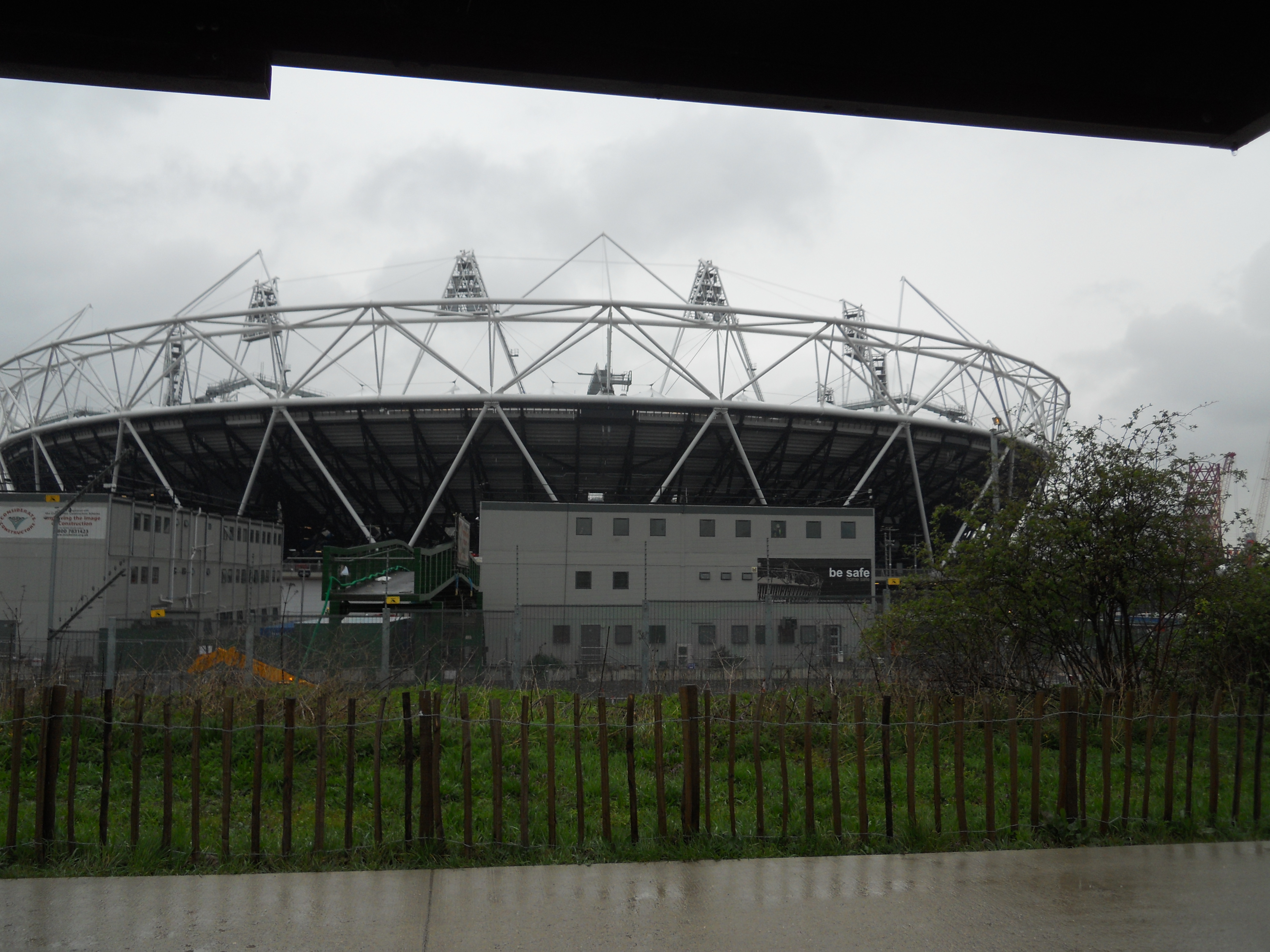
The London Olympic Stadium
Obviously, landscaping and a few other things need to be done, but it is now virtually complete.
You can also see the ArcelorMittal Orbit and the Aquatics Centre.
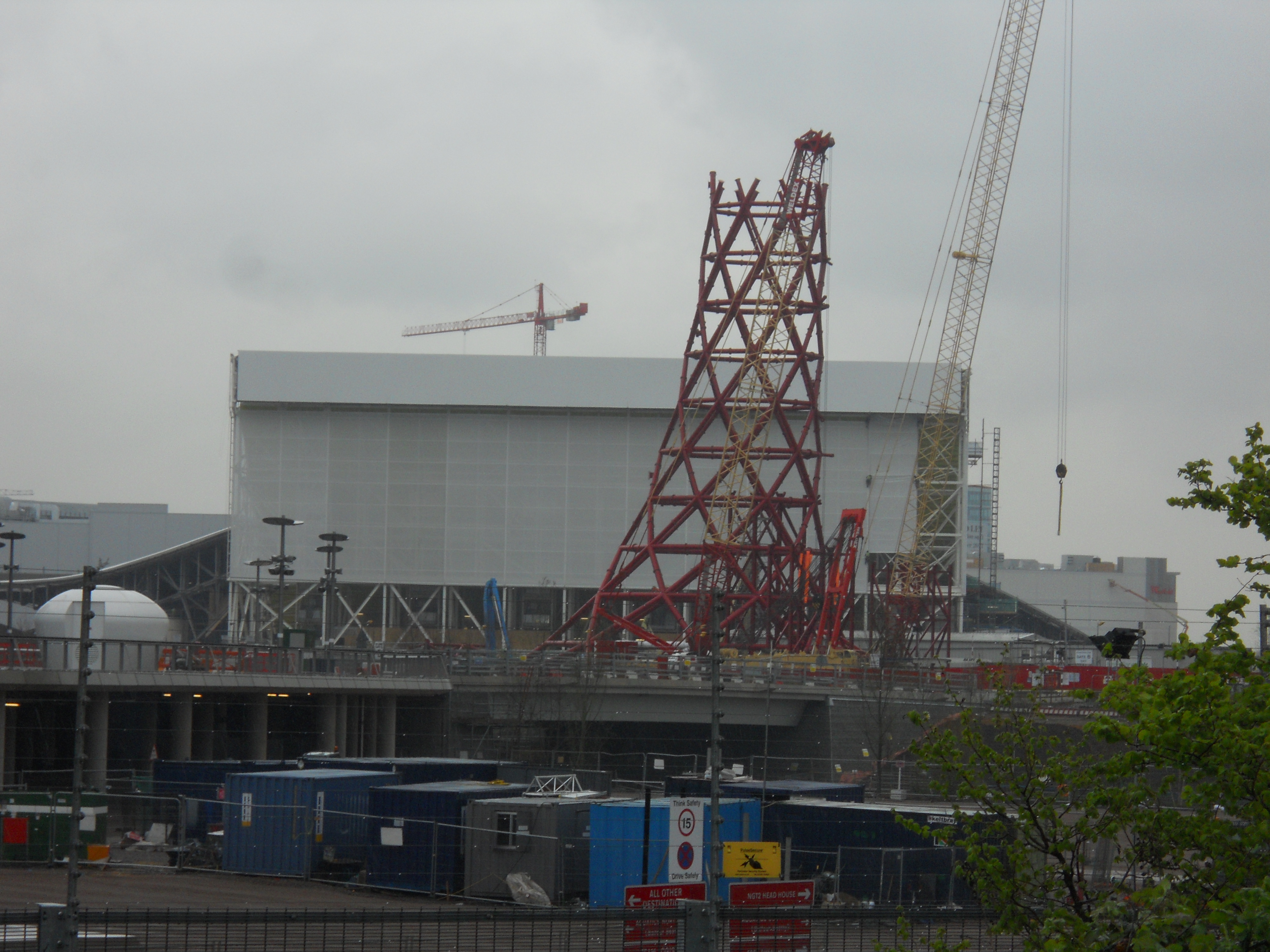
ArcelorMittal Orbit and the Aquatics Centre
The Orbit structure has aroused controversy, but seeing it close to, I found it rather fascinating. You can also see all of the bits lined up like groups of acrobats ready to climb into position in the tower.
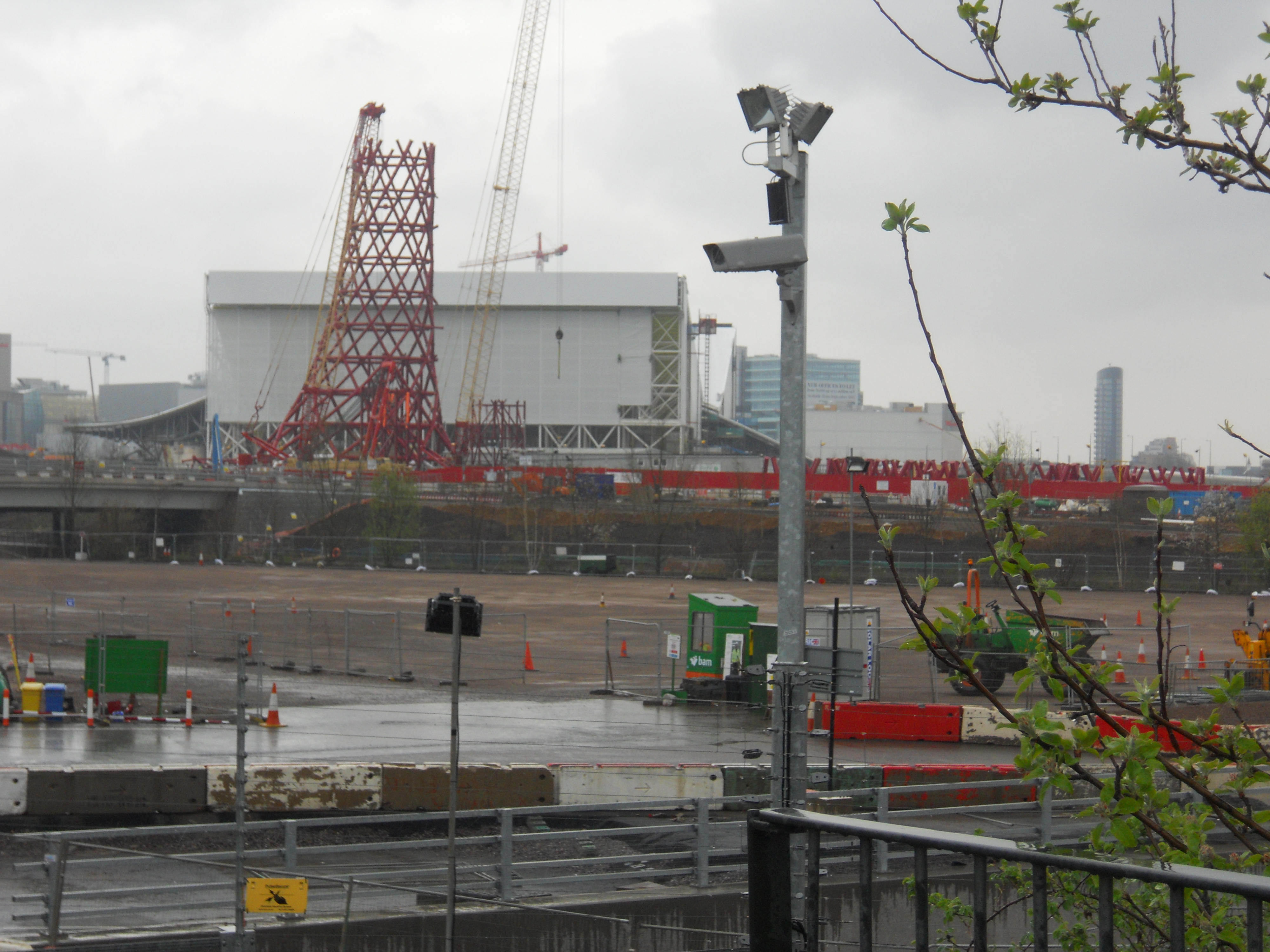
I’m Ready to Ascend!
I suspect that like the Eiffel Tower has for Paris, it might end up as an icon of East London after the Games.
The one think you can’t say about it, is that it is boring! The only things that should be boring are some machine tools and tunnelling machines.
One thing that has been got right is the information for visitors, as this picture shows.
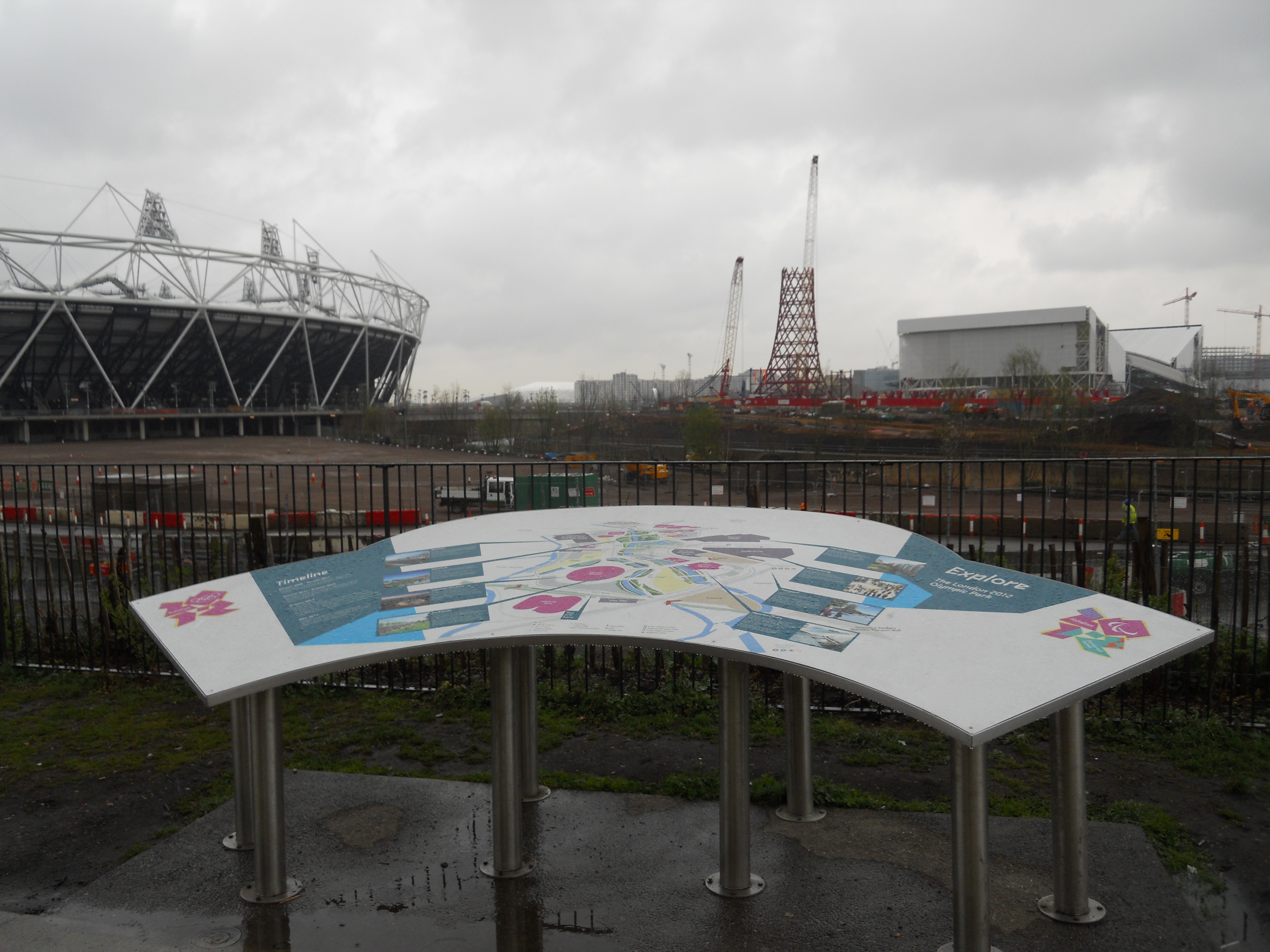
Olympic Park Panorama and Information
Do you think that the far-sighted Joseph Bazalgette had realised that his enormous sewer would one day be used as a grandstand for a construction project, of which I’m sure he would have proud? Obviously not, but with so many things he did, he got them absolutely right. And right for possibly a thousand years!
No walk is complete without a cup of something and at the south end of the portion of the Greenway that crosses the Olympic Park, there is this cafe and viewing point called ViewTube.

The ViewTube, Olympic Park, London
I had a good cappucino and a rest before walking on to Pudding Mill Lane and the DLR, where I took this final picture.

The Olympic Park from Pudding Mill Lane, DLR Station
All in all, this walk took about two hours including refreshments. On a good day, it should easily be possible to do it in the same time from the Angel at Islington to the ViewTube cafe.
But I suspect it’ll get busy!
One Up, A Few More to Go!
Today the Olympic Velodrome is being handed over. On time and on budget!
It looks good and I hope to be there for some of the action in 2012, as I said in an earlier post.
Let’s hope that the London Olympics set a new standard for project management and that all the venues follow this example of time and cost. After all the North and East London Lines, which will help take people to the games, set a precedent for this and the latest addition here, the Western Curve at Dalston, is expected to open soon.
Resisting the Obvious Headline
In the latest edition of Modern Railways, there is an article entitled East London line goes ’round the corner’, which describes the insertion of the missing link between the North and East London lines.
Should it have used the headline East London line goes ’round the bend’?
Possibly in a tabloid, but the whole exercise seems to have been conducted in a sane and measured manner.
Transport for London actually took the risk for the scheme, by acting as the project manager. The main outcome was that they shaved £2.5 million off a £16 million budget. They also managed to rebuild the bridge that carried Kingsland Road over the railway with a lot less disruption, than traditional methods would have caused.
So all things considered, the team is to be congratulated, when it opens next month, a few weeks ahead of schedule.
The article also says that they will be taking a similar project management approach to the expansion of the East London line to Clapham Junction.
So is this all to the good of passengers?
I use the new East London line occasionally and it got me back from IKEA in double-quick time last week, but then passenger numbers on the line are at levels that had been predicted to not be reached until a year later.
So is there a lesson here? Upgrade railways will new trains and frequent services and they’ll be used and repay the investment.
The Golden Age of Tunneling
London is one of the most dug under cities in the world and has been for many years.
The first large tunnels under London were Sir Joseph Bazalgette‘s Victorian sewers, built in response to the Great Stink. In some ways it was a large and very expensive scheme, but it started the clean-up of the Thames and effectively removed cholera from the City. It was in some ways the first great project, as it did what it said in the spec, vast numbers of people weren’t killed builling it and lots of it still works today. It is all documented in an excellent book; The Great Stink of London: Sir Joseph Bazalgette and the Cleansing of the Victorian Metropolis
Then came the Underground described so well in the Christian Wolmar’s book; The Subterranean Railway: How the London Underground Was Built and How it Changed the City Forever
Since the Second World War, we have seen a few tunneling projects and the reuse of some of the old ones.
The Victoria Line, the world’s first totally automated passenger railway was built in the 1960s. We missed a trick here, as we never realised what we had built. So the automation was vacuum tube, but for well over thirty years it showed how a well-designed underground railway could perform. It is now being upgraded with new signalling and new trains and the old reliability is rumoured to be suffering. Everybody is blaming the convenient scapegoat of the old 1967 trains running in partnership with the new ones, until all the new are delivered. I don’t! I blame bad project design and management. In the 1960s they got the automation absolutely correct and created a good system. They should have replaced all the old stuff with something that was modern and compatible and then built new trains, that were compatible with the old signalling.
They should also have used the principles of the line; no junctions, totally underground, hump-backed stations to save energy, full automation to create new lines where they were needed. But they didn’t, as the Victoria Line wasn’t sexy and didn’t appeal to the vanity of politicians. But it was and still is a superb design.
The Jubilee Line was then created by splitting the Bakerloo. The extension to Stratford was built on a grand scale and has some of the most amazing stations in the world. Was it the first example of bad co-operation between bankers and politicians, designed to appeal to both their vanities? It was also designed to serve that other monument to the vanity of politicians; the Dome.
In some ways a lot of the design of the extension of the Jubilee line, with large stations and platform edge doors were an attempt to future proof the line and in some ways, this has been vindicated by the decision to stage the 2012 Olympics at Stratford and the decision to build other lines which interchange with it. Only time will tell if the original cost was worth it.
In some ways the design of the Jubilee shows just how good the design of the Victoria was and the trick we missed was not building the Jubilee to the principles of the earlier line. Even now, despite being still a relatively new line, it is still being constantly upgraded.
There was also the building of High Speed One, which tunneled into St. Pancras from East London. Did they get this right? Substantially yes and it seems to work, although the Eurostar trains have suffered reliability problems. But that’s not down to the tunnels.
Other unqualified successes are the Docklands Light Railway extensions to Lewisham and Woolwich in tunnels under the Thames. The original DLR was built down to a cost, but in some ways this has proven to be a virtue, as like Topsy it keeps growing and has earned a big place in the hearts of those who use it. It will also play a big part in getting people to the Olympics.
But two of London’s most successful tunneling projects are reuse of old tunnels; Thameslink and the East London Line.
Thameslink was originally built by connecting the suburban lines running out of St. Pancras to those running south of London to Gatwick and Brighton using the old Snow Hill Tunnel. The economic argument says that as you do away with expensive terminal platforms in London, you can spend the money to buy more trains and electrify the lines. Thameslink was a victim of it’s own success and the necessary upgrades with a new station over the river at Blackfriars and twelve-coach trains are running many years late and billions of pounds over budget. Perhaps we needed a less elaborate Julibee Line, that interfaced properly with Thameslink?
The new East London Line uses the Thames Tunnel under the Thames. In some ways, it is a modest scheme, but I believe that like the DLR, it’ll prove to be an unqualified success. It surely must be the only new railway in the world running through a tunnel built in the first half of the nineteenth century. The tunnel surely is the supreme monument to its creator, Sir Marc Brunel and his more famous son, Isambard Kingdom Brunel, who was engineer in charge for much of the building.
Now, two major tunneling projects are in progress; CrossRail, which is actually being built and High Speed Two, which is just being planned. I am dubious about the latter, as I think that the money could be better spent upgrading existing lines and trains.
But in some ways to London, the most important scheme is the creation of electrical cable tunnels under the city to carry the high voltage mains here, there and everywhere. This PDF explains the project and shows how good thinking and engineering can benefit everyone.
So perhaps the golden age of tunneling will arrive in the next few years.
Is the Cambridge Busway Britain’s Worst Transport Project?
It may not be Britain’s as the Edinburgh Tram will take a lot of beating. But it is certainly England’s, especially if you read this report in the Hunts Post.
Here’s a flavour of the report.
Building the St Ives-Cambridge guided busway is now expected to cost nearly two-thirds more than the target price – an overrun of well over £50million.
Cambridgeshire County Council, which is promoting the scheme, expects construction to have cost £142m.
When the cost of land, the county council’s own costs and those of its engineering consultants Atkins are added, the total cost of the project looks set to reach £170m before the High Court decides who pays the final bills.
When originally proposed in the early 2000s, the scheme was costed at £56m. After a few modifications, a lengthy public inquiry and Government approval, the bill had risen to £116.7m. The Government promised to chip in £92.5m, with the balance coming from developers who would benefit from the project.
As with many of these fiascos, it’ll be the lawyers who make the real money.
Why Politicians Should Keep Their Sticky Fingers Out of Government Projects
The aircraft-carrier fiasco is a classic project, where politicians have tried to be all things to all men and quite a few women as well.
Surely, if France can make do with just one carrier, the Charles de Gaulle, then why do we need two. And surely, we should have an Anglo-French aircraft manning both,as quite a few projects between the two countries work well.
But that more affordable option would have been bad for NuLabor in its Scottish heartland.
The Scots are good at many things, but over recent years they have shown that they are not very good at politics with an English dimension or one with a great amount of project mangement.
I’ve just read this piece from Robert Peston’s blog. The highlight for me was a comment from Wee Scamp, who as you see describes himself as a non-voting Scot.
As a non Labour voting Scot I am quite sure that Gordon Brown set up the carrier contract to ensure Scotland – and particularly Glasow – would vote Labour in the May election.
My logic for believing this is quite straightforward. Most importantly, the design of the new carrier is very badly flawed in that they’re not nuclear powered, do not have an angled flight deck and aren’t equipped with either a catapult or arrestor gear. In other words they are limited to using VSTOL and/or helicopters but couldn’t carry a conventional jet and will be limited in range due to their dependence on needing a refuelling tanker or access to dockside refuelling facilities.
In other words, if we really needed these carriers they would have been properly designed. In fact though they are just a job creation exercise and Brown couldn’t have really cared less what they were or weren’t capable of.
Indeed, politically the only error he made was ensuring the contracts can’t be broken. If they had been then both carriers would have been cancelled and the boost to Labour would have been huge. Not surprisingly though he couldn’t even get that right.
Yet again Prudence shows himself to be an even worse Prime Minister than Lord North.
 The Anonymous Widower