Could Fracking Be The Saviour of the North?
I can remember a documentary on the BBC in probably the 1960s about how a Scottish company extracted oil from shale rock. I don’t know whether they still do. I have just found this museum to the industry and it says it closed in 1962.
According to today’s Sunday Times, there is enough shale gas in the shale deposits mostly in the north of England to last 70 years.
Now I know extracting shale gas is controversial, especially, where the process of fracking is used. There was controversy in the Blackpool are, as fracking was blamed for a couple of small earthquakes. Read about it here.
But then there was controversy, when horseless carriages first arrived on British roads and they had to be preceded by a man with a red flag.
I’m not saying there is no risk from fracking, but I do think, that with proper research fracking will be safe to use in many places in the world.
And eventually, it will be used in many places in the UK, when the problems are sorted out. After all, we mined coal for years, despite the subsidence risk nearby.
And remember that for the same amount of energy coal produces forty-percent more CO2! This is because coal is pure carbon, whereas natural gas is a mixture of Hydrogen H2 and Methane, CH4, so it produces a large proportion of water when it burns.
Hopefully, I’ll know more later in the week, when I have gone to the Geological Society of London to hear a lecture.
The other thing about shale gas in the UK, is that it is located where we need jobs; in the north of England. So it becomes a vote winner for whoever wants to play the shale gas card.
Any extraction of shale gas, should be linked to two measures.
1. A local extraction tax, that goes directly to the local authorities over the extraction. This was proposed in the seventies, by someone I knew, as a means of pursuing oil extraction in places like Surrey, which in his knowledgeable view was one of the most likely places to find oil in the UK. Imagine the fuss it would create if large quantities of oil were found under say Epsom. But if Surrey got enough money to build everything they needed, the reaction of some might be different.
2. Full insurance for any buildings damaged by extraction process.
Politicians and the press will see it as a simple black and white issue. Most will be against! I see it as a multi-coloured jigsaw, that must be based on sound technology.
I would start by setting up an well–funded Institute of Fracking, at a university that has the reputation to recruit some of the best researchers in the world. It may prove that fracking is a dead end but if it showed that it was economically viable in the UK, we would reap the benefit in spades.
I have just found this article from the American Consumer Institute. It makes a lot of interesting points. Note that the United States has a local extraction tax in some or all states and this seems to push opinion in various directions.
I think the worst thing we could do is ban fracking, with the second worst being to ignore it.
Whatever we do, because we have so much of this gas, we should set up some form of research institute.
There is also a page of expert opinion to the Qradilla report on the links between fracking and earthquakes at Blackpool.
Magnetic Soap
You might say so-what as there have been magnetic soap holders for years.
But Bristol University have come up with something special, if it can be used to say clean up oil spills or waste water.
There’s a more technical explanation here in The Engineer.
Could it be that the next ten years will be decade of chemistry, as micro-electronics have ruled for too long? I have also heard that some of the new techniques used in chemistry owe a lot to chip fabrication methods. After all you could argue that a lot of chips are just a three-dimensional array of atoms.
Daddy Of Them All
A ram has made a name for himself by escaping and fathering 33 lambs in one 24 hour session. It’s all here in the Daily Mail.
This reminds me of a conversation with a Research Vet at Liverpool University in the 1960s.
At the time, the M62 was being built, and the Ministry was worried that sheep would get on the motorway. The University had been asked to find a solution and found that moorland sheep could easily climb a chain-link fence several feet high. Judging by the lack of reports of sheep on the motorway these days, I’m sure that the research indicated a solution that worked well.
Getting Between Kings Cross/St. Pancras and Euston
London’s three major stations that serve the North and of course the Continent; Kings Cross, St. Pancras and Euston, are all close together on the Euston Road.
The first has been superbly rebuilt, the second is approaching the end of a major redevelopment and they now share probably the best Underground station in London. But Euston is rather isolated from the other two, with several ways to get between them.
- You can take a rather unpleasant walk along the busy Euston Road.
- You can use the Metropolitan or Circle lines, but this means a walk to or from Euston Square at the Euston end.
- You can dive into the Underground and take the Victoria or Northern lines, but it is not step free at the Euston end, and not recommended with a heavy case. Both deep stations are also easy places to get lost or confused.
- Going from Euston to Kings Cross or St. Pancras is quite easy by bus 30, 73, 205 or 476, which you catch in front of Euston station, but the reverse journey means you have to cross Euston Road twice.
- There are of course taxis. But not everyone can afford them.
As I had time to spare at Kings Cross, before I caught my train to Hartlepool, I decided to investigate and found a map which showed there was a fairly simple direct walking route that avoided the pollution and traffic of the Euston Road.
I started by walking through St. Pancras station and exited by the cab rank onto Midland Road, with the intention of going down Brill Place.
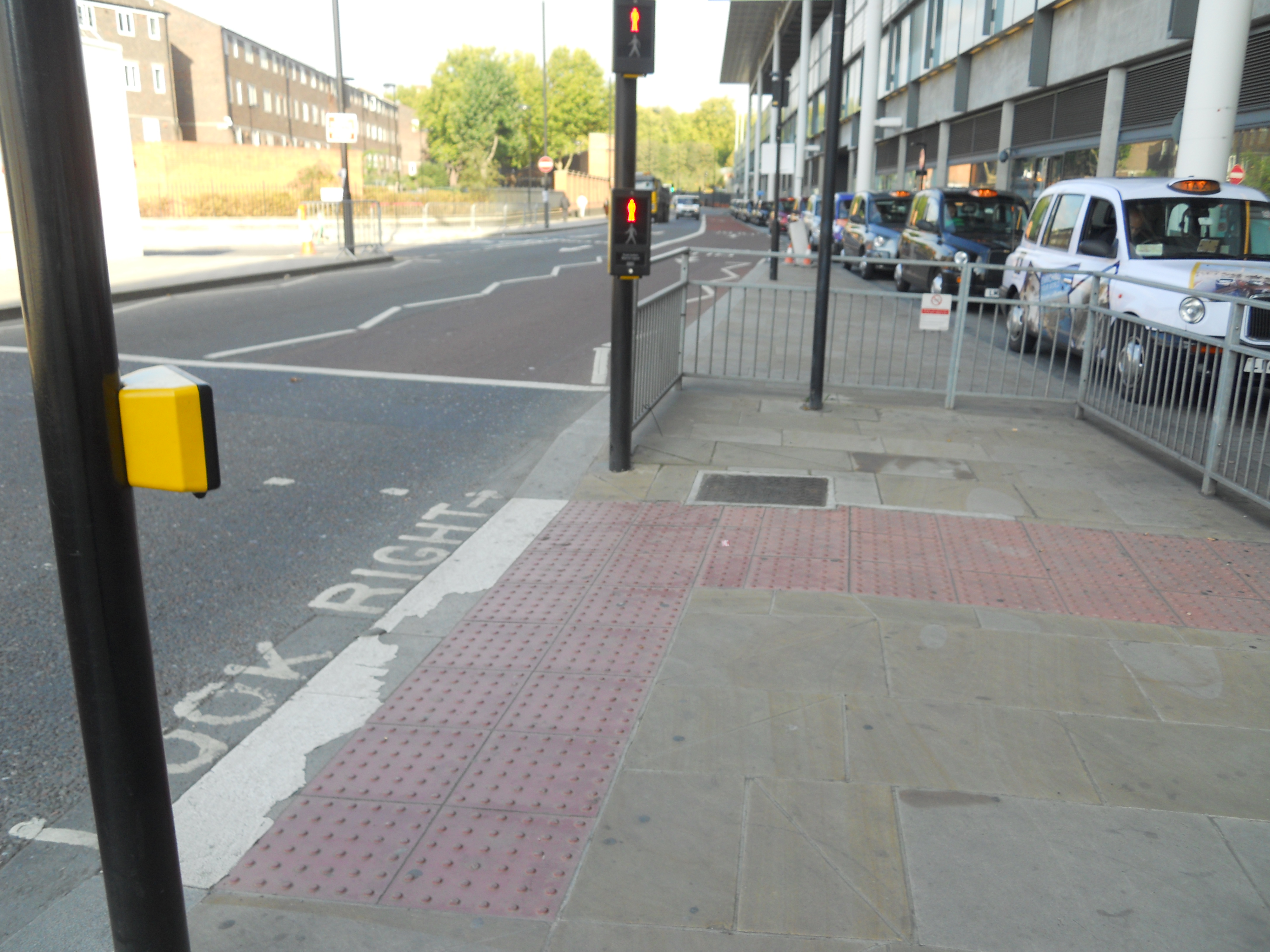
Crossing Midland Road
There is a light controlled crossing, but it is rather blocked by badly placed railings and the cab rank. Brill Place, which is the start of the road to Euston is on the left.
Brill Place is flanked on one side by the new Francis Crick Institute and on the right, there is a small pleasant park, which could provide an oasis from the crowds in the stations.
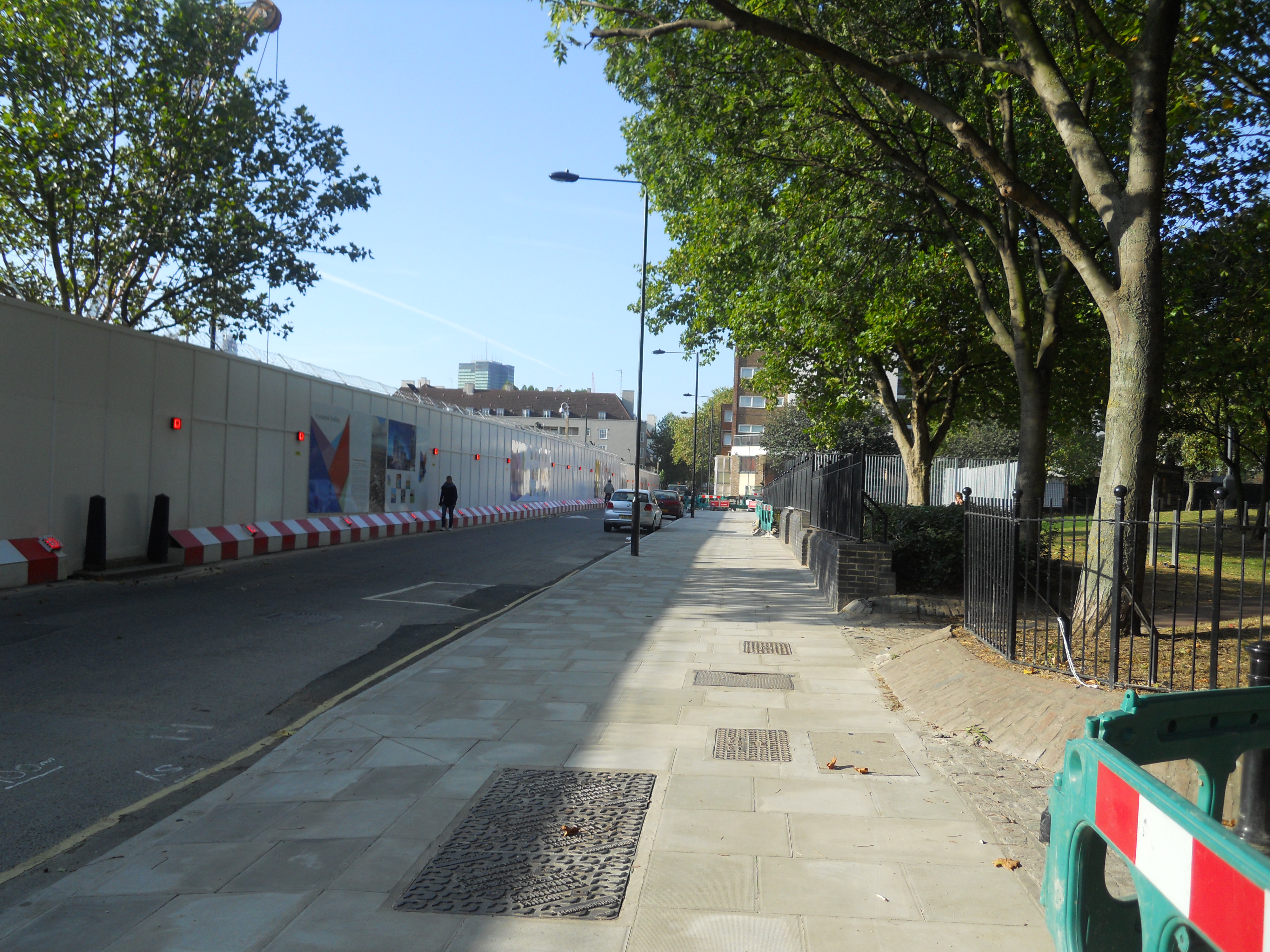
Brill Place
Brill Place itself, is not a grotty dusty road lined by parked cars, but a wide tree-lined avenue that leads on to Phoenix Road.
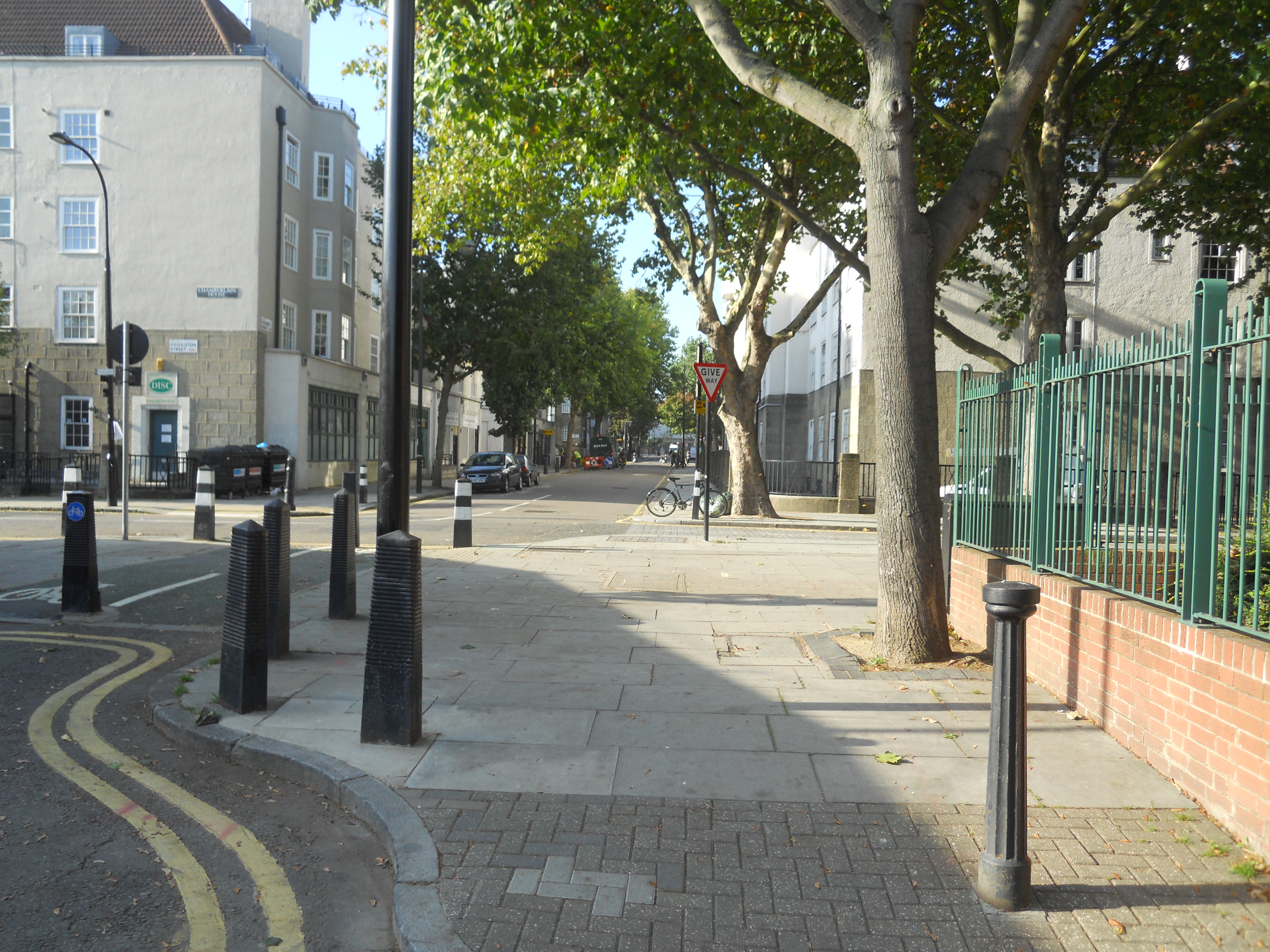
Towards Pheonix Road
At the end of Phoenix Road, you just cross Eversholt Street on one of the two pedestrian crossings and you walk down the road to Euston station.
The advantages of the route are as follows.
- The route is virtually flat.
- It would be easy trailing quite a large case.
- There are only two major roads to cross and both have light-controlled pedestrian crossings.
- There is the park, which would as I said before, be a better place to eat a packed meal than the station.
- You do pass a few shops and a reasonable-looking pub.
But there are disadvantages.
- The route is not signposted.
- The barriers at the St. Pancras end are wrongly placed.
- The side entrance to Euston station could be better.
So how would I make it better, so that in effect we had one super station for the north.
- I’d start with sign-posting. The posts are there at the St. Pancras end already.
- Perhaps, it should be marked on the ground, as a Kings Cross/St. Pancras to Euston walking route.
- You might even provide some eco-friendly transport along the route, like an electric shuttle bus or bicycle rickshaws.
- A couple of suitably placed Boris bike stations would help too.
- Shops and cafes should be developed along the road. There are some already.
To me though, this is one of those things that will happen. But probably first in a very unofficial way, as how many of those that work in the Francis Crick Institute will commute into Euston and walk there? It won’t be a small number.
It took me about fifteen minutes to do the walk and I just got a 205 bus back to Kings Cross for my train from the front of Euston station.
Why We Should Consult Bill Bratton
It is being reported that David Cameron is to consult Bill Bratton, the former Boston, New York and Los Angeles Police Chief.
And so we should!
When you have a serious problem, you should consult with anybody who might have some serious input. Some of these might not be obvious and many will not share your views.
All of my life I have been a scientific or engineering researcher. If anybody was an expert in what I was looking at, I would seek them out and discuss my problem with them. It often paid huge dividends.
The trouble is that too many people, and especially politicians, think totally inside the box. The only reason for having boxes in thinking, is to store good ideas, that might be of use later, but are quite inappropriate at the present time.
So who else should David Cameron consult about the riots?
Let’s start with Terence Conran, Norman Foster, Danny Baker, David Attenborough, Dan Snow, Stephen Bayley, Rio Ferdinand, Jo Hussain and Joey Barton.
Looking for Ferrous Inclusions in Copper Wire
One of the first real research projects I ever did, was to look for small ferrous inclusions in copper wire. This was during a vacation job from Liverpool University at Enfield Rolling Mills. It was I think the third summer I spent there and it was all good training for the future.
My problem was to look for small pieces of iron in thin copper wire, that was being drawn smaller to make electrical cable. Even the smallest piece of iron of the order of ten micrograms can do bad damage to the dies that shape the copper. To complicate matters the wire was travelling at something like 3,000 feet per minute, although I can’t remember exactly what the speed was.
I remember building a frame from Dexion, with pulleys at three corners, so that a cotton sash cord could be passed round these and an electric motor at the fourth. The cord was used as I could slip straightened lengths of wire into it to simulate the wire. I can also remember drilling the wire down its length to insert very small pieces of iron in the middle. The whole was sealed with copper wire, as I wanted to make sure that the only magnetic material was the speck of iron.
The person who’d tried the problem before had used a detector based on permanent magnets with a coil in the middle. It didn’t work too well, as you got a pulse when the wire entered and left, with only a small blip from the iron.
I used a longer detector based on an electromagnetic coil, with the detecting coil in the middle. The idea was that any eddy currents created by the start of the wire would die down before the detecting coil. I’m not sure if I got the maths right, but it did work and I got a nice one cycle wave on the Cossorscope, with two smaller ones when the wire entered and left. Note that in those days of 1966, you had to develop miles and miles of paper film to get your results from the oscilloscope. Although I should say that there were plenty of good Textronix ones at the University, but then it was so much better funded than industry.
It wasn’t perfect but it would have been good enough to say that a coil of wire didn’t contain anything bigger than so many micrograms. I think in the end they solved the problem, by better hygiene in the wire drawing, so that there was no need to apply a qualitative test.
But I was rather proud of what I had done as a nineteen year old and have always felt that the technique has other applications.
Hope For Cancer Sufferers
On Wednesday I was invited around the Cancer Trials Unit at Liverpool University. I have to declare two interests in that my youngest son died from cancer of the pancreas and I contribute in a small way to their research.
It is an impressive unit and the visit left me with the feeling, that if their attitude, thoroughness and methods are repeated in hundreds of other similar units across the world, as I suspect they are, then there may well be some better news for cancer sufferers in the future.
Now Is The Time For All The Good To Come To The Aid of Universities
A friend and I recently gave some money to Liverpool University for pancreatic cancer research.
What we hadn’t realised was that as Liverpool University is in tier three of the government’s Matched Funding Scheme, this means that they add one pound for every three pounds raised. So if you say give £100, which with Gift Aid is actually £125 to the University, another £42 will be added. There are conditions and not all universities get a one to three topup.
Full details of the scheme are detailed here.
The scheme ends in July 2011, so if you are thinking about giving some money to a University, perhaps now is the time to do it!
The Real Olympic Legacy
The Wellcome Trust has made a bid to run the Olympic Park and the Village after the 2012 Games finishes. Read about it here.
It seems to me that this could be a real lasting legacy for East London, especially if they eventually create a science and technology park, as they are indicating.
Gossip About Polythene
I’m putting in this post, as it was just office gossip with a guy I shared an office with at ICI Mond Division in Runcorn, but feel it ought to be recorded before I forget it again.
Bert Cross was ICI Mond’s infra-red analysis expert and he was a man who’d worked for the company from well before the Second World War. I remember one classic tale about the visit of the then Lord Melchett to the laboratories, where Bert then worked in Northwich and the Lord’s meeting with a researcher, who let’s say didn’t like the idea of capitalism. Whenever, I hear the current Lord Melchett mentioned, I chuckle at Bert’s tale.
Bert also told how when polythene was discovered at ICI’s laboratories by accident, when they were applying high pressures to ethylene gas. They found this waxy substance in the experiments. but they had no idea what to do with it. One idea that was current, was that it might be added to candles to stop them bending. In the end it was polythene’s excellent electrical insulation properties combined with the need to develop better radar systems in the Second World War, that were to prove polythene’s earliest substantial use.
In the early days, it was thought that polythene was a perfect polymer, with no cross linking or imperfections. Bert disproved this using infra-red analysis and always claimed he was nearly fired for his work.
Later when I worked at ICI Plastics Division, I didn’t actually work on polythene, but I worked with others who did.
At the time, ICI made low-density polythene and this was an amazing process with high-pressures, whirling shafts to mix it all and bearings that were lubricated by molten polythene. It was engineering at its most difficult and best. The section I worked for, had actually applied computer control to two plants, using IBM 1800 computers.
At the time, one of ICI’s products was a high-grade cable-grade polythene used where a high-degree of electrical insulation was required. A lot of this product went to Tupperware, as it made the containers look perfect.

