Global Investor Joining RWE On Two Norfolk Vanguard Offshore Wind Projects, FID Expected in Summer
The title of this post, is the same as that of this article on offshoreWIND.biz.
This is the sub-heading.
Global investment firm KKR and RWE have signed an agreement under which KKR acquire a 50 per cent stake in each of RWE’s Norfolk Vanguard East and Norfolk Vanguard West offshore wind projects, totalling 3.1 GW in installed capacity. The wind farms were just awarded Contracts for Difference (CfDs) in the UK’s seventh CfD allocation round (AR7).
These three paragraphs add a few more details.
The two Norfolk Vanguard projects, which RWE bought from Vattenfall in March 2024, have already secured seabed rights, grid connections, development consent orders (DCOs) and all other key permits.
On 14 January, RWE said it launched the process to raise non-recourse project finance debt for the projects and that it expects the closing of the partnership transaction and the project financing, as well as the final investment decision (FID), in the summer of 2026.
Located 50 to 80 kilometres off the coast of Norfolk, the two offshore wind farms are planned to be commissioned in 2029 (Norfolk Vanguard West) and 2030 (Norfolk Vanguard East).
RWE do seem to be lining up everything ready for that final investment decision in the summer of 2026.
- I suspect that with KKR on board, that they have got the money ready and I wouldn’t be surprised to see these two projects quickly progress to a completion.
- I also think it was significant that we have Goldman Sachs involved in Highview Power, who may have a solution to affordable energy storage and now we have KKR getting involved with one of the most professional offshore wind power developers in the world.
- Are Goldman Sachs and KKR placing bets against Trump’s anti wind power stance?
The Germans will certainly need a lot of energy and British offshore wind power, would appear the only place, where it is available easily in quantity to the Germans.
I await the next few months with a lot of interest.
BP’s Morven Wind Farm At Risk Of Missing Start Date
The title of this post, is the same as that as this article in The Times.
This is the sub-heading.
A lengthening queue for grid connection could scupper plans to provide energy for three million homes from a development in the North Sea by the end of the decade
These two paragraphs introduce the article.
One of the largest wind farms in the UK risks missing its 2030 target to start generating power, due to lengthy grid connection queues and supply chain shortages.
The Morven Wind Farm being developed by BP, which is to be located 38 miles off the coast of Aberdeen, will have capacity of 2.9 gigawatts, which is expected to be capable of powering three million homes in Britain.
The delays in getting a grid connection and obtaining various electrical parts could derail BP’s plans.
The Morven wind farm is one of three being developed by a partnership of BP and a German company, which is outlined in this paragraph.
Morven is one of three UK wind farms being built by BP in a joint venture with Energie Baden-Württemberg AG (EnBW), the German energy company. The other two, Mona and Morgan, are being developed in the Irish Sea and have already secured grid connections.
These are my thoughts on the problems with the Morven Wind Farm.
Everybody is assuming that there will be a large cable to bring the 2.9 GW of electricity to the Scottish coast somewhere near Aberdeen.
Cables can be a problem as the article indicates, with connection to the grid and the erection of large numbers of pylons being major ones.
But the energy from Morven doesn’t necessarily need to go to Scotland.
It can be converted into hydrogen using an offshore electrolyser and sent to where it is needed by pipeline or a tanker ship.
I have also noted that BP’s partners are German and Germany has a massive need for zero-carbon energy to replace the large amount of coal they burn.
The Germans are building a massive pipeline called AquaVentus, from their North-West coast to the Dogger Bank, to collect hydrogen created by up to 10 GW of offshore wind farms in the German Ocean or their part of the North Sea to the shore.
I introduced AquaVentus in this post called AquaVentus.
This video shows the structure of AquaVentus.
I clipped this map from the video.

Note.
- The thick white line running North-West/South-East is the spine of AquaVentus, that will deliver hydrogen to Germany.
- There is a link to Esbjerg in Denmark, that is marked DK.
- There appears to be an undeveloped link to Norway, which goes North,
- There appears to be an undeveloped link to Peterhead in Scotland, that is marked UK.
- There appears to be a link to just North of the Humber in England, that is marked UK.
- Just North of the Humber are the two massive gas storage sites of Aldbrough owned by SSE and Brough owned by Centrica.
- Aldbrough and Rough gas storage sites are being converted into two of the largest hydrogen storage sites in the world!
- There appear to be small ships sailing up and down the East Coast of the UK. Are these small coastal tankers, that are distributing the hydrogen to where it is needed?
When it is completed, AquaVentus will be a very comprehensive hydrogen network.
- Pipelines from Denmark, Norway, The Netherlands and the UK will feed directly into AquaVentus.
- Will enBW and BP build a giant offshore electrolyser at Morven and send the hydrogen to Germany via the spine of AquaVentus?
- Will AquaVentus use the vast hydrogen storage North of Hull to store excess hydrogen?
- Will connections be built between AquaVentus and the UK’s Northern gas terminals at St Fergus and Easington?
If AquaVentus works as intended, Germany’s Russian gas will be replaced by zero-carbon hydrogen, a large proportion of which will come from the UK’s waters.
Where Will We Get Our Electricity From?
If the energy from Morven is sold to the Germans as hydrogen, where will we get the energy we need?
Morven is just one of several large wind farms and being developed around the North of Scotland and we’ll probably use the energy from another wind farm.
- Wind farms that can best send their energy to the grid, will do so.
- Wind farms that can best send their energy to one or more of the large Scottish pumped storage hydro-electric power-stations, will do so.
- Wind farms that can best send their energy to Germany as hydrogen, will do so.
- Wind farms that can best send their energy to Scotland or another country as hydrogen, will do so.
The hydrogen will get distributed to those who need it and can pay the appropriate price.
Where Will The Turbines And the Electrical Gubbins Come From?
I’m sure that if Morven was sending a couple of GW of hydrogen to Germany, Siemens could build the turbines and the associated electrical gubbins needed at a favourable price, with an acceptable delivery date.
Conclusion
Germany will likely be pleased, in that they will be able to close a lot of very dirty coal-fired power stations, by replacing coal with green hydrogen.
The UK should be pleased, as the Germans will pay us for the hydrogen.
As for Putin, who knows, what the mad Russian will do?
The EuroAsia Interconnector
The Wikipedia entry for the EuroAsia Interconnector, introduces the project like this.
The EuroAsia Interconnector is a proposed HVDC interconnector between the Greek, Cypriot, and Israeli power grids via the world’s longest submarine power cable (310 kilometres (190 mi) from Israel to Cyprus and 898 kilometres (558 mi) from Cyprus to Greece, for a total of 1,208 kilometres (751 mi)). Connecting Kofinou, Cyprus to Hadera, Israel and Korakias, Crete, Greece and stated to finish construction in 2023.
When completed it will have a capacity of 2 GW.
From Wikipedia, it appears that at least initially, Israel will export electricity produced in gas-fired power stations from their own more than adequate supplies of natural gas.
In Andrew Forrest’s Fortescue Future Industries Inks Deal With Kingdom of Jordan For Green Hydrogen Study, I published this Google Map of Jordan.
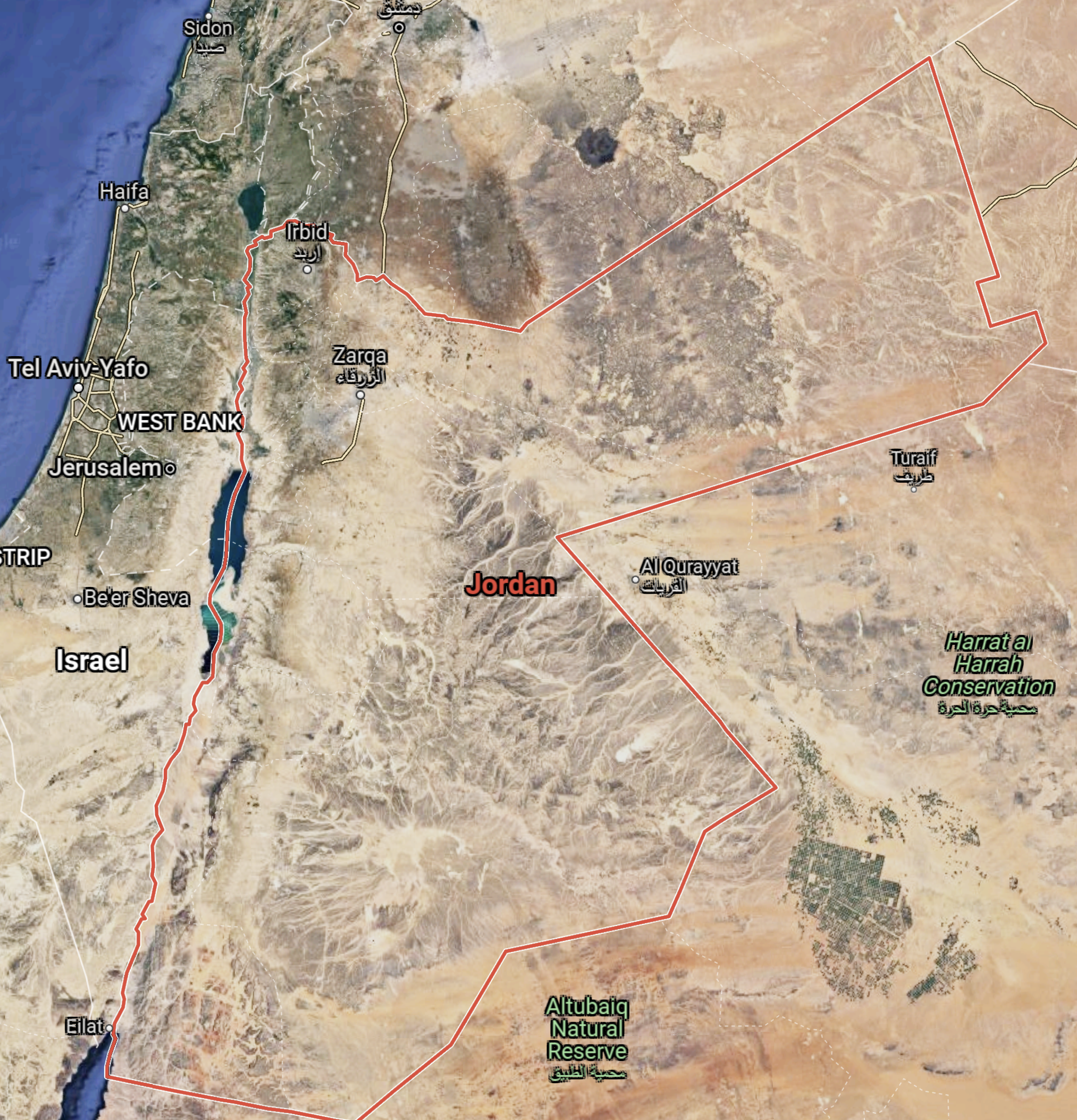
Surely, in the future, the EuroAsia interconnector could be carrying solar generated green electricity from Iraq, Jordan and Saudi Arabia to Cyprus and Greece.
As, according to Reuters, Greece covers about 40% of its annual energy needs with Russian gas, this can’t be good for Vlad the Mad and his bloodstained gas.
 The Anonymous Widower