Will Some Of The New Buildings For Heathrow Be Built In Scotland?
It’s all explained in this article on the Offsite Hub website, which is entitled Heathrow To Offer Offsite Hubs To Other Mega Projects.
This is the first two paragrahs.
Airport says schemes such as HS2 and Hinkley could make use of planned offsite manufacturing hubs
Heathrow Airport has said it hopes its idea for a series of offsite manufacturing hubs to help with its £16bn expansion plans will be used by other major projects, including the new nuclear power station at Hinkley and the HS2 railway.
Sounds a good idea to me.
A few other points.
- Offsite accounts for 10% of the construction industry.
- Heathrow are aiming for between 25% and 40%.
- It will reduce the peak on-site workforce at Heathrow.
- Offsite was safer, cleaner and less weather dependent.
- Four hubs are plans, with one definitely in Scxotland.
A few months ago I talked to one of the managers building Custom House station, which was largely built offsite in Sheffield.
He told me, that the quality was so much better, than if it had been built traditionally.
The quality certainly wasn’t traditional pre-fab either.
Could this be part of the solution to our housing crisis?
Scotland’s Gritter Tracker
Scotland’s Gritter Tracker was mentioned on BBC Breakfast.
So I had to point to it! Just click here!
Note the names!
Levenmouth’s Rail Link Moves A Step Closer In Scotland
The title of this post is the same as this article in Global Rail News.
I wrote about the Levenmouth Rail Link before in Is The Levenmouth Rail Link Going To Be Scotland’s Next New Railway?.
According to the Global Rail News article the Scottish Parliament has debated the proposal to reopen the railway and it all went well, with support from seven MSPs from various parties.
The Scottish Transport Minister; Humza Yousaf, recommended that Transport Scotland look at the project.
So perhaps nearly sixty years after it closed, the Levenmouth Rail Link could be reopened.
The project certainly has a lot going for it.
- Levenmouth is the largest urban area in Scotland not directly served by rail.
- The line passes the largest grain distillery in Europe.
- The line is mostly single track and only five miles long.
- The track is still intact, so relaying won’t be the most difficult job.
- Only two stations need to be built.
- Could the stations be single platform?
My only negative thought about the reinstatement of this line is that like the Borders Railway, it might suffer from London Overground Syndrome, where the new line has such a high level of patronage, that more trains have to be procured.
Running Electric Trains Across The Forth Bridge
Search for something like Electrification of the Forth Bridge and you find a lot of speculation and no one who.believes it can be done easily.
A ScotRail conductor said very firmly that it wouldn’t be done.
I think that in addition to the engineering problems of electrifying the Forth railway bridge, there will probably be a lot of opposition from the heritage lobby!
I also think, that if you could solve the engineering oroblems, they will.cost a lot and mean closing the bridge for at least several.months.
Bi-Mode Trains
Virgin are proposing to use Class 800 trains, which are bi-mode and will use diesel power on the bridge. These trains will have no problems crossing the bridge.
They will probably even be quieter than the current InterCity 125s, that will be continued to be used by ScotRail.
Trains With Energy Storage
The bridge is not very long at 2.5 km. and an electric train with onboard energy storage could prossibly cross the bridge, if the tracks were electrified as far as the approaches.
So do I think it is possible that a train with onboard energy storage could cross the Forth Bridge?
The Energy Storage Could Be Full Before Crossing
If the overhead electrification reached to perhaps five hundred metres from the bridge, then the onboard storage would be full.
The train would lower the pantograph and then raise it again, when under the wires on the other side.
The Maximum Speed On The Bridge Is 50 mph
This must help.
The Bridge Deck Appears Level
This must help.
Any Train Manufacturer Who Creates A Train With Onboard Energy Storage Will Gain A Worldwide Reputation
There is a lot of scepticism about trains with onboard energy storage or batteries and this would dismiss it for ever, once the crossing was shown on world-wide television with headlines like.
Battery Train Crosses Forth Rail Bridge Carrying Three Hundred Passengers
I believe that any train manufacturer, who felt they could achieve this feat would be willing to have a go, as the rewards would be immense!
Scotland Would Have A Unique Tourist Attraction
Although, I wouldn’t think it would be unique for long, as other countries would do the same to solve transport problems.
But nothing would ever be as iconic as the Forth Bridge!
I also doubt Scotland and ScoRail would say No!
Could A Class 385 Train Cross The Bridge On Stored Power?
In Hitachi Class 385 Trains, Batteries And Charging Stations, I discussed whether batteries or energy storage could be put into a Class 385 train.
I said this after giving details of Hitachi’s battery trains in Japan.
So will Scotrail’s new Class 385 trains have a battery capability?
Probably not initially!
But Hitachi have obviously been doing a lot of research into battery trains and the JR Kyushu is the first practical application.
Scotland’s rail system outside Edinburgh and Glasgow is not electrified, but it is well-known that Scotland’s Government would like more electrified services and also links to places like Leven and St. Andrews.
Both of these places, and there are probably others as well, are a few miles from a main line, that is very likely to be electrified.
So could we see a battery train charged as the JR Kyushu train on a main line, serving these branch lines on battery power?
I feel that the chance of this happening is very high.
So I feel it is highly likely, that if some form of stored power was fitted to Class 385 trains, that they would be able to bridge the gap between electrification systems North and South of the Forth Bridge.
Electrification Of The Fife Circle Line
Electrification of the Fife Circle Line would be the simplest way to improve the local rail service from North of the Forth Bridge to Edinburgh.
This shows a map of the line North from Edinburgh Gateway station.
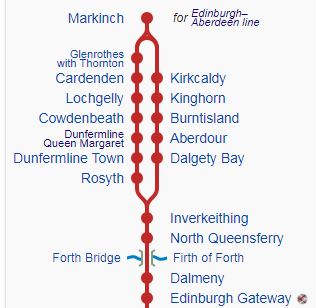
It would need the electrification from Haymarket station through Edinburgh Gateway station to be completed South of the Bridge to an appropriate point on the bridge approach.
North of the Bridge, the circle could be electrified from an appropriate point on the bridge approach, all round the circle to Markinch station.
Running The Fife Circle Service With Class 385 Trains With Onboard Energy Storage
A belt and braces approach might see North Queensferry and Dalmeny stations being the changeover point from overhead to onboard power, so that with any problems, the train is safely in a station, rather than stuck on the bridge.
Currently, the two routes between Glenrothes With Thornton and Edinburgh stations take the following times.
- Via Kirkaldy – 59 minutes with ten stops.
- Via Dunfermline – 62 minutes with eleven stops.
This means a train doing a round trip from Edinburgh takes just over two hours with twenty-one stops.
The Class 385 trains will have the following characteristics compared to the current diesel trains on the route.
- They will be faster.
- They will accelerate better and have smoother regenerative braking.
- They will have a much shorter dwell time at stations.
It would not be unreasonable to assume that the new electric trains could be several minutes under two hours for the round trip.
Trains that didn’t reverse could also go straight round the circle with the driver only changing ends at Edinburgh.
Currently, the route has three trains per hour (tph), so to run this level of service would require six trains.
Running four tph would need an extra two trains and if two tph used each direction, all stations would have a two tph service.
The trains would only need the ability to run between Dalmeny and North Queensferry stations on onboard storage.
Bi-Mode Trains Between Edinburgh And Aberdeen
Virgin Trains East Coast and possibly other operators wlll be running bi-mode Class 800 trains between Edinburgh and Markinch stations.
They will have to use diesel power where there is no electrification, but if the Fife Circle Line were to be electrified, they could use it, to run the trains more efficiently.
Onward From The Fife Circle
The Fife Circle Line could be a bridgehead to extend electrified services to the North.
Consider these distances.
- Markinch to St. Andrews – 20.7 miles
- Markinch to Dundee – 25.1 miles
- Markinch to Perth – 22.7 miles
- Glenrothes to Leven – 7.1 miles
All of these destinations could be reached by a combination of short lengths of electrification and trains with onboard energy storage.
Scotrail’s Extra Ten Class 385 Trains
Scotrail have an extra ten Class 385 trains on option, if the franchise is extended by 7 to 10 years and the trains would enter service in 2023.
Could these trains be to run an electrified Fife Circle Line service and perhaps running to Leven?
Conclusion
Scotrail have some ambitious plans for Scotland’s railways and I wonder, if they include using Class 385 trains with onboard energy storage to get electric trains across the Forth Bridge.
Over The Queensferry Crossing
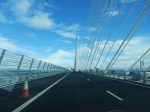
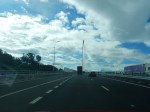
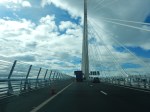
The Queensferry Crossing is Scotlan’s newest bridge over the Rover Forth.
I took these picture as we went North.
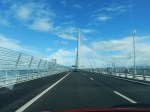


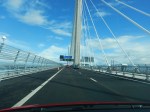
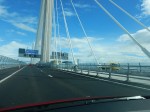



And these were taken coming South.





The one disappointment was that it was difficult to get pictures of the other bridges.
The Cavalry Are Arriving!
This article in Rail Magazine is entitled First HST for ScotRail Arrives In Scotland.
I seem to remember reading accusations that Tony Blair, Gordon Brown and their governments weren’t too keen on the ageing InterCity 125 trains, that plied up to Scotland and across to Wales and the West of England. So they did a deal with Hitachi, which included a new train factory close to Blair’s constituency in the North-East of England.
But removing InterCity 125s or High Speed Trtains (HSTs) as they are commonly known, from the UK rail network, appears to be as difficult as removing Japanese knot-weed from a garden.
When delays hit the Great Western electrification, Great Western Railway started experimenting with short formation HSTs, consisted of two Class 43 power cars and four or five Mark 3 coaches. The experiments were obviously a success, as they have decided to do this according to Wikipedia.
Great Western Railway are to retain 24 powercars and 48 carriages to form 11 four-carriage sets for use on local services between Cardiff and Penzance. The carriages will be fitted with automatic doors and controlled emission tanks at Wabtec, Doncaster.
Scotrail have gone down a similar route of shortened HSTs.
This article in Rail |Engineer is entitled ScotRail’s ‘new’ HSTs, gives full details. This is the first three paragraphs of the article.
In 2012, Transport Scotland published the results of its rail passenger service consultation. This considered how the railway should develop and the types of passenger services required. Its results were incorporated into the specification for the ScotRail franchise which was renewed in 2014.
One conclusion from this consultation exercise was that passengers traveling from central Scotland to Aberdeen and Inverness much preferred to travel in Virgin Trains East Coast High Speed Trains (HSTs) from London than ScotRail’s Class 170 diesel multiple units (DMUs).
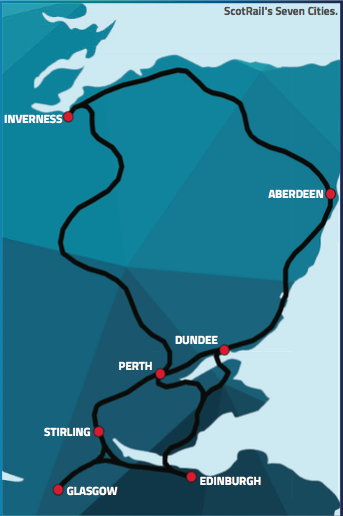
For this reason, the invitation to tender (ITT) document for the ScotRail franchise included a specification for improved rolling stock for Scotland’s internal inter-city services that could have been based on the HST’s mark 3 coach. In its franchise bid, Abellio’s response to this requirement was that it would provide refurbished HSTs on the routes that serve Scotland’s seven cities (Glasgow, Edinburgh, Stirling, Perth, Dundee, Aberdeen and Inverness).
Abellio received the franchise and ScotRail will be getting seventeen 2+5 and nine 2+4 HSTs. This paragraph from the Rail Engineer article gives more details on the trains.
The HSTs will be phased into service from summer 2018, with the full fleet operational for the May 2019 timetable change. This aligns with the completion of Network Rail’s Highland main line journey time improvements project. 54 power cars and 121 coaches will be leased from Angel Trains. These will make up 17 five-coach trains and 9 four- coach trains with two power cars spare. The 2019 timetable will require 23 trains in service each day with five coach sets operating Central Belt to Aberdeen services and the four coach trains generally running to Inverness. The number of through services from Inverness to the Central Belt via Aberdeen will also be increased.
As the first HST has now arrived in Scotland as is reported in the Rail Magazine article, it looks like everything is going to plan.
Politicians and others might say, why are the lines not being electrified or services provided by Class 802 trains.
- Network Rail’s record on electrification isn’t good.
- There would probably be opposition to overhead electrification marching all over the Highlands.
- The lines in the North of Scotland probably have a maximum speed of 100 mph at best.
- Drivers have forty years of experience of running HSTs to Aberdeen and Inverness.
- To many of the British, the InterCity 125s are the definitive High Speed Train.
Could there even be a popular feeling behind using the trains, in much the same way people cling to the past in their politics?
I think it is a sensible plan for the following reasons.
- A 2+5 shortened set running at less than the 125 mph design speed could be a very sound economic proposition.
- The trains have large windows for a good view.
- I’m sure Scotrail will add appropriate catering, on the upwards of two to three hour journeys.
- These trains could be passenger magnets for business, leisure and tourists, especially from countries like Germany, The Netherlands, Sweden, Canada and the USA.
But above all these Scottish InterCity services must be the Marketing Department’s dream!
Faster Trains For Slower In Scotland
In my analysis of the Kentish routes in Kent On The Cusp Of Change, I wrote a post called Elimination Of Slow Trains.
In the post, I said that the 75 mph Class 465 trains, were slowing services and reducing capacity, based on an article called Kent on the Cusp of Change in the July 2017 Edition of Modern Railways.
I proposed a minimum specification for trains on Kentish routes.
- 100 mph capability
- Designed for a fast station stop with minimum dwell-time
- Regenerative braking
- Efficient traction motors
- Wi-fi in all classes
- The capability to fit boosters for 4G signals.
Southeastern’s Class 465 trains fail on all points.
In Scotland, there is a new batch of Class 385 trains on order to work the new electrified services between Edinburgh and Glasgow.
Under Operation in the Wikipedia entry for the trains, this is said.
The new trains will also operate on the newly electrified Croy, Dunblane and Shotts lines as well as replacing existing stock on the currently electrified Carstairs, North Berwick and Cathcart Circle Lines. This will allow for the replacement of ScotRail’s Class 314 fleet, and allow for the cascading of a number of Class 156, Class 158 and Class 170 units.
The Class 314 trains are even older and less capable than Southeastern’s Class 465 trains.
So what will be effect on services in Scotland, where the Class 385 trains replace the Class 314 trains?
If you look at the North Berwick Line trains between Edinburgh and North Berwick stations take around 33-34 minutes, when run by 100 mph Class 380 trains. Under Rolling Stock in the Wikipedia entry for the North Berwick Line, this is said.
From December 2017, ScotRail services on the North Berwick Line will begin to use new Class 385 units. Services will be formed of six coaches (two 3-car units) following growing passenger numbers (the platform at North Berwick was extended in early 2016 to accommodate these new longer trains). In the short term Class 380/1s (four car) will be removed from the line and two Class 380/0s (three car) used instead until the Summer and back again to four car units until December. Once the new units arrive, The Class 380 units will be cascaded to increase capacity on the Ayrshire and Inverclyde Lines to and from Glasgow making all services on these routes operated by Class 380s.
So could it be that although both Class 380 and 385 trains are 100 mph units, the newer trains have a better station stop performance, which enables the timings on the line to be reduced and possibly allow the doubling of frequency of trains to two trains per hour?
Conclusion
Modern 100 mph trains with the ability to execute fast stops at stations are good for operators and passengers alike.
Hitachi Class 385 Trains, Batteries And Charging Stations
This article in the International Railway Journal is entitled JR Kyushu battery EMU to enter service in October.
This is said.
JAPAN’s Kyushu Railway Company (JR Kyushu) announced on August 24 that its pre-series Dual Energy Charge Train (Dencha) battery-assisted EMU will enter revenue service on the 11km Orio – Wakamatsu section of the Chikuho Line on October 19.
The two-car 819 series set draws power from the 20 kV ac 60Hz electrification system to feed a bank of onboard batteries, which give the train a wire-free range of up to 90km.
At least it can do 11 km. This is said about the train’s manufacture.
The 819 series is based on the existing 817 series EMU and was built by Hitachi at its plant in Kudamatsu in Yamaguchi prefecture.
Note the word Hitachi!
Hitachi call it a BEC819 train and it is one of their ubiquitous A-trains.
On the Hitachi Rail Europe web site, three new trains are mentioned.
All are A-trains and on all pages, the word battery is mentioned under power supply.
So will Scotrail’s new Class 385 trains have a battery capability?
Probably not initially!
But Hitachi have obviously been doing a lot of research into battery trains and the JR Kyushu is the first practical application.
Scotland’s rail system outside Edinburgh and Glasgow is not electrified, but it is well-known that Scotland’s Government would like more electrified services and also links to places like Leven and St. Andrews.
Both of these places, and there are probably others as well, are a few miles from a main line, that is very likely to be electrified.
So could we see a battery train charged as the JR Kyushu train on a main line, serving these branch lines on battery power?
I feel that the chance of this happening is very high.
Put a charging station, like a Railbaar at the terminal station and it could be done as soon as the train is built.
The Train Of The Future
This article in Rail |Engineer is entitled ScotRail’s ‘new’ HSTs, gives full details of the modifications ScotRail wukk make to their HSTs, before they enter service in Summer 2018. This is said.
The iconic HST is now over forty years old. It ensured the success of British Rail’s inter-city service and is still the world’s fastest diesel train, although the ScotRail HSTs will have a maximum speed of 100 mph. With around ten million miles on the clock these trains are approaching retirement for long-distance services as they are about to be replaced by IEPs. However, as ScotRail is about to demonstrate with its reincarnation of these trains, there is still much life left in them.
I wrote Edinburgh to Inverness in the Cab of an HST, after a trip to Inverness and it was the trip of a lifetime.
On the trip, you realise that Scotland has a big problem and an asset with railways and it’s called mountains. So a train is needed with bags of grunt and big windows.
An HST has both, coupled with an iconic style, unmatched since the days of steam.
Scotrail’s plan to run the trains between the seven Scottish cities would appear to be a good one.
I wonder, if we’ll ever see the trains going to Kyle of Lochalsh, Thurso and Tweedbank.
The article is worth reading, as it details everything that will be done to create a train worthy of the iconic routes.
If I’m still of this life next Summer, I shall be in Scotland.
I’ve never spent a night in Aberdeen, Dundee or Perth for a start!
Rail Sleeper Plan Between Caithness And Edinburgh
This is the headline on an article in the John O’Groats Journal.
So is this a good idea?
Some of the comments to the article are cynical it would work, but I feel that it could be a runner.
The Current Service
There are two train services from Edinburgh to Thurso during the day, both of which need a change at Inverness.
- The 08:32 from Edinburgh arrives in Thurso at 17:50.
- The 13:34 from Edinburgh arrives in Thurso at 22:20.
Both services could be summed up like this.
- The total time of the journey approaches nine hours.
- The train is something like a Class 158 diesel multiple unit.
- Both legs are between three and four hours.
- There is a long wait in Inverness.
- The second service does the second leg mainly in the dark.
- London to Thurso in a day is possible, but it would be dark and tiring.
Although there are quicker routes with more changes, I can think of better ways of spending a day, travelling North from Edinburgh to Thurso.
Coming back, there are three practical one-change services
- The 06:50 from Thurso arrives in Edinburgh at 14:22.
- The 08:34 from Thurso arrives in Edinburgh at 16:25
- The 13:01 from Thurso arrives in Edinburgh at 22:28.
These services can be summed up like this.
- The first two services are faster than the nine hours going North.
- On a good day the morning services must give good views.
- You would certainly be able to do Thurso to London by train in a day.
Certainly, as a practical train service to attract visitors, the Edinburgh-Thurso service is not a service that says you must go, like say Inverness to Kyle of Lochalsh, which I wrote about in Inverness to Kyle of Lochalsh.
The Far North Line
The Far North Line connects Inverness with Thurso and Wick. This introduction from Wikipedia, is a good summary of the line.
The Far North Line is a rural railway line entirely within the Highland area of Scotland, extending from Inverness to Thurso and Wick. It is the northernmost railway in the United Kingdom. The line has many sections of single track, mostly north of Dingwall. In common with other railway lines in the Highlands and northern Lowlands, it is not electrified and all trains are diesel-powered.
The trains are typically Class 158 trains, which provide four trains per day all the way between Inverness and Thurso. Other services give a better service on the Southern part of the line including four trains per day to Kyle of Lochalsh.
Improving The Far North Line
Wikipedia has a section on Future Expansion of the line. This is said.
For many years there have been proposals to bypass the Lairg loop with a line across the Dornoch Firth, linking Tain (via Dornoch) more directly with Golspie. This would involve building a new bridge over the Firth, or making dual-purpose the bridge[5] which now carries just the A9. Discussions have been held concerning the shortening of the Far North Line involving a bridge over the Dornoch Firth and the possible use of the trackbed of the former light railway.[6] Nothing has yet come of these ideas.
But these are expensive developments and is the traffic available.
The John O’Groats Journal has this paragraph.
I have spoken to Caledonian Sleeper and want to investigate the business case for a sleeper combination with freight.
So could Internet and other parcels traffic be a nice little earner for the line.
But then a lot of tourists venturing along the line will be heavily loaded with bicycles and heavy luggage.
Incidentally, In the 1960s, I used to work with a John Baxendale, who used to go surfing off the North Coast of Scotland, as he said it was some of the best surfing in the world.
Do surfboards feature on trains to the North, as they do on trains to Cornwall?
Trains For The North
So perhaps, this line, the Kyle of Lochalsh Line and the Inverness to Aberdeen Line need a fleet of specially configured Highland trains.
- Four carriages.
- A good buffet/restaurant car serving proper Sottish food.
- Lots of space for luggage.
- Big windows.
Abellio ScotRail are planning to refurbish twenty-six Inter-City 125s for longer routes, which fit this specification, as the rear sections of the Class 43 locomotives can be used for freight and oversized luggage.
Will we be seeing these trains on the routes out of Inverness?
Imagine a tourist day out from Inverness, where the morning train to Thurso and the evening return to Inverness offered the best breakfast, dinner and hospitality that Scotland can provide.
You never say never where Terry Miller’s iconic trains are concerned.
If ever a train will still be in main line service, a hundred years after it was built, it will be these trains.
Given their unique status, if they worked the Far North Line, they might just attract enough passengers to make line improvements worthwhile.
Factors Affecting The Edinburgh-Thurso Sleeper
In the following sections, I’ll detail a few factors that will surely affect ridership of a sleeper train between Edinburgh and Thurso.
Sleeper Trains Are Having A Revival
A few years ago, it was predicted that sleeper trains would be consigned to history in a few years.
But in the UK, the Caledonian Sleeper and the Night Riviera, seem to have ignored this advice, with the Scottish service ordering new rolling stock.
Deutsche Bahn thought sleeper trains were the past and they probably were, given the customer-unfriendly way DB ran them. But Austrian Railways are taking over the sleeper services and investing in new rolling stock.
In Sweden, there’s even their own Far North sleeper train from Stockholm to the Arctic Circle. Check out this map on the Swedish Railways web site.
The Curiosity Factor
Done properly, an Edinburgh to Thurso Sleeper would surely attract those, of which I’m probably one, who like to travel to out of the way places as some form of box-ticking.
My Reason For Using Sleeper Trains
I am one of those lucky people, who can sleep anywhere.
So if I’m coming down from a trip to Scotland, I will often have a full day and then catch the sleeper back down to Euston. If I book at the right time, I often find that my First Class sleeper ticket, is less than staying in say a Premier Inn in Edinburgh or Glasgow and buying a train ticket for the morning. I also arrive in London at a time, that hasn’t wasted half the day.
If say, I had to go to an important event in Glasgow or Edinburgh, if possible, I would take the first train to the North in the morning and then come back on that day’s sleeper.
The Edinburgh To Thurso Day Trip
If you look at the times for a train service between Edinburgh and Thurso, it would not be possible to go up and back in a day and have time for a worthwhile meeting or party.
I once drove from Ipswich to Aberdeen and back in a day, but I was in a Lotus Elan doing speeds at up to a hundred on the way.
But you couldn’t do those sorts of speeds now!
On the other hand, if there was a sleeper service between Edinburgh and Thurso, you’d arrive fresh and ready for the day or you could sleep off the Highland hospitality on the way back. Or of course vice-versa!
Why Not A Glasgow To Thurso Sleeper?
Once all the electric trains are running across the Central Belt, Glasgow to Edinburgh could be 36 minutes, with a train every 15 minutes.
So only one route would be needed, as passengers from Glasgow could just take a train across.
But for operational reasons, the sleeper service might start from anywhere in the Central Belt, like the new Edinburgh Gateway station, which is close to Edinburgh Airport.
Thurso To Edinburgh Airport
An Edinburgh-Thurso service would certainly stop at Edinburgh Gateway station, to give easy access to the Airport.
Suppose you were going on holiday or for business reasons to Caithness or somewhere on the Far North Line.
You would catch a convenient flight into Edinburgh Airport and perhaps board the Sleeper st around nine in the evening for the North.
Coming back, you’d catch the Sleeper in Thurso and arrive at Edinburgh in time for a morning flight.
Caithness Tourism
Tourism to Caithness and the North Coast of Scotland could be a big driver of passengers to an Edinburgh to Thurso Sleeper Service.
This page on the Visit Scotland web site gives more details.
There’s even pictures of surfers.
Conclusion
I feel that not next year, but once Scotland’s rail system is fully developed, with the shortened Inter-City 125s serving the longer routes and electric trains all over the Central Belt, that a Sleeper Train between Edinburgh and Thurso will be viable.

