Cyclehoops By Selfridges
I found these two cyclehoops by Selfridges today.
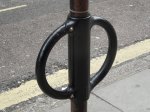

One seemed to have had a bicycle part-nicked from it, bt the other was ready to do its job.
Verified By Visa Revisited
I have moaned about this crap before.
I have been fighting it for a couple of hours and in the end I managed to buy two extra Olympic tickets. Can the reason that so many people find buying these tickets difficult is you must use a Visa card and you can’t fight your way through this awful system?
I have just written to my credit card company, saying that after the Olympics, they can put their Visa card in a place where it will hurt.
Today I was adding a new password all the time and then when I tried it the next it was rejected, so I had to start again. Surely entering a new password every time you use the card is the most insecure way to use a credit card on line.
It might well be that the US version of this system works because everybody uses the last four digits of their Social Security Number. In the UK no-one knows theirs and anyway it ends in a letter. So perhaps the problem is that the system has not been properly rewritten for the UK.
Anyway it’s crap!
There Are Now Guard Whippets On London Buses
Because of the Olympics and the Queen’s Diamond Jubilee, specially trained whippets like this one, are now being carried on London’s buses.
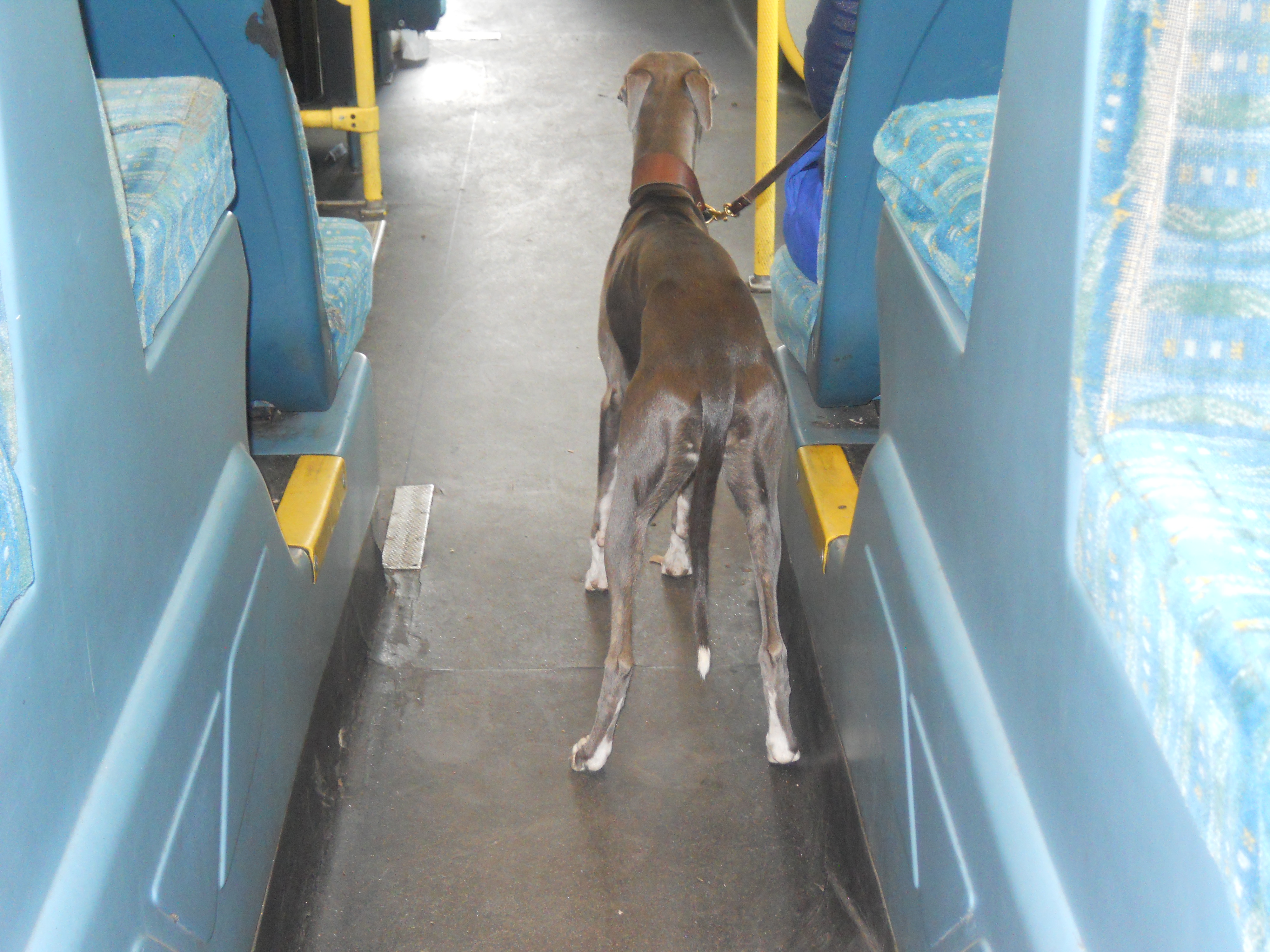
A Guard Whippet on a London Bus
I spotted this rather smart grey one on a 141 bus this afternoon.
I had a brief chat with the handler and they said, they were a bit short of whippets, so they’re going to have to use beagles and coney dogs as well!
The Zopa Login
Adnmittedly, I know the people at Zopa well, but is there a financial site, that has such a simple, foolproof and I think secure, login. All you need to remember is your e-mail address and password and know the answers to a set of personal questions, whose answers, most people would know about themselves.
So what would happen if you someone broke my login? They might find out how much I had invested, but they wouldn’t be able to withdraw any money without first setting up a link to their bank account and then authorising the link. Not something that is easily done without leaving a trail of evidence. I suspect too, that alarms would ring at Zopa.
Everybody, who designs a secure login could do no better, than build on the excellent work Zopa has done.
The Olympic Site Is Protected
I took this picture at the start of the Greenway just as it crosses the canal at the western site of the Olympic site, close to Hackney Wick.
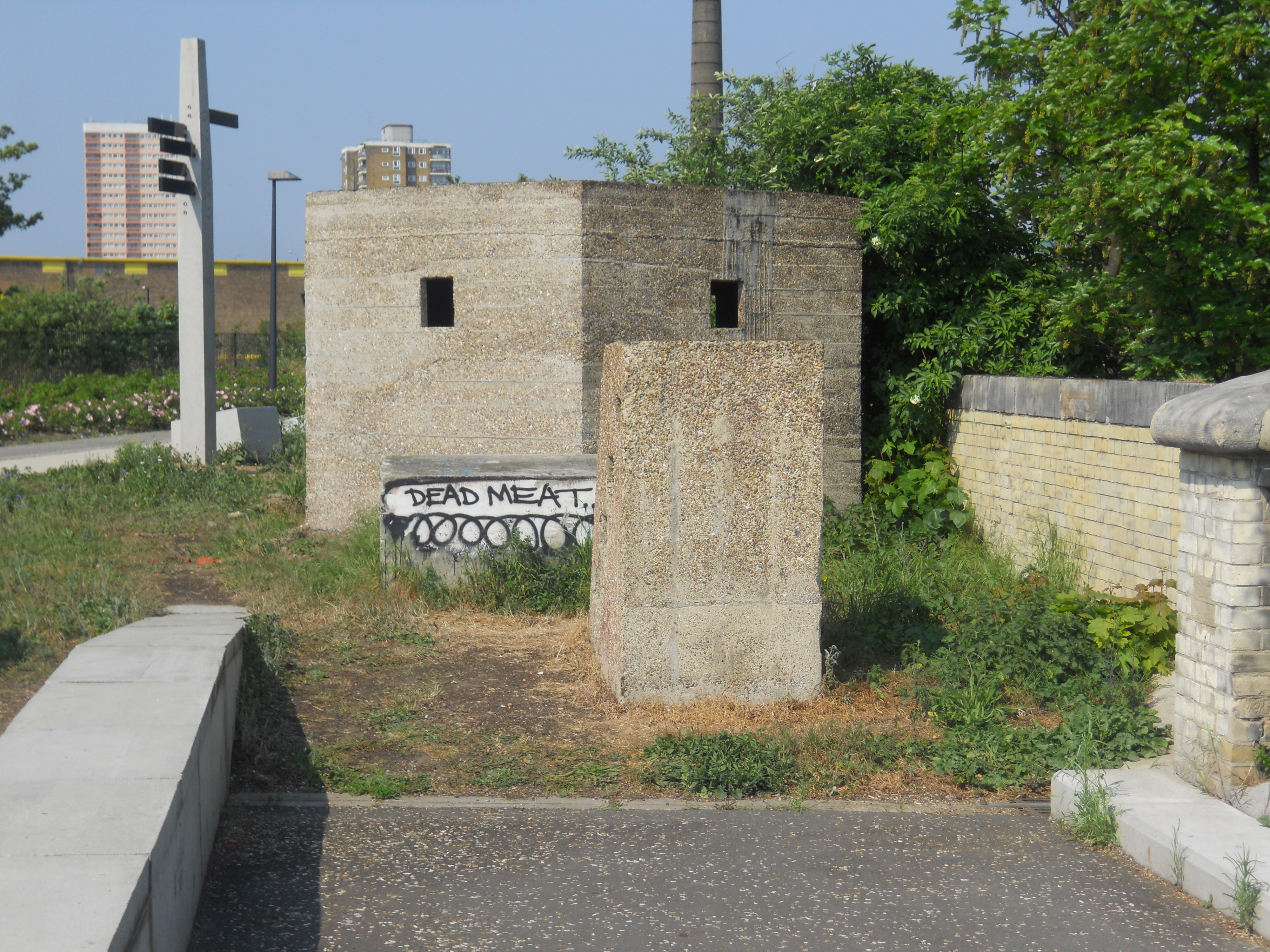
A Pill-Box by the Olympic Site
Two guys in this pill-box with a couple of PIAT anti-tank guns could stop anything.
Personal Security From American Express
I have all of my credit cards registered with a security program from American Express, so that if I lose my wallet. it’s just one call to stop everything. When I registered, they also sent me a rather nice key fob,so that if I drop my keys, it would increase the chances of their return.
A couple of weeks ago, I dropped my camera somewhere. It was only a fairly cheap Nikon, but I liked it and it has taken most of the pictures here. So I phoned Amex to see if they had some tags with which I could label my personal belongings.
I got a whole load of goodies yesterday.
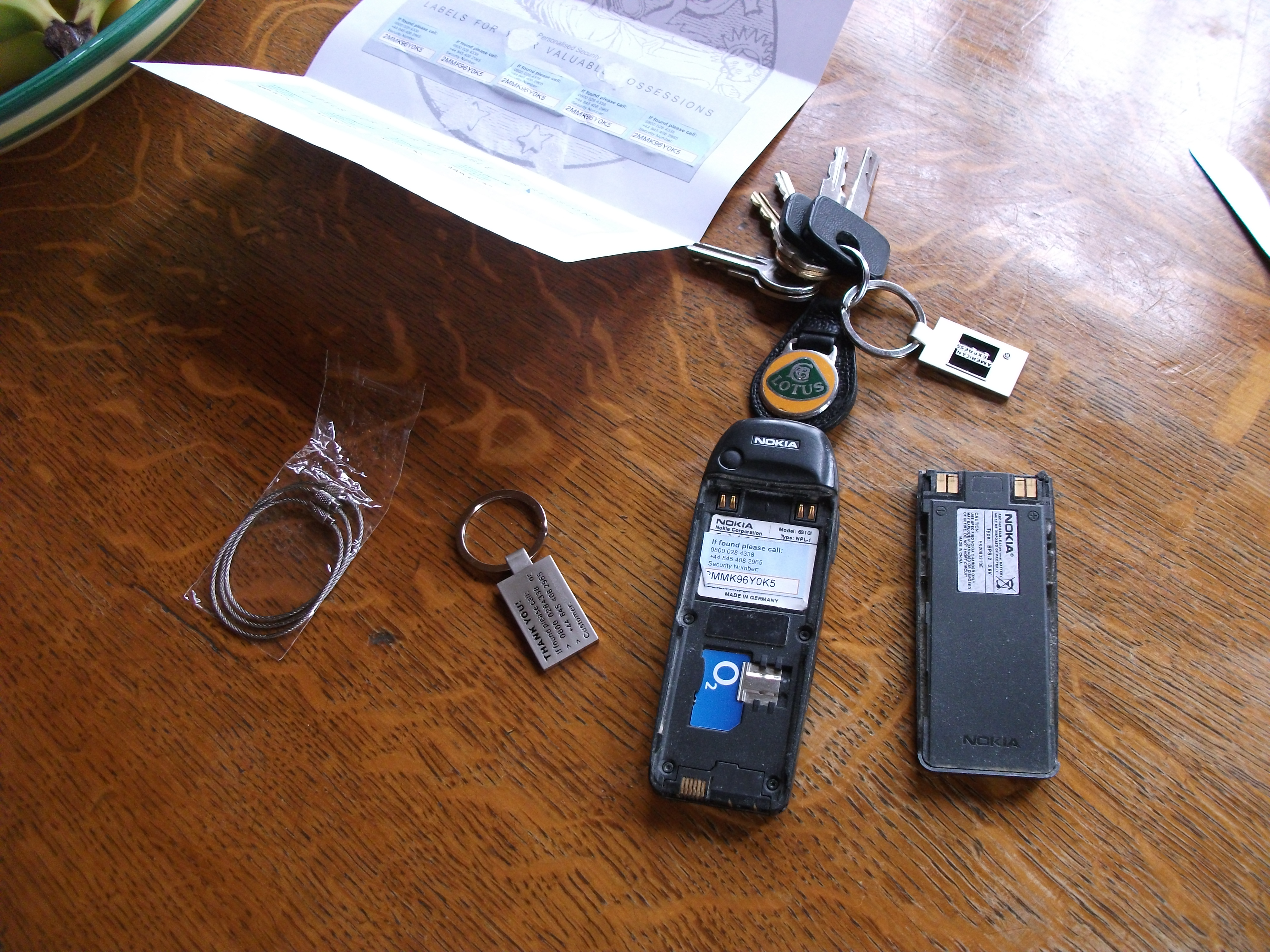
American Express Personal Security
Note the security label inside the phone.
So all in all a good set of tags, from just one call to Amex.
Body Scanners
There has been a couple of women refused travel on a plane at Manchester, because they would not be checked by one of the new body scanners.
I’m all for security and are broadly for increased measures, but the way it is in the UK is different to the USA. There if you refuse to go on a body scanner, you can be personally searched. In the UK, you can’t.
This is wrong, as there are various illnesses such as Li-Fraumeni Syndrome, where exposure to radiation is not recommended. In my view anybody suffering from such a disease would be totally within their rights to ask for a personal search, especially if they had a letter from their hospital.
Banking Security
I don’t like internet banking. Well to be truthful, I like the concept, but some of the implementations of it are rather poor.
Take my bank. I need to enter my account reference, a password and then three numbers from a key code. I can remember these in most cases, but if I access the account from someone else’s computer, I need to have the account reference written down. But I do write it down in a way that no-one could ascertain.
Although it is a system that works, it is not the best. It is typical of many systems used to login to on-line banking.
I am a mentor on The Horse’s Mouth, which is a web site where people put ideas and others pass comments. It is an interesting concept and from what I read in the press, it is highly regarded.
In the last few days, the web site has put me in touch with a company called SafeTok.
It looks like it could be a solution to better Internet security.
But then I am not an expert in this field. But then I’m a consumer who knows what I don’t like.
How Can We Improve Security?
Over the years the security services and the police all over the world have made many basic mistakes which have meant that people have lost their lives. I should also add that there have been lots of cases of domestic violence and child abuse which were not picked up, which also resulted in death. I could also add in things like misdiagnosis in hospitals.
It’s all part of the same problem.
The evidence in many cases is there, but no-one can put it together to find the correct or even deadly link.
So the first thing that must be done to improve security or in the NHS’s case patient diagnosis is to make sure that all computers can talk properly to each other.
As an example of this, the DVLA can check quickly that vehicles are taxed, insured and MOT’ed instantly. The benefit to the general public is that it is now a simple process to retax a vehicle over the Internet. But to the police it is a valuable tool to check whether vehicles are legal. I suspect that the number of untaxed vehicles has also reduced and the tax take has increased. The only downside of this linking of databases is that because of the on-line purchase of road tax, Post Offices are getting less revenue and this doesn’t help their financial situation.
We still are nowhere near getting a decent patients’ record computer system and I’ve also heard stories about how police computer systems are all different and sometimes need the same data to be entered more than once. I hope most of the stories I’ve heard are wrong. But I doubt it!
All my life I’ve been a maverick kicking against complacency and the status quo.
Any organisation handling data should employ people like me. Well not me, as I’m too old and well past my sell-by date.
But I know that some of my software and other similar systems have been used in very sensitive applications to link data together so that police and others can target criminals, problems or epidemics. This type of software is used outside of the computer mainstream and to many so-called computer managers it is a pain. I can understand their point, but they should see that these analysts are on their side. It could be argued that the collapse of several of the banks in recent months was because senior managers knew better and ignored the well-researched facts and opinions of analysts with minds much sharper than their own.
So every organisation should have a group of people, whose job is to analyse and question the data in every way possible. Unfortunately, these type of groups are the first to be got rid of in times of financial restraint. They are always a pain in the arse to so-called managers.
I should put a bit of history in here. Years ago in ICI, I worked in a Computer Techniques section, that had free rein to poke its nose into problems in the Division. It was very successful, but had it not been for the diplomacy of those that ran it, it would have been very unpopular. I was at one time, when I told a chemist that he was barking up the wrong tree. But then he wasn’t using any mathematics for his reactions and I was!
I also believe that we rely too much on conservative techniques. I sometimes think that some of the problems with the banks were caused because too many people looked at them all in the same way, with the same software.
So if the maverick groups are to be effective, they need to be able to purchase software and services, that may not fit the policy of the organisation. They also need to have access to specialist programming resources. I would say that wouldn’t I!
I would also make the watch lists much more publicly available.
Let’s say that you are a check-in clerk for an airline. Someone turns up and there is something you don’t like about them. You should be able to flag the guy quickly with just a single key stroke. Perhaps, you can now, but if you can’t then you should be able to. If the watch list was able to be checked at that moment, then it would help airport security ascertain if the person was just nervous of flying or a bomber.
But the key to better security is that everyone should be on watch for anything suspicious. After all one of the biggest failures in the Umar Farouk Abdulmutallab case, is the fact that his father reported him and no-one did anything about it. We need a system that allows the public to contribute to the data, when they have suspicions.
But our biggest problem is that all of these security services are closed and secretive organisations, so they tend to believe all their own methods, publicity and hype. I am reminded of a friend, who in the 1950s needed to be cleared to work on top-secret radar systems. The fact that he was a member of CND should have precluded this, but the security services never knew, as they never asked him.
Have they got any better?
But what will we get?
Probably a lot more restrictions on our lives.
 The Anonymous Widower