Could Paddington And Minehead Be Within Range Of Hitachi Battery-Electric Intercity Trains?
I am prompted to ask this question, by an article in today’s Telegraph, which is entitled The New British Rail Services Reversing The Damage Of Beeching’s Axe.
Line 8. is given as the West Somerset Railway between London and Minehead?
This paragraph describes the idea.
As with the Severn Valley Railway (SVR) to Bewdley, the West Somerset Railway (WSR) looks like it could one day host mainline trains and connect communities along the route with destinations such as Taunton and Bristol. Like the SVR, the WSR is a very long and well-staffed heritage line with a long history (50 years, in fact, and it was one of Britain’s first heritage lines following its Beeching closure). Running to Minehead and Dunster, you don’t need me to tell you that this is a beautiful part of the world with numerous castles and beaches, and Exmoor National Park next door.
Note.
- The author doesn’t mention London services in the text.
- Batteries are not mentioned either.
- Minehead will be only about twenty miles from Hinckley Point C nuclear power station.
Is it feasible?
What Is The Battery Range Of An Hitachi Intercity Tri-Mode Battery Train?
In The Data Sheet For Hitachi Battery Electric Trains, I came to these conclusions.
- The battery pack has a capacity of 750 kWh.
- A five-car train needs three battery-packs to travel 100 miles.
- A nine-car train needs five battery-packs to travel 100 miles.
- The maximum range of a five-car train with three batteries is 117 miles.
- The maximum range of a nine-car train with five batteries is 121 miles.
As battery technology gets better, these distances will increase.
What Is The Distance Between Minehead And Taunton?
I shall be using 24.8 miles, which I have calculated from figures given in the Wikipedia entry for the West Somerset Railway.
What is The Distance Between Paddington And Taunton Via Newbury?
I shall be using 142.6 miles, which I have calculated from figures given in RealTimeTrains.
What Is The Maximum Range From Paddington Via Newbury Of An Hitachi Intercity Tri-Mode Battery Train?
Consider.
- The electrification runs between Paddington and Newbury.
- The distance between Paddington and Newbury is 53 miles, according to RealTimeTrains.
- Paddington and Taunton is almost 30 miles shorter by Newbury, than via Bath.
This Google Map shows Taunton station.
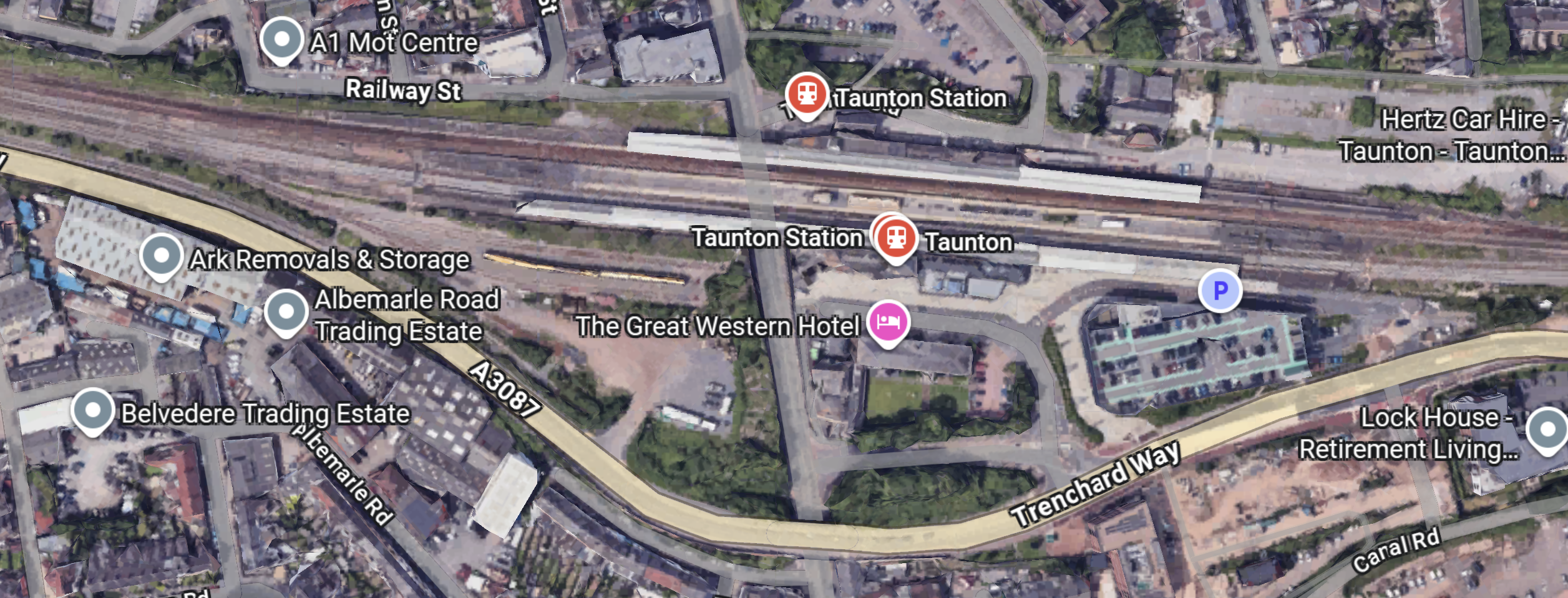
Taunton station looks spacious with numerous platforms and a hotel.
I believe that a five-car Hitachi Intercity train leaving Newbury with three full batteries could travel as far as 53+117 or 170 miles from Paddington.
Could A Hitachi Intercity Five-Car Train Reach Taunton?
This would mean that Taunton would be in range as it is only 142.6 miles.
The train would need to be recharged before returning to London.
Could A Hitachi Intercity Five-Car Train Reach Minehead?
But it could also have enough power in the batteries to reach Minehead, which is only a further 24.8 miles or 167.4 miles in total.
As with Taunton, the train would need to be recharged before returning to London.
Options For Charging Trains That Are Returning To London
This OpenRailwayMap shows the tracks through Taunton.
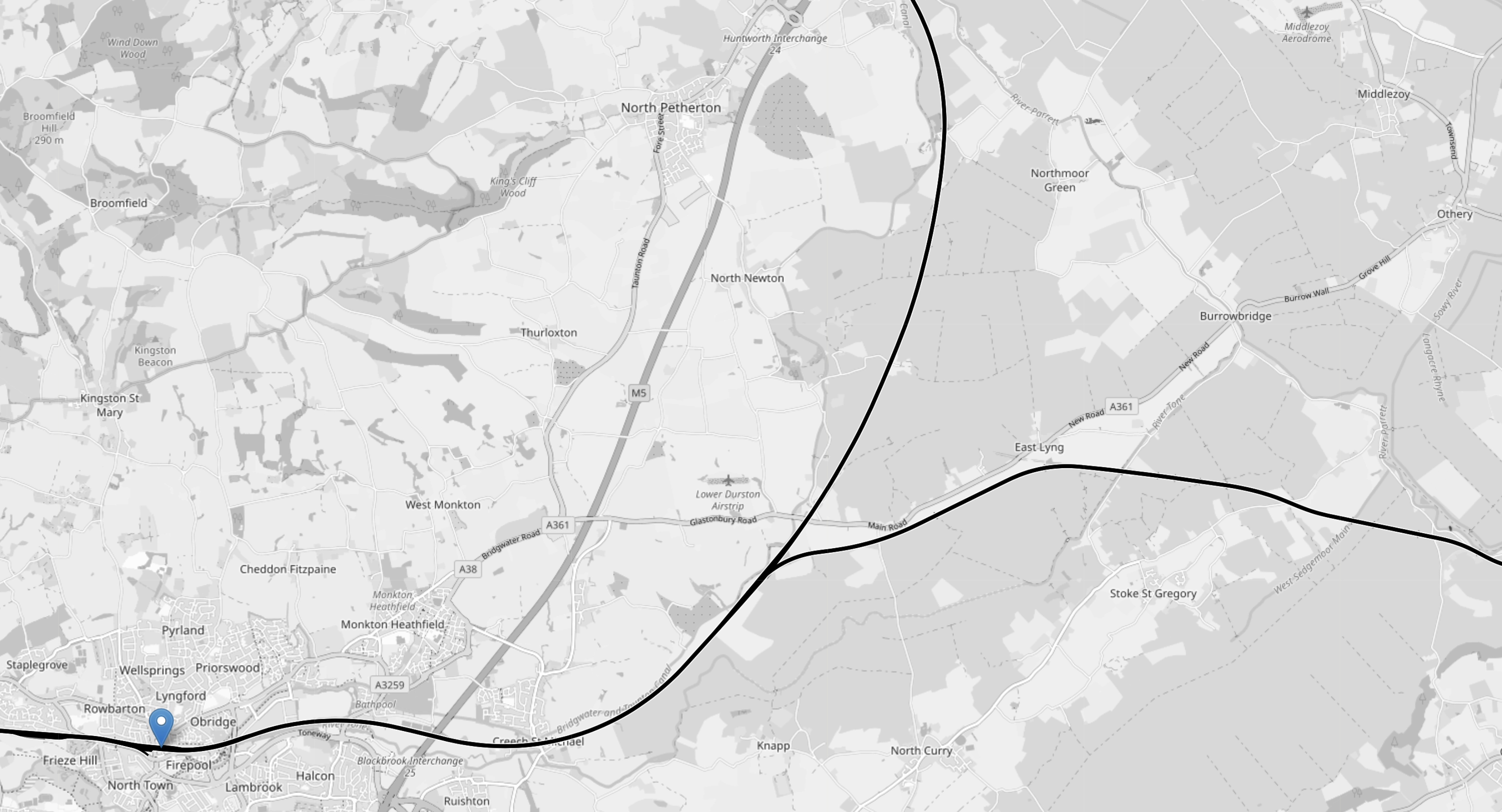
Note.
- Taunton station is indicated by the blue arrow.
- Running East-West across the map and through Taunton station, is the Reading-Taunton Line.
- Running more North-South across the map and through Taunton station, is the ~Bristol-Exeter Line.
- The two lines split going East at Cogload junction.
- Taunton station and Cogload junction are about 4.5 miles apart.
- Trains typically take about six minutes between the two places.
I believe there are three options for charging the trains.
Option 1 – Charge In Minehead Station
This would be possible, but as not all trains go to Minehead station, it probably wouldn’t be very practical.
Option 2 – Charge In Taunton Station
This would be possible, especially as most trains seem to call in Taunton station.
Option 3 – Electrify Between West Of Taunton Station And East Of Cogload Junction
Consider.
- The length of the electrification could be as long as is necessary.
- Trains would charge their batteries at line speed.
- Pantographs would be raised and lowered at line speed.
- Trains would not have to call at Taunton station.
- Trains could charge their batteries on both routes.
- Trains could charge their batteries in both directions.
I believe this could be the most efficient way to charge trains through Taunton.
Onward From Taunton
If the electrification through Taunton could be made long enough, so trains left the station with a full battery, the following would be possible.
- Going South trains should go past Plymouth.
- Going towards Newbury, trains should have enough in the batteries to reach Newbury and electrification for London.
- Going towards Chippenham, which is 63 miles away, trains should have enough in the batteries to reach Chippenham and electrification for London.
- Going towards Bristol Temple Meads, which is 44.8 miles away, trains should have enough in the batteries to reach Bristol Temple Meads.
Possible Regular Services Between West Somerset Railway And Taunton
The title of this post, is the same as that of this article on Rail Advent.
These are the introductory paragraphs.
Hopes are growing that regular scheduled train services will once more operate between the West Somerset Railway (WSR) and the national rail network.
There is an increasing interest in re-opening long-closed stations and lines on the network. To this end, a partnership working group has been set up to look at the prospects of running scheduled trains between WSR’s Bishops Lydeard station and Taunton, which would safeguard the WSR’s long-term future.
The working group comprises representatives of the Heart of South West Local Enterprise Partnership, Great Western Railway, Network Rail, Somerset County Council, and WSR Plc.
Given the success of the reopened Okehampton station, that I wrote about in Success For The Dartmoor Line, where 2,500 passengers a week have used the trains since last November, I wonder if Somerset is aiming to emulate Devon’s success, with the West Somerset Railway.
There are certainly similarities between the two routes.
Connection To The County Town
Both routes connect to the county town.
- The Dartmoor Line connects to Exeter, which is the county town of Devon.
- The West Somerset Railway connects to Taunton, which is the county town of Somerset.
As the county town usually contains important local services like the council offices and the Courts, this is often convenient.
Connection To The Great Western Railway
Both routes could have excellent connections to the Great Western Railway.
- Exeter St. David’s station is a major interchange.
- Taunton station could be a more important interchange.
Note.
- Both stations have connections to Bristol, London and Cornwall.
- The two stations are well-connected to each other.
- Both stations have six platforms, which include some bay platforms for branch line services.
This Google Map shows the less developed Taunton station.
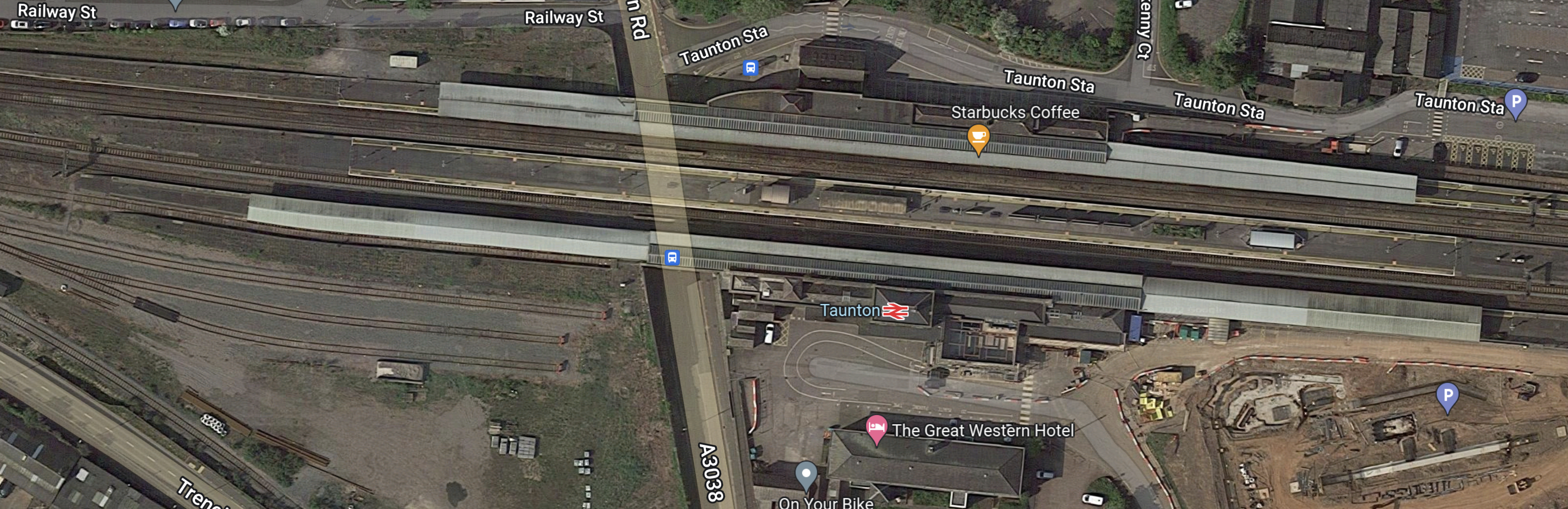
Note that there appears to be lots of space for development of rail and related development.
Both Branches Were/Are In Use Before Development
Before the Dartmoor Line was reopened, the route was in occasional use for both freight and passenger trains. Great Western Railway have in recent years run InterCity125 trains to Okehampton station.
With reopening the line to Okehampton, there was no major viaduct or bridges to rebuild, although Network Rail took the prudent decision to relay the track.
It would appear that the West Somerset Railway has similar use for both freight and passenger trains. How much work will be needed to bring it up to an acceptable standard.
Great Western Railway Are Providing Initial Weekend Services
On the Dartmoor Line services started between Exeter and Okehampton in 2019 and Wikipedia says this about initial services between Taunton and Bishops Lydeard station.
In 2019, the WSR entered into a partnership with the modern Great Western Railway (GWR) to operate Summer Saturday services to Bishops Lydeard from Taunton beginning on 27 July 2019. The introduction of these GWR services will mark the first time the station has been connected to the rest of the national rail network since its initial closure in 1971.
Is history going to repeat itself?
The First Step
This paragraph from the Rail Advent article, indicates the first step to reopening a service between Taunton and Minehead.
The first task will be to look at the simplest and most effective way in which the link between the WSR and the mainline can be improved, signalled, and operated. An outline business plan will then be developed to estimate how much it would cost.
This Google Map shows the link between the West Somerset Railway and the mainline.
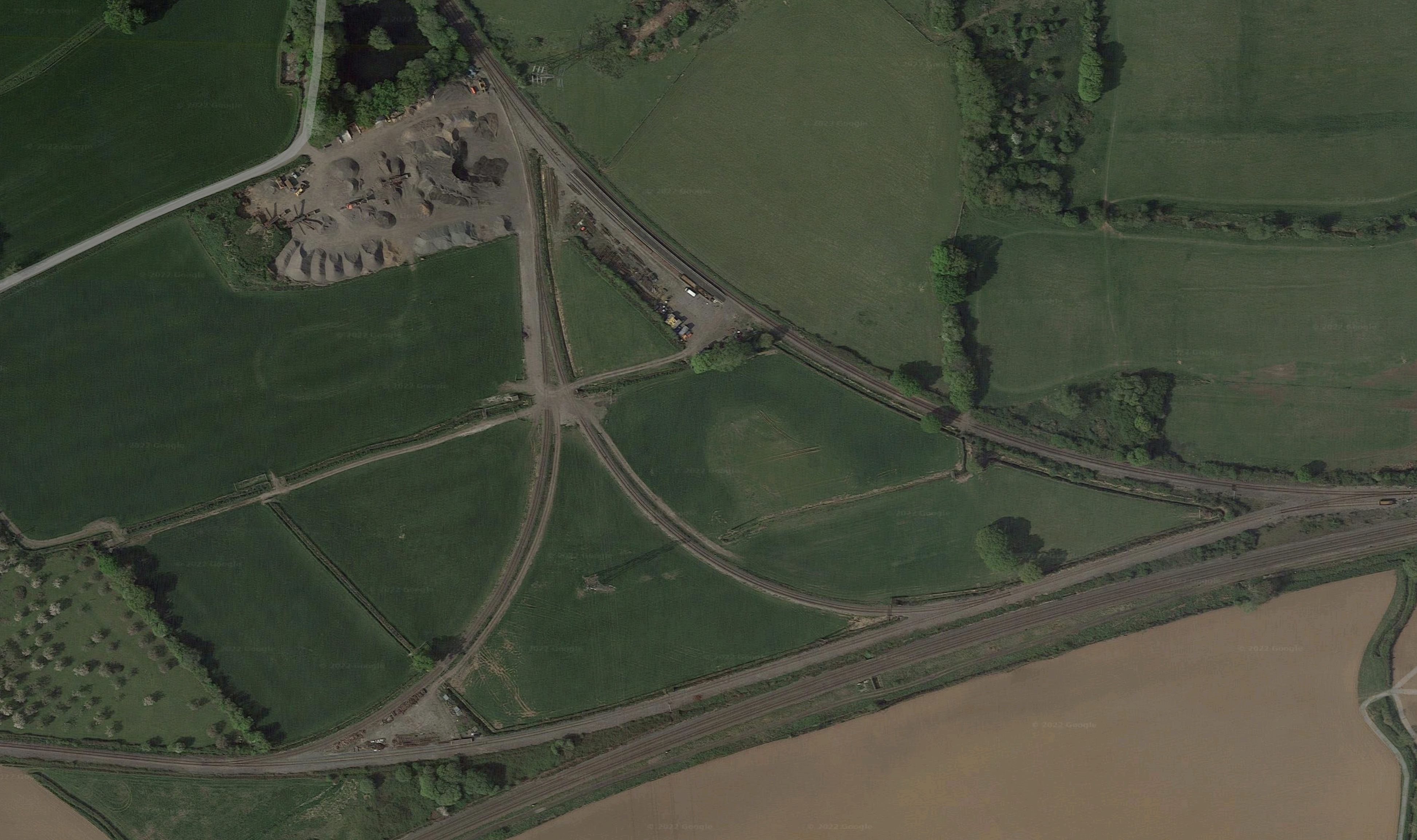
Note.
- The large triangular junction.
- The Bristol-Exeter railway runs East-West across the bottom of the map.
- Minehead is to the North.
- Taunton is to the East.
- A disused line to Barnstaple is to the West.
- The site to the West of the top of the triangular junction is a ballast cleaning site.
It does appear that there could be the space to create an efficient junction linking the two railways.
Initial Regular Services
This was one of the introductory paragraphs.
There is an increasing interest in re-opening long-closed stations and lines on the network. To this end, a partnership working group has been set up to look at the prospects of running scheduled trains between WSR’s Bishops Lydeard station and Taunton, which would safeguard the WSR’s long-term future.
This page on the Railway Touring Company web site is entitled The West Somerset Steam Express.
This paragraph describes the trip.
This series of trains from London Paddington to Minehead features haulage by two steam locomotives in one day.
One steam locomotive will haul our train from London Paddington to the West Somerset Railway at Bishops Lydeard.
The Heritage Railway will then provide a steam locomotive to haul our train to Minehead and back. This provides a truly fascinating day out travelling through beautiful scenery to the Bristol Channel coast.
So it looks like, the initial services on the between Taunton and Bishops Lydeard stations, will duplicate services that are already planned on a very much less frequent basis.
Bishops Lydeard Station
Bishops Lydeard station is the station, where mainline and West Somerset services meet.
This OpenRailwayMap shows the track layout at the station.
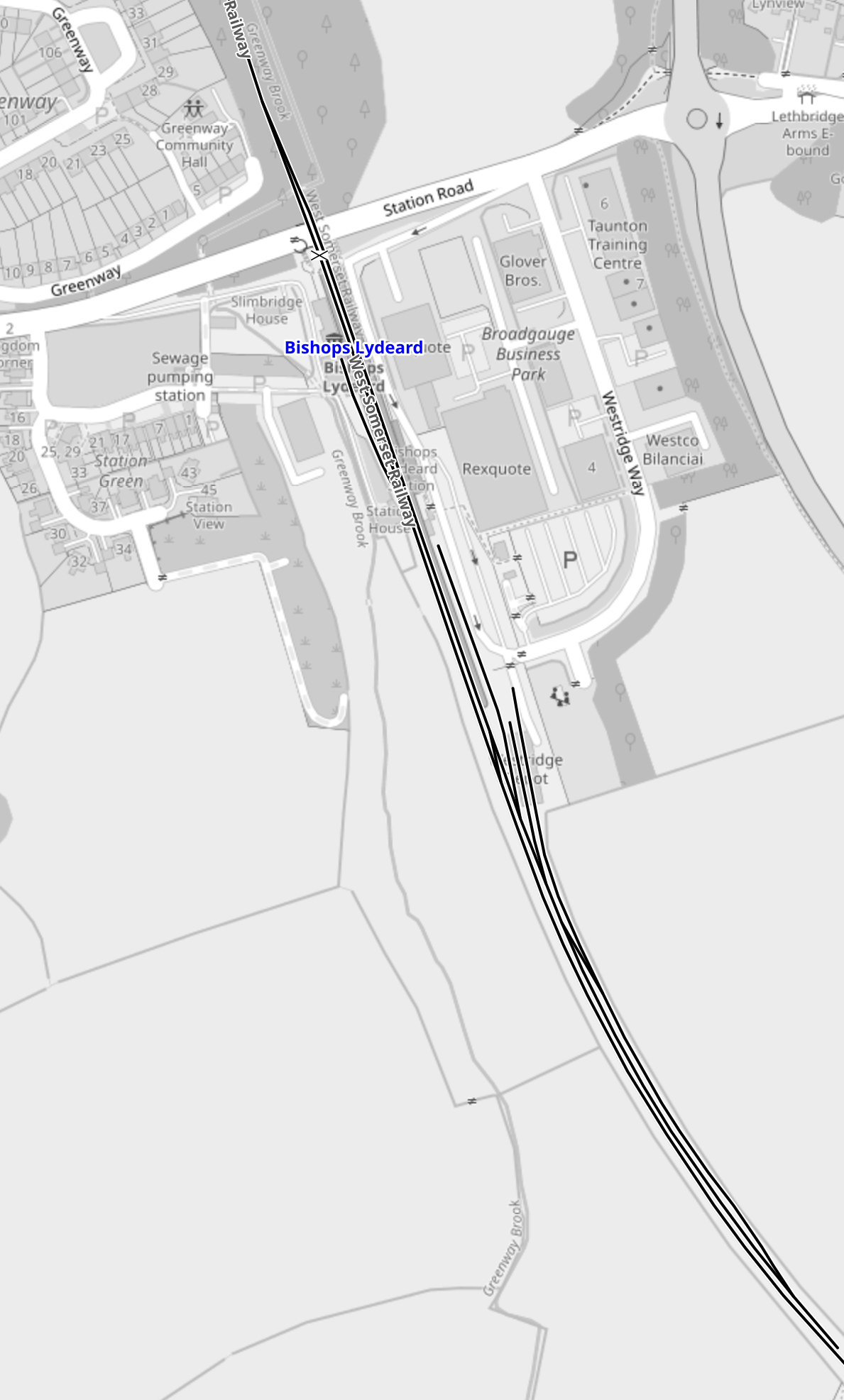
Note.
- The station is the Southern terminus of the West Somerset Railway.
- Track is single to the North and South of the station.
- Bishops Lydeard station has two platforms.
- There is a passing loop.
If the terminal station has a serious problem, it doesn’t appear to have much parking.
So it would appear, that a link to Taunton might improve the finances of the West Somerset Railway, by attracting more visitors.
Onward To Minehead
This OpenRailwayMap shows the last section of the West Somerset Railway to Minehead.
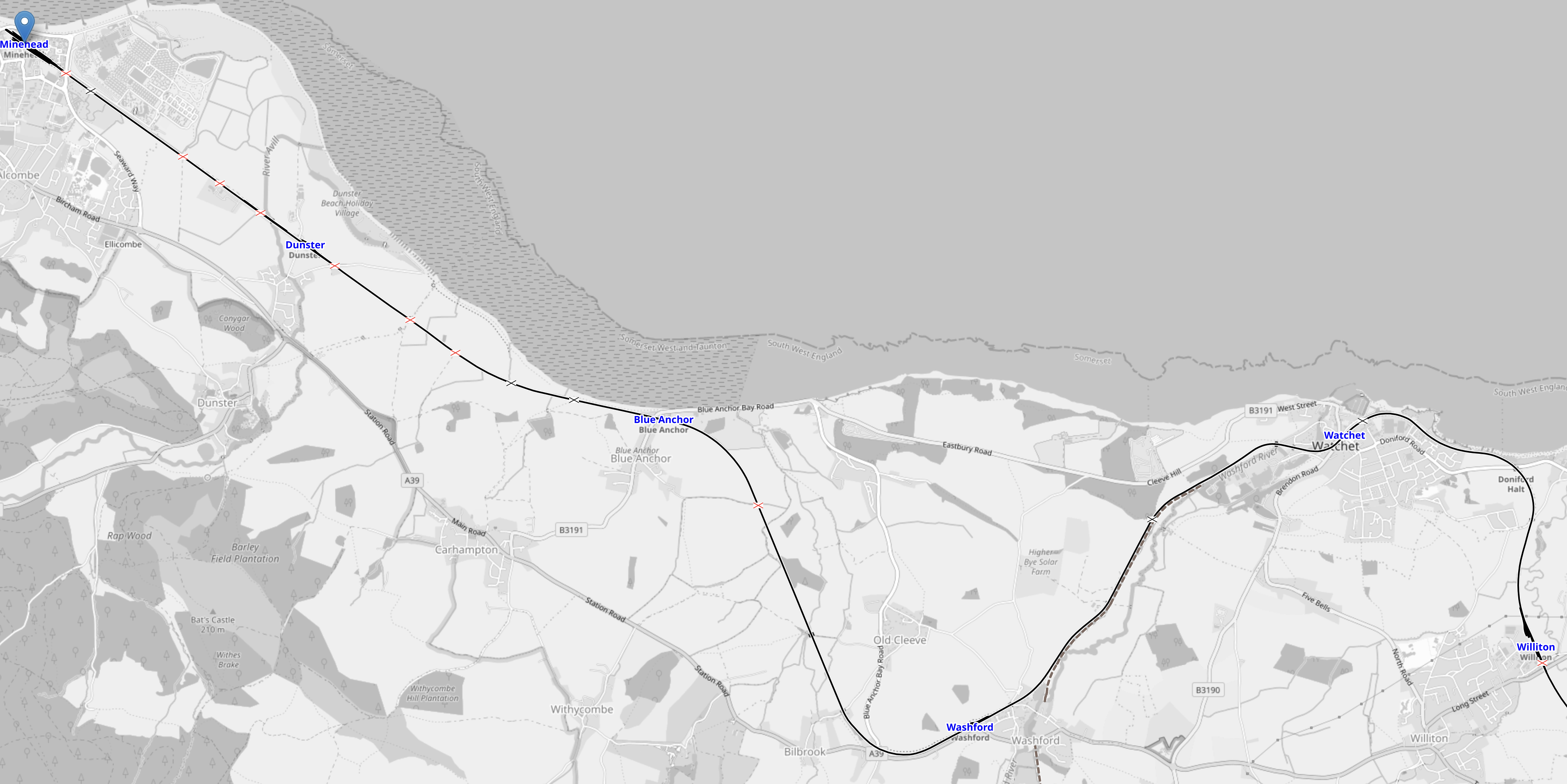
Note.
- Minehead station is in the North West corner of the map.
- Minehead station appears to be a well-equipped station, with two platforms.
- Minehead station even has a turntable for turning locomotives.
- There are four or five stations close to the coast.
The Wikipedia entry for Minehead, says this about the town.
The parish of Minehead has a population of approximately 11,981, making it the most populous town in the western part of the Somerset West and Taunton local government district, which in turn, is the worst area in the country for social mobility.
The West Somerset Railway could become both a useful and a real bucket-and-spade railway. Surely, that could generate revenue and level-up the area.
Financing
If you want something to work well, you must get the finances right.
I have lived in Dalston in London for twelve years now. When I moved here after my wife died and I had had a serious stroke, which left me unable to drive, I relied on an antiquated mainly bendy-bus-based public transport system.
Then along came the Overground and fleets of shiny new buses and Hackney and Dalston in particular was more than levelled up with London’s more salubrious boroughs.
Shopping improved with M & S returning after at least seventy years. There’s even a Pret, which boomed during the pandemic.
Transport for London got the financing for the Overground right and they created a success.
Conclusion
Can the initial working group find a financial model so that the West Somerset Railway can do for West Somerset, what the Overground has done for Dalston and the Dartmoor Line appears to be doing for Devon?
I thoroughly hope so!

