Getting Your Money Back On Oyster
I don’t use my Oyster card much on London’s transport system, as I have a Freedom Pass.
But I do appreciate how difficult it could be to get a refund on a journey that has gone wrong. So this story about getting refunds on-line through Oyster is to be welcomed. Here’s an extract.
Whilst the system for taking your money is very slick – automatic Oyster top-up, contactless payment – getting it back has been a laborious process, with a lengthy online or even pen-and-paper form.
Sigh no more, commuters. From today, TfL are making it easier to get a refund for late Underground and Overground trains.
Now, instead of entering all of your personal information every time your Underground or DLR train is 15 minutes late (or 30 minutes if you’re on the Overground), you can set up an account that holds it all, so you only have to put in the details of your late journey.
This does show how the way public transport ticketing is going.
With only a few days now before London’s buses go cashless and as it looks like the Underground and Overground will go the same way soon, London is eliminating the hassle from public transport.
As Oyster can now be topped-up automatically, I wonder how many companies now give employees an Oyster card, that the company tops up automatically? Take say a bit employer like University College Hospital, where there is no staff parking, would a company Oyster card be a simple perk to recruit and retain staff.
Transport for London seems to be becoming a giant computer system, with large numbers of ride-on terminals. Wouldn’t it be nice if black taxis and the bikes were able to be charged to Oyster?
A Ticket Machine With A Canopy
I saw this ticket machine at Canonbury Road and Barnsbury Station yesterday.
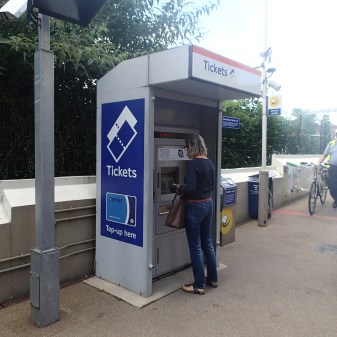
A Ticket Machine With A Canopy
It’s certainly more customer-protective than those on the Edinburgh Tram
A Tricky Problem For Thameslink
I said in this post, that Thameslink will make it possible a lot of journeys across London with just a single change.
Looking at the provision timetable for Thameslink, there are some terminals at either end of the line, which are not connected to others at the opposite side of London. For instance Tattenham Corner only links to Cambridge and Maidstone East only links to Luton.
So say if you wanted to go from Tattenham Corner to Luton, you’d need to get off a train in the core section and then get on one to your required destination. It will mean two easy steps across a level gap, as the new trains will obviously align to the platforms.
If you look at St. Pancras Thameslink station, the platforms are long and bleak with few seats and no outlets of any sort. But upstairs there is St. Pancras International station, which is almost a shopping and refreshment venue, where trains happen to arrive and depart.
So will ticketing allow a traveller from say the South Coast to Peterborough, to break their journey at St. Pancras and perhaps have lunch, a meeting or get their supper for the evening?
Electronic ticketing will be the key in some ways, as obviously this will be possible using something like Oyster as it is now from Wimbledon to say Cricklewood with a break at St. Pancras on the current Thameslink.
Wouldn’t it be nice to be able to use Oyster or a contactless bank card as a ticket on buses, trains and trams all over the UK!
The Edinburgh Trams Finally Arrive
One of the reasons to go to Edinburgh was to see the new trams.




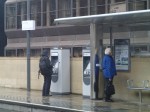

The trams themselves are impressive and are the first I’ve seen with leather seats. Incidentally according to this Wikipedia article, the Edinburgh tram is a special design and unlike any others.
The trams, like many Lothian buses are being fitted with wi-fi, which is something I’d like to see on all public transport.
But I think that the design of the system shows a few shortcomings.
Edinburgh is a World Heritage Site, so why didn’t they use battery or catenary-free technology, through the historic centre, as is done in Bordeaux, Nice and Seville. Incidentally the Seville trams were built by the same manufacturer as those in Edinburgh; CAF. It therefore seems even more surprising that Edinburgh doesn’t use the same technology in the city centre, especially as in addition to not using intrusive and ugly catenary, according to some technical articles, I’ve read they are cheaper to install in heritage areas, as no posts or attachments on buildings are needed.
Even the most patriotic of Scots, will admit that it rains in their country. The ticket machines, like they are in many places I’ve been, are out in the open and buying a ticket without an umbrella wasn’t an easy process. All it needed was to make the shelters a little bit longer, as one of the pictures shows.
The ticketing is something that doesn’t take advantage of modern technology. These days, you shouldn’t need to buy a ticket, as you don’t on London’s buses, where if you haven’t got a ticket or an Oyster, you can use a contactless bank or credit card. I hope Edinburgh has plans to allow these cards, as visitors will demand this, as it gets implimemted in more places across the world.
I also felt the ticketing zones weren’t visitor friendly. You can buy one day tickets, but why don’t they do what I found in one European city and offer twenty-four hour tickets. This helps people who might fly into Edinburgh for business or a concert and then fly back out the next day. Charging people for two separate tickets will just upset visitors.
The tram also failed my map and information standards by a long way. Edinburgh has virtually no maps and surely there should be one on every tram stop.
Restrictive Rules On Heathrow Connect And Express
I might go to look at Stockley Junction today and the best way would be to get Heathrow Connect to the airport and back.
So I checked up whether I can use my Senior Railcard on the train services. This section on the Heathrow Express gives the details about how you can. There is also this statement.
Yes, you can use a number of railcards on Heathrow Express to obtain discounted travel. To qualify you must purchase at the ticket office, not online or on board.
Obviously, they don’t agree with TfL’s policy of closing ticket offices.
They also don’t agree with the policy of the Gatwick Express as stated here.
Gatwick Express now accepts railcards online allowing you to make great savings on the already discounted online price if you have one of the following cards:
So Heathrow and Gatwick are out of step. Or you can always use the Piccadilly line, where the main problem is overcrowding.
It does appear though that according to Boris, as reported here, Crossrail will have a similar ticketing regime to the Underground.
So perhaps time will be up for the rip-off Heathrow rail services?
A Misunderstanding With Heathrow Connect
I was talking to an e-friend last night in California, who shares my interests of trains and large projects. He is getting on a bit and asked me to find an easy route from Heathrow to Barking, from where he can get a mini-cab to his sister’s. He’s coming in to Heathrow and asked me, if I knew of a step-free route.
Last time he took the Piccadilly line to Kings Cross from where he took the lifts up to the Metropolitan line for Barking. He managed it with ease, but wondered if Heathrow Express or Connect would be easier.
As I wanted to go to see the new Crossrail flyover at Stockley and I thought that Heathrow Connect would be a good camera platform to get a photo, as the train turned towards Heathrow, I told my e-friend, that I’d find out.
I checked last night and a web site told me, that my Freedom Pass could be used after 09:30 this morning.
Before I boarded the train, I asked the First Great Western man on the gate and said I’d be alright after 09:30. As it was 11:00, I boarded the train.
But I had to get off at Hayes and Harlington, as the rules seem to have changed.
I was not pleased, to say the least.
There’ll be an unholy row, if when Crossrail opens in a few years time, Freedom Passes can’t be used to the airport.
Update – I spoke to my friend late last night and he’ll be using the Piccadilly line with the Oyster card, he uses when he’s in London. He was also pleased to know, that probably from the end of this year, he’ll be able to use a contactless card as a ticket.
London’s Express Buses
Many cities in the UK and elsewhere have express buses to speed you on your way.
With the introduction of a substantial number of New Buses for London on route 38, it seems that London now has express buses, as they are faster than the traditional buses.
Today, I arrived at Dalston Junction station and as I do caught the first bus along the Balls Pond Road. It was an elderly 56 and before it got to the first stop, it had been passed by a following New Bus for London on route 38. The 38 had been able to make a faster getaway at the lights, as their hybrid drive train seems to give better acceleration.
But by the time I got to my stop at Southgate Road, the new bus was on its way to Islington. This is probably because with three doors the cargo gets on and off a lot quicker.
It also helps that only about a third of the passengers need to go past the driver to check in.
As I can get both 38s and 56s to the Angel, it’ll be interesting to see if the 56s get less crowded when route 38 has its full compliment of new buses.
It would also appear than the traditional buses are having their route displays updated for the introduction of cashless buses in July, with nudge messages suggesting you go cashless. They are also saying you can go in and out through either door.
So will the two door buses be fitted with a touch pad at the rear door, just as the new buses do?
It would certainly speed loading and unloading of buses.
All of this shows that good design can make something as mundane as a bus better!
A Maritime Tour Of England
My trip to Portsmouth yesterday, got me thinking.
As I waited for my train to return to London, there was a First Great Western train waiting in Portsmouth Harbour station waiting to depart to Cardiff via Bristol.
So why if you are thinking of visiting England and you’re interested in the sea and ships, why not visit England’s three western maritime cities; Portsmouth, Bristol and Liverpool? All have their main attractions close to the city centres and with the exception of Bristol, the stations are too!
Trains between Portsmouth and Bristol are every hour and take about two and a half hours and those between Bristol and Liverpool have the same frequency but take just over three hours.
So it is feasible to perhaps start your trip in London and then spend say two or three days in each city. Remember that Portsmouth and Bristol are near to excellent beaches for swimming and sunbathing and Liverpool is near to the amazing beach at Formby with its statues by Antony Gormley.
After Liverpool, you might carry on to Newcastle or Glasgow for a maritime theme or take the flight home from either Liverpool or Manchester airports.
As all cities are to the west, the weather is more likely to be sunny and warm, than some other places I could mention. The weather in Portsmouth yesterday was supposed to be of cloud and rain, but I ended in the sun all day.
Two things would improve your trip.
Some rail companies allow you to break your journey, provided you keep going in the same direction. So for instance, between Portsmouth and Bristol, you might like to break your journey at Salisbury for lunch.
But if you do, I suspect there’s no Left Luggage facilities at the station.
As to hotels, you would obviously pay your money and take your choice. I think that in each city, there are ones at all prices in the city centres or by the stations.
Remember if you’re over sixty, you can buy a Senior Railcard for a third off rail fares. If you are someone, who can stick to a timetable, the three tickets linking London, Portsmouth, Bristol and Liverpool, booked in advance over the Internet will probably cost around £30 each leg or £20 with a Railcard.
Judging by the number of foreign tourists, that I meet on trains, this type of holiday is getting much more common.
Visa And Amex In Germany
When I arrived in Berlin, I needed to buy a ticket and as I’m a Nationwide customer, I have one of their Visa cards that converts local currencies immediately without charges to my statement.
But in many places in Germany the only card you can use in Mastercard. As I travel usually with just Amex and Visa, I would have been scuppered, if I didn’t have quite a few Euros.
Surely, if we are a united Europe economically, then all machines and web sites that accept credit and charge cards, should be m,mandated in EU law to accept all types.
A consequence of the German policy was at Berlin, the machine on the platform to buy tickets for the S-Bahn was blocked with Americans and Australians trying to buy tickets without a Visa card and no euros.
Obviously, because of the way things are going when in perhaps five years, many cities will allow contactless cards as tickets, as London buses now do, this is going to be an area, where the Germans will have to allow cards other than Mastercard.
The Gdansk Trams
I used the Gdansk trams to get about the city, buying a daily ticket for a few zlotis. The daily ticket incidentally cost me just £2.36 according to my credit card statement.

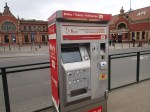
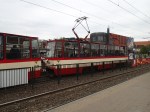



I did play a bit of musical trams, where yoiu get on one and then get off at a promising site, before repeating the process to get srpound the city.
 The Anonymous Widower